
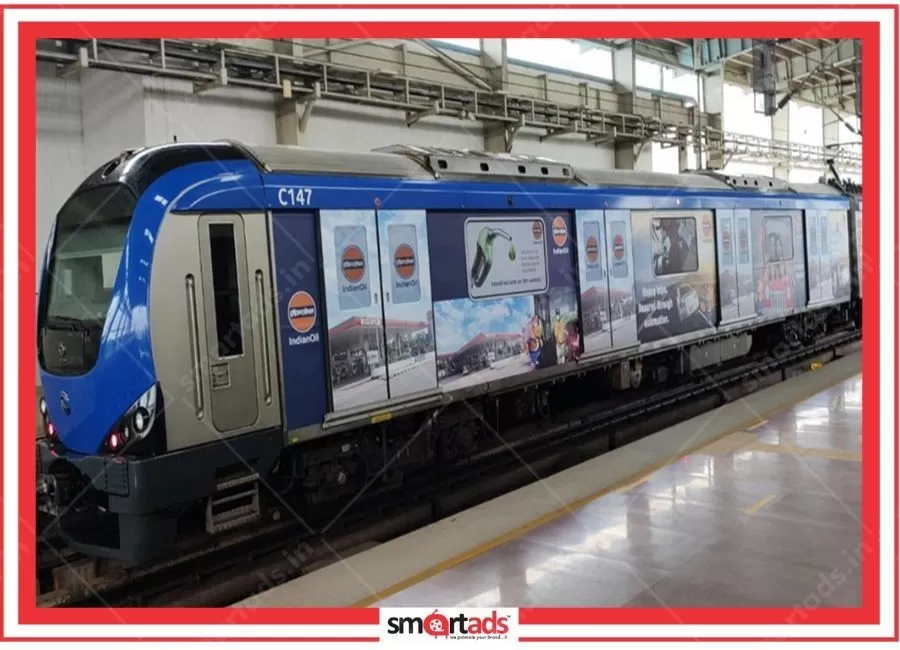
Exterior Metro Wrap
Size & Printing Cost as per actual
On the outside of metro Train, advertise
Rate per Metro Display Cost / 1 Month
Route:Ghatkoper To Versova
₹1260000.00
Showing 1 to 5 of 5 Results
MEDIA DETAILS
Size & Printing Cost as per actual
On the outside of metro Train, advertise
Rate per Metro Display Cost / 1 Month
Route:Ghatkoper To Versova
₹1260000.00
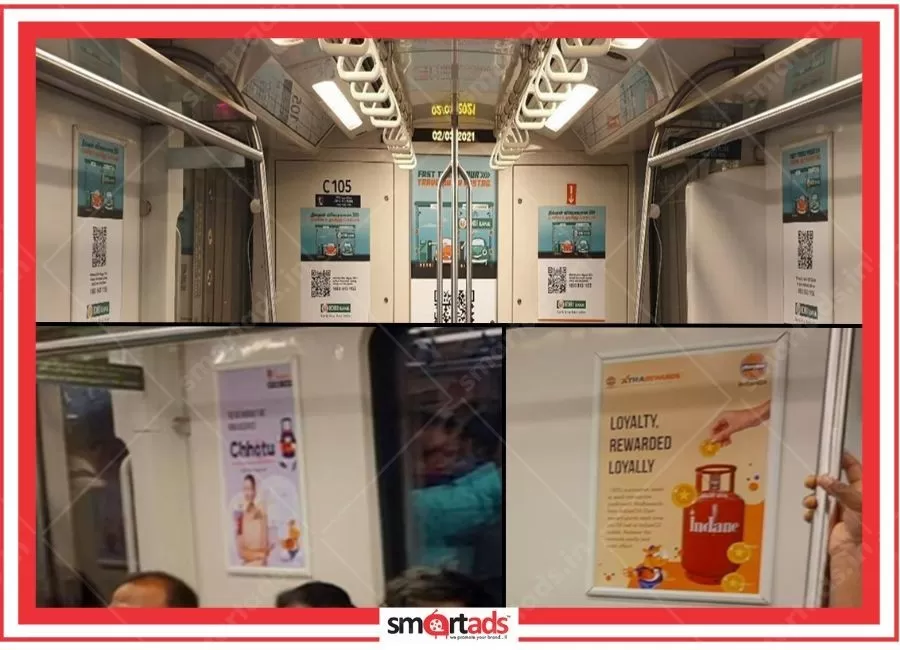
Size & Printing Cost as per actual
On the outside of metro Train, advertise
Rate per Metro Display Cost / 1 Month
Route:Ghatkoper To Versova
₹730000.00

10 Sec Video
On the outside of metro Train, advertise
Rate per Metro Display Cost / 1 Month
Route:Ghatkoper To Versova
₹600000.00
20 Sec Jingle
On the outside of metro Train, advertise
Rate per Metro Display Cost / 1 Month
Route:Ghatkoper To Versova
₹400000.00

Size & Printing Cost as per actual
On the outside of metro Train, advertise
Rate per Metro Display Cost / 1 Month
Route:Ghatkoper To Versova
₹1880000.00
MEDIA REACH

MinimumQty :
1
EstimateReachPeople :
150000000
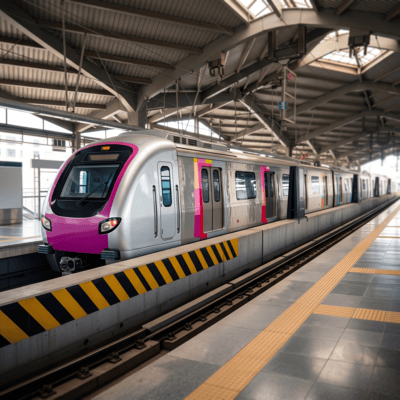
Most outdoor media plans for Mumbai still default to hoardings on the Western Express Highway or bus shelters near Bandra — and frankly speaking, that instinct is understandable, but it is leaving a significant audience on the table. The Mumbai Metro Blue Line (Line 1), running from Versova to Ghatkopar through Andheri, moves somewhere in the ballpark of 4.5 to 5 lakh commuters on a typical weekday, which means a well-placed campaign inside those coaches or on station platforms is reaching a captive, largely upper-middle-class audience that most traditional outdoor formats simply cannot pin down with the same precision.
The Blue Line — officially Metro Line 1, the oldest and most operationally mature of Mumbai's metro corridors — connects three of the city's most commercially dense zones: Versova in the west, Andheri in the centre, and Ghatkopar in the east, where it intersects with the Harbour Line of the suburban rail network. That east-west corridor, which cuts through Chakala, Marol Naka, Airport Road, and Saki Naka, is essentially a spine running through Mumbai's IT, FMCG, and logistics employment belt; the audience profile that emerges from this geography is one that most brand managers would pay a premium to reach through digital channels.
What a lot of people miss is that metro commuters, unlike road-based audiences, are not distracted by driving. They are standing or seated in an enclosed environment for an average dwell time of somewhere between 22 and 28 minutes per journey — which, from a media standpoint, is an extraordinary window of attention. Our experience at SmartAds shows that recall rates for in-coach advertising on metro networks consistently outperform comparable outdoor formats, a finding that aligns with what the Outdoor Advertising Confederation of India has been reporting about transit media over the past several years.
The environment itself is also worth noting. Metro stations on the Blue Line are air-conditioned, well-lit, and maintained to a standard that creates a positive ambient association for brands displayed within them; this is not the cluttered, weather-beaten context of a highway hoarding. Brands that appear in this environment benefit from what media planners sometimes call a halo effect — the cleanliness and modernity of the space transfers, at least partially, to the brand perception of whatever is being advertised there.
The audience question is the one that matters most, and the Blue Line has one of the most clearly defined commuter profiles of any transit corridor in western India. MMRDA ridership data, cross-referenced with IRS survey findings on metro usage patterns, suggests that the Blue Line skews heavily toward working professionals aged 22 to 45, with household incomes that place them firmly in the SEC A and SEC B categories. A significant share of daily riders are employees of the IT parks concentrated around Marol and SEEPZ, which means technology brands, fintech products, professional services, and premium consumer goods find a naturally receptive audience here.
On top of that, the Andheri station — which serves as a major interchange between the metro and the Western Railway suburban line — generates footfall that is difficult to replicate anywhere else in the city's transit network. The sheer volume of people passing through that single station on a weekday morning creates an impression count that, when measured on a cost-per-thousand basis, works out to roughly ₹80 to ₹120 for platform-level advertising, which is a number that surprises most first-time advertisers when they compare it to what they are paying for targeted digital display on the same demographic.
We worked with a consumer banking client targeting salaried professionals in the 28-to-40 age bracket; they had been running a digital-heavy campaign with reasonable click-through rates but poor brand recall scores in post-campaign surveys. When we shifted a portion of their budget to Blue Line station branding — specifically the pillar wraps and platform screen door panels at Andheri, Chakala, and Ghatkopar — their unaided recall in the target demographic improved by nearly 34% over the subsequent quarter, which was a result that genuinely surprised their marketing team and validated the medium in a way that their internal models had not predicted.
The Blue Line offers a wider range of format options than most planners initially expect, which is partly why it rewards a thoughtful approach rather than a one-size-fits-all booking. At the station level, the primary formats include platform screen door (PSD) branding, pillar wraps, concourse wall panels, ticket counter surrounds, and entry-exit gate branding; inside the trains themselves, the options span overhead panels, door panels, full coach wraps, and the increasingly popular digital screen placements that have been installed in newer rolling stock.
The thing is, not all formats perform equally for all objectives. If the goal is brand awareness and visual dominance, a full station takeover — which involves branding across all touchpoints at a single station — creates an immersive experience that is difficult to ignore; Andheri and Ghatkopar are the two stations where this format delivers the highest impression volumes simply because of their interchange status. For product launches or time-sensitive campaigns, the in-coach digital screens are particularly effective because they allow for dynamic creative rotation, which means a brand can run different messages at different times of day without any physical changeover cost.
At SmartAds, we have found that pillar wraps at mid-platform positions tend to generate the most sustained visual contact, because commuters waiting for trains naturally orient themselves toward the platform edge and the pillars that frame their sightline; a well-designed pillar wrap at Andheri or Chakala can hold a commuter's gaze for 15 to 20 seconds, which is a meaningful exposure by any media planning standard. For clients with tighter budgets, we often recommend starting with a three-station package covering Andheri, Marol Naka, and Ghatkopar — which captures the highest-traffic nodes of the corridor without requiring the investment of a full-line buy.
Frankly speaking, this is the question that every client asks first, and it is also the question that most agency websites refuse to answer directly — which is a frustration we understand and try to address. Rates on the Blue Line are structured around format type, station tier, campaign duration, and the share of inventory being booked; MMRDA and its concessionaire partners typically operate on a quarterly or annual licensing model for static formats, while digital screen inventory can be bought on shorter cycles.
For platform-level static formats — backlit panels, pillar wraps, and concourse displays — a single-station campaign at a Tier 1 station like Andheri or Ghatkopar works out to somewhere between ₹3 lakh and ₹8 lakh per month depending on the number of panels and the format size. Full station takeovers, which are increasingly popular for brand launches and product re-stagings, are priced in the ballpark of ₹15 lakh to ₹35 lakh per month at premium stations, which sounds significant until you calculate the effective CPM against the daily footfall numbers. In-coach advertising — the overhead panels and door panels inside the train coaches — tends to be priced more accessibly, with a full-coach package across a set number of coaches running somewhere between ₹4 lakh and ₹10 lakh for a four-week campaign period.
One automotive brand we worked with had a new model launch timed to coincide with the festive season; they wanted maximum visibility in the Andheri-to-Ghatkopar corridor specifically because their dealerships were concentrated in that belt. We structured a campaign that combined full-coach wraps on six coaches with platform branding at three stations, which came in at a total investment of roughly ₹28 lakh for six weeks — and the brand's walk-in inquiry data from dealerships in that micro-geography showed a 41% spike compared to the same period the previous year, which was the kind of attribution data that made the metro investment very easy to justify in their next planning cycle.
This is where the real value lies, and it is a comparison worth making carefully. Mumbai's outdoor advertising market is among the most expensive in the country; a premium hoarding on the Western Express Highway or the Bandra-Worli Sea Link approach can cost upwards of ₹20 lakh to ₹40 lakh per month, and while the reach numbers are substantial, the audience composition is essentially uncontrolled — you are paying for everyone who drives past, regardless of whether they match your target profile. The Blue Line, by contrast, delivers a far more defined audience with a measurably longer dwell time and a controlled environment that enhances creative impact.
To be fair, highway hoardings do deliver scale that no single metro corridor can match in terms of raw impression volume; the WEH carries vehicle traffic that generates tens of millions of impressions per month across all demographic segments. But for brands whose target audience is specifically the urban professional commuter — fintech apps, insurance products, ed-tech platforms, premium personal care brands, business-to-business services — the Blue Line's audience quality more than compensates for the narrower reach. The FICCI-EY Media and Entertainment Report has consistently highlighted transit media as one of the fastest-growing segments within Indian out-of-home advertising, and the Blue Line is a significant part of that growth story in Mumbai.
Radio advertising on Mumbai stations, which is another medium that competes for the same urban professional audience, typically delivers CPMs in the range of ₹150 to ₹250 for drive-time slots — and while radio has the advantage of frequency and audio engagement, it lacks the visual impact and the captive, undistracted context that metro advertising provides. We have seen campaigns that combine Blue Line metro placements with targeted digital retargeting perform significantly better than either medium alone; the metro creates the brand impression, the digital layer reinforces it, and the combined effect on purchase intent is measurably higher than the sum of the individual contributions.
The booking process for Blue Line advertising is more structured than most clients expect, which is actually a good thing — it means inventory is properly managed and campaigns are executed with a level of professionalism that is not always guaranteed in the unorganised segments of the outdoor market. The primary concessionaire for advertising rights on Metro Line 1 operates under a licensing framework established by MMRDA, and bookings are typically managed through authorised media partners rather than directly with the concessionaire in most cases.
The process generally begins with a format and station selection exercise, which is best done with a media partner who has current availability data — because certain formats at high-demand stations like Andheri are booked weeks or sometimes months in advance, particularly around festive periods and the January-March planning cycle. Once the inventory is confirmed, a booking order is raised with the concessionaire, creative specifications are shared, and production is coordinated either through the client's agency or through the concessionaire's empanelled vendors. Static formats typically require a production lead time of 10 to 14 days, while digital content can be updated with as little as 48 hours' notice.
At SmartAds, we manage the entire process end-to-end for our clients — from format recommendation and availability checking through to creative production coordination and post-campaign measurement; this matters because the Blue Line's inventory moves quickly during peak periods, and a delay of even a few days in confirming a booking can mean losing the specific stations or formats that make a campaign effective. One retail client in Pune who was expanding into Mumbai asked us to plan their entry campaign with a six-week lead time; we were able to secure Andheri and Chakala station inventory that would have been unavailable had they approached the booking two weeks later, which made a material difference to the campaign's geographic coverage.
Measurement is the area where metro advertising has historically been at a disadvantage compared to digital channels, and it is worth being honest about that. Unlike a programmatic display campaign where impressions, clicks, and conversions are tracked in real time, metro advertising relies on a combination of MMRDA ridership data, footfall audits, and brand lift studies to establish campaign effectiveness — and while these methodologies are credible, they require more effort to set up and interpret than a dashboard that updates every hour.
That said, the measurement toolkit for transit media has improved considerably. MMRDA publishes monthly ridership data which can be used to calculate gross impressions for a given station and format combination; independent research firms conduct footfall studies that provide more granular data on audience composition and dwell time. Brand lift studies — which measure aided and unaided recall, brand preference, and purchase intent before and after a campaign — are the most reliable way to demonstrate the value of a metro campaign to a sceptical CFO or marketing director, and they are increasingly being commissioned as a standard part of campaign planning rather than an afterthought.
What we tell our clients is that the most powerful measurement approach is to combine metro advertising with a geo-targeted digital layer — running mobile ads specifically to users whose devices have been detected within Blue Line station boundaries — which allows you to track downstream digital behaviour, including website visits, app downloads, and even store visits if location data is available. This kind of integrated measurement architecture, which is something we help clients set up at SmartAds, transforms metro advertising from a "trust us, it works" proposition into one that can be tied to actual business outcomes with a reasonable degree of confidence.
Not every brand is equally well-suited to metro advertising, and frankly speaking, we have seen campaigns underperform not because the medium was wrong but because the category or creative approach was misaligned with the audience and context. The categories that consistently perform best on the Blue Line — based on our own campaign data and the broader patterns visible in TAM AdEx's transit media reporting — are financial services, technology products, ed-tech and upskilling platforms, premium FMCG, healthcare and wellness brands, and real estate developers targeting the mid-to-premium segment.
The common thread across these categories is that they are selling to aspirational, income-earning adults who make considered purchase decisions — which is precisely the profile of the Blue Line's commuter base. A brand selling a mutual fund SIP or a professional certification course is speaking to exactly the right person when they place their creative on a pillar wrap at Marol Naka or an overhead panel in a coach running between Andheri and Ghatkopar. By contrast, categories like mass-market FMCG or hyperlocal services may find that the CPM efficiency of metro advertising is less compelling relative to broader-reach formats, simply because the audience skew is narrower than those categories require.
Here's where it gets interesting: some of the most effective Blue Line campaigns we have seen were not from large national advertisers but from regional brands using the metro as a tool for rapid brand building in a specific micro-geography. A Mumbai-based fintech startup, for instance, used a concentrated four-station campaign along the Andheri-to-Ghatkopar stretch to establish brand recognition among tech-sector employees before launching a broader digital acquisition push; the metro campaign, which ran for eight weeks, generated enough ambient awareness that their cost-per-install on the subsequent digital campaign dropped by roughly 22% compared to their baseline, because users were already familiar with the brand name when they encountered the digital creative.
Timing a metro campaign well is something that separates experienced media planners from those who are simply filling a schedule, and the Blue Line has some fairly predictable seasonal patterns that are worth understanding before committing a budget. The October-to-December festive window — which encompasses Navratri, Dussehra, Diwali, and the pre-Christmas retail surge — is the most competitive period for Blue Line inventory, with premium stations often booked out two to three months in advance; brands that want to be present during this window need to begin their planning conversations in July or August at the latest.
The January-to-March quarter is the second peak, driven by the financial year-end planning cycle, tax-season financial product advertising, and the general uptick in consumer spending that follows the festive period. The April-to-June period, which coincides with the summer and the onset of monsoon, is historically softer in terms of advertiser demand — which means inventory is more readily available and, in some cases, negotiated rates are more favourable; this is a window that value-conscious brands should consider seriously, particularly if their product or service has year-round relevance rather than a seasonal peak.
Our general recommendation to clients is to plan at least one campaign cycle around the softer demand periods, not because the audience is smaller — ridership on the Blue Line is relatively consistent year-round — but because the competitive clutter is lower and the creative impact of a well-executed campaign is therefore higher. A brand that dominates a station during a low-competition period often achieves better recall scores than a brand that is one of many competing for attention during the festive rush; this is a counterintuitive finding, but one that our post-campaign measurement data has supported consistently.
Q: What is the minimum budget required to run a campaign on the Blue Line?
The honest answer is that there is no single minimum that applies universally, because the cost structure depends heavily on the format, station tier, and campaign duration being considered. A focused campaign at a single mid-tier station — covering, say, two or three platform panels for a four-week period — can be structured for somewhere in the range of ₹1.5 lakh to ₹3 lakh, which makes the medium accessible to brands that are not working with large outdoor budgets. At the other end of the spectrum, a full-corridor campaign covering multiple stations with diverse formats is a significantly larger investment, but the cost-per-impression efficiency improves substantially as the campaign scale increases. What we generally advise clients who are new to metro advertising is to start with a focused, well-chosen single-station or two-station campaign, measure the results carefully, and use that data to build the case for a larger commitment in the next cycle.
Q: Can small or regional brands afford to advertise on the Mumbai Metro Blue Line?
Absolutely, and this is a misconception that we encounter surprisingly often. Metro advertising is not exclusively the domain of large national advertisers; in fact, some of the most efficient campaigns we have planned at SmartAds have been for regional brands and startups that used the Blue Line's geographic precision to their advantage. Because the corridor runs through a specific employment and residential belt, a brand that operates in that micro-geography — a local restaurant chain, a neighbourhood real estate developer, a Mumbai-specific service provider — can achieve very high relevance with a relatively modest investment. The key is to be selective about station choice and format, rather than trying to replicate the coverage of a national advertiser on a fraction of the budget.
Q: How far in advance should a campaign be booked to secure the best inventory?
For premium stations like Andheri and Ghatkopar, and particularly for high-visibility formats like full station takeovers or full-coach wraps, we recommend beginning the booking conversation at least six to eight weeks before the intended campaign start date — and during the festive season, that lead time should extend to three months or more. The Blue Line's advertising inventory, particularly at interchange stations, is genuinely competitive, and the formats that deliver the best results are the ones that tend to be booked first. Clients who come to us with very short lead times are not always able to access the specific inventory that would make their campaign most effective, which is why we encourage early planning conversations even when the campaign brief is still being finalised.
Q: What creative formats work best in the metro environment, and are there any restrictions?
The metro environment rewards clean, high-contrast creative with a single dominant message — which is a discipline that many brands find challenging but which ultimately produces better results than cluttered, information-heavy executions. MMRDA and the concessionaire have content guidelines that restrict political advertising, certain categories of competitive comparative advertising, and content that may be deemed offensive or inappropriate for a public transit environment; these guidelines are fairly standard across Indian metro networks and are not significantly more restrictive than what applies to other public-space advertising. For digital screen formats, the creative specifications include aspect ratio requirements and file format standards that need to be adhered to precisely; our production team at SmartAds handles these technical specifications as part of the campaign setup process, which saves clients the frustration of creative rejections at the last stage.
Q: Is it possible to run a campaign only on specific coaches or trains rather than across the entire fleet?
This is a question that reflects a more sophisticated understanding of the medium than most first-time metro advertisers bring to the conversation, and the answer is nuanced. In-coach advertising is typically sold on a per-coach basis, which means a brand can choose to brand a specific number of coaches rather than the entire fleet; however, because trains are rostered dynamically across the network, it is generally not possible to guarantee that a branded coach will appear on a specific route at a specific time. What can be controlled is the number of coaches carrying the brand's creative, which determines the probability of any given commuter encountering the campaign during their journey. A larger coach buy increases that probability; a smaller buy is more cost-effective but results in lower frequency of exposure per individual commuter.
Q: How does Blue Line metro advertising integrate with digital campaigns for better overall performance?
The integration between metro advertising and digital channels is something we consider a standard part of campaign architecture rather than an optional add-on, because the two media genuinely amplify each other in ways that are measurable and meaningful. The most effective integration approach involves geo-fencing the Blue Line stations — setting up a digital targeting perimeter around each station — so that commuters who have been exposed to the metro creative are subsequently served the same or complementary digital ads on their mobile devices. This creates a multi-touchpoint exposure sequence which dramatically improves brand recall and, in categories where online conversion is the goal, measurably improves conversion rates compared to either medium operating in isolation. The GroupM TYNY Report and Dentsu e4m data on media mix effectiveness both point to the same conclusion: out-of-home and digital work better together than either does alone, and the metro environment is particularly well-suited to this kind of integration because the audience is digitally active and mobile-first by profile.
The Mumbai Metro Blue Line is not simply another outdoor format to add to a media plan; it is a precision instrument for reaching a specific, valuable, and genuinely captive audience in one of India's most commercially significant urban corridors. The brands that get the most out of it are the ones that treat it with the same strategic rigour they would apply to a television or digital buy — thinking carefully about format selection, station choice, creative execution, timing, and measurement rather than treating it as a box to tick in the out-of-home column of a media schedule.
What we have seen consistently across the campaigns we have planned and executed on this corridor is that the medium rewards specificity. A campaign that is designed for the Blue Line's audience — that speaks to the aspirations, daily realities, and decision-making contexts of a 32-year-old IT professional commuting between Marol and Andheri — will outperform a generic campaign that has simply been resized to fit a metro panel. The creative brief for a metro campaign should be informed by what we know about the audience, not by what happened to be available from the last television or digital campaign.
The broader Indian transit media market, which the FICCI-EY Media and Entertainment Report has tracked as one of the most dynamically growing segments within out-of-home, is moving in a direction that makes the Blue Line increasingly attractive as a planning option — more digital formats, better measurement infrastructure, and a ridership base that continues to grow as Mumbai's metro network expands and more commuters shift from road-based transport to rail. Brands that establish a presence on this corridor now, while it is still undervalued relative to its audience quality, are likely to find that the investment appreciates in strategic terms as the network matures and competition for inventory increases.
If you are evaluating metro advertising for an upcoming campaign — whether it is a brand launch, a product re-staging, or a sustained awareness initiative — the team at SmartAds.in can help you build a plan that is grounded in current rate data, real availability intelligence, and measurement frameworks that will let you demonstrate the value of the investment to your stakeholders. Reach out to us at SmartAds.in for a customised media plan built around your specific objectives, budget, and target audience; we have planned campaigns across every format and station on the Blue Line, and we can tell you, from direct experience, what works and what does not.
