


Delhi

Mumbai

Bengluru

Ahmedabad

Jaipur

Chennai

Hydrabad

Kolkatta

Lucknow

Pune
Pick Up Bus Stand Advertising | BTL Non-Traditional Advertising India | Bus Stand Branding Agency | Lowest Cost Bus Stand Ads | PAN India Transit Advertising
This article draws on SmartAds' direct campaign experience across 500+ Indian cities to give you actual rate benchmarks, city-specific market intelligence, format comparisons, and a practical booking workflow — the kind of information that rarely makes it into public-facing content but that every serious media planner needs before committing budget to pick up bus stand advertising.
What Is Pick Up Bus Stand Advertising and How Does It Work in India?
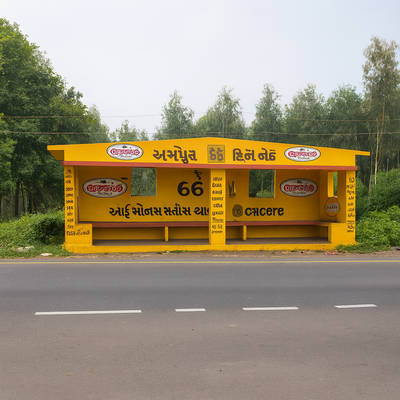
Most people who ask us about bus stand advertising are actually conflating three or four different formats under one umbrella, which is a mistake that ends up costing them either reach or money — sometimes both. A pick up bus stand, to be precise, is not the same as a covered bus shelter on a city arterial road, nor is it the same as a terminus or depot. Pick up bus stands are the designated boarding points — often open-air or semi-covered structures — where passengers wait for specific routes, shared autos, intercity buses, or state transport services; and the advertising inventory at these locations operates on a fundamentally different logic from what you would find at a premium bus shelter in Connaught Place or Bandra.
The way pick up bus stand advertising works in practice is fairly straightforward, though the backend involves more coordination than most clients expect. Advertising panels — which can be backlit panels, non-lit panels, flex banners, or increasingly digital screens — are mounted at these waiting points under agreements with the relevant municipal body, state transport corporation, or private operator managing the stand. In Maharashtra, for instance, MSRTC controls a significant share of intercity pick up points, while BEST manages intra-city stops in Mumbai; in Karnataka, KSRTC and BMTC have separate inventory pools, which means a single campaign covering Bengaluru and Mysuru requires coordination with two different authorities. What a lot of people miss is that this fragmentation, while operationally complex, is actually what keeps the rates so accessible — there is no single consolidated monopoly driving up the price.
At SmartAds, we have found that the most effective pick up bus stand campaigns treat the format as a frequency medium rather than a pure reach medium. The commuter audience at any given pick up point tends to be highly repetitive — the same people board from the same stand five or six days a week — which means brand recall compounds over a campaign duration in a way that a one-time newspaper insertion simply cannot replicate. A retail client we worked with in Ahmedabad ran a 45-day pick up bus stand campaign across 60 stands in key residential and commercial corridors, and by the third week, their in-store team was reporting that walk-in customers were referencing the bus stand creative unprompted. That kind of organic brand reinforcement is difficult to engineer through digital channels alone.
Why Choose Pick Up Bus Stand Advertising as a BTL Strategy?
Frankly speaking, the case for pick up bus stand advertising as a BTL advertising tactic rests on three things that almost no other below-the-line format can simultaneously deliver: hyper-local targeting precision, sustained dwell time, and a cost per impression that makes most digital planners do a double-take. The average commuter waiting at a pick up bus stand spends somewhere between four and twelve minutes at the location depending on the route and time of day — which is an eternity in advertising terms when you compare it to the 1.5-second average view time for a mobile display ad. That dwell time translates directly into message absorption, and it is why we consistently see higher brand recall scores from bus stand campaigns than from equivalent-budget social media spends.
The non-traditional advertising category in India has been growing steadily, and transit advertising specifically has benefited from the expansion of urban commuter populations. According to data cited in the FICCI-EY Media and Entertainment Report, OOH advertising — which includes transit media formats like pick up bus stand advertising — has been recovering strongly post-pandemic and is projected to continue growing as urban mobility infrastructure expands under the Smart Cities Mission. What that means practically is that inventory is being upgraded: smart bus shelters with digital out-of-home (DOOH) screens are appearing in Tier 1 cities, while Tier 2 city advertising opportunities at pick up bus stands are expanding as state transport corporations modernise their infrastructure. Brands that establish a presence in these markets now are building recognition ahead of the curve.
There is also the audience quality argument, which we think is underappreciated. The commuter audience at pick up bus stands in India skews heavily toward working adults — typically in the 18-to-45 age bracket — who are making daily economic decisions about where to shop, eat, study, and bank. A healthcare advertising campaign for a diagnostic chain, or an education brand advertising its coaching programmes, or an FMCG brand launching a new product in a specific district — all of these benefit enormously from the concentration of aspirational, economically active commuters at pick up points. We have seen this work particularly well for real estate advertising in satellite towns, where developers target commuters who work in the city but are actively considering homes in the periphery; one such campaign we ran in Pune's Hinjewadi corridor generated qualified site visit enquiries at a cost that was roughly one-third of what the same developer was spending per lead through Google Search.
Ad Formats Available for Pick Up Bus Stand Campaigns
The format question is where a lot of first-time advertisers get conservative when they should be getting creative. Pick up bus stands support a wider range of ad formats than most people assume, and the choice of format has a significant impact on both the cost and the visual impact of the campaign. The most common format remains the non-lit panel — a printed flex banner or vinyl wrap mounted on a fixed frame — which is available at virtually every pick up bus stand across India, from Mumbai bus stand advertising locations to remote district headquarters in Gujarat bus stand advertising markets like Bhuj and Morbi.
Backlit panels are the next step up, and they are worth the incremental cost in high-footfall urban locations because they remain visible after dark, which effectively doubles the active impression window for any stand that sees evening commuter traffic. In cities like Delhi bus stand advertising locations along DTC routes, or Bangalore bus stand advertising points managed by BMTC, backlit panels at key pick up bus stands can generate impressions well into the 9 PM hour — which is the peak return-commute window and arguably the most commercially valuable moment of the day. Digital bus stand ads, which run on LED screens at smart bus shelters and upgraded pick up points, are available in select Tier 1 locations and allow for time-of-day scheduling, which means a quick-service restaurant can run breakfast messaging in the morning and dinner promotions in the evening on the same screen.
Beyond static and digital formats, pick up bus stand advertising also accommodates on-ground activation and experiential marketing elements at larger stands — sampling tables, demonstration counters, QR code advertising installations that allow commuters to scan and engage with a brand's digital presence while they wait. This is where the offline advertising and online worlds genuinely start to blur; a well-designed QR code at a high-footfall pick up bus stand can drive lead capture at a cost per lead that competes favourably with performance marketing campaigns. At SmartAds, we always tell our clients that the QR code is not a gimmick — it is a measurement tool, and it transforms what would otherwise be a purely awareness-stage format into something that contributes directly to the conversion funnel.
Pick Up Bus Stand Advertising Rates & Minimum Quantity in India
Pricing is the section that every competitor page either skips entirely or buries in vague language, so we are going to be direct about it. Pick up bus stand advertising rates in India vary considerably based on city tier, format type, and campaign duration — but the ballpark figures are accessible enough that any media planner should be able to build a preliminary budget without a formal quote.
For a non-lit flex panel at a Tier 2 or Tier 3 city pick up bus stand, the monthly rate works out to somewhere between ₹800 and ₹2,500 per panel depending on the state and the managing authority. In Maharashtra bus stand advertising markets outside Mumbai — think Nagpur, Aurangabad, or Kolhapur — you are typically looking at the lower end of that range, which makes it possible to run a 50-panel campaign for a monthly outlay in the ballpark of ₹60,000 to ₹80,000 including production. For backlit panels in Tier 1 cities like Mumbai, Delhi, or Bengaluru, the rate climbs to somewhere between ₹4,000 and ₹12,000 per panel per month depending on the specific location and footfall; a prime pick up bus stand near a railway station or a commercial hub will command a premium, while a residential feeder route will be priced more modestly. The CPM — cost per thousand impressions — on a well-located pick up bus stand works out to roughly ₹8 to ₹25, which is a number that surprises most first-time advertisers when they compare it to what they are paying for Instagram reach or programmatic display.
On minimum quantity: most state transport corporations and municipal bodies require a minimum booking of somewhere between 10 and 25 panels per campaign, though private operators at smaller pick up bus stands can sometimes be more flexible. For PAN India advertising campaigns that span multiple states, the minimum quantity per state tends to be negotiated as part of a consolidated booking — which is one of the genuine advantages of working with an agency like SmartAds that has existing relationships across the vendor ecosystem rather than approaching each state authority independently. Campaign duration minimums are typically 30 days, with 45-day and 90-day campaigns offering progressively better rates; we have found that 45 days is the sweet spot for most brand awareness objectives, while 90-day campaigns make more sense for categories like education brand advertising where the purchase decision cycle is longer.
Cities & States Covered: PAN India Pick Up Bus Stand Network
The geographic footprint of pick up bus stand advertising in India is genuinely vast, which is both its greatest strength and the thing that makes it operationally complex to execute without the right agency infrastructure. SmartAds operates across 500+ cities, which means our pick up bus stand network spans everything from Mumbai bus stand advertising locations managed by BEST to rural advertising India opportunities at district-level pick up points in states like Rajasthan, Odisha, and Chhattisgarh — markets where transit advertising is often the only format that reaches commuters with any meaningful frequency.
In Maharashtra, the network is particularly dense: Mumbai, Pune, Nagpur, Nashik, and Aurangabad all have well-organised pick up bus stand inventory, with PMPML managing Pune's intra-city network and MSRTC covering intercity routes. Gujarat bus stand advertising is another strong market — Ahmedabad, Surat, Vadodara, and Rajkot have high-footfall pick up stands that serve both urban and semi-urban commuters, and the Gujarat state transport network extends into smaller towns like Bhuj and Anand where Tier 2 city advertising opportunities are underutilised by most national brands. Delhi NCR's DTC network covers thousands of pick up points across the capital and satellite cities like Gurgaon, Faridabad, and Ghaziabad; Bengaluru's BMTC and KSRTC networks together cover over 6,000 bus stops and pick up points, making Bangalore bus stand advertising one of the most scalable transit media opportunities in South India.
What a lot of national brands underestimate is the opportunity in Tier 2 and Tier 3 city advertising markets — places like Coimbatore, Madurai, Vizag, Bhopal, Indore, Ludhiana, and Patna — where pick up bus stand footfall is high, competition for advertising space is low, and the cost per impression is frankly extraordinary. TNSTC in Tamil Nadu manages an extensive network of pick up bus stands across the state, many of which see daily footfall in the thousands but carry very little advertising. For brands looking to build brand awareness in these markets ahead of distribution expansion, pick up bus stand advertising offers a cost-efficiency that no other format can match; a regional FMCG brand we worked with used a 90-day pick up bus stand campaign across 12 Tier 2 cities in Tamil Nadu and Karnataka to support a new product launch, achieving an estimated 4.2 crore impressions at a total campaign cost that most brands would consider a rounding error in their digital budget.
Which Industries Benefit Most from Pick Up Bus Stand Advertising?
The honest answer is that almost any consumer-facing category can benefit from pick up bus stand advertising, but some industries extract dramatically more value from the format than others — and understanding why helps you decide how to weight it in your media mix. FMCG advertising is probably the most natural fit: daily-use product categories whose target consumers are, by definition, the working adults and homemakers who use public transit every day. A soap brand, a packaged food company, or a mobile recharge service that puts its creative in front of the same 500 commuters every morning for 45 days is building purchase-moment salience in a way that a digital impression simply cannot.
Education brand advertising is another category where we have seen pick up bus stand advertising consistently punch above its weight. Coaching institutes, skill development programmes, and professional certification courses target exactly the demographic that relies on public transit — young adults between 18 and 30 who are actively investing in their careers and who have both the time and the motivation to read and absorb a well-designed creative while waiting for their bus. Healthcare advertising — particularly for diagnostic chains, pharmacy networks, and health insurance products — benefits from the same demographic alignment; a diagnostic centre that places its creative at pick up bus stands near hospitals and commercial areas is reaching people who are already thinking about health-related decisions. Real estate advertising, as we mentioned earlier, works exceptionally well at route-specific pick up bus stands on commuter corridors, where the audience is self-selecting for exactly the lifestyle aspiration that most real estate developers are trying to address.
Financial services, telecom, and retail are also strong performers in the pick up bus stand advertising format. To be fair, there are categories where the format is less effective — luxury goods, for instance, or B2B industrial products — but even these can use bus stand branding strategically in specific contexts, like advertising at pick up stands near industrial estates or IT parks where the audience profile shifts considerably. At SmartAds, our experience shows that the most important variable is not the industry category but the quality of the creative and the specificity of the location selection; a mediocre creative at a premium location will underperform a sharp, well-targeted creative at a modest location every single time.
How to Measure ROI from a Pick Up Bus Stand Campaign?
This is the question that makes some outdoor advertising vendors uncomfortable, but it is one we actively encourage our clients to ask — because the measurement frameworks for pick up bus stand advertising have improved considerably, and brands that treat it as an unmeasurable format are leaving valuable data on the table. The starting point for any campaign ROI measurement is establishing a baseline: what were your brand awareness, footfall, or sales metrics in the target geography before the campaign ran? Without that baseline, any post-campaign improvement is anecdotal rather than attributable.
The most direct measurement tool available for pick up bus stand advertising is the QR code, which converts a passive impression into an active digital signal. When a commuter scans a QR code on a bus stand panel, you get a timestamp, a location, and a device identifier — which is enough to build a retargeting audience, measure lead capture rates, and calculate a genuine cost per lead. We have run campaigns where QR code scan rates at well-located pick up bus stands have been in the range of 0.3% to 0.8% of estimated daily impressions, which sounds modest but translates to meaningful lead volumes when you are running 50 or 100 panels simultaneously. On top of that, GPS tracking campaign tools can be used to measure footfall uplift at nearby retail or service locations during and after the campaign period — a methodology that is increasingly being adopted by sophisticated advertisers to bridge the gap between OOH advertising exposure and in-store behaviour.
Proof of execution is another measurement component that SmartAds builds into every pick up bus stand campaign as standard. This means geo-tagged photographs of every panel at installation, periodic monitoring visits during the campaign duration, and a post-campaign report that documents panel condition, any replacements made, and a summary of estimated impressions based on footfall data from the relevant transport authority. The impression estimates themselves are derived from a combination of transport corporation ridership data, independent footfall counts, and — for digital bus stand ad locations — actual screen play logs. Campaign ROI, calculated as the ratio of estimated impressions or leads to total campaign spend, consistently shows pick up bus stand advertising outperforming equivalent-budget digital campaigns on a cost per impression basis, though we are careful to note that the two formats are measuring different things and are best understood as complementary rather than competitive.
Pick Up Bus Stand Advertising vs Bus Shelter vs Bus Branding: What's the Difference?
The terminology confusion in this space is real, and it costs advertisers money when they book the wrong format for their objective. Pick up bus stand advertising, bus shelter advertising, and bus branding are three distinct formats with different cost structures, audience profiles, and creative requirements — and understanding the differences is essential before you commit to a media plan.
Bus shelter advertising refers specifically to the covered, often illuminated structures at designated stops on city roads — the kind you see on arterial roads in Mumbai, Delhi, or Bengaluru, typically managed by municipal corporations or their concessionaries. These are premium locations with high visibility to both pedestrian and vehicular traffic; the advertising rates are correspondingly higher, and the inventory is often sold out months in advance in Tier 1 cities. Bus stop advertising is sometimes used interchangeably with bus shelter advertising, though technically a bus stop can be any designated boarding point with or without a shelter structure. Pick up bus stand advertising, by contrast, refers to the boarding points — which may or may not have shelter structures — where specific routes originate or where passengers congregate to board particular services; these tend to have higher dwell times than roadside bus shelters because passengers arrive early and wait for their specific route rather than simply boarding the next available bus.
Bus branding — the wrapping or panel advertising on the exterior or interior of buses themselves — is a transit media format that follows the route rather than staying fixed at a location; it generates impressions from both pedestrian and vehicular audiences along the entire route, which gives it a reach advantage over fixed-point formats like pick up bus stand advertising. The trade-off is that the dwell time per impression is much shorter — a bus passes a pedestrian in seconds — and the creative must communicate its message almost instantaneously. At SmartAds, our media planning team typically recommends a combination of bus branding for reach and pick up bus stand advertising for frequency and depth, particularly for campaigns where brand recall rather than mere brand awareness is the primary objective. The two formats are genuinely complementary, and the cost of running both simultaneously is often lower than clients expect when booked through a single agency that has consolidated vendor relationships.
How to Integrate Pick Up Bus Stand Ads with Digital Marketing?
The most exciting development in pick up bus stand advertising over the past two or three years is not the format itself — it is the increasingly sophisticated ways in which it can be integrated with digital marketing to create omnichannel advertising campaigns that are measurably more effective than either channel running in isolation. The integration starts at the creative level: a pick up bus stand panel that carries a QR code, a specific landing page URL, or a campaign hashtag creates a direct bridge between the offline advertising impression and the brand's digital ecosystem, allowing the commuter's journey to continue on their smartphone after they have boarded their bus.
Beyond QR code advertising, the integration extends to digital retargeting. Mobile advertising platforms can serve ads to users whose devices have been detected near specific pick up bus stand locations — a methodology sometimes called geo-fencing or location-based retargeting — which means a commuter who sees your bus stand panel in the morning can be served a follow-up digital ad on their phone during their lunch break. This kind of sequential messaging, which reinforces the offline advertising impression with a timely digital touchpoint, has been shown in multiple studies to significantly improve brand recall and purchase intent compared to either channel running alone. The FICCI-EY Media Report has consistently highlighted omnichannel advertising approaches as a key driver of advertising effectiveness, and pick up bus stand advertising is one of the most natural offline anchors for this kind of integrated strategy.
Digital out-of-home (DOOH) screens at smart bus shelters — which are being rolled out in major cities under the Smart Cities Mission — add another layer of integration capability, allowing brands to run dynamic creative that changes based on time of day, weather, or even live data feeds. While true DOOH inventory at pick up bus stands is still limited to select Tier 1 locations, the direction of travel is clear; and brands that are already building their creative and campaign workflows around integrated offline-digital strategies will be well positioned to take advantage of this inventory as it scales. At SmartAds, we have been helping clients build these integrated workflows since before DOOH became a mainstream conversation in India, and our experience shows that the brands which see the highest campaign ROI are invariably the ones that treat pick up bus stand advertising not as a standalone tactic but as a foundational layer in a broader media architecture.
How to Book a Pick Up Bus Stand Campaign in 5 Simple Steps
The booking process for pick up bus stand advertising is more structured than most clients expect, and knowing the workflow in advance saves a significant amount of time and prevents the kind of last-minute scrambles that result in poor location selection or rushed creative production. The process, as we walk our clients through it at SmartAds, follows a consistent sequence that works whether you are booking 10 panels in a single city or 500 panels across a PAN India advertising campaign.
The first step is the brief — and we mean a real brief, not a one-line email. We need to know the target geography, the campaign duration, the objective (awareness, footfall, lead generation), the budget range, and any specific audience or location requirements. From that brief, our team builds a location recommendation that maps available pick up bus stand inventory against your target audience profile and footfall data; this is where the hyper-local targeting precision of the format really comes into its own, because a well-chosen set of 30 pick up bus stands in a city can outperform a poorly chosen set of 100. The second step is the rate negotiation and booking confirmation, which involves securing inventory from the relevant state transport corporation, municipal body, or private operator — a process that typically takes between three and seven working days for Tier 1 cities and slightly longer for Tier 2 and Tier 3 markets where the vendor relationships are more relationship-dependent.
Creative production is the third step, and it is one where we see a lot of advertisers underinvest. Pick up bus stand creative has specific requirements that differ from standard OOH advertising: the format rewards simplicity, large typography, and a single dominant visual because the commuter audience is often reading the panel from a distance or in motion; the CTA needs to be immediately actionable, whether that is a phone number, a QR code, or a simple brand name recall prompt. The fourth step is installation and proof of execution — geo-tagged photographs of every panel, submitted within 48 hours of installation, which form the basis of the campaign monitoring process. The fifth and final step is the post-campaign report, which we deliver within two weeks of campaign end and which includes impression estimates, QR code scan data where applicable, panel condition documentation, and our strategic recommendations for the next campaign cycle. Permissions and approvals from local transport authorities are handled by SmartAds as part of the booking process — clients do not need to navigate the bureaucratic complexity of state transport corporation approvals independently, which is one of the more practical advantages of working with an experienced advertising agency India rather than approaching vendors directly.
FAQ: Pick Up Bus Stand Advertising in India
Q: What is pick up bus stand advertising in India?
Pick up bus stand advertising refers to the placement of brand communication materials — panels, banners, digital screens, or on-ground activation elements — at designated boarding points where passengers wait for buses, shared transport, or intercity services. These are distinct from roadside bus shelters in that they are typically route-specific gathering points with higher average dwell times; the commuter audience at a pick up bus stand tends to wait longer and engage more deeply with surrounding advertising than a pedestrian passing a roadside shelter. The format falls under the broader category of transit advertising and BTL advertising, and it is managed through agreements with state transport corporations, municipal bodies, or private operators depending on the location.
Q: How is pick up bus stand advertising different from bus shelter advertising?
Bus shelter advertising typically refers to premium, covered structures on arterial city roads — high-visibility locations that generate impressions from both pedestrian and vehicular traffic passing by. Pick up bus stand advertising, by contrast, is anchored at specific boarding points where a captive commuter audience waits for their route; the audience is more concentrated, the dwell time is longer, and the cost per panel is generally lower. Bus shelter advertising tends to prioritise reach and visibility to passing traffic; pick up bus stand advertising prioritises frequency and depth of engagement with a specific commuter audience. The two formats serve different objectives and are most effective when used together rather than as substitutes for each other.
Q: What is the cost of pick up bus stand advertising in India?
The cost varies considerably based on city tier, format type, and campaign duration. For non-lit flex panels at Tier 2 and Tier 3 city pick up bus stands, monthly rates are typically in the ballpark of ₹800 to ₹2,500 per panel; backlit panels at Tier 1 city locations like Mumbai, Delhi, or Bengaluru range from roughly ₹4,000 to ₹12,000 per panel per month depending on footfall and location. Production costs for flex banners are additional and typically work out to somewhere between ₹30 and ₹80 per square foot. The overall CPM — cost per thousand impressions — for a well-located pick up bus stand campaign works out to roughly ₹8 to ₹25, which compares very favourably with most digital advertising formats.
Q: What is the minimum quantity required for a pick up bus stand campaign?
Most state transport corporations and municipal bodies require a minimum booking of between 10 and 25 panels per campaign, though this varies by authority and market. For PAN India advertising campaigns spanning multiple states, the minimum per state is typically negotiated as part of a consolidated booking. Private operators at smaller pick up bus stands can sometimes accommodate smaller bookings. Campaign duration minimums are generally 30 days, with 45-day and 90-day campaigns offering better rates per panel.
Q: How many people can a pick up bus stand ad reach?
Reach depends heavily on the specific location and city. A pick up bus stand at a major transit hub in a Tier 1 city — near a railway station or a large market — can generate daily footfall in the range of several thousand commuters; a residential feeder route stand in a Tier 2 city might see a few hundred daily. Across a 50-panel campaign in a mid-sized city over 45 days, total estimated impressions are typically in the range of 30 to 80 lakh, depending on location selection and footfall data. For PAN India campaigns spanning multiple cities, total impressions can reach several crore at a fraction of the cost of equivalent digital reach.
Q: Which cities in India offer pick up bus stand advertising?
Pick up bus stand advertising is available across virtually every city and town in India that has organised public transport — which covers the full spectrum from Mumbai, Delhi, Bengaluru, Hyderabad, and Chennai at the Tier 1 level to hundreds of Tier 2 and Tier 3 cities served by state transport corporations like MSRTC, KSRTC, DTC, TNSTC, PMPML, and their counterparts in other states. SmartAds covers 500+ cities, which includes not just metros but markets like Surat, Vadodara, Rajkot, Coimbatore, Vizag, Bhopal, Indore, Patna, Ludhiana, and many others where pick up bus stand advertising inventory is available and underutilised.
Q: What ad formats are available at pick up bus stands?
The available ad formats at pick up bus stands include non-lit panels (printed flex or vinyl), backlit panels, digital LED screens at upgraded locations, vinyl wraps on shelter structures, and on-ground activation spaces at larger stands. QR code advertising installations can be incorporated into any of the static formats. Digital bus stand ads on DOOH screens are available in select Tier 1 city locations and allow for time-of-day creative scheduling. The choice of format should be driven by campaign objective, budget, and the specific footfall profile of the chosen locations.
Q: Is pick up bus stand advertising a BTL or ATL activity?
Pick up bus stand advertising is firmly a below-the-line (BTL) advertising activity — it is targeted, location-specific, and designed to engage a defined audience at a particular touchpoint rather than broadcasting to a mass audience through mass media. It sits within the broader OOH advertising and transit media categories and is typically planned alongside other BTL advertising formats like mall advertising, cinema advertising, and on-ground activation as part of an integrated non-traditional advertising strategy.
Q: How long should I run a pick up bus stand campaign for best results?
Our experience at SmartAds consistently shows that 45 days is the minimum effective campaign duration for brand awareness objectives — shorter campaigns tend to generate insufficient frequency to build meaningful brand recall in the commuter audience. For categories with longer purchase decision cycles — real estate advertising, education brand advertising, financial services — 90-day campaigns deliver significantly better ROI because they align with the audience's natural consideration timeline. Seasonal campaigns around festivals like Diwali, Navratri, or the academic admission season can be effective at shorter durations of 21 to 30 days, provided the creative is tightly aligned with the seasonal moment and the call to action is time-sensitive.
Q: What permissions or approvals are needed to advertise at bus stands in India?
The permissions required depend on who manages the specific pick up bus stand. For stands managed by state transport corporations — MSRTC, KSRTC, DTC, TNSTC, PMPML, and others — advertising rights are granted through the corporation's commercial or advertising department, typically under a formal agreement with an approved vendor or agency. For stands managed by municipal corporations, permissions come through the relevant municipal advertising or outdoor media department. Private pick up stands operated by bus operators or terminal management companies have their own commercial arrangements. Navigating these approvals is one of the more complex aspects of pick up bus stand advertising, which is why most brands work through an agency that already has established vendor relationships and approved status with the relevant authorities.
Q: Can pick up bus stand advertising be combined with digital marketing?
Absolutely — and in our view, it should be. The integration can happen at multiple levels: QR codes on panels that drive traffic to landing pages, geo-fencing campaigns that retarget commuters who have been near the pick up bus stand locations, social media campaigns that reinforce the bus stand creative with consistent messaging, and DOOH screens at smart bus shelters that allow dynamic creative linked to live data. The omnichannel advertising approach consistently outperforms single-channel strategies in brand recall and conversion metrics, and pick up bus stand advertising is one of the most natural offline anchors for this kind of integrated campaign architecture.
Q: How do I measure the ROI of a pick up bus stand campaign?
ROI measurement for pick up bus stand advertising combines several methodologies: QR code scan rates for direct digital attribution, footfall uplift measurement at nearby retail or service locations using GPS tracking campaign tools, brand recall surveys conducted with the target commuter audience before and after the campaign, and post-campaign sales data analysis in the target geography. Proof of execution documentation — geo-tagged photographs and monitoring reports — provides the operational accountability layer. SmartAds delivers a post-campaign report for every campaign that synthesises these data points into a campaign ROI assessment.
Q: Which industries benefit most from pick up bus stand advertising?
FMCG advertising, education brand advertising, healthcare advertising, real estate advertising, financial services, telecom, and retail are the categories that consistently extract the most value from pick up bus stand advertising. The format is particularly effective for any brand whose target consumer is an economically active urban or semi-urban commuter — which describes a very large share of the Indian consumer market. Categories that benefit less include luxury goods, high-ticket B2B products, and very niche consumer segments that are not well represented in the general commuter population.
Q: Is pick up bus stand advertising effective in Tier 2 and Tier 3 cities?
It is not just effective — it is often the most cost-efficient advertising format available in these markets. Tier 2 city advertising and Tier 3 city advertising through pick up bus stands offers very low competition for panel inventory, high daily footfall relative to the available advertising space, and a cost per impression that is genuinely extraordinary by any benchmark. For brands expanding distribution into smaller cities, pick up bus stand advertising builds brand awareness ahead of retail availability in a way that is both affordable and locally resonant. Rural advertising India opportunities at district-level pick up stands extend this reach even further into markets that most national brands have historically underserved.
Q: How do I book a pick up bus stand advertising campaign?
The booking process involves five core steps: submitting a campaign brief with geography, duration, objective, and budget; receiving a location recommendation and rate proposal from your agency; confirming the booking and initiating the permissions and approvals process with the relevant transport authority; producing and installing the creative materials; and receiving proof of execution and a post-campaign report. Working with an experienced advertising agency India that has existing vendor relationships across multiple states significantly accelerates this process and reduces the risk of inventory unavailability or approval delays.
Closing: Why Pick Up Bus Stand Advertising Deserves a Permanent Place in Your Media Mix
The brands that consistently underestimate pick up bus stand advertising are, in our experience, the ones that are most impressed when they finally see the numbers from a well-executed campaign. There is something counterintuitive about a format that is physically modest — a panel at a bus stand, not a billboard on a highway — delivering brand recall and cost efficiency that outpaces channels that command far larger budget allocations. But the logic is sound: a captive commuter audience, a dwell time measured in minutes rather than seconds, a cost per impression that sits at the very bottom of the media cost spectrum, and a geographic reach that extends from the largest metros to the smallest district towns — these are not small advantages.
The Indian advertising market is evolving rapidly, and transit media is evolving with it. Smart bus shelters with DOOH screens, QR code-enabled panels that feed directly into digital retargeting funnels, GPS tracking campaign tools that measure footfall attribution —