


Delhi

Mumbai

Bengluru

Ahmedabad

Jaipur

Chennai

Hydrabad

Kolkatta

Lucknow

Pune
Why Ticket Window Digital Screen Advertising Is One of India's Most Underrated BTL Branding Opportunities
Most brand managers, when they think about railway station advertising, picture large hoardings on the platform or banners strung across the concourse — and in doing so, they walk right past one of the most cost-efficient, high-dwell-time formats available in Indian non-traditional advertising. The ticket window digital screen, positioned directly at the point where a commuter stands and waits for anywhere between two and eight minutes, delivers something that most OOH formats simply cannot: guaranteed, undistracted attention. At SmartAds, we have run campaigns across this format for clients ranging from FMCG brands to financial services companies, and the consistent feedback is that the cost per eyeball works out to a fraction of what the same brand was spending on roadside hoardings in the same city.
What Is Ticket Window Digital Screen Advertising in India?
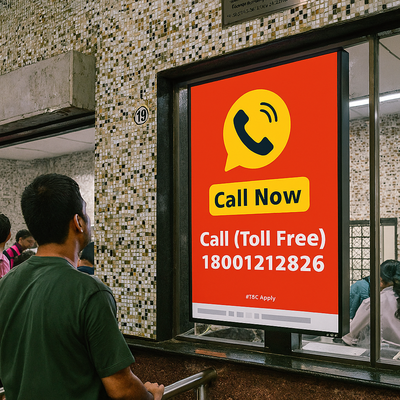
There is a tendency to describe this format as "just another digital screen," which does it a disservice. Ticket window digital screen advertising refers specifically to LED screens or digital signage units installed at or directly above the ticket counters inside Indian Railways stations, where passengers queue to purchase tickets, make enquiries, or collect reservations. These screens typically cycle through a loop of advertisements interspersed with real-time ticket information — train timings, platform numbers, booking status — which means the commuter has a functional reason to look at the screen and keeps returning their gaze to it throughout their wait.
The format is distinct from the broader category of railway station advertising because of where it sits in the commuter's journey. A platform hoarding is seen in passing; a concourse banner competes with a dozen other visual stimuli; but the ticket window digital screen is positioned at a moment of enforced stillness, which is a media planner's dream. The dwell time at a ticket counter queue in a busy urban station — think Mumbai Central Line or Delhi's Hazrat Nizamuddin — can run anywhere from three to ten minutes during peak hours, which gives a brand's message multiple exposures within a single visit.
What a lot of people miss is the sheer scale of this network. Indian Railways carries somewhere in the ballpark of 23 million passengers every single day across its network, and a significant proportion of those passengers pass through ticket counters even in the IRCTC era, particularly in Tier 2 and Tier 3 cities where online booking penetration remains lower. The infrastructure for this format has been significantly expanded through RailTel Corporation of India's digital network rollout, which has brought connected digital signage to hundreds of stations that previously had no dynamic advertising capability at all.
Why Are Railway Ticket Counter Digital Screens a Powerful BTL Medium?
Frankly speaking, the reason this format punches above its weight in any media plan is the captive audience dynamic, which is something that most above-the-line formats have been struggling to replicate for the better part of a decade. When someone is standing in a ticket counter queue, they are not scrolling through their phone with the same intensity they would on a bus or in a waiting room — they are periodically watching the screen for their queue number or for train information, and that periodic attention is exactly the kind of engaged viewing that brand awareness campaigns depend on.
The demographic targeting opportunity here is also worth pausing on. Railway commuters in India skew heavily toward working adults between the ages of 22 and 55, which is the core earning and spending demographic that most FMCG brands, financial services companies, and consumer durables advertisers are trying to reach. On top of that, the mix of income groups at a railway ticket counter is genuinely broad — from daily wage workers to middle-management professionals — which makes this format particularly valuable for mass-market brands that need breadth of reach rather than surgical precision. Our experience at SmartAds shows that clients in the banking and insurance categories, in particular, find the railway ticket counter environment highly aligned with their target audience, because the act of purchasing a ticket is itself associated with planning, travel, and financial decision-making.
The below-the-line advertising argument for this format is also compelling from a budget perspective. A brand that might spend upwards of ₹15 to 20 lakh on a single week of prime-time television in a regional market can achieve comparable reach figures — and in some cases better recall numbers — by running a month-long ticket window digital screen advertising campaign across 50 to 80 stations in the same geography, at a fraction of that cost. To be fair, the formats serve different purposes and different stages of the funnel; but for on-ground activation and brand visibility at the last mile, the railway digital screen is a format that deserves a much larger share of the BTL advertising conversation than it currently gets.
How Does a Ticket Window Digital Screen Ad Campaign Work?
The mechanics are simpler than most first-time advertisers expect. A ticket window digital screen operates on a content loop — typically running somewhere between 8 and 15 advertisements per cycle, depending on the station and the network operator — with each ad slot lasting 10 seconds. The loop runs continuously from the moment the station opens until the last train of the day, which in most major stations means 18 to 20 hours of daily ad exposure. A brand's 10-second video ad or motion graphics creative is uploaded to the network's content management system, which then distributes it across all the screens included in the campaign booking.
The content itself alternates with real-time ticket information — arrival and departure boards, queue management numbers, booking confirmations — which is the functional content that keeps commuters watching the screen. This interleaving of utility content and advertising is what makes the format so effective; the commuter is not watching an ad channel, they are watching an information channel that also happens to carry advertising, which means their guard is lower and their attention is more genuine than it would be in a purely commercial environment. Dynamic content capabilities on newer screens — particularly those on the RailTel network — also allow for dayparting, where a brand can run different creatives at morning rush hour versus evening peak, which is a level of contextual relevance that traditional static OOH advertising simply cannot offer.
At SmartAds, the way we typically structure a ticket window digital screen campaign for a new client involves three stages: first, defining the geographic footprint — which stations, which cities, which tier — based on the brand's distribution map or target audience concentration; second, agreeing on the campaign duration, which we generally recommend at a minimum of four weeks for any meaningful brand recall impact; and third, coordinating the creative delivery to the network operator in the correct technical specifications, which we handle end-to-end so the client does not have to navigate that process themselves. The campaign goes live within a few days of creative approval, and the brand's ad slots begin running across every screen in the booked network simultaneously.
What Are the Advertising Rates for Ticket Window Digital Screens in India?
This is the question that most media planners come to us with first, and the honest answer is that rates vary considerably depending on the city tier, the station footfall, and the network operator — but we can give you a realistic ballpark that most competitor pages conspicuously avoid publishing. In Tier 1 cities like Mumbai, Delhi, Bangalore, and Chennai, a single ticket window digital screen at a high-footfall station typically costs somewhere in the range of ₹8,000 to ₹15,000 per screen per month, depending on the station's daily passenger count and the operator's rate card. A campaign covering 20 screens across Mumbai's Western and Central Line stations, for instance, would work out to roughly ₹2 to ₹3 lakh per month — which, when you divide it by the estimated monthly impressions of 8 to 12 lakh commuters across those screens, gives you a cost per thousand impressions in the ballpark of ₹20 to ₹35, which is a number that surprises most first-time advertisers when they compare it to what they are paying for Instagram reach in the same city.
In Tier 2 cities like Ahmedabad, Pune, Jaipur, Lucknow, and Nagpur, rates are meaningfully lower — typically somewhere between ₹4,000 and ₹8,000 per screen per month — while still delivering substantial footfall at major junction stations. This is where the format becomes genuinely compelling for regional brands and for national brands running market-specific campaigns; a ₹50,000 monthly investment can cover 8 to 10 screens across a mid-sized city's key stations, which gives the brand a visible presence at multiple high-footfall locations simultaneously. Tier 3 cities and smaller towns, where RailTel and other operators have been expanding their digital signage networks, can bring that per-screen cost down further still, sometimes to ₹2,500 to ₹4,000 per month, which makes ticket window digital screen advertising genuinely accessible for local and regional advertisers who have historically been priced out of most OOH formats.
One thing we always tell our clients at SmartAds is that the ticket counter screen ad rates per month should never be evaluated in isolation — the relevant metric is always cost per eyeball relative to the campaign objective. A screen at a smaller Tier 2 station might cost less, but if the daily footfall is only 3,000 passengers, the effective CPM may not be materially different from a well-priced Tier 1 screen. The smarter approach is to build a station selection matrix that weights both rate and footfall, which is something our media planning team does as a standard part of the campaign brief process.
Which Cities and Railway Stations Can You Target with Ticket Window Digital Screen Ads?
The geographic reach of this format is one of its most significant advantages over many other BTL advertising options, and it is an advantage that has grown substantially as the RailTel Corporation of India has expanded its connected digital infrastructure to stations beyond the major metros. A PAN India ticket window screen campaign is genuinely achievable today in a way that would have been logistically complex even five years ago, because the network operators now have standardised content management systems that allow a single creative upload to be distributed across hundreds of stations simultaneously.
In the major metros, the station options are extensive. In Mumbai, the Western Line stations from Churchgate to Virar and the Central Line stations from CSMT to Kalyan between them cover one of the densest commuter corridors in the world; railway digital screen advertising Mumbai across these corridors reaches a daily footfall that is difficult to match with any other single-format BTL buy. Delhi's network — spanning New Delhi, Hazrat Nizamuddin, Anand Vihar, and the suburban rail corridors — similarly offers a breadth of geographic and demographic coverage that makes it a cornerstone of most national campaigns we plan. Bangalore's KSR City Railway Station and Yeshwanthpur, Chennai Central and Egmore, Hyderabad's Secunderabad and Kacheguda, and Kolkata's Howrah and Sealdah are all high-footfall locations where ticket window digital screen advertising delivers strong brand visibility numbers.
What is often underappreciated, though, is the Tier 2 and Tier 3 city opportunity. Stations like Surat, Vadodara, Coimbatore, Madurai, Visakhapatnam, Bhopal, Indore, Kanpur, and Patna carry enormous daily footfall — in some cases rivalling smaller metro stations — and the advertising rates at these locations are significantly lower, which makes the ROI calculation very attractive for brands that are expanding their distribution into these markets. We have found, from our campaign experience at SmartAds, that a brand running its first non-traditional advertising campaign in a Tier 2 market almost always gets a better return from ticket window digital screens than from the local newspaper or radio buy they would have defaulted to previously.
What Are the Key Benefits of Non-Traditional BTL Advertising on Railway Digital Screens?
The case for this format as a below-the-line advertising vehicle rests on several pillars, and the most important one — which is also the most frequently underestimated — is the quality of the audience engagement rather than just the quantity of impressions. Most OOH advertising formats are designed around the assumption of passive, mobile audiences: people in cars, on bikes, walking past a hoarding. The railway ticket counter environment inverts that assumption entirely, because the audience is stationary, the screen is at eye level or slightly above, and the functional content on the screen gives them a reason to keep looking. That combination of factors produces dwell time and brand recall numbers that are genuinely difficult to replicate in most other non-traditional advertising contexts.
Brand awareness at the ticket counter also benefits from a contextual alignment that is easy to overlook. A commuter standing in a queue is in a planning mindset — they are thinking about their journey, their schedule, their destination — and advertising that speaks to travel, convenience, financial products, mobile services, or everyday consumer goods lands in a mental state that is more receptive than, say, the same ad seen on a roadside hoarding during a traffic jam. One FMCG client we worked with — a packaged food brand running a regional campaign in Maharashtra — reported a measurable uplift in brand recognition scores in railway corridor towns after a six-week ticket window digital screen campaign, which they attributed specifically to the frequency of exposure among the commuter demographic that formed their core distribution target.
The on-ground activation value of this format also extends to its ability to support multilingual and regional language campaigns, which is a significant practical advantage for any brand operating across India's linguistic diversity. A PAN India campaign can be localised at the station level — running Tamil creatives in Chennai, Marathi in Pune, Kannada in Bangalore, and Hindi in Delhi — all within the same campaign booking, which is a level of regional personalisation that most mass-media formats cannot offer without significant additional cost. At SmartAds, we routinely advise clients planning Tier 2 and Tier 3 city campaigns to invest in regional language creatives, because the brand recall improvement in those markets is consistently and measurably better than running a Hindi or English creative in a predominantly non-Hindi-speaking audience.
Which Brands Have Successfully Used Railway Ticket Counter Digital Screen Advertising?
The advertiser mix on ticket window digital screens is broader than most people expect, which is itself a signal of the format's versatility. Financial services brands have been early and consistent adopters — SBI's various retail banking and savings product campaigns have used railway station digital signage extensively, and mutual fund brands like Kotak Mahindra Mutual Fund have found the railway commuter demographic well-aligned with their investor acquisition campaigns, particularly in the 25-to-45 age bracket that forms the core of India's growing retail investment market. Telecom brands, including Vodafone and others, have used the format for SIM card and recharge promotions, where the impulse-purchase nature of the product aligns well with the high-frequency, high-footfall environment.
Maruti Suzuki and other automotive brands have used railway ticket counter digital screen advertising in an interesting way — not to sell cars to people standing in a ticket queue, but to build brand salience among the aspirational middle-class commuter who is a current or future car buyer. The logic is sound: the person standing in that queue today may be a train commuter, but they are also a consumer with disposable income and purchasing aspirations, and the brand that achieves consistent visibility in their daily environment builds a familiarity that influences decisions made much later. We worked with an automotive accessories brand in this vein — running a three-month campaign across 60 stations in four Tier 1 cities — and the brand reported a 34% increase in website traffic from the cities covered during the campaign period, which they attributed in part to the sustained railway station advertising presence.
FMCG brands have also found this format effective for new product launches and seasonal campaigns, where the broad demographic reach of the railway network complements the mass-market nature of the product. A health beverage brand we worked with ran a summer campaign across 120 stations in Maharashtra and Gujarat — covering both Tier 1 and Tier 2 locations — and achieved an estimated reach of over 18 lakh unique commuters over the six-week campaign period, at a total campaign cost that was significantly lower than a comparable regional television buy. The key insight from that campaign was that the combination of high footfall, multiple exposures per commuter, and the contextual relevance of a hydration product in a hot-weather travel environment produced brand recall scores that the client's research team described as among the best they had seen for any BTL advertising format.
How Do You Measure Campaign ROI and Performance for Ticket Window Digital Screen Ads?
This is where a lot of advertisers feel uncertain, and frankly speaking, it is a fair concern — the measurement infrastructure for ticket window digital screen advertising is less mature than what is available for digital or even television, but it is considerably more developed than most people assume. The primary measurement inputs are footfall data (typically provided by the station operator or derived from Indian Railways passenger traffic statistics), screen uptime reports (which network operators like RailTel and Nexus Media Works provide as standard), and loop play logs that confirm how many times your ad slot was served across the campaign period.
From these inputs, a competent media planner can construct a reasonably reliable reach and frequency estimate. If a station handles 40,000 passengers per day and the screen is positioned at the ticket counter where 60% of those passengers pass, the daily reach for that screen is approximately 24,000 people; with a loop frequency of, say, 80 plays per day and an average of three to four exposures per commuter visit, the effective OTS (Opportunities to See) per month works out to a substantial number that can be benchmarked against other media formats in the same plan. The return on investment calculation then depends on the brand's own conversion and attribution models, which vary by category — but the cost per thousand impressions figure for this format is, in our experience, consistently competitive with or better than comparable OOH advertising formats in the same geography.
More sophisticated measurement approaches are also becoming available. Some operators on the RailTel digital network are beginning to integrate audience measurement tools — including camera-based footfall counters and anonymised demographic detection systems — which allow for more granular reporting on who is actually looking at the screen rather than just who is passing by. On top of that, brands can layer in their own measurement approaches: running brand recall surveys among railway commuters in campaign versus non-campaign cities, tracking search volume uplifts in covered geographies, or using mobile data partnerships to identify commuter audiences and measure their subsequent digital behaviour. At SmartAds, we help clients build a measurement framework before the campaign launches, not after, because the data you need to prove return on investment has to be collected from day one.
How Does Ticket Window Digital Screen Advertising Compare to Other OOH Advertising Formats?
The comparison that comes up most often in our client conversations is ticket window digital screen versus metro station digital screen, and the distinction is more nuanced than it first appears. Metro station digital screens — particularly in cities like Delhi, Mumbai, Bangalore, and Hyderabad — carry premium rates that reflect the high-income, tech-savvy demographic of metro rail users; a single prominent digital screen at a Delhi Metro interchange station can cost several times more per month than a comparable railway ticket counter screen in the same city. The railway ticket counter screen, by contrast, reaches a broader and more economically diverse audience, which makes it better suited for mass-market brands and worse suited for luxury or premium-tier products that need demographic precision.
Against airport digital screen advertising, the comparison is even more stark. Airport digital signage reaches a high-income, high-frequency traveller demographic that is genuinely valuable for certain categories — premium financial products, luxury goods, international travel brands — but the cost per impression is dramatically higher, and the total reach is a fraction of what the railway network delivers. A PAN India airport campaign covering the top 10 airports might reach 2 to 3 lakh passengers per day; a comparable investment in ticket window digital screen advertising across the railway network could reach 10 to 15 times that number. The formats serve different purposes, and the smarter media plan often includes both rather than choosing between them.
Against traditional static OOH advertising — hoardings, bus shelters, wall paintings — the digital screen format offers the obvious advantages of dynamic content, dayparting capability, and the ability to update creative without physical replacement costs. What a lot of people miss is that the dwell time advantage of the ticket counter environment makes even a 10-second video ad more effective than a static hoarding that a commuter passes in two seconds at 40 kilometres per hour. The motion graphics capability of LED screens also allows for more information density in a 10-second slot than any static format can achieve, which is particularly valuable for brands with a message that requires some explanation — a financial product, a new service, a promotional offer with a specific mechanic. Guerrilla marketing and on-ground activation can complement this format well, but the ticket window digital screen delivers the scale and consistency that one-off activations cannot.
How to Book Ticket Window Digital Screen Advertising Across India?
The booking process for ticket window digital screen advertising in India runs through either the network operators directly or through an advertising agency India that has established relationships with those operators — and the practical difference between those two routes is significant. Going directly to a network operator like RailTel, Nexus Media Works, or NuRe Bharat Network (NBN) gives you access to their specific inventory, but it means you are dealing with multiple vendors if you want a multi-city or PAN India campaign, each with their own rate cards, creative specifications, and reporting formats. Going through an integrated agency like SmartAds means a single point of contact, consolidated billing, unified reporting, and the benefit of negotiated rates that come from volume buying across multiple networks.
The technical specifications for creative submission are worth understanding before you commission your agency or production house to build the assets. Most ticket window digital screens run at a resolution of 1920x1080 pixels (full HD), with file formats typically accepted in MP4 or AVI with H.264 encoding; the ad slot duration is almost universally 10 seconds, and the file size limit is generally under 50MB per creative. Motion graphics and animated text work well in this format; creative with very fine text or complex visual detail tends to underperform because the screen is often viewed from a distance of 2 to 4 metres. We always advise clients to use large, bold typography, a single clear message, and a brand logo that occupies at least 20% of the screen area — principles that sound obvious but are surprisingly often ignored when production teams design for this format without understanding the viewing environment.
The minimum campaign duration that most operators will accept is typically four weeks, though some networks offer two-week trial packages for first-time advertisers who want to test the format before committing to a longer run. For seasonal campaigns — Diwali, summer, back-to-school — we recommend booking at least six to eight weeks in advance, because ad slots at high-footfall stations fill up quickly during peak advertising periods. Book ticket window digital screen ad online options are increasingly available through aggregator platforms, but for campaigns spanning more than 20 stations or multiple cities, the manual booking route through an agency remains more reliable for ensuring consistent delivery and quality control. The campaign booking process at SmartAds typically takes three to five working days from brief to live, assuming creative assets are ready.
Frequently Asked Questions About Ticket Window Digital Screen Advertising
Q: What is ticket window digital screen advertising?
Ticket window digital screen advertising refers to the placement of brand advertisements on LED or digital signage screens installed at or above ticket counters inside Indian Railways stations and other transit hubs. These screens display a rotating loop of advertisements interspersed with real-time train and ticketing information, which creates a captive audience environment where commuters waiting in queue are exposed to brand messages multiple times during a single visit. The format is classified as a non-traditional BTL advertising medium and is distinct from platform hoardings or concourse banners because of its specific placement at the point of enforced dwell time.
Q: How much does ticket window digital screen advertising cost in India?
The ticket window digital screen advertising cost varies by city tier and station footfall. In Tier 1 cities like Mumbai, Delhi, and Bangalore, rates typically fall somewhere between ₹8,000 and ₹15,000 per screen per month; in Tier 2 cities like Ahmedabad, Pune, and Jaipur, the range is more in the ballpark of ₹4,000 to ₹8,000 per screen per month; and in Tier 3 cities and smaller towns, rates can be as low as ₹2,500 to ₹4,000 per screen per month. A typical multi-city campaign covering 50 to 100 screens would therefore work out to somewhere between ₹3 lakh and ₹10 lakh per month depending on the city mix, which compares very favourably with the cost per impression of most alternative OOH advertising formats in the same geographies.
Q: Which railway stations in India have ticket window digital screens for advertising?
Digital screens at ticket counters are currently operational at hundreds of stations across India, with the network continuing to expand through RailTel Corporation of India's infrastructure rollout and private operator installations. Major stations with established digital screen advertising inventory include Mumbai's CST, Dadar, Bandra, and Andheri; Delhi's New Delhi, Hazrat Nizamuddin, and Anand Vihar; Bangalore's KSR City and Yeshwanthpur; Chennai Central and Egmore; Hyderabad's Secunderabad; Kolkata's Howrah and Sealdah; and Ahmedabad, Pune, Surat, Vadodara, Lucknow, Kanpur, Bhopal, Indore, and many others. The specific inventory available at any given time is best confirmed through a media agency with current network access, as new stations are added regularly.
Q: How many people can a ticket window digital screen campaign reach per day?
Daily reach depends heavily on the stations selected. A single screen at a high-footfall station like Mumbai's Dadar or Delhi's New Delhi can reach anywhere from 20,000 to 50,000 commuters per day; a screen at a mid-tier station in a Tier 2 city might reach 5,000 to 15,000. A campaign covering 100 screens across a mix of Tier 1 and Tier 2 stations could realistically deliver aggregate daily impressions in the range of 15 to 30 lakh, which over a four-week campaign period represents a total reach figure that is genuinely competitive with regional television or large-format OOH buys.
Q: What ad formats and durations are supported on railway ticket counter digital screens?
The standard ad slot duration on most railway ticket counter digital screens is 10 seconds, and the creative format is typically a full-motion video or animated graphic at 1920x1080 resolution. MP4 files with H.264 encoding are the most widely accepted format, with file sizes generally capped at 50MB. Some networks support static image ads as well, though motion graphics consistently outperform static creatives in recall studies. Dynamic content capabilities — including dayparting and real-time data integration — are available on more advanced screens within the RailTel network and select private operator installations.
Q: How is ticket window digital screen advertising different from traditional OOH advertising?
The fundamental difference is the audience dynamic. Traditional OOH advertising — hoardings, bus shelters, wall murals — reaches a mobile audience in passing, with typical exposure durations of two to five seconds. Ticket window digital screen advertising reaches a stationary audience with a dwell time of three to ten minutes, which allows for multiple exposures per visit and significantly higher brand recall. On top of that, the digital format enables dynamic content, creative rotation, and dayparting — none of which are possible with static OOH formats — and the cost per impression is typically lower than comparable large-format OOH in the same geography.
Q: Can small businesses afford ticket window digital screen advertising in India?
Yes, and this is one of the format's most underappreciated advantages. With per-screen costs starting at roughly ₹2,500 to ₹4,000 per month in Tier 3 cities and smaller towns, a local business can achieve meaningful brand visibility at a key transit hub for a monthly investment that is within reach of most SME advertising budgets. Even in Tier 1 cities, a single-screen booking at a well-chosen station can be a cost-effective branding solution for a local business that cannot afford a hoarding or a television spot. The low cost advertising credentials of this format make it one of the few non-traditional advertising options that genuinely scales down to the small business level without losing its effectiveness.
Q: How do I book a ticket window digital screen advertising campaign in India?
The most straightforward route is through an advertising agency India that has existing relationships with the major network operators — RailTel, Nexus Media Works, NuRe Bharat Network, and others — because this gives you access to consolidated inventory across multiple networks, negotiated rates, and a single point of accountability for delivery and reporting. Alternatively, some operators offer direct booking through their own sales teams or through aggregator platforms. For first-time advertisers, we recommend the agency route because the creative specification requirements, station selection logic, and measurement setup are all areas where experienced guidance makes a material difference to campaign outcomes.
Q: What is the minimum campaign duration for ticket window digital screen advertising?
Most operators require a minimum booking of four weeks, which is also the duration we recommend from a brand recall perspective — shorter campaigns tend not to generate the frequency of exposure needed for meaningful awareness impact. Some networks offer two-week trial packages for first-time advertisers, which can be useful for testing the format before committing to a longer campaign. For seasonal campaigns tied to specific festivals or promotional periods, a six-week run that begins two weeks before the peak period and runs through it tends to deliver the best results in our experience.
Q: How can I measure the ROI of my ticket window digital screen advertising campaign?
ROI measurement for this format rests on three primary data sources: station footfall data (from Indian Railways traffic statistics or operator-provided counts), screen uptime and loop play logs (from the network operator), and brand-side attribution data (search volume, sales uplift, brand recall surveys). From the first two inputs, a reliable reach and frequency estimate can be constructed, and the cost per thousand impressions can be calculated and benchmarked against other formats in the media plan. More advanced measurement approaches — including mobile audience tracking and pre/post brand recall studies — can be layered on top for campaigns where rigorous return on investment reporting is required.
Q: Which industries or brands benefit most from ticket window digital screen advertising?
Financial services — banking, insurance, mutual funds — consistently perform well because the railway commuter demographic aligns closely with the target audience for retail financial products. FMCG brands benefit from the mass-market reach and the impulse-awareness dynamic. Telecom brands, consumer electronics, automotive brands targeting the aspirational middle class, e-commerce platforms, and government or public service campaigns are all categories that have found strong results from this format. Categories that tend to underperform are those requiring very precise demographic targeting — luxury goods, niche B2B products — where the broad demographic mix of the railway environment is a disadvantage rather than an asset.
Q: Are ticket window digital screens available in Tier 2 and Tier 3 cities in India?
Yes, and the network is expanding rapidly. RailTel Corporation of India's digital infrastructure rollout has brought connected screens to hundreds of stations beyond the major metros, and private operators have followed suit in commercially attractive Tier 2 markets. Cities like Surat, Vadodara, Nashik, Aurangabad, Coimbatore, Madurai, Visakhapatnam, Bhopal, Indore, Agra, Varanasi, Patna, and many others now have ticket window digital screen advertising inventory available. For brands expanding into these markets, the combination of lower rates and meaningful footfall makes Tier 2 and Tier 3 city railway station advertising one of the most cost-efficient BTL advertising options currently available in India.
Why SmartAds Recommends Building Ticket Window Digital Screens Into Your Next Media Plan
The advertising formats that tend to get overlooked are often the ones that deliver the best return on investment, and ticket window digital screen advertising is a near-perfect example of that pattern. It sits at the intersection of high footfall, enforced dwell time, dynamic content capability, and genuinely accessible pricing — a combination that is rare in any media category, and rarer still in the OOH and non-traditional advertising space. The railway network's reach across Tier 1, Tier 2, and Tier 3 cities gives this format a geographic versatility that very few other BTL advertising formats can match, and the continued expansion of the RailTel digital network means that the inventory available today is a fraction of what will be available in the next two to three years.
What we tell our clients at SmartAds, when they are building a media plan that needs to balance reach, cost efficiency, and brand recall, is that ticket window digital screen advertising should be evaluated not as a supplementary or experimental line item but as a core component of the non-traditional advertising mix — particularly for brands that are trying to build consistent visibility in markets where traditional media costs have become prohibitive. The format rewards brands that invest in good creative, that commit to a campaign duration long enough to generate meaningful frequency, and that choose their station mix thoughtfully based on audience data rather than just geographic convenience.
The FICCI-EY Media Report and the GroupM TYNY Report have both highlighted the accelerating growth of DOOH and non-traditional advertising formats in India's overall media mix, and the railway digital screen category is one of the primary beneficiaries of that shift. As more brands discover that the cost per eyeball on this format compares favourably with digital display, regional television, and large-format OOH, the inventory at premium stations will become more competitive — which means the brands that establish a presence now are buying at rates that will look very attractive in retrospect.
If you are planning a campaign that needs PAN India reach, regional market penetration, or cost-efficient brand visibility among India's working adult demographic, the SmartAds media planning team would be glad to build a customised ticket window digital screen advertising proposal for your brand — one that covers station selection, rate negotiation, creative specifications, and measurement framework from the first conversation. Reach out to us at SmartAds.in, and let us show you what this format can do for your next advertising campaign.
