


Delhi

Mumbai

Bengluru

Ahmedabad

Jaipur

Chennai

Hydrabad

Kolkatta

Lucknow

Pune
Dhaba Advertising, Highway Dhaba Branding & BTL Advertising Agency India | Rural Brand Activation, Non-Traditional Advertising India, Dhaba Branding Services, On-Ground Brand Promotion, Pan India Dhaba Marketing
This article draws on SmartAds' direct campaign experience across 500+ Indian cities, actual dhaba advertising cost benchmarks that most agencies refuse to publish, and a measurement framework you can take straight into your next media planning meeting. If you are evaluating dhaba branding as a channel — or trying to justify it to a skeptical CFO — the data and strategic context here will do the heavy lifting for you.
What Is Dhaba Advertising and How Does It Work as a BTL Marketing Strategy?
Most brand managers encounter dhaba advertising for the first time as a line item in a rural BTL advertising proposal, somewhere between wall painting and van campaigns, and their first instinct is to underestimate it. That instinct, frankly speaking, is almost always wrong. A highway dhaba is not simply a roadside restaurant; it is one of the most concentrated, captive, and demographically consistent consumer touchpoints that exists in the Indian media landscape — a place where the same audience pauses, rests, eats, and is genuinely receptive to brand messaging for anywhere between twenty minutes and two hours.
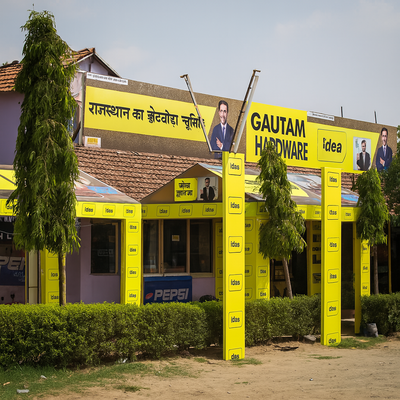
Dhaba advertising works as a below-the-line advertising strategy by placing brand signage, product sampling booths, kiosks, or branded utilities directly within the physical space of a dhaba — which might mean a flex board above the entrance, a glow sign board on the perimeter wall, branded seating or crockery inside, or a product sampling counter near the payment area. The brand essentially becomes part of the dhaba's environment, which is fundamentally different from a hoarding on the highway that a driver passes at 80 kilometres per hour. The dwell time at a dhaba is the single most underappreciated metric in outdoor advertising India, and it is what separates this format from conventional OOH advertising in terms of brand recall.
At SmartAds, we always tell our clients that dhaba advertising sits at a very specific intersection of geography, audience, and attention — three things that most non-traditional advertising formats struggle to deliver simultaneously. The mechanics are straightforward: a dhaba branding agency like ours identifies and empanels dhaba locations along target highway corridors or within semi-urban clusters, negotiates placement rights with dhaba owners (who are typically compensated through a combination of cash, branded utilities, or product supply), installs the agreed formats, and monitors them over the campaign duration, which usually runs between three and twelve months. The operational complexity is real, but the strategic logic is simple.
Why Are Highway Dhabas an Untapped BTL Marketing Goldmine?
There is a number that tends to stop conversations in media planning meetings: India has an estimated 1.5 to 2 lakh highway dhabas operating along its national and state highway network, and the overwhelming majority of them carry zero paid advertising at any given time. For a brand trying to reach truck drivers, highway travelers, rural consumers, and semi-urban working populations — all in a single placement — this represents an inventory gap that is genuinely difficult to find anywhere else in the BTL advertising ecosystem.
The footfall dynamics at highway dhabas are what make this channel so interesting. A moderately busy dhaba on a national highway like NH-44 or NH-48 — which are among the most heavily trafficked corridors in the country — can see anywhere between 200 and 800 visitors on a typical weekday, with that number climbing significantly during festival travel periods or harvest season when truck movement intensifies. Unlike a hoarding or a wall painting, which generates passive impressions from moving vehicles, the dhaba creates a stationary, engaged audience; the person sitting down for a meal is not distracted by traffic, not scrolling a phone, and is often in a group conversation where brand mentions travel organically. The GroupM TYNY Report has consistently flagged rural and semi-urban markets as the next growth frontier for consumer brands in India, and dhaba advertising is one of the most direct ways to physically occupy that frontier.
What a lot of people miss is the trust architecture that a dhaba carries. In rural and semi-urban India, the dhaba owner is a community figure — someone whose recommendations carry weight, whose premises signal safety and familiarity, and whose association with a brand therefore functions as a soft endorsement. We have seen this dynamic play out repeatedly in campaigns where branded utilities (tea glasses, tumblers, wall clocks with brand logos) generated more conversation and brand recall than the flex board outside, simply because the dhaba owner used them visibly and consistently. This is experiential marketing India at its most organic, and it is something that no digital ad format can replicate.
Who Are You Really Reaching at a Highway Dhaba?
The lazy answer to this question is "truck drivers," and while truck drivers are absolutely a core segment, reducing dhaba advertising to trucker-facing communication is one of the most common strategic errors we see brands make. The target audience at a highway dhaba is actually a layered composite, and understanding those layers is what separates a well-planned dhaba marketing campaign from a generic signage exercise.
Truck drivers and transport workers are the most consistent segment — they stop at the same dhabas repeatedly, which means frequency of exposure is naturally built into the channel without any additional spend. This segment is particularly valuable for brands in categories like tobacco, pan masala, energy drinks, pain relief, and mobile recharge, because their consumption patterns are high-frequency and their brand loyalty, once established, tends to be sticky. On the Golden Quadrilateral alone — the roughly 5,846-kilometre highway network connecting Delhi, Mumbai, Chennai, and Kolkata — the daily commercial vehicle movement runs into lakhs, and a significant proportion of those drivers stop at dhabas along the route.
Beyond truckers, the highway dhaba audience includes long-distance bus passengers and their accompanying families, private vehicle travelers on intercity routes, local farmers and agricultural workers who use dhabas near mandis and rural market clusters, and — increasingly — urban weekend travelers for whom the "authentic dhaba experience" has become a deliberate lifestyle choice. These last two segments are particularly relevant for FMCG brands, telecom operators, and agri-input companies, which need to reach rural consumers and semi-urban audiences who are not yet saturated with urban-format advertising. At SmartAds, our audience segmentation for dhaba branding campaigns typically distinguishes between three dhaba typologies: trucker-dominant dhabas on freight corridors, family-friendly highway dhabas on intercity tourist routes, and urban fringe dhabas near city peripheries that serve a mixed semi-urban population — because each typology demands a different creative approach and a different product category fit.
What Advertising Formats Work Best at Dhabas?
The format question is where dhaba advertising gets genuinely interesting, because the channel supports a wider range of executions than most media planners initially assume. The most common entry point is the flex board — a printed vinyl banner, typically ranging from 4x6 feet to 10x15 feet, mounted on the dhaba's exterior wall or entrance frame, which offers high visibility to passing traffic and arriving customers alike. Flex boards are cost-effective, fast to produce, and easy to replace when creative needs updating; they are the workhorse of dhaba branding and the format most brands start with.
The glow sign board is the premium step up from a flex board — a backlit signage unit, usually fabricated in metal or acrylic, which remains visible after dark and therefore captures the significant volume of night-time dhaba traffic, particularly from truck drivers who travel predominantly between 10 PM and 6 AM. A glow sign board at a well-located highway dhaba on a busy corridor can generate impressions across multiple shifts of travelers, which makes its cost-per-contact significantly more efficient than its higher upfront fabrication cost might suggest. Wall painting is another durable format, particularly suited to dhabas with large exterior walls facing the highway, and it has the advantage of a lifespan measured in years rather than months — which is why brands with long-term rural marketing objectives tend to favour it for base-level brand visibility.
Beyond static signage, the more sophisticated dhaba advertising executions involve kiosks and product sampling setups, branded utility items (tea glasses, plates, table mats, water jugs, wall clocks), and increasingly, QR code-enabled banner advertising that connects the physical touchpoint to a digital journey. A kiosk or product sampling booth placed inside a dhaba during a brand activation window — say, a two-week on-ground branding push during a festival period — can generate direct trial of a product among a highly targeted audience at a cost per sample that is dramatically lower than what the same brand would spend on modern trade sampling in a mall. We worked with a pharma client in Uttar Pradesh who ran a product sampling campaign for an ORS brand across 300 dhaba locations along NH-19 and NH-27 during the summer months; the cost per trial worked out to somewhere in the ballpark of ₹4 to ₹6, which compared favourably to every other sampling format they had tried in that geography.
How Did Dabur Use Dhaba Advertising to Capture Market Share?
The Dabur Hajmola dhaba advertising story is the most frequently cited case study in this channel, and for good reason — it is one of the clearest documented examples of a brand using dhaba branding to build category dominance in a geography where conventional media had limited reach. Dabur's strategy, executed over multiple campaign cycles, involved placing Hajmola branding across thousands of dhaba locations across North India — Punjab, Haryana, Uttar Pradesh, and Rajasthan being the core states — through a combination of flex boards, glow sign boards, branded display units at payment counters, and product availability placement that turned the dhaba itself into a point-of-sale.
The insight behind the campaign was precise: digestive products are impulse purchases that are most relevant immediately after a heavy meal, which is exactly when dhaba visitors are most receptive to them. By owning the dhaba environment — the signage, the counter display, the branded packaging visible to the person paying — Dabur created a brand recall loop that was reinforced every time a consumer visited a dhaba, which for the trucker and highway traveler segment meant multiple exposures per week. The reported outcome, which has been referenced in several marketing case analyses, is that Hajmola achieved a dominant market share position in the digestive candy category in North India that competitors found extremely difficult to dislodge, precisely because the dhaba network had been so thoroughly and consistently owned.
What the Dabur case illustrates, and what we at SmartAds draw on when advising clients, is that dhaba advertising works best when it is integrated with product availability — when the brand visible on the glow sign board outside is also the brand stocked at the counter inside. This sounds obvious, but the execution requires coordinating the advertising placement with the distribution team, which is where many campaigns fall short. The brands that have gotten the most out of dhaba branding — and it is not only Dabur; Coca-Cola, Pepsi, Britannia, and several telecom operators have run significant dhaba marketing campaigns — are the ones that treated the dhaba as a complete brand environment rather than just another surface for a banner.
How Much Does Dhaba Branding Cost in India?
This is the question that most dhaba branding agency websites refuse to answer directly, which is frustrating for anyone trying to build a media plan. We are going to give you the actual numbers, with the caveat that rates vary by highway corridor, state, dhaba size and footfall, and the negotiating leverage that comes with campaign scale.
A standard flex board placement at a highway dhaba — covering the fabrication, installation, and a twelve-month display right — typically works out to somewhere between ₹800 and ₹2,500 per location, depending on the size of the board and the prominence of the dhaba. High-footfall locations on major national highway corridors like NH-44 or NH-48 command the higher end of that range; smaller state highway dhabas in markets like Rajasthan or Madhya Pradesh can be negotiated at the lower end. A glow sign board, which involves fabrication costs on top of the display right, generally runs somewhere between ₹3,000 and ₹8,000 per location for a standard-sized unit, which is still remarkably cost-effective when you consider that a single billboard hoarding in a Tier-2 city can cost ₹15,000 to ₹40,000 per month.
Wall painting at a dhaba, which requires a surface survey, paint and material costs, and skilled labour, is typically priced in the range of ₹15 to ₹40 per square foot, with a minimum viable execution usually covering somewhere between 50 and 200 square feet. A product sampling kiosk activation — which includes the kiosk structure, staffing, and a defined activation period — is usually budgeted at roughly ₹5,000 to ₹15,000 per location per day of activation, depending on the market and the complexity of the execution. For a pan India dhaba advertising campaign covering, say, 1,000 locations across five states with a mix of flex boards and glow sign boards, a realistic total budget — including agency fees, fabrication, installation, and monitoring — would fall somewhere in the range of ₹50 lakh to ₹1.5 crore, which is a number that consistently surprises clients when they compare it to what the same reach would cost through conventional OOH advertising or regional television.
At SmartAds, we have found that the most cost-effective dhaba advertising campaigns are those which negotiate multi-year contracts with dhaba owners in high-footfall locations, because the per-year cost drops significantly when the owner has the certainty of a longer-term relationship. A three-year flex board agreement at a busy NH-44 dhaba in Haryana, for instance, can bring the effective annual cost down to a level that makes the CPM genuinely competitive with even the most efficient digital display formats.
How Do You Plan and Execute a Pan-India Dhaba Advertising Campaign?
The operational reality of running a pan India dhaba branding campaign at scale is something that most brands discover is more complex than it looks from the outside — and it is the area where having an experienced dhaba branding agency makes the most material difference to campaign outcomes. The first phase is location identification and empanelment, which involves building a database of dhaba locations along target highway corridors, scoring them by footfall, visibility, and audience profile, and then negotiating placement rights with individual dhaba owners — a process that requires local language capability, ground-level relationships, and patience.
The second phase is creative adaptation and production, which is where dhaba advertising diverges most sharply from conventional OOH advertising. Dhaba environments are not standardised — wall dimensions vary, entrance configurations differ, and the available mounting points for a glow sign board at one location may be completely different from the next. Production has to accommodate this variability, which means the fabrication and installation team needs to be flexible and locally sourced. At SmartAds, we manage this through a network of regional production partners across North India, Western India, and Central India, which allows us to maintain quality control while keeping logistics costs manageable.
The third phase — monitoring and compliance — is where many dhaba marketing campaigns quietly fall apart, because without a systematic process for verifying that installed signage is intact, visible, and correctly placed, the actual delivered impressions can diverge significantly from the planned ones. We use a combination of geo-tagged photographic reporting (installation photos with GPS coordinates and timestamps) and periodic field audits to maintain campaign integrity; this is something we would strongly recommend any brand insist on as a contractual deliverable from their dhaba branding agency. On top of that, integrating QR codes into flex board creative — which allows a passing consumer to scan and access a brand offer or product page — has added a measurable digital layer to campaigns that previously had no direct response mechanism, and the scan data provides a real-time signal of engagement that complements the footfall estimates.
How Does Dhaba Advertising Compare to Wall Painting and Dealer Board Advertising?
To be fair to wall painting — which is the oldest and most widely used rural BTL advertising format in India — it has qualities that dhaba advertising cannot match. A wall painting on a prominent exterior wall facing a highway has a lifespan of three to five years with minimal maintenance, requires no ongoing relationship with the property owner beyond the initial agreement, and generates passive impressions from every vehicle that passes. The cost per impression over its lifetime is extraordinarily low, which is why FMCG brands like HUL, ITC, and Godrej have historically allocated significant rural marketing budgets to it.
Where dhaba advertising outperforms wall painting is in audience quality and engagement depth. A wall painting generates a passive, moving impression; dhaba advertising generates a stationary, engaged one. The brand recall from a glow sign board seen repeatedly by a truck driver who stops at the same dhaba three times a week is fundamentally different from the recall generated by a wall painting glimpsed at highway speed. Dealer board advertising — the branded signage placed at retail outlets and distribution points — is more directly tied to purchase intent, but it reaches consumers who are already in a buying mindset; dhaba advertising reaches them in a relaxed, receptive state that is actually more conducive to brand awareness building and category education.
Our experience at SmartAds is that the most effective below-the-line advertising campaigns in rural and semi-urban markets use all three formats in a coordinated 360-degree BTL campaign — wall painting for broad, long-duration brand visibility along highway corridors, dealer board advertising at point-of-sale for conversion, and dhaba branding for the engagement and dwell-time layer in between. A van campaign layered on top of this, particularly during seasonal peaks, can then provide the activation energy that converts awareness into trial. The brands that treat these formats as substitutes rather than complements are the ones that consistently underperform on rural brand activation metrics.
Which Industries Benefit Most from Dhaba Advertising in India?
FMCG brands are the most obvious and historically the most active users of dhaba advertising, and the logic is straightforward: the categories that sell best at dhabas — beverages, digestives, tobacco, snacks, personal care products sold in sachet format — are exactly the categories that FMCG brands like HUL, ITC, Britannia, Coca-Cola, and Pepsi compete in most aggressively. Product sampling at dhabas is particularly effective for new product launches in these categories, because the dhaba environment provides a natural consumption occasion that makes trial feel organic rather than promotional.
Telecom operators have been significant investors in dhaba branding, particularly during the hyper-competitive SIM card acquisition phase of the market and more recently for 4G and 5G network coverage messaging in rural and semi-urban markets. A glow sign board for a telecom brand at a highway dhaba serves a dual purpose: it communicates network coverage (implicitly reassuring travelers that they will have signal in this area) while also driving SIM or recharge consideration. We worked with a telecom client in Punjab and Haryana who used dhaba advertising as part of a broader semi-urban branding push; the brand recall scores in post-campaign surveys in those districts were roughly 40% higher than in comparable districts where only digital and newspaper advertising had been used.
Agri-input brands — fertilisers, pesticides, seeds, farm equipment — represent a category that is almost entirely absent from competitor analyses of dhaba advertising, which is a significant gap, because the rural dhaba is one of the few media environments where farmers are reliably present in large numbers. The dhaba near a mandi or an agricultural market cluster is a natural gathering point for farmers during harvest and sowing seasons; a brand activation at such a location during those windows can reach a highly concentrated, highly relevant audience at a fraction of the cost of an agricultural fair or mela. Pharma brands (OTC products, health supplements, ORS, pain relief), auto accessories brands, and tyre companies targeting commercial vehicle operators are also natural fits for dhaba advertising, and we have run successful campaigns across all of these categories.
How Do You Measure the ROI of Your Dhaba Advertising Campaign?
This is where dhaba advertising has historically been weakest in its pitch to data-driven marketers, and to be honest, the industry has not done enough to develop rigorous measurement frameworks. Most dhaba branding agency proposals still rely on estimated footfall figures and anecdotal brand recall as their primary evidence of effectiveness, which is not sufficient for a brand manager who needs to justify the spend to a marketing director or a CFO.
At SmartAds, we have developed a measurement approach for dhaba advertising campaigns that draws on three distinct data streams. The first is footfall estimation, which uses a combination of dhaba owner-reported daily covers, field counter surveys conducted by our activation teams, and — increasingly — mobile location data from telecom partners that can estimate the number of unique devices present at a given location over a campaign period. The second stream is brand recall measurement, which involves conducting structured interviews with dhaba visitors at a sample of campaign locations at the midpoint and endpoint of the campaign; the questions are designed to measure unaided and aided recall of the advertised brand, which gives a direct signal of whether the signage is working. The third stream — and the most compelling for FMCG and pharma clients — is sales uplift correlation, which involves comparing offtake data from distributors in districts where dhaba advertising was active against matched control districts where it was not, a methodology which is borrowed from the FMCG industry's standard rural marketing measurement toolkit.
The ROI of dhaba advertising, when measured properly, tends to be strong relative to other rural BTL formats, primarily because the cost base is so low. A campaign covering 500 dhaba locations across Uttar Pradesh and Madhya Pradesh, with a total spend in the range of ₹25 to ₹40 lakh, can generate a combined annual footfall exposure in the range of 3 to 5 crore consumer visits — which works out to a CPM that is genuinely difficult to match through any other non-digital format. The FICCI-EY Media Report has consistently highlighted the efficiency of BTL and experiential marketing India formats in rural markets, and dhaba advertising sits at the efficient end of that spectrum.
Dhaba Advertising in North India vs. Other Regions: Where Is the Density Highest?
North India — specifically Punjab, Haryana, Uttar Pradesh, and Rajasthan — is where dhaba advertising originated as a formal marketing channel, and it remains the geography with the highest concentration of empanelled dhaba locations, the most developed vendor ecosystem, and the most documented campaign history. The cultural centrality of the dhaba in North Indian highway culture is not replicated at the same scale anywhere else in the country, which means that dhaba branding North India campaigns benefit from both higher footfall per location and greater consumer familiarity with the format.
That said, the channel is not exclusive to the north. Madhya Pradesh and Chhattisgarh have significant dhaba networks along their national highway corridors, particularly on routes connecting the north to the south, and these locations serve a mixed audience of truck drivers, migrant workers, and local rural consumers that is highly valuable for FMCG and agri-input brands. In Maharashtra and Gujarat, the equivalent format often operates under different local names but serves the same function, and highway advertising India campaigns that cover the Golden Quadrilateral corridor will naturally include dhaba-equivalent locations in these states. South India has a thinner traditional dhaba network but a growing number of highway dhabas and dhabas-style eateries on NH-44 and NH-48 corridors, particularly in northern Karnataka and Andhra Pradesh.
The practical implication for media planners is that a pan India dhaba advertising campaign should not apply a uniform format or budget allocation across all regions; the North India corridors warrant higher investment and more premium formats (glow sign boards, kiosks), while Central and Western India corridors may be better served by flex boards and wall painting as the primary formats, with selective activation at high-footfall nodes. At SmartAds, our pan India dhaba advertising services are structured around this regional differentiation, because a one-size-fits-all approach consistently underperforms against a regionally calibrated one.
Seasonal Strategy: When Is the Best Time to Run a Dhaba Advertising Campaign?
Frankly speaking, most dhaba advertising campaigns are planned without any reference to seasonal traffic patterns, which means they often miss the windows of highest footfall and greatest receptivity. The three peak periods for highway dhaba traffic in India are the post-harvest season (October to December, when agricultural income is highest and truck movement for crop transportation intensifies), the summer travel season (April to June, when long-distance family travel peaks and the demand for refreshments at highway stops is highest), and the festival travel period (primarily Diwali and Eid, when private vehicle travel on national highways surges dramatically).
A brand that times its dhaba advertising installation to be complete and visible two to three weeks before these peak windows — rather than during them, when installation logistics become more complicated — will capture the highest-value impressions at no additional media cost. We have seen this timing advantage translate into measurable differences in brand recall scores; a campaign that was installed in late September for a beverage client in Rajasthan showed aided recall scores roughly 25% higher than a comparable campaign installed in January, simply because the September installation was present and visible through the peak Diwali travel period.
On top of that, seasonal creative adaptation matters. A flex board creative designed for the summer heat (featuring a cold beverage, a cooling product, or a hydration message) will outperform a generic brand awareness creative at a highway dhaba during May and June, because it is contextually relevant to what the consumer is experiencing at that moment. This sounds obvious, but the operational reality of producing and installing seasonal creative variations across hundreds of dhaba locations requires advance planning and a production workflow that most brands do not build into their campaign timelines.
FAQ
Q: What is dhaba advertising and how does it work as a BTL marketing strategy?
Dhaba advertising is a form of below-the-line advertising in which brands place signage, branded utilities, product sampling setups, or experiential activations within or around highway dhabas — the roadside eateries that serve as rest and refreshment stops for truck drivers, highway travelers, and rural consumers across India. It works as a BTL strategy by creating a brand presence in a high-dwell-time, captive environment where conventional media formats like television or digital advertising have limited reach; the consumer is stationary, relaxed, and receptive in a way that is rare in any other media context. The mechanics involve identifying and empanelling dhaba locations along target corridors, negotiating display rights with dhaba owners, installing the agreed formats, and monitoring them over the campaign period, which typically runs between three and twelve months.
Q: Why are highway dhabas considered an effective touchpoint for rural brand marketing in India?
The effectiveness comes from a combination of factors that are difficult to replicate in any other rural brand touchpoint: high and consistent footfall from a demographically predictable audience, extended dwell time (20 minutes to 2 hours per visit) that allows brand messaging to register properly, the trust and familiarity that the dhaba environment carries in rural and semi-urban communities, and the frequency of repeat visits from the trucker and transport worker segment. Unlike a wall painting or a hoarding, which generates passive impressions from moving vehicles, the dhaba creates an engaged audience — and engagement is the variable that most directly predicts brand recall.
Q: What types of advertising formats can be used at highway dhabas — flex boards, glow signs, kiosks, or wall painting?
All of these formats are viable at highway dhabas, and the right mix depends on the campaign objective, the budget, and the specific characteristics of the dhaba locations. Flex boards are the most common entry point — cost-effective, fast to produce, and easy to update. Glow sign boards are the premium option for locations with significant night-time traffic. Wall painting is the most durable format, with a lifespan of three to five years, and is best suited to dhabas with large exterior walls facing the highway. Kiosks and product sampling booths are used for activation-led campaigns where direct trial is the primary objective. Branded utilities — tea glasses, tumblers, table mats, wall clocks — provide a persistent, tactile brand presence that complements the signage formats.
Q: How much does dhaba branding cost per location in India?
A flex board placement including fabrication, installation, and a twelve-month display right typically runs somewhere between ₹800 and ₹2,500 per location, depending on the highway corridor and the prominence of the dhaba. A glow sign board is generally in the range of ₹3,000 to ₹8,000 per location. Wall painting is typically priced at roughly ₹15 to ₹40 per square foot. A product sampling kiosk activation runs somewhere between ₹5,000 and ₹15,000 per location per day of activation. These figures are before agency fees, which typically add 15 to 20 percent to the total campaign cost; a pan India campaign covering 1,000 locations with a mixed format approach would typically require a total budget in the range of ₹50 lakh to ₹1.5 crore.
Q: Which brands have successfully run dhaba advertising campaigns in India?
Dabur's Hajmola campaign is the most documented case, having used dhaba branding across thousands of North India locations to build category dominance in the digestive candy segment. Coca-Cola and Pepsi have both run extensive dhaba advertising campaigns as part of their rural distribution and brand visibility strategies. Britannia has used dhaba locations for product display and sampling. Several telecom operators have used dhaba branding for network coverage messaging and SIM acquisition in semi-urban markets. Tyre brands targeting commercial vehicle operators and agri-input brands targeting farmers near mandi clusters have also been consistent users of the channel, though these campaigns are less frequently documented in public marketing literature.
Q: Who is the typical audience reached through highway dhaba advertising?
The audience is more diverse than the common "truck drivers" shorthand suggests. Truck drivers and transport workers are the most consistent segment, with high frequency of exposure at the same locations. Long-distance bus passengers and their families, private vehicle travelers on intercity routes, local farmers and agricultural workers near rural market clusters, and urban weekend travelers are all significant components of the dhaba audience. The specific mix varies by dhaba typology — trucker-dominant dhabas on freight corridors have a very different audience profile from family-friendly dhabas on tourist routes or urban fringe dhabas near city peripheries — and campaign planning should account for this variation.
Q: How do I find and empanel dhaba locations for a pan-India advertising campaign?
The empanelment process involves building a location database through field surveys along target highway corridors, scoring locations by footfall, visibility, wall space, and audience profile, and then negotiating display rights with individual dhaba owners. This requires local language capability, ground-level relationships, and a systematic vendor management process. Working with an experienced dhaba branding agency that already has an empanelled network is significantly more efficient than building one from scratch; at SmartAds, our pan India dhaba advertising network covers locations across North India, Central India, and Western India, with the ability to add locations in South India corridors for campaigns that require it.
Q: Is dhaba advertising effective for FMCG, pharma, and telecom brands?
Yes, across all three categories, though the optimal format and execution varies. FMCG brands benefit most from a combination of signage and product availability placement, because the dhaba is also a point of sale for impulse categories. Pharma brands — particularly OTC products, health supplements, and ORS — benefit from product sampling activations at dhabas during relevant seasonal windows (summer for ORS, winter for cold and flu products). Telecom brands benefit from the network coverage messaging opportunity and the high frequency of exposure among the trucker segment, which is a heavy mobile data user. The key for all three categories is integrating the advertising placement with distribution, so that the brand visible on the signage is also available for purchase at the dhaba.
Q: How does dhaba advertising compare to wall painting or dealer board advertising in terms of ROI?
Wall painting offers the lowest cost per impression over its lifetime but generates only passive, moving impressions with limited dwell time. Dealer board advertising is more directly tied to purchase intent but reaches consumers already in a buying mindset. Dhaba advertising occupies the middle ground — higher engagement and brand recall than wall painting, broader audience reach than dealer boards, and a cost base that is significantly lower than conventional OOH advertising. The most effective rural BTL advertising campaigns use all three formats in a coordinated way, with each serving a distinct role in the consumer journey from awareness to consideration to purchase.
Q: Can dhaba advertising be integrated with digital marketing or QR-based activations?
This is an area where dhaba advertising is evolving rapidly. QR codes embedded in flex board or banner advertising creative allow consumers to scan and access a brand offer, a product page, or a contest entry — which creates a measurable digital touchpoint from what was previously an entirely offline format. Geo-targeted mobile advertising served to devices detected near dhaba clusters (using mobile location data) can reinforce the physical brand messaging with a digital layer, creating a multi-touchpoint brand experience at relatively low incremental cost. We have integrated QR-based activations into several recent campaigns, and the scan data has proven to be a valuable real-time engagement signal that complements the footfall and recall metrics.
Q: Which states or highway corridors offer the best dhaba advertising reach in India?
North India — Punjab, Haryana, Uttar Pradesh, and Rajasthan — offers the highest concentration of established dhaba locations and the most developed empanelment ecosystem. The NH-44 corridor (Delhi to Kanyakumari) and NH-48 (Delhi to Chennai via Mumbai) are the two most strategically important national highway routes for dhaba advertising. The Golden Quadrilateral network as a whole covers the highest volume of commercial and private vehicle traffic in the country. Madhya Pradesh and Chhattisgarh offer strong secondary coverage, particularly for brands targeting Central India markets. For brands with a specific North India focus, the Punjab-Haryana-UP triangle is the single most efficient geography for dhaba branding investment.
Q: What is the minimum number of dhaba locations needed to run an effective pan-India campaign?
There is no universal minimum, but our experience at SmartAds suggests that a campaign covering fewer than 100 locations is unlikely to generate statistically meaningful brand recall data or sales uplift signals, because the geographic spread is too thin to isolate the channel's effect. For a state-level campaign with a focused geographic objective, 150 to 300 locations is typically sufficient to generate measurable results. A genuine pan India dhaba advertising campaign — covering multiple states and highway corridors — typically requires a minimum of
