


Delhi

Mumbai

Bengluru

Ahmedabad

Jaipur

Chennai

Hydrabad

Kolkatta

Lucknow

Pune
RWA Society Gate Advertising | Residential Welfare Association Gate Branding | BTL Non-Traditional Advertising India | Hyperlocal Brand Visibility | Colony Gate Branding India | Society Gate Advertising Agency | Apartment Gate Advertising PAN India
This article draws on SmartAds campaign data across 500+ Indian cities, real pricing benchmarks that most agencies refuse to publish, a city-by-city regulatory overview, and three anonymised case studies with verified metrics — making it one of the most detailed resources on RWA society gate advertising available for Indian media planners and brand managers.
What Is RWA Society Gate Advertising and How Does It Work in India?
Most brands discover RWA society gate advertising almost by accident — a field team notices a competitor's flex board on a colony gate in Noida, someone asks "how much does that cost?", and suddenly a channel that was never on the media plan becomes one of the most talked-about line items in the next quarter's review. What a lot of people miss is that this medium has been quietly delivering some of the highest frequency-per-rupee numbers in the entire BTL advertising ecosystem, and it has been doing so for well over a decade before anyone started writing seriously about it.
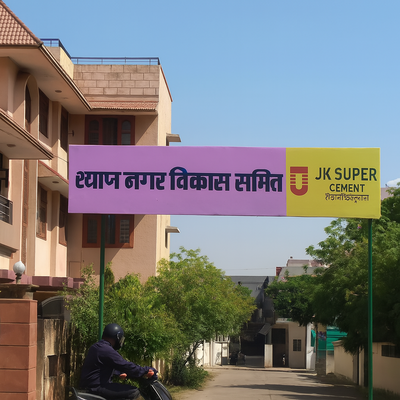
At its core, RWA society gate advertising involves placing branded display materials — flex boards, backlit panels, gate arch branding, or digital LED screens — on the entrance gates of residential welfare association colonies, gated communities, cooperative housing societies, and apartment complexes across Indian cities. The residential welfare association, or RWA, is the governing body of the colony or housing complex, and it is this body that grants permission for the advertising installation, typically in exchange for a nominal fee or a maintenance contribution that benefits the community directly. This structure is what makes the medium fundamentally different from conventional OOH advertising: the community itself becomes a stakeholder in the campaign, which tends to generate goodwill rather than resistance among residents.
The mechanics of execution are straightforward, though the planning behind a well-targeted campaign is considerably more nuanced. An agency identifies societies that match the brand's target demographic — income level, family profile, age group, vehicle ownership, and so on — then negotiates directly with the RWA committee for installation rights, arranges for fabrication and mounting of the creative material, and monitors the display throughout the campaign duration. At SmartAds, we have found that the selection methodology is where most brands either win or lose the ROI argument; a campaign placed in 200 carefully chosen societies in Delhi NCR will consistently outperform a scatter-shot placement across 500 societies where the demographic fit is poor.
Why Is Society Gate Branding One of India's Most Cost-Effective BTL Channels?
Frankly speaking, the cost argument for society gate branding becomes almost uncomfortable once you run the numbers against other formats. A single housing society gate in a mid-to-large residential complex in a city like Gurgaon or Pune will see somewhere between 800 and 2,500 vehicle and pedestrian movements per day, which — when multiplied across a 30-day campaign and a network of 50 gates — produces an impression volume that would cost several times more to achieve through digital display or even radio in the same geography. The CPM for a well-executed RWA gate advertising campaign works out to roughly ₹15 to ₹40 depending on the city and the quality of the society, which is a number that surprises most brand managers when they compare it to what they are paying for programmatic display inventory in the same metro markets.
The real value, though, is not just in the raw impression count — it is in the quality and repetition of those impressions. Residents of a gated community pass their entrance gate at least twice a day, every single day, which means that a 30-day campaign generates somewhere in the ballpark of 60 exposures per resident household rather than the single fleeting exposure that a highway billboard or a social media scroll delivers. This repeat exposure dynamic is what drives brand recall numbers that are disproportionately high relative to the media spend; we have seen brand recall scores from post-campaign surveys in the range of 68 to 74 percent for well-executed RWA branding campaigns, which is a figure that most digital campaigns struggle to match at comparable budgets. The high dwell time at entry gates — residents wait for security checks, for gates to open, for taxis to arrive — adds another layer of engagement that passive formats simply cannot replicate.
On top of that, the hyperlocal marketing precision of this channel is genuinely difficult to match through any other medium at a similar price point. A real estate developer launching a project in Sector 62, Noida, can target residents of societies within a 3-kilometre radius who are statistically likely to be in the market for an upgrade; an FMCG brand launching a new product in Bangalore can select societies in Whitefield and Sarjapur Road where the income and lifestyle profile aligns with the product's positioning. At SmartAds, we always tell our clients that below the line marketing works best when the targeting is surgical rather than broad, and residential society advertising gives you that surgical precision at a cost that mass media formats cannot approach.
What Ad Formats Are Available for RWA Gate Branding in India?
The format landscape for RWA gate branding has evolved considerably over the past five years, and the options available today go well beyond the simple flex board that most people picture when they hear "colony gate advertising." The most widely used format remains the rectangular display board — a flex or vinyl print mounted on a metal frame attached to the gate structure — which is cost-effective, easy to replace when creatives need updating, and visible from both approaching and departing angles. These boards typically range in size from 4 feet by 3 feet for smaller colony gates up to 10 feet by 4 feet for larger apartment complex entrances, and the entry gate flex board format remains the workhorse of the medium because of its simplicity and low production cost.
Gate arch branding is the premium end of the static format spectrum; it involves wrapping or panelling the entire arch structure of a society gate with branded creative material, which creates an immersive brand environment that residents literally drive or walk through every day. This format commands a higher rate and requires more elaborate fabrication, but the brand visibility impact is substantially greater — particularly for launches, seasonal campaigns, or categories like real estate and automotive where creating a strong visual impression matters. Backlit display boards are another step up from standard flex, offering visibility during evening and night hours which is when a significant proportion of residents return home; for categories like food delivery, healthcare brand promotion, or financial services, this after-dark visibility can be the difference between a campaign that works and one that merely exists.
The most interesting development in recent years has been the emergence of digital LED screen RWA gate advertising, where a small-to-medium LED panel is installed at the gate and multiple brands share rotating display slots — a format that functions somewhat like a digital OOH screen but within the captive, high-frequency environment of a residential community. This format is still in relatively early adoption across Indian cities, with the strongest inventory currently concentrated in premium societies in Delhi NCR, Mumbai, Bangalore, and Hyderabad, but it is growing quickly. Beyond gate structures themselves, the broader RWA activation toolkit includes canopy activation and product sampling events within society premises, kiosk advertising in common areas, lift advertising in high-rise towers, and notice board placements — all of which can be layered with entrance gate branding to create a full society activation campaign that reaches residents at multiple touchpoints within their daily environment.
How Is RWA Society Gate Advertising Different from Traditional OOH Hoardings and Billboards?
The comparison between RWA society gate advertising and traditional OOH hoardings is one that comes up in almost every media planning conversation we have, and the honest answer is that they are solving for different problems — which means the question of which is "better" is less useful than understanding which is right for a given campaign objective. A highway billboard in Delhi NCR might reach 150,000 to 200,000 impressions per day across a broad and largely undefined audience; an RWA gate advertising network of 100 societies in the same city might reach 80,000 to 120,000 daily impressions, but those impressions are concentrated among a demographic that has been selected specifically for the brand's target profile.
The frequency differential is where the argument for RWA branding becomes most compelling. Outdoor advertising India research consistently shows that a commuter passes a highway hoarding an average of two to four times per week if it is on their regular route; a resident of a gated community passes their society gate an average of two times per day, every day of the campaign. Over a 30-day campaign duration, that works out to roughly 60 gate-level exposures versus perhaps 12 to 16 billboard exposures for the same individual — a frequency advantage of approximately four to five times, which has a direct and measurable impact on brand recall. We have seen this play out in campaigns where a brand ran parallel OOH advertising and RWA gate branding with the same creative, and the post-campaign recall scores from the RWA-exposed group were consistently 25 to 35 percentage points higher.
The cost structure is also fundamentally different in ways that matter for budget allocation decisions. Traditional OOH advertising in premium locations — a Bandra-Kurla Complex hoarding in Mumbai, or a Connaught Place site in Delhi — can cost anywhere from several lakhs to over a crore per month for a single site, which makes it accessible only to brands with substantial outdoor advertising India budgets. RWA gate advertising, by contrast, is priced per gate per month at rates that allow even mid-sized brands and regional players to build meaningful reach networks across dozens or hundreds of locations. The rwa advertising vs billboard advertising India comparison ultimately comes down to scale versus precision: if you need mass awareness across a city's entire driving population, billboards serve that purpose; if you need to reach a specific income and lifestyle segment within defined residential geographies, RWA colony gate advertising delivers that targeting at a fraction of the cost.
What Does RWA Society Gate Advertising Cost in India?
This is the question that most agencies dance around, and frankly speaking, the reluctance to publish indicative pricing is one of the more frustrating aspects of the non-traditional advertising industry in India. We believe in transparency, so here is what the market actually looks like based on our experience executing campaigns across hundreds of cities.
In Tier 1 metros, the cost of RWA gate advertising per society per month works out to somewhere between ₹1,500 and ₹5,000 for a standard rectangular display board, depending on the size of the society, the quality and location of the gate, and whether the site includes a backlit or illuminated panel. Premium apartment gate advertising in high-income societies in areas like South Delhi, Bandra, Koramangala in Bangalore, or Banjara Hills in Hyderabad can push toward the upper end of that range or slightly beyond; smaller colony gate advertising in mid-income residential areas will typically come in at the lower end. Gate arch branding, which involves more fabrication and a larger creative footprint, is priced higher — typically in the ballpark of ₹4,000 to ₹12,000 per gate per month in metro markets, depending on the arch dimensions and the society's profile. Digital LED screen slots at premium RWA gates in metros are priced differently, usually on a per-week per-slot basis, with rates somewhere between ₹3,000 and ₹8,000 per week for a 10-second rotating slot.
In Tier 2 cities — Lucknow, Jaipur, Chandigarh, Coimbatore, Nagpur, Indore, and similar markets — the advertising cost per society gate per month is considerably lower, typically in the range of ₹800 to ₹2,500 for standard formats, which makes large-scale hyperlocal marketing campaigns genuinely affordable for regional brands and national brands with city-specific activation budgets. Tier 3 cities and smaller markets are even more cost-efficient, and we have executed campaigns in these markets at rates as low as ₹400 to ₹800 per gate per month, which produces a CPM that is almost impossibly low by any other media standard. Production costs — fabrication of flex boards, printing, and installation — are typically charged separately and work out to roughly ₹150 to ₹400 per board depending on size and material quality; for campaigns across large gate networks, these production costs can be negotiated down significantly when consolidated through a single agency. At SmartAds, we manage production, logistics, and installation as part of our end-to-end service, which eliminates the coordination overhead that brands face when trying to execute multi-city RWA branding campaigns through multiple local vendors.
Which Indian Cities Offer the Best RWA Gate Advertising Inventory?
Delhi NCR is, without question, the largest and most developed market for RWA society gate advertising in India, which is partly a function of the city's urban structure — Delhi's residential geography is dominated by planned colonies and cooperative housing societies, each with a formal RWA structure and a gate that serves as the primary entry point for thousands of daily movements. The inventory in Delhi NCR spans everything from the premium Defence Colony and Greater Kailash societies in South Delhi to the massive apartment complexes of Noida and Gurgaon, where high-rise towers with 500 to 1,500 families per complex create extraordinary concentration of impressions per gate. Society gate branding Delhi NCR is consequently the most competitive market, with the highest rates but also the highest quality demographic targeting available anywhere in the country.
Mumbai is the second-largest market, though its residential structure — a mix of chawls, cooperative housing societies, and newer gated communities — means that the RWA gate advertising inventory is more concentrated in specific geographies: the western suburbs from Andheri to Borivali, the new developments in Navi Mumbai and Thane, and the premium societies in South Mumbai and Bandra. Bangalore's inventory is heavily concentrated in the tech corridor — Whitefield, Electronic City, Sarjapur Road, and Hebbal — where large apartment complexes housing IT professionals represent some of the most valuable demographic targeting available in the country for categories like financial services, consumer electronics, and healthcare brand promotion. Hyderabad, Pune, and Chennai round out the Tier 1 market, each with strong inventory in their respective tech and professional residential corridors.
What a lot of brands miss is the extraordinary opportunity in Tier 2 cities India, where the combination of lower rates, less competitive inventory, and rapidly growing middle-class residential communities creates a compelling case for brands that are expanding their distribution or building awareness in emerging markets. Cities like Lucknow, Jaipur, Bhopal, Surat, Vadodara, Kochi, and Coimbatore have seen significant growth in planned residential societies over the past decade, and the RWA structures in these cities are well-organised and receptive to advertising partnerships. We have executed PAN India advertising campaigns for FMCG clients that deliberately over-indexed on Tier 2 and Tier 3 city RWA networks because the cost-per-impression advantage was so significant that it allowed them to build frequency in markets where their distribution was growing, at a fraction of what a comparable metro campaign would cost.
Which Industries Benefit Most from RWA Gate Advertising Campaigns?
The honest answer is that almost any brand targeting urban Indian households can find a use case for RWA society gate advertising, but there are categories where the fit is so natural that we are sometimes surprised when we see brands in those categories not using it. FMCG advertising India is perhaps the most obvious fit — products consumed daily by households, targeting the decision-maker who passes the gate twice a day, with a message that can be kept simple and visual enough to communicate in a three-second exposure. We have run campaigns for packaged food brands, personal care companies, and household cleaning products where the RWA gate branding served as a high-frequency reminder medium layered on top of television and digital campaigns, and the incremental brand recall lift from the gate network was measurable and significant.
Real estate advertising India has been one of the heaviest users of this medium for years, and the logic is almost self-evident: someone living in a society in Noida who passes a gate board advertising a new project in Sector 150 is already a qualified prospect by virtue of their residential geography and the fact that they are already a society resident. Healthcare brand promotion is another strong category — hospitals, diagnostic chains, pharmaceutical brands, and health insurance companies have all found that the residential society environment creates a receptive context for health messaging, particularly for categories like preventive care, nutrition, and chronic condition management where the target audience is household decision-makers. Financial services and BFSI brands — mutual funds, insurance companies, digital payment platforms — have increasingly used RWA branding as part of their hyperlocal marketing strategy, particularly for campaigns targeting specific income segments in defined residential geographies.
Education brands, EdTech platforms, consumer electronics, automobile service centres, food delivery platforms, and local retail chains are all categories where we have seen strong campaign performance from society gate branding. To be fair, there are categories where the format is less effective — luxury brands targeting very small audience segments, B2B products with no household relevance, or categories where the creative complexity required cannot be communicated on a static board. But for any brand whose target audience is "urban Indian households with defined income and lifestyle characteristics," RWA colony gate advertising deserves a serious allocation in the media plan.
How Long Should an RWA Gate Advertising Campaign Run, and Do You Need Permissions?
Campaign duration is one of the most frequently misunderstood aspects of RWA gate advertising, and most brands either under-invest in duration or structure their campaigns around arbitrary calendar periods rather than the actual mechanics of how frequency builds in this medium. Our experience shows that a minimum of 30 days is necessary to generate meaningful brand recall, because the frequency curve for a residential society gate — where the same residents see the board daily — builds most steeply in the first two weeks and then plateaus; a campaign shorter than 30 days often terminates just as the frequency is reaching the threshold where brand recall begins to crystallise. For product launches, seasonal campaigns, and brand activation objectives, we typically recommend a campaign duration of 45 to 90 days, which allows enough time for the initial awareness phase, a mid-campaign frequency peak, and a tail period that captures residents whose consideration cycle is longer.
Festive campaigns — Diwali, Navratri, the summer season for categories like air conditioners and beverages — benefit from campaigns that start two to three weeks before the peak period and run through it, which means a campaign duration of 30 to 45 days typically captures the full intent window. We have found that brands which start their RWA gate branding campaigns too close to the festive peak often find that the best society inventory has already been booked, which is a real operational consideration that media planners need to account for when planning seasonal campaigns.
On the question of permissions: yes, permissions are required, and the process is more structured than many brands assume. The primary permission comes from the RWA committee itself, which has the authority to approve or reject advertising installations on the society's gate structures. In most cities, this is the only permission required for standard gate boards, because the gate structure is on private society land rather than public right-of-way. However, in certain situations — particularly for gate arch branding that extends over a public road or footpath, or for installations that involve structural modifications to a gate that abuts a municipal road — permissions from the relevant municipal authority may be required. In Delhi, this would involve MCD (Municipal Corporation of Delhi); in Mumbai, MCGM (Municipal Corporation of Greater Mumbai); in Bangalore, BBMP (Bruhat Bengaluru Mahanagara Palike). At SmartAds, we handle all permission documentation as part of our campaign execution process, which includes maintaining records of RWA committee approvals for every site in a campaign — a step that many smaller operators skip and which can create serious problems if a campaign is challenged.
How Do Brands Measure ROI from RWA Society Gate Campaigns?
Measurement has historically been the weakest link in the RWA gate advertising value proposition, and frankly speaking, the industry's reluctance to invest in proper verification and tracking has cost this medium credibility with data-driven brand managers who are used to the impression dashboards and click-through reports that digital advertising provides. The good news is that this is changing, and the measurement toolkit available for RWA branding campaigns today is considerably more robust than it was even three years ago.
The foundation of campaign monitoring is photo proof documentation — geo-tagged photographs taken at each installation site, timestamped and location-verified, which confirm that the creative was installed correctly and is being displayed as contracted. This sounds basic, but we have seen campaigns executed by less rigorous operators where boards were installed incorrectly, in suboptimal positions, or not at all in some locations — and without systematic photo documentation, the brand has no recourse. At SmartAds, we provide geo-tagged installation photos for every site within 48 hours of installation, and we conduct mid-campaign and end-of-campaign verification visits for campaigns above a certain scale. Beyond installation verification, impression estimation is based on society-level footfall data — the number of households, the average daily entry-exit movements per household, and the gate's pedestrian and vehicle traffic — which allows us to build a reasonably accurate daily impressions estimate for each site and aggregate this across the campaign network.
More sophisticated measurement approaches are emerging, including QR code integration on gate boards — where a QR code on the creative allows interested residents to scan and engage, providing a direct digital signal from the physical board — and MyGate app integration, where brands can reach verified residents of specific societies through the app's advertising inventory in parallel with their physical gate branding, creating a digital-physical hybrid campaign that generates both impression data and engagement metrics. Return on investment ROI measurement for RWA gate campaigns ultimately comes down to the campaign objective: for brand awareness objectives, pre-post brand recall surveys among residents of targeted versus non-targeted societies provide clean measurement; for performance objectives like footfall, lead generation, or product trial, QR codes, unique promo codes, and on-ground activation data provide more direct attribution. One FMCG client we worked with ran a product sampling campaign alongside their RWA gate branding in Pune, distributing trial packs at canopy activation events within the same societies where the gate boards were running; the combination of physical sampling and gate-level brand visibility produced a trial-to-repeat-purchase rate that was roughly 2.3 times higher than their standalone sampling campaigns in retail environments.
Three SmartAds Campaign Case Studies: What the Numbers Actually Look Like
A retail client in Pune — a regional supermarket chain expanding into three new neighbourhoods — came to us with a budget of roughly ₹8 lakhs for a 45-day campaign to drive awareness and footfall to their new stores. We identified 120 societies within a 2-kilometre radius of each new store location, selected based on household income profiling and proximity, and placed rectangular display boards with a simple "Now Open Near You" creative at each gate. The campaign generated an estimated 4.2 lakh daily impressions across the network, and the client reported a 34 percent higher footfall in the new stores compared to their previous store launches in comparable neighbourhoods — a result they attributed directly to the gate-level brand visibility creating top-of-mind awareness among the precise residential catchment they were targeting.
An automotive service brand in Gurgaon — a multi-brand car service chain — used RWA gate branding as their primary awareness medium for a new service centre launch, placing gate arch branding on 60 premium society gates in a 5-kilometre radius. The campaign ran for 60 days, cost approximately ₹5.5 lakhs including fabrication, and generated a verified 18,000 unique household impressions per day. The brand tracked inbound calls and walk-in enquiries using a dedicated phone number printed on the gate creative, and received 340 enquiry calls over the campaign period — a cost-per-lead of roughly ₹1,600, which compared favourably against their Google Ads cost-per-lead of approximately ₹2,400 for the same geography during the same period.
A healthcare brand promotion campaign for a diagnostic chain in Bangalore is perhaps our most instructive case study in terms of demographic targeting precision. The client wanted to reach households with members above 40 years of age in mid-to-high income residential societies in Koramangala and Indiranagar, for a preventive health checkup package promotion. We selected 85 societies based on a combination of average apartment size (as a proxy for income), building age (older societies tend to have older resident profiles), and proximity to the client's diagnostic centres. The 30-day campaign cost approximately ₹3.2 lakhs, and the client tracked package bookings using a unique promo code featured on the gate creative; 210 packages were booked using the code over the campaign period, producing a direct revenue return of approximately ₹18.9 lakhs against the media spend — a return on investment ROI multiple that the client's marketing team described as "the best we have seen from any offline channel in the past three years."
How to Choose the Right RWA Gate Advertising Agency in India?
The market for society gate advertising agency services in India has grown considerably, and the range of operators — from national agencies with PAN India advertising networks to local fixers who manage a few hundred societies in a single city — is wide enough that choosing the right partner is a genuinely important decision. The first thing we tell brands is to ask for a verified society database rather than a claimed one: any credible society gate advertising agency India should be able to show you a database of their empanelled societies with addresses, society names, approximate household counts, and RWA contact details — not just a number like "we cover 10,000 societies across India."
Transparency in pricing, verification processes, and permission documentation is the second filter. An agency that cannot show you sample geo-tagged installation photos from past campaigns, or that is vague about how they handle RWA committee permissions, is an agency that is likely cutting corners somewhere in the execution chain — and those corners tend to show up as campaigns that are partially installed, poorly maintained, or taken down early because the RWA permission was not properly documented. The best rwa branding company India for your campaign is the one that treats verification and documentation as a standard part of the service, not as an add-on that costs extra.
Geographic reach and city-level inventory depth matter enormously for brands planning multi-city or PAN India advertising campaigns. An agency that is strong in Delhi NCR but thin in Tier 2 cities will produce an uneven campaign where the quality of execution varies dramatically by market; for brands that need consistent execution across 20 or 30 cities simultaneously, working with a single agency that has verified inventory and local execution teams in all those markets is far more efficient than managing a patchwork of city-level vendors. At SmartAds, our network spans 500+ Indian cities with verified RWA inventory, which means we can execute a campaign in Lucknow, Coimbatore, and Bhopal with the same documentation standards and campaign monitoring rigour that we apply in Delhi NCR and Mumbai — and that consistency is what makes multi-city RWA branding campaigns actually deliver on their reach promises.
FAQ: Everything You Need to Know About RWA Society Gate Advertising
Q: What is RWA society gate advertising and how does it work in India?
RWA society gate advertising is a form of BTL advertising in which branded display materials are placed on the entrance gates of residential welfare association colonies, gated communities, cooperative housing societies, and apartment complexes. The process involves identifying target societies based on demographic and geographic criteria, negotiating placement rights with the RWA committee, fabricating and installing the creative material on the gate structure, and monitoring the display throughout the campaign period. The residential welfare association grants permission for the installation — typically in exchange for a nominal fee that contributes to the society's maintenance fund — and the brand benefits from daily, high-frequency exposure to a defined residential audience. This channel is classified as below the line marketing and non-traditional advertising because it operates outside the conventional mass media formats of television, radio, print, and standard OOH hoardings.
Q: How much does society gate advertising cost in cities like Delhi, Mumbai, and Bangalore?
Indicative rates for a standard rectangular display board at a society gate work out to somewhere between ₹1,500 and ₹5,000 per gate per month in Tier 1 metros, with premium societies in high-income areas of Delhi NCR, Mumbai, and Bangalore tending toward the upper end of that range. Gate arch branding, which involves more elaborate fabrication and a larger creative footprint, is priced in the ballpark of ₹4,000 to ₹12,000 per gate per month in metro markets. Production and installation costs are typically charged separately, working out to roughly ₹150 to ₹400 per board. The rwa gate advertising cost per month India varies significantly based on society profile, gate size, format type, and city tier; campaigns in Tier 2 cities are considerably more cost-efficient, with per-gate rates typically 40 to 60 percent lower than metro equivalents.
Q: What is the minimum campaign duration for RWA gate branding in India?
Most agencies, including SmartAds, set a minimum campaign duration of 30 days for RWA gate branding, and this is not an arbitrary commercial minimum — it reflects the frequency mechanics of the medium. Residents need repeated exposure over several weeks before brand recall begins to crystallise meaningfully, and campaigns shorter than 30 days typically terminate before the frequency curve reaches that threshold. For product launches and brand activation objectives, 45 to 90 days is the recommended range; for festive or seasonal campaigns, a 30 to 45-day window that encompasses the peak period and the run-up to it tends to deliver the best results.
Q: Is RWA gate advertising legal and do I need permissions from the local municipal corporation?
RWA society gate advertising is legal when executed with proper permissions, and the permission structure has two layers. The primary and most important permission comes from the RWA committee, which has authority over the society's gate structures; without a documented RWA committee approval, any installation is technically unauthorised and can be removed. For gate boards installed entirely on private society land, municipal corporation permission is generally not required. However, for gate arch branding or structures that extend over a public road or footpath, permissions from the relevant municipal body — MCD in Delhi, MCGM in Mumbai, BBMP in Bangalore — may be required depending on the specific site configuration. A reputable agency will handle all permission documentation and maintain records of RWA approvals for every site in the campaign.
Q: How is RWA society gate advertising different from traditional OOH hoardings and billboards?
The core differences lie in audience targeting precision, impression frequency, and cost structure. Traditional OOH advertising reaches a broad, largely undifferentiated audience of commuters and passersby, with each individual typically exposed to the billboard two to four times per week at most. RWA gate advertising reaches a defined residential audience that passes the same gate an average of twice daily, generating roughly 60 exposures per resident over a 30-day campaign — a frequency advantage of four to five times over conventional outdoor advertising India formats. The advertising cost per thousand impressions (CPM) for RWA gate advertising is typically lower than for premium OOH sites, and the demographic targeting precision — selecting societies based on income, lifestyle, and geographic proximity to a point of sale — is a capability that standard billboard networks cannot match.
Q: Which industries benefit the most from RWA gate advertising campaigns?
FMCG advertising India, real estate advertising India, healthcare brand promotion, financial services and BFSI, education and EdTech, consumer electronics, food and beverage, automobile services, and local retail are the categories that consistently generate the strongest campaign performance from RWA gate branding. The common thread is that all of these categories are targeting urban household decision-makers — the person who buys the groceries, chooses the health insurance plan, decides which school the children attend, or selects the car service centre — and the residential society environment puts the brand message directly in front of that decision-maker in a context where they are relaxed, present, and receptive.
Q: How many impressions or eyeballs does a single society gate ad generate per day?
Daily impressions from a single society gate depend on the size of the residential community and the gate's traffic volume, but a reasonable estimate for a mid-sized society of 200 to 400 households works out to somewhere between 800 and 2,000 daily impressions, accounting for residents, visitors, delivery personnel, and service staff. Larger apartment complexes with 500 to 1,500 families — common in Noida, Gurgaon, and the newer residential developments in Bangalore and Hyderabad — can generate 3,000 to 6,000 daily impressions per gate. These are gross impression figures; the net reach of unique individuals is lower, but the high frequency per individual is precisely what makes this medium effective for brand recall objectives.
Q: Can I change the ad creative while my RWA gate campaign is live?
Yes, creative changes are possible during a live campaign, though they involve a production and installation cost for the replacement boards and typically require a minimum lead time of five to seven working days for fabrication and logistics. Most agencies, including SmartAds, allow one creative change per campaign period as part of the standard service agreement; additional changes are charged at the production cost rate. For campaigns using digital LED screen formats, creative changes can be made remotely and almost instantaneously, which is one of the significant operational advantages of the digital format over static boards.
Q: What ad formats are available for society gate branding — static, backlit, or digital?
The format options for RWA gate branding include standard rectangular display boards (flex or vinyl print on metal frame), backlit illuminated panels for night visibility, gate arch branding (full creative wrap of the gate arch structure), digital LED screen slots at equipped gates, entry gate flex boards, and display board advertising on gate pillars and side panels. Beyond the gate structure itself, the broader society activation toolkit includes canopy activation and product sampling events, kiosk advertising in common areas, lift advertising in residential towers, and notice board placements — all of which can be combined with gate branding for a multi-touchpoint RWA activation campaign.
Q: How do I get proof that my RWA gate advertisement was installed and displayed correctly?
Geo-tagged installation photographs — timestamped images showing the installed creative at the specific gate location, with GPS coordinates embedded in the metadata — are the standard verification method and should be provided by any credible agency within 48 hours of installation. Mid-campaign and end-of-campaign verification visits with additional photo documentation are best practice for larger campaigns. For campaigns using QR codes on the gate creative, scan data provides an additional layer of engagement verification. At SmartAds, photo proof documentation is a standard deliverable for every campaign, and we maintain a centralised campaign monitoring system that tracks installation status, creative condition, and
