


Delhi

Mumbai

Bengluru

Ahmedabad

Jaipur

Chennai

Hydrabad

Kolkatta

Lucknow

Pune
IRCTC Catering Advertising: The Pan India BTL Branding Channel That Puts Your Brand in Every Train Passenger's Hands
Indian Railways moves somewhere in the ballpark of 23 million passengers every single day — and a significant share of those passengers, particularly on long-distance trains, will hold your brand in their hands, read it at eye level, and sit with it for hours. That is not a metaphor. That is what happens when you print your logo on a paper cup, a tray mat, or a paper napkin served through IRCTC catering. What surprises most brand managers when they first encounter this channel is not just the scale; it is the intimacy of the contact — a captive audience with nowhere else to go, no scroll button to press, no ad blocker to deploy.
What Is IRCTC Catering Advertising and How Does It Work?
Most people think of Indian Railways advertising and immediately picture station hoardings or platform banners — the kind of high-traffic advertising you see and forget in thirty seconds. IRCTC catering advertising is a fundamentally different animal. It operates through the Indian Railway Catering and Tourism Corporation, which is the public sector undertaking responsible for food and beverage services across the Indian Railways network, and it places your brand on the consumable and disposable items that passengers physically interact with during their journey. We are talking about paper cups, paper napkins, tray mats, paper tea kits, carry bags, and even the uniforms worn by catering staff — all of which can carry your brand's visual identity.
The mechanism is straightforward, though the logistics behind it are more nuanced than most agencies will tell you. IRCTC-authorised vendors manufacture catering consumables in bulk; these items are co-branded with the advertiser's artwork during the production process, and then distributed through the pantry car and e-catering systems on eligible trains. Because the Ministry of Railways governs what appears on IRCTC-branded materials, the advertising process involves working through approved channels — which is where an experienced advertising agency with established IRCTC vendor relationships becomes genuinely important, not just a convenience.
At SmartAds, we always tell our clients that this is one of the few below-the-line advertising formats in India where the distribution infrastructure is already built and running at national scale. You are not paying to create a new touchpoint; you are riding an existing, government-operated delivery system that reaches trains running from Delhi to Chennai, Mumbai to Kolkata, and every tier 2 city corridor in between. The brand visibility you get is not incidental — it is baked into the service itself.
What Are the Different IRCTC Catering Advertising Formats Available?
The range of formats under IRCTC catering advertising is wider than most media planners initially expect, and each format offers a different kind of brand interaction — which means the right choice depends heavily on your campaign objective rather than just your budget.
Paper cup advertising is probably the most recognised format in this space; a printed paper cup carrying your brand is served with tea or coffee, which means the passenger holds it for several minutes, reads it at close range, and often places it on the tray table where others in the same compartment can see it. The typical paper cup used in IRCTC catering has a print area of roughly 200 to 250 square centimetres on the outer sleeve, which is a surprisingly generous canvas for a brand message, a QR code, or a product visual. Paper napkin advertising works similarly — your brand is printed on the napkin that accompanies every meal served in the pantry car and through e-catering orders, and the tactile nature of the interaction creates a different quality of brand recall compared to a hoarding seen from a moving vehicle.
Flask branding is a format that tends to perform particularly well for premium brands; the insulated flasks used by IRCTC catering staff to serve hot beverages carry your artwork and are seen repeatedly throughout the journey as staff move through the coaches. Paper tea kit advertising takes this a step further by branding the entire packaged tea kit — the envelope, the sugar sachet, and sometimes the stirrer — which creates a multi-touch brand experience within a single service interaction. Tray mat advertising is placed directly under the food tray during meal service on trains like Rajdhani Express and Shatabdi Express, which means it sits in the passenger's direct line of sight for the entire duration of the meal; we have found this format delivers unusually high brand recall scores in post-campaign surveys, particularly for FMCG and personal care brands.
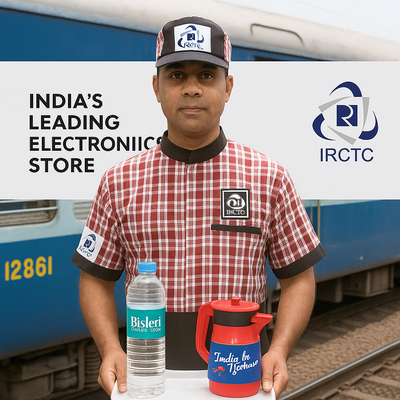
Staff uniform advertising is the format that consistently surprises clients — catering staff uniforms can carry your brand patch or logo, which effectively turns every IRCTC catering employee into a walking brand ambassador for the duration of their shift. Paper carry bag advertising covers the bags used for packed meals and e-catering deliveries; these are particularly valuable because they travel beyond the train itself, often carried by passengers into stations, taxis, and homes. And then there is product sampling via food bag insertion, which is arguably the most powerful format of all — your actual product sample, whether it is a sachet, a trial pack, or a small unit, is physically inserted into the food bag delivered to the passenger, which transforms a passive impression into an active product trial.
How Much Does IRCTC Catering Advertising Cost in India?
Frankly speaking, this is the question where most competitor pages either go vague or go silent — and that is frustrating for any media planner trying to build a budget proposal. We will be as specific as the market allows, with the caveat that rates fluctuate based on train category, zone, season, and minimum quantity commitments.
For paper cup advertising, the cost works out to somewhere between ₹1.50 and ₹3.50 per unit including printing and distribution, which means a campaign of one lakh cups — a reasonable starting point for a national brand — comes in at a total investment in the ballpark of ₹1.5 lakh to ₹3.5 lakh. When you calculate the CPM on that, it works out to roughly ₹15 to ₹35 per thousand impressions, which is a number that surprises most first-time advertisers when they compare it to what they are paying for Instagram reach or even regional newspaper advertising. Paper napkin advertising runs at a broadly similar per-unit cost, though the print area is smaller and the interaction duration is shorter.
Tray mat advertising tends to cost more on a per-unit basis — somewhere in the range of ₹4 to ₹8 per mat — but the extended dwell time during meal service on premium trains like Rajdhani Express and Vande Bharat Express justifies the premium. Staff uniform advertising is typically priced on a per-train per-month basis rather than per unit, and the investment can range from a few thousand rupees per train to significantly more depending on the number of staff and the train category. Product sampling via food bag insertion carries the highest per-unit cost because you are supplying the actual product sample in addition to the distribution fee, but the return on investment calculation changes entirely when you factor in the conversion rates that direct product trial generates — which is something we have seen validated repeatedly across FMCG campaigns we have executed.
Why Is IRCTC Catering One of the Best BTL Advertising Channels in India?
The honest answer is that very few below-the-line advertising channels in India can offer a genuinely captive audience at this scale and at this cost. A passenger on a Duronto Express from Mumbai to Delhi is in that train for sixteen to eighteen hours; they will eat multiple meals, drink multiple cups of tea, and interact with IRCTC catering items several times over the course of that journey. That is not a fleeting exposure — it is sustained, repeated brand contact in an environment where the passenger has limited distractions and a natural tendency to read whatever is in front of them.
The non-traditional advertising dimension of this channel is also worth emphasising for clients who are tired of the clutter in conventional media. Television advertising, for all its reach, is increasingly fragmented across hundreds of channels; outdoor advertising in major metros is so dense that individual brands struggle to stand out. IRCTC catering advertising, by contrast, operates in a space where brand visibility is essentially uncontested — your paper cup is the only paper cup on that tray, your tray mat is the only thing between the passenger's meal and the table. That exclusivity is rare in any advertising medium, and it is something we consistently highlight when advising clients on their below-the-line campaign mix.
On top of that, the demographic profile of IRCTC train passengers — particularly on premium trains — skews toward working professionals, business travellers, and middle-to-upper-income families, which is precisely the audience that FMCG, BFSI, pharma, and personal care brands are trying to reach. The Dentsu e4m India Advertising Report has consistently flagged transit advertising as an underutilised channel relative to its actual reach and engagement metrics, and our experience at SmartAds bears that out in campaign after campaign.
How Many Passengers Can Your Brand Reach Through IRCTC Catering Advertising Pan India?
The scale numbers here are genuinely staggering, and they rarely get communicated properly in the standard media plan. Indian Railways, operated under the Ministry of Railways, runs over 13,000 trains daily across its network; of these, IRCTC catering services cover the premium and long-distance categories — Rajdhani Express, Shatabdi Express, Vande Bharat Express, Duronto Express, and a large number of Mail and Express trains — which together carry several crore passengers every month. A pan India IRCTC catering advertising campaign running across multiple train categories can realistically generate impressions in the range of several crore per month, depending on the format and the number of trains covered.
What makes the reach calculation particularly interesting is the geographic spread. A single campaign running on trains departing from Delhi can reach passengers in Patna, Lucknow, Jaipur, Ahmedabad, and Mumbai within the same week — which means IRCTC catering advertising functions as a pan India campaign by default, not by additional investment. For brands trying to build brand awareness in tier 2 cities and smaller markets, this is a significant advantage; the trains passing through Nagpur, Bhopal, Vadodara, and Coimbatore carry the same IRCTC catering items as the trains running between major metros.
We worked with a pharma client — a mid-sized OTC brand based in Ahmedabad — who had been spending the bulk of their below-the-line budget on chemist shop displays and in-clinic advertising. When we shifted a portion of that budget to IRCTC catering advertising across Western Railway and Central Railway routes, the brand's recall scores in a follow-up survey showed a measurable uplift in markets like Surat, Vadodara, and Nagpur, which were cities they had never specifically targeted before. The reach passengers get on long-distance trains simply does not respect the city-by-city targeting logic that most brand managers are used to thinking in.
What Is the Minimum Quantity Required to Book IRCTC Catering Ads?
This is one of the most practical questions any media planner will ask, and the answer is more accessible than most people expect. For paper cup advertising, the minimum quantity typically starts at around 50,000 units, which sounds large until you realise that this quantity can be distributed across multiple trains over a period of two to four weeks — making it a viable entry point even for brands with modest below-the-line budgets. Paper napkin advertising has broadly similar minimum quantity thresholds, while tray mat advertising may require a slightly higher minimum commitment given the production costs involved.
Product sampling via food bag insertion has a different minimum quantity logic because the cost structure includes the product itself; most IRCTC-authorised vendors will require a minimum of 25,000 to 50,000 samples for a pilot campaign, which is actually a very reasonable number for any FMCG or personal care brand that is serious about product trial. Staff uniform advertising, being a time-based format rather than a unit-based one, is typically booked on a minimum of one month per train, which keeps the entry threshold low for brands that want to test the format before scaling.
At SmartAds, we often recommend that new advertisers to this channel start with a pilot campaign on two or three specific train routes — say, the Delhi-Mumbai Rajdhani Express and one or two Shatabdi Express services — before committing to a pan India rollout. This approach lets you validate the format, test your creative, and gather initial brand recall data before you scale the investment; it is the kind of campaign planning discipline that saves clients from expensive mistakes, and it is something we build into every IRCTC catering advertising proposal we put together.
How Do I Book an IRCTC Catering Advertising Campaign Pan India?
The booking process for IRCTC catering advertising is not as simple as placing a digital ad through a self-serve platform, and that is worth understanding clearly before you start. Because IRCTC is a public sector undertaking operating under the Ministry of Railways, all advertising on its catering materials must go through IRCTC-authorised vendors and approved processes; working directly without the right vendor relationships can result in delays, rejections, or — worse — non-compliant materials that get pulled before distribution.
The practical steps involve identifying the right vendor empanelled with IRCTC for the specific format you want to run, submitting your artwork for approval against IRCTC's brand and content guidelines, confirming the train categories and routes, agreeing on quantities and distribution timelines, and then managing the production and logistics chain to ensure materials reach the pantry car in time for the scheduled runs. Each of these steps has its own lead time; artwork approval alone can take one to two weeks, and production lead times for printed consumables typically add another two to three weeks on top of that. A campaign that a brand manager thinks can go live in two weeks will realistically need five to six weeks from briefing to first distribution.
This is where an experienced advertising agency with established IRCTC vendor relationships makes a material difference to campaign outcomes, not just convenience. SmartAds has been executing IRCTC catering advertising campaigns across multiple zones — Northern Railway, Western Railway, Southern Railway, and Central Railway — and the vendor network and process knowledge we have built means our clients' campaigns go live faster, with fewer revision cycles, and with better distribution accountability than if they were trying to navigate the process independently.
What Brands and Industries Benefit Most from IRCTC Catering Advertising?
The honest answer is that almost any brand targeting India's consuming middle class can find value in this channel, but some verticals have a structural advantage that makes IRCTC catering advertising particularly well-suited to their objectives. FMCG advertising on IRCTC catering items is the most natural fit — a food or beverage brand appearing on a paper cup or tray mat during meal service creates an association between the brand and the consumption moment that is genuinely difficult to replicate in any other medium. We have seen this work particularly well for brands in the packaged foods, dairy, and beverages categories.
Personal care and pharma brands benefit from the demographic profile of long-distance train passengers, which skews toward health-conscious, brand-aware consumers who are actively making purchase decisions. A skincare brand running product sampling via food bag insertion on Rajdhani Express routes can put its trial sachet directly into the hands of exactly the kind of consumer it is trying to convert — which is a level of targeted advertising that most digital campaigns struggle to achieve at comparable cost. BFSI brands, particularly insurance and mutual fund companies, have found the tray mat and paper cup formats effective for awareness campaigns, given that the extended dwell time allows for slightly longer brand messages and QR codes linking to product pages.
Edtech brands, real estate developers targeting pan India audiences, and fintech companies have all run successful IRCTC catering advertising campaigns in our experience; the common thread is that they are all targeting a mobile, aspirational, middle-income audience that is disproportionately represented among long-distance train passengers. What a lot of people miss is that the co-branding opportunity with IRCTC's own brand equity is itself a value-add — being associated with Indian Railways, which carries enormous trust and familiarity across all demographics, gives your brand a contextual credibility that is hard to put a price on.
How Is IRCTC Catering Advertising Different from Traditional Train Advertising?
Traditional train advertising — station hoardings, platform banners, train exterior wraps — is fundamentally an outdoor advertising play; it relies on visual impact at a distance and derives its value from the volume of people who pass by a particular location. IRCTC catering advertising operates on an entirely different logic: it is about physical contact, not visual exposure. The passenger does not see your brand from across the platform; they hold it, touch it, and in the case of product sampling, taste or use it. That is the distinction that makes this a genuinely non-traditional advertising medium rather than just another variant of transit advertising.
The other significant difference is dwell time. A station hoarding gets perhaps two to five seconds of attention from a commuter walking past; a paper cup served during a four-hour journey on a Shatabdi Express sits on that passenger's tray table for the duration of the tea service, and the tray mat sits there for the entire meal. The brand recall implications of this difference are substantial — which is why experiential marketing practitioners have been increasingly recommending IRCTC catering advertising as a complement to, rather than a substitute for, outdoor campaigns. Below-the-line campaign thinking has always been about creating depth of engagement rather than breadth of exposure, and this channel delivers that depth at a scale that most BTL formats cannot match.
To be fair, station OOH advertising has its own advantages — it can generate mass awareness in high-traffic locations like Mumbai Central, Delhi's Hazrat Nizamuddin, or Bengaluru City Station, and it is easier to execute with short lead times. But when a client asks us to choose between a station hoarding and IRCTC catering advertising for a brand awareness campaign targeting long-distance travellers, we almost always recommend the catering route for the sheer quality of the impression, even if the raw impression count is lower.
How Can You Measure ROI and Get Campaign Execution Proof for IRCTC Catering Ads?
Campaign execution proof is one of the most common objections we hear from brand managers considering IRCTC catering advertising for the first time, and it is a legitimate concern. Unlike a digital campaign where every impression is logged and attributed, a paper cup distributed on a train does not come with a pixel. But the verification mechanisms that exist in this space are more robust than most people assume.
Standard campaign proof for IRCTC catering advertising includes photographic documentation of the branded items at the production stage, distribution manifests from the IRCTC-authorised vendor showing which trains and routes received the materials, and increasingly, QR code tracking on the printed items themselves — which allows brands to measure how many passengers scanned the code, providing a lower-bound estimate of active engagement. For product sampling campaigns, the IRCTC vendor provides distribution logs by train number and date, which can be cross-referenced with IRCTC's own passenger data to estimate the reach. We have started building QR-code-based tracking into every IRCTC catering advertising campaign we execute, because it gives clients a tangible digital signal from an offline activation — which makes the ROI conversation with management significantly easier.
The return on investment calculation for this channel should also account for the halo effects that are harder to measure directly. A consumer who receives your product sample on a Rajdhani Express from Delhi to Mumbai is not just a single impression; they are a potential advocate who may share the experience, a potential buyer who has now tried the product, and a data point in your brand's growing presence in the transit advertising space. One FMCG client we worked with ran a product sampling campaign inserting sachets of a new personal care product into food bags on Vande Bharat Express services across four zones; the campaign reached an estimated 80,000 passengers over six weeks, and the client reported a measurable spike in e-commerce search volume for the product in the cities served by those routes — which, while not a perfect attribution, is a meaningful signal.
FAQ
Q: What is IRCTC catering advertising and what makes it a BTL/non-traditional advertising medium?
IRCTC catering advertising refers to the practice of placing brand messages, product visuals, and promotional content on the consumable and disposable items used in IRCTC food service operations across Indian Railways trains. This includes paper cups, paper napkins, tray mats, paper tea kits, carry bags, flasks, and staff uniforms, as well as product sampling through food bag insertion. It is classified as a below-the-line advertising medium because it operates outside traditional mass media channels — there is no broadcaster, no publisher, and no platform algorithm involved; the brand reaches the consumer through a physical, tangible interaction during a real service moment. What makes it genuinely non-traditional is the combination of captive audience conditions, physical brand contact, and the government-operated distribution infrastructure of the Indian Railway Catering and Tourism Corporation, which gives it a scale and credibility that most BTL formats cannot replicate.
Q: What are all the different advertising formats available under IRCTC catering branding?
The full range of IRCTC catering advertising formats includes paper cup advertising, paper napkin advertising, tray mat advertising, flask branding, paper tea kit advertising, paper carry bag advertising, staff uniform advertising, and product sampling via food bag insertion. Each format offers a different type of brand interaction and suits different campaign objectives. Paper cup and paper napkin advertising are best for high-frequency brand impressions at low cost; tray mat advertising offers extended dwell time during meal service; flask branding and staff uniform advertising create repeated visual exposure throughout the journey; paper tea kit advertising provides a multi-touch brand experience within a single service interaction; and product sampling via food bag insertion is the most powerful format for driving actual product trial and purchase intent.
Q: How much does IRCTC catering advertising cost per train or per unit in India?
Rates vary by format, train category, and minimum quantity, but to give you a working benchmark: paper cup advertising typically costs somewhere between ₹1.50 and ₹3.50 per unit all-in, which works out to a CPM in the range of ₹15 to ₹35 — a number that compares very favourably with most digital and print media options. Tray mat advertising runs higher, in the range of ₹4 to ₹8 per mat, reflecting the larger print area and longer exposure duration. Product sampling costs depend on the product itself plus a distribution fee that typically runs between ₹5 and ₹15 per unit depending on the train category and the volume committed. Staff uniform advertising is priced on a per-train per-month basis rather than per unit. For accurate campaign-specific rates, the investment varies based on the specific train routes, zones, and quantities involved, and a media plan from an experienced agency will give you a much more precise figure than any generic rate card.
Q: What is the minimum quantity or minimum booking required for IRCTC catering advertising?
For most consumable formats like paper cups and paper napkins, the minimum quantity starts at around 50,000 units, which is achievable within a budget of ₹1 lakh to ₹2 lakh depending on the format. Tray mat advertising may have a minimum in the range of 25,000 to 30,000 units. Product sampling via food bag insertion typically requires a minimum of 25,000 to 50,000 samples for a pilot run. Staff uniform advertising is booked on a minimum of one month per train. These minimums are designed to make the format accessible to brands at various budget levels, and a pilot campaign on two or three specific routes is a perfectly viable way to test the channel before committing to a pan India rollout.
Q: How many passengers can a brand reach through IRCTC catering advertising pan India?
A pan India IRCTC catering advertising campaign running across premium and long-distance train categories can generate impressions in the range of several crore per month, depending on the number of trains covered and the format used. Even a focused campaign on a single train category — say, all Rajdhani Express services — will reach passengers across dozens of city pairs simultaneously, covering the length and breadth of the country. The Indian Railway Catering and Tourism Corporation serves millions of meals and beverages every day across its network, and each of those service interactions is a potential brand touchpoint. For brands trying to build pan India brand awareness without the fragmentation costs of multi-market ATL campaigns, the scale-to-cost ratio of this channel is genuinely difficult to beat.
Q: Which trains are covered under IRCTC catering advertising — does it include Vande Bharat, Rajdhani, and Shatabdi?
Yes, IRCTC catering advertising is available across all trains where IRCTC manages catering operations, which includes Rajdhani Express, Shatabdi Express, Vande Bharat Express, Duronto Express, and a large number of Mail and Express trains. Vande Bharat Express services have become particularly attractive for advertisers because of the premium passenger profile and the newer, cleaner packaging materials used in the on-board catering service — which makes branded items more visually prominent. Rajdhani Express routes are valuable for long-haul campaigns because of the extended journey duration, while Shatabdi Express services are ideal for reaching business travellers on intercity corridors. The specific trains available for each format depend on the IRCTC zone and the vendor's distribution network, and a good advertising agency will help you select the right train mix for your target audience.
Q: What industries or brand categories are best suited for IRCTC catering advertising?
FMCG brands — particularly in food, beverages, personal care, and health products — are the most natural fit because the consumption context of catering service creates a direct association between the brand and the usage moment. Pharma and OTC health brands benefit from the captive, health-conscious audience profile of long-distance train passengers. BFSI brands including insurance, mutual funds, and fintech companies find the extended dwell time useful for communicating slightly more complex brand messages. Real estate developers targeting pan India audiences, edtech brands, and consumer durables companies have all run successful campaigns in this space. Essentially, any brand targeting India's middle-income, mobile, aspirational consumer segment will find a receptive audience in IRCTC train passengers — the question is which format best suits the specific campaign objective.
Q: How is product sampling via IRCTC food bag insertion executed and priced?
Product sampling via food bag insertion works by physically placing your product sample — a sachet, a trial pack, a small unit, or a promotional leaflet with a QR code — inside the food bag that is delivered to the passenger either through the pantry car service or through e-catering. The advertiser supplies the product samples to the IRCTC-authorised vendor, who then inserts them into the food bags at the distribution point before delivery. The pricing structure includes a distribution fee charged by the vendor, which typically runs between ₹5 and ₹15 per unit depending on the train category and the volume committed, plus the cost of the product samples themselves. This format has the highest per-unit cost of any IRCTC catering advertising option, but the return on investment logic is different from an impression-based format — you are paying for actual product trial, not just brand exposure, and the conversion rates from direct product sampling consistently outperform those from passive advertising formats across virtually every FMCG category we have worked in.
Q: How do I get campaign execution proof or ROI measurement for an IRCTC catering ad campaign?
Campaign execution proof is provided through a combination of production-stage photography, distribution manifests from the IRCTC-authorised vendor showing train numbers, routes, dates, and quantities distributed, and — for brands that build it into their creative — QR code tracking data showing active consumer engagement. The distribution manifests are the primary accountability document and are standard practice among reputable vendors. QR codes on printed items allow brands to track how many passengers scanned the code and what action they took, providing a digital signal from an offline activation. For product sampling campaigns, distribution logs by train and date can be cross-referenced with IRCTC passenger data to estimate total reach. We recommend that every IRCTC catering advertising campaign include a QR code component, not just for tracking but because it creates an interactive bridge between the physical brand contact and the brand's digital ecosystem.
Q: How is IRCTC catering advertising different from railway station OOH or digital IRCTC website advertising?
Railway station OOH advertising is a high-traffic advertising format that generates mass visual exposure in station environments; it works on the same logic as any outdoor advertising placement — brief, repeated exposures to a large number of people passing through. Digital IRCTC website advertising reaches passengers during the ticket booking process, which is a high-intent moment but a brief one. IRCTC catering advertising is fundamentally different in that it involves physical, sustained brand contact during the journey itself — the passenger holds your brand, reads it at close range, and in the case of product sampling, uses or consumes it. The quality of the impression is categorically different, even if the raw impression count may be lower than a major station hoarding. For brand awareness campaigns where depth of engagement matters more than breadth of exposure, IRCTC catering advertising consistently outperforms both station OOH and digital IRCTC placements on recall metrics.
Q: Can I run an IRCTC catering advertising campaign targeting a specific region, route, or city?
Yes, and this is one of the more underappreciated features of IRCTC catering advertising as a targeted advertising medium. Because IRCTC catering operations are organised by railway zone — Northern Railway, Western Railway, Southern Railway, Central Railway, Eastern Railway, and so on — it is possible to target specific geographic corridors by selecting trains that operate within or between those zones. A brand wanting to focus on the Delhi-NCR to UP corridor can select specific Shatabdi and Mail Express services on that route; a brand targeting the Mumbai-Pune-Bengaluru corridor can focus on Western and Southern Railway services. Route-specific targeting is not as granular as digital geo-targeting, but it is far more precise than a national TV or newspaper campaign, and it allows brands to align their IRCTC catering advertising investment with specific regional sales priorities or distribution footprints.
Q: How do I book IRCTC catering advertising through an agency in India?
The booking process involves working with an advertising agency that has established relationships with IRCTC-authorised catering vendors, because direct booking without vendor empanelment is not possible for most advertisers. The process typically involves a briefing on campaign objectives, target audience, and budget; a media plan recommending specific formats, train categories, and zones; artwork development and submission for IRCTC compliance review; production of the branded items; and distribution logistics management. Lead times from briefing to first distribution are typically five to seven weeks, so campaigns need to be planned well in advance — particularly for seasonal peaks like Diwali travel, summer vacations, or major pilgrimage seasons like Kumbh Mela, when both passenger volumes and advertiser competition are at their highest. An agency with existing vendor relationships and IRCTC process knowledge can significantly compress these timelines and reduce the risk of compliance-related delays.
Timing Your IRCTC Catering Advertising Campaign for Maximum Impact
The thing is, most brands approach IRCTC catering advertising as an always-on channel, which is a perfectly valid strategy, but the brands that get the best return on investment from this medium are the ones that align their campaign timing with the natural peaks in long-distance train travel. Diwali is the single biggest travel surge in the Indian Railways calendar — the weeks immediately before and after Diwali see passenger volumes on premium trains spike dramatically, and a brand that has its paper cups and tray mats in distribution during this window is reaching a particularly large and festive-minded audience. Summer vacation travel, which runs roughly from mid-April through June, is another high-volume period, particularly for family travel on overnight trains — which makes it an excellent window for FMCG, personal care, and family-oriented brand campaigns.
Kumbh Mela years create extraordinary passenger volumes on specific corridors — the Prayagraj routes see passenger numbers that dwarf normal travel patterns, and an IRCTC catering advertising campaign timed to coincide with a Kumbh Mela event can generate reach numbers that would be impossible to achieve at any other time on those specific routes. We have also found that the wedding season — which runs across multiple windows through the year depending on the region — drives significant long-distance travel, particularly on routes connecting major metros with tier 2 cities, which is worth factoring into campaign planning for brands in jewellery, lifestyle, and consumer durables categories.
Booking for peak season campaigns needs to happen significantly earlier than brands typically expect; a Diwali campaign, for instance, should be in production by August at the latest, which means briefing and planning needs to start in June or July. This is not a channel where you can decide in October that you want to be on trains during Diwali week — the production and logistics chain simply does not allow for that kind of short-notice execution. At SmartAds, we build a seasonal campaign calendar for every IRCTC catering advertising client at the start of the year, which ensures that peak-season inventory is secured well in advance and that creative is ready for production without the last-minute scramble that tends to compromise both quality and cost.
Building a Pan India Below-the-Line Campaign Around IRCTC Catering
For brands that are serious about using IRCTC catering advertising as a strategic pillar rather than a one-off activation, the most effective approach is to build a multi-format, pan India campaign that combines two or three formats for layered brand contact. A campaign that runs paper cup advertising for broad reach, tray mat advertising for depth of engagement during meal service, and product sampling for conversion — all running simultaneously across Rajdhani Express, Shatabdi Express, and Vande Bharat Express services — creates a brand presence on trains that is genuinely immersive rather than incidental.
The geographic logic of a pan India campaign through IRCTC catering is also worth thinking through carefully. Because Indian Railways routes connect every major metro with every tier 2 and tier 3 city in the country, a campaign running across all zones simultaneously is not just reaching passengers in Delhi, Mumbai, and Bengaluru — it is reaching passengers in Bhopal, Patna, Coimbatore, Rajkot, and Guwahati, which are markets where below-the-line campaign investment is often more cost-effective than in the saturated metros. The FICCI-EY Media and Entertainment Report has consistently highlighted the growth of advertising investment in non-metro markets, and IRCTC catering advertising is one of the
