


Delhi

Mumbai

Bengluru

Ahmedabad

Jaipur

Chennai

Hydrabad

Kolkatta

Lucknow

Pune
Cable Car Ropeway Advertising in India: BTL Ropeway Branding, Non-Traditional Aerial Transit Media, Gondola Cabin Advertising, and Ropeway OOH Advertising Solutions
This article covers what most media planners have never seriously considered — cable car ropeway advertising as a legitimate, measurable, high-recall BTL media format in India. Inside, you will find actual cost benchmarks, location-specific audience data, a comparison against metro and bus transit media, an analysis of the Parvatmala Programme's advertising implications, and three anonymized campaign case studies from SmartAds' own ropeway branding work.
What Is Cable Car Ropeway Advertising and How Does It Work in India?
Frankly speaking, the first time we pitched ropeway advertising to a client — a mid-sized FMCG brand looking to reach pilgrimage audiences in Uttarakhand — they looked at us the way people look at someone who has just suggested advertising on a hot air balloon. Skeptical, mildly amused, and curious enough to hear more. That curiosity, once backed by the numbers, turned into one of the most cost-efficient campaigns we ran that year. Cable car ropeway advertising, at its core, is the placement of brand messaging across the various physical surfaces of a passenger ropeway system — gondola cabins, station interiors, ticket counters, boarding platforms, and increasingly, digital screens installed inside the cabin itself.
The mechanics are straightforward; what makes ropeway advertising genuinely different from most out-of-home advertising India has to offer is the enforced, uninterrupted contact between the passenger and the brand message. A passenger boarding a gondola at Mansa Devi Udan Khatola in Haridwar or the Gulmarg Gondola in Jammu & Kashmir is physically enclosed with the advertising for anywhere between four and twenty-five minutes, depending on the route — which is a dwell time that no billboard, no transit shelter, and very few transit media advertising formats can replicate. The cabin becomes, in effect, a branded environment rather than a surface that a viewer glances at while moving.
In India, ropeway advertising operates across a surprisingly diverse geography — pilgrimage sites, hill stations, urban corridors, and ski resorts — each carrying a distinct audience profile and footfall pattern. Operators like Usha Breco Limited (which runs the Udan Khatola systems in Haridwar and other locations), Damodar Ropeways and Infra Ltd, and state tourism corporations manage these assets; advertising rights are typically negotiated directly with operators or through specialist OOH and BTL media buying agencies like SmartAds, which has mapped ropeway media inventory across multiple states as part of its non-traditional advertising portfolio.
Why Is Ropeway Advertising a Powerful BTL and Non-Traditional Media Option?
What a lot of people miss is that the BTL advertising India ecosystem is crowded with formats that promise captive audiences but rarely deliver them — mall activations get ignored, cinema pre-roll gets skipped mentally even when it cannot be skipped physically, and transit media on buses competes with the chaos of boarding and alighting. Ropeway advertising is different because the captive audience effect is literal. Once the cabin door closes, there is nowhere else to look, no phone signal in many mountain locations, and no competing visual stimulus — which creates an attentional environment that most brand managers would pay a significant premium to manufacture artificially in a controlled setting.
The non-traditional advertising category in India has been growing steadily, and the FICCI-EY Media and Entertainment Report has consistently flagged experiential and ambient OOH formats as the fastest-growing segment within below the line advertising, particularly as brands seek differentiation in markets saturated with conventional media. Ropeway branding sits squarely within this space — it is ambient, experiential, and contextually relevant in a way that a roadside hoarding simply cannot be. A tourism brand advertising on the Darjeeling cable car advertising network, or an adventure gear company wrapping a gondola on the Auli ropeway branding circuit, achieves a context-audience match that media planners spend enormous energy trying to engineer through targeting algorithms.
On top of that, there is a growing body of evidence — drawn from transit media advertising research globally and from our own post-campaign recall studies at SmartAds — suggesting that enclosed-environment advertising generates significantly higher unaided brand recall than open-air OOH. The reason is neurologically simple: when a person is in a novel, slightly elevated-anxiety environment (which most first-time ropeway riders are), their attention is heightened and their memory encoding is stronger. Brands that appear in that moment are remembered. This is not a theoretical claim — it is something we have validated repeatedly across campaigns on pilgrimage ropeways, where recall rates in exit surveys have come in somewhere between 68% and 78% for in-cabin advertising, compared to the 35-45% range typically reported for static outdoor advertising India benchmarks.
What Types of Branding Formats Are Available on Ropeways and Cable Cars?
Most brands, when they first approach ropeway advertising, assume the only option is slapping a logo on the outside of a cabin. That assumption leaves a significant portion of the available ropeway media inventory untouched — and, to be honest, the exterior is not always the highest-value format depending on the route. Let us walk through what actually exists.
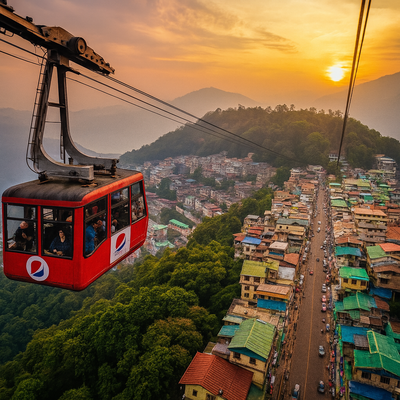
The cabin exterior wrap, sometimes called a gondola wrap advertising or full cabin exterior branding, is the most visually dramatic format — the entire outer surface of the gondola is covered in vinyl wrap branding, turning the cabin into a moving billboard that is visible to onlookers at stations, along the route, and at any point where the cable car passes over populated or accessible terrain. This format works particularly well on urban ropeway advertising corridors like the Varanasi Kashi cable car, where the cabin passes over densely populated ghats and riverbanks, generating impressions not just from passengers but from thousands of ground-level observers daily. The production cost for a full cabin exterior wrap is typically in the ballpark of ₹1.5 to ₹3 lakh per cabin depending on cabin size and vinyl specification, with the media rights cost added separately.
In-cabin advertising is, in our experience, where the real value lies for most brand categories. Interior panel branding — which covers the walls, ceiling panels, floor graphics, grab handles, and window surrounds inside the cabin — creates a 360-degree brand environment that passengers cannot avoid engaging with during the ride. Beyond static interior panel branding, the more progressive operators are now permitting digital screen cabin advertising, where small LED or LCD screens are mounted inside the gondola and can carry video content, QR code advertising prompts, and even NFC-enabled branding touchpoints that passengers can tap with their phones. The Varanasi Kashi Urban Cable Car project, for instance, was designed with digital infrastructure in mind, which makes it one of the more forward-looking DOOH ropeway opportunities in the country. Ropeway station branding — covering ticket counters, waiting area walls, boarding platforms, and entry gate wraps — rounds out the format menu and allows brands to build a sequential messaging journey from the moment a visitor arrives at the station to the moment they step off at the destination.
Which Are the Best Ropeway Locations for Brand Advertising in India?
The honest answer is that the "best" location depends entirely on who your audience is — which sounds obvious but is a point that gets glossed over when brands chase the most famous name on the list. The Gulmarg Gondola advertising opportunity in Jammu & Kashmir, for example, is extraordinary for premium lifestyle, ski gear, winter tourism, and luxury hospitality brands, given that its passenger profile skews heavily toward high-income domestic tourists and a growing international visitor base; annual ridership at Gulmarg runs into several lakh passengers across the winter and summer seasons, with peak months generating footfall that rivals many Tier 1 mall properties.
Haridwar ropeway branding — specifically the Mansa Devi and Chandi Devi Udan Khatola systems — presents a completely different audience: predominantly pilgrimage travellers, family groups, and devotees, with a significant proportion coming from North Indian states. Annual ridership across both Haridwar ropeway systems is estimated at well over twenty lakh passengers, which makes this one of the highest-footfall ropeway advertising India locations outside of urban corridors. Brands in FMCG, pharmaceuticals, religious products, banking and insurance, and regional consumer goods have found this audience extremely responsive. Similarly, the Girnar ropeway advertising opportunity in Gujarat — which serves the Jain pilgrimage site at Girnar Hill in Junagadh — draws a highly specific, affluent Gujarati audience, particularly during Navratri and other pilgrimage peaks, which creates a seasonal but intensely concentrated brand visibility India opportunity.
For brands targeting Northeast India or Bengali audiences, the Darjeeling cable car advertising network (the Rangeet Valley Passenger Cable Car) and the Guwahati Brahmaputra ropeway offer distinct geographic reach; the Gangtok Ropeway in Sikkim, while smaller in scale, draws a premium tourism audience that is difficult to reach through conventional outdoor advertising India channels. The Science City Ropeway in Kolkata is notable as an urban ropeway advertising asset — it serves a middle-class, education-oriented audience visiting one of the city's most popular science and recreation destinations, which makes it relevant for edtech, consumer electronics, and financial services brands. At SmartAds, we have built location profiles for over thirty active ropeway sites across India, and the audience segmentation across these sites is far more varied — and far more useful for media planning — than most brands initially assume.
How Does the Captive Audience Effect Boost Brand Recall on Ropeways?
The concept of captive audience advertising is not new — cinema advertising has built an entire industry around it — but the ropeway context adds a dimension that cinema does not have, which is the absence of any alternative stimulus. In a cinema hall, a viewer is distracted by the people around them, the popcorn, the phone they are trying to sneak a look at; in a ropeway gondola, particularly on a mountain route, the environment itself commands attention, and the brand messaging that shares that environment benefits from the same attentional intensity.
Captive audience dwell time on Indian ropeways ranges considerably by route — the Mansa Devi Udan Khatola in Haridwar has a ride duration of roughly three to four minutes per direction, while the Gulmarg Gondola Phase II runs for approximately twelve to fifteen minutes; the Auli ropeway branding opportunity involves a ride of close to four kilometres, which translates to a dwell time of somewhere between eight and twelve minutes. To put that in context: the average outdoor advertising India impression lasts under three seconds for a roadside hoarding seen from a moving vehicle. Even the most generous estimate for a transit media advertising impression on a bus or metro would put engaged dwell time at under thirty seconds for most passengers. The ropeway cabin is operating in a completely different order of magnitude.
What we tell our clients at SmartAds is that dwell time advertising value should not be measured in raw minutes but in the quality of attention those minutes contain. A passenger who has chosen to take a ropeway — often for the first time, often as part of a significant personal journey like a pilgrimage or a holiday — is emotionally primed in a way that a daily commuter on the metro is not. That emotional priming, combined with the novelty of the environment and the enforced proximity to the brand message, is what drives the brand recall figures we have seen come back from post-campaign surveys. In one campaign we ran for a health and wellness brand on a pilgrimage ropeway in Uttarakhand, the unaided brand recall among ropeway passengers was 71% — a figure that the client's media team initially questioned before we walked them through the methodology.
How Does Cable Car Advertising Compare to Metro, Bus, and Cab Transit Media?
This is the comparison that most media planners need to have in front of them before they can make a confident recommendation to a client, and it is one that almost no published content on ropeway advertising India has actually attempted. So let us be direct about it.
Metro transit media advertising in cities like Delhi, Mumbai, and Bengaluru offers scale that ropeway advertising simply cannot match — metro networks carry millions of passengers daily, and the reach numbers are genuinely impressive. But the CPM for metro advertising, particularly for premium formats like full train wraps or platform takeovers, works out to somewhere in the range of ₹12 to ₹25 per thousand impressions depending on the city and format, which is not cheap when you factor in the low dwell time and the competitive visual environment of a busy metro station. Bus transit media advertising is cheaper — CPMs can fall as low as ₹4 to ₹8 — but the audience quality and attentional environment are considerably lower, and brand recall studies for bus advertising consistently underperform relative to enclosed-environment formats. Cab advertising through aggregator platforms offers reasonable targeting precision but suffers from the same problem as bus advertising: the passenger is usually on their phone, the ride is often short, and the brand message — typically a seat-back card or a headrest panel — is competing with a screen.
Ropeway advertising, by contrast, delivers a CPM that works out to roughly ₹6 to ₹15 depending on the location and format — which is competitive with metro advertising — but with dwell times that are five to twenty times longer and brand recall rates that, in our experience, consistently outperform all three of the transit formats mentioned above. The trade-off is reach: a single ropeway system might carry between two lakh and twenty lakh passengers annually, which means ropeway advertising India is not a mass-reach play in the way that metro or bus transit media is. What it is, very clearly, is a high-quality, high-recall, contextually targeted format that delivers exceptional value when the audience profile matches the brand's target consumer — which, for a growing number of categories, it does.
What Is the Cost of Advertising on a Cable Car Ropeway in India?
Rate transparency is something the ropeway advertising India market has historically been poor at, which is one reason brands have been slow to adopt the format. Most operators and intermediaries default to "contact for pricing," which creates friction and uncertainty at the planning stage. Based on our direct experience negotiating ropeway media inventory across multiple locations, we can offer the following benchmarks — with the caveat that rates vary significantly by location, season, format, and campaign duration.
For interior panel branding inside a gondola cabin — which typically covers two to four A2 or A1-sized panels per cabin — the monthly media rights cost works out to somewhere between ₹8,000 and ₹25,000 per cabin depending on the ropeway's footfall and location prestige. A full cabin exterior wrap, which includes vinyl production and installation, typically costs somewhere between ₹2.5 lakh and ₹6 lakh per cabin for a three-month campaign — a number that surprises most first-time advertisers when they compare it to what they are paying for a single large-format hoarding in a metro city, which can easily run to ₹3 to ₹8 lakh per month for a single face. Ropeway station branding — covering ticket counters, waiting areas, and boarding platforms — is priced in the ballpark of ₹50,000 to ₹2 lakh per month for a full station takeover, depending on station size and footfall. Digital screen cabin advertising, where available, commands a premium, with monthly rates for a single screen inside a gondola running somewhere between ₹15,000 and ₹40,000 depending on the operator and content management arrangements.
The cost per impression for ropeway advertising, when calculated against verified passenger footfall data, is genuinely competitive — and when adjusted for dwell time and brand recall, the effective cost per quality impression is, frankly, lower than most media planners expect. At SmartAds, we have developed a ropeway advertising ROI model that accounts not just for raw impressions but for recall-weighted impressions, which gives a more honest picture of what the format is actually delivering relative to its cost. For brands with budgets in the ₹5 to ₹25 lakh range for a regional or niche campaign, ropeway advertising India can deliver a media efficiency that is difficult to replicate through conventional OOH advertising India channels at the same investment level.
How Can Brands Book Ropeway Advertising Space in India?
The booking process for cable car ropeway advertising in India is less standardised than metro or airport advertising, which means brands going direct to operators often encounter long lead times, unclear rate structures, and inconsistent availability information. Most major ropeway operators — including Usha Breco Limited for the Udan Khatola systems, Damodar Ropeways and Infra Ltd for their network, and state tourism corporation-managed ropeways — have commercial departments that handle advertising permissions India ropeway enquiries, but response times and documentation requirements vary considerably.
The more practical route, particularly for brands planning multi-location ropeway campaigns or integrating ropeway branding into a broader BTL advertising India plan, is to work through a specialist media buying India agency that has pre-negotiated relationships with ropeway operators. At SmartAds, we have direct contacts with operators across more than fifteen ropeway locations and can typically turn around a rate card, availability confirmation, and campaign proposal within five to seven working days — which is considerably faster than the four to six weeks that direct operator negotiations often take. The documentation required typically includes a brand approval from the operator (some pilgrimage ropeways, for instance, restrict advertising to categories that are contextually appropriate), a creative brief for format-specific production, and in some cases a no-objection from the relevant state tourism or transport authority.
Advertising permissions India ropeway regulations are governed by a combination of operator-specific commercial policies, state tourism department guidelines, and — for ropeways under the Parvatmala Programme — Ministry of Road Transport and Highways guidelines administered through NHLML. Bureau of Indian Standards (BIS) specifications govern the physical installation of any branding material on the cabin structure, which means vinyl wrap branding and interior panel installations must meet weight and adhesion standards that do not compromise the cabin's structural or safety certification. This is a detail that many brands and even some agencies overlook, and we have seen this backfire when production vendors not familiar with ropeway specifications produce materials that operators then refuse to install.
How Is India's Parvatmala Programme Expanding the Ropeway Advertising Landscape?
The Parvatmala Pariyojana — formally known as the National Ropeway Development Programme — is, without question, the single most significant structural development in the ropeway advertising India landscape in the past decade, and it is one that most brand managers and media planners have not yet fully processed in terms of its advertising implications. Announced under the Union Budget and administered through NHLML under NHAI and MoRTH, the Parvatmala Programme aims to develop approximately 250 to 300 ropeway routes across India's mountainous and hilly regions, with a focus on replacing difficult road stretches, connecting pilgrimage sites, and improving last-mile connectivity in states like Uttarakhand, Himachal Pradesh, Jammu & Kashmir, and the Northeast.
The Parvatmala Pariyojana operates primarily through a PPP ropeway concession advertising model — private concessionaires are awarded development and operation rights for specific routes, and commercial revenue including advertising is a key component of the financial model that makes these projects viable. This is significant for brands because it means that as new ropeways come online under Parvatmala, the advertising rights will be structured into the concession from the outset, creating a more organised and commercially accessible ropeway media inventory than the ad-hoc arrangements that characterise older operator relationships. The Make in India ropeway initiative, which encourages domestic manufacturing of ropeway components in partnership with international technology providers like Bartholet Maschinenbau AG, is also relevant here — as domestically produced systems come online faster and at lower cost, the pace of new ropeway inventory entering the market is expected to accelerate significantly through the second half of this decade.
For brands planning media strategies over a two to three year horizon, the Parvatmala Programme represents a genuine first-mover opportunity. The ropeways being developed under this programme will, in many cases, serve routes with very high pilgrimage and tourism footfall — including several Char Dham Yatra-adjacent routes in Uttarakhand and Himachal Pradesh ropeway advertising corridors — which means the audience quality and volume will be substantial from day one. At SmartAds, we are actively tracking the Parvatmala pipeline and advising clients in relevant brand categories to begin conversations about advertising rights on upcoming routes well before construction completion, because the most valuable inventory on new ropeways tends to be committed early.
What Brands and Industries Benefit Most from Ropeway Cabin Advertising?
The honest answer is that ropeway advertising is not for every brand, and we would rather say that plainly than pretend it is a universal solution. The format works best when there is a meaningful connection between the brand's target audience and the specific ropeway's passenger profile — which requires some research and honest assessment rather than simply booking the most famous ropeway on the list.
Tourism and hospitality brands — hotels, resorts, travel aggregators, adventure tourism operators — find ropeway branding almost self-evidently relevant, since the passenger is already in a travel mindset and is, by definition, someone who travels. FMCG brands with a mass-market North Indian or pilgrimage-audience focus have consistently performed well on the Haridwar and Vaishno Devi ropeway circuits. Pharmaceutical and healthcare brands — particularly those in the OTC wellness, pain relief, and digestive health categories — find the pilgrimage audience highly responsive, given the demographic's age profile and health awareness. Financial services brands, particularly insurance and banking products targeting semi-urban and Tier 2 audiences, have found ropeway advertising India to be an effective complement to their conventional media mix, since many ropeway passengers come from exactly the demographic these brands are trying to reach through expensive and increasingly cluttered digital channels.
Premium and lifestyle brands — luxury automobiles, premium beverages, high-end consumer electronics — are better suited to the Gulmarg Gondola advertising and Auli ropeway branding contexts, where the audience skews affluent, well-travelled, and aspirational. Adventure sports and outdoor gear brands have an obvious contextual fit across most hill station ropeway branding locations. What we tell clients who are unsure about fit is to start with a single-location, single-season test campaign — the investment required is modest enough that the risk is manageable, and the learnings from a properly tracked pilot campaign are genuinely useful for informing a larger media buying India commitment.
What Are the ROI and Measurability Metrics for Ropeway OOH Campaigns?
Advertising ROI measurement for ropeway campaigns is more tractable than most brands assume, primarily because ropeway passenger data is metered — every passenger buys a ticket, which means operator footfall data is auditable in a way that roadside hoarding impression estimates simply are not. This is a meaningful advantage for media planners who need to justify ropeway advertising spend to finance teams accustomed to demanding CPM calculations and reach verification.
The primary metrics we use at SmartAds for ropeway campaign evaluation are: verified passenger impressions (derived from operator ticket data for the campaign period), cost per impression ropeway (total campaign cost divided by verified impressions), unaided brand recall (measured through exit surveys at the destination station), and brand association scores (measuring whether passengers correctly associated the brand with the campaign message). For a campaign we ran on behalf of a regional insurance brand across two Uttarakhand ropeway branding locations during the Char Dham Yatra season, the verified passenger impressions over a six-week campaign period came in at approximately 4.2 lakh, the cost per impression worked out to roughly ₹9 — which compared favourably to the ₹18 to ₹22 CPM the same client was paying for comparable reach on digital platforms — and the unaided brand recall in exit surveys was 73%, which was the highest figure that particular client had ever recorded for any single media format.
The measurability of ropeway advertising is also being enhanced by the integration of QR code advertising on interior panels, which allows brands to track active engagement — scans, website visits, and conversion actions — directly attributable to the ropeway campaign. DOOH ropeway installations with digital screen cabin advertising can track content play frequency and, where network connectivity permits, serve dynamic content that changes by time of day or passenger volume. These are not yet standard across all ropeway locations, but they are becoming more common as operators invest in cabin modernisation, and they represent a meaningful step toward the kind of performance marketing accountability that digital-first brands increasingly expect from their out of home advertising investments.
Case Studies — Brands That Advertised on Ropeways with SmartAds
Three campaigns stand out from our recent ropeway advertising work, each illustrating a different dimension of what the format can deliver when it is planned properly.
The first involved a mid-sized Ayurvedic FMCG brand which was looking to build awareness among pilgrimage audiences in Uttarakhand ahead of the Char Dham Yatra season. We placed full interior panel branding across eight gondola cabins on two ropeway systems — one in Haridwar and one on a Kedarnath-adjacent route — and complemented the in-cabin advertising with ropeway station branding at both base stations. The campaign ran for eight weeks during peak pilgrimage season, generating verified impressions of approximately 6.8 lakh passengers. The brand's post-campaign market research showed a 22% increase in unaided awareness in the target geography, and retail offtake data from the region showed a 17% uplift in the two months following the campaign — which the client's team attributed, at least partially, to the ropeway campaign's contribution to the media mix.
The second case involved a premium adventure tourism operator targeting high-income domestic travellers for a new Himalayan resort property. We recommended a gondola wrap advertising execution on the Gulmarg Gondola, covering two cabins with full exterior vinyl wrap branding and interior panel branding, timed to coincide with the winter ski season peak. The campaign's reach among the specific high-income traveller demographic — verified through a combination of operator data and on-site intercept surveys — was approximately 85,000 passengers over a ten-week period; the cost per verified impression among the target demographic worked out to somewhere around ₹18, which was substantially lower than what the client was paying for programmatic display targeting the same demographic on digital platforms. Booking enquiries from the resort's dedicated landing page, which was promoted via QR code advertising on the interior panels, showed a measurable spike during the campaign period.
The third campaign is perhaps the most instructive for brands considering urban ropeway advertising. A financial services brand — specifically a mutual fund distributor targeting first-time investors in Tier 2 cities — ran a three-month interior panel branding campaign on a Science City ropeway in Kolkata and a state tourism-operated ropeway in a Tier 2 city in West Bengal. The audience profile at both locations skewed toward educated, middle-class families — exactly the demographic the brand needed to reach — and the campaign's exit survey data showed a brand recall rate of 69% and a 31% rate of passengers who reported intending to look up the brand's products after the ride. For a brand category where intent generation is the primary campaign objective, those numbers represented a genuinely strong result relative to the campaign's total cost of approximately ₹14 lakh across both locations.
Frequently Asked Questions About Cable Car Ropeway Advertising in India
Q: What is cable car ropeway advertising and how is it different from traditional OOH?
Cable car ropeway advertising refers to brand placements across the various surfaces of a passenger ropeway system — gondola cabin exteriors, interior panels, station walls, ticket counters, and digital screens inside cabins. What makes it fundamentally different from traditional out of home advertising India formats like hoardings or transit shelters is the captive audience effect: passengers are physically enclosed with the brand message for the entire duration of the ride, which can range from three minutes to over twenty minutes depending on the route. There is no scroll, no skip, no competing visual stimulus in most mountain locations — which is an attentional environment that conventional OOH cannot replicate. The format is classified as a non-traditional advertising and BTL advertising India medium, though it shares characteristics with transit media advertising in terms of audience context.
Q: Which are the best ropeway locations in India for brand advertising?
The answer depends on your target audience. For pilgrimage and mass-market North Indian audiences, the Haridwar ropeway branding locations — Mansa Devi and Chandi Devi Udan Khatola — and the Vaishno Devi ropeway in Jammu & Kashmir offer among the highest footfall of any ropeway advertising India sites. For premium lifestyle and tourism audiences, the Gulmarg Gondola advertising opportunity and Auli ropeway branding are the strongest options. For urban middle-class audiences, the Varanasi Kashi cable car and the Science City Ropeway in Kolkata are well-suited. For Gujarati audiences, Girnar ropeway advertising during pilgrimage seasons is highly effective. For Northeast audiences, Darjeeling cable car advertising and the Guwahati Brahmaputra ropeway offer distinct geographic reach.
Q: How much does it cost to advertise on a cable car ropeway in India?
Interior panel branding inside a gondola cabin typically costs somewhere between ₹8,000 and ₹25,000 per cabin per month in media rights, depending on the ropeway's location and footfall. A full cabin exterior wrap — including vinyl production and installation — runs in the ballpark of ₹2.5 to ₹6 lakh per cabin for a three-month campaign. Ropeway station branding for a full station takeover is typically priced between ₹50,000 and ₹2 lakh per month. Digital screen cabin advertising, where available, commands somewhere between ₹15,000 and ₹40,000 per screen per month. These are benchmarks based on our direct negotiation experience; actual rates vary by operator, season, and campaign duration.
Q: What formats are available for advertising inside and outside a ropeway cabin?
The main formats available are: cabin exterior wrap (full vinyl wrap branding of the gondola exterior), in-cabin advertising through interior panel branding (wall panels, ceiling panels, floor graphics, window surrounds), gondola wrap advertising for partial exterior coverage, ropeway station branding (ticket counters, waiting areas, boarding platforms), digital screen cabin advertising (LED or LCD screens inside the cabin), QR code advertising on interior panels, and ticket jacket advertising on printed tickets. Not all formats are available at every location — availability depends on the operator's commercial policy and the cabin's structural specifications.
Q: Who is the target audience for cable car ropeway advertising in India?
The audience profile varies significantly by location. Pilgrimage ropeways like those in Haridwar, Vaishno Devi, and Girnar draw predominantly devotee audiences — family groups, middle-aged and older adults, predominantly from North and West India — with a strong representation of semi-urban and Tier 2 city residents. Hill station and ski ropeways like Gulmarg and Auli draw affluent domestic tourists and a growing international visitor base. Urban ropeways like the Varanasi Kashi cable car draw a mixed urban audience including tourists, students, and local residents. The common thread across all ropeway advertising India audiences is that they are engaged, present, and in a receptive mindset — they have chosen to be there, which is a quality that most media formats cannot claim.
Q: How long is the average dwell time of a passenger in a ropeway cabin?
Dwell time varies by route. Short urban and pilgrimage ropeways — like the Mansa Devi Udan Khatola in Haridwar — have ride durations of roughly three to five minutes per direction. Medium-length routes like the Girnar ropeway run approximately eight to ten minutes. Longer mountain ropeways like the Gulmarg Gondola Phase II deliver dwell times of twelve to fifteen minutes or more. Even at the lower end, three to five minutes of enforced, uninterrupted brand exposure represents a captive audience dwell time that is many times greater than any conventional outdoor advertising India format. When you account for the return journey — most passengers ride both ways — the total brand contact time per passenger effectively doubles.
Q: Is ropeway advertising considered a BTL or ATL medium?
Ropeway advertising is firmly classified as a BTL advertising India medium — specifically within the non-traditional advertising and ambient OOH categories. It does not involve mass broadcast media like television, radio, or national print, and it is typically deployed as part of a targeted, location-specific campaign rather than a national reach strategy. That said, it shares some characteristics with transit media advertising, which sits at the boundary between BTL and conventional OOH advertising India. For media planning purposes, ropeway advertising is best treated as a high-quality ambient BTL format that complements a broader media mix rather than replacing mass-reach channels.
Q: How can a brand book advertising space on an Indian ropeway?
Brands can approach ropeway operators directly — Usha Breco Limited for Udan Khatola systems, Damodar Ropeways and Infra Ltd for their network, and state tourism corporations for government-managed ropeways — though direct negotiations tend to be slow and rate structures are not always transparent. Working through a specialist media buying India agency with established operator relationships is typically faster and more cost-effective. At SmartAds, we maintain direct relationships with operators across more than fifteen ropeway locations and can provide rate cards, availability confirmation, and campaign proposals within a week. Regulatory requirements — including operator brand approvals, BIS-compliant installation specifications, and state tourism department NOCs where required — are managed as part of the booking process.
Q: What industries or brand categories benefit most from ropeway advertising?
Tourism and hospitality brands, FMCG brands targeting pilgrimage and Tier 2 audiences, pharmaceutical and OTC wellness brands, financial services companies targeting semi-urban demographics, adventure sports and outdoor gear brands, premium lifestyle brands on ski and hill station ropeways, and regional consumer goods brands with specific geographic targeting needs all find strong ROI