


Delhi

Mumbai

Bengluru

Ahmedabad

Jaipur

Chennai

Hydrabad

Kolkatta

Lucknow

Pune
Railway Station Advertising in India: The Complete 2025 Guide to Train Station Advertising, BTL Activation, OOH Formats, Rates & Media Planning
This guide draws on SmartAds' direct campaign experience across 500+ Indian cities, real 2025 rate benchmarks from active media buying, audience profiling data, and a format-by-format breakdown that most agency pages simply do not provide. If you are trying to decide whether railway station advertising belongs in your media mix — and at what budget — this is the most complete reference you will find.
What Is Railway Station Advertising and How Does It Work in India?
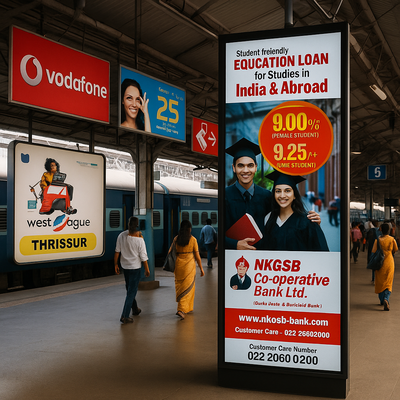
Indian Railways moves somewhere in the ballpark of 23 million passengers every single day — a number that, when you say it out loud at a media planning meeting, tends to stop the conversation. That daily footfall figure, which is larger than the entire population of several European countries, is the foundational reason why railway station advertising has quietly become one of the most cost-efficient outdoor advertising channels available to Indian brands. What a lot of people miss is that this is not simply a volume story; it is a dwell time story, which makes it fundamentally different from a highway hoarding that a car passes in three seconds.
Railway station advertising works by placing brand communication at touchpoints where commuters, travellers, and visitors spend extended, uninterrupted time — on platforms waiting for trains, inside station concourses navigating to exits, on foot-over bridges crossing between platforms, and even inside waiting rooms and ticketing halls. The process involves brands working through an authorized advertising agency that holds a valid licence from the relevant Zonal Railway authority — whether that is Western Railway, Central Railway, Northern Railway, Southern Railway, or any of the other zonal bodies that govern Indian Railways' commercial advertising rights. At SmartAds, we always tell our clients that the permissions structure here is more layered than most outdoor advertising, but once you understand the zonal licensing system, the process becomes quite straightforward. Campaigns are typically booked for a minimum of one month, though high-traffic stations often command longer minimum commitments during peak seasons.
The way a campaign actually gets executed involves three stages that often run in parallel: creative approval by the Zonal Railway's commercial department, physical installation by empanelled vendors, and monitoring by the agency. What makes this channel particularly interesting from a media planning standpoint is the repetitive exposure dynamic — a daily commuter on the Mumbai Local Train Network, for instance, passes the same platform hoardings at Dadar or Thane every working day, which means your brand recall compounds over the duration of the campaign in a way that a single digital impression simply cannot replicate. Our experience shows that brands which run railway station advertising for a minimum of 45 days see significantly stronger unaided recall scores than those that treat it as a one-week burst.
Top Advertising Formats Available at Indian Railway Stations
The format landscape at Indian railway stations is considerably richer than most brand managers realise when they first approach this medium, and frankly speaking, this is where a lot of campaigns underperform — not because the medium is weak, but because the wrong format was chosen for the campaign objective. Platform hoardings are the most familiar entry point: large-format backlit panels positioned along platform edges, which are visible to passengers both on the platform and from passing trains. These hoardings come in a range of sizes, with 10x5 feet and 20x5 feet being the most common at major stations, and their illuminated nature means they maintain visibility well into the evening hours when commuter traffic is often at its peak.
Beyond platform hoardings, the format menu includes pole kiosks — those double-sided display units mounted on platform pillars, which are particularly effective because they are positioned at eye level and surrounded by stationary, waiting passengers. Foot-over bridge (FOB) advertising deserves far more credit than it typically receives; the FOB is essentially a corridor that every passenger must walk through, which creates a captive audience situation that is genuinely rare in outdoor advertising. Then there are vinyl stickers applied to floors, walls, and pillars — a format that works exceptionally well for product launches and brand awareness campaigns because the sheer visual disruption tends to generate earned social media attention when executed boldly. Train wraps and full train wrap campaigns, where the exterior of an entire train is branded, represent the premium end of the format spectrum; a full train wrap on a busy route like the Mumbai Local or a Vande Bharat Express corridor can generate impressions in the millions within a single week of operation.
Digital screens and LED screens have been expanding rapidly across major stations under the RailTel Corporation of India's infrastructure rollout and the NuRe Bharat Network (NBN) initiative, which is bringing programmatic DOOH capabilities to railway environments for the first time at meaningful scale. Audio advertising — specifically railway announcement advertising, where brand messages are woven into station PA systems — remains one of the most underutilised formats in the entire railway advertising ecosystem; we have found that audio advertising at stations like New Delhi Railway Station or Howrah Junction reaches passengers who are actively listening because they are waiting for train announcements, which creates an attentiveness that most audio channels cannot manufacture. Kiosk advertising, which involves branded physical structures in station concourses, bridges the gap between static display and experiential marketing, and is increasingly being used by FMCG brands for product sampling railway station activations.
Why Railway Station Advertising Delivers Unmatched Brand Recall
There is a concept in media planning called "dwell time," and Indian railway stations are, without exaggeration, among the highest dwell time environments in the entire out-of-home advertising universe. The average passenger at a major station like Chennai Central or Bangalore City Station (KSR) spends somewhere between 20 and 45 minutes on the premises — time during which they have relatively little to do except observe their surroundings. This is the core mechanism behind the brand recall advantage of railway branding, which operates very differently from the fleeting exposure of a roadside hoarding or a skippable pre-roll ad. When we have run brand recall studies for clients post-campaign, the numbers from railway station advertising consistently outperform what the same budget would have delivered on digital display.
The repetitive exposure factor compounds this advantage significantly. A retail client in Pune for whom we ran a three-month railway station branding campaign at Pune Junction found that unaided brand recall among surveyed commuters reached 67% by the end of the campaign — a figure that the client's own market research team described as among the highest they had recorded for any single-channel outdoor campaign. The daily commuter who sees the same backlit panel or pole kiosk five days a week for eight weeks has effectively received 40 exposures to that creative, which is a frequency level that most digital campaigns would consider exceptional and most television campaigns would find expensive to achieve. Brand visibility at railway stations is not a passive benefit; it is a structural feature of the medium.
What a lot of people miss is that railway station audiences are not a homogeneous mass — they are a remarkably stratified mix of demographics that, taken together, represent a more complete cross-section of urban and semi-urban India than almost any other single advertising environment. The GroupM TYNY Report and Dentsu e4m Report have both highlighted transit advertising as a growing priority for brands seeking to reach aspirational middle-class consumers, and Indian Railways sits at the centre of that aspiration — carrying everyone from daily wage workers to corporate executives, from students heading to coaching centres to families travelling for weddings. At SmartAds, we have found that this demographic breadth is actually a selling point for certain campaign types, particularly FMCG, fintech, and telecom brands that need genuinely pan-India reach without the complexity of managing 50 different hyperlocal campaigns.
How Much Does Railway Station Advertising Cost in India? (2025 Rate Guide)
Advertising rates at Indian railway stations vary more dramatically than most clients expect, and the variation is driven by three factors: the station's daily footfall, the specific format chosen, and the zonal railway authority under whose jurisdiction the station falls. To give you a working sense of the numbers — a standard backlit platform hoarding at a Tier-2 city station in Madhya Pradesh or Rajasthan might cost somewhere in the ballpark of ₹15,000 to ₹30,000 per month, which is a number that surprises most brand managers when they realise the reach it delivers relative to what they are paying for equivalent digital display impressions. At the other end of the spectrum, a premium platform hoarding at Chhatrapati Shivaji Maharaj Terminus (CSMT) in Mumbai can run to ₹1.5 lakh to ₹3 lakh per month, depending on size, position, and whether it is backlit or a digital screen.
Pole kiosk advertising at major metro stations — New Delhi Railway Station, Howrah Junction, Bangalore City Station — typically falls in the range of ₹20,000 to ₹60,000 per unit per month, which makes them an attractive entry point for brands that want presence at a landmark station without committing to a full station domination package. Foot-over bridge (FOB) advertising, which we consider one of the most underpriced formats in railway advertising given its captive audience dynamics, generally costs somewhere between ₹40,000 and ₹1.2 lakh per month at major stations, depending on the length of the FOB panel run and whether vinyl or backlit formats are used. Full train wrap campaigns are priced differently — they are typically quoted per train per month, and at major networks the cost works out to roughly ₹3 lakh to ₹8 lakh per train per month, which sounds significant until you calculate the impression volume a single wrapped train generates across its daily route.
Station domination packages — where a brand takes over all or most of the advertising inventory at a single station for a defined period — are priced on negotiation and can range from ₹5 lakh to ₹25 lakh per month at major stations, depending on the station and the scope of formats included. Railway station advertising cost per month for a modest but meaningful campaign at a mid-size city station, covering a combination of platform hoardings and pole kiosks, typically works out to somewhere between ₹80,000 and ₹2 lakh — a budget that, in our experience at SmartAds, delivers cost per reach figures that are genuinely difficult to match through any other outdoor advertising channel at equivalent scale. Audio advertising and railway announcement advertising are among the most affordable formats, with monthly costs at major stations often falling in the ₹15,000 to ₹50,000 range, which makes them an excellent complement to visual formats for brands that want multi-sensory presence.
Best Railway Stations in India for High-Impact Advertising Campaigns
Not all railway stations are created equal from an advertising standpoint, and the difference between a well-chosen station and a poorly chosen one can be the difference between a campaign that moves brand metrics and one that simply runs its course without measurable impact. Chhatrapati Shivaji Maharaj Terminus (CSMT) in Mumbai is, by most measures, the single most powerful railway station advertising location in India — it handles well over a million footfalls daily when you account for both long-distance and suburban traffic, which means a brand placed here achieves a reach density that is genuinely comparable to prime-time television in Maharashtra. New Delhi Railway Station, which serves as the country's busiest railway junction by number of trains, offers a similarly compelling case, particularly for brands targeting North Indian markets or pan-India travellers.
Howrah Junction and Sealdah Station together dominate the Kolkata market in a way that no single outdoor location can match; a brand that runs simultaneous campaigns at both stations effectively owns the transit advertising space in West Bengal's largest city. Bangalore City Station (KSR) has seen significant infrastructure upgrades in recent years, which have expanded the available advertising inventory considerably and made it a more attractive proposition for brands targeting Bangalore's large tech-sector workforce. Chennai Central, Hyderabad's Secunderabad Junction, and Pune Junction round out the list of stations where we consistently recommend clients invest when building a South or West India-focused railway branding campaign. One automotive brand we worked with ran a coordinated campaign across six of these stations simultaneously for a new model launch, achieving a combined estimated footfall reach of over 4 crore unique individuals over a 60-day period — a reach figure that the client's media team acknowledged would have cost three to four times as much through television alone in the same markets.
Tier-2 city stations deserve a separate mention because they represent one of the most underutilised opportunities in Indian railway advertising. Stations like Nagpur Junction, Lucknow Charbagh, Jaipur Junction, Surat, and Coimbatore serve cities with rapidly growing consumer markets, where the advertising clutter is significantly lower than in metros and where brand visibility at the railway station carries an outsized influence on local brand perception. Our experience shows that FMCG brands, real estate developers, and ed-tech companies that invest in tier-2 city railway station advertising often see stronger relative ROI than comparable campaigns at metro stations, precisely because the competitive noise is lower and the audience is less advertising-saturated.
OOH vs DOOH: Choosing the Right Format for Railway Advertising
The distinction between static OOH advertising and digital DOOH advertising at railway stations is not simply a question of technology — it is a question of campaign objective, budget flexibility, and the kind of creative impact you are trying to create. Static formats — platform hoardings, backlit panels, pole kiosks, vinyl stickers, and FOB panels — are the backbone of railway station advertising in India and remain the dominant format by volume, simply because the infrastructure for static displays exists at virtually every station across the country's vast network. The strength of static OOH at stations is its permanence and its cumulative brand recall effect; a backlit panel that has been in place for 60 days has been seen by the same commuters dozens of times, which creates a depth of brand familiarity that a single digital impression cannot replicate.
DOOH advertising at railway stations — delivered through LED screens and digital screens installed at major stations — offers a fundamentally different value proposition. The ability to run multiple creatives in rotation, to update messaging in near real-time, and to schedule ads by time of day (morning rush versus evening peak versus weekend travel) makes DOOH particularly valuable for brands with dynamic offers, time-sensitive promotions, or campaigns that need to speak differently to different audience segments. RailTel Corporation of India's expanding digital infrastructure, combined with the NuRe Bharat Network's (NBN) rollout of connected screens across stations, is making programmatic DOOH at railway stations a realistic option for brands that want data-driven outdoor advertising. The CPM for DOOH at major railway stations works out to roughly ₹12 to ₹25 per thousand impressions, which compares favourably to what most brands are paying for premium digital display on mobile platforms when you factor in the quality of attention the railway environment commands.
To be fair, DOOH at railway stations comes with its own constraints — the inventory is more limited than static formats, the minimum booking periods at some stations can be inflexible, and the creative specifications are more demanding. Our recommendation at SmartAds is to treat OOH and DOOH as complementary rather than competing choices: use static platform hoardings and backlit panels for sustained brand awareness and repetitive exposure, and layer DOOH screens for campaign-specific messaging around product launches, seasonal offers, or festival periods. This integrated approach to railway advertising has, in our experience, consistently outperformed single-format campaigns on brand recall metrics.
BTL Activations at Railway Stations: Kiosks, Sampling & Experiential Marketing
Below-the-line advertising at railway stations is a category that deserves far more strategic attention than it typically receives in media planning conversations, and frankly speaking, it is one of the areas where we see the biggest gap between what brands could be doing and what they are actually doing. BTL advertising in railway environments goes well beyond putting up a hoarding — it encompasses branded kiosk advertising structures where brand representatives can engage directly with commuters, product sampling railway station activations where FMCG products can be distributed to a captive audience, and experiential marketing railway station setups that create memorable brand interactions in high-footfall concourse areas.
The mechanics of BTL activation at Indian railway stations require coordination with the relevant Zonal Railway authority, which grants permission for commercial activities in station premises through a licensing process that is separate from the standard display advertising permissions. A food and beverage brand we worked with ran a product sampling railway station campaign at five major stations across Maharashtra and Gujarat simultaneously, distributing trial packs of a new snack product to commuters over a 10-day period; the campaign reached an estimated 8 lakh direct product interactions, which the brand's sales team subsequently correlated with a measurable spike in retail offtake in those cities during the following month. Experiential marketing railway station activations work particularly well for categories like FMCG, consumer electronics, fintech apps, and ed-tech platforms — essentially any brand where a brief, direct interaction can meaningfully accelerate the consumer's journey from awareness to trial.
Kiosk advertising at stations, which involves branded physical structures staffed by brand representatives or equipped with interactive digital interfaces, is increasingly being used for QR code advertising railway campaigns — where commuters scan a QR code at the kiosk to access an offer, download an app, or register for a service. This integration of physical BTL activation with digital lead capture is, in our view, one of the most exciting developments in non-traditional advertising at railway stations, because it creates a measurable conversion pathway from an otherwise awareness-only medium. At SmartAds, we have helped several fintech and insurance clients use this approach to generate qualified leads at a cost per acquisition that was significantly lower than what their digital performance campaigns were delivering at the same time.
How to Plan and Book a Railway Station Advertising Campaign
The booking process for railway station advertising in India is more structured than most clients expect, and understanding it upfront saves a significant amount of time and prevents the kind of last-minute surprises that can derail a campaign launch. The first step is identifying the stations and formats that align with your target audience and campaign objective — which sounds obvious, but in practice requires a detailed footfall analysis, an understanding of the passenger profile at each station, and a realistic assessment of what creative formats will work in the physical environment. At SmartAds, our media planning team begins every railway advertising brief with a station audit, which involves reviewing available inventory, checking existing brand occupancy (to avoid category conflicts), and assessing the physical condition and visibility of each format position.
Once the station and format selection is finalised, the permissions process begins — and this is where working with an authorized advertising agency becomes genuinely important rather than merely convenient. Advertising at Indian railway stations requires approval from the commercial department of the relevant Zonal Railway, and the documentation requirements include creative artwork in specified formats, a no-objection certificate from the agency's railway advertising licence, and in some cases a site inspection report. The timeline from brief to live campaign is typically somewhere between 21 and 45 days for static formats, depending on the station and the zonal authority; DOOH campaigns on digital screens can sometimes be turned around faster, particularly at stations where the infrastructure is managed by a single network operator. Train wrap advertising, which involves coordination with the Railway's rolling stock department, typically requires 45 to 60 days of lead time and should be planned accordingly.
The practical cost-saving strategies that our media planning team consistently applies include booking multi-station packages rather than individual units (which unlocks volume discounts that can reduce effective rates by 15 to 25%), timing campaigns to avoid peak festival periods when inventory is heavily contested and rates are elevated, and negotiating for value-added positions — such as FOB panels or audio advertising — as part of a larger platform hoarding booking. Media buying at scale also creates leverage for creative production cost absorption, where the agency's vendor relationships allow for installation and fabrication costs to be bundled into the media rate rather than billed separately. Frankly speaking, these are the kinds of negotiation dynamics that only become available when you have an established relationship with the zonal railway's empanelled vendors, which is one of the practical reasons why working with an experienced station advertising agency India matters.
Railway Station Advertising for SMEs: Budget-Friendly Options That Work
There is a persistent misconception that railway station advertising is exclusively a large-brand game — that it requires crore-level budgets and pan-India ambitions to make sense. Our experience at SmartAds tells a very different story, and we have seen railway station advertising for small businesses deliver some of the most impressive ROI we have encountered across any media category. The key is matching the format and station selection to the budget and the geographic scope of the business, rather than trying to replicate what a national FMCG brand would do.
A local real estate developer in Nashik, for instance, ran a three-month campaign using pole kiosks and backlit panels at Nashik Road Station — a station that handles substantial daily footfall from the city's working population — at a total campaign cost of roughly ₹1.8 lakh for the full period. The developer attributed a measurable increase in site visit enquiries to the campaign, with the cost per enquiry working out to a fraction of what their Google Ads campaigns were generating at the same time. Railway station advertising for small businesses works best when it is hyperlocal — focused on the one or two stations most relevant to the brand's catchment area, using formats that maximise dwell time exposure, and running for long enough to build the repetitive exposure that drives brand recall. Hyperlocal advertising railway station campaigns, which target a single station or a cluster of stations in a defined city zone, are entirely viable at monthly budgets of ₹50,000 to ₹1.5 lakh, which puts this medium within reach of serious SME advertisers.
The minimum budget required to start a meaningful railway station advertising campaign at a Tier-2 or Tier-3 city station is, in our assessment, somewhere around ₹25,000 to ₹40,000 per month — enough to secure a pole kiosk or a small backlit panel at a station with meaningful daily footfall. At metro stations, the entry point is higher, but even at stations like Churchgate in Mumbai or Delhi's Hazrat Nizamuddin, there are format options that fall within a ₹75,000 to ₹1.5 lakh monthly budget range, which is accessible to mid-size businesses with a serious brand-building agenda. The thing is, railway station advertising for small businesses is not about matching the scale of large brands — it is about owning a specific, relevant environment so completely that your target audience cannot help but notice you.
How to Measure ROI and Campaign Effectiveness of Railway Station Advertising
ROI measurement in railway station advertising is a topic that deserves more honest treatment than it usually gets, because the medium does not offer the kind of real-time attribution dashboards that digital advertising has conditioned marketers to expect. That said, the measurement toolkit available for railway advertising is more sophisticated than most people realise, and the brands that invest in measurement upfront consistently get more value from the medium than those that treat it as an unmeasurable brand exercise. The foundational measurement approach involves pre-campaign and post-campaign brand recall surveys conducted among commuters at the advertised stations — a methodology that, while not perfect, provides directional evidence of the campaign's impact on awareness and recall metrics.
Footfall data, which is available from Indian Railways' commercial department and from third-party measurement partners, allows for an estimated reach calculation that can be used to derive a cost per reach figure — and when you run that calculation for a well-placed platform hoarding at a busy station, the numbers are typically very compelling relative to other outdoor advertising channels. For campaigns that incorporate QR code advertising railway elements or kiosk activations with digital lead capture, the measurement becomes significantly more precise — you can track scan rates, app downloads, form submissions, and even downstream purchase behaviour if your CRM is set up to handle it. One ed-tech client we worked with ran a QR code-enabled pole kiosk campaign at 12 stations across Delhi and NCR, generating over 4,200 verified app downloads over a 45-day period at a cost per install that was roughly 40% lower than their concurrent Meta Ads campaign.
The FICCI-EY Media Report and various TAM AdEx analyses have consistently highlighted transit advertising as a channel with strong brand impact metrics, particularly for categories where purchase decisions are influenced by repeated exposure rather than single-moment intent signals. At SmartAds, our approach to ROI measurement for railway station advertising campaigns combines footfall-based reach estimates, brand recall survey data, and — where digital integration is present — hard conversion metrics from QR codes, unique URLs, or promotional codes that are exclusive to the railway campaign. This triangulated approach gives clients the confidence to justify railway advertising investment to their management teams, which is ultimately what makes the difference between a one-time trial and a sustained media strategy.
City-Wise Guide to Railway Station Advertising in India
Mumbai is, without question, the most complex and the most rewarding railway advertising market in India. The Mumbai Local Train Network alone carries somewhere in the ballpark of 75 lakh passengers daily across the Western Railway and Central Railway networks, which means that train platform advertising and station advertising in Mumbai operates at a scale that has no equivalent anywhere else in the country. Railway advertising agency Mumbai operations require familiarity with both the Western Railway's commercial licensing structure and the Central Railway's separate approval process; CSMT and Churchgate Station are the flagship locations, but stations like Dadar, Thane, Borivali, and Andheri offer exceptional footfall at rates that are considerably more accessible than the terminus stations. A railway station branding campaign across five mid-size Mumbai local stations can be executed for a monthly budget in the range of ₹4 lakh to ₹8 lakh, which delivers a combined daily reach that is genuinely difficult to match through any other single outdoor advertising channel in the city.
Delhi's railway advertising landscape is anchored by New Delhi Railway Station, which is among the busiest in the world by number of trains handled, but the market also includes Hazrat Nizamuddin, Old Delhi Station, and the cluster of stations serving the NCR region — Gurgaon, Faridabad, Ghaziabad — which are increasingly attractive for brands targeting the suburban professional audience. Advertising rates at New Delhi Railway Station for premium platform hoardings work out to roughly ₹1 lakh to ₹2.5 lakh per month per unit, with FOB advertising and pole kiosks available at considerably lower price points. Bangalore City Station (KSR) has seen the most significant infrastructure transformation of any major Indian railway station in recent years, with new concourse areas, expanded digital screen networks, and improved advertising inventory management making it a much stronger proposition for railway branding campaigns targeting the tech-sector audience that defines Bangalore's consumer market.
Kolkata's Howrah Junction and Sealdah Station together form one of the most interesting advertising duopolies in Indian transit media — the two stations serve different catchment areas and different passenger profiles, which means a brand that runs simultaneous campaigns at both achieves a genuinely comprehensive coverage of Kolkata's commuter population. Chennai Central and Hyderabad's Secunderabad Junction anchor the South Indian railway advertising market outside Bangalore; both stations handle substantial long-distance and suburban traffic, and both offer advertising inventory across the full range of formats from backlit panels to digital screens. For brands building a pan-India railway station advertising strategy, we typically recommend a tiered approach: anchor campaigns at three or four major metro stations for brand visibility and reach, supplement with targeted campaigns at five to eight Tier-2 city stations for market penetration, and use train wraps on high-frequency routes to create the kind of mobile brand presence that connects the dots between markets.
Why Indian Railways Is the Future of Outdoor & Non-Traditional Advertising
Indian Railways is not simply a large advertising platform — it is a uniquely positioned media channel that sits at the intersection of scale, dwell time, demographic diversity, and infrastructure investment in a way that no other outdoor advertising environment in India can replicate. The ongoing modernisation of railway stations under the Indian Railways Station Development Corporation's redevelopment programme is transforming major stations into high-quality commercial environments that are increasingly comparable to airport retail and advertising environments in terms of audience quality and dwell time — but at a fraction of the cost per impression that airport advertising commands. Non-traditional advertising at Indian Railways is benefiting from this infrastructure investment in a very direct way, as new station designs incorporate dedicated advertising zones, digital screen networks, and experiential marketing spaces that simply did not exist five years ago.
The Vande Bharat Express network, which has been expanding rapidly across major corridors, represents a distinct and underexplored advertising opportunity within the railway ecosystem. Vande Bharat trains carry a predominantly upper-middle-class, business-oriented passenger profile — the kind of audience that is typically associated with airport advertising — but at advertising rates that are significantly more accessible. A full train wrap on a Vande Bharat Express corridor, or interior advertising within Vande Bharat coaches, reaches an audience with high disposable income and strong brand responsiveness; we have found that automotive, luxury FMCG, financial services, and premium ed-tech brands are particularly well-suited to Vande Bharat advertising as a distinct campaign layer within a broader railway branding strategy.
The integration of railway station advertising with digital campaigns — through geofencing, programmatic DOOH, QR code activations, and social media amplification of station domination campaigns — is rapidly making this medium more measurable, more targetable, and more attractive to performance-oriented marketers who have historically been sceptical of outdoor advertising's accountability. At SmartAds, we believe that the brands which build railway station advertising into their regular media mix now — rather than treating it as an occasional experimental channel — will have a significant advantage as the medium's measurement capabilities continue to mature and as Indian Railways' passenger volumes continue to grow. The combination of unmatched reach, strong brand recall, expanding digital infrastructure, and genuinely competitive advertising rates makes Indian Railways, in our assessment, the most undervalued advertising platform in the country right now.
Frequently Asked Questions About Railway Station Advertising in India
Q: What is railway station advertising and how does it work in India?
Railway station advertising refers to the placement of brand communication across the physical and digital touchpoints within Indian railway stations — including platform hoardings, pole kiosks, foot-over bridges, digital screens, train wraps, and audio announcements. It works through a licensing system administered by the Zonal Railways (Western, Central, Northern, Southern, Eastern, etc.), which grant commercial advertising rights to empanelled agencies and vendors. Brands work with an authorized advertising agency to select formats and station locations, obtain creative approval from the relevant Zonal Railway authority, and execute installation through empanelled fabrication vendors. Campaigns are typically booked for a minimum of one month, with longer durations delivering stronger brand recall through repetitive exposure to daily commuters.
Q: What are the different types of advertising formats available at Indian railway stations?
The format range at Indian railway stations is broader than most advertisers initially appreciate. Static display formats include platform hoardings (large backlit panels along platform edges), pole kiosks (double-sided units on platform pillars), foot-over bridge (FOB) advertising panels, backlit panels in concourses and waiting areas, vinyl stickers on floors and walls, and train wraps including full train wrap campaigns on exterior surfaces. Digital formats include LED screens and digital screens at major stations, which are increasingly available on programmatic DOOH networks. Experiential and BTL formats include branded kiosk advertising structures, product sampling railway station activations, and experiential marketing railway station setups in concourse areas. Audio advertising through railway announcement advertising on station PA systems rounds out the format menu, and is one of the most underutilised but cost-effective options available.
Q: How much does railway station advertising cost in India in 2025?
Railway station advertising cost varies significantly by station, format, and location. At Tier-2 city stations, a standard backlit platform hoarding typically costs somewhere in the range of ₹15,000 to ₹30,000 per month; at major metro stations like CSMT or New Delhi Railway Station, the same format can cost ₹1.5 lakh to ₹3 lakh per month. Pole kiosks at major stations generally fall in the ₹20,000 to ₹60,000 per unit per month range. Full train wrap campaigns are priced per train per month and typically work out to ₹3 lakh to ₹8 lakh. Station domination packages at major stations range from ₹5 lakh to ₹25 lakh per month. A modest but meaningful campaign at a mid-size city station covering platform hoardings and pole kiosks can be executed for ₹80,000 to ₹2 lakh per month. Railway station advertising cost per month for entry-level campaigns at Tier-2 or Tier-3 stations starts at roughly ₹25,000 to ₹40,000.
Q: Which are the best railway stations in India for advertising a brand?
The highest-impact stations for railway station advertising are Chhatrapati Shivaji Maharaj Terminus (CSMT) and Churchgate Station in Mumbai, New Delhi Railway Station and Hazrat Nizamuddin in Delhi, Howrah Junction and Sealdah Station in Kolkata, Bangalore City Station (KSR), Chennai Central, and Secunderabad Junction in Hyderabad. For brands targeting specific regional markets, stations like Pune Junction, Nagpur Junction, Lucknow Charbagh, Jaipur Junction, Surat, and Coimbatore offer excellent reach with lower competitive clutter and more accessible advertising rates. The best station for your brand depends on your target audience's geography, the campaign's reach objectives, and the budget available — which is why station selection should always be preceded by a footfall analysis and audience profile review.
Q: Is railway station advertising effective for small and medium-sized businesses?
Railway station advertising for small businesses is not only effective — it is, in many cases, one of the most cost-efficient brand-building channels available to SMEs with a local or regional focus. The key is hyperlocal advertising railway station strategy: focusing on the one or two stations most relevant to the brand's geographic catchment area, selecting formats that maximise dwell time exposure, and running campaigns long enough to build meaningful brand recall through repetitive exposure. A local real estate developer, a regional FMCG brand, an ed-tech platform targeting students at a university city station, or a healthcare provider targeting a specific city — all of these are categories where railway station advertising for small businesses has delivered strong ROI in our experience. Entry-level campaigns at Tier-2 city stations are accessible at ₹25,000 to ₹40,000 per month, which is a budget that many serious SME advertisers can accommodate.
Q: How is railway station advertising different from metro station advertising?
The most important distinction is audience profile and geographic reach. Metro station advertising — at Delhi Metro, Mumbai Metro, Bengaluru Metro, and similar networks — reaches a predominantly urban, upper-middle-class audience that
