


Delhi

Mumbai

Bengluru

Ahmedabad

Jaipur

Chennai

Hydrabad

Kolkatta

Lucknow

Pune
No Parking Board Advertising in India
Marketers in India are always on the lookout for innovative ways to reach their audience. One emerging OOH micro media format that’s gaining traction in Tier 1 and Tier 2 cities is No Parking Board Advertising. These humble “No Parking” signs – usually found on society gates, building entrances, or street fences – are now doubling as hyper-local advertising boards. In this report-style overview, we’ll explore data-driven insights, case studies, ROI comparisons, and trends around no parking board advertising. Why no parking board advertising (also searched as noparking advertising or no parking signboard advertising) is becoming a powerful tool for brands and media planners, and how it stacks up against traditional out-of-home options like billboards or transit ads.
The Rise of No Parking Board Advertising in India
Outdoor advertising in India is booming – the OOH segment grew ~10% in 2024 to reach ₹5,920 crore. But beyond the big hoardings and digital screens, micro-media formats are quietly making waves. No parking board advertising has transcended its niche origins and is now embraced in metros as well as smaller cities. In fact, this format is “not just restricted to major metros alone”, as almost all cities (Tier-I, II, and III) are “slowly but surely” adopting no-parking ads. What’s driving this growth?
- Local Presence: No parking boards are inherently hyper-local. They are typically posted right in residential colonies, markets, or office complexes – literally at people’s doorsteps. As a result, these local advertising boards in India naturally target the community where they’re placed, ensuring minimal wastage in reaching the intended audience. Passersby and residents see the message daily in their routine environment.
- Clutter-Free Visibility: Unlike crowded billboards or digital ads competing for attention, a No Parking sign board often stands alone on a gate or wall. It’s eye-level and “greets every resident and non-resident of the locality”, instantly noticed by anyone attempting to park or walking by. This makes the ad message hard to miss. SmartAds.in notes that “parking board advertising’s unique positioning at eye level” guarantees high visibility for the brand.
- Nationwide Proliferation: The simplicity and effectiveness of this medium have led to its spread across India. Ease of installation and general acceptability are key factors in its proliferation across Tier-1 and Tier-2 cities. Essentially, any gated premise is a potential ad spot – from upscale Mumbai apartments to small town shop fronts – making the inventory of no-parking ad locations virtually endless.
What Makes “No Parking” Advertising Effective?
No Parking board advertising may seem unconventional, but it works for clear, data-backed reasons. Let’s break down the key advantages of this format:
- Hyper-Local Targeting: A no parking board is by definition placed in a specific locality – often the same neighborhood where a business’s potential customers live or work. Advertisers can “install these boards in areas where they actually provide services”, ensuring the message is relevant to the viewer. For example, a new gym can put up ads on “No Parking” signs around residential blocks in its 2-3 km radius, or a food delivery app can target specific societies. This location-based targeting means your ad is reaching people who are most likely to act (and even physically close to your store or service).
- High Recall & Daily Impressions: No parking signs are seen repeatedly by the same audience – residents see them every day as they leave or return home, and regular passersby notice them on each trip. This builds strong brand recall through frequency. The messages are typically concise (just a logo, tagline, and contact info) so they register quickly. As SmartAds.in puts it, “parking board advertising generates curiosity in the minds of onlookers, and your brand stays in their mind at conscious as well as subconscious level”. For big brands, it reinforces recall; for small businesses, it creates local awareness. Notably, once deployed, these boards remain in place for months – often “six months until intentionally removed” – giving continuous exposure without additional spend.
- Cost-Effective and Tangible: No parking boards are one of the “most cost-effective forms of marketing”, according to SmartAds.in. They are usually printed on sunpack (plastic corrugated) or tin sheets, which are waterproof and durable, so they withstand rain and sun. This longevity means a one-time print cost yields a long-term presence. The materials are inexpensive – for instance, a standard 1.5ft x 1ft sunpack no-parking board can cost very less to produce and install. Compare that to other OOH formats and you see why no parking signboard advertising is prized for “low-cost effectiveness”. These boards are literally tangible mini-billboards that a brand owns outright (no recurring rental fees), making them a low-risk, high-return investment as SmartAds describes.
- Uncluttered, Exclusive Messaging: A typical no parking board ad is shared with only the “No Parking” notice itself. In fact, boards commonly use a 60:40 split – roughly 60% of the space for the brand’s message, and 40% reserved for the “No Parking” text and symbol. This means your brand’s logo and offer aren’t fighting for space with other ads – it’s a dedicated spot. And because these signs are placed at prime eye-level locations (gates, fences), they feel naturally integrated into the viewer’s environment rather than intrusive. Some marketers even consider them a form of “guerrilla advertising” – unexpected yet contextually relevant placements that surprise people and thus stick in memory.
- Easy Deployment & Maintenance: Installing a no parking board is straightforward – usually it’s tied or nailed onto a gate or wall. There’s “ease of installation” and even small businesses can deploy them without complex logistics. They don’t need electricity (unless you use an optional reflective or glow board at night) and require minimal maintenance. “Longevity” is built-in; as long as the board isn’t damaged, it keeps delivering impressions day after day. Many boards are water-resistant and UV-protected, so the ads don’t fade easily. This durability is a huge plus – as SmartAds.in highlights, “no parking board advertising is durable and long-lasting… it attracts only a one-time investment” for months of visibility.
In short, no parking board ads check many boxes: targeted reach, high frequency exposure, low cost, and long life. They allow brands to “reach a big audience in high-traffic localities” very efficiently. For marketers aiming to maximize ROI on limited budgets – especially in local campaigns – this medium is a compelling choice.
Data-Driven Insights and Trends
What does the data say about the impact and usage of no parking board advertising? Although still an emerging micro-media format, there are some telling numbers and trends:
- Reach and Impressions: A well-planned no parking board campaign can deliver substantial reach in a concentrated area. For example, SmartAds.in’s media options show that deploying 500 no-parking boards in a city like Mumbai can yield an estimated reach of ~200,000 people (impressions). In cities like Bangalore, Hyderabad or Pune, 500 boards are estimated to reach around 150,000+ people in the targeted localities. These figures suggest that by scaling up the quantity of boards, brands can approach the reach of larger OOH formats, but focused within specific neighborhoods. Notably, media planners recommend a minimum of 500 boards for effective coverage – smaller buys (e.g. 100 boards) not only cover fewer areas but also raise the cost per board by 40-50% due to lost bulk discounts. With 500 boards, a campaign might cover 1-2 neighborhoods in detail, and 1,000 boards could blanket 3-4 areas in a city. This scale flexibility is a huge advantage: advertisers can dial campaigns up or down by the number of boards to match the desired reach or budget.
- Industry Adoption: Sectors that benefit the most from local targeting have been early adopters of no parking advertising. Real estate developers use it to promote new housing projects in the vicinity (e.g., placing project ads on boards in nearby residential colonies). Healthcare and clinics have leveraged it – consider that even a major hospital chain used local no-parking boards to guide patients to neighborhood clinics. Retail and hyperlocal services (salons, grocery apps, home maintenance services) find these ads effective for driving footfall from the immediate catchment area. And interestingly, financial services have jumped in as well: for instance, Renowned NBFC, a banking subsidiary, ran a multi-state campaign using no parking boards around 209 of its branch locations. The objective was to boost awareness of its gold loan product within a 2 km radius of each branch. The localized messaging (in local languages) and strategic placement led to “heightened awareness” among the community and “positive feedback” on the innovative use of the medium. This case underscores how even large brands are integrating no parking signs into their media mix to target micro-markets effectively.
- Innovative Use-Cases: Marketers are also getting creative with this format. Because no-parking signs are essentially mini-billboards, some brands have used them for tactical or themed campaigns. A notable example is Online Used-Car Platform. In a recent Father’s Day initiative, this platform transformed no-parking signs into a tongue-in-cheek campaign. They placed custom “No Parking” boards in parking lots across Delhi and Bengaluru with a twist: the signs read, “Reserved. For the car you should have gifted your dad.”. This guerrilla stunt, instead of using traditional billboards, created buzz by catching people off-guard at malls and markets – delivering a witty message right where parking is on everyone’s mind. It shows the versatility of the medium: beyond static branding, no-parking boards can be used for short-term creative activations that earn social media chatter and PR. The success of such campaigns (people stopping to take photos, share on Instagram, etc.) hints that no parking boards have high engagement potential when used imaginatively – they invite a second look.
- Integration with Other Media: Another trend is using no parking board ads as part of a multi-channel campaign. Because they are cost-effective, they can complement bigger spends. For example, a brand might run citywide radio ads or digital ads, but also cover key localities with no parking boards to reinforce the message on-ground. SmartAds.in points out that integrating no parking boards with other media can “help notch up good results” in the overall marketing plan. They act as reminders in the real world that bolster the impact of your other advertising. Moreover, being a “non-traditional” medium, they can generate word-of-mouth (“Hey, did you see our society gate has an ad for that new store?”) which is essentially free added impressions. It’s common to see smart marketers treat these boards as part of their OOH mix for localized brand dominance – e.g., combine a highway billboard for broad awareness with 100 boards in target neighborhoods for conversion and recall.
Case Studies: Brands Parking Their Message (and Winning)
To make this discussion concrete, let’s look at a couple of real-world examples where brands benefited from no parking board advertising:
- Financial Services – Renowned NBFC: Mentioned earlier, this campaign is a great example of multi-city localized advertising. In 2023, This NBFC aimed to promote its gold loan offering to communities around its branches in South India. Instead of broad media, they went hyper-local: placing branded no-parking boards within a 2 km radius of 200+ branch locations in Tamil Nadu, Kerala, Karnataka, Andhra Pradesh, Telangana and Madhya Pradesh. Each board was designed in the local language and highlighted the gold loan benefits, effectively turning every neighborhood into a micro-market for the bank. The challenges were diverse demographics and ensuring visibility, but by “identifying high foot-traffic areas” for placement and using localized content, the campaign delivered. The outcome? Increased awareness around those branches, greater inquiry for gold loans, and community goodwill – people appreciated the culturally relevant messaging and the novel use of a “No Parking” sign for advertising. This case underlines ROI in action: rather than spending crores on mass media, the bank achieved its goal through a targeted, cost-effective outdoor tactic.
- Consumer Services – Renowned Pest Management Company: A more everyday example, a pest control company that has been very visible on no parking boards in many cities. If you walk around residential areas in metros like Mumbai or Bangalore, you may notice “No Parking – Company Name – #1 Pest Control Company” boards on gates. Pest control services are hyper-local (people typically call a local provider), and this pest management company leveraged this by putting its contact number and branding on society gates where its target customers live. The constant visibility keeps pest management company’s number top-of-mind so that when a resident finds a termite problem, they recall the board and call this pest management company. An example board from SmartAds.in’s portfolio (see image below) shows the simple yet effective design: a prominent logo, a tagline “Protecting Your World”, their phone number, and the no parking disclaimer at top and bottom.
The result is subconscious conditioning – even if one doesn’t need pest control today, the day they do, that green-and-blue board they’ve walked past for weeks makes this Pest Management Company the first brand they think of. This strategy has helped this pest management company to establish dominance in many local markets with minimal ad spend. It’s a case of brand recall translating to leads thanks to micro-targeted presence.
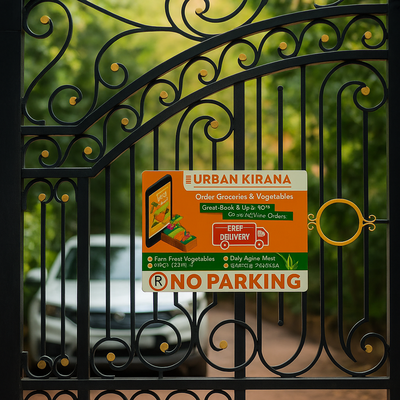
Example of a No Parking board advertisement. The board reserves the parking spot while also promoting the brand’s services at a society gate. Such boards are waterproof, durable, and remain in place for months, ensuring repeated exposure to residents and visitors.
- Auto Sector – Online Used-Car Platform: We touched on this as a creative campaign. While Online Used-Car Platform’s Father’s Day activation was a short-term stunt, it’s worth noting how effective it was in demonstrating engagement. The sarcastic “reserved parking” boards not only got people talking at the locations, but also earned coverage in the media for their originality. This shows that even big-budget brands see value in ‘No Parking’ ads – not for lack of budget, but for the unique impact and viral potential they offer. In everyday use, automobile dealers (used car lots, service centers, etc.) also often use no parking boards near their outlets to direct customers and advertise promos (“No Parking – Visit XYZ Car Service, 500m ahead”). It blends utility (keeping the area clear) with messaging.
- Retail & Others: Many other case studies abound – from Narayana Health clinics raising local health camp awareness with society gate boards, to Cashify (a smartphone resale startup) using them in residential areas to find people looking to sell old phones. The pattern is clear: brands that need local footfall or neighborhood-level penetration benefit greatly from no parking advertising. Even large FMCG brands have used it tactically – e.g., a new dairy brand might put boards in a locality announcing “No Parking – Amul Now Available at Your Local Store” to drive store visits. The possibilities are endless, as this medium essentially turns every gated premise into an advertising canvas. Brands that experiment here often find it a “credible and efficient” channel, as it feels more like a community bulletin than a blatant ad, thus gaining consumer trust.
ROI and Pricing: No Parking Boards vs Other OOH Formats
One of the strongest arguments in favor of no parking board advertising is the return on investment (ROI). Let’s compare it to traditional out-of-home in terms of cost and impact:
- Budget-Friendly Exposure: To illustrate, consider the cost of a typical billboard (hoarding) in a major city. In Mumbai, a single static billboard in a high-traffic area can cost anywhere from ₹2 lakh to ₹6 lakh per month. Even in a Tier-2 city like Jaipur, a decent hoarding might be ₹40k–₹100k a month. Now compare that to no parking boards: for the price of one big city hoarding for one month, you could print and deploy perhaps 5,000 no parking boards (at ~₹50 each) and have them up for six months straight! That is an almost incomparable difference in cost per ad and duration. Of course, a billboard delivers million-plus impressions across a city, whereas each no parking board delivers a few hundred impressions in its immediate vicinity – they serve different objectives. But when it comes to cost-efficiency, no parking boards shine. A campaign of 500 boards might cost on the order of ₹20–25 thousand total, covering a couple of neighborhoods for half a year. Many startups and local brands have realized that this kind of “low investment promotional medium” can yield excellent returns, especially when conversions depend on local reach.
- Cost per Impression: If we crunch the numbers, the CPM (cost per thousand impressions) for no parking boards often beats larger OOH. For example, say 500 boards in Bangalore reach ~150,000 people (as estimated). If that campaign costs ₹25,000, the cost per person reached is roughly ₹0.17 – or ₹170 per thousand impressions (CPM). Now, a single premium billboard might reach, say, 1,000,000 people in a month, but costing ₹5,00,000, which is ₹0.50 per person or ₹500 per thousand impressions. By this simplistic measure, the no parking boards delivered the message at about one-third the cost per impression of the billboard. In reality many factors vary, but the point stands: micro media can be remarkably cost-efficient. SmartAds.in emphasizes that “no parking board advertising is a low-risk, high-return investment” and another platform likewise notes it comes with “greater impact and higher ROI” for the money spent. For small and medium enterprises (SMEs) especially, this ROI advantage can mean the difference between an ad campaign being feasible or not.
- Comparing ROI with Other OOH: Apart from billboards, how do no parking boards fare against other OOH like transit ads or digital screens? Let’s consider transit media: something like a bus shelter ad in a metro might cost ₹30,000 per month for one shelter, reaching a broad array of commuters. If our same ₹30,000 were put into no parking boards, we could target perhaps 20 strategic residential locations with ~600 boards (assuming bulk rate ~₹50 each). Which yields better ROI depends on the campaign – bus shelter might give city-wide brand presence, whereas 600 boards saturating 2-3 neighborhoods give localized dominance (everyone in those areas sees the brand multiple times a day). For a neighborhood store or an event in a specific area, the board strategy clearly wins. For a mass consumer brand, the transit ad might serve a different goal (wider reach). However, even large brands are starting to realize that splitting a fraction of their OOH budget into these micro-media can dramatically increase local engagement. The “good return on investment… at a budgeted price” delivered by no parking boards is repeatedly proven when sales lift or footfall in targeted localities can be attributed to these omnipresent little signs.
- Measurability and ROI Tracking: One traditional challenge with OOH is measurement – and no parking boards are no exception. It can be tricky to directly attribute conversions to them unless you use clever tracking (like a unique phone number or QR code on the board). But marketers have found proxies to gauge ROI: for instance, local store owners report increased walk-ins from nearby apartments after putting up boards, or service brands see a spike in calls from pin codes where boards were deployed. Because the investment is low, even a handful of new customers gained can justify the cost. The risk-reward ratio is strongly in favor: as SmartAds.in observes, even if one can’t precisely quantify every view, the “significant returns on investment” and brand recognition from a well-executed campaign make it worthwhile. And unlike digital ads that vanish after the campaign, a no parking sign might still be hanging and doing its job quietly months later.
SmartAds.in’s Take and Best Practices
To lend some authority on this topic, let’s hear from SmartAds.in itself. SmartAds.in is a leading advertising platform that has been at the forefront of non-traditional media in India since 2015. In their experience serving thousands of campaigns across the country, no parking board advertising stands out as a high-ROI, impactful medium. As the SmartAds team puts it:
“No Parking Board Advertising is one of the most cost-effective forms of marketing... Better visibility, ease of installation, longevity, brand recognition, tangibility, and water resistance are all advantages of no parking board advertisement.”
They highlight that this format offers a combination of physical durability and marketing effectiveness that few other channels can match, especially at such low costs. Moreover, SmartAds.in emphasizes the inclusive reach of this medium – it “is non-discriminatory and inclusive”, able to speak to anyone in the vicinity without bias. In a country as diverse as India, that’s a notable advantage for mass-market brands aiming for broad appeal in local communities.
Another insight from SmartAds is about integration: they suggest that pairing no parking board ads with other media amplifies overall campaign performance. For example, if you’re running a radio jingle or a newspaper ad about a local offer, adding these boards in the neighborhood provides a constant visual reminder. According to SmartAds, “integrating no parking board advertising with other advertising mediums can help you notch up good results for your marketing plans.” This holistic approach ensures that a potential customer hears about your brand on radio or sees it online, and then also physically sees your branding on their street – reinforcing credibility and prompting action.
SmartAds.in’s own success with this format speaks volumes. They note that many of their clients, including private and public organizations, have “achieved good returns from using this simple and cost-effective advertising tool”. The company has been offering 360° media services across India and has seen first-hand how a small investment in no parking boards can boost local brand recognition and sales. “So far thousands of organizations have realized the benefits of engaging with us through advertising... We have developed to be one of the largest advertising agencies based in Mumbai,” the SmartAds team mentions, underlining their expertise in both traditional and non-traditional ad formats.
For marketers considering diving into no parking board ads, here are a few best practices distilled from experts (and common sense):
- Plan Your Target Areas: Do your research on which localities matter most for your campaign. Identify the neighborhoods or streets where your potential customers are concentrated. A site inspection can help – as one guide suggests, evaluate spots for visibility and foot traffic, and ensure you have permission to put up the boards (usually from the building or local authority).
- Design for Clarity: Keep the board design simple and bold. Remember people often see it briefly as they walk or drive by. Use large fonts, bright contrast, and include essential information (brand name/logo, a short tagline or offer, and a contact number/website if applicable). Avoid clutter; the “No Parking” text is usually pre-printed or added by default, so focus your design on the ad message portion. Many brands use bilingual text (local language + English) in areas where that helps connect with the audience, as seen in the IDFC Bharat campaign which produced multilingual boards.
- Quality and Durability: Opt for good quality sunpack or tin sheet printing. It’s worth spending a little extra for UV-resistant ink or lamination, since these boards will face weather. According to SmartAds, “prismatic sheets” or reflective materials can also be used for better night visibility, and LED boards (though expensive) are an option for premium segments. For most campaigns, a standard waterproof sunpack with one or two color screen printing suffices – lightweight, easy to mount, and cost-effective.
- Deployment Strategy: Aim for a consistent spread of boards in the chosen area. For example, rather than putting 10 boards all on one street, cover all the main entry/exit points of a colony or every lane of a neighborhood with a few boards each. This way, residents encounter the ad wherever they turn. A rule of thumb some use is one board every 50-100 meters in residential lanes, more on busy roads. Also, ensure boards are placed at eye level and not obscured by trees or parked vehicles. Tying them to gate grills or nailing to guard hut walls are common methods. Make sure they’re secure so they don’t fall off.
- Monitor and Refresh: Though long-lasting, some boards may get damaged or removed over time. It’s good to monitor the campaign (SmartAds.in and others often provide photos as proof of installation). Replace any missing boards promptly to maintain coverage. And if your campaign runs for very long, consider refreshing the design/message every 6-12 months so locals see something new (this could coincide with changing offers or seasonal messaging).
By following these practices, brands can ensure they extract the maximum value from their no parking board advertising efforts.
Parking Your Brand in Consumers’ Minds
No parking board advertising in India has evolved from an oddball idea to a mainstream marketing tactic in the out-of-home arena. In this age of hyper-local marketing and ROI-conscious ad spending, it offers a rare sweet spot – high visibility, high recall, and low cost. From data and case studies, we’ve seen that this format can drive tangible benefits, whether it’s increasing local foot traffic, building brand recall, or augmenting a larger advertising campaign. It is particularly powerful in Tier 1 and Tier 2 cities where urban audiences are inundated with ads; a simple “No Parking” board with a brand message cuts through that clutter in the very spaces where people live and make daily decisions.
For brands and media agencies, the takeaway is clear: OOH micro media like no parking boards should be part of the advertising mix when targeting specific localities. It’s a strategy to “park” your brand quite literally at the consumer’s gate, ensuring your message is seen repeatedly and remembered. And as we’ve highlighted, when done creatively (like CARS24’s campaign) or strategically (like IDFC’s branch targeting), it can even yield buzz and engagement that far exceed the modest investment required.
In a competitive market, leveraging such innovative channels can give you the edge. SmartAds.in, with its years of experience in this domain, advocates for a data-driven yet creative approach – use the numbers to plan your reach and frequency, but also use storytelling and context to make each board memorable. As one SmartAds.in quote encapsulates, “No parking board advertising… by creating ‘buzz’ and relying on free advertising whenever possible, is more efficient and credible” in reaching today’s savvy consumers.
So next time you’re plotting an out-of-home campaign, think beyond the big hoardings. Think small to win big – a few hundred well-placed No Parking ads could very well drive results that make your marketing director say, “This is the best spend we’ve made this quarter.” In the ever-evolving landscape of advertising, it’s often these nimble, grounded tactics that outperform the expensive traditional methods. No parking board advertising is proving just that, by helping brands park their message right where it matters most.
SmartAds.in is proud to be a facilitator of this trend, helping brands large and small unlock the power of no parking boards and other non-traditional media across India. As the industry moves forward, one thing is certain – the writing (or rather, the ad) is on the wall (or the gate!), and it’s making a lasting impression.
Advertisement On No Parking Board
No Parking Board advertisement is an effective way to communicate. No Parking Board Advertising is one of the most cost-effective forms of marketing. No Parking Boards are used to communicate critical messages to the general public and are placed on roads and public spaces. SmartAds would help you create the best advertisement on No Parking Board. Better visibility,ease of installation, longevity, brand recognition, tangibility, and water resistance are all advantages of no parking board advertisement.
No Parking Board Ads
No Parking Board advertising in is designed to stand out from traditional forms of advertising. With so many ads vying for consumers attention on a daily basis, marketers are exploring new and unorthodox ways to reach their target audience. No Parking Board marketing strategies often involve placing ads in unusual locations or displaying them in creative ways to capture the interest of viewers.
No Parking Board ads are often seen as more organic, authentic, and relevant to consumers. They tend to be more targeted, speaking directly to specific demographics within their own territory. This type of advertising is also typically cheaper than more traditional forms.
While No Parking Board media is unexpected and eye-catching, it can be difficult to measure the success of a campaign. Marketers may struggle to quantify and measure their efforts, and a poorly executed campaign can even have a negative impact on a company`s reputation. Despite these challenges, No Parking Board advertising has the potential to deliver significant returns on investment.
Overall, No Parking Board marketing in is more flexible, uncertain, and subjective. It places a greater emphasis on execution rather than planning and is often more efficient and credible. By creating "buzz" and relying on free advertising whenever possible, No Parking Board advertising is non-discriminatory and inclusive.
