


Delhi

Mumbai

Bengluru

Ahmedabad

Jaipur

Chennai

Hydrabad

Kolkatta

Lucknow

Pune
ATM Advertising in India: The Hyperlocal BTL Strategy Most Brands Are Still Sleeping On
There are roughly 2.5 lakh ATMs operating across India right now, and every single one of them sits inside a small, quiet room where a person stands alone for anywhere between 45 seconds and two full minutes — with nothing to look at except the machine in front of them and the walls around them. That is not a trivial number. Most brands spend considerable sums chasing audiences on platforms where the average attention span has collapsed to under three seconds; ATM branding offers something those platforms genuinely cannot — a captive audience with undivided attention and zero competing stimuli. We have been placing campaigns on ATM networks for years at SmartAds, and the question we hear most often from brand managers is not "does it work?" — it is "why didn't we do this sooner?"
What Is ATM Advertising and How Does It Work in India?
ATM advertising is, at its core, a form of below the line advertising that places brand messaging inside or on the exterior of automated teller machine kiosks — a format which sits at the intersection of out-of-home advertising and hyperlocal targeting in a way that very few BTL advertising channels can replicate. The mechanics are straightforward: brands secure placement on ATM screens, glass doors, interior walls, receipt backs, or the machine body itself, and their message is delivered to every person who uses that particular kiosk during the campaign period. What makes this format genuinely interesting, from a media planning perspective, is the combination of physical proximity and temporal captivity — the user is not scrolling past your ad, they are standing in front of it while they wait for their transaction to complete.
India's ATM ecosystem is substantial enough to make pan India campaigns viable at scale. The Reserve Bank of India's published data consistently shows that ATM transaction volumes remain enormous even as UPI payments have grown, because cash withdrawal behaviour is deeply embedded in semi-urban and rural India where digital payment infrastructure is still patchy. The network spans metro cities like Delhi, Mumbai, and Bangalore right through to tier 2 cities like Jaipur and Lucknow, and further into tier 3 cities and rural markets where ATMs are often the only formal financial touchpoint in a catchment area. For brands that need to reach audiences across this entire spectrum — not just the urban, digitally-active consumer — advertising on ATM networks provides a distribution infrastructure that is already built, already trusted, and already attracting daily footfall.
What a lot of people miss is that ATM advertising is not a single format; it is a family of formats, each with its own reach dynamic, cost structure, and creative requirement. A campaign that uses only ATM screen advertising will behave very differently from one that combines glass door branding with in-room ATM advertising and receipt-based offers. At SmartAds, we always tell our clients that the format selection should follow the objective — if you want brand visibility, the exterior and glass door are your primary assets; if you want action and lead generation, the screen and receipt are where the conversion mechanics live.
What Are the Different Types of ATM Advertising Formats Available?
The format landscape for ATM advertising in India is considerably richer than most media planners initially assume, which is part of why campaigns planned without specialist knowledge often underperform. ATM glass door branding is typically the first format brands encounter — it involves vinyl wraps or printed panels applied to the transparent glass door of the ATM kiosk, which means the brand message is visible from the street or mall corridor before a consumer even enters the vestibule. This is essentially a mini-billboard at eye level, placed in a location that has been pre-selected for high footfall by the bank or white label ATM operator; the catchment area benefit is built in.
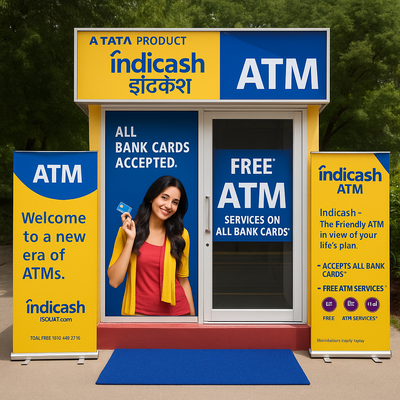
ATM screen advertising operates on a different logic entirely. The digital screens on modern ATMs — particularly on white label ATM networks like Indicash and India1 ATM — can display dynamic, rotating creatives during the idle state of the machine, which means your brand gets exposure to every person who approaches the kiosk even if they do not complete a transaction. ATM AdNext, the advertising platform operated by Tata Communications Payment Solutions Ltd (TCPSL) under the Indicash network, has been particularly active in this space, offering screen-based placements across thousands of ATMs with the ability to schedule content by time of day, geography, and even language — a capability which we will return to when discussing tier 2 and tier 3 city strategy. In-room ATM advertising covers the interior walls, side panels, and ceiling cards of the ATM vestibule itself, which are the surfaces a user faces during the 45 to 120 seconds they spend completing their transaction; this is where dwell time works most powerfully in the advertiser's favour.
ATM receipt advertising deserves special mention because it is chronically underused relative to its effectiveness. The back of an ATM receipt is a small but guaranteed-to-be-handled piece of print media — the user takes it, looks at it, and often folds it into their wallet. Brands that print QR codes, discount coupons, or promotional offers on ATM receipts have found this to be a surprisingly strong lead generation tool, particularly for FMCG brands running local promotions and NBFC brands offering loan products to the exact demographic that is withdrawing cash at a particular kiosk. ATM wrapping — where the entire machine body is covered in brand livery — and ATM standee advertising, which places a freestanding display unit inside the vestibule, round out the format menu; ATM poster advertising on interior walls is the most cost-effective entry point for brands testing the channel for the first time.
How Does ATM Advertising Enable Hyperlocal Targeting for Brands?
Frankly speaking, hyperlocal advertising is one of those terms that gets thrown around a lot in media planning conversations without much rigour behind it — but ATM advertising is one of the few formats where the hyperlocal claim is genuinely defensible. Every ATM kiosk has a defined catchment area, typically a radius of 500 metres to 1.5 kilometres depending on whether it is located in a dense urban market or a semi-urban township; the people using that machine are, by definition, residents or regular visitors of that catchment area. This is not a probabilistic inference the way digital targeting is — it is a physical reality. When a brand books advertising on ATM kiosks in a specific pin code or locality, they are reaching the community of that locality with a precision that most out-of-home advertising cannot match.
The hyperlocal targeting capability becomes even more powerful when you layer in the demographic intelligence that ATM operator data provides. Kiosks located inside or adjacent to housing societies in Pune's Kothrud or Bangalore's Whitefield attract a very different user profile than kiosks placed in a wholesale market in Ludhiana or a mandi town in Rajasthan — and a well-planned ATM advertising campaign accounts for this. We worked with a retail banking client who wanted to promote a new savings product specifically to middle-income households in Tier 2 cities; by selecting ATM kiosks in residential neighbourhoods rather than commercial zones, we were able to concentrate the campaign's reach on exactly the target audience the product was designed for, which reduced the effective cost per relevant impression significantly compared to what a city-wide OOH advertising plan would have cost.
On top of that, the combination of ATM screen advertising with time-of-day scheduling adds a behavioural targeting dimension that is unusual for a physical medium. Morning ATM users in residential areas tend to be salaried individuals on their way to work; afternoon users in market areas tend to be traders and small business owners; evening users near entertainment zones are often young adults. A brand that understands this rhythm can schedule its ATM screen advertising creatives to match the most relevant audience window — which is a level of strategic sophistication that most brands using this channel have not yet explored.
What Does ATM Advertising Cost in India?
This is the question that every media planner eventually asks, and it is also the question where most published information is either vague or outdated. We will be as specific as the market allows, while acknowledging that rates vary by city, network, format, and campaign duration. ATM glass door branding in a metro like Mumbai or Delhi typically works out to somewhere in the range of ₹3,000 to ₹6,000 per kiosk per month for a standard vinyl or printed panel placement — which, when you consider that a well-located ATM in a residential area might serve 200 to 400 unique users per day, translates to a cost per thousand impressions that is genuinely competitive with most OOH advertising formats. In Bangalore and Hyderabad, rates tend to be slightly lower, in the ballpark of ₹2,500 to ₹5,000 per kiosk per month, while Tier 2 cities like Jaipur, Lucknow, and Nagpur can be accessed for roughly ₹1,200 to ₹2,500 per kiosk per month — a figure which surprises most first-time advertisers when they realise the footfall quality in these markets is often higher relative to cost than in saturated metros.
ATM screen advertising rates on networks like Indicash AdNext are structured differently, typically on a per-screen per-month basis with packages that bundle a minimum number of screens across a geography. A campaign covering 100 screens in a single city for a month might cost somewhere between ₹2 lakh and ₹5 lakh depending on the city tier and the screen network, which works out to a cost per screen that is considerably lower than a comparable digital screen placement in a mall or transit hub. ATM receipt advertising is priced per thousand receipts printed, with rates generally in the range of ₹150 to ₹400 per thousand depending on the network and geography — making it one of the most cost-effective advertising rates available in any BTL advertising format. ATM wrapping, which involves more complex production and installation, carries a premium; full machine wraps in metro markets can run to ₹8,000 to ₹15,000 per machine per month inclusive of production, but the brand visibility impact is proportionally higher.
What we tell our clients at SmartAds is that the minimum budget to run a meaningful ATM advertising campaign — one with enough geographic coverage to generate measurable brand awareness rather than just isolated placements — is somewhere around ₹3 to ₹5 lakh for a city-level campaign, and ₹15 to ₹25 lakh for a pan India campaign covering 500 to 1,000 kiosks across multiple city tiers. These are not small numbers for a small business, but they are significantly lower than the entry cost for comparable reach through television or large-format OOH advertising; and for an NBFC or a regional FMCG brand that needs to speak to a specific geographic community rather than a national audience, the return on investment calculation often favours ATM branding quite strongly.
Which Industries Benefit the Most from ATM Advertising in India?
The answer here is more nuanced than most category lists suggest. Banking and finance brands are the obvious natural fit — and they do use ATM advertising extensively, from private banks promoting credit card offers to NBFCs advertising personal loan products to the exact demographic that is withdrawing cash because they need liquidity. The contextual alignment is almost too perfect; a person standing at an ATM is, by definition, thinking about money at that precise moment, which makes them unusually receptive to a well-crafted financial services message. DBS digibank ran a particularly effective co-branding campaign on ATM networks that used the contextual moment to drive app downloads, which is a good example of how a digital-first brand can use physical ATM branding to bridge into its target audience's offline behaviour.
FMCG brands are the second major category, and they use ATM advertising in a way that is more about catchment-area brand visibility than contextual relevance. A soap brand, a biscuit brand, or a regional snack company that wants to build brand awareness in a specific residential neighbourhood will find that ATM glass door branding and in-room ATM advertising in that neighbourhood's kiosks delivers concentrated, repeated exposure to the local community — the kind of frequency-building that drives brand recall in the way that a single newspaper insertion or a radio spot cannot. We ran a campaign for a regional FMCG client in Maharashtra that used ATM poster advertising across 300 kiosks in tier 2 cities; over a 45-day period, the brand's prompted recall in those markets improved measurably in post-campaign surveys, at a total advertising cost that was roughly 40% lower than a comparable print campaign would have been.
Education brands — particularly schools, coaching institutes, and early childhood education chains like Kidzee — have found ATM advertising to be an excellent lead generation tool when combined with receipt-based QR codes or SMS opt-in mechanics. The reasoning is straightforward: parents of young children are disproportionately represented among the working-age adults who use ATMs in residential areas, and a well-placed ATM standee advertising piece or a receipt coupon offering a free school visit can generate enquiries at a cost per lead that is difficult to match through digital channels in smaller cities. Healthcare brands, real estate developers, e-commerce brands running local delivery promotions, and government scheme awareness campaigns — including Jan Dhan and Digital India outreach — have all found productive applications for this format.
What Is White Label ATM Advertising and How Does It Work?
White label ATMs — which are ATMs deployed and operated by non-bank entities under a licence from the Reserve Bank of India — represent a particularly interesting segment of the ATM advertising ecosystem, and one which most brands have not fully explored. The RBI's white label ATM framework, introduced in 2013, allowed companies like Tata Communications Payment Solutions Ltd (TCPSL), which operates the Indicash network, and The Banktech Group, which operates India1 ATM, to deploy ATMs in underserved areas — particularly in tier 3 cities, semi-urban markets, and rural India — where bank-owned ATM density was low. Hitachi Money Spot ATM is another operator in this space. These networks have, over time, developed sophisticated advertising platforms specifically because their revenue model requires supplementary income streams beyond transaction fees.
ATM AdNext, operated by TCPSL under the Indicash brand, is arguably the most developed ATM advertising platform in India; it offers screen advertising, in-room ATM advertising, and receipt-based placements across a network that spans thousands of locations, with particular depth in tier 2 and tier 3 cities and rural India. What makes white label ATM advertising strategically valuable is the geographic distribution of these machines — they are often the only ATM in a particular village or small town, which means the footfall is concentrated and the captive audience is genuinely captive in a way that urban ATMs, which face competition from nearby machines, are not. For brands targeting rural India or semi-urban markets — whether for FMCG distribution, microfinance awareness, or government scheme communication — white label ATM networks provide a physical media infrastructure that reaches communities which are effectively media dark areas for most conventional advertising formats.
The RBI's regulatory framework for white label ATMs does permit third-party advertising on these machines, subject to guidelines around content appropriateness and the primacy of banking transaction information on screens — which is worth understanding before briefing creative teams. Advertising content cannot interfere with the transaction process, screen advertising must yield immediately when a user initiates a transaction, and certain categories of advertising (such as competing financial products in some interpretations) may face restrictions depending on the network operator's policies. At SmartAds, we navigate these requirements routinely, and our experience shows that working within these parameters is straightforward once the creative brief is written with the format's constraints in mind.
What Are the Key Benefits of ATM Advertising Over Other BTL Formats?
The case for ATM advertising rests on a cluster of advantages that, taken together, are genuinely difficult to replicate in any other single BTL advertising format. The first and most important is dwell time — the 45 to 120 seconds of undivided attention that every ATM user spends in the vestibule is a number that media planners should treat as a hard competitive advantage. Compare this to lift advertising, where dwell time is typically 15 to 30 seconds and the user is often on their phone; or to bus shelter advertising, where the audience is moving and distracted; or to in-store POS material, which competes with hundreds of other brand messages in the same environment. ATM branding operates in a clutter-free advertising environment — there are typically no more than two or three brand messages in the entire vestibule, which means share of attention is dramatically higher than in almost any other OOH advertising context.
The second major advantage is the combination of high footfall and geographic precision. A well-located ATM in a residential area of Mumbai or a market street in Lucknow might process 300 to 600 transactions per day; across a 30-day campaign on 500 kiosks, that is a reach figure in the tens of millions of impressions, delivered to a geographically defined and demographically coherent audience. This is not the same as a pan India television campaign, which reaches a vast but diffuse audience — it is concentrated, repeated brand exposure to a specific community, which is exactly what brand awareness building at the local level requires. Non-traditional advertising formats that offer this combination of footfall scale and geographic precision are genuinely rare.
Cost-effective advertising is a phrase that gets overused, but in the context of ATM advertising it is arithmetically defensible. When we have run the CPM calculations for clients comparing ATM glass door branding against comparable formats — transit advertising, mall branding, residential society activation — the ATM numbers consistently come out favourably, particularly in tier 2 and tier 3 markets where the cost per kiosk is low but the relative footfall share is high. The phygital marketing potential — where a physical ATM placement drives digital engagement through QR codes on screen or receipt-based SMS marketing — adds a measurability layer that most traditional OOH advertising cannot offer, which makes the return on investment conversation with management considerably easier to have.
Is ATM Advertising Effective in Tier 2 and Tier 3 Indian Cities?
Our honest answer, based on years of campaign data, is that tier 2 and tier 3 cities are where ATM advertising often delivers its strongest return on investment — and this is a point that most discussions of this format miss entirely. The logic is straightforward: in a metro like Delhi or Mumbai, a consumer is exposed to hundreds of brand messages daily through billboards, digital screens, transit advertising, and social media; one more message on an ATM glass door adds to an already saturated attention environment. In a tier 2 city like Coimbatore or Bhopal, or a tier 3 city like Aligarh or Muzaffarpur, the ambient advertising density is dramatically lower; an ATM branding placement in these markets has a disproportionately high share of the consumer's visual attention budget.
The white label ATM networks are particularly valuable here, because their geographic footprint in semi-urban and rural India is deeper than bank-owned ATM networks. Indicash, India1 ATM, and Hitachi Money Spot ATM have collectively deployed machines in hundreds of towns and villages where the nearest competing ATM is several kilometres away — which means the catchment area for each machine is larger, footfall is more concentrated, and the advertising exposure per kiosk is higher. For FMCG brands doing rural India distribution pushes, for microfinance institutions and NBFCs targeting underserved credit markets, and for government scheme communication campaigns, these networks provide a media reach that is simply not available through any other physical advertising format at comparable cost.
ATM screen advertising in these markets also has a language advantage that is worth highlighting. The Indicash AdNext platform, for instance, supports content delivery in multiple Indian languages — which means a brand can run its creative in Hindi in Uttar Pradesh, Tamil in Tamil Nadu, and Bengali in West Bengal, all within the same campaign framework. This regional language capability is a genuine differentiator for brands that understand that a message in the consumer's mother tongue performs meaningfully better than the same message in English or even standard Hindi, particularly in tier 3 cities and rural markets where language proximity is a trust signal.
How Do I Book ATM Advertising Across Cities Like Delhi, Mumbai, and Bangalore?
The booking process for ATM advertising is less standardised than, say, newspaper or radio advertising, which means the quality of the agency relationship matters more than it does in those channels. The first step is catchment area selection — identifying which pin codes, localities, or market zones you want to cover, which should be driven by your brand's distribution footprint, your target audience's residential patterns, or the specific retail locations you are trying to drive traffic to. This is not a step to rush; we have seen campaigns underperform simply because the kiosk selection was done on the basis of availability rather than strategic fit.
Once the geography is defined, format selection follows — and this is where understanding the ATM advertising rates for each format in each city becomes important. Delhi NCR, Mumbai, and Bangalore have the highest rate cards, but they also have the highest ATM density, which means you have more choice in kiosk selection and can be more precise about neighbourhood targeting. A campaign covering 200 kiosks in Delhi NCR with ATM glass door branding and in-room ATM advertising, for instance, can be structured to cover specific residential corridors in Dwarka, Rohini, or Noida without paying for coverage in areas that are not relevant to your distribution strategy. In Mumbai, the distinction between Western Suburbs, Central Line catchments, and Navi Mumbai is significant enough that kiosk selection should be treated as a media planning decision, not an administrative one.
Creative specifications vary by format and network — ATM glass door panels are typically 1.5 feet by 4 feet for standard kiosk doors, though dimensions vary by kiosk manufacturer; ATM screen advertising creatives are generally produced in 800x600 or 1024x768 pixel formats for older screens, with some newer networks supporting HD resolutions; ATM receipt advertising requires artwork sized to the receipt width, typically 80mm, with QR codes and promotional text that remain legible at small scale. At SmartAds, we handle the full campaign workflow — from catchment area mapping and kiosk selection through creative production, booking coordination with network operators, and post-campaign proof of execution — which is particularly important in a format where physical verification of installation quality is the only way to confirm that what was booked was actually delivered.
Can ATM Advertising Be Integrated With Digital and Phygital Campaigns?
This is where ATM advertising gets genuinely exciting from a modern media planning perspective, and it is an area where most brands are leaving real value on the table. The integration of QR codes into ATM screen advertising and ATM receipt advertising creates a direct bridge between the physical touchpoint and a digital action — a consumer who scans a QR code on an ATM receipt while standing at the machine is demonstrating a level of engagement that is qualitatively different from a passive impression on a billboard or a skipped pre-roll ad. We ran an ATM advertising campaign for an education brand in which receipt-based QR codes linked to a landing page for school admissions; the conversion rate from QR scan to form fill was substantially higher than the brand's comparable digital campaign, which we attribute to the combination of contextual relevance and the unhurried attention that the ATM environment provides.
SMS marketing integration works similarly — some ATM networks can trigger an SMS to the user's registered mobile number at the point of transaction, carrying a promotional message or a discount coupon code on behalf of the advertiser. This is a form of permission-based outreach that is both more targeted and less intrusive than cold SMS blasts, because the trigger is a real-time transaction event rather than a list-based broadcast. The combination of a physical ATM branding impression and a triggered SMS creates a two-touch phygital marketing sequence that reinforces brand recall in a way that either channel alone cannot achieve.
On top of that, the data generated by QR code scans and SMS responses from ATM advertising campaigns provides a measurability layer that makes the return on investment calculation considerably more precise than it is for most OOH advertising formats. A brand can track exactly how many receipts generated scans, which kiosk locations drove the highest engagement, and what the conversion rate from scan to purchase or enquiry was — which is the kind of campaign intelligence that makes the next ATM advertising campaign smarter than the last one. This is a meaningful advantage over formats like transit advertising or newspaper inserts, where impression measurement is estimated rather than directly observed.
ATM Advertising vs Other BTL Channels: An Honest Comparison
To be fair, ATM advertising is not the right answer for every brief — and we would rather give clients an honest assessment than oversell a format. Compared to lift advertising in residential apartments, ATM advertising typically offers higher footfall per location but lower frequency of exposure to the same individual; a resident who uses their building's lift multiple times a day will see a lift panel ad with far greater repetition than they will see an ATM glass door branding piece, which they may visit only two or three times a month. For campaigns where frequency is the primary objective — building deep recall through repeated exposure to the same audience — lift advertising in a targeted housing society can sometimes outperform ATM branding on a cost-per-frequency basis.
Compared to electricity bill inserts or door-to-door pamphlet distribution, ATM advertising scores higher on brand perception — there is an implicit credibility transfer from the banking environment that makes a brand message placed on or inside an ATM feel more trustworthy than a loose flyer pushed under a door. This matters particularly for financial services brands, healthcare brands, and education brands where trust is a prerequisite for engagement. The clutter-free advertising environment of an ATM vestibule is also a significant advantage over newspaper inserts, which compete with dozens of other inserts and the editorial content of the paper itself for the reader's attention.
Where ATM advertising genuinely struggles relative to other BTL formats is in creative flexibility and production lead time. A newspaper insert can be produced in 48 hours; an ATM glass door panel requires printing, logistics, and installation across potentially hundreds of locations, which means lead times of two to three weeks are typical for a well-executed campaign. ATM screen advertising has shorter lead times for creative deployment on digital networks, but the creative canvas is constrained by screen size and the need to communicate a message in a few seconds before the transaction begins. These are real limitations, and a media plan that ignores them will run into execution problems; at SmartAds, our experience shows that the campaigns which work best are those where the creative brief is written specifically for the ATM format rather than adapted from a creative originally designed for another medium.
Frequently Asked Questions
Q: What is ATM advertising and how does it work?
ATM advertising is a form of below the line advertising that places brand messages on or inside automated teller machine kiosks — on the glass door, interior walls, the machine screen, the transaction receipt, or the machine body itself. It works by intercepting consumers at the moment they are using an ATM, delivering a brand message during the 45 to 120 seconds of captive attention that the transaction process creates. The format operates across both bank-owned ATM networks and white label ATM networks, and can be booked on a per-kiosk, per-city, or pan India basis depending on the campaign's geographic objectives. The core mechanism is simple: high footfall location plus a clutter-free advertising environment plus a captive audience equals brand exposure that is difficult to ignore.
Q: What are the different types of ATM advertising formats available in India?
The main formats are ATM glass door branding (vinyl or printed panels on the kiosk's exterior glass door, visible from outside), ATM screen advertising (digital creatives displayed on the ATM's screen during idle state), in-room ATM advertising (posters, panels, or wraps on the interior walls and surfaces of the vestibule), ATM receipt advertising (brand messages, QR codes, or discount coupons printed on the back of transaction receipts), ATM wrapping (full or partial wrap of the machine body in brand livery), ATM standee advertising (freestanding display units placed inside the vestibule), and ATM poster advertising (printed posters on interior walls). Each format has different cost structures, creative specifications, and audience engagement dynamics, and the best campaigns typically combine two or three formats rather than relying on a single placement.
Q: How much does ATM advertising cost in India?
ATM advertising rates vary considerably by city, format, and network. As a general benchmark, ATM glass door branding in metros like Mumbai and Delhi works out to roughly ₹3,000 to ₹6,000 per kiosk per month, while tier 2 cities like Jaipur and Lucknow are in the ballpark of ₹1,200 to ₹2,500 per kiosk per month. ATM screen advertising on digital networks is typically packaged at a per-screen per-month rate, with city-level campaigns of 100 screens costing somewhere between ₹2 lakh and ₹5 lakh. ATM receipt advertising is priced per thousand receipts, generally in the range of ₹150 to ₹400 per thousand. Production costs for vinyl panels and machine wraps are additional. These are indicative ranges — actual advertising rates depend on the specific network, campaign duration, and volume of locations booked.
Q: What is the minimum budget required to start an ATM advertising campaign in India?
A meaningful city-level ATM advertising campaign — one with enough kiosk coverage to generate measurable brand awareness rather than token presence — typically requires a minimum budget of around ₹3 to ₹5 lakh, inclusive of production and installation. For a pan India campaign covering multiple city tiers and 500 to 1,000 kiosks, the budget range is more typically ₹15 to ₹25 lakh. ATM advertising for small business is possible at lower budgets if the campaign is focused on a single locality or a small cluster of kiosks — a hyperlocal campaign covering 20 to 30 kiosks in a specific residential area can be executed for ₹50,000 to ₹1.5 lakh, which makes it genuinely accessible for local businesses, coaching institutes, or regional FMCG brands testing the format for the first time.
Q: Which industries benefit the most from ATM advertising?
Banking and finance brands benefit most obviously, because the contextual alignment between the medium and the message is almost perfect — a consumer thinking about money is naturally receptive to financial product offers. NBFCs promoting personal loans, credit card issuers, insurance brands, and digital payment platforms have all found strong return on investment from ATM branding campaigns. FMCG brands use the format for catchment-area brand visibility and promotional activation. Education brands — particularly schools and coaching institutes — use receipt-based QR codes for lead generation. Healthcare brands, real estate developers, e-commerce brands running local promotions, and government scheme communication campaigns have all found productive applications. The format is broadly applicable; the key is matching the kiosk selection to the brand's target audience geography.
Q: Can small businesses advertise on ATMs?
Yes, and this is one of the format's underappreciated advantages. Because ATM advertising can be booked at the individual kiosk level, a small business with a genuinely local catchment area — a restaurant, a pharmacy, a coaching institute, a real estate developer with a single project — can run a campaign on the 10 to 30 ATMs within their relevant radius without committing to a city-wide or pan India buy. ATM advertising for small business works best when the creative is simple, the offer is clear, and the kiosk selection is tightly aligned with the business's actual customer geography. The cost per kiosk in tier 2 and tier 3 cities is low enough that even modest marketing budgets can sustain a meaningful presence.
Q: What is White Label ATM advertising and who are the main operators in India?
White label ATMs are ATMs operated by non-bank entities under a Reserve Bank of India licence, deployed primarily in underserved markets — tier 3 cities, semi-urban areas, and rural India — where bank-owned ATM density is insufficient. The main operators are Indicash (operated by Tata Communications Payment Solutions Ltd / TCPSL), which runs the ATM AdNext advertising platform; India1 ATM (operated by The Banktech Group); and Hitachi Money Spot ATM. These networks have developed advertising platforms specifically because their revenue model requires supplementary income, and they offer screen advertising, in-room placements, and receipt-based advertising across networks that reach communities which are effectively invisible to most conventional advertising formats. For brands targeting rural India and semi-urban markets, white label ATM networks are among the most valuable non-traditional advertising assets available.
Q: How does ATM advertising help with hyperlocal targeting?
Every ATM kiosk has a defined catchment area — the geographic radius from which its regular users are drawn, typically 500 metres to 1.5 kilometres in urban areas and larger in rural markets. By selecting kiosks in specific pin codes, neighbourhoods, or market zones, a brand can concentrate its advertising exposure on exactly the community it wants to reach, with a geographic precision that most OOH advertising formats cannot match. This hyperlocal targeting capability is particularly valuable for brands with localised distribution, for businesses driving footfall to specific retail locations, and for campaigns targeting specific residential communities or market clusters. The ability to select kiosks by locality, combined with time-of-day scheduling on digital screen networks, makes ATM advertising one of the most precise hyperlocal advertising tools available in the Indian market.
Q: How long does a viewer spend at an ATM — and does this matter for ad recall?
The average dwell time at an ATM in India is somewhere between 45 seconds and two minutes, depending on the transaction type and queue conditions. This matters enormously for ad recall, because the relationship between dwell time and memory encoding is well-established in advertising research — longer exposure to a message, in a low-distraction environment, produces stronger recall than shorter exposure in a high-distraction environment. The ATM vestibule is one of the lowest-distraction advertising environments that exists in the physical world; there is no competing editorial content, no other consumers browsing nearby, and no digital notifications pulling attention away. Our experience at SmartAds shows that post-campaign recall scores for ATM branding campaigns are consistently higher than for comparable OOH advertising formats, which we attribute directly to this combination of dwell time and undivided attention.
Q: What is ATM screen advertising and how is it different from ATM glass door branding?
ATM screen advertising uses the digital display screen of the ATM machine itself to show brand creatives during the machine's idle state — before a user initiates a transaction. It is a dynamic format that can display animated content, rotate multiple creatives, and be scheduled by time of day and geography. ATM glass door branding,
