



Delhi

Mumbai

Bengluru

Ahmedabad

Jaipur

Chennai

Hydrabad

Kolkatta

Lucknow

Pune
E Rickshaw Non Traditional Advertising: The Mobile Billboard Strategy Rewriting Hyperlocal Brand Visibility in India
This article contains actual rate benchmarks, city-specific market intelligence, campaign booking guidance, and ROI measurement frameworks that most agency pages simply do not publish. If you are evaluating e rickshaw BTL advertising for a brand or planning a transit media campaign in 2025, the data and strategic context here will save you considerable time and budget.
What Is E Rickshaw Non Traditional Advertising and How Does It Work in India?
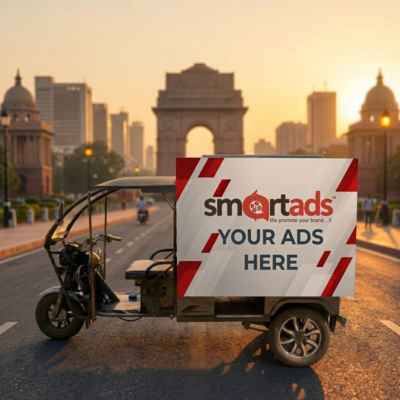
Most brand managers we speak with have seen e rickshaws on the road carrying wrapped branding for a local coaching institute or a regional FMCG product, and their first instinct is to dismiss it as a tier-2 city tactic — which is, frankly speaking, one of the more expensive assumptions a media planner can make. E rickshaw non traditional advertising is a form of transit media advertising where battery-operated electric rickshaws are converted into moving brand communication vehicles through vinyl wraps, hood panels, stepney covers, back panels, or mounted LED screens; the vehicles then operate on pre-planned routes through high-density residential and commercial corridors, generating continuous impressions across a target audience that no static hoarding can replicate.
The mechanics of how this works are worth understanding in some detail, because the operational model is quite different from what most ATL-trained planners expect. A fleet of e rickshaws — anywhere from 10 vehicles for a hyperlocal campaign to several hundred for a pan India advertising push — is identified through an aggregator network or directly through driver cooperatives; each vehicle is then branded with the advertiser's creative using UV-resistant vinyl material, and the fleet is deployed on GPS-tracked routes that are mapped to the brand's target geography. The routes are typically planned to cover last-mile connectivity corridors — areas between metro stations and residential colonies, market approach roads, hospital zones, school belts — which are precisely the spaces that traditional outdoor advertising India formats like hoardings and bus shelters tend to miss.
What a lot of people miss is that the Indian electric rickshaw market has grown at a pace that makes this medium genuinely scalable. With over 15 lakh e rickshaws estimated to be operating across Indian cities as of 2024, and the fleet expanding particularly aggressively in Delhi NCR, Kolkata, Lucknow, Jaipur, and the eastern belt of Uttar Pradesh and Bihar, the inventory available for e rickshaw branding has crossed a threshold where national brands can legitimately consider it as a primary BTL advertising channel rather than a supplementary one. At SmartAds, we always tell our clients that the vehicle is not just a canvas — it is a route, a frequency, and a demographic selector all rolled into one media unit.
What Are the Different Types of E Rickshaw Branding Formats Available?
The format question is where most campaigns either get the creative strategy right or completely waste their print budget, and we have seen both outcomes enough times to have strong opinions here. The most commonly used format is the full vehicle wrap, which covers the body panels, hood, and rear of the e rickshaw in a continuous vinyl graphic — this is the highest-visibility option and commands the most attention from pedestrians and co-passengers, but it also requires the most precise creative adaptation because the wrap must account for wheel arches, door gaps, and the curved geometry of the vehicle body.
Stepney cover branding is a format that deserves far more strategic attention than it typically receives; the spare tyre mounted at the rear of most e rickshaw models presents a circular, eye-level canvas that is directly in the sightline of pedestrians walking behind the vehicle and of drivers in following traffic — which means it functions almost like a moving poster in stop-and-go urban traffic conditions. A retail client in Pune that we worked with ran a stepney cover branding campaign for a new store launch, pairing the circular format with a QR code advertising execution; the QR code scan rate on that specific format outperformed the hood panel creative by a margin that surprised even our own team, partly because the eye-level positioning and the circular frame made the code easier to scan from a short distance.
Beyond full wraps and stepney cover branding, there are several other formats that serve specific campaign objectives. Auto hood advertising — the branding applied to the front canopy or bonnet area of the e rickshaw — offers strong visibility at intersections and is particularly effective for brand awareness campaigns where a single bold visual and a brand name need to register quickly. Back panel advertising covers the rear-facing surface, which is the most-viewed panel in congested traffic. LED screen advertising mounted on the roof or rear of select e rickshaw models introduces a dynamic digital display advertising element to the format, allowing brands to rotate multiple creatives across the day — which is particularly valuable for FMCG sector campaigns running time-sensitive promotions or for EdTech and coaching institutes advertising different courses to different audience segments across the same route.
How Much Does E Rickshaw Advertising Cost in India?
Frankly speaking, this is the question that every client asks first and that most agency pages refuse to answer — which is why we are going to be specific here, while being clear that rates vary by city, fleet size, format, and campaign duration. For a standard back panel or stepney cover branding execution in a tier-2 city like Jaipur, Lucknow, or Indore, the cost per vehicle per month works out to somewhere between ₹800 and ₹1,500, which includes the vinyl printing, installation, and basic route management. A full vehicle wrap in the same markets runs in the ballpark of ₹2,000 to ₹3,500 per vehicle per month when you factor in the higher material cost and the more complex installation process.
In metro markets — Delhi NCR, Mumbai, Kolkata, Bengaluru, Hyderabad — the e rickshaw advertising rates are naturally higher, partly because of higher operational costs and partly because the route density and daily impression count justify a premium. A full wrap in Delhi NCR typically costs somewhere between ₹3,000 and ₹5,000 per vehicle per month, while LED screen advertising formats on premium e rickshaw models can go up to ₹8,000 to ₹12,000 per vehicle per month depending on the screen size and the number of daily content rotation slots the brand purchases. For a campaign running 50 branded vehicles in Delhi NCR for a month, a brand is looking at a total investment in the range of ₹2 to ₹2.5 lakh for a back panel or stepney format — which, when you calculate the CPM against the estimated daily impressions per vehicle, works out to roughly ₹4 to ₹8 per thousand impressions; that is a number that genuinely surprises most planners when they compare it to what they are currently paying for OOH advertising on hoardings in the same city.
The minimum budget required to start an e rickshaw BTL advertising campaign in India is meaningfully lower than most non-traditional advertising formats, which is a significant part of its appeal for e rickshaw advertising for small business clients and regional brands. A 10-vehicle campaign in a single city for 30 days — which is a reasonable starting point for testing the format — can be executed for as little as ₹50,000 to ₹80,000 all-in, including creative adaptation, printing, installation, and basic monitoring. On top of that, the e rickshaw advertising cost per month scales linearly with fleet size, which means a brand can start small, measure brand recall and engagement, and then scale the fleet up for subsequent months without committing to a large upfront investment — a flexibility that static outdoor advertising India formats simply do not offer.
Why Is E Rickshaw Advertising Considered a Powerful BTL Strategy?
The honest answer is that it earns its place in a media plan not through glamour but through geometry — the geometry of where Indian consumers actually spend their time and attention. Below the line advertising, by definition, is about reaching specific audiences in specific contexts rather than broadcasting to the largest possible undifferentiated mass; and e rickshaws operate in precisely the micro-corridors — the lane between the main road and the housing society, the 400-metre stretch from the metro exit to the vegetable market — where brand visibility through conventional OOH advertising simply does not exist. A single branded e rickshaw operating in a dense residential corridor in Lucknow can generate somewhere between 8,000 and 15,000 daily impressions depending on route density and peak-hour traffic — which means a 30-vehicle fleet generates between 7.2 and 13.5 lakh impressions per month, at a cost that is a fraction of a single mid-size hoarding in the same city.
What makes this particularly powerful as a BTL advertising strategy is the proximity factor, which is something that the CPM calculation alone does not capture. When a pedestrian walking to a market or a commuter waiting at a crossing sees a branded e rickshaw at a distance of 3 to 10 metres, the brand exposure is qualitatively different from a billboard seen from 50 metres at 60 kilometres per hour; the dwell time is longer, the creative detail is legible, and the context — a familiar neighbourhood vehicle in a familiar neighbourhood setting — creates a brand association that tends to be more durable. Our experience at SmartAds shows that brand recall rates for e rickshaw branding campaigns in hyperlocal markets consistently outperform recall rates for static OOH formats in the same geography, particularly among audiences in the 25-to-45 age bracket who use e rickshaws as daily last-mile transport.
The hyperlocal advertising precision of this format is also worth dwelling on. A real estate developer launching a new residential project in Noida Sector 62 does not need pan India advertising reach — they need to reach people who live within a 5-kilometre radius of the project site, who are in the right income bracket, and who are actively thinking about housing decisions; an e rickshaw fleet operating on the routes between that sector's metro station and its residential colonies is, in effect, a targeting mechanism that no digital platform can replicate with the same physical presence and local credibility. We have seen this approach work particularly well for e rickshaw advertising real estate campaigns, e rickshaw advertising healthcare clinic launches, and e rickshaw advertising education campaigns for coaching institutes targeting students in specific localities.
How Does E Rickshaw Non Traditional Advertising Compare to Billboards and TV Ads?
The comparison is not really about which medium is better in the abstract — it is about which medium is doing the right job at the right cost for a given campaign objective, and this is where a lot of brand managers get the allocation wrong. A large-format hoarding on a national highway or a major arterial road in Mumbai serves a reach and awareness function at a city scale; a television commercial on a national GEC serves a mass brand-building function; e rickshaw non traditional advertising serves a hyperlocal marketing and activation function in the last mile — and conflating these objectives leads to either overspending on mass media for a hyperlocal launch or underinvesting in last-mile visibility for a national brand.
To be fair to the comparison, there are scenarios where e rickshaw advertising directly competes with and outperforms traditional OOH advertising on pure cost-effectiveness grounds. A mid-size hoarding in a secondary location in Delhi NCR costs somewhere in the range of ₹80,000 to ₹1.5 lakh per month, which generates a fixed number of impressions from a fixed location — whereas the same budget deployed across 25 to 30 branded e rickshaws generates a comparable or higher impression count across a much wider geographic spread, with the added advantage of reaching audiences in lanes and bylanes where no hoarding inventory exists. The GroupM TYNY Report has consistently flagged transit media advertising as one of the fastest-growing OOH sub-segments in India, and the e rickshaw format specifically has been gaining share within that category as brands in FMCG sector, EdTech, and real estate sector India have started treating it as a primary channel rather than a top-up.
Against television, the comparison is less about cost per impression and more about campaign function. A TV commercial builds brand awareness at scale and drives top-of-mind recall; e rickshaw branding reinforces that awareness at the point of daily life, creating what media planners call a phygital loop — the consumer sees the brand on television, encounters it again on a vehicle in their neighbourhood, scans a QR code advertising execution on the stepney cover, and lands on a digital campaign page. One automotive brand we worked with used exactly this 360 degree advertising architecture during a product launch — national television for awareness, e rickshaw fleet advertising in 12 cities for neighbourhood-level reinforcement, and QR codes linking to a test drive booking page; the test drive conversion rate from the e rickshaw QR traffic was nearly double the rate from the brand's social media campaigns in the same period, which was a finding that changed how that client thought about their media mix permanently.
Which Cities in India Offer the Best E Rickshaw Advertising Reach?
Delhi NCR is, without question, the largest and most developed market for e rickshaw advertising in India — the sheer density of the e rickshaw fleet in areas like Gurgaon, Noida, Faridabad, Ghaziabad, and the trans-Yamuna corridors of East Delhi means that a brand can achieve genuine neighbourhood saturation with a fleet of 100 to 200 vehicles, covering everything from metro feeder routes to market approach roads and hospital zones. Delhi NCR also has the most organised fleet aggregation infrastructure, which means GPS route tracking and campaign monitoring are more reliably executed here than in smaller markets.
Kolkata is the second market we would highlight, and it is consistently underestimated by planners who default to Mumbai and Bengaluru when thinking about non-traditional advertising. The e rickshaw penetration in Kolkata's suburban and peri-urban corridors — Salt Lake, Rajarhat, Howrah, Barrackpore — is extremely high, and the vehicle operates as a primary commute mode rather than a supplementary one, which means dwell time and frequency of exposure per commuter are both elevated. Lucknow and Jaipur are the standout tier-2 cities India markets; in both cities, the e rickshaw has effectively replaced the cycle rickshaw as the dominant last-mile vehicle, and the fleet density in residential zones is high enough to support meaningful brand visibility campaigns. Hyderabad and Bengaluru are growing markets for e rickshaw branding, particularly in the outer ring road corridors and the new township developments on the city peripheries, where last-mile connectivity gaps are most acute. Guwahati and the northeastern markets represent an emerging opportunity that very few brands have yet activated — the e rickshaw fleet is growing rapidly there, and the competitive clutter in non-traditional advertising is almost zero, which means brand recall for early movers tends to be disproportionately high.
At SmartAds, we have executed e rickshaw advertising campaigns in over 80 cities across India, and our experience shows that the markets with the highest ROI advertising outcomes are not always the largest metros — they are the cities where the e rickshaw is the dominant last-mile mode and where the brand has limited competition in the format. A regional FMCG brand we worked with in Punjab ran a 60-vehicle e rickshaw branding campaign across Amritsar, Ludhiana, and Jalandhar for a new product launch; the campaign generated an estimated 45 lakh impressions over 45 days at a total cost of under ₹4 lakh, and the brand reported a 23% uplift in retail offtake in the campaign zones compared to control zones — which is a return on investment figure that would be difficult to replicate through any other outdoor advertising India format at that budget level.
What Industries Can Benefit Most from E Rickshaw BTL Advertising?
The honest answer is that almost any brand selling to urban and semi-urban Indian consumers can find a use case here, but there are industries where the format delivers outsized returns because of the specific nature of the audience and the purchase journey. E rickshaw advertising FMCG campaigns are among the most common and most effective executions we run — daily-use consumer goods brands benefit enormously from the repeated exposure in residential corridors, because the purchase decision for a soap, a packaged food brand, or a personal care product is made at the point of daily life rather than in front of a television screen; a branded e rickshaw passing through the same residential lane twice a day, five days a week, creates the kind of low-level frequency that drives trial and brand switching in ways that are difficult to achieve through any other cost effective advertising format.
E rickshaw advertising education campaigns — particularly for coaching institutes, school admissions, and EdTech platforms targeting students in specific localities — are another category where we have seen consistently strong results. The target audience for most coaching institutes is geographically concentrated around specific school belts and residential zones; an e rickshaw fleet operating on the routes between those schools and the residential colonies where the students live is, in effect, a precision targeting tool. E rickshaw advertising real estate campaigns work on a similar logic — the buyer for a new residential project is typically someone who already lives or works within a few kilometres of the site, and a hyperlocal marketing campaign using branded e rickshaws in those corridors reaches exactly that audience at a fraction of the cost of newspaper inserts or digital retargeting.
E rickshaw advertising healthcare campaigns for hospitals, clinics, diagnostic centres, and pharmacy chains are a growing category, particularly in tier-2 cities India where digital penetration is lower and the trusted neighbourhood vehicle carries genuine credibility. Government, NGO, and public awareness campaigns — vaccination drives, sanitation messaging, election campaigns, public health initiatives — have also found e rickshaw non traditional advertising to be one of the most effective last-mile communication tools available, precisely because the vehicle reaches the deepest residential lanes where other media cannot penetrate. On top of that, we have seen strong results for e rickshaw advertising for small business clients — local restaurants, new retail outlets, gym launches, real estate brokers — where the hyperlocal advertising precision of the format allows a small budget to generate genuine neighbourhood awareness that would cost ten times as much through any ATL channel.
How Do Brands Measure ROI and Campaign Performance for E Rickshaw Ads?
This is the section of the planning conversation where we spend the most time with new clients, because the measurement framework for transit media advertising is genuinely different from what most brand managers are used to with digital or television campaigns — and the absence of a clear measurement methodology is one of the main reasons brands underinvest in this format despite its cost effectiveness. The good news is that the measurement tools available for e rickshaw advertising campaigns have improved substantially over the past three years, and a well-structured campaign can generate reasonably robust performance data.
GPS route tracking is the foundational measurement tool; each branded vehicle in the fleet is fitted with a GPS device which transmits real-time location data, allowing the campaign manager to verify that vehicles are operating on the agreed routes and within the agreed time windows. This data is used to calculate actual impression estimates — the methodology involves cross-referencing the GPS route data with pedestrian and traffic density data for each road segment, which produces an estimated daily impression count per vehicle; aggregated across the fleet and the campaign duration, this gives a total impression figure that can be used to calculate the CPM and compare it against other media formats. At SmartAds, we provide GPS-verified route reports to our clients on a weekly basis during active campaigns, which gives brand managers the kind of accountability data that most non-traditional advertising vendors do not offer.
QR code advertising executions add a direct digital measurement layer to the campaign; when a QR code is incorporated into the creative — on the stepney cover, the back panel, or the hood — every scan generates a trackable digital event, which can be linked to a landing page, an app download, a WhatsApp conversation, or a product purchase flow. The scan rate serves as a direct engagement metric, and the downstream conversion data from the landing page or app provides a cost-per-acquisition figure that makes ROI advertising calculations straightforward. Beyond GPS tracking and QR analytics, brand recall surveys — conducted through intercept interviews in the campaign zones before and after the campaign period — provide qualitative evidence of brand awareness lift, which is particularly valuable for clients who need to justify the campaign investment to senior management. Campaign performance can also be triangulated against retail sales data in the campaign zones, which is the approach we used in the Punjab FMCG campaign mentioned earlier; the zone-level sales uplift methodology is not perfect, but it provides a directionally reliable measure of the campaign's commercial impact.
What Makes E Rickshaw Advertising an Eco-Friendly Marketing Option?
There is a dimension to this format that does not get nearly enough attention in media planning conversations, which is the sustainability angle — and we are not raising it as a marketing talking point but as a genuine strategic consideration for brands that have made public commitments to green marketing and sustainable advertising. The electric rickshaw is, by definition, a zero emission advertising vehicle; the brand's message is being carried through urban streets without the carbon footprint associated with diesel-powered transit media formats like bus advertising or truck branding, and without the material waste associated with large-format vinyl hoardings that are replaced on a monthly cycle.
The eco-friendly advertising credentials of the format are further strengthened when you consider the lifecycle of the vinyl wrap itself; modern UV-resistant vinyl materials used in e rickshaw branding are increasingly available in recyclable grades, and the smaller surface area per vehicle means the total material consumption per impression is significantly lower than a large-format hoarding. For brands in categories like FMCG sector, personal care, and consumer durables — where sustainability messaging has become a genuine purchase driver among urban consumers — the association between the brand's advertising medium and eco-friendly values creates a coherent narrative that reinforces the above-the-line brand communication. Ola Electric, for instance, has been associated with e rickshaw branding executions in several markets, where the medium itself — a zero emission vehicle — becomes an extension of the brand's core positioning; that kind of medium-message alignment is rare and valuable.
Sustainable advertising through electric rickshaw advertising also aligns with the growing emphasis on green marketing in India's corporate sustainability frameworks. The FICCI-EY Media Report has noted the increasing interest among Indian advertisers in media formats that can contribute to ESG reporting metrics, and transit media advertising on electric vehicles is one of the few outdoor advertising India formats that can credibly claim a measurable environmental benefit. For government campaigns and NGO public awareness initiatives focused on environmental themes, the choice of e rickshaw as the advertising vehicle is itself a communication act — which is a level of medium-message integration that most advertising formats simply cannot achieve.
How to Book an E Rickshaw Non Traditional Advertising Campaign in India?
The booking process is more structured than most clients expect when they first approach it, and understanding the steps upfront saves a significant amount of time and prevents the most common execution errors. The process begins with a campaign brief — the brand's target geography, the specific localities or pin codes they want to cover, the campaign duration, the format preference (back panel, stepney cover, full wrap, LED screen), and the primary campaign objective (awareness, footfall, QR engagement, or sales activation). This brief is used to identify the appropriate fleet size, map the routes, and prepare a cost estimate; for a single-city campaign, this scoping stage typically takes two to three working days.
Once the brief is confirmed and the budget approved, the creative adaptation stage begins — the brand's existing artwork is adapted to the specific dimensions of the chosen e rickshaw format, accounting for the vehicle's geometry, the wrap material's colour reproduction characteristics, and any regulatory requirements around the size and placement of the branding. The regulatory question is one that most clients do not think about until it becomes a problem; in several Indian cities, including Delhi NCR and some BRTS-governed corridors, there are municipal guidelines around the permissible size of commercial wraps on vehicles, and in some cases a no-objection certificate from the local transport authority is required before the campaign can go live. At SmartAds, we handle the regulatory compliance process as part of our campaign management service, which prevents the delays that can occur when brands or their creative agencies are unaware of these requirements.
After creative sign-off and regulatory clearance, the printing and installation stage takes between three and seven days depending on fleet size and city; the vinyl wraps are printed, quality-checked, and installed on the vehicles by trained technicians. The campaign then goes live, with GPS route tracking activated from day one; our campaign management team monitors route compliance and vehicle availability on a daily basis, replacing any vehicles that go off-route or go out of service to maintain the committed fleet size. At the end of the campaign period, a comprehensive performance report is delivered covering GPS-verified impressions, QR code scan data if applicable, route coverage maps, and a CPM comparison against the original estimate — which gives the brand manager everything they need to evaluate the campaign and plan the next one.
FAQ: E Rickshaw Non Traditional Advertising in India
Q: What is e rickshaw non traditional advertising and how does it differ from traditional OOH advertising?
E rickshaw non traditional advertising is a below the line advertising format where electric rickshaws are branded with vinyl wraps, panel graphics, or digital screens and deployed on planned routes through urban and semi-urban areas; the key difference from traditional OOH advertising like hoardings or bus shelters is mobility — the branded vehicle moves through multiple localities and micro-corridors throughout the day, generating impressions across a far wider geographic area than any static format. Traditional outdoor advertising India formats are fixed in location and reach only the audiences who pass that specific point, whereas a branded e rickshaw reaches different audience clusters across its entire daily route — which means the effective reach per rupee spent is substantially higher in most hyperlocal marketing scenarios.
Q: How much does e rickshaw advertising cost per month in India?
The e rickshaw advertising cost per month varies by city, format, and fleet size, but as a general benchmark: back panel or stepney cover branding in tier-2 cities like Jaipur or Lucknow runs somewhere between ₹800 and ₹1,500 per vehicle per month, while full vehicle wraps in metro markets like Delhi NCR or Kolkata typically cost in the range of ₹3,000 to ₹5,000 per vehicle per month. LED screen advertising formats on premium vehicles can go up to ₹8,000 to ₹12,000 per vehicle per month. A minimum viable campaign of 10 vehicles for 30 days in a single city can be started for as little as ₹50,000 to ₹80,000 all-in, making it one of the most accessible non-traditional advertising formats for brands with limited budgets.
Q: What are the different types of e rickshaw branding formats available in India?
The main formats available are full vehicle wrap, which covers the entire body of the vehicle in a continuous vinyl graphic; back panel advertising, which covers the rear-facing surface; stepney cover branding, which uses the spare tyre as a circular eye-level canvas; auto hood advertising, which covers the front canopy; and LED screen advertising, which mounts a digital display on the roof or rear of the vehicle for dynamic content rotation. Each format has different cost, visibility, and creative requirements; the choice depends on the campaign objective, the budget, and the specific audience the brand is trying to reach.
Q: Which cities in India are best suited for e rickshaw non traditional advertising campaigns?
Delhi NCR offers the largest and most organised e rickshaw fleet for advertising purposes, making it the most scalable market for pan India advertising campaigns. Kolkata, Lucknow, Jaipur, and Hyderabad are the next most developed markets, followed by Bengaluru, Indore, Guwahati, and the major cities of Punjab and Uttar Pradesh. For tier-2 cities India campaigns, the e rickshaw often has a higher share of last-mile commute than in metros, which means the reach per vehicle can actually be higher in smaller cities even though the absolute fleet size is smaller.
Q: How many impressions can one branded e rickshaw generate in a day?
A single branded e rickshaw operating on a standard urban route generates somewhere between 8,000 and 15,000 daily impressions, depending on the route density, the time of day, and whether the vehicle operates during peak commute hours. In very dense corridors — market approach roads, metro feeder routes, hospital zones — the daily impression count can go higher; in lower-density residential lanes, it will be at the lower end of that range. These estimates are derived from GPS route data cross-referenced with pedestrian and traffic density counts, which is the methodology we use at SmartAds for our campaign performance reporting.
Q: Is e rickshaw advertising eco-friendly and how does it support sustainability goals?
Yes — electric rickshaw advertising is a zero emission advertising format, which means the brand's communication is being delivered without the carbon footprint of diesel-powered transit media. The smaller surface area per vehicle also means lower material consumption compared to large-format hoardings, and modern vinyl materials are increasingly available in recyclable grades. For brands with active green marketing commitments or ESG reporting requirements, e rickshaw branding offers a credible sustainable advertising credential that most other outdoor advertising formats cannot match.
Q: What is stepney cover branding on e rickshaws and how effective is it?
Stepney cover branding uses the spare tyre mounted at the rear of the e rickshaw as a circular advertising canvas; the format is positioned at eye level for pedestrians walking behind the vehicle and for drivers in following traffic, which gives it a distinctive visibility advantage in stop-and-go urban conditions. The circular format is particularly well-suited to QR code advertising executions, logo-centric brand promotion, and short punchy messages; our experience shows that stepney cover branding consistently generates higher QR scan rates than flat panel formats because the eye-level positioning makes the code easier to read from a short distance.
Q: How do I measure the ROI and success of an e rickshaw advertising campaign?
ROI advertising measurement for e rickshaw campaigns typically combines three data streams: GPS route tracking for impression verification, QR code scan analytics for direct engagement measurement, and brand recall surveys or retail sales data for commercial impact assessment. The GPS data provides a verified impression count which can be used to calculate CPM; the QR analytics provide a cost-per-engagement and, if linked to a conversion funnel, a cost-per-acquisition; and the brand recall or sales data provides evidence of the campaign's downstream commercial effect. At SmartAds, we provide weekly GPS reports during active campaigns and a comprehensive performance report at campaign close.
Q: What is the minimum budget required to start an e rickshaw BTL advertising campaign in India?
A minimum viable e rickshaw advertising for small business campaign — 10 vehicles, one city, 30 days, back panel or stepney cover format — can be executed for somewhere between ₹50,000 and ₹80,000 all-in, including printing, installation, and basic monitoring. This makes e rickshaw BTL advertising one of the most accessible non-traditional advertising formats for small and medium businesses, regional brands, and brands testing a new city market before committing to a larger investment.
Q: Can e rickshaw advertising be combined with digital marketing strategies like QR codes?
Absolutely — and in our experience, the campaigns that integrate e rickshaw branding with a digital activation layer consistently outperform pure awareness campaigns on every measurable metric. QR code advertising on the stepney cover or back panel creates a direct bridge between the physical impression and a digital destination — a landing page, an app download, a WhatsApp chatbot, or a product purchase page; this offline-to-online funnel is one of the most effective phygital strategies available in the Indian market, particularly in tier-2 cities India where digital ad costs are rising but physical brand visibility remains highly influential.
Q: How long does a typical e rickshaw non traditional advertising campaign run?
Most campaigns run for a minimum of 30 days, which is the threshold at which frequency effects begin to build meaningfully in a hyperlocal geography; 45 to 60 days is the sweet spot for brand awareness campaigns, while activation campaigns tied to a specific event or product launch can be as short as 15 to 21 days. Seasonal campaigns — Diwali, IPL, local festivals, back-to-school season — are typically planned for 30 to 45 days around the peak period, with the fleet size increased during the high-traffic festival days to maximise brand visibility when consumer attention and purchase intent are both elevated.
Q: Which industries benefit the most from e rickshaw advertising in India?
FMCG sector brands, EdTech and coaching institutes, real estate sector India developers, healthcare providers, retail chains, and financial services brands targeting semi-urban consumers are the categories that consistently generate the strongest return on investment from e rickshaw BTL advertising. Government and NGO public awareness campaigns have also found the format highly effective for last mile advertising communication, particularly for health, sanitation, and civic messaging in dense residential areas.
Q: How is e rickshaw advertising different from auto rickshaw advertising?
The operational difference is significant: auto rickshaws are typically diesel or CNG-powered, operate on longer routes, and carry fewer passengers per trip; e rickshaws are battery-powered, operate on shorter last-mile routes in residential and market corridors, and carry three to five passengers per trip with a much higher frequency of stops. From an advertising perspective, e rickshaw advertising reaches a more concentrated hyperlocal audience in residential micro-corridors, while auto rickshaw advertising tends to cover broader city routes. The eco-friendly advertising credentials are also different — the zero emission nature of the electric rickshaw is a genuine sustainability differentiator that auto rickshaw advertising cannot claim.
Q: Do I need municipal permissions or regulatory approvals for e rickshaw branding in India?
This varies by city and by the extent of the branding. In Delhi NCR and several other cities with BRTS or organised transport authority oversight, there are guidelines around permissible wrap sizes and placement on commercial vehicles; in some cases, a no-objection certificate from the local transport authority or municipal body is required before a campaign can go live. Full vehicle wraps are more likely to require formal clearance than partial panel formats. At SmartAds, we manage the regulatory compliance process as part of our campaign execution service, which prevents the delays and legal complications that can arise when brands handle this independently.
Q: Can e rickshaw advertising campaigns be executed pan-India across multiple cities simultaneously?
Yes — and this is one of the format's significant advantages for national brands running localized advertising India campaigns. Through our network of fleet partners across 500+ Indian cities, SmartAds can execute simultaneous e rickshaw advertising campaigns across multiple markets with consistent creative standards, coordinated launch dates, and unified campaign performance reporting. A pan India advertising campaign running across 20 cities simultaneously can be managed through a single campaign brief and a single point of contact, which significantly reduces the coordination burden for brand managers running multi-market launches.
A Narrative Conclusion: Why E Rickshaw Non Traditional Advertising Deserves a Permanent Place in Your Media Mix
The case for e rickshaw non traditional advertising is not built on novelty or on the appeal of doing something different — it is built on the arithmetic of reach, frequency, and cost in the specific geographies where Indian consumers actually live their daily lives. The last mile is where purchase decisions are made, where brand associations
