


Delhi

Mumbai

Bengluru

Ahmedabad

Jaipur

Chennai

Hydrabad

Kolkatta

Lucknow

Pune
Umbrella Branding in BTL Advertising: The Non-Traditional Advertising Strategy That Puts Your Brand in Every Hand Across India
This article breaks down exactly how umbrella branding works as a BTL advertising tool — including real cost benchmarks across Indian cities, ROI measurement frameworks most agencies won't share, monsoon campaign timing strategies, and the kind of city-specific audience data that actually helps you make a budget decision. If you're evaluating promotional umbrella advertising for an upcoming campaign, this is the most specific resource you'll find on the subject.
What is Umbrella Branding and How Does It Work as a BTL Strategy?
Most brand managers, when they first hear "umbrella branding," think of the corporate strategy concept — the kind Tata Group or Amul use to extend a parent brand across multiple product categories. That's a legitimate interpretation, and we'll address it properly later in this article. But what we're talking about here is something far more tactile and immediate: the use of custom printed umbrellas, branded canopies, and promotional umbrella merchandise as a below the line marketing tool that puts a physical brand impression directly into the hands — or above the heads — of your target audience.
The mechanics of umbrella branding as a BTL advertising strategy are deceptively simple, which is precisely why they work so well. A branded umbrella carries your logo, tagline, and brand colours on a surface area that ranges from roughly 800 square centimetres on a compact folding umbrella to well over 3,000 square centimetres on a golf or beach umbrella; that surface moves through public spaces, creates repeated impressions across different audiences, and — unlike a pamphlet or a newspaper insert — is actively kept and used by the recipient for months or even years. What a lot of people miss is that this is essentially a mobile billboard that your audience carries voluntarily, without any media placement cost after the initial production investment.
At SmartAds, we always tell our clients that the distinction between BTL advertising and ATL advertising is not just about media channels — it's about the quality of engagement. Below the line marketing, by definition, targets a specific audience through direct, measurable, and often physical touchpoints; umbrella advertising fits this definition precisely because it combines distribution control, geographic targeting, and long-duration brand exposure in a single unit. The FICCI-EY Media & Entertainment Report has consistently flagged experiential marketing and on-ground branding as the fastest-growing segments of the BTL advertising market in India, and promotional umbrella campaigns are a significant contributor to that growth, particularly during the June-to-September monsoon window.
Why Are Custom Printed Umbrellas Effective for On-Ground Brand Activation?
There's a reason FMCG brands like Hindustan Unilever Limited have been deploying branded umbrellas at retail points, kirana stores, and street vendor locations for decades — the medium simply works at a level that most POSM advertising cannot replicate. A custom printed umbrella with logo is not a passive display; it is a functional object that the recipient uses repeatedly, which means every use is a fresh brand impression delivered to a fresh set of eyes. Our experience shows that a single promotional umbrella deployed at a high-footfall street vendor location in a city like Mumbai or Hyderabad generates somewhere between 400 and 800 unique visual impressions per day, depending on the specific location and time of year.
The effectiveness of on-ground branding through umbrella advertising is also tied to what brand strategists call "ambient media value" — the brand impression that occurs not because someone is actively looking at an advertisement, but because the branded object is simply present in their environment. This is where umbrella branding outperforms traditional outdoor advertising formats like hoardings or transit panels in a very specific way: the impression happens at eye level, in close proximity to the viewer, and in a context that is often associated with a positive or useful experience (shade, shelter from rain, a familiar chai stall). Brand recall lift from ambient, contextually relevant media has been documented in multiple TAM AdEx studies as significantly higher than recall from passive OOH formats.
One retail client we worked with — a regional dairy brand expanding from Maharashtra into Goa and Karnataka — ran a promotional umbrella campaign targeting tea stalls, juice vendors, and small grocery shops across roughly 2,400 distribution points. The branded umbrellas, which carried the brand's signature yellow and white colour scheme along with the product name in both English and Kannada, were distributed as part of a trade activation programme; within three months, unaided brand recall in the target markets had improved by a margin that the client's own consumer research team described as "well beyond what the media spend would typically justify." That's the compound effect of umbrella advertising — the medium keeps working long after the campaign is technically over.
What Are the Key Benefits of Promotional Umbrella Branding in India?
Frankly speaking, the benefits of promotional umbrella branding are most clearly understood when you compare the cost-per-impression figure against other BTL formats — and that comparison tends to be quite striking. A quality branded umbrella with full-colour logo printing, produced in a bulk order of 500 units or more, works out to somewhere between ₹180 and ₹450 per unit depending on umbrella type, print quality, and material specification; spread across the lifetime impressions that umbrella generates over 12 to 24 months of active use, the effective CPM (cost per thousand impressions) works out to a number that surprises most first-time advertisers when they compare it to what they are paying for Instagram reach or even newspaper inserts.
The geographic flexibility of umbrella branding solutions is another benefit that doesn't get enough attention. Unlike a hoarding, which is fixed to one location, or a radio spot, which is confined to a broadcast radius, a distributed fleet of promotional umbrellas moves with the people who use them — through markets, residential areas, offices, and public transport hubs. This mobility is particularly valuable for brands doing PAN India campaigns across Tier-2 and Tier-3 cities, where traditional outdoor advertising infrastructure may be limited but where a well-distributed umbrella branding campaign can achieve meaningful brand visibility in markets that are otherwise difficult to reach efficiently.
On top of that, there is a durability and brand equity dimension to umbrella advertising that most non-traditional advertising formats cannot claim. A well-made branded umbrella, which carries the brand's identity on a product that is genuinely useful and appreciated, creates a positive brand association that extends beyond mere awareness — it builds the kind of brand loyalty that comes from repeated, positive utility. This is why corporate gifting programmes have long included advertising umbrellas with logo as a premium item; the brand extension value of a quality promotional umbrella is substantially higher than that of a pen, a keychain, or even a tote bag, because the umbrella is used in public and seen by others.
How Does Umbrella Branding Compare to Other Non-Traditional Advertising Methods?
This is a question we get asked often, and the honest answer is that umbrella branding doesn't compete with most other BTL formats — it complements them. But when a client is choosing between umbrella advertising, canopy branding, kiosk activation, or tricycle branding for a specific campaign objective, the differences matter quite a bit. A canopy or tent branding setup, for instance, is fixed to a single location and requires a staffed presence to be effective; it generates high-quality engagement at that one point, but its reach is limited to whoever passes through that specific location. A promotional umbrella, by contrast, is distributed and mobile — it generates lower-intensity impressions but across a far wider geographic footprint.
Tricycle branding and auto-rickshaw advertising are closer comparisons to umbrella advertising in terms of mobility, but they require ongoing media placement costs (daily or monthly rental to the vehicle owner), whereas a distributed umbrella campaign is a one-time production cost with no recurring media fees. POSM advertising at retail points — shelf danglers, counter cards, standees — operates at a very similar distribution logic to umbrella branding, but the display materials are typically replaced or discarded within weeks, while a quality promotional umbrella stays in active use for a year or more. What we tell our clients is that if your campaign objective is sustained, long-duration brand visibility across a distributed geography with a fixed production budget, umbrella branding solutions are almost always the most cost-efficient choice in the BTL toolkit.
The comparison with experiential marketing formats is also worth making. Trade show advertising and brand activation events create intense, memorable brand experiences at a specific moment and location — they are excellent for product launches and brand extension campaigns, but the impression window is narrow. Umbrella branding, by contrast, is a slow-burn medium; it doesn't create a single dramatic brand moment, but it creates hundreds of small, repeated brand impressions over an extended period, which is precisely the pattern that drives brand recall and brand loyalty in consumer psychology research. The two approaches work best when combined — which is a campaign architecture we have used successfully for several FMCG brands doing simultaneous event activation and field distribution campaigns.
Which Industries Benefit Most from Umbrella Branding Campaigns in India?
The short list of industries that benefit from umbrella branding in India is, frankly, almost every industry that sells to consumers through physical channels — but some sectors extract disproportionately high value from this medium. FMCG brands are the most obvious beneficiaries, and the logic is straightforward: FMCG distribution in India runs through an enormous network of small retailers, kirana stores, and street vendors, which are exactly the kinds of high-footfall, outdoor-adjacent locations where a branded umbrella creates maximum brand visibility. Hindustan Unilever Limited and similar companies have been using promotional umbrella advertising as a trade marketing tool for decades, and the medium remains highly effective because it serves both a trade relationship function (the retailer appreciates a useful gift) and a consumer-facing brand visibility function simultaneously.
The beverage and food service sector — tea brands, cold drink companies, ice cream vendors, packaged snack brands — is another category where umbrella advertising for events and outdoor cafes generates exceptional returns. A tea brand that supplies branded umbrellas to roadside stalls is essentially buying a permanent, branded display unit at every one of those stalls; the umbrella is visible to every customer who stops at that stall, every passerby, and every vehicle that slows down at that junction. One beverage client we worked with in Hyderabad calculated that their umbrella branding campaign across 1,800 street vendor points generated a daily brand impression count that was comparable to a mid-tier hoarding campaign in the same city — at roughly one-fifth of the cost.
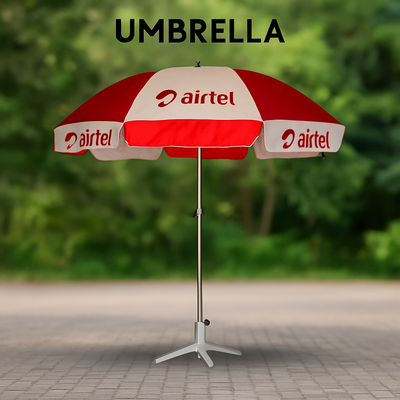
Beyond FMCG, the sectors that benefit most from umbrella branding campaigns in India include telecom companies doing rural outreach advertising and Tier-2/Tier-3 city penetration campaigns, pharmaceutical companies doing chemist and clinic activation (subject to applicable CDSCO guidelines on promotional material), financial services brands doing agent network activation, and political campaigns — which represent one of the highest-volume use cases for umbrella advertising in India, particularly during state and national election cycles. The agricultural inputs sector — seeds, fertilisers, pesticides — has also been a significant user of promotional umbrella branding for rural outreach advertising, where the umbrella serves both as a brand visibility tool and as a genuinely useful item for farmers working in the field.
Umbrella Branding for Monsoon Season: Maximising Brand Recall
If there is one strategic insight that separates experienced media planners from beginners when it comes to umbrella advertising, it is this: the monsoon season (June through September across most of India) is not just a good time to run umbrella branding campaigns — it is the period during which the medium delivers its highest possible ROI, and brands that don't plan their campaigns to peak during this window are leaving significant value on the table. The reason is obvious once you think about it: umbrella usage in India spikes dramatically during the monsoon, which means branded umbrellas are being used more frequently, in more public settings, and are more visible than at any other time of year.
The planning calendar for a monsoon season umbrella branding campaign needs to begin in March or April at the latest, because production lead times for custom printed umbrellas with logo — particularly for bulk orders above 1,000 units — typically run between four and eight weeks depending on the supplier and the complexity of the print design. Distribution logistics, especially for PAN India campaigns covering multiple cities and rural markets, add another two to four weeks to the timeline; a brand that starts planning in May will almost certainly miss the first and most intense month of the monsoon window. At SmartAds, we recommend briefing umbrella branding campaigns no later than the end of March for June deployment, which gives adequate time for design finalisation, production, quality checks, and field distribution.
The monsoon season branding opportunity is particularly acute in markets like Mumbai, Kolkata, Chennai, and the coastal cities of Kerala and Goa, where rainfall intensity is highest and umbrella usage is most consistent. But the opportunity extends well into Tier-2 and Tier-3 markets across Maharashtra, Karnataka, Andhra Pradesh, and Odisha, where monsoon-season umbrella branding campaigns by agri-input brands, telecom companies, and FMCG players have consistently delivered strong brand recall metrics. One agri-brand client we worked with ran a monsoon-timed promotional umbrella campaign across 340 villages in Vidarbha and Marathwada; the campaign, which distributed 5,000 branded umbrellas through their dealer network in the weeks before the monsoon onset, generated unaided brand recall figures that were, in the client's own words, the best they had seen from any BTL campaign in that geography.
How to Plan an Umbrella Branding Campaign: From Design to Distribution
The design phase of a promotional umbrella campaign is where most brands make their first and most consequential mistake — they treat the umbrella as a small canvas and try to fit too much information onto it. Our experience shows that the most effective custom printed umbrellas with logo use a maximum of three design elements: the brand logo, a single tagline or product name, and the brand's primary colour palette. The umbrella canopy, when open, is seen from a distance and in motion; it is not a leaflet, and it should not be designed like one. The logo should be large enough to be legible from 10 to 15 metres, which typically means it should occupy at least 30 to 40 percent of one or two canopy panels.
Material selection is the second major decision point, and it has both functional and brand equity implications. Promotional umbrellas for distribution campaigns are typically produced in 190T or 210T polyester with fibreglass or aluminium frames; the 210T specification, which is slightly heavier and more water-resistant, is worth the marginal cost premium for campaigns where the umbrella is intended to remain in active use for 18 months or more. Golf umbrellas, which have canopy diameters of roughly 60 inches, are the preferred format for outdoor cafe branding, street vendor activation, and event umbrella advertising because of their large visible surface area; compact folding umbrellas are more appropriate for corporate gifting and trade show advertising where portability is valued. The choice of umbrella type should be driven by the distribution context, not by cost alone.
Distribution planning is where the campaign either succeeds or fails at scale, and it is the phase that most brands underestimate. A PAN India umbrella branding campaign covering 10,000 distribution points across 50 cities requires a field force, a tracking mechanism, and a quality assurance process that most brands do not have in-house — which is precisely why working with a promotional umbrella agency that has established field distribution infrastructure is so important. At SmartAds, our distribution network across 500+ cities allows us to manage end-to-end umbrella branding campaigns from production to placement, with GPS-tagged installation confirmation and photographic proof of deployment for every distribution point — a level of accountability that is genuinely difficult to achieve without an agency partner that has invested in the field infrastructure.
City-Wise Umbrella Branding Services: Mumbai, Delhi, Bangalore, Hyderabad and More
The cost and logistics of umbrella branding campaigns vary meaningfully across Indian cities, and understanding these differences is important for accurate budget planning. Mumbai, which has the highest density of high-footfall outdoor locations of any Indian city, is also the market where umbrella advertising generates the highest per-unit impression count — a branded umbrella deployed at a Dadar or Bandra street vendor location can generate somewhere between 600 and 1,000 daily impressions during the monsoon season, which is a figure that compares very favourably with the CPM of most traditional outdoor advertising formats in the same city. The logistics cost of distribution in Mumbai, however, is also higher than in most other markets, reflecting the city's traffic density and the complexity of its geography.
Delhi and the NCR region present a different campaign architecture, where the sheer geographic spread of the market — from Gurgaon and Noida to Faridabad and Ghaziabad — means that umbrella branding campaigns typically need to be planned across multiple micro-markets rather than as a single unified deployment. The monsoon season in Delhi is shorter and less intense than in Mumbai or Bangalore, which means the seasonal timing advantage of umbrella advertising is somewhat compressed; however, the winter fog season (November through January) is a period when umbrella usage for sun protection is lower but when branded golf umbrellas at outdoor dining and event venues generate strong brand visibility. Bangalore, which has a year-round mild climate with significant rainfall in both the southwest and northeast monsoon seasons, is arguably the most consistently favourable market for umbrella advertising in India.
Hyderabad and Chennai represent strong Tier-1 markets for umbrella branding, particularly for FMCG, pharmaceutical, and telecom brands doing regional activation campaigns; the cost of umbrella branding in these markets is typically 15 to 25 percent lower than in Mumbai or Delhi, which makes them attractive for brands that want to test the medium before scaling to a national campaign. Beyond the Tier-1 cities, the real untapped opportunity in umbrella branding India lies in Tier-2 and Tier-3 markets — cities like Nagpur, Coimbatore, Visakhapatnam, Indore, and Jaipur, where outdoor advertising infrastructure is less developed but where a well-distributed umbrella branding campaign can achieve dominant brand visibility in key commercial areas at a fraction of the cost of comparable coverage in the metros. Our campaigns in these markets have consistently demonstrated that the cost-per-impression advantage of umbrella advertising is even more pronounced in Tier-2 cities than in the metros.
How Much Does Umbrella Branding Cost in India?
This is the question that every media planner eventually asks, and the frustrating reality is that most promotional umbrella agencies either refuse to publish rates or provide ranges so wide as to be useless. We are going to be more specific than that, because we think brands deserve actual numbers to work with when they are making budget decisions. A standard 2-fold promotional umbrella with single-colour logo printing, produced in a minimum order quantity of 500 units, works out to roughly ₹150 to ₹200 per unit from established Indian suppliers — which is a price point that makes umbrella advertising for small businesses genuinely accessible. A 3-fold umbrella with full-colour digital printing on all panels, which is the specification most FMCG brands use for trade activation campaigns, is in the ballpark of ₹280 to ₹420 per unit at volumes of 500 to 1,000 units, with meaningful cost reductions available at volumes above 2,500 units.
Golf umbrellas, which are the preferred format for outdoor cafe branding and event umbrella advertising, are priced somewhere between ₹450 and ₹800 per unit for full-colour printed versions at standard campaign volumes; at the premium end, auto-open golf umbrellas with UV-coated canopies and fibreglass frames — the kind that a bank or a luxury brand would use for a corporate gifting campaign — can reach ₹1,200 to ₹2,000 per unit. These numbers are production costs only; distribution costs, which vary significantly by geography and scale, typically add 20 to 40 percent to the total campaign cost for PAN India deployments. The umbrella branding cost India calculation should also factor in design fees, which for a properly executed campaign brief with multiple panel layouts and regional language adaptations, typically runs between ₹15,000 and ₹50,000 depending on complexity.
The ROI framing that we use with our clients is this: a ₹5 lakh umbrella branding campaign deploying 1,500 promotional umbrellas across 1,500 distribution points in a single city generates a conservative estimate of 600,000 daily impressions during the monsoon season — that's a daily CPM of roughly ₹8, which is a number that most digital media planners would consider extremely competitive even before accounting for the fact that the campaign continues generating impressions for 12 to 18 months after deployment. Umbrella branding cost India comparisons become even more compelling when you factor in the extended campaign duration; the effective CPM over the full lifetime of the campaign works out to a fraction of what you would pay for equivalent reach through hoardings, transit advertising, or digital display. To be fair, umbrella advertising cannot match the reach scale of mass media — but for targeted, geography-specific brand visibility campaigns, the marketing ROI case is very strong.
What Does a Promotional Umbrella Advertising Agency Do?
A promotional umbrella agency does considerably more than just print logos on umbrellas and ship them to a warehouse — or at least, a good one does. The full scope of what an experienced umbrella branding solutions provider should offer covers four distinct phases: strategic planning (which includes audience mapping, distribution point selection, umbrella type and specification recommendation, and campaign timing advice), design and production (which covers artwork development, supplier selection, quality control, and logistics management), field distribution and activation (which requires a ground-level field force with coverage across the target geography), and campaign measurement (which should include impression tracking, brand recall surveys, and ROI reporting).
The production side of umbrella advertising involves a supply chain that most brand managers are not familiar with — and the quality variance between suppliers is significant enough to materially affect campaign outcomes. Umbrella printing and branding quality depends on the printing process used (heat transfer, screen printing, and digital sublimation each produce different results on different fabric types), the fabric weight and weave, the frame material, and the finishing quality of the canopy edges and handle. A poorly made promotional umbrella that breaks after two uses is not just a wasted production cost — it actively damages the brand's image in the hands of the recipient. This is why working with a promotional umbrella agency that has verified supplier relationships and enforces quality standards is worth the modest premium over buying directly from an IndiaMART listing.
The measurement and accountability dimension is where most promotional umbrella agencies fall short, and it is the area where we believe the industry needs to raise its standards. At SmartAds, we have developed a campaign measurement framework for umbrella branding that uses GPS-tagged distribution confirmation, periodic field audits to verify that umbrellas remain deployed and in good condition, and — for larger campaigns — consumer intercept surveys to measure brand recall lift among audiences in the distribution geography. This kind of structured measurement is what allows us to give clients a defensible ROI number rather than a vague claim about "brand visibility," and it is the kind of accountability that brand managers need when they are justifying a BTL advertising budget to their management.
FAQ: Umbrella Branding in BTL Advertising — Your Questions Answered
Q: What is umbrella branding in BTL advertising and how is it different from traditional advertising?
Umbrella branding in the BTL advertising context refers to the use of custom printed umbrellas, branded canopies, and promotional umbrella merchandise as a below the line marketing tool — distinct from the corporate brand strategy concept (where "umbrella branding" describes a parent brand covering multiple product lines, as Tata or Amul do). The key difference from traditional advertising is that BTL umbrella advertising is a physical, distributed medium that targets specific audiences at specific locations rather than broadcasting to a mass audience; it is measurable, geographically targeted, and generates long-duration impressions through a functional object that the recipient actively uses. Unlike a TV commercial or a newspaper advertisement, which creates a single impression at a single moment, a promotional umbrella generates hundreds or thousands of impressions over its useful life, which makes the cost-per-impression economics fundamentally different from traditional media.
Q: How much does umbrella branding cost in India for small and large businesses?
For small businesses, the entry point for umbrella branding is surprisingly accessible — a minimum order of 100 to 200 branded folding umbrellas with single-colour logo printing can be produced for roughly ₹150 to ₹250 per unit, making a basic umbrella advertising campaign achievable for a total production budget of ₹25,000 to ₹50,000. For larger businesses running PAN India campaigns, the economics shift significantly at scale: bulk orders of 5,000 units or more can bring the per-unit cost of a full-colour printed golf umbrella down to ₹350 to ₹500, and the total campaign cost including distribution across multiple cities typically ranges from ₹10 lakh to ₹50 lakh depending on geography, umbrella specification, and distribution complexity. The umbrella branding cost India calculation should always include distribution logistics, which can add 20 to 40 percent to the production cost for multi-city campaigns.
Q: Which industries benefit most from promotional umbrella branding campaigns in India?
FMCG brands, beverage companies, telecom operators, agricultural input companies, financial services firms, and pharmaceutical companies (within applicable regulatory guidelines) are the heaviest users of umbrella branding in India, and for good reason — these are all sectors where distribution runs through large networks of small retailers, street vendors, and field agents who operate in outdoor environments where a branded umbrella is both useful and visible. Political campaigns are also a very high-volume use case for umbrella advertising in India, particularly during election seasons. Beyond these categories, any brand that sells through physical retail channels, conducts outdoor events, or operates in markets where outdoor advertising infrastructure is limited will find promotional umbrella branding to be an effective and cost-efficient brand visibility tool.
Q: What types of umbrellas are used for branding — folding, golf, beach, canopy or patio?
The umbrella type selection should be driven by the distribution context and campaign objective. Compact 2-fold and 3-fold umbrellas are the standard choice for trade activation campaigns, corporate gifting, and consumer distribution programmes because they are portable and practical for everyday use; these are the most commonly used format in FMCG and telecom umbrella branding campaigns. Golf umbrellas, with their large canopy diameter of 55 to 62 inches, are preferred for outdoor cafe branding, street vendor activation, and event umbrella advertising because their size maximises the visible brand surface area. Beach and patio umbrellas are used for fixed-location brand activation at beaches, melas, and outdoor events. Canopy branding (large frame tents and gazebos) is a related but distinct format used for brand activation events and trade show advertising, where a staffed, immersive brand presence is required.
Q: How effective is promotional umbrella advertising for brand recall compared to hoardings or pamphlets?
The brand recall advantage of umbrella advertising over pamphlets is substantial and well-documented — pamphlets are typically discarded within minutes of receipt, while a promotional umbrella is retained and used for months or years. The comparison with hoardings is more nuanced: a hoarding generates a high daily impression count at a fixed location, but the impression is passive and fleeting; a promotional umbrella generates a lower per-unit daily impression count but does so at close range, in a contextually relevant setting, and with a degree of brand association (the recipient values the umbrella and associates the brand with a useful gift) that a hoarding cannot replicate. Our experience with consumer recall surveys across umbrella branding campaigns in India consistently shows unaided brand recall rates of 35 to 55 percent among audiences who have been exposed to branded umbrellas in their immediate environment — a figure that compares very favourably with recall benchmarks for outdoor advertising formats.
Q: Can umbrella branding be used for rural marketing and Tier-2/Tier-3 city outreach in India?
Rural outreach advertising through umbrella branding is not just possible — it is one of the most effective applications of the medium in India. In rural markets and Tier-2/Tier-3 cities, where traditional outdoor advertising infrastructure (hoardings, transit panels, digital screens) is sparse or absent, a well-distributed umbrella branding campaign can achieve a level of brand visibility that is simply not achievable through any other affordable medium. FMCG brands, agri-input companies, and telecom operators have been using promotional umbrella advertising for rural outreach for decades, distributing branded umbrellas through dealer networks, agri-input retailers, and field sales teams. The umbrella is particularly well-suited to rural India because it is a high-utility item that is valued and retained, and because it creates brand visibility in the market squares, mandis, and village centres where purchasing decisions are made.
Q: What is the minimum order quantity for branded umbrella advertising in India?
Most promotional umbrella suppliers in India have a minimum order quantity of 100 to 200 units for standard folding umbrellas with screen-printed logos; for digital sublimation printing, which produces full-colour photographic-quality prints, the minimum order quantity is typically 200 to 500 units because of the setup costs involved. Golf umbrellas and premium auto-open umbrellas often have higher minimum order quantities of 500 units from most manufacturers. That said, for small businesses or brands testing the medium for the first time, it is possible to source smaller quantities through distributors and resellers — though the per-unit cost at quantities below 100 units is significantly higher and may not represent good value for a campaign-scale deployment.
Q: How do I choose the right promotional umbrella advertising agency for my BTL campaign?
The most important criteria for selecting a promotional umbrella agency are field distribution capability, production quality control, and measurement accountability — in that order. An agency that can design and produce beautiful branded umbrellas but cannot reliably distribute them to 1,000 specific locations across three cities is not actually useful for a campaign-scale deployment. Ask any prospective agency for case studies with specific distribution metrics, not just creative work samples; ask how they confirm deployment and what their field audit process looks like; ask specifically about their supplier relationships and quality control processes. An agency that is vague about these operational details is likely outsourcing the entire production and distribution process without adding meaningful value. The right umbrella branding solutions partner should be able to demonstrate end-to-end capability from brief to deployment to measurement.
Q: Is umbrella branding a good strategy for monsoon season marketing in India?
It is, without question, the single most contextually relevant BTL advertising format for the June-to-September monsoon season in India — and the brands that plan their campaigns to peak during this window consistently report the strongest brand recall outcomes from their umbrella advertising investments. The logic is simple: umbrella usage spikes during the monsoon, which means branded umbrellas are used more frequently, in more public settings, and are more visible than at any other time of year. The key planning consideration is lead time — production and distribution for a monsoon season umbrella branding campaign needs to begin no later than March or April to ensure that branded umbrellas are in the hands of distributors and at deployment locations before the first rains arrive.
Q: What is the difference between umbrella branding as a BTL tactic and umbrella branding as a corporate brand strategy (like Amul or Tata)?
These are two entirely distinct concepts that share a name, which causes genuine confusion in marketing discussions. As a corporate brand strategy, "umbrella branding" (also called family branding) refers to the practice of marketing multiple products under a single parent brand — the Tata brand architecture, which covers everything from salt to trucks to software under the Tata parent brand, is the classic Indian example of umbrella branding as a brand architecture strategy. Amul umbrella branding similarly covers dairy products ranging from butter to ice cream to cheese under a single brand identity. This form of umbrella branding is about brand extension and brand equity management at a strategic level. As a BTL advertising tactic, "umbrella branding" refers specifically to the use of physical promotional umbrellas as a brand visibility and distribution medium — it has nothing to do with brand architecture and everything to do with on-ground branding and experiential marketing. Both are legitimate and important marketing concepts; they simply operate at entirely different levels of the marketing function.
Closing: Making Umbrella Branding Work for Your Brand
The brands that get the most out of umbrella branding campaigns in India are the ones that treat the medium seriously — not as a novelty or an afterthought, but as a precision BTL advertising tool with its own planning logic, its own ROI framework, and its own strategic timing considerations. The medium rewards careful distribution planning, quality production investment, and campaign timing that aligns with the monsoon season window; it punishes shortcuts in any of these areas with wasted spend and underwhelming results.
What we have seen, across hundreds of umbrella branding campaigns across India, is that the brands which succeed with this medium are the ones that think about the distribution point first and the umbrella design second — because a beautifully printed promotional umbrella sitting in a warehouse is worth nothing, while a simply designed but strategically deployed branded umbrella at 2,000 high-footfall locations is a powerful brand visibility engine. The medium is also evolving in interesting ways: QR codes on umbrella canopies that link to product pages or offers, NFC-enabled umbrella handles for contactless brand engagement, and eco-friendly umbrella materials (recycled PET fabric, FSC-certified wooden handles) that allow brands to align their umbrella advertising campaigns with sustainability commitments — all of these are formats that we are actively deploying for clients who want to integrate their on-ground branding with digital engagement objectives.
If you are evaluating umbrella branding for an upcoming campaign — whether it's a monsoon season FMCG activation, a rural outreach programme, a product launch at trade shows, or a corporate gifting initiative — the SmartAds media planning team is available to provide a customised campaign proposal with city-specific distribution recommendations, production cost estimates, and an ROI projection based on our campaign data from comparable deployments. Visit [SmartAds.in](https://smartads.in/services/traditional/umbrella-branding) to brief your campaign requirements, and we will put together a plan that is specific to your brand, your geography, and your budget — not a generic rate card, but an actual campaign architecture built around your objectives.
*SmartAds.in is an integrated advertising and media buying agency operating across 500+ Indian cities, covering television, cinema, outdoor, newspaper, magazine, radio, digital, and BTL channels including umbrella branding, canopy activation, and
