


Delhi

Mumbai

Bengluru

Ahmedabad

Jaipur

Chennai

Hydrabad

Kolkatta

Lucknow

Pune
Ferry Advertising in India: The Complete Guide to Ferry Branding, Waterway Transit Media, and BTL Advertising Across Coastal and Inland Routes
This article contains actual cost benchmarks, route-specific market intelligence, audience demographic data, and campaign insights drawn from SmartAds' experience planning ferry advertising campaigns across India's coastal and inland waterways — information that most generic OOH advertising guides simply do not carry. If you are evaluating ferry branding as part of a BTL advertising strategy, or trying to justify waterway transit media to a sceptical client, read this before you make any decisions.
What is Ferry Advertising and How Does It Work in India?
Most brand managers, when they first hear the term ferry advertising, picture a small sticker on a boat and move on. That instinct is worth correcting immediately, because what is actually available across India's waterways — from the Kochi Water Metro's air-conditioned vessels to the Mumbai–Mandwa ROPAX ferry carrying over a thousand passengers per trip — is a genuinely mature, measurable, and surprisingly affordable form of out-of-home advertising that most competitors have not yet discovered.
Ferry advertising, at its core, is a form of transit media placed on or within passenger ferry vessels and their associated terminals; it encompasses everything from full vessel wraps on the exterior hull to cabin wall advertising, onboard digital screens, seat-back panels, overhead branding strips, and ferry terminal advertising at jetties and waiting areas. What makes it distinct from other forms of outdoor advertising is the combination of captive audience conditions and extended dwell time — a passenger on the Mumbai–Mandwa route, for instance, spends somewhere between 55 and 70 minutes on board, which is a duration that most transit advertising formats simply cannot match. On the Kochi Water Metro, even shorter inter-station hops produce dwell times of 15 to 30 minutes, which is still considerably longer than the average commuter's exposure to a metro station poster or a roadside billboard.
The mechanics of how ferry advertising is booked and executed in India vary by state and operator. In Kerala, the Kerala State Water Transport Department (KSWTD) manages advertising rights on government-operated vessels, while the Kochi Metro Rail Limited (KMRL) administers Kochi Water Metro branding independently. In Maharashtra, the Maharashtra Maritime Board oversees ferry routes including the Gateway of India jetty operations, and advertising permissions flow through their commercial licensing division. In Goa, the River Navigation Department controls rights on the Mandovi and Zuari river crossings. What this means practically is that ferry advertising in India is not a single national buy — it is a patchwork of state and port authority relationships, which is exactly why having an experienced media buying partner matters more here than in almost any other OOH advertising category.
What Are the Different Ferry Advertising Formats Available in India?
The range of ad formats available across Indian ferry routes is wider than most planners expect, and the right format depends heavily on whether the campaign goal is brand awareness, product recall, or direct response. We have found, across dozens of ferry advertising campaigns, that brands often underestimate the interior branding opportunity and over-focus on exterior branding — which is understandable, since a vessel wrap is visually dramatic, but it is the onboard advertising that actually converts attention into recall.
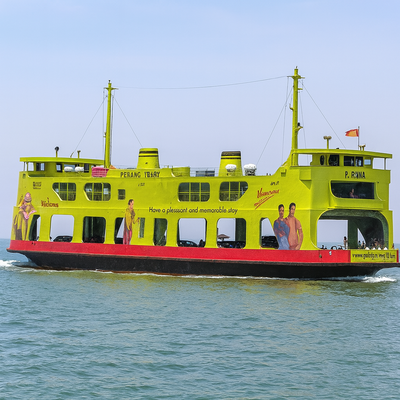
Exterior branding on a passenger ferry typically takes the form of hull wraps, which cover the sides of the vessel with large-format vinyl graphics; bow panels, which are smaller but highly visible from jetties and waterfronts; and rooftop branding, which is particularly effective on routes where the ferry passes under bridges or alongside elevated promenades. A full ferry wrap on a mid-sized vessel operating on, say, the Goa Mandovi crossing can produce impressions in the range of several lakh per month simply from waterfront visibility — pedestrians, restaurant patrons, and hotel guests along the riverfront all register the branding without ever boarding. Interior branding, on the other hand, is where the captive audience dynamic really comes into play; cabin wall advertising, overhead hanging banners, seat-back panels, backlit panel ads near entry and exit points, and digital screen placements all reach passengers who have nowhere else to look during their journey.
Ferry terminal advertising deserves its own category entirely, because it reaches a broader audience than just the passengers — terminal areas, particularly at high-footfall waterfront locations like the Gateway of India in Mumbai or the Vypeen and Fort Kochi jetties in Kochi, attract tourists, vendors, taxi drivers, and bystanders who never board a ferry at all. Backlit panel ads in waiting areas, floor graphics, pillar wraps, and digital kiosks in ferry terminals function more like traditional outdoor advertising in terms of audience composition, while still benefiting from the concentrated, unhurried attention of passengers waiting for their vessel. On top of that, there is an emerging format category that we are increasingly recommending to clients — QR code tracking panels placed at eye level inside vessels, which bridge the gap between physical ferry branding and digital attribution, allowing brands to measure actual engagement from their onboard advertising rather than relying purely on estimated impressions.
Which Indian Cities and Waterways Offer the Best Ferry Advertising Opportunities?
The honest answer is that the opportunity map is growing faster than most media planners realise, driven in large part by the Sagarmala Programme launched by the Ministry of Ports, Shipping and Waterways, which has been systematically developing India's coastal and inland waterway infrastructure since 2015. What was once a handful of legacy ferry routes in Mumbai, Kolkata, and Kerala has expanded into a network that now includes new ROPAX ferry services, the Kochi Water Metro, and developing waterway corridors in Assam, Andhra Pradesh, and West Bengal — each of which represents fresh, uncluttered advertising inventory.
Mumbai ferry advertising remains the flagship opportunity in the country, simply because of the volume and quality of the passenger base. The Mumbai–Mandwa route, operated by private and Maharashtra Maritime Board-licensed vessels, carries a mix of weekend tourists, Alibaug-bound leisure travellers, and Pen/Mandwa-area daily commuters; the Gateway of India jetty itself is one of the highest-footfall waterfront advertising locations in Asia, which means ferry terminal advertising here reaches an audience that skews heavily urban, affluent, and brand-conscious. Kerala ferry advertising, particularly on the Alappuzha–Kottayam backwater routes and the Ernakulam–Fort Kochi crossing, reaches a combination of domestic tourists, international backpackers, and local commuters — a demographic mix that is genuinely unusual in Indian transit media. Kochi Water Metro advertising, which operates across 38 stations and 76 vessels as of the most recent KMRL operational reports, is arguably the most premium ferry advertising platform in India right now; the vessels are modern, air-conditioned, and designed with interior branding zones built in, which makes the ad format execution considerably more polished than older government ferry stock.
Goa ferry advertising on the Mandovi and Zuari crossings is particularly interesting from a seasonal standpoint — peak tourist season from October through March delivers a dramatically different audience profile than the monsoon months, and brands in travel, hospitality, and lifestyle categories can time their campaigns to coincide with the highest-value passenger windows. Kolkata ferry advertising on the Hooghly River, operated across multiple ghats including Howrah and Chandpal, reaches a large daily commuter base that is often overlooked in favour of Kolkata's bus and metro transit media; the CPM on Hooghly ferry routes works out to roughly ₹6 to ₹10, which is a number that surprises most first-time advertisers when they compare it to what they are paying for equivalent reach through metro station advertising. Andaman ferry advertising, covering the inter-island routes between Port Blair, Havelock, and Neil Island, is a niche but high-value opportunity for tourism, hospitality, and FMCG brands targeting high-spending domestic and international tourists. The Brahmaputra River ferry routes in Assam, designated under National Waterway 2, are an emerging frontier — passenger volumes are growing, and advertising inventory here remains almost entirely untapped.
Why is Ferry Advertising an Effective BTL and Non-Traditional Advertising Strategy?
Below-the-line advertising works best when it creates an environment where the brand message cannot be easily ignored or skipped — and few environments achieve this as effectively as a moving vessel on water. The captive audience dynamic on a passenger ferry is qualitatively different from what you get in a bus or a metro; passengers are not rushing to exit at the next stop, they are not distracted by street-level activity outside the window, and they have genuinely limited options for where to direct their attention. We have seen this translate into brand recall scores that consistently outperform equivalent spends in bus or auto transit media, particularly for campaigns that use interior branding with some creative depth rather than simple logo placement.
The non-traditional advertising quality of ferry branding also creates a novelty premium — passengers notice and remember advertising in unexpected environments more reliably than they do in saturated media contexts. This is a principle that experiential marketing practitioners have documented extensively, and it applies with particular force to waterway advertising in India, where the format is still uncommon enough to feel surprising. One FMCG client we worked with — a packaged foods brand running a regional campaign in Kerala — reported that their ferry advertising creative generated more spontaneous social media sharing than any of their concurrent outdoor advertising placements, simply because passengers photographed the vessel wrap and posted it organically. That kind of earned media amplification is difficult to price into a media plan, but it is real and it happens more consistently with ferry branding than with most other BTL advertising formats.
From a through-the-line marketing perspective, ferry advertising integrates unusually well with digital campaigns — a point we will return to in more detail later, but worth flagging here. The enclosed, dwell-time-rich environment of a passenger ferry is one of the few physical advertising contexts where QR code engagement rates are actually meaningful; passengers have their phones out, they have time, and if the creative gives them a genuine reason to scan, they do. This makes ferry advertising a genuinely useful bridge between outdoor advertising and digital attribution, which is a capability that most BTL advertising formats struggle to deliver cleanly.
How Does Ferry Advertising Compare to Bus, Metro, and Auto Advertising?
Transit advertising across different vehicle types is often treated as interchangeable by media planners working under time pressure, but the audience experience — and therefore the advertising effectiveness — varies significantly across formats. The single most important differentiating variable is dwell time, and on this metric, ferry advertising wins by a considerable margin. A bus passenger in a congested Indian city might spend 20 to 40 minutes on board, but their attention is fragmented by frequent stops, boarding and alighting activity, and the general chaos of urban bus travel; a metro commuter's average journey is often under 15 minutes; an auto passenger is typically exposed to the ad format for under 10 minutes. A ferry passenger, by contrast, is physically contained in a vessel for a journey that rarely lasts less than 15 minutes and frequently extends to an hour or more — which means the onboard advertising has multiple opportunities to register.
The cost comparison is also instructive. Metro advertising in Tier 1 cities — Mumbai, Delhi, Bengaluru — has become increasingly expensive as the format has matured and inventory has been consolidated; station branding packages on premium metro lines can run into several lakh per month for meaningful coverage, and the CPM on high-footfall stations can be surprisingly high when calculated against actual dwell-time-adjusted impressions. Bus advertising, while cheaper, suffers from clutter — most major city bus fleets carry multiple advertisers simultaneously, and the creative competition for passenger attention is significant. Ferry advertising, by contrast, typically allows for category exclusivity on a given vessel or route, which means a brand can own the entire passenger experience for the duration of the journey; the cost for this exclusivity works out to somewhere between ₹50,000 and ₹3,00,000 per month depending on the route, vessel size, and format mix — a range that positions it as genuinely competitive with mid-tier metro and bus advertising on a cost-per-engaged-impression basis.
What ferry advertising does not offer, to be fair, is the sheer volume reach of bus or metro advertising in a large city. Mumbai's bus network reaches millions of passengers daily; even the busiest ferry routes in India carry tens of thousands per day at most. This means ferry advertising is best positioned not as a mass-reach vehicle but as a high-quality, high-engagement complement to broader transit advertising or outdoor advertising campaigns — a format that builds brand recall and brand engagement among a specific, capturable audience segment rather than delivering raw impression volume.
What is the Cost of Ferry Advertising in India?
Ferry advertising cost in India is one of the most opaque areas in the entire OOH advertising market, partly because there is no centralised rate card and partly because pricing is negotiated directly with state transport departments, port authorities, or private ferry operators — each of whom has different commercial frameworks. What we can share, based on our media buying experience across multiple routes and cities, is a practical set of benchmarks that should help any brand manager or media planner build a realistic budget.
For exterior branding — hull wraps or partial wraps on a passenger ferry — the cost in Mumbai works out to roughly ₹1,50,000 to ₹3,50,000 per month for a mid-sized vessel on the Gateway of India routes, which sounds significant until you calculate the waterfront impressions generated by a branded vessel making multiple crossings per day past one of the most photographed locations in India. On the Kochi Water Metro, water metro branding packages — which include interior branding zones across multiple vessels — are available in the ballpark of ₹80,000 to ₹2,00,000 per month depending on the number of vessels and the format mix; KMRL has been relatively progressive about structuring commercial branding packages, which makes Kochi Water Metro advertising more accessible to brands than many other government-operated ferry systems. In Goa, ferry advertising cost on the Mandovi crossings is considerably more affordable — exterior and interior branding on a single vessel can be secured for somewhere between ₹30,000 and ₹80,000 per month, which makes Goa ferry advertising an attractive option for brands with regional or seasonal campaign objectives. Kerala ferry advertising on KSWTD-operated vessels on the backwater routes runs in a similar range, though the negotiation process is more involved and typically requires a longer lead time for approvals.
Ferry terminal advertising tends to be priced separately and is often the better value option for brands that want high-footfall waterfront visibility without committing to a vessel-specific campaign. A backlit panel ad at a major Mumbai jetty terminal can be secured for roughly ₹40,000 to ₹1,00,000 per month; terminal branding at the Fort Kochi jetty, which is one of the busiest tourist transit points in South India, runs in a similar range. The CPM across most Indian ferry advertising formats works out to somewhere between ₹8 and ₹25 depending on the route and format — which, when adjusted for the quality of the captive audience and the extended dwell time, represents genuinely strong value compared to equivalent spends in urban outdoor advertising or digital display.
Who is the Target Audience for Ferry Advertising in India?
The audience profile of Indian ferry passengers is one of the most interesting and underappreciated aspects of this medium, and it is significantly more varied than most planners assume. The common mental model — that ferry passengers are primarily lower-income daily commuters — is accurate for some routes but completely wrong for others, and conflating the two leads to poor media planning decisions.
On the Mumbai–Mandwa and Gateway of India routes, the passenger base skews strongly toward upper-middle-class and affluent urban consumers — weekend leisure travellers, Alibaug resort guests, and corporate professionals who choose the ferry over the road journey for speed and convenience. This is an audience that is actively sought by categories like real estate, luxury FMCG, financial services, automotive, and premium hospitality, and it is an audience that is surprisingly difficult to reach through conventional outdoor advertising because they are not heavy commuters on public transit. On the Kochi Water Metro, the commuter advertising opportunity is different — the passenger base includes IT professionals from the Kakkanad tech corridor, students, and urban middle-class residents who have adopted the water metro as a daily commute option, which makes it an excellent platform for BFSI, telecom, education, and consumer electronics brands. On the Goa Mandovi crossings and the Andaman inter-island routes, the audience is overwhelmingly tourist-heavy — domestic and international travellers with above-average disposable income and a high propensity to spend on experiences, food, and lifestyle products.
The Hooghly River ferry routes in Kolkata serve a genuinely mass commuter audience — daily workers, students, and lower-middle-income residents for whom the ferry is the most practical crossing option between Howrah and central Kolkata; this makes Kolkata ferry advertising particularly relevant for FMCG categories targeting mass-market consumers, as well as for regional brands in categories like mobile banking, insurance, and packaged foods. The Brahmaputra River routes in Assam serve a mix of rural and semi-urban commuters, which creates a hyper-local targeting opportunity for brands with specific northeastern regional objectives. What ties all of these audience segments together, across every ferry route in India, is the captive audience condition — regardless of demographic, every ferry passenger is physically present and temporally available for the duration of the journey in a way that no other transit advertising format can guarantee.
How Can You Measure the ROI of a Ferry Advertising Campaign?
Campaign ROI measurement in ferry advertising is an area where we have invested considerable effort, because the honest answer — that traditional OOH measurement methods apply imperfectly to waterway contexts — is not particularly satisfying to a client who needs to justify the spend to their CFO. The good news is that the measurement toolkit has improved significantly, and a well-structured ferry advertising campaign can now generate attribution data that is meaningfully comparable to what you would expect from a digital campaign.
The most reliable primary metric for ferry advertising is reach and frequency estimation based on route passenger data, which is available from the operating authority for most major Indian ferry routes; the Maharashtra Maritime Board publishes passenger counts for Mumbai routes, KMRL provides ridership data for the Kochi Water Metro, and KSWTD maintains records for Kerala backwater services. These numbers, combined with a standard frequency multiplier for repeat commuters, give a defensible impressions figure that can be used to calculate CPM and benchmark against other media in the plan. On top of that, QR code tracking panels placed inside vessels provide a direct engagement signal — we have run campaigns where QR code scan rates from ferry onboard advertising reached 2 to 4 percent of estimated passengers, which is a response rate that most digital display campaigns would envy. One automotive brand we worked with on a Kochi Water Metro campaign used geo-fenced mobile attribution to track whether passengers exposed to the onboard advertising subsequently visited their dealerships — the attribution window showed a measurable lift in dealership visits from the Kochi metro catchment area over the campaign period, which gave the client a concrete ROI data point to present internally.
Brand recall measurement through intercept surveys at ferry terminals is another method we recommend for longer campaigns, particularly where brand awareness is the primary objective rather than direct response. Terminal surveys conducted at the end of a 60-day campaign can capture aided and unaided recall scores that, in our experience, consistently show higher recall rates for ferry branding than for equivalent outdoor advertising exposures — a finding that aligns with the broader academic literature on captive audience advertising effectiveness. The combination of reach data from operator records, QR code engagement tracking, geo-fenced mobile attribution, and terminal intercept surveys gives a multi-layered measurement framework that makes ferry advertising ROI genuinely defensible in a media planning context.
What Are the Key Benefits of Ferry Terminal Advertising?
Ferry terminal advertising occupies a slightly different strategic position from vessel-based advertising, and it is worth understanding that distinction clearly before deciding how to allocate budget between the two. The terminal environment reaches a broader audience than the vessel — not just passengers, but also those dropping off and picking up travellers, vendors, taxi and auto drivers waiting for fares, and general waterfront visitors who are drawn to jetty areas for reasons unrelated to ferry travel.
At high-footfall waterfront locations like the Gateway of India in Mumbai — which receives millions of visitors annually as a tourist attraction entirely independent of its function as a ferry departure point — the terminal advertising audience is genuinely mass-market in scale, while still being geographically concentrated in a way that allows for meaningful hyper-local targeting. A backlit panel ad at the Gateway of India jetty reaches tourists, business travellers, and local Mumbaikars in roughly equal measure, which makes it an unusually versatile outdoor advertising placement. The dwell time in terminal waiting areas is also significant — passengers typically arrive 15 to 30 minutes before departure, which means they are stationary, relatively relaxed, and genuinely receptive to advertising in a way that rushing commuters in metro stations are not.
At SmartAds, we always tell our clients that the terminal and the vessel are not competing for the same budget — they are doing different jobs. The terminal creates awareness and sets the context; the vessel delivers depth of engagement and brand recall during the journey itself. A campaign that uses both in combination — terminal advertising to intercept the audience before they board, vessel onboard advertising to reinforce the message during the journey, and terminal advertising again at the destination — creates a three-touchpoint sequence within a single transit experience, which is a brand engagement structure that is genuinely difficult to replicate in any other BTL advertising format. We ran exactly this kind of layered campaign for a retail client in Pune who was expanding into the Goa market; by using both Mandovi terminal branding and onboard advertising on the Panaji–Betim crossing, they achieved a brand awareness lift of over 30 percent among tourist-segment consumers in their target zone within a single peak season.
How is the Growth of India's Waterway Infrastructure Boosting Ferry Advertising?
The Sagarmala Programme, which is the Government of India's flagship initiative for port-led development and waterway infrastructure expansion, has been creating new ferry advertising inventory at a pace that most media planners have not yet caught up with. Since its launch, the programme has funded the development of new jetties, upgraded passenger ferry services on multiple national waterways, and catalysed the launch of ROPAX ferry services on routes including the Mumbai–Mandwa corridor — all of which translates directly into new, structured advertising opportunities on vessels and terminals that did not exist a decade ago.
The Inland Waterways Authority of India (IWAI) has been progressively developing commercial passenger services on National Waterways across the country; National Waterway 3, which runs through Kerala along the West Coast Canal, is particularly relevant for ferry advertising because it passes through densely populated coastal districts with strong consumer markets. The Brahmaputra River routes in Assam, covered under National Waterway 2, are seeing increasing passenger volumes as IWAI improves vessel quality and service frequency — creating advertising inventory in a market that is chronically underserved by conventional outdoor advertising. The Ganga river ferry services in Uttar Pradesh and Bihar, which are being developed under Sagarmala funding, will eventually add significant waterway advertising inventory in the Hindi heartland markets.
The Kochi Water Metro is perhaps the most significant single development in Indian ferry advertising in the last decade; operated by Kochi Metro Rail Limited (KMRL) with vessels built by Cochin Shipyard Limited, it is the first water metro system in India and represents a qualitative leap in the kind of advertising environment available on Indian waterways. The system has already served over 5 million passengers since its launch, and ridership is growing consistently — which means the Kochi Water Metro advertising inventory is becoming more valuable with every passing quarter. The vessels are designed with dedicated interior branding zones, digital screen placements, and exterior branding areas that are far more structured and brand-friendly than the improvised advertising arrangements that characterise older government ferry stock; this makes water metro branding on the Kochi system a genuinely premium product that compares favourably with metro rail advertising in other Indian cities.
What Brands and Industries Benefit Most from Ferry Advertising in India?
Frankly speaking, the category fit for ferry advertising is more specific than for most OOH advertising formats, and getting the industry match right is one of the most important decisions in media planning for this medium. The brands that consistently see the strongest returns from ferry advertising campaigns are those whose target consumers either travel on ferries as part of their regular behaviour or are present in the waterfront environments that ferry routes pass through.
Tourism and hospitality brands have an obvious and powerful fit — a hotel chain, a resort property, or a travel booking platform advertising on the Andaman ferry routes or the Goa Mandovi crossings is reaching consumers who are literally in the act of travelling, which creates an unusually high purchase-intent context. FMCG brands targeting regional markets — particularly in Kerala, Goa, and coastal Maharashtra — find ferry branding effective because the routes penetrate markets that are sometimes difficult to reach efficiently through conventional outdoor advertising. Real estate developers in coastal cities have used ferry advertising very effectively; one developer we worked with in Mumbai used vessel wrap advertising on the Mumbai–Mandwa route to reach the exact demographic of upper-middle-class Mumbaikars who were considering weekend home purchases in Alibaug — the audience targeting precision was remarkable for an OOH format. BFSI brands, particularly those offering insurance, mutual funds, and digital banking products, find the commuter-heavy routes like Kochi Water Metro and Hooghly River ferries effective for reaching a working-age, financially active audience during their daily transit.
Tourism advertising from state tourism boards is a natural fit — several state governments have used ferry branding campaigns to promote domestic tourism destinations, and the format's association with travel and leisure reinforces the message in a way that a roadside billboard simply cannot. Education brands, particularly those targeting professional courses and upskilling programmes, have found the Kochi Water Metro audience — which skews toward young IT professionals and students — to be a responsive segment for onboard advertising. The broader point is that ferry advertising works best when the brand's message has some natural resonance with the act of being on water, in transit, or in a coastal or tourist environment — which covers a wider range of categories than most planners initially assume.
How to Plan and Book a Ferry Advertising Campaign in India?
The booking process for ferry advertising in India is more involved than for most other OOH advertising formats, and understanding the process upfront saves significant time and prevents the kind of last-minute complications that derail campaigns. The first step is identifying which routes and formats are relevant for the campaign objective — a decision that requires understanding both the audience profile of each route and the physical advertising inventory available on the vessels and terminals in question.
For government-operated ferry services — which include KSWTD routes in Kerala, Maharashtra Maritime Board routes in Mumbai, and Goa River Navigation Department crossings — advertising rights are typically granted through a formal application process that involves submitting creative materials for approval, obtaining a no-objection certificate from the relevant authority, and signing a commercial licensing agreement. Lead times for this process range from two to six weeks depending on the state and the complexity of the format; campaigns involving full vessel wraps require additional structural approval to ensure the vinyl application does not interfere with vessel safety markings or navigation lights, which adds time to the process. For private ferry operators — which are more common on tourist routes in Goa and on some Mumbai harbour crossings — the negotiation is more direct and timelines are shorter, though creative approvals are still required.
At SmartAds, our media planning team manages the entire permissions and booking process on behalf of clients, which is particularly valuable for brands that are running multi-city ferry advertising campaigns across different state jurisdictions simultaneously; coordinating approvals from KMRL in Kochi, the Maharashtra Maritime Board in Mumbai, and KSWTD in Kerala for a single integrated campaign requires relationships and process knowledge that take years to build. The practical advice we give every client entering this medium for the first time is to build at least four to six weeks of lead time into the campaign timeline, to have creative materials finalised before beginning the approval process rather than in parallel with it, and to plan for seasonal demand — peak season slots on Goa and Andaman routes in particular are booked months in advance by experienced advertisers who understand the value of those windows.
Frequently Asked Questions About Ferry Advertising in India
Q: What is ferry advertising and how does it work in India?
Ferry advertising is a form of transit media and out-of-home advertising placed on passenger ferry vessels and their associated terminals across India's coastal and inland waterways. It works by placing brand creatives — in formats ranging from full vessel wraps and hull panels to interior cabin wall advertising, seat-back panels, backlit panel ads, and digital screens — in environments where passengers are a captive audience for the duration of their journey. In India, ferry advertising operates across a range of routes including the Mumbai–Mandwa ROPAX services, the Kochi Water Metro, Kerala backwater routes, Goa Mandovi crossings, Hooghly River ferries in Kolkata, and Andaman inter-island services; each route has its own operating authority — whether the Maharashtra Maritime Board, KMRL, KSWTD, or the Goa River Navigation Department — which controls advertising rights and approvals.
Q: Which cities in India offer the best ferry advertising opportunities?
Mumbai offers the highest-profile ferry advertising inventory, particularly on the Gateway of India routes and the Mumbai–Mandwa ROPAX corridor, with a premium urban and leisure audience. Kochi is arguably the most exciting emerging market, with the Kochi Water Metro providing modern, structured advertising environments across 38 stations and a growing ridership base. Kerala's backwater routes — particularly Alappuzha and Ernakulam — offer a unique mix of domestic tourists and international travellers. Goa's Mandovi and Zuari crossings are excellent for seasonal campaigns targeting peak-season tourist audiences. Kolkata's Hooghly River ferries provide mass-market commuter reach at very competitive CPMs. Andaman ferry routes serve a high-spending tourist audience on inter-island crossings, making them particularly valuable for premium and tourism brands.
Q: What are the different formats available for ferry advertising in India?
The available ad formats span exterior and interior branding across vessels and terminals. Exterior formats include full ferry wraps covering the hull, partial hull panels, bow branding, and rooftop graphics. Interior onboard advertising formats include cabin wall advertising, overhead hanging banners, seat-back panels, floor graphics, backlit panel ads near entry and exit points, and digital screen placements where vessels are equipped with screens. Ferry terminal advertising includes backlit panels in waiting areas, pillar wraps, floor graphics, digital kiosks, and gate branding at jetty entry points. QR code tracking panels are an emerging format that bridges physical onboard advertising with digital attribution, and they are increasingly being incorporated into interior branding packages on routes like the Kochi Water Metro.
Q: How much does ferry advertising cost in India?
Ferry advertising cost in India varies considerably by route, format, and operator. As a general benchmark, exterior vessel wrap advertising on Mumbai harbour routes works out to roughly ₹1,50,000 to ₹3,50,000 per month for a mid-sized vessel; Kochi Water Metro branding packages are available in the ballpark of ₹80,000 to ₹2,00,000 per month depending on the number of vessels and format mix; Goa and Kerala route advertising is more affordable, with single-vessel interior and exterior branding available somewhere between ₹30,000 and ₹80,000 per month. Ferry terminal advertising — backlit panels and static formats at major jetties — typically ranges from ₹40,000 to ₹1,00,000 per month at high-footfall locations. The CPM across most Indian ferry advertising formats works out to between ₹8 and ₹25, which compares favourably with urban metro and bus advertising on a dwell-time-adjusted basis.
Q: How is ferry advertising different from bus or metro advertising?
The primary difference is dwell time and audience containment. Ferry passengers are physically on board for journeys that typically last between 15 minutes and over an hour, with no option to exit early and limited competing stimuli — which creates a quality of advertising exposure that bus and metro formats cannot match. Bus advertising reaches larger volumes but suffers from fragmented attention, frequent stops, and creative clutter from multiple simultaneous advertisers. Metro advertising offers a cleaner environment but typically delivers dwell times of under 15 minutes and is significantly more expensive in Tier 1 cities. Ferry advertising also offers the possibility of category exclusivity on a given vessel, which means a brand can own the entire passenger experience — something that is structurally impossible in bus or metro advertising, where multiple advertisers share the same vehicle.
Q: Who is the target audience for ferry advertising campaigns in India?
The audience profile varies significantly by route. Mumbai harbour routes attract upper-middle-class and affluent urban consumers — leisure travellers, resort guests, and corporate professionals — making them relevant for premium FMCG, real estate, financial services, and lifestyle brands. Kochi Water Metro commuters skew toward IT professionals, students, and urban middle-class residents, which suits BFSI, telecom, education, and consumer electronics brands. Goa and Andaman routes serve a predominantly tourist audience with above-average disposable income, which is ideal for travel, hospitality, and lifestyle categories. Hooghly River ferries in Kolkata reach a mass commuter audience relevant for FMCG, mobile banking, and insurance brands. Kerala backwater routes serve a mix of domestic and international tourists alongside local commuters, creating a versatile audience for regional and national brands alike.
Q: How can I measure the ROI of a ferry advertising campaign?
ROI measurement for ferry advertising combines several data sources. Primary reach and frequency estimates are built from official passenger count data published by operating authorities — KMRL for Kochi Water Metro, Maharashtra Maritime Board for Mumbai routes, KSWTD for Kerala services. QR code tracking panels placed inside vessels provide direct engagement data; in our experience, scan rates of 2 to 4 percent of estimated passengers are achievable on routes with high dwell times and engaged audiences. Geo-fenced mobile attribution — using location data to track whether passengers exposed to onboard advertising subsequently visit a brand's physical locations — provides a direct conversion signal for retail, automotive, and BFSI advertisers. Brand recall surveys conducted at ferry terminals before and after a campaign provide awareness lift data that is particularly useful for campaigns with brand-building objectives.
Q: Is ferry advertising effective for FMCG and tourism brands in India?
Yes, and for different reasons. FMCG brands benefit from the mass-commuter routes — Hooghly River in Kolkata, KSWTD routes in Kerala — where daily repeat exposure to a consistent passenger base creates strong brand recall over a campaign period; the repeat exposure dynamic on commuter ferry routes is similar to what makes bus advertising effective for FMCG, but with the added advantage of longer dwell
