
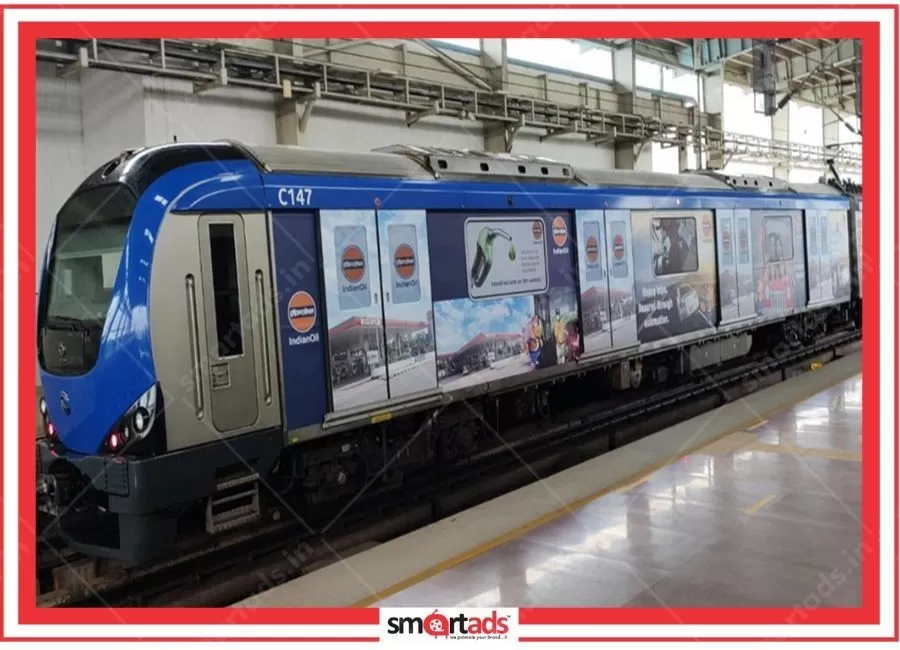
Exterior Metro Wrap
Size & Printing Cost as per actual
On the outside of metro Train, advertise
Rate per Metro Display Cost / 1 Month
Route:JBS Parade Ground To Falaknuma
₹860000.00
Showing 1 to 5 of 5 Results
MEDIA DETAILS
Size & Printing Cost as per actual
On the outside of metro Train, advertise
Rate per Metro Display Cost / 1 Month
Route:JBS Parade Ground To Falaknuma
₹860000.00
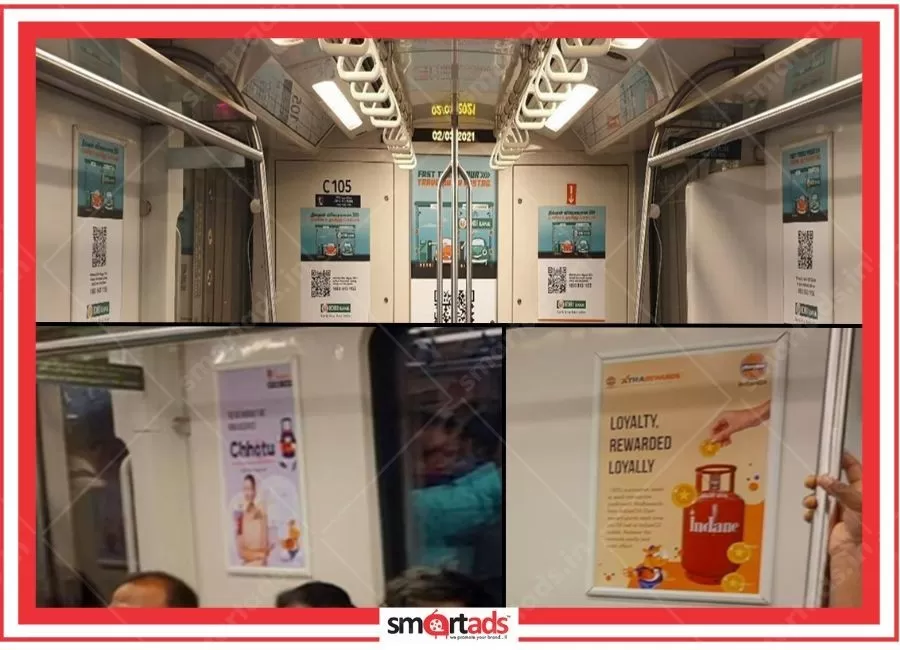
Size & Printing Cost as per actual
On the outside of metro Train, advertise
Rate per Metro Display Cost / 1 Month
Route:JBS Parade Ground To Falaknuma
₹480000.00

10 Sec Video
On the outside of metro Train, advertise
Rate per Metro Display Cost / 1 Month
Route:JBS Parade Ground To Falaknuma
₹135000.00
20 Sec Jingle
On the outside of metro Train, advertise
Rate per Metro Display Cost / 1 Month
Route:JBS Parade Ground To Falaknuma
₹400000.00

Size & Printing Cost as per actual
On the outside of metro Train, advertise
Rate per Metro Display Cost / 1 Month
Route:JBS Parade Ground To Falaknuma
₹1330000.00
MEDIA REACH

MinimumQty :
1
EstimateReachPeople :
150000000
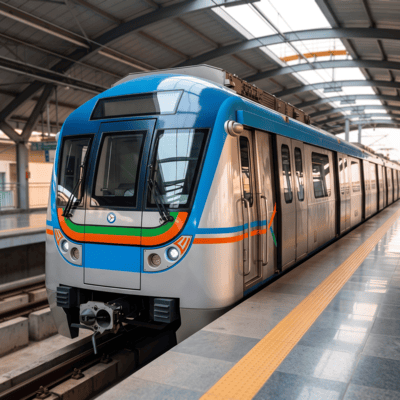
The Hyderabad Metro Rail's Green Line — officially Line 2, running from Jubilee Bus Station to Mahatma Gandhi Bus Station via Secunderabad — carries somewhere in the ballpark of 1.5 to 2 lakh daily commuters through some of the city's most commercially dense corridors, which makes it one of the most underutilised advertising channels in the south Indian market. Most brands we speak to have already explored television and digital, yet they consistently overlook a medium that delivers captive, repeated, high-dwell-time exposure to exactly the kind of urban professional audience they are trying to reach. That, frankly speaking, is a missed opportunity we have seen cost brands real money in terms of reach efficiency.
The Green Line is not just another metro route — it is, in our experience, the most commercially strategic of the three Hyderabad Metro Rail corridors, and the reasons for that are worth unpacking carefully. The route connects Jubilee Bus Station in the north to MGBS in the south, passing through Secunderabad, which is simultaneously a major railway interchange, a commercial hub, and a residential catchment area that feeds daily commuters from Malkajgiri, Uppal, and the broader eastern suburbs. What this means for an advertiser is that the audience is not a homogeneous group of office-goers; it is a layered mix of intercity travellers, daily wage earners, IT-adjacent professionals, and shoppers moving between Secunderabad's retail clusters and the older parts of the city.
The stations along this corridor — Parade Grounds, Gandhi Hospital, Musheerabad, RTC X Roads, Chikkadpally, Narayanguda, Sultan Bazaar, MG Bus Station — each have their own micro-audience character, which is something we always map carefully before recommending placement to a client. A pharmaceutical brand we worked with some time ago chose station-specific placements at Gandhi Hospital and Musheerabad stations rather than buying the entire corridor, and the result was a cost saving of roughly 35 percent against a full-line buy while maintaining near-identical reach within their target audience of patients, caregivers, and medical professionals. That kind of surgical planning is only possible when you understand the corridor's geography, not just its aggregate numbers.
On top of that, the Green Line's overlap with Secunderabad Railway Station — one of the busiest rail junctions in Telangana — means that advertising here reaches an audience which is, in many cases, visiting Hyderabad from tier-2 and tier-3 cities in the state, which adds a dimension of regional brand building that pure urban metro corridors simply cannot offer. For FMCG brands, educational institutions, and financial services companies looking to build recognition beyond the Hyderabad city limits, this is where the real value lies.
Most brands we speak to initially think of metro advertising as just the large backlit panels they see on station walls, but the actual inventory available across the Green Line is considerably more varied, which gives media planners real flexibility in how they construct a campaign. The primary formats include platform-level unipole and flex panels, concourse-level backlit displays, train wrap or train skin advertising on the exterior of rakes, in-train panel advertising inside coaches, digital screens at ticketing areas and concourses, and pillar branding at high-footfall stations. Each of these formats serves a different strategic purpose, and mixing them intelligently is something we have found produces significantly better recall than a single-format buy.
Train wrap advertising — where the exterior of an entire rake is branded with a client's creative — is the format which generates the most visibility per impression, because it moves through the city and is seen not just by commuters but by pedestrians, motorists, and bystanders at every station and along elevated sections of the track. The cost of a full train wrap on the Hyderabad Metro works out to somewhere between ₹8 lakh and ₹15 lakh per month depending on the rake and the duration of the booking, which is a number that surprises most clients when they realise a single branded rake can generate millions of impressions across all three corridors if it is not route-restricted. In-train panel advertising, by contrast, is priced far more modestly — in the ballpark of ₹15,000 to ₹40,000 per coach panel per month — which makes it accessible even for brands with tighter budgets who still want to reach a captive audience.
Digital screens at Green Line stations represent the newest and, in our view, the most underpriced format in the current inventory. These screens allow for dynamic creative rotation, which means a single screen placement can carry multiple messages across different day-parts — a feature that static formats simply cannot match. At SmartAds, we have started recommending digital screen combinations to clients who previously relied exclusively on static formats, particularly for campaigns where the message needs to change based on time of day, such as morning commute messaging for a breakfast brand versus evening messaging for a food delivery platform.
Frankly speaking, pricing transparency is one of the biggest gaps in how metro advertising is discussed in the Indian market, and we think brands deserve better than vague "contact us for rates" responses. The cost of advertising on the Hyderabad Metro Green Line varies based on format, station tier, duration, and the volume of inventory being booked — but we can share the general benchmarks we work with at SmartAds based on current market rates.
Station-level backlit panels at high-traffic Green Line stations like Secunderabad and RTC X Roads are priced in the range of roughly ₹50,000 to ₹1.2 lakh per panel per month, which reflects the premium that comes with those stations' footfall and commercial density. Mid-tier stations on the same corridor — Musheerabad, Chikkadpally, Narayanguda — tend to come in somewhere between ₹25,000 and ₹60,000 per panel per month, which offers considerably better cost-per-impression efficiency for brands whose target audience skews toward residential and mixed-use neighbourhoods rather than pure commercial zones. Pillar branding and concourse wraps are typically negotiated as packages, and we have found that a well-structured package buy across four to six stations can bring the effective CPM down to roughly ₹12 to ₹18, which compares very favourably against premium digital display formats in the same city.
What a lot of people miss is that duration significantly affects the per-unit cost — a three-month commitment typically attracts a discount of somewhere between 15 and 25 percent against the monthly card rate, and a six-month or annual commitment can push that discount further, which is why we almost always advise clients to plan metro campaigns in quarterly blocks at minimum. One automotive brand we worked with initially wanted a one-month trial on the Green Line; we restructured their plan into a three-month campaign with a slightly reduced footprint, which delivered better per-impression economics and gave the campaign enough time to build the frequency required for brand recall to actually shift.
This is the question which determines whether metro advertising belongs in a particular brand's media mix, and the answer for the Green Line is more nuanced than aggregate ridership numbers suggest. Based on Hyderabad Metro Rail's own ridership data and the broader urban mobility research which has been cited in FICCI-EY Media Reports in recent years, the metro commuter in Hyderabad skews toward the 22-to-45 age bracket, with a meaningful proportion of monthly pass holders who are salaried employees — which means this is a repeat-exposure medium, not a one-time-reach medium, and that distinction matters enormously for campaign planning.
The Green Line specifically draws heavily from the Secunderabad catchment, which includes a significant defence and government services population alongside the commercial workforce, and this gives the corridor a slightly different socioeconomic texture compared to the Red Line's IT-heavy Hitech City corridor. For brands in categories like banking and financial services, insurance, consumer electronics, apparel, and healthcare, the Green Line audience represents a high-value urban segment which is actively making purchase decisions and has the income to act on them. We have seen this dynamic play out particularly well for educational brands — coaching institutes, professional certification platforms, and private universities — which have found that the commute environment, where audiences have unoccupied time and are often thinking about career progression, is exceptionally well-suited to their messaging.
The dwell time factor is something we emphasise repeatedly to clients who are used to thinking in terms of digital impressions. A commuter on the Green Line spends an average of somewhere between 8 and 22 minutes on the train depending on their journey length, which is an uninterrupted exposure window that no digital format can reliably replicate. During that window, in-train panel advertising is seen multiple times, which creates a frequency-per-journey effect that compounds over weeks of daily commuting into genuine brand familiarity.
The planning approach we recommend at SmartAds starts with a clear objective hierarchy — because the format mix that makes sense for a brand-building campaign looks very different from the format mix that makes sense for a product launch or a retail footfall drive. For brand building, we typically recommend a combination of station concourse panels at two or three anchor stations, supplemented by in-train panels across multiple coaches; this creates a surround-sound effect where the commuter encounters the brand at the point of entry, again on the platform, and then once more during the journey itself.
For campaigns with a more immediate conversion objective — a new store opening near a Green Line station, for instance, or a limited-period offer from a brand with a nearby retail presence — the station-level formats at the closest station become the priority, and the creative needs to carry a clear directional or action element. A retail client in Hyderabad's Narayanguda area ran exactly this kind of campaign with us ahead of a festive season sale; by concentrating spend at Narayanguda and Sultan Bazaar stations with high-visibility concourse panels and pillar branding, they drove a measurable increase in footfall which they tracked through their own in-store counters, attributing roughly 18 percent of the incremental footfall to the metro campaign based on customer surveys conducted at the point of sale.
Creative adaptation is another area where campaigns either succeed or fall flat on metro formats, and we have seen this backfire when brands simply repurpose their television or digital creatives without accounting for the viewing context. Metro advertising is consumed at varying distances and in motion — a commuter walking past a platform panel has perhaps two to four seconds of direct visual contact, which means the creative must communicate the core message in the headline and visual alone, without relying on body copy or extended narrative. At SmartAds, we work with our clients' creative teams to ensure that metro-specific adaptations are developed as part of the campaign brief, not as an afterthought.
Not every category performs equally well in the metro environment, and we think it is more useful to be direct about this than to oversell the medium. Categories which have consistently delivered strong results in our experience include financial services, real estate, education, healthcare, FMCG, consumer electronics, and e-commerce platforms — all of which benefit from repeated exposure to an urban, economically active audience. Luxury and premium lifestyle brands have also found the metro environment increasingly relevant as ridership demographics have shifted toward higher-income commuters who have adopted metro travel for its convenience rather than its cost.
Categories which tend to underperform, or where we would counsel a more selective approach, include highly localised businesses with a very narrow geographic catchment that does not align with the corridor's reach, and B2B brands whose decision-makers are unlikely to be part of the commuter audience. That said, even B2B brands have found creative ways to use metro advertising — one IT services company we worked with used Green Line station advertising not for direct lead generation but for employer branding, targeting the engineering and technology talent pool that commutes through Secunderabad, which is a use case that is often overlooked in category-fit discussions.
The GroupM TYNY Report and Dentsu e4m Report have both highlighted out-of-home and transit advertising as among the fastest-growing segments of Indian media spend over the past two years, which reflects a broader recognition among brand managers that the post-pandemic return to physical mobility has made transit environments more valuable, not less. The Hyderabad Metro, which crossed the 4 lakh daily ridership mark in peak periods according to L&T Metro Rail Hyderabad's own disclosures, represents one of the most significant transit advertising opportunities in the south Indian market.
The booking process for Hyderabad Metro advertising goes through L&T Metro Rail Hyderabad's authorised advertising concessionaire, and the practical reality is that inventory at premium stations and for high-demand formats like train wraps tends to get committed well in advance — particularly around festive seasons, election periods, and major sporting events. We have seen clients lose their preferred placements by approaching the booking process too late, which is why we recommend initiating conversations at least six to eight weeks before the intended campaign start date for standard formats, and three to four months ahead for train wraps or large-scale station takeovers.
The documentation and approval process for metro advertising creative is more structured than for most outdoor formats; all creatives must be submitted for approval by the concessionaire and must comply with guidelines around content, dimensions, and production specifications. Production itself — particularly for backlit panels and digital content — needs to be factored into the timeline, and we always build a buffer of at least ten working days between creative approval and installation. Brands which have worked through an experienced media buying partner tend to navigate this process more smoothly, because the relationships and process familiarity that come from repeated bookings translate into faster approvals and better placement outcomes.
Negotiation leverage is another practical consideration which is worth addressing directly. Larger volume commitments across multiple formats or multiple stations give a buyer meaningfully better negotiating position than a single-panel, single-station booking; we have consistently been able to secure value additions — extended campaign duration, additional digital screen rotations, or complimentary pillar branding — for clients who commit to a certain minimum spend threshold. At SmartAds, our volume relationships across the Hyderabad Metro network mean that clients benefit from the aggregate buying power of a multi-client portfolio, which individual brands booking directly simply cannot access.
Hyderabad's outdoor advertising market is genuinely competitive — the city has a well-developed hoarding inventory along its major arterials, active mall advertising at Inorbit, GVK One, and Forum Sujana, and a growing airport advertising presence at Rajiv Gandhi International Airport. So the honest question a media planner should ask is where metro advertising sits in the efficiency hierarchy relative to these alternatives. Our experience is that metro advertising occupies a distinct position which is not really comparable to roadside hoardings on a like-for-like basis, because the audience relationship is fundamentally different.
A roadside hoarding on the Outer Ring Road delivers high gross impressions but very low dwell time — a driver passing at 60 kilometres per hour has perhaps two seconds of exposure, which is why roadside OOH works best for simple, high-frequency brand reminders rather than for communicating any meaningful product or service detail. Metro advertising, by contrast, delivers lower gross impressions but dramatically higher dwell time and frequency-per-individual, which makes it more effective for campaigns where the objective is to shift brand perception, communicate a value proposition, or build consideration. The CPM for a well-planned Green Line metro campaign works out to roughly ₹12 to ₹20, which is broadly comparable to mid-tier digital display but with the added credibility and physical presence that out-of-home formats carry.
Mall advertising in Hyderabad is the format which most closely competes with metro advertising for the same urban, mid-to-high income audience; the key difference is that mall advertising reaches consumers who are already in a shopping mindset and physically proximate to retail, which makes it more effective for immediate purchase conversion, while metro advertising reaches the same audience during a neutral, receptive moment in their day, which makes it more effective for brand building and consideration. The two formats are genuinely complementary rather than competitive, and the best campaigns we have planned in Hyderabad have used both in combination.
We are cautious about making blanket promises on campaign outcomes, because the results depend heavily on creative quality, format selection, duration, and how well the campaign is integrated with other media. That said, based on our campaign experience and the broader transit advertising research which has been published in industry reports, there are some realistic benchmarks worth sharing. Brand recall studies conducted in transit environments consistently show aided recall rates of somewhere between 65 and 80 percent for well-executed in-train and station advertising, which compares very favourably to the 40 to 55 percent recall typically reported for digital display in comparable urban markets.
The frequency effect is what makes metro advertising particularly powerful for brands with a medium-to-long campaign duration. A daily commuter on the Green Line who encounters a brand's advertising at their boarding station, on the platform, and inside the train is receiving three exposures per journey; over a 30-day campaign, that commuter has potentially been exposed to the brand's message somewhere in the range of 60 to 90 times, which is a frequency level that would require a significant digital budget to replicate and which builds the kind of deep familiarity that drives brand preference. One FMCG brand we worked with tracked brand preference scores in Hyderabad before and after a 90-day metro campaign; the lift in unaided brand awareness among the metro-commuter demographic was roughly 12 percentage points, which was the highest single-channel awareness lift they had recorded in the market that year.
The integration question is one which we think deserves more attention than it typically gets. Metro advertising works best when it is part of a broader media mix rather than a standalone channel; in our experience, campaigns which pair metro advertising with targeted digital retargeting — using geofencing around Green Line stations to serve mobile ads to commuters who have been exposed to the out-of-home creative — deliver measurably better conversion outcomes than either channel alone. This kind of phygital integration is something we actively plan for at SmartAds, because the data increasingly supports it as a best practice rather than a nice-to-have.
Q: What is the minimum budget required to run a campaign on the Hyderabad Metro Green Line?
The honest answer is that there is no single minimum that applies to every situation, because the format mix and station selection determine the budget more than any fixed floor. That said, based on current market rates, a meaningful single-station campaign with two to three panel placements at a mid-tier Green Line station can be structured for somewhere in the range of ₹1.5 lakh to ₹3 lakh per month, which is accessible for mid-sized brands and local businesses with a geographic connection to the corridor. A more comprehensive multi-station campaign with in-train panels and concourse branding would typically require a monthly investment in the range of ₹8 lakh to ₹20 lakh, depending on the number of stations and the volume of inventory. What we always tell clients is that a focused, well-placed smaller campaign will outperform a diluted larger one — so the priority should be on strategic placement rather than simply maximising the number of panels.
Q: How long does it take to get a metro advertising campaign live on the Green Line?
From the point of brief confirmation to campaign going live, brands should plan for a minimum of four to six weeks for standard static formats, and six to ten weeks for train wraps or large-scale station takeovers. The timeline breaks down into creative development and adaptation (which varies by brand but should not be rushed), creative submission and approval by the concessionaire (which typically takes five to ten working days), production and printing of physical materials (seven to fourteen working days depending on format complexity), and installation, which is scheduled by the metro authority and is typically done during non-operational hours. Delays most commonly occur at the creative approval stage when brands submit materials that do not conform to the technical specifications or content guidelines — something which an experienced media buying partner can help avoid by briefing the creative team correctly from the outset.
Q: Can small or local businesses advertise on the Hyderabad Metro Green Line, or is it only for large brands?
Metro advertising on the Green Line is genuinely accessible to smaller and local businesses, particularly those with a geographic connection to the corridor — a hospital near Gandhi Hospital station, a coaching institute in the Narayanguda or Chikkadpally catchment, a retail store near Sultan Bazaar. The key for smaller advertisers is to concentrate their investment at the one or two stations most relevant to their business rather than trying to buy the full corridor, which keeps the budget manageable while still delivering meaningful reach within the target area. We have worked with local businesses on Green Line campaigns with total monthly budgets of ₹2 lakh to ₹4 lakh which delivered very strong results precisely because the placement was chosen with surgical precision rather than broad coverage. The metro environment also lends a certain credibility and scale to smaller brands that other local advertising formats do not — there is a perception effect that comes from being seen in a premium transit environment, which smaller brands often find disproportionately valuable.
Q: What creative formats and dimensions are required for Green Line metro advertising?
The specific dimensions vary by format and station, and the official specifications are provided by the concessionaire at the time of booking confirmation — which is why we always recommend confirming the technical brief before the creative team begins production. As a general orientation, platform panels are typically produced in large-format flex or vinyl with backlit specifications, concourse displays follow standard OOH production norms, and in-train panels are produced in smaller formats that must account for the coach's interior dimensions and lighting conditions. Digital screen content must be provided in the appropriate resolution and file format, and the concessionaire typically specifies the maximum file size and aspect ratio. Train wrap artwork requires extremely precise production specifications and is almost always managed by a specialist large-format printer — this is not a format where brands should attempt to manage production independently without experience in large-format vehicle wrapping.
Q: How is the audience measurement and campaign effectiveness tracked for metro advertising?
This is an area where transit advertising has historically lagged behind digital in terms of measurement sophistication, though the gap is narrowing. Hyderabad Metro Rail publishes ridership data which provides the base for audience estimation, and independent research firms have conducted footfall and dwell-time studies at various stations which inform the reach and frequency calculations used in media planning. For campaign effectiveness, brands typically rely on a combination of brand tracking studies (measuring aided and unaided awareness before and after the campaign), in-store footfall counters for retail brands with nearby locations, digital attribution through geofencing and mobile retargeting (which can track the mobile behaviour of audiences exposed to the out-of-home creative), and customer surveys at the point of sale. At SmartAds, we recommend that clients with significant metro investments build a measurement framework into the campaign plan from the outset rather than trying to evaluate effectiveness retrospectively — because the data collection needs to be structured in advance to be meaningful.
Q: Is it possible to run a campaign only on the Green Line without buying inventory across other Hyderabad Metro corridors?
Yes, absolutely — and in many cases, a Green Line-only campaign is the right strategic choice rather than a compromise. The three Hyderabad Metro corridors serve distinct geographic and demographic catchments, and a brand whose target audience or retail footprint is concentrated in the Secunderabad-to-MGBS corridor has no particular reason to invest in the Red Line's Miyapur-to-LB Nagar corridor or the Blue Line's Nagole-to-Raidurg stretch. Buying across all three corridors makes sense for brands with city-wide awareness objectives and the budget to sustain meaningful presence across the full network; for brands with more focused geographic or demographic objectives, a well-planned Green Line campaign will almost always deliver better efficiency than a thin spread across the full network. The concessionaire's inventory is sold by corridor and by station, so there is no structural requirement to buy across the full network — though multi-corridor packages do attract better rates for brands that have the budget and the strategic rationale.
The Hyderabad Metro Green Line is one of those advertising environments which rewards careful planning and punishes lazy media buying — and that distinction matters more here than in most other formats. The corridor's audience is real, captive, and commercially valuable; the formats are varied enough to suit almost any budget and objective; and the frequency effect that comes from daily commuter exposure is something which very few other urban media channels can match at comparable cost. What separates successful campaigns from forgettable ones on this corridor is the quality of the strategic thinking that goes into station selection, format mix, creative adaptation, and integration with the broader media plan.
Our experience at SmartAds across hundreds of transit advertising campaigns in Indian cities has consistently shown that the brands which treat metro advertising as a standalone tactical buy tend to be disappointed, while the brands which integrate it thoughtfully into a broader media strategy — using it to build frequency and familiarity with an urban audience while other channels drive reach and conversion — tend to find it one of the most cost-efficient elements of their plan. The Green Line, with its unique mix of commercial, residential, and transit-hub catchments, offers a particularly interesting canvas for brands that understand how to use it.
If you are planning a campaign in Hyderabad and want a media plan that is built on actual market intelligence rather than generic rate cards, the SmartAds team would be glad to put together a detailed proposal — one that maps your target audience to specific Green Line stations, recommends the right format mix for your objectives, and gives you honest benchmarks for what you can expect to achieve. Reach out to us at [SmartAds.in](https://smartads.in) to start the conversation; we work across 500+ Indian cities and have the Hyderabad market knowledge to make your investment count.
