
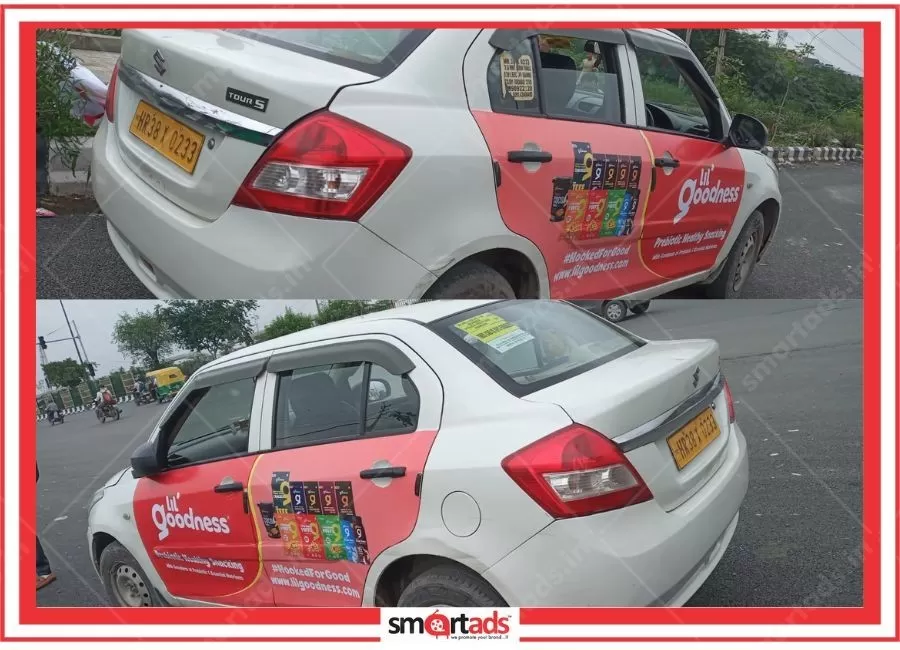
Cab Outside Door
78 in x 34 in
Door of the cab is placed with the adver
Rate per Cabs / Month
It completely covers four doors outside
₹3500.00
Showing 1 to 3 of 3 Results
MEDIA DETAILS
78 in x 34 in
Door of the cab is placed with the adver
Rate per Cabs / Month
It completely covers four doors outside
₹3500.00

A4
Inside Panel is placed inside the cab an
Rate per Display / Month
It completely covers the Interior back
₹1600.00
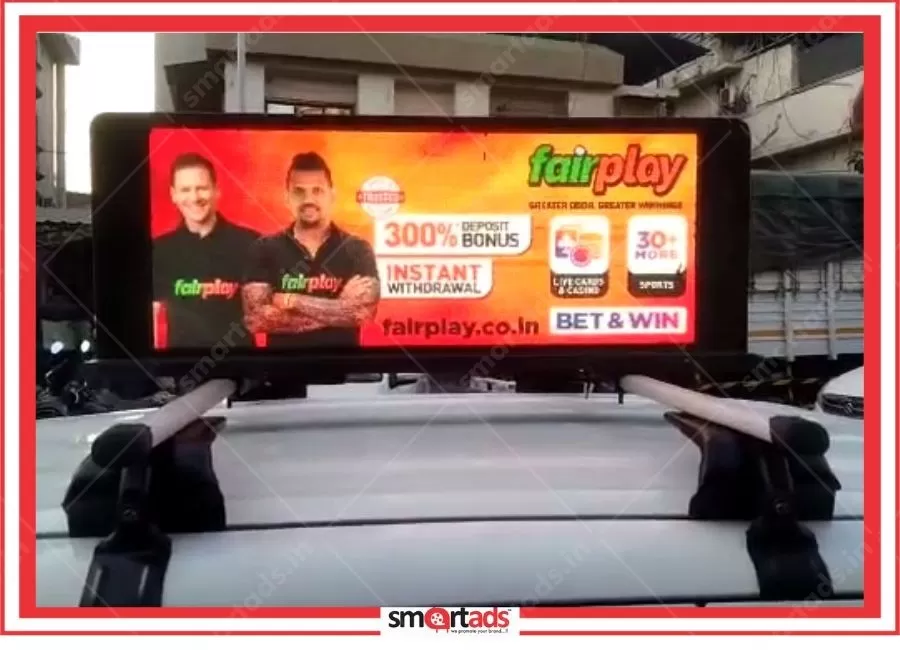
3 x 1 Ft
The advertisement, which will be digital
Rate per Hours / Day
The digital screen displays advertiseme
₹260.00
MEDIA REACH

MinimumQty :
100
EstimateReachPeople :
300000
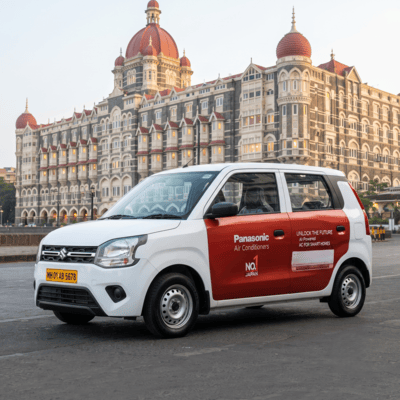
Mumbai's cabs collectively travel somewhere in the ballpark of 8 to 12 million kilometres every single month — which means a well-planned cab branding campaign in Mumbai is not just reaching people at a static point in space, it is chasing them through every corridor of the city, from the pre-dawn rush at Chhatrapati Shivaji Maharaj International Airport to the late-night crawl along the Bandra-Worli Sea Link. Most brand managers we speak to have never thought about it that way, and that shift in perspective tends to change the entire conversation about where their outdoor advertising budget should go.
There is a moment in almost every media planning conversation where a client asks why their hoarding on the Western Express Highway is not moving the needle the way they expected — and the honest answer, more often than not, is that static does not mean effective. Cab advertising in Mumbai operates on an entirely different principle: the medium moves with the city, which means the brand moves with the city. A branded cab does not wait for a consumer to walk past it; it drives through Andheri in the morning, parks outside a corporate tower in Bandra Kurla Complex at noon, and sits in the queue outside a multiplex in Worli by evening. That kind of geographic fluidity is genuinely difficult to replicate with any fixed out-of-home advertising format.
As a BTL advertising medium, cab branding in Mumbai sits in a category that is sometimes underestimated by planners who default to television or digital. Below-the-line advertising, by its nature, is designed for precision and proximity — and few formats deliver both as efficiently as transit media on cabs. The FICCI-EY Media Report has consistently noted that non-traditional advertising formats, particularly transit and vehicle-based media, have been growing at a faster clip than traditional OOH advertising in tier-one Indian cities, which reflects a broader shift in how brands are thinking about urban reach. Mumbai, being the most congested and commercially dense metro city in the country, amplifies every advantage that cab advertising already has.
What a lot of people miss is the sheer dwell time that cab advertising generates. When a cab sits in traffic on the Eastern Express Highway or waits at the signal near Andheri station, the branded vehicle is essentially a mobile billboard that has been forced to hold position in front of hundreds of pedestrians, auto-rickshaw passengers, and fellow commuters — sometimes for three to five minutes at a stretch. At SmartAds, we have found that this involuntary, repeated exposure in high-traffic areas is one of the most undervalued aspects of cab advertising in Mumbai, and it is a core reason why brand recall numbers from well-executed cab branding campaigns tend to outperform what clients expect when they first see the format.
The format question is where most first-time cab advertisers get stuck, because the options are more varied than they appear on the surface — and choosing the wrong one for your objective can mean spending a reasonable budget on something that simply does not get noticed. The most impactful format, and the one we almost always recommend for brand awareness campaigns, is the full cab wrap, which covers the entire exterior of the vehicle in the brand's creative. A full cab wrap advertising execution in Mumbai turns the car into a moving canvas; there is no competing visual noise on the vehicle itself, which means the brand message gets the entire surface area to work with. For campaigns where visual dominance is the objective — a new product launch, a rebranding exercise, or a high-visibility seasonal push — this is the format that delivers.
Door panel ads represent a more cost-efficient entry point into cab advertising in Mumbai, and they work particularly well for brands that need to communicate a single, sharp message rather than a full brand story. The rear door panels on both sides of a cab are at eye level for pedestrians and passengers in adjacent vehicles, which makes them surprisingly readable even in slow-moving traffic. Interior cab advertising is a different beast altogether — these are the branding elements placed on the back of the front seat headrest or on the roof lining inside the cab, which means the target audience is literally a captive audience: the passenger sitting in the vehicle for the duration of their ride. We have seen interior cab advertising work exceptionally well for fintech apps, insurance brands, and ed-tech platforms, where the message needs a few seconds of uninterrupted attention to land properly.
Taxi top advertising — the illuminated or printed panels mounted on the roof of the cab — has made a significant comeback in Mumbai, particularly because rooftop cab ads are visible from a height that most other vehicle-based formats are not. In dense pedestrian zones like Bandra, Colaba, or the streets around Dadar, where foot traffic is heavy and eye-level sightlines are often blocked by other vehicles, rooftop cab ads cut through in a way that door panels simply cannot. On top of that, there are rear windshield branding options and bonnet branding formats which, while less commonly used, serve specific creative and directional purposes — particularly for brands that want visibility in the vehicle's wake rather than alongside it.
Frankly speaking, this is the question every client asks first, and it is also the question that most cab advertising vendors in Mumbai are least transparent about — which is something we find genuinely frustrating from a media planning standpoint, because opaque pricing makes campaign budgeting nearly impossible. So let us put some real numbers on the table. A full cab wrap advertising campaign in Mumbai, covering the entire exterior of the vehicle, typically costs somewhere between ₹4,500 and ₹7,000 per cab per month, depending on the cab operator, the campaign duration, and the specific zones or routes being targeted. That number includes the media cost; the production cost for the vinyl wrap itself is usually an additional ₹2,500 to ₹4,000 per cab, which is a one-time expense for the duration of the campaign.
Door panel ads, which are the partial exterior formats covering the rear doors on both sides, work out to roughly ₹1,800 to ₹3,000 per cab per month — which is a number that makes a lot of brand managers pause when they realise how much reach they can generate by scaling the fleet. Interior cab advertising, covering the headrest panels and in-cab branding, is priced in the ballpark of ₹1,000 to ₹2,000 per cab per month; the CPM for interior formats is actually quite competitive when you factor in the captive, undistracted audience that each passenger represents. Taxi top advertising — the rooftop cab ads — sits somewhere between ₹2,000 and ₹3,500 per cab per month, and the illuminated variants command a premium of roughly 20 to 30 percent over the standard printed panel.
The cab advertising rates in Mumbai vary based on a few key factors which are worth understanding before you finalise a plan. Campaign duration has a significant impact on the per-cab cost — a 30-day campaign will always cost more per day than a 90-day campaign, and most operators offer meaningful discounts at the three-month and six-month marks. Fleet size matters too; a campaign running on 50 cabs is priced differently from one running on 500, and the economies of scale can be substantial. At SmartAds, we always tell our clients that the most cost-effective cab advertising cost structure in Mumbai is achieved by committing to a minimum of 60 days and a fleet of at least 100 vehicles — below those thresholds, the per-impression cost climbs steeply and the campaign loses the density it needs to generate meaningful brand recall.
The comparison between cab advertising and traditional OOH advertising in Mumbai is one that comes up in almost every media planning conversation we have, and the answer is more nuanced than most people expect. A hoarding on the Western Express Highway or near the Bandra-Worli Sea Link is undeniably powerful — the sheer size of the format commands attention, and a well-placed static billboard in a high-traffic area can generate enormous impressions over a month. But the cab advertising in Mumbai equation changes when you account for mobility: a single branded cab, over the course of a day, passes through multiple zones, multiple demographic pockets, and multiple high-traffic areas in a way that no static format can replicate. The hoarding reaches whoever comes to it; the cab goes to where the audience already is.
The cost comparison is equally instructive. A premium hoarding in a location like Andheri or BKC can cost anywhere from ₹3 to ₹8 lakh per month, which makes it inaccessible for most mid-market brands and virtually all startups. Cab branding in Mumbai, by contrast, allows a brand to launch a meaningful campaign — 50 to 100 cabs, full exterior wrap, running for 60 days — at a total cost that is a fraction of a single premium hoarding. The reach is different in character, not necessarily in volume; a fleet of 200 branded cabs moving through Mumbai's suburbs generates impressions that are distributed across the city rather than concentrated at one point, which is actually more valuable for brands trying to build broad awareness rather than dominate a single location.
To be fair, there are scenarios where static OOH advertising wins the argument. If a brand is launching in a specific micromarket — say, a luxury residential project targeting buyers in South Mumbai — a well-placed hoarding near Worli or Nariman Point delivers a precision that a roaming cab fleet cannot guarantee. But for most brand awareness objectives, particularly for brands that need to build visibility across the entire Mumbai metropolitan area, the mobility advantage of cab advertising combined with the cost-effectiveness of the format makes it a genuinely compelling alternative to traditional outdoor advertising. We have seen this play out repeatedly in campaigns where clients have shifted a portion of their OOH budget into cab branding and watched their overall reach metrics improve without a corresponding increase in spend.
Route planning is, in our experience, the single most underappreciated element of a cab advertising campaign in Mumbai — and it is where the difference between a mediocre campaign and a genuinely effective one is often made. The Western Express Highway corridor, running from Dahisar through Borivali, Kandivali, Malad, Goregaon, Jogeshwari, and into Andheri, is one of the highest-volume transit corridors in the country; cabs operating on this route are exposed to a dense mix of office commuters, shoppers, and residents across Mumbai's suburbs throughout the day. Andheri itself — both East and West — is arguably the single most commercially active node in the city, and any cab branding campaign that does not include significant Andheri coverage is leaving a significant portion of the city's consumer base unaddressed.
Bandra Kurla Complex deserves special mention because the demographic concentration there is unlike almost anywhere else in Mumbai. The working population in BKC skews heavily toward finance, consulting, media, and technology — which makes it an ideal zone for brands targeting urban professionals, whether the product is a premium financial service, a business-class travel offering, or a high-end consumer electronics brand. Cabs operating in and around BKC, including the routes connecting it to Bandra West and Kurla station, generate impressions among a target audience that is genuinely difficult to reach through mass media. Similarly, the Chhatrapati Shivaji Maharaj International Airport zone — covering the approach roads, the pick-up and drop-off areas, and the connecting routes to Andheri and Vile Parle — is a premium zone for cab advertising, particularly for brands in travel, hospitality, and financial services.
Navi Mumbai and Thane represent a different kind of opportunity — one that is often overlooked by planners who focus exclusively on the island city and the western suburbs. The cab advertising ecosystem in Navi Mumbai and Thane has grown substantially as the population of these areas has increased, and the cab advertising rates in these zones tend to be 15 to 25 percent lower than equivalent formats in core Mumbai, which makes them attractive for brands that want to extend their geographic reach without proportionally increasing their budget. At SmartAds, we have planned several campaigns that used a core Mumbai fleet for brand awareness and a Navi Mumbai and Thane fleet for hyperlocal advertising around specific retail or service locations — a structure which delivered measurably better outcomes than concentrating the entire budget in a single zone.
The planning process for a cab advertising campaign in Mumbai is more structured than most clients initially expect, and getting the sequencing right makes a significant difference to the final outcome. The first step is defining the campaign objective with genuine precision — not "we want brand awareness" but "we want to drive app downloads among 25-to-35-year-old professionals in the western suburbs of Mumbai over the next 60 days." That level of specificity determines the format choice, the zone selection, the fleet size, and the creative brief, all of which cascade from the objective rather than being decided in isolation. A campaign built around a vague objective tends to produce vague results, which is something we have seen enough times to be quite direct about with clients at the briefing stage.
Once the objective is clear, the media planning phase involves selecting the right mix of formats — whether that is full cab wrap advertising for maximum visual impact, door panel ads for cost-efficient scale, or interior cab advertising for a captive audience experience — and mapping those formats to the zones and routes that best match the target audience profile. The minimum fleet size for a campaign that generates meaningful impressions in Mumbai is, in our assessment, somewhere around 50 cabs; below that threshold, the density is insufficient to create the frequency of exposure that drives brand recall. Most effective campaigns we have managed run on fleets of 100 to 300 cabs, with campaign durations of 60 to 90 days, which is the window in which brand recall metrics typically show the strongest uplift.
The production and deployment phase involves artwork approval, vinyl printing, and vehicle wrapping — a process that typically takes 10 to 14 days from artwork finalisation to the first cab going live on the road. MCGM regulations and BMC guidelines govern what can and cannot be displayed on commercial vehicles operating in Mumbai, and compliance is not optional; campaigns that skip the regulatory check have been pulled mid-flight, which is an expensive and embarrassing outcome. At SmartAds, we handle the compliance verification as part of our standard campaign onboarding process, which means clients do not have to navigate the regulatory landscape themselves. Once the campaign is live, monitoring involves a combination of GPS-based fleet tracking, periodic photography at key locations, and — for campaigns that have integrated digital elements — QR code scan data and geofenced retargeting performance.
The short version of this answer is yes, but the mechanics are more specific than most people realise. Ola cab branding and Uber cab advertising in Mumbai are both available, but they operate through aggregator-approved vendor networks rather than through direct arrangements with individual drivers — which means the process of booking a campaign on Ola or Uber cabs involves working with an authorised cab advertising agency in Mumbai that has the relevant operator relationships in place. The driver network for both platforms in Mumbai is enormous; Ola and Uber together account for a substantial share of the app-based cab market in the city, which means a well-structured Ola cab branding or Uber cab advertising campaign can reach a geographically diverse audience across all of Mumbai's major zones.
The format options available on Ola and Uber cabs in Mumbai are broadly similar to those available on other fleet operators — full cab wrap, door panel ads, rooftop cab ads, and interior cab advertising are all accessible — but the production standards required by the aggregators tend to be stricter, which is actually a good thing for brand quality. Uber cab advertising, in particular, has specific guidelines around vinyl quality, installation standards, and creative content which ensure that the branded vehicles maintain a consistent appearance throughout the campaign duration. Ola cab branding campaigns in Mumbai tend to offer slightly more flexibility in terms of zone selection and route targeting, which makes them useful for campaigns with specific geographic objectives.
What we tell our clients who are specifically interested in Ola cab branding or Uber cab advertising is that the aggregator fleet is most valuable when the campaign objective involves reaching app-savvy, urban consumers — which, given the demographic profile of ride-hailing users in Mumbai, is a reasonably broad target. The passenger profile for Ola and Uber in Mumbai skews toward the 22-to-45 age group, with a higher-than-average proportion of working professionals and frequent travellers, which makes these platforms particularly relevant for fintech brands, travel and hospitality companies, and consumer electronics advertisers. On top of that, the interior cab advertising opportunities on aggregator-platform vehicles — where the passenger is sitting in the cab for an average of 15 to 25 minutes — represent one of the most genuinely captive audience environments available in any BTL advertising format.
The honest answer is that cab advertising in Mumbai works for a wider range of brand categories than most planners initially assume, but there are certain categories where the format's advantages align almost perfectly with the marketing objective. D2C brands — particularly those in personal care, health and wellness, and food delivery — have found cab branding in Mumbai to be an exceptionally efficient vehicle for building brand awareness among urban consumers who are already predisposed to discovering new brands through visual cues in their environment. One FMCG client we worked with — a personal care brand launching a new product line in Mumbai — ran a 90-day campaign across 200 cabs covering the western suburbs from Andheri to Borivali; the campaign generated an estimated 4.2 crore impressions over the period, and the brand's aided awareness score in the target zone improved by 18 percentage points compared to the pre-campaign baseline, which was a result that significantly exceeded the client's expectations.
Real estate brands have historically been among the most active users of cab advertising in Mumbai, and the logic is straightforward: property buyers in Mumbai are mobile, they are evaluating multiple locations, and they are often making decisions that involve significant geographic research. A branded cab operating on the routes between South Mumbai and the western suburbs, or between BKC and Navi Mumbai, is reaching prospective buyers at precisely the moments when they are physically moving between the areas they are considering. Fintech and banking brands have also found cab advertising to be a strong performer, particularly when combined with interior cab advertising formats that give passengers a QR code or a short URL to engage with during their ride — a structure which creates a measurable digital touchprint from an OOH format.
Ed-tech platforms, particularly those targeting working professionals for upskilling courses, have been among the more interesting recent entrants into the cab advertising space in Mumbai. One ed-tech client we worked with ran a campaign specifically targeting the BKC and Lower Parel corridors — areas with a high concentration of the working professional demographic they were trying to reach — using a combination of full cab wrap advertising on the exterior and interior cab advertising with a QR code linking to a free trial offer. The interior format generated a scan-through rate that was, frankly, surprising even to us; the captive audience effect in a cab is real, and when the creative is sharp and the offer is relevant, passengers do engage. That campaign ran for 60 days on 120 cabs and delivered a cost-per-acquisition that was competitive with the brand's paid digital channels — which is not something you hear very often about an OOH format.
Measurement is the area where cab advertising has historically been weakest, and it is also the area where the most interesting innovation is happening right now. The traditional approach to measuring out-of-home advertising performance — estimating impressions based on traffic count data and average vehicle occupancy — is still the baseline for most cab advertising campaigns in Mumbai, and it is a reasonable starting point. A single branded cab operating in high-traffic areas of Mumbai for a full day generates somewhere between 15,000 and 25,000 impressions, depending on the zone, the time of day, and the traffic density; a fleet of 100 cabs running for 30 days therefore generates somewhere in the ballpark of 4.5 to 7.5 crore impressions over the campaign period, which is a reach figure that compares favourably with many digital and traditional media buys at the same budget level.
The more sophisticated measurement approaches involve integrating digital tracking mechanisms directly into the cab advertising creative. QR codes placed on the interior panels or the rear windshield of branded cabs allow brands to track direct engagement — every scan is a data point that connects the OOH exposure to a digital action, whether that is a website visit, an app download, or a form fill. Promo codes embedded in cab advertising creatives serve a similar function, particularly for e-commerce and D2C brands that can attribute purchases to the code. Geofenced digital retargeting is perhaps the most powerful integration available: by defining a geographic zone that corresponds to the cab campaign's operating area, brands can serve digital ads to mobile users who have been physically present in that zone, creating a reinforcement loop between the out-of-home advertising exposure and the digital touchpoint.
At SmartAds, we have been building measurement frameworks that combine fleet GPS data — which shows where each branded cab has been and for how long — with digital engagement metrics from QR codes and geofenced campaigns, to produce a campaign performance dashboard that gives clients a much more granular view of their return on investment than a simple impression estimate. The GPS data, in particular, is valuable because it allows us to verify that the fleet is actually operating in the zones specified in the media plan, which is a level of accountability that most cab advertising agency arrangements in Mumbai do not offer. We think this kind of transparent, data-backed reporting is simply what good media planning looks like — and it is something we insist on for every campaign we manage.
Q: What is cab advertising in Mumbai and how does it work?
Cab advertising in Mumbai is a form of transit media and BTL advertising in which a brand's creative is applied to the exterior or interior of a cab — or both — which then operates across the city's road network, generating impressions among pedestrians, other road users, and passengers. The mechanics are straightforward: a brand selects a format (full cab wrap, door panel ads, rooftop cab ads, or interior cab advertising), works with a cab advertising agency in Mumbai to identify the fleet and zones, produces the vinyl or printed creative, and deploys it across the agreed number of vehicles for the campaign duration. The cab continues its normal operating pattern throughout the campaign, which means the brand is reaching audiences across multiple zones and demographics without any additional effort or cost on the advertiser's part.
Q: How much does cab advertising cost in Mumbai?
Cab advertising rates in Mumbai vary by format and fleet size, but to give you a working range: full cab wrap advertising costs somewhere between ₹4,500 and ₹7,000 per cab per month in media cost, with production adding roughly ₹2,500 to ₹4,000 per vehicle. Door panel ads are in the ballpark of ₹1,800 to ₹3,000 per cab per month, interior cab advertising runs from ₹1,000 to ₹2,000 per cab per month, and rooftop cab ads sit between ₹2,000 and ₹3,500 per cab per month. A minimum viable campaign — 50 cabs, 30 days, door panel format — can be launched for a total cab advertising cost in Mumbai of roughly ₹2 to ₹3 lakh including production; a more substantial campaign running 200 cabs on full wrap for 90 days would sit in the ₹30 to ₹45 lakh range.
Q: What are the different formats available for cab advertising in Mumbai?
The main formats available for cab advertising in Mumbai are full cab wrap (covering the entire exterior), door panel ads (rear doors on both sides), rooftop cab ads (illuminated or printed panels on the roof), interior cab advertising (headrest panels, roof lining, and seat-back creatives inside the vehicle), and rear windshield branding. Each format serves a different objective: full cab wrap advertising is best for brand awareness and visual dominance; door panel ads offer cost-efficient reach; interior cab advertising delivers a captive audience experience; and rooftop cab ads provide visibility in pedestrian-heavy zones where eye-level formats are obscured.
Q: Can I advertise on Ola and Uber cabs in Mumbai?
Yes — Ola cab branding and Uber cab advertising in Mumbai are both available through authorised vendor networks. Neither platform allows direct arrangements with individual drivers; campaigns must be booked through a cab advertising agency in Mumbai that has established relationships with the aggregator-approved operator networks. Both Ola and Uber have specific production and installation standards that must be met, and the creative content must comply with their brand guidelines as well as MCGM regulations for vehicle advertising in Mumbai.
Q: What is the minimum number of cabs required for a campaign in Mumbai?
Most operators will accept a minimum fleet of 25 to 30 cabs for a short-duration campaign, but our honest recommendation is that a minimum of 50 cabs is needed to generate the impression density required for meaningful brand recall in a city the size of Mumbai. For campaigns targeting specific zones — say, Andheri or BKC exclusively — a smaller fleet can work if the zone is tightly defined; for city-wide campaigns, 100 to 200 cabs is the range in which the campaign starts to generate the frequency and reach that makes a measurable difference to brand awareness metrics.
Q: How long should a cab advertising campaign run in Mumbai for best results?
A 30-day campaign is the absolute minimum, and it is really only appropriate for event-linked or time-sensitive promotions. For brand awareness objectives, a campaign duration of 60 to 90 days is where the research — and our own campaign experience — suggests the strongest brand recall uplift occurs. The reason is simple: consumers in Mumbai are exposed to an enormous volume of advertising stimuli every day, and a branded cab needs to be seen multiple times before the message registers at a conscious level. Campaigns running for less than 30 days tend to generate impressions without generating recall, which is a waste of the production investment.
Q: How many impressions can one branded cab generate per day in Mumbai?
A single branded cab operating in Mumbai's high-traffic areas generates somewhere between 15,000 and 25,000 impressions per day, depending on the zone, the time of day, and traffic conditions. This estimate is based on traffic count data and average pedestrian and vehicular density in the operating zones; the actual figure varies by route, with cabs operating on the Western Express Highway or in the BKC corridor tending toward the higher end of that range, while cabs operating in lower-density residential zones generate fewer daily impressions.
Q: Is cab advertising better than hoarding or billboard advertising in Mumbai?
The honest answer is that it depends on the campaign objective. For broad, city-wide brand awareness at a cost-effective price point, cab advertising in Mumbai generally outperforms a single hoarding because the mobile format reaches multiple zones and demographics rather than a fixed audience at one location. For dominating a specific high-value location — a premium junction, a key commercial corridor — a large-format hoarding may deliver stronger impact at that specific point. The most effective campaigns we have managed combine both: a cab branding fleet for broad reach and frequency, supported by one or two strategic static OOH placements for location-specific dominance.
Q: Which areas or routes in Mumbai are best for cab advertising?
The highest-impression zones for cab advertising in Mumbai are the Western Express Highway corridor (Andheri to Borivali), Bandra Kurla Complex and its connecting routes, the airport zone around Chhatrapati Shivaji Maharaj International Airport, the Bandra-Worli Sea Link approach roads, and the Eastern Express Highway corridor connecting Thane and Navi Mumbai to the city. For demographic targeting, BKC and Lower Parel are best for urban professionals; Andheri West and Bandra West for lifestyle and consumer brands; and Navi Mumbai and Thane for brands targeting the rapidly growing suburban middle class.
Q: How do I measure the ROI of my cab advertising campaign in Mumbai?
ROI measurement for cab advertising combines impression estimation (based on fleet size, operating zones, and daily traffic data), digital engagement tracking (QR code scans, promo code redemptions), and brand lift measurement (pre- and post-campaign awareness surveys). Geofenced digital retargeting — which serves digital ads to mobile users who have been physically present in the cab campaign's operating zones — adds a measurable conversion layer to the OOH exposure. At SmartAds, we provide GPS-verified fleet activity reports alongside digital engagement data, which gives clients a transparent and auditable view of their campaign performance rather than a single estimated impression figure.
Q: What type of brands benefit most from cab advertising in Mumbai?
D2C brands, fintech and banking companies, real estate developers, ed-tech platforms, FMCG brands, quick-service restaurants, and healthcare brands have all found cab advertising in Mumbai to be an effective and cost-efficient format. The common thread is that these are categories where broad urban reach, repeated exposure, and demographic targeting across Mumbai's diverse zones align with the marketing objective. Brands with a hyperlocal advertising need — a new store opening, a neighbourhood service launch — can also use cab advertising very effectively by restricting the fleet to specific zones.
Q: What artwork or design specifications are required for cab wraps in Mumbai?
Full cab wrap advertising artwork is typically supplied at 1:1 scale in a high-resolution vector or raster format (minimum 150 DPI at final print size), with bleed allowances specified by the production vendor. Colour contrast is critical for moving vehicles; dark backgrounds with high-contrast text and imagery perform significantly better than light or pastel palettes, which tend to wash out in Mumbai's ambient light conditions. Font sizes should be large enough to be readable at 10 to 15 metres — a headline should be no smaller than 150mm in height on a full wrap. The creative should communicate the core message in under three seconds, which is the average time a pedestrian or adjacent driver has to register the brand before the cab moves on.
Q: Is cab advertising considered a BTL or ATL advertising medium?
Cab advertising is firmly classified as a BTL advertising medium — specifically, it sits within the transit media and non-traditional advertising categories. Unlike ATL formats such as television, radio, and national print, which broadcast to mass undifferentiated audiences, cab advertising allows for geographic targeting, demographic zone selection, and campaign customisation that is characteristic of below-the-line advertising. That said, at sufficient scale — a fleet of 500 or more cabs operating across all of Mumbai — cab branding can generate reach figures that begin to approach mass-media territory, which makes it one of the more scalable BTL advertising formats available in a metro city.
Q: How does cab advertising compare to auto-rickshaw or bus advertising in Mumbai?
Auto-rickshaw advertising in Mumbai offers broader geographic penetration in residential and suburban zones where cabs are less common, and the per-vehicle cost is lower — typically in the range of ₹500 to ₹1,500 per vehicle per month. However, the creative canvas on an auto-rickshaw is significantly smaller, and the audience profile is different: auto-rickshaw passengers and pedestrians in auto-heavy zones tend to skew toward a different demographic than cab users. BEST bus advertising offers very high-volume impressions on fixed routes, with strong penetration in the commuter segment, but the fixed-route nature means geographic flexibility is limited. Cab advertising sits between these two in terms of cost and demographic profile, with the advantage of greater geographic mobility and a more premium audience profile than either auto-rickshaw or bus advertising.
Q: What is the process to get started with cab advertising in Mumbai?
The process begins with a briefing call or meeting to define the campaign objective, target audience, geographic zones, budget, and timeline. From there, the cab advertising agency in Mumbai prepares a media plan specifying the format mix, fleet size, operating zones, and campaign duration, along with a cost breakdown. Once the plan is approved, the artwork brief is issued and the creative is developed and submitted for production. After artwork approval and vinyl printing — which takes roughly 10 to 14 days — the vehicles are wrapped and the campaign goes live. Monitoring begins immediately, with GPS tracking and periodic photography providing ongoing campaign verification throughout the flight period.
Mumbai is, by almost any measure, the most commercially intense city in India — and yet the advertising conversation about it is dominated by television ratings, digital CPMs, and the same handful of premium hoarding locations that everyone already knows. Cab advertising in Mumbai represents something genuinely different: a medium that moves through the city the way its residents do, reaching people at the petrol station in Malad, the traffic signal in Worli, the airport drop-off lane in Vile Parle, and the parking bay outside a mall in Thane, all within the same campaign and often within the same day. The format's mobility is its superpower, and when it is planned with the same rigour that goes into a television or digital buy — with clear objectives, the right format mix, zone-specific route planning, and a measurement framework that goes beyond a simple impression estimate — it consistently delivers results that surprise even experienced brand managers.
The brands that have gotten the most out of cab branding in Mumbai are the ones that treated it as a strategic medium rather than a tactical afterthought — the ones that invested in sharp creative, committed to a meaningful campaign duration, integrated their OOH exposure with digital retargeting, and measured the outcomes with the same discipline they would apply to any other channel. That is the approach we bring to every cab advertising campaign we plan at SmartAds, and it is the approach that has produced the kind of results — 18-point awareness lifts, competitive cost-per-acquisition figures, and impression volumes that rival far more expensive media buys — that keep clients coming back to the format.
If you are evaluating cab advertising in Mumbai for your brand and want a media plan built on real market data, transparent pricing, and a measurement framework that holds up to scrutiny, the SmartAds team is ready to put one together for you. Visit SmartAds.in or reach out directly to start a conversation about what a well-planned cab branding campaign in Mumbai could do for your brand's visibility across the city.
