
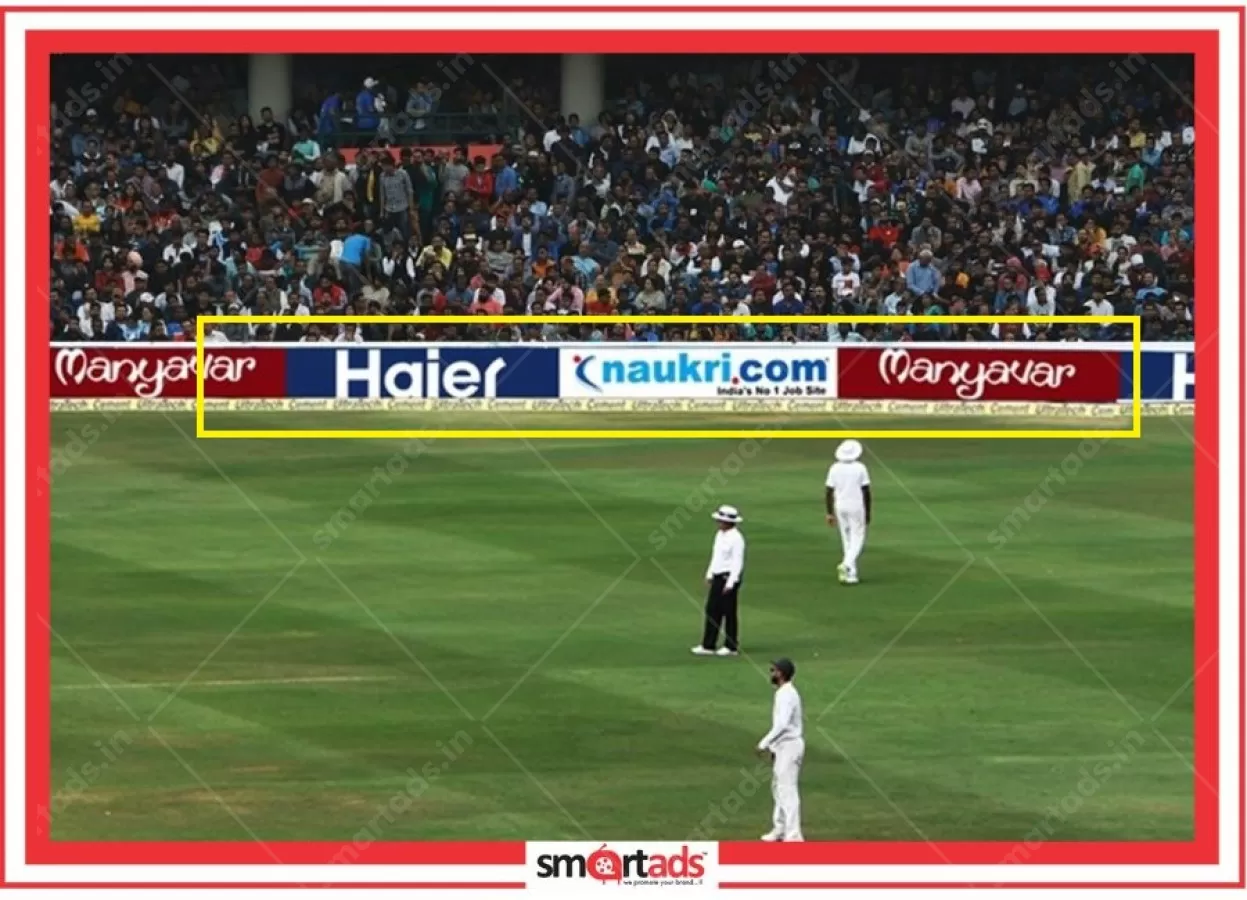
Silver HD Perimeter Signage
Various Sizes
1 ball in every 10 Balls : 50% of the Gr
Rate per Digital Screen / Per match
At Time Only 3 Display Name.
₹1100000.00
Showing 1 to 4 of 4 Results
MEDIA DETAILS
Various Sizes
1 ball in every 10 Balls : 50% of the Gr
Rate per Digital Screen / Per match
At Time Only 3 Display Name.
₹1100000.00
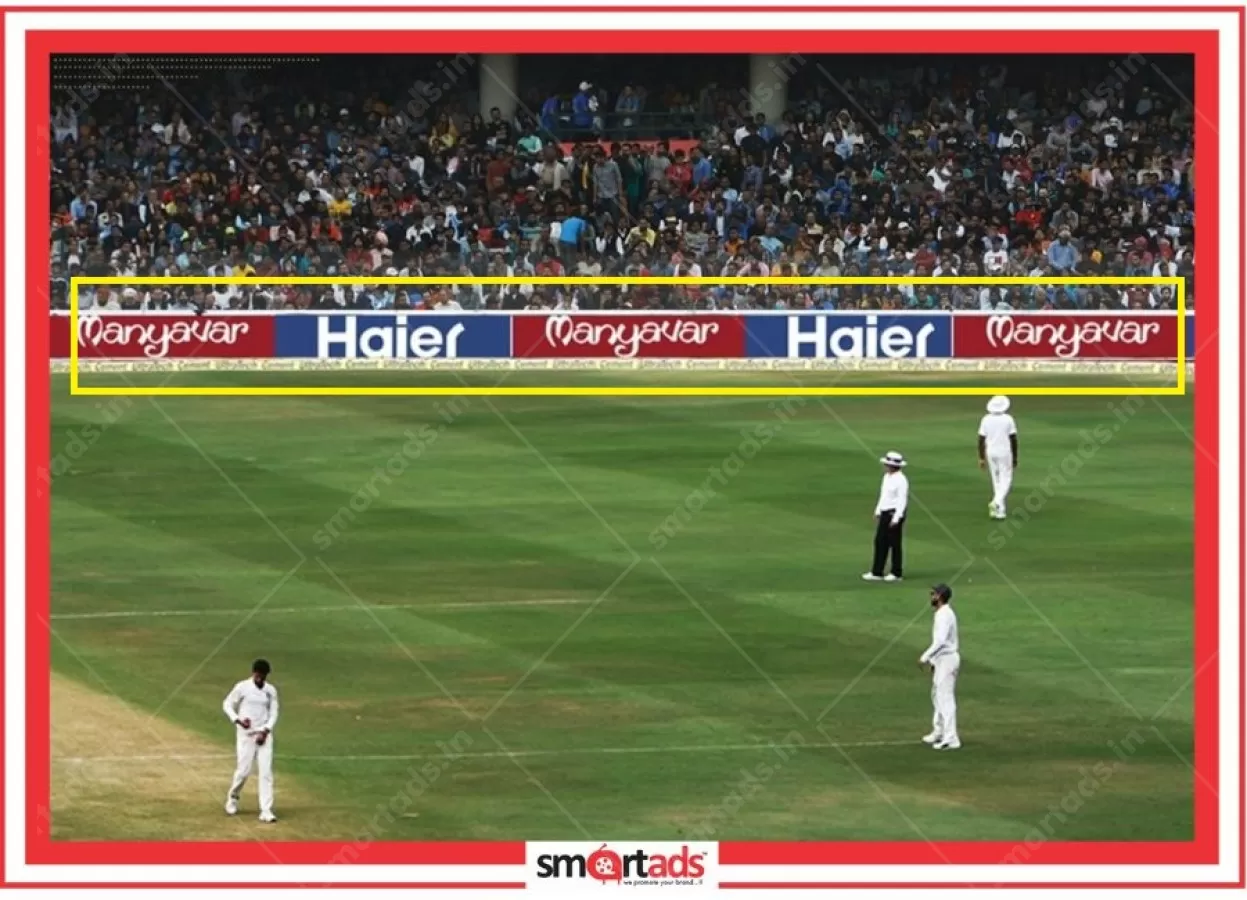
Various Sizes
1 Ball In Every 10 Balls : 50% Of The Gr
Rate per Digital Screen / Per match
At Time Only 2 Display Name.
₹1700000.00
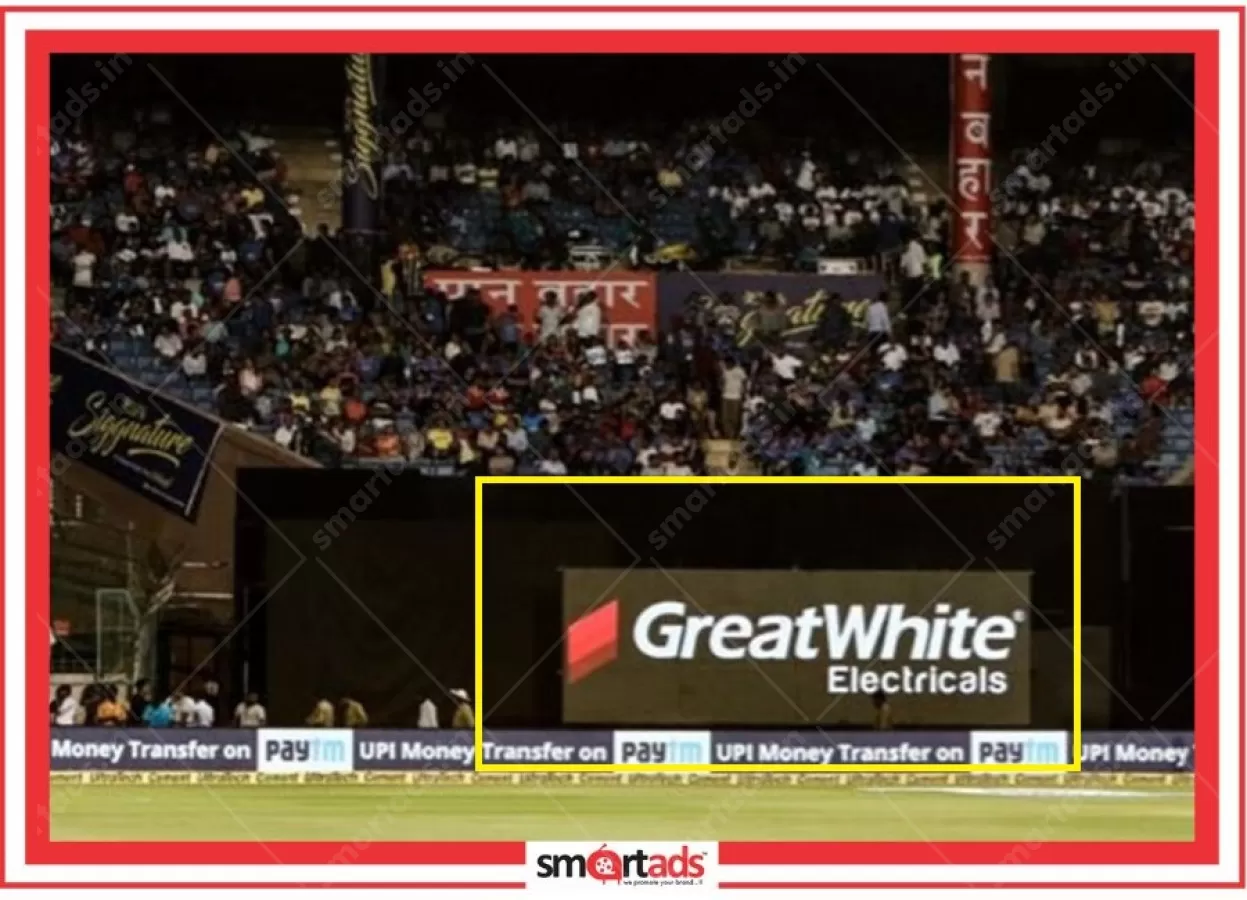
Various Sizes
5 Overs Per ODI Match , 2 Overs Per T20
Rate per Digital Screen / Per match
At Time Only 1 Display Name.
₹1150000.00
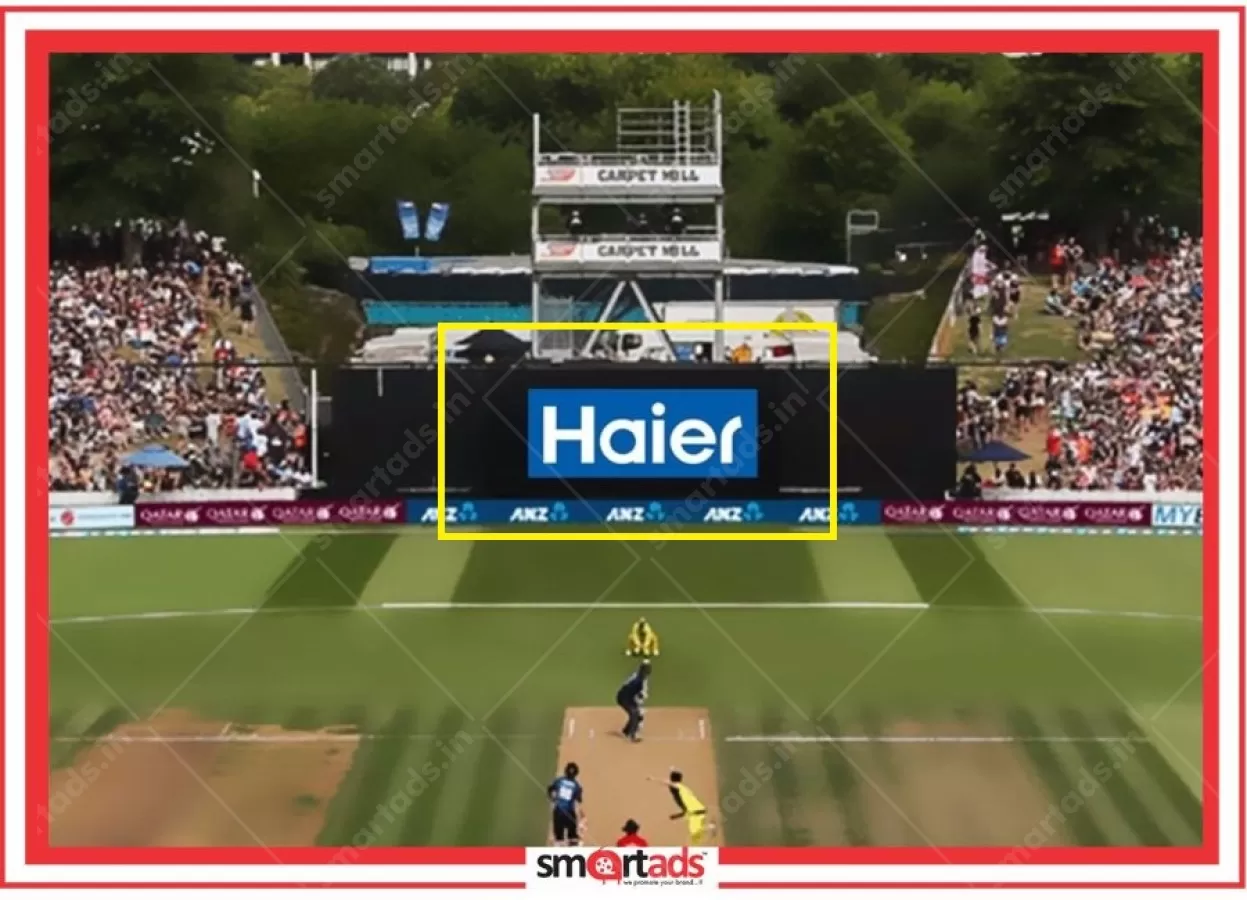
Various Sizes
5 Overs Per ODI Match , 2 Overs Per T20
Rate per Digital Screen / Per match
At Time Only 1 Display Name.
₹1150000.00
MEDIA REACH

MinimumQty :
1
EstimateReachPeople :
50000

Few advertising environments in India command the kind of undivided attention that Wankhede Stadium generates on a match day — a captive audience of roughly 33,000 cricket fans packed into one of South Mumbai's most iconic venues, with millions more watching on broadcast and OTT simultaneously. What most brand managers underestimate is that Wankhede stadium advertising is not simply a sponsorship play for large corporations; it is a genuinely scalable BTL advertising channel, which opens up meaningful visibility opportunities for mid-sized brands willing to think beyond the conventional hoarding or digital banner.
The range of advertising formats at Wankhede Stadium is considerably wider than most media planners expect when they first approach us. The most visible and most discussed format is, of course, the perimeter board — the boundary boards that ring the playing field and appear in virtually every broadcast frame during a match. These come in two distinct variants: static perimeter boards, which display a fixed creative for the duration of a session or a match, and LED perimeter boards, which cycle through multiple brand creatives in real time and allow for dynamic advertising that can be updated remotely. The LED perimeter board format has become the dominant choice for premium advertisers at Wankhede, largely because it offers broadcast visibility alongside in-stadium brand exposure — two audiences for the price of one placement.
Beyond the boundary, in-stadium advertising at Wankhede extends to scoreboard advertising, which places a brand's identity in one of the highest-attention zones in the ground since every spectator glances at the scoreboard repeatedly through the course of a match. Seat back branding is another format that is frequently underestimated; when seats are occupied, the branding is partially obscured, but during breaks, replays on broadcast, and wide-angle stadium shots, the cumulative visual impression of thousands of branded seat backs is substantial. Entrance gate branding at Wankhede is particularly effective for brands seeking to create an immersive arrival experience — the Garware Pavilion entrance and the Tata End gates see every single spectator pass through them, which makes these touchpoints genuinely high-footfall in the most literal sense. Pitch mat advertising, which involves branding placed on the ground cover or pitch surrounds, is another format that generates strong broadcast visibility during strategic moments — drinks breaks, pitch inspections, and mid-over pauses.
We have also executed campaigns involving digital screens placed at concourse areas and food courts within the stadium, which reach fans during the high-dwell intervals between overs and at the innings break. These concourse digital screens are often overlooked in favour of the more glamorous perimeter board advertising, but frankly speaking, they deliver a concentrated brand message to an audience that is physically stationary and receptive — which is a combination that most outdoor advertising formats cannot replicate. Brand activation zones, which we will discuss in more detail later, represent the most experiential end of the non-traditional advertising spectrum at Wankhede and require a separate conversation about permissions and logistics.
Advertising rates at Wankhede Stadium vary considerably depending on the match type, the format chosen, and the duration of the campaign — and this is where a lot of brands get caught out by assuming a flat rate applies across all events. To give you a realistic sense of the cost landscape: static perimeter board advertising for a single IPL match at Wankhede works out to somewhere in the ballpark of ₹8 to ₹15 lakh per board per match, depending on the board's position relative to the camera-facing side of the ground. LED perimeter board advertising, which carries the broadcast amplification premium, typically runs higher — in the range of ₹20 to ₹40 lakh per match for a premium position — which is a number that surprises most clients when they first hear it, until we explain that a single IPL match at Wankhede is being watched by somewhere between 40 and 80 lakh viewers on television and OTT platforms simultaneously.
Scoreboard advertising rates at Wankhede are generally structured on a per-match or per-series basis, with costs in the range of ₹5 to ₹12 lakh per match for a prominent scoreboard panel. Seat back branding, because it covers a large physical area across thousands of seats, tends to be priced on a per-series or seasonal basis rather than per match; a full-season seat back branding package for an IPL season at Wankhede can run anywhere from ₹30 lakh to ₹80 lakh depending on the scope of coverage. Entrance gate branding — which covers the physical gates, gantries, and approach walkways — is priced in the range of ₹10 to ₹25 lakh per series, which is actually excellent value when you consider that every single spectator walks through these touchpoints. Pitch mat advertising, being a more specialised format with high broadcast sensitivity, commands a premium that typically starts around ₹15 lakh per match for IPL and somewhat less for domestic or bilateral international series.
What a lot of people miss is that Wankhede stadium advertising cost is not fixed by a public rate card in the way that, say, a newspaper advertisement is priced. Rates are negotiated through the Mumbai Cricket Association or through authorised media buying agencies, and they fluctuate based on demand, the opponent in an international fixture, and the stage of the IPL tournament — playoff matches command a significant premium over league-stage games. At SmartAds, we always tell our clients that the first question to ask is not "what is the rate?" but "what is the match calendar, and which fixtures deliver the audience profile we actually need?" — because a league-stage match against a mid-table opponent and a playoff match at Wankhede are very different media buys, even if the physical format is identical.
Wankhede Stadium occupies a genuinely unique position in the Indian advertising landscape, and it is worth being specific about why, rather than simply asserting that it is prestigious. The stadium sits in Churchgate, Mumbai — arguably the most commercially dense neighbourhood in the country — which means that the audience arriving for a match is not a random cross-section of the city; it is a self-selected group of consumers who have the disposable income to purchase tickets that frequently start at ₹1,500 and extend well beyond ₹10,000 for premium stands. This is a captive audience of affluent, urban, predominantly male consumers between the ages of 18 and 45, which is the exact demographic that most FMCG, automotive, financial services, and consumer electronics brands are spending significant portions of their media budgets trying to reach through digital channels.
The stadium's history adds a layer of cultural resonance that few other venues in India can claim. The 2011 ICC Cricket World Cup Final was played at Wankhede, and the image of Sachin Tendulkar being carried on teammates' shoulders in front of a packed house is one of the most reproduced photographs in Indian sports history. This emotional association means that brands appearing at Wankhede Stadium are not simply buying ad space; they are associating themselves with a venue that carries genuine cultural weight for Indian cricket fans — which is a form of contextual advertising that no programmatic platform can replicate. The Mumbai Cricket Association, which administers the ground, has been deliberate about maintaining the premium character of the advertising inventory, which means that brand clutter at Wankhede is considerably lower than at some other Indian cricket venues.
On top of that, the broadcast footprint of matches played at Wankhede — whether IPL advertising during Mumbai Indians home games or international cricket across Test match advertising and T20 advertising formats — extends the reach of in-stadium advertising far beyond the 33,000 spectators in the ground. BARC viewership data consistently shows that IPL matches are among the most-watched broadcast events in India, and matches featuring Mumbai Indians at Wankhede routinely draw television and OTT audiences that dwarf the in-stadium footfall by a factor of several hundred. This broadcast visibility bonus is, in our experience at SmartAds, the single most undervalued aspect of Wankhede cricket stadium advertising when brands are doing their initial cost-benefit calculations.
Wankhede Stadium has a seating capacity of approximately 33,108 spectators, which is modest by the standards of some Indian cricket venues — Narendra Modi Stadium in Ahmedabad, for instance, holds more than 130,000 — but the composition of the Wankhede audience is arguably more valuable per head than almost any other cricket ground in India. The stadium sells out for virtually every IPL match and for most international fixtures, which means that the in-stadium footfall for a full IPL home season of seven or eight matches at Wankhede can be estimated at somewhere between 2.3 and 2.7 lakh unique visitors across the season, many of whom are repeat attendees with strong brand recall from previous match experiences.
The demographic profile of Wankhede match-goers, based on what we have observed across campaigns executed at the venue, skews heavily toward SEC A and SEC B consumers — professionals, business owners, and upper-middle-class families from Mumbai and the broader Maharashtra region. The gender split is approximately 70:30 male to female, though this has been shifting gradually as cricket's audience base broadens; T20 matches and IPL games in particular attract a more balanced demographic than Test match advertising formats, which tend to draw an older, more male-dominated audience. The age concentration is strongest in the 22-to-42 bracket, which aligns well with the core target audience for categories like financial services, premium smartphones, automobiles, and lifestyle brands.
What the footfall number alone does not capture is the broadcast and OTT amplification layer. According to BARC viewership data, IPL matches consistently rank among the top-rated broadcast events in India, and Mumbai Indians home games at Wankhede attract viewership that routinely runs into the crores across television and JioCinema. The Dentsu e4m Report and the FICCI-EY Media Report have both highlighted cricket as the dominant driver of sports advertising expenditure in India, with IPL accounting for a disproportionate share of that investment. When we present audience reach numbers to clients considering Wankhede stadium advertising, we always make the point that the 33,000 in the ground is the floor, not the ceiling — the real audience reach for a well-positioned LED perimeter board or scoreboard advertisement during an IPL match is measured in millions.
The difference between IPL advertising at Wankhede and advertising during a bilateral international series or a domestic Ranji Trophy match is significant enough that they are essentially different media products, and treating them as interchangeable is a mistake we have seen brands make more than once. IPL advertising at Wankhede commands a premium that reflects the combination of higher in-stadium footfall, dramatically higher broadcast viewership, and the association with the Mumbai Indians franchise — one of the most commercially powerful sports brands in India. The advertising rates during IPL season are typically two to four times higher than equivalent formats during an international bilateral series, and for playoff matches, the premium can be even steeper.
The format landscape during IPL also differs from regular international cricket. The IPL's commercial structure, which is governed by the BCCI, means that certain advertising inventory — particularly the most prominent LED perimeter board positions and the on-field branding elements — is controlled centrally by the league and sold as part of IPL-level sponsorship packages, which are priced at a scale that is accessible only to large national or multinational brands. However, a meaningful portion of the in-stadium advertising inventory at Wankhede during IPL remains under the control of the Mumbai Cricket Association and the Mumbai Indians franchise, which is where brands working with an experienced advertising agency in Mumbai can access match-day advertising without committing to a full league-level sponsorship. At SmartAds, we have helped several mid-sized brands access this secondary inventory layer during IPL season at Wankhede, achieving meaningful brand visibility at a fraction of the cost of a central IPL sponsorship.
One campaign that illustrates this well involved a financial services brand we worked with during an IPL season — the client had a budget that ruled out central IPL sponsorship but was specifically targeting the affluent Mumbai consumer. We structured a campaign around entrance gate branding and concourse digital screens at Wankhede for the Mumbai Indians' home games, which delivered an estimated in-stadium brand exposure of roughly 2.2 lakh impressions across the season, with an additional broadcast visibility component from the gate branding appearing in pre-match broadcast coverage. The cost worked out to considerably less than what the same brand was spending on a month of programmatic digital advertising for the same audience — and the brand recall scores from a post-campaign survey were notably higher than their digital benchmarks.
Perimeter board advertising at Wankhede is the format most directly associated with cricket stadium branding in the popular imagination, and for good reason — boundary boards are in the broadcast frame for the majority of the match duration, which means that every ball bowled is also, in effect, an advertising impression. Static perimeter boards at Wankhede are typically constructed from flex or vinyl material stretched across a rigid frame, positioned along the boundary rope at intervals determined by the MCA's advertising layout. These boards are replaced between matches or series, which means that the creative can be updated for each campaign, though the lead time for production and installation needs to be factored into the booking timeline.
LED perimeter boards represent a significant evolution from static boundary boards, and Wankhede has progressively upgraded its perimeter infrastructure to accommodate this format. The LED perimeter board at Wankhede operates on a rotation system, cycling through multiple brand creatives at intervals of typically 30 to 90 seconds, which allows for real-time branding updates and dynamic advertising that can respond to match situations or time-of-day contexts. A brand running LED perimeter board advertising at Wankhede during a televised match is effectively running a broadcast advertisement simultaneously — the LED board appears in the background of virtually every on-field broadcast shot, which means that the television and OTT audience is receiving the brand impression alongside the 33,000 spectators in the ground.
The positioning of perimeter boards within the ground matters considerably, and this is something that a lot of first-time buyers of Wankhede stadium advertising do not fully appreciate. The camera-facing side of the ground — which at Wankhede is the side facing the Garware Pavilion and the media boxes — delivers broadcast visibility that the opposite side does not. Boards on the non-broadcast side are visible to in-stadium spectators but do not appear on television, which means they carry a lower rate but also a lower reach. At SmartAds, we always recommend that clients with broadcast visibility as a campaign objective prioritise the camera-facing perimeter positions, even if it means reducing the number of boards purchased, because the amplification from broadcast visibility fundamentally changes the cost-per-impression calculation.
Frankly speaking, not every brand is a natural fit for Wankhede stadium advertising, and we would rather be honest about that than oversell the medium. The venue works best for brands whose target consumer overlaps meaningfully with the Wankhede match-going audience — which, as we have described, is predominantly affluent, urban, male-skewing, and concentrated in the 22-to-45 age bracket. Financial services brands — banks, mutual funds, insurance companies, and fintech platforms — have historically been among the most consistent advertisers at Wankhede, because the venue delivers their precise target demographic in a high-attention environment. Automobile brands, particularly those in the mid-premium and premium segments, find Wankhede cricket stadium advertising effective for the same reason; a consumer who can afford a Wankhede IPL ticket is very likely in the market for a car that costs upward of ₹10 lakh.
Consumer electronics and smartphone brands have also found strong ROI at Wankhede, particularly during IPL season when the broadcast amplification multiplies the reach of in-stadium placements significantly. FMCG brands in the premium segment — premium beverages, grooming products, and packaged foods — are well-suited to the concourse and digital screen formats, which reach fans during the high-engagement intervals when they are actively consuming food and beverages within the ground. Sports marketing by lifestyle and apparel brands has a natural fit with the cricket audience, and several international sportswear brands have used Wankhede stadium branding as part of broader India market entry campaigns.
Where we have seen this backfire is when brands with a genuinely mass-market positioning try to use Wankhede as a reach play — the venue is not designed for mass reach in the way that a newspaper advertisement or a television spot on a general entertainment channel is. A brand trying to reach 10 crore consumers across India will find that Wankhede cricket stadium advertising is an expensive way to do it; but a brand trying to make a specific impression on the top 5% of Mumbai's consumer base, in an environment where attention is high and competitive clutter is low, will find it genuinely difficult to replicate the impact through any other single medium.
The booking process for BTL advertising at Wankhede is more structured than most people expect, and understanding the hierarchy of who controls what inventory is essential before any conversation about rates or formats begins. The Mumbai Cricket Association is the primary authority over the stadium and controls the base layer of advertising inventory — this includes the physical infrastructure of perimeter boards, entrance gate branding positions, scoreboard panels, and seat back branding. For international matches and domestic fixtures, advertising at Wankhede is typically booked through the MCA's commercial department, either directly by large brands or through an authorised advertising agency in Mumbai with an established relationship with the MCA.
During IPL season, the inventory structure becomes more layered. The BCCI controls the central IPL sponsorship inventory, which includes the most prominent on-field branding positions; the Mumbai Indians franchise controls a separate layer of team-associated inventory; and the MCA retains control over certain venue-specific positions. Navigating this three-tier structure without an experienced media buying partner is genuinely difficult, and we have seen brands waste significant time and budget approaching the wrong entity for the inventory they actually want. At SmartAds, we have established working relationships across all three layers of the Wankhede advertising ecosystem, which allows us to identify the right access point for each client's specific campaign objective and budget.
The practical timeline for booking Wankhede stadium advertising — particularly for IPL matches — is longer than most clients anticipate. Premium perimeter board positions for IPL matches are typically committed six to eight weeks before the match, and in some cases, popular positions are locked in before the IPL schedule is even officially announced. For international series, the lead time is somewhat shorter, but even for a bilateral T20 series, we would recommend initiating the booking conversation at least four to six weeks before the first match. Brands that approach us two weeks before an IPL match looking for prime perimeter board advertising at Wankhede are almost always going to be disappointed — the inventory is simply not available at that point, and the residual positions that remain are rarely the high-visibility placements that justify the investment.
Return on investment for below-the-line advertising at Wankhede is a question that deserves a more nuanced answer than a simple CPM comparison, because the value of in-stadium advertising is not fully captured by impression counts alone. The CPM for a well-positioned LED perimeter board at Wankhede during an IPL match — accounting for both in-stadium and broadcast reach — works out to roughly ₹15 to ₹30 per thousand impressions when the broadcast audience is included in the denominator, which is actually competitive with prime-time television CPMs and considerably more targeted. When you exclude the broadcast audience and calculate only in-stadium CPM, the number is higher — in the range of ₹400 to ₹800 per thousand — but the quality of those impressions, in terms of dwell time, attention, and demographic precision, is substantially higher than a television spot that competes with 30 other ads in a commercial break.
Brand recall studies conducted after cricket stadium advertising campaigns — including work we have done at SmartAds for clients across financial services and consumer electronics categories — consistently show aided recall scores in the range of 60 to 75 percent for brands with prominent perimeter board or scoreboard positions at Wankhede. For context, the average aided recall for a 30-second television commercial in a standard advertising break is typically in the 30 to 45 percent range, according to industry benchmarks referenced in the FICCI-EY Media Report. The difference is attributable to the immersive, distraction-free environment of the stadium — a spectator at Wankhede is not scrolling through their phone while the cricket is on, which means that brand impressions delivered in that environment are genuinely absorbed rather than passively received.
One automotive brand we worked with ran a three-match perimeter board campaign at Wankhede during an international T20 series — not IPL, which made the budget more accessible — and tracked dealership enquiries from the South Mumbai and Churchgate catchment area before and after the campaign. The enquiry volume from that specific geography increased by roughly 34 percent in the four weeks following the campaign, against a flat trend in other Mumbai zones where no stadium advertising was running. We are always careful about attributing causality to a single media channel, and other factors were certainly at play; but the directional signal was strong enough that the brand committed to a longer engagement for the following IPL season.
Mumbai is one of the most competitive outdoor advertising markets in India, and brands planning a non-traditional advertising campaign in the city have no shortage of options — hoardings along the Western Express Highway, metro station branding across the new lines, local train advertising across the suburban network, and airport advertising at Chhatrapati Shivaji Maharaj International Airport. Each of these channels has its own audience profile and cost structure, and the honest answer is that Wankhede stadium advertising is not a replacement for any of them; it is a complement, which serves a specific purpose within a broader Mumbai OOH strategy.
The most meaningful comparison is probably between Wankhede stadium advertising and premium hoarding advertising in South Mumbai — along Marine Drive, Nariman Point, or the Churchgate corridor. A premium hoarding in this geography might cost somewhere between ₹8 and ₹20 lakh per month, depending on size and exact location, which is broadly comparable to a single-match perimeter board at Wankhede. The hoarding delivers continuous impressions over 30 days to a mixed audience of commuters, office workers, and residents; the Wankhede placement delivers concentrated impressions over three to four hours to a highly self-selected, affluent audience with a strong emotional engagement with the environment. Neither is inherently superior — they serve different campaign objectives — but for brands prioritising demographic precision and brand recall over raw impression volume, the Wankhede placement typically wins the comparison.
Metro station branding across Mumbai's expanding metro network offers broad reach at a lower CPM, but the audience is more diffuse and the dwell time, while reasonable, does not match the sustained attention of a cricket match. Airport advertising at Mumbai airport reaches a high-income audience with strong purchasing power, which makes it a natural companion to Wankhede stadium advertising in a premium Mumbai campaign; the two channels together can create a coherent brand presence across the highest-value consumer touchpoints in the city. What we tell clients who are weighing these options is that the channel mix matters as much as the individual channel — Wankhede stadium advertising is most effective when it is part of a coordinated campaign that uses other Mumbai OOH and digital channels to reinforce the same message to the same audience across multiple touchpoints.
Brand activation at Wankhede is possible, but it requires a different kind of planning and a different set of permissions than standard advertising formats — and we want to be clear about that distinction because brands sometimes conflate the two. Experiential marketing activations within the stadium premises — fan engagement zones, product sampling, interactive installations, or branded entertainment areas — require specific permissions from the Mumbai Cricket Association, which has become more structured about how it manages commercial activations within the ground. The MCA's approach to brand activation at Wankhede has evolved considerably over the past few years, with a clearer framework for what is permitted, where activations can be located, and what the commercial terms look like.
The most effective brand activation formats we have seen executed at Wankhede are those that integrate naturally with the fan experience rather than interrupting it. A financial services brand that set up a digital engagement zone near the Garware Pavilion concourse during an IPL match — offering fans a quick, gamified financial health check in exchange for a brand interaction — generated over 4,000 direct consumer engagements across a single match day, which is a quality of first-party data collection that no passive advertising format can match. The activation cost, including permissions, staffing, and technology, worked out to roughly ₹12 lakh for the match day, which translated to a cost per engagement of around ₹300 — a number that compares very favourably with the cost of generating equivalent quality leads through digital performance marketing in a competitive financial services category.
Virtual and augmented reality advertising formats are beginning to appear in the in-stadium advertising conversation at Wankhede, though this remains an emerging area rather than an established inventory category. Some international cricket venues have experimented with AR overlays visible through the stadium's broadcast feed, and virtual perimeter board advertising — where digital overlays are inserted into the broadcast frame in post-production — is a technology that is being actively explored by several Indian cricket administrators. At SmartAds, we are tracking these developments closely, because virtual in-stadium advertising has the potential to decouple broadcast visibility from physical presence at the venue, which would fundamentally change the economics of cricket stadium BTL advertising in India.
Q: What are the advertising formats available at Wankhede Cricket Stadium in Mumbai?
The advertising formats at Wankhede Stadium span a wide range of in-stadium and venue-based options, which can be broadly categorised into on-field formats and off-field formats. On-field formats include static perimeter boards and LED perimeter boards along the boundary, pitch mat advertising placed on ground covers during breaks, and scoreboard advertising panels. Off-field formats include seat back branding across the stadium's seating sections, entrance gate branding at the Garware Pavilion and Tata End gates, concourse digital screens positioned at food and beverage areas, and brand activation zones in the stadium's public areas. Each format serves a different campaign objective — broadcast-facing formats like LED perimeter boards and scoreboard advertising are best for brands seeking reach amplification through television and OTT, while entrance gate branding and concourse screens are better suited for direct consumer engagement and brand recall among the in-stadium audience.
Q: How much does it cost to advertise at Wankhede Stadium?
Wankhede stadium advertising cost varies significantly by format, match type, and position within the ground. As a general orientation: static perimeter board advertising for a single IPL match is in the range of ₹8 to ₹15 lakh per board, while LED perimeter board advertising for a premium camera-facing position can run between ₹20 and ₹40 lakh per match. Scoreboard advertising typically falls in the ₹5 to ₹12 lakh per match range, entrance gate branding is priced in the ₹10 to ₹25 lakh per series bracket, and seat back branding for a full IPL season can range from ₹30 to ₹80 lakh depending on coverage scope. These are indicative ranges rather than fixed rate card figures; actual rates are negotiated through the MCA or authorised media buying agencies and fluctuate based on match significance, demand, and campaign duration.
Q: What is BTL or non-traditional advertising at Wankhede Stadium?
Below-the-line advertising at Wankhede Stadium refers to all the advertising and brand communication activities that occur within the stadium environment but outside of traditional broadcast media buys. This includes everything from perimeter board advertising and scoreboard branding to brand activation zones, experiential marketing, entrance gate branding, and concourse digital screens. The "non-traditional" designation distinguishes these formats from above-the-line media like television commercials or newspaper advertisements; BTL advertising at Wankhede is characterised by its physical presence within the venue, its direct engagement with a captive audience, and its ability to create immersive brand experiences that passive media formats cannot replicate. The growing interest in BTL advertising at cricket venues like Wankhede reflects a broader industry shift toward environments where audience attention is genuinely captured rather than merely available.
Q: How do I book an advertising slot at Wankhede Cricket Stadium?
Booking advertising at Wankhede Stadium involves engaging with the Mumbai Cricket Association's commercial department, either directly or through an authorised advertising agency in Mumbai. For IPL matches, the booking process is more complex because inventory is distributed across the MCA, the Mumbai Indians franchise, and the BCCI's central IPL commercial structure; identifying the right access point for the specific format you want requires familiarity with this three-tier system. The recommended lead time for IPL match advertising is six to eight weeks before the match, and for international series, four to six weeks. Working with an experienced media buying partner who has established MCA relationships significantly simplifies the process and often results in better positioning and more favourable rates than a direct approach.
Q: What is the audience reach and footfall at Wankhede Stadium during IPL and international matches?
Wankhede Stadium's in-stadium capacity is approximately 33,108 spectators, and the ground sells out for virtually all IPL matches and most international fixtures. Across a full IPL home season of seven to eight matches, the cumulative in-stadium footfall is estimated at between 2.3 and 2.7 lakh unique visitors. However, the broadcast and OTT audience amplifies this reach dramatically — BARC viewership data indicates that IPL matches draw television and streaming audiences in the crores, with Mumbai Indians home games at Wankhede consistently among the higher-rated fixtures of the season. For international T20 matches and Test match advertising at Wankhede, the in-stadium audience profile is similar but the broadcast reach varies by opponent and match significance.
Q: What is the difference between perimeter board advertising and LED screen advertising at Wankhede?
Static perimeter boards at Wankhede display a fixed creative for the duration of a match or session and are constructed from flex or vinyl material; they are visible to in-stadium spectators and to broadcast audiences when the camera is directed toward that section of the boundary. LED perimeter boards operate on a rotation system, cycling through multiple brand creatives in real time, which allows for dynamic advertising and the ability to run multiple brands or multiple messages within a single match. The LED format also delivers higher broadcast visibility because the illuminated display registers more clearly on camera, particularly in evening matches under floodlights. The cost premium for LED perimeter board advertising over static boards reflects both the broadcast amplification and the operational flexibility of the dynamic format.
Q: Does advertising at Wankhede Stadium get broadcast on TV or OTT platforms?
Yes — and this is one of the most important aspects of Wankhede cricket stadium advertising that brands sometimes fail to account for in their media planning. LED perimeter boards and scoreboard advertising at Wankhede appear in the broadcast frame throughout the match, which means that every television and OTT viewer watching the match is also receiving the brand impression. For IPL matches at Wankhede, which are broadcast on Star Sports and streamed on JioCinema, the broadcast audience can be several hundred times larger than the in-stadium audience. Entrance gate branding also appears in pre-match broadcast coverage and in wide-angle stadium shots. Brands should factor this broadcast visibility bonus into their cost-per-impression calculations when evaluating the ROI of Wankhede stadium advertising.
Q: Which brands are best suited to advertise at Wankhede Cricket Stadium?
Brands whose target consumer aligns with the Wankhede audience profile — affluent, urban, predominantly male, aged 22 to 45, concentrated in Mumbai and Maharashtra — will find the strongest fit. Financial services brands, premium automobile manufacturers, consumer electronics companies, lifestyle and apparel brands, and premium FMCG products are historically the most active and most effective advertisers at Wankhede. Brands targeting a genuinely mass-market audience across all income segments may find that the cost-per-reach at Wankhede is higher than alternatives like television or newspaper advertising; but for brands where audience quality matters more than raw reach volume, Wankhede stadium advertising offers a concentration of the right consumers that is difficult to match through any other single medium in Mumbai.
Q: How does Wankhede Stadium advertising compare to hoardings or metro advertising in Mumbai?
Wankhede stadium advertising delivers higher demographic precision and higher brand recall per impression than most Mumbai OOH alternatives, but at a higher cost per impression. A premium South Mumbai hoarding along Marine Drive or the Churchgate corridor delivers continuous impressions over 30 days to a mixed urban audience; a Wankhede perimeter board delivers concentrated impressions over three to four hours to a highly self-selected, high-income audience. Metro station branding offers broader reach at a lower CPM but with less audience selectivity. The most effective Mumbai OOH strategies we have built at SmartAds combine Wankhede stadium advertising with complementary channels — airport advertising, premium hoardings, and metro branding — to create a coherent multi-touchpoint presence across the city's highest-value consumer environments.
Q: What is the minimum budget required for a BTL advertising campaign at Wankhede Stadium?
The practical minimum for a meaningful Wankhede stadium advertising campaign — one that delivers measurable brand exposure rather than a token presence — is in the range of ₹10 to ₹15 lakh for a single-match placement in a non-IPL international fixture. For IPL advertising at Wan
