
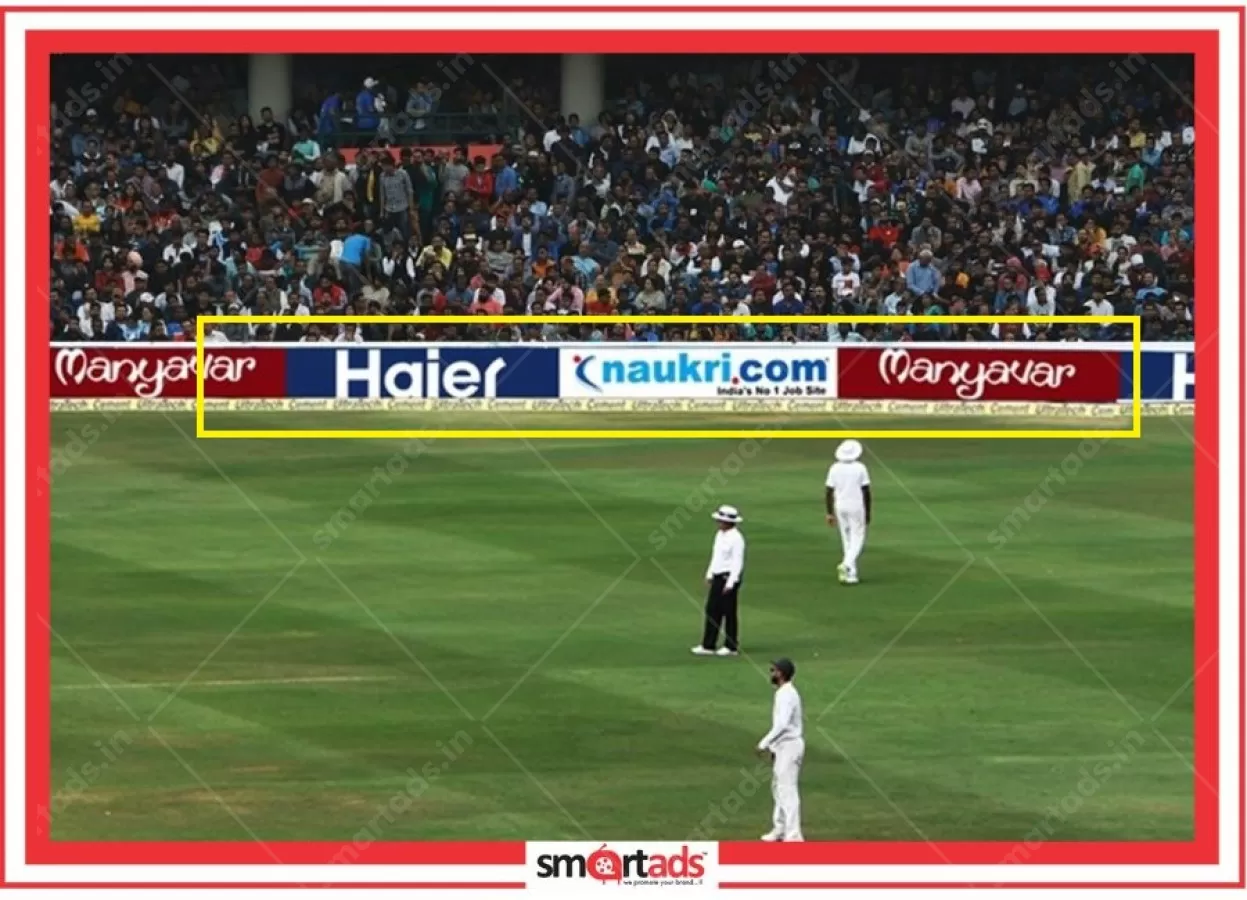
Silver HD Perimeter Signage
Various Sizes
1 ball in every 10 Balls : 50% of the Gr
Rate per Digital Screen / Per match
At Time Only 3 Display Name.
₹1100000.00
Showing 1 to 4 of 4 Results
MEDIA DETAILS
Various Sizes
1 ball in every 10 Balls : 50% of the Gr
Rate per Digital Screen / Per match
At Time Only 3 Display Name.
₹1100000.00
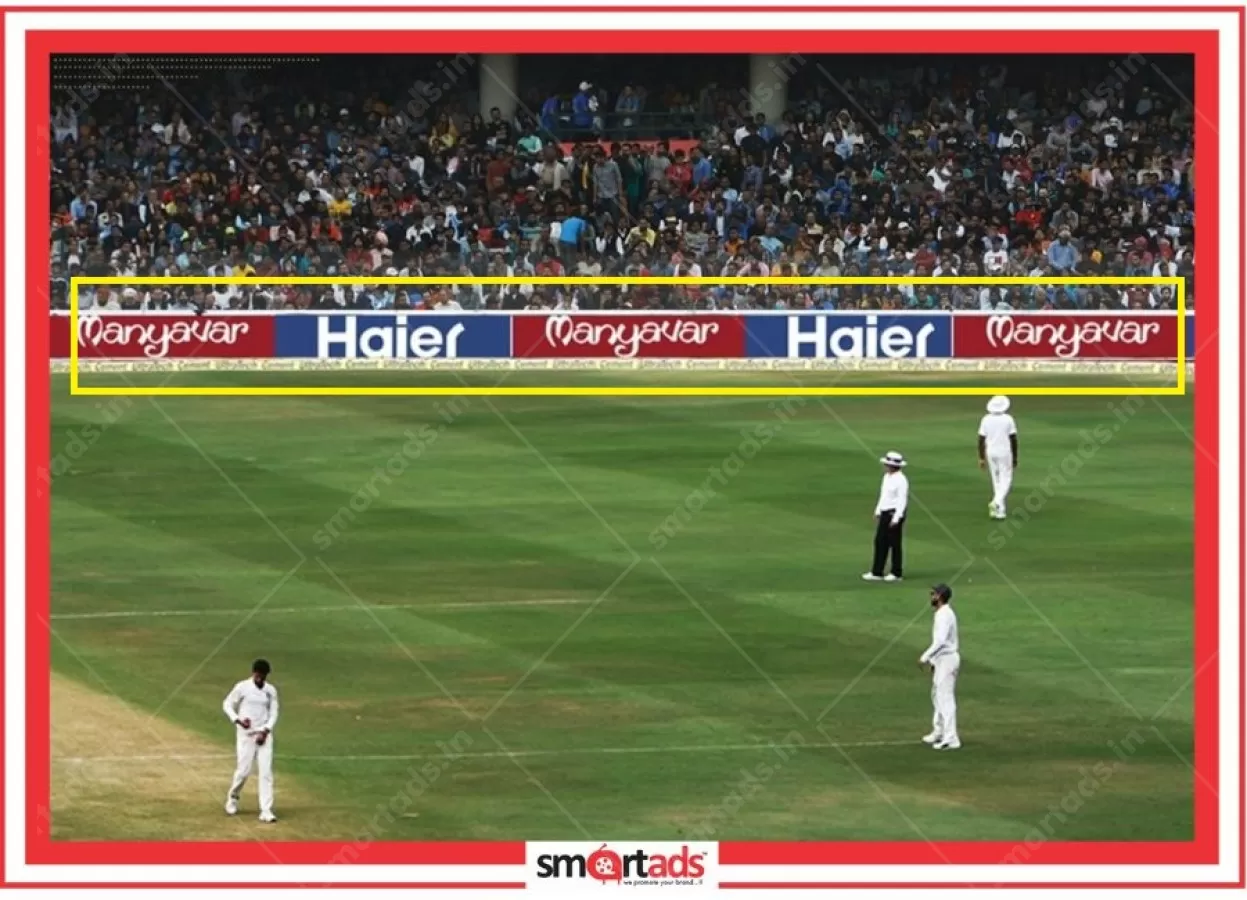
Various Sizes
1 Ball In Every 10 Balls : 50% Of The Gr
Rate per Digital Screen / Per match
At Time Only 2 Display Name.
₹1700000.00
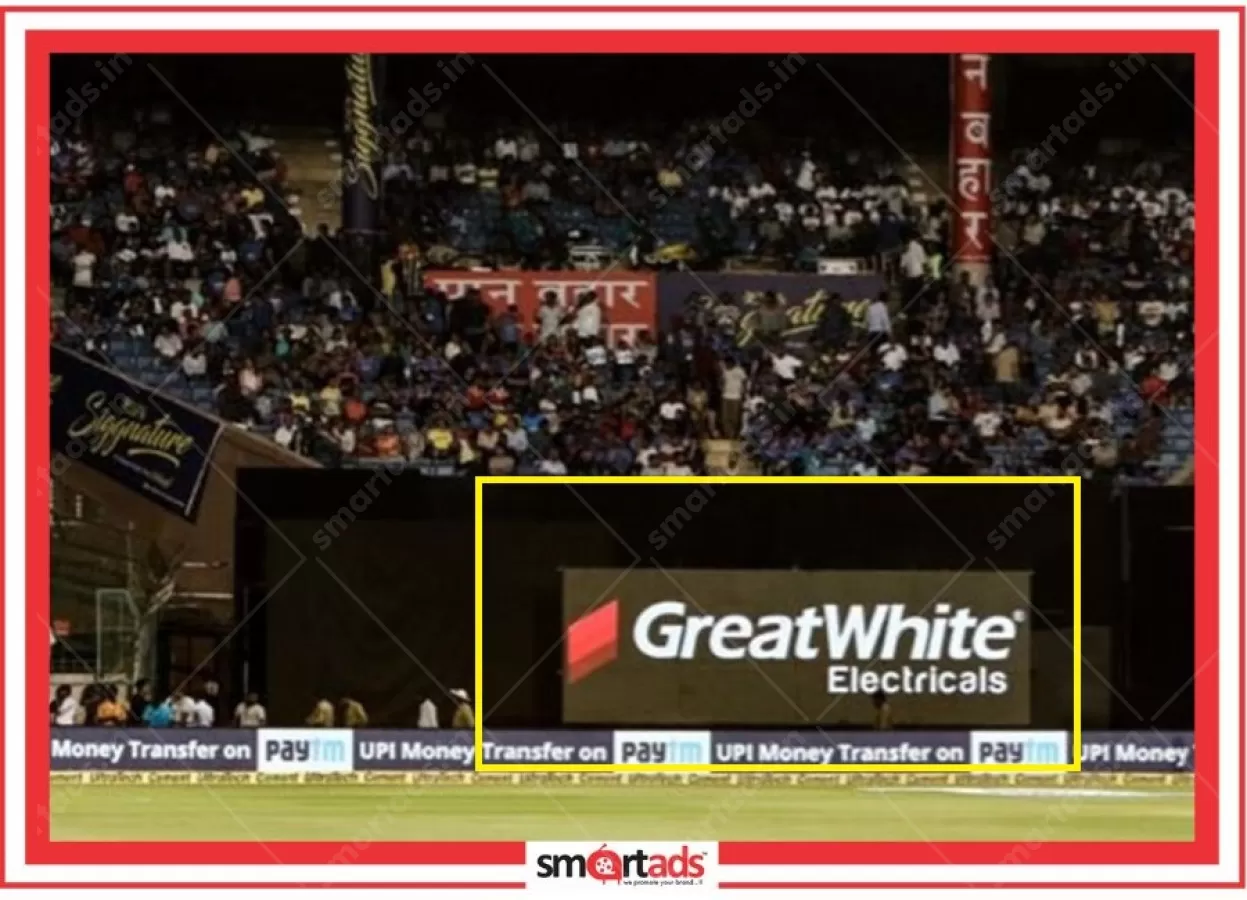
Various Sizes
5 Overs Per ODI Match , 2 Overs Per T20
Rate per Digital Screen / Per match
At Time Only 1 Display Name.
₹1150000.00
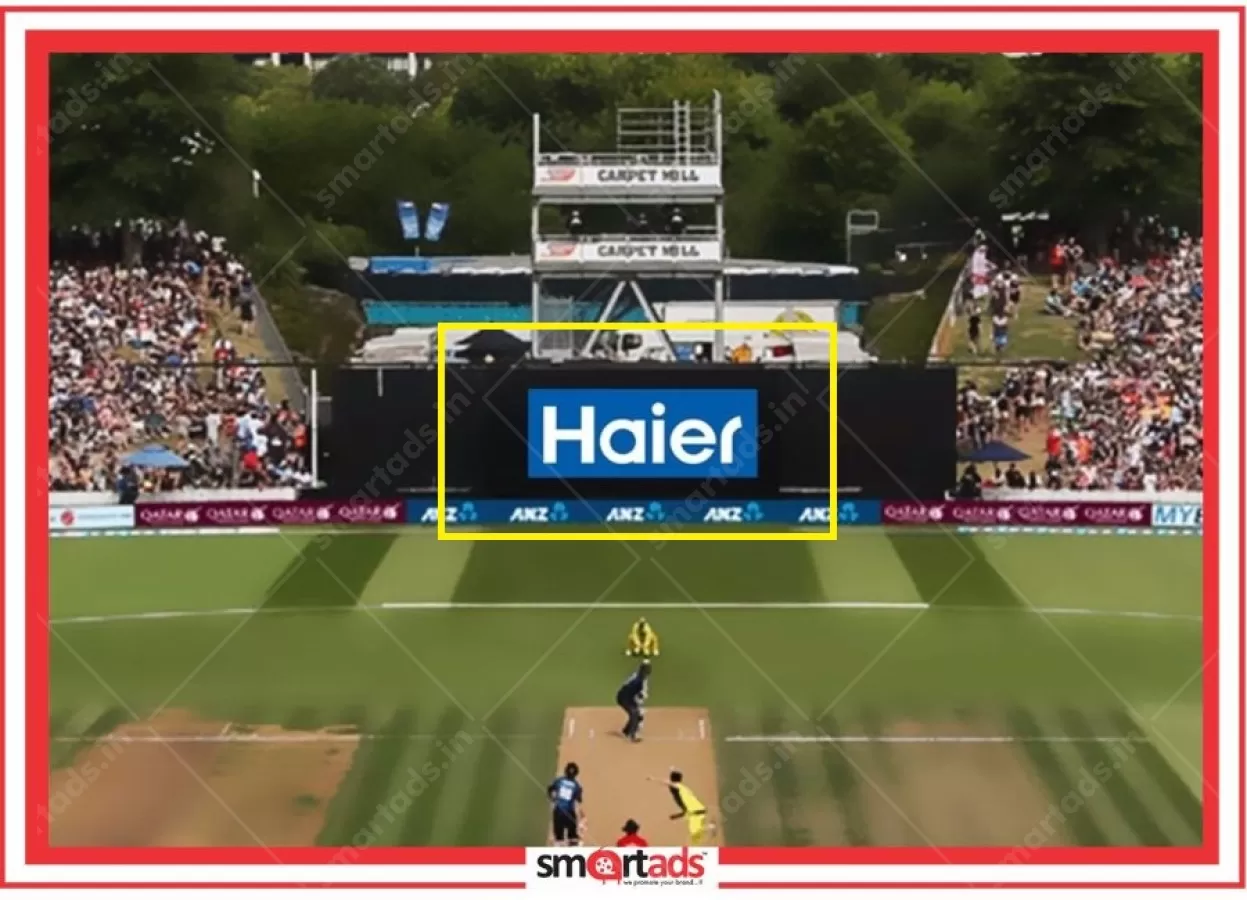
Various Sizes
5 Overs Per ODI Match , 2 Overs Per T20
Rate per Digital Screen / Per match
At Time Only 1 Display Name.
₹1150000.00
MEDIA REACH

MinimumQty :
1
EstimateReachPeople :
140000

The world's largest cricket stadium sits in Ahmedabad, and most brands are still treating it like a footnote in their media plans. Narendra Modi Stadium, with its staggering 132,000-seat capacity, delivers something that no billboard on the Sarkhej-Gandhinagar Highway or newspaper wrap-around can replicate — a captive audience of emotionally charged cricket fans who are, for three to five hours, completely present and completely engaged. What we have found, after running campaigns across multiple IPL seasons and international fixtures at Motera, is that the brands which understand this emotional context are the ones that see recall numbers that make their marketing heads do a double-take.
Frankly speaking, the numbers alone do not tell the full story — but they are a good place to start. A single IPL match at Narendra Modi Stadium draws somewhere in the ballpark of 80,000 to a full-house 1,32,000 spectators, which makes even a sold-out Wankhede or Chinnaswami look modest by comparison. The Gujarat Cricket Association has consistently reported near-capacity attendance for Gujarat Titans home games since the franchise debuted in 2022, and the demographic profile of that crowd is genuinely attractive to advertisers: a significant proportion of attendees are SEC A and SEC B households from Ahmedabad, Gandhinagar, Surat, and Vadodara, with a meaningful slice of NRI visitors and corporate ticket holders who are, by definition, high-disposable-income consumers.
What a lot of people miss is the broadcast multiplier effect. Every perimeter board, every LED screen placement, and every piece of in-stadium branding at Motera gets picked up by the broadcast cameras that are transmitting to a JioHotstar audience which, during peak IPL evenings, runs into tens of millions of concurrent viewers. The BARC viewership data from recent IPL seasons consistently places Gujarat Titans home matches among the top-rated fixtures of the tournament, which means your brand's stadium hoarding is not just speaking to the crowd inside the ground — it is appearing on television screens and mobile devices across India. That broadcast visibility is what separates cricket stadium advertising in Ahmedabad from virtually every other form of BTL advertising available in the city.
The stadium itself, formally part of the Sardar Vallabhbhai Patel Sports Enclave at Motera, was redesigned and rebuilt to a specification that media planners genuinely appreciate: the oval shape, the unobstructed sightlines, and the placement of the boundary rope mean that perimeter boards and digital perimeter displays are visible from almost every seat in every stand. We have done the walkthroughs ourselves, and the visibility consistency here is noticeably better than at several older Indian venues where pillars, overhangs, and awkward angles reduce effective impressions. For any brand seriously considering cricket stadium advertising in Ahmedabad, this physical design advantage is not a minor detail — it is a fundamental part of the value proposition.
The format menu at Narendra Modi Stadium is considerably wider than most advertisers expect when they first come to us. The most visible — and most discussed — are the perimeter boards that ring the boundary rope; these come in both static and digital variants, and the digital perimeter boards are the ones that command premium rates because they rotate multiple creatives across a single match, which gives brands the ability to run different messages at different points in the game. A static perimeter board is a fixed physical hoarding that stays in place for the duration of the match, while the digital perimeter option allows creative swaps mid-innings — something that a retail client we worked with in Ahmedabad used brilliantly to push a lunch-hour offer during the drinks break and a store-visit message in the final overs.
Beyond the boundary, the format options expand considerably. LED screens — the giant scoreboards and replay screens positioned at both ends of the ground — carry advertising slots between overs and during strategic timeouts, which is when the entire stadium's attention is directed upward at the screen simultaneously; this is one of the highest-attention moments in any match-day experience, and the CPM for those slots works out to figures that surprise most clients when they compare it to what they are paying for pre-roll video on YouTube. Then there is in-pitch branding — the ground mural or pitch-side branding painted onto the outfield itself — which is arguably the most broadcast-visible format of all because cameras covering the pitch naturally capture those markings in almost every wide-angle shot. Stand branding, seat-back advertising, digital sight screens at either end, and stadium banners stretched across concourse railings round out the primary format inventory.
The formats that often get overlooked — and which we consider genuinely undervalued — are the experiential and activation zones within the stadium's concourses. Narendra Modi Stadium's concourse design allows for branded kiosks, product sampling stations, and fan engagement activations that intercept spectators during the pre-match period and at the innings break, when foot traffic through the concourse is at its peak. On-ground branding in these zones is a form of below-the-line marketing that creates direct consumer interaction, not just passive impression delivery; a FMCG client we worked with ran a sampling activation at the stadium during a T20I series, and the volume of product trials achieved in a single evening match was comparable to what a weekend mall activation in Ahmedabad would deliver over two full days. The end-naming rights — the Adani Pavilion End and the Jio End branding — represent a separate, ultra-premium tier of in-stadium branding that is essentially a stadium sponsorship product, and those are negotiated directly with the GCA at a level that is well above standard advertising packages.
The Gujarat Titans have done something remarkable in a short time: they have built genuine fan equity in a city that was, for years, considered a difficult market for franchise cricket. Since their debut IPL season in 2022, the team has won the tournament once and reached the final twice — a record that has translated into the kind of fan loyalty that makes Gujarat Titans IPL stadium advertising particularly potent. When fans are emotionally invested in the team on the field, their attention to everything in their peripheral vision — including your brand's perimeter board or LED screen slot — is measurably higher than it would be at a neutral venue.
Gujarat Titans sponsorship opportunities sit at a different level from standard in-stadium advertising, and it is worth understanding the distinction clearly. A team sponsorship — whether it is a jersey branding deal, a kit sponsor arrangement, or a title sponsor of a specific match feature — is negotiated with the franchise directly and carries rights that extend beyond the stadium: social media visibility, player association rights, and integration into the team's broadcast graphics package. Player jersey branding, in particular, delivers broadcast visibility that is essentially continuous throughout the match, since cameras follow the players constantly; the CPM on a jersey sponsor arrangement, when you divide the total fee by the total broadcast impressions across a full IPL season, often works out to be more efficient than people expect. That said, Gujarat Titans sponsorship at the title or principal sponsor level is a significant investment — we are talking about packages that start in the crore range — and it is genuinely suited to brands with national distribution and the creative infrastructure to activate the association properly.
For brands that want IPL advertising in Ahmedabad without committing to a full team sponsorship, the match-day advertising inventory managed through BCCI-approved advertising vendors and the GCA offers a more accessible entry point. IPL season branding packages — which bundle perimeter board slots, LED screen time, and sometimes a concourse activation space across multiple home matches — are available at rates that, while still meaningful, are within reach of regional brands and category leaders who want to make a statement during the tournament window. At SmartAds, we have helped several mid-size Gujarat-based brands structure IPL advertising packages that maximise broadcast visibility without requiring the kind of budget that only a national FMCG or telecom brand could justify.
This is the question every client asks first, and the honest answer is that stadium advertising rates at Narendra Modi Stadium vary more than most people expect — because the pricing is driven by match type, format, position, and season, all at once. For an IPL match, which carries the highest demand and the highest broadcast viewership, a single-match static perimeter board placement works out to somewhere between ₹3 lakh and ₹8 lakh depending on the board's position relative to the camera-facing side of the ground; boards on the broadcast-facing arc command a significant premium over those on the non-broadcast side, which is a distinction that a surprising number of first-time advertisers do not think to ask about.
Digital perimeter board slots during IPL matches are priced differently — typically on a per-rotation or per-match basis — and the cost per impression works out to a number that is genuinely competitive when you account for the quality of the audience and the broadcast amplification. A rough benchmark: a digital perimeter rotation package across a full IPL home season for Gujarat Titans — which typically means seven home matches — is in the ballpark of ₹25 lakh to ₹60 lakh depending on the number of rotations per match and the position on the digital perimeter. LED screen advertising slots, which run during strategic timeouts and between overs, are typically sold as packages rather than individual spots, with match-day advertising packages for a single IPL game starting somewhere around ₹5 lakh for a meaningful presence.
The narendra modi stadium branding cost picture changes significantly when you move from IPL to international fixtures. For a bilateral T20I or ODI series involving the Indian national team, rates are somewhat lower than peak IPL pricing — roughly 20 to 35 percent less for equivalent formats — because while the broadcast audience is still substantial, the local fan intensity and the associated demand for inventory is slightly lower. Domestic matches like Ranji Trophy or Vijay Hazare fixtures at the ground carry the most accessible stadium advertising rates of all, with perimeter board placements available in the range of ₹50,000 to ₹2 lakh per match; these are genuinely interesting for regional brands or businesses that want the association with the venue without the IPL price tag. Cricket stadium ad rates in Ahmedabad for 2025 reflect a market that has matured considerably since the stadium's reopening, and we always advise clients to plan and book well in advance — particularly for IPL slots, which are typically committed six to eight weeks before the season begins.
Below-the-line marketing, as a discipline, has always been about creating brand experiences that bypass the broadcast model and engage consumers directly — and cricket stadiums are, in many ways, the ideal environment for it. The thing is, most BTL advertising happens in environments where the consumer has agency: they can walk past a mall activation, ignore a roadshow, or step around a product sampling table. At Narendra Modi Stadium during a live match, that dynamic is fundamentally different; the audience is seated, engaged, and — critically — in a state of heightened emotional arousal that makes them significantly more receptive to brand messages than they would be in a neutral retail environment.
Non-traditional advertising formats at cricket stadiums work on multiple levels simultaneously, which is what distinguishes them from most other BTL advertising channels. The in-stadium branding reaches the live audience directly; the broadcast visibility extends that reach to television and digital viewers; and the social media activity generated by fans at the match — photographs, videos, live commentary — creates a third layer of organic amplification that is essentially impossible to buy through conventional media. We have seen this dynamic play out particularly strongly with brands that place visually distinctive or contextually clever creatives on perimeter boards; one consumer electronics brand we worked with at Motera during an international series used a creative that referenced the match situation in real time, and the social media pickup of photographs showing that board was genuinely significant, extending the campaign's effective reach well beyond the stadium itself.
The comparison with traditional OOH advertising in Ahmedabad is instructive. A standard billboard on the SG Highway or near Vastrapur Lake might deliver a broad, undifferentiated audience of passing motorists; the CPM on that inventory is low, but so is the attention quality. Cricket ground advertising at Narendra Modi Stadium delivers a smaller but far more concentrated audience — one that is physically present, emotionally engaged, and demographically skewed toward exactly the kind of consumer that most premium and aspirational brands are trying to reach. At SmartAds, we often frame this distinction for clients as the difference between reach and resonance; the stadium wins on resonance, and for brand recall and brand awareness objectives, that distinction matters enormously.
The booking process for cricket stadium advertising in Ahmedabad runs through two primary channels, and understanding which channel is appropriate for which format is the first practical step. For IPL match inventory — perimeter boards, LED screen slots, and digital perimeter packages during Gujarat Titans home games — the primary rights holder is the BCCI, which manages the IPL's central commercial inventory through a defined set of BCCI-approved advertising vendors; these vendors hold the master rights for specific format categories and sell down to agencies and direct clients. The Gujarat Cricket Association manages a separate layer of inventory that covers non-IPL international matches and domestic fixtures at the ground, and the GCA approval process for in-stadium branding at those events runs through their commercial operations team.
The practical workflow for how to advertise in Narendra Modi Stadium typically looks like this: a brand or its agency approaches either the BCCI-approved vendor network or the GCA commercial team (depending on the match type), submits a brief specifying the desired format, match dates, and creative requirements, and receives a rate card and availability confirmation. Creative specifications are fairly detailed — the GCA and BCCI both have defined requirements for artwork dimensions, file formats, colour profiles, and content compliance, and creatives that do not meet these specifications will be rejected, which can cause delays if the process is started too late. We always advise clients to have their creative assets ready at least three weeks before the match date, and for IPL season packages, the creative submission window often closes earlier than clients expect.
One aspect of the booking process that competitors rarely explain is the cancellation and amendment policy. Stadium advertising slots — particularly for IPL matches — are typically non-refundable once confirmed, because the inventory is finite and high-demand; a booking that is cancelled close to the match date is difficult to resell. Some packages include a limited amendment window of seven to fourteen days before the match, during which creative changes can be submitted, but format or position changes after booking are generally not accommodated. For brands booking stadium advertising for the first time, working with an experienced cricket stadium advertising agency in Ahmedabad is genuinely valuable here — not just for rate negotiation, but for navigating the approval workflow and ensuring that creative submissions meet the technical requirements on the first pass.
Return on investment from in-stadium BTL advertising is a question that deserves a more nuanced answer than most agencies give. The honest position is that stadium advertising's ROI is strongest for brands with specific objectives — brand awareness, brand recall, and brand association with cricket — and weakest for brands expecting direct, measurable conversion from a single match-day exposure. What the data consistently shows, across BARC brand recall studies and TAM AdEx analyses of sports marketing effectiveness, is that brands which maintain a consistent presence across a full IPL season at a single venue see significantly higher unaided recall than brands that run a single-match campaign; the frequency effect in a captive audience environment is real and meaningful.
The cost per impression calculation for IPL advertising at Ahmedabad stadium is worth working through carefully. A sold-out Gujarat Titans home match delivers roughly 1,30,000 live impressions at the ground; add the JioHotstar broadcast audience for that specific match — which, for a competitive fixture, can be in the range of 15 to 25 million concurrent viewers — and the total impression pool for a well-positioned perimeter board or LED screen slot is substantial. When you divide a mid-range perimeter board investment of, say, ₹5 lakh against that combined live-plus-broadcast impression figure, the cost per impression works out to a number that compares very favourably with what most brands are paying for equivalent reach through digital video or outdoor advertising in Ahmedabad. The brand recognition among cricket fans in India is also a compounding factor: studies referenced in the FICCI-EY Media and Entertainment Report consistently show that cricket audiences have higher-than-average brand recall for in-stadium advertisers compared to audiences for most other live sports events.
A case study that illustrates this well: we worked with a real estate developer from Ahmedabad who wanted to build brand visibility among the SEC A audience attending Gujarat Titans matches. The campaign ran across four home IPL matches, using a combination of digital perimeter board rotations and a concourse activation zone where the brand's team engaged with fans during the innings break. Post-campaign brand awareness surveys — conducted among Ahmedabad residents who had attended at least one match — showed a recall rate that was roughly three times higher than the same brand's recall from a simultaneous outdoor campaign running on major Ahmedabad arterials. The developer subsequently committed to a full-season package the following year, which is, frankly, the most honest endorsement of the format's effectiveness that we can offer.
There is a widespread assumption that cricket stadium advertising is exclusively the domain of national brands with eight-figure media budgets, and we have spent a fair amount of time over the years disabusing clients of that notion. The reality is more nuanced: while the premium formats — title sponsorships, jersey branding, full-season digital perimeter packages — are indeed priced for large advertisers, the format inventory at Narendra Modi Stadium includes entry points that are genuinely accessible to regional businesses, category leaders in Gujarat, and ambitious mid-size brands that want to make a statement.
Stadium banners, stand branding in specific sections, and seat-back advertising are formats that carry lower minimum investments than the boundary-facing perimeter boards; a stand branding package for a domestic international match at Motera can be structured at a cost that is comparable to a week's worth of radio spots in Ahmedabad, which puts it within reach of businesses that have meaningful but not unlimited advertising budgets. On top of that, the domestic match calendar — which includes T20I series, ODI series, and occasional Test matches at the ground — provides lower-cost windows where the stadium advertising rates are more accessible than during IPL season. We have helped businesses ranging from a regional insurance brand to a Gujarat-based educational institution book cricket ground advertising at Narendra Modi Stadium at investment levels that worked within their budgets while still delivering the brand association value that the venue provides.
The key strategic advice we give to smaller advertisers is to be precise about their objectives and format selection. A mid-size brand that tries to compete for broadcast-facing perimeter board inventory during an IPL match will find the rates challenging; the same brand that books a well-positioned concourse activation or a stand branding package for a bilateral T20I series can achieve meaningful fan engagement and brand visibility at a fraction of the cost. Below-the-line marketing at cricket stadiums does not require a national brand's budget — it requires a clear objective and a format choice that is calibrated to the investment level.
International fixtures at Narendra Modi Stadium — whether Test matches, ODI series, or T20I games involving the Indian national team — operate under a different commercial framework from IPL events, and that distinction has real implications for advertisers. The BCCI manages the central broadcast and in-stadium commercial rights for international matches, and the advertising packages available at Motera during these events are structured differently from the franchise-driven IPL inventory; in particular, the absence of a team sponsorship layer means that the available formats are more straightforwardly transactional, which some advertisers actually prefer.
Test matches at Narendra Modi Stadium are relatively rare but commercially interesting for a specific reason: the five-day format means that in-stadium branding has an extended dwell time that no other cricket format can match. A perimeter board or stadium hoarding that is in place for a full Test match is seen by spectators across five days of play, which multiplies the effective frequency of exposure in a way that a single T20I match cannot replicate. The audience for Test cricket at Motera also tends to skew older and more affluent than the T20 crowd, which makes Test match advertising particularly relevant for brands targeting the 35-plus, high-income demographic. The advertising packages for Test matches are typically structured on a per-day or per-series basis rather than per-match, and the rates — while lower per day than IPL match rates — represent strong value when the extended exposure duration is factored in.
The Commonwealth Games 2030, which Ahmedabad is scheduled to host, represents a genuinely significant upcoming opportunity that almost no competitor content addresses. Narendra Modi Stadium is expected to be a primary venue for the Games, which will bring an international audience — both in-stadium and on broadcast — that is qualitatively different from the domestic cricket crowd. Brands that are already established at the venue through existing stadium advertising relationships will be well-positioned to extend and upgrade their presence for the Games; we are already in early conversations with several clients about structuring their current Motera advertising commitments with an eye toward the 2030 opportunity, because the brands that build familiarity with the GCA and the venue's commercial team now will have a meaningful advantage when the Games inventory comes to market.
The agency landscape for cricket stadium advertising in Ahmedabad includes a mix of national players and local specialists, and the choice of partner matters more than most advertisers initially appreciate. The booking process, the creative compliance requirements, the negotiation of rate and position, and the post-campaign reporting are all areas where an experienced agency adds genuine value — and where an inexperienced one can cost you money, time, or both. Agencies like Excellent Publicity and Ginger Media Group have established presences in the Ahmedabad outdoor and stadium advertising market; platforms like The Media Ant offer a more transactional, self-serve approach to booking certain format categories.
What distinguishes a genuinely capable cricket stadium advertising agency in Ahmedabad from a vendor that simply processes bookings is the depth of market knowledge they bring to the planning conversation. Understanding which perimeter board positions are broadcast-facing at Narendra Modi Stadium, knowing the difference in audience demographics between an IPL match and a bilateral T20I series, advising on the creative specifications that the GCA requires for different format categories — these are the details that determine whether a campaign delivers on its objectives or merely occupies inventory. At SmartAds, our experience across 500+ Indian cities includes extensive work at cricket stadiums across the country, and the Ahmedabad market specifically is one where we have developed relationships with the relevant rights holders and a clear understanding of the inventory landscape.
The practical advice we give to brands evaluating agency partners for in-stadium BTL branding in Ahmedabad is to ask specific questions: Can the agency provide documented examples of campaigns they have run at Narendra Modi Stadium? Can they provide a clear breakdown of what is BCCI-managed inventory versus GCA-managed inventory, and how the booking process differs? Can they advise on the creative specification requirements for each format before the brief is written, rather than after? These questions quickly separate agencies with genuine expertise from those who are essentially middlemen without proprietary knowledge. Sports marketing at the scale of Narendra Modi Stadium deserves a partner who has been in the room before.
Q: How much does cricket stadium advertising at Narendra Modi Stadium in Ahmedabad cost?
The stadium advertising cost at Narendra Modi Stadium varies significantly based on match type, format, and position. For IPL matches, a static perimeter board on the broadcast-facing arc works out to somewhere between ₹3 lakh and ₹8 lakh per match, while a digital perimeter rotation package across a full Gujarat Titans home season is typically in the ballpark of ₹25 lakh to ₹60 lakh. LED screen advertising slots during IPL matches start at roughly ₹5 lakh for a meaningful package. For international non-IPL fixtures, rates are generally 20 to 35 percent lower than IPL pricing for equivalent formats. Domestic match advertising — Ranji Trophy, Vijay Hazare — carries the most accessible rates, with perimeter board placements available from approximately ₹50,000 to ₹2 lakh per match. All rates are subject to negotiation based on package size, season, and the specific inventory category being booked.
Q: What are the different advertising formats available at Narendra Modi Stadium Ahmedabad?
The format inventory at Narendra Modi Stadium is extensive. Perimeter boards — both static hoardings and digital rotating boards — ring the boundary and represent the most broadcast-visible format category. LED screens at both ends of the ground carry advertising during over breaks and strategic timeouts. In-pitch branding and ground murals on the outfield are captured by broadcast cameras in virtually every wide-angle shot. Digital sight screens at either end of the pitch carry advertising between deliveries. Stand branding, seat-back advertising, and stadium banners in the concourse areas provide additional touchpoints. The Adani Pavilion End and Jio End naming rights represent a premium stadium sponsorship product. Experiential activation zones in the concourses allow for product sampling, fan engagement, and branded kiosk installations during pre-match and innings break periods.
Q: How do I book a BTL advertising slot at a cricket stadium in Ahmedabad?
Booking cricket stadium advertising in Ahmedabad runs through two channels depending on the match type. For IPL matches, the inventory is managed through BCCI-approved advertising vendors who hold category-specific rights; an agency with established relationships in this network is essential for accessing the full range of available formats. For international non-IPL matches and domestic fixtures, the Gujarat Cricket Association manages the commercial inventory directly. The process involves submitting a brief with desired format, match dates, and creative concept; receiving rate card and availability confirmation; paying a booking deposit; and submitting final creative assets — which must meet GCA or BCCI technical specifications — typically three weeks before the match date. Cancellation policies are strict, with most IPL slots being non-refundable once confirmed.
Q: What is the seating capacity and audience reach of Narendra Modi Stadium?
Narendra Modi Stadium is the world's largest cricket stadium, with an official seating capacity of 1,32,000 — a figure that makes every other cricket venue on the planet look modest by comparison. In practice, IPL matches and major international fixtures regularly draw between 80,000 and the full capacity, delivering a live audience that is unmatched in Indian sports. Beyond the in-stadium audience, the broadcast reach via JioHotstar for IPL matches extends to tens of millions of concurrent viewers nationally, and the social media amplification from fans photographing and sharing content from inside the ground adds a further organic layer of reach. The audience demographic skews toward SEC A and SEC B households from across Gujarat, with a meaningful proportion of corporate ticket holders and NRI visitors at premium fixtures.
Q: Can small businesses advertise at cricket stadiums in Ahmedabad?
Yes, and more practically than most small business owners assume. While the premium formats — broadcast-facing perimeter boards during IPL matches, team jersey branding, end-naming rights — are priced for large advertisers, the format inventory at Narendra Modi Stadium includes options that are accessible to regional businesses. Stand branding, seat-back advertising, stadium banners in specific sections, and concourse activation spaces can be structured at investment levels comparable to a week of radio advertising in Ahmedabad. Domestic match fixtures — T20I bilateral series, ODI series, and Ranji Trophy games — carry significantly lower stadium advertising rates than IPL events, which makes them particularly suitable entry points for smaller advertisers who want the brand association with the venue without the IPL price premium.
Q: What is the difference between perimeter board advertising and LED digital screen advertising at a cricket stadium?
A perimeter board is a physical hoarding — either a traditional printed banner or a static display — that is fixed in position around the boundary rope for the duration of the match. It delivers a single, consistent creative to both the in-stadium audience and broadcast cameras throughout the game. An LED digital screen placement, by contrast, refers to advertising slots on the large electronic scoreboards and replay screens positioned at either end of the ground; these run during defined windows — over breaks, strategic timeouts, drinks breaks — and deliver a dynamic, video-format creative to the entire stadium simultaneously. The digital perimeter board is a third category that combines elements of both: it is positioned around the boundary like a perimeter board but uses LED technology to rotate multiple creatives across the match, allowing different messages at different moments. Each format has a distinct use case, and most effective in-stadium campaigns use a combination of formats rather than relying on a single placement.
Q: How does cricket stadium advertising in Ahmedabad compare to traditional billboard advertising?
The fundamental difference is audience quality rather than audience size. A billboard on a major Ahmedabad arterial — SG Highway, CG Road, Ashram Road — delivers broad reach across a mixed, largely inattentive audience of passing motorists; the CPM is low, but so is the attention quality and the emotional context. Cricket stadium advertising at Narendra Modi Stadium delivers a smaller but far more concentrated audience that is physically present, emotionally engaged, and demographically skewed toward premium consumers. Brand recall studies referenced in the FICCI-EY Media and Entertainment Report consistently show higher unaided recall for in-stadium advertising compared to equivalent OOH placements, which reflects the attention quality differential. Additionally, the broadcast visibility component of stadium advertising — which a billboard cannot replicate — extends the effective reach far beyond the in-stadium audience, making the total impression pool considerably larger than the live attendance figure suggests.
Q: What types of matches are held at Narendra Modi Stadium, Ahmedabad, and when is the best time to advertise?
Narendra Modi Stadium hosts IPL matches (Gujarat Titans home games, typically March through May), bilateral international series involving the Indian national team (T20Is, ODIs, and occasionally Tests, spread across the cricket calendar), and domestic fixtures including Ranji Trophy and Vijay Hazare Trophy matches. For pure broadcast visibility and audience scale, IPL matches represent the premium advertising window; for cost efficiency and a more accessible entry point, bilateral international series offer strong value. Test matches — rare at the venue but significant when they occur — are ideal for brands targeting an older, more affluent demographic with a multi-day exposure strategy. The Commonwealth Games 2030 will represent a unique, once-in-a-generation advertising window at the venue for brands that plan ahead.
Q: How does in-stadium branding reach TV audiences watching the match from home?
Broadcast cameras covering a cricket match at Narendra Modi Stadium are positioned to capture the action on the pitch, which means that perimeter boards and in-pitch branding in the camera-facing arc are captured in virtually every wide-angle and mid-range broadcast shot. The digital perimeter boards, in particular, are specifically designed to be broadcast-legible — the LED specifications used at modern cricket grounds are calibrated to avoid the flicker and colour distortion that older LED technology produced on camera. A brand whose perimeter board is positioned on the broadcast-facing arc of the ground effectively appears on television and streaming screens every time the camera pulls back to show the full field, which across a four-hour T20 match represents a very substantial number of broadcast exposures. This broadcast visibility component is what makes in-stadium branding fundamentally different from other BTL advertising formats — it is simultaneously below-the-line and above-the-line in its reach.
Q: Is Gujarat Titans IPL team sponsorship the best way to advertise at the Ahmedabad cricket stadium?
Gujarat Titans sponsorship is the highest-impact option for brands that can justify the investment and activate it properly — but it is not the only option, and for many brands it is not the most efficient one. A team sponsorship, particularly at the principal sponsor or jersey branding level, delivers continuous broadcast visibility across all matches (home and away), social media association, and player rights that extend the campaign well beyond the stadium. However, the investment threshold is significant, and the value is only fully realised by brands that have the creative and marketing infrastructure to activate the association across multiple touchpoints. For brands that want strong in-stadium presence during Gujarat Titans home matches specifically, a well-structured perimeter board and LED screen package often delivers better return on investment than a lower-tier team sponsorship, because it concentrates the investment on the highest-visibility moments at the highest-attendance venue.
Q: What is the ROI from in-stadium BTL advertising during an IPL match in Ahmedabad?
ROI from in-stadium BTL advertising is strongest when measured against brand awareness and brand recall objectives rather than direct conversion metrics. The cost per impression for a well-positioned perimeter board during a Gujarat Titans home match — accounting for both live audience and broadcast reach — compares favourably with digital video and outdoor advertising in Ahmedabad when attention quality is factored in. BARC brand recall data from IPL seasons consistently shows above-average unaided recall for in-stadium advertisers, particularly those with consistent multi-match presence. Our own campaign experience at SmartAds shows that brands running across a full Gujarat Titans home season typically see brand awareness lifts of 15 to 25 percent among the target demographic, with recall rates that significantly outperform equivalent OOH investments in the same market.
Q: What are the brand recall statistics for cricket advertising in India?
Brand recall for cricket advertising in India is among the highest of any media context, which is a finding that appears consistently across BARC viewership studies and the FICCI-EY Media and Entertainment Report. The emotional engagement of cricket audiences — particularly during IPL matches — creates a neurological environment that is demonstrably more receptive to brand messages than passive media consumption. TAM AdEx data on sports marketing effectiveness in India shows that brands with consistent in-stadium presence across an IPL season achieve significantly higher unaided recall than brands relying solely on broadcast advertising during the same tournament. The brand recognition among cricket fans in India is further amplified by the social sharing behaviour of stadium attendees, who generate organic brand impressions through their own content creation at matches.
Q: What approvals or permissions are needed to advertise inside Narendra Modi Stadium?
Advertising inside Narendra Modi Stadium requires approval from the relevant rights holder for the specific match type: the BCCI for IPL and international matches (through their approved vendor network), and the Gujarat Cricket Association for domestic fixtures. All creative content must comply with BCCI or GCA content guidelines, which prohibit certain
