
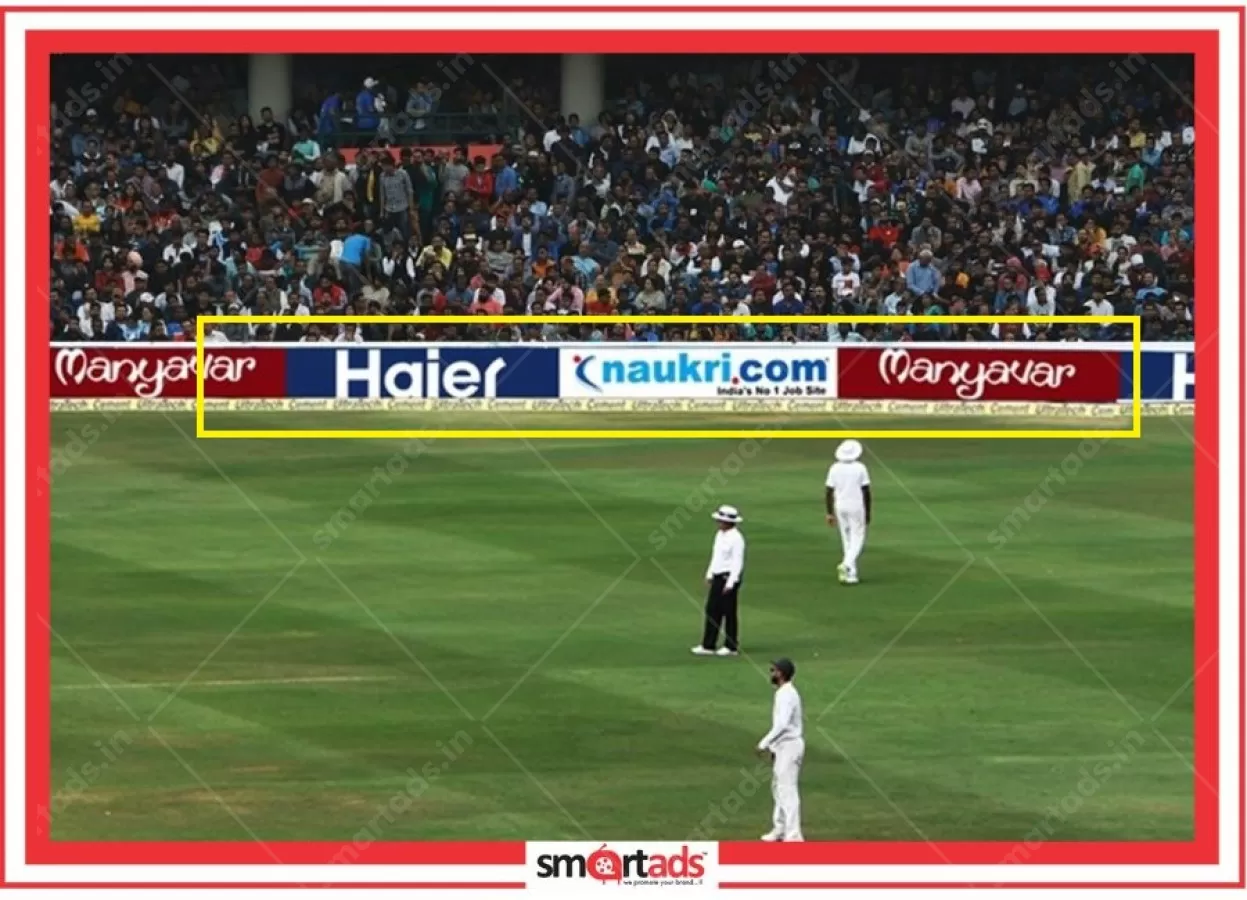
Silver HD Perimeter Signage
Various Sizes
1 ball in every 10 Balls : 50% of the Gr
Rate per Digital Screen / Per match
At Time Only 3 Display Name.
₹1100000.00
Showing 1 to 4 of 4 Results
MEDIA DETAILS
Various Sizes
1 ball in every 10 Balls : 50% of the Gr
Rate per Digital Screen / Per match
At Time Only 3 Display Name.
₹1100000.00
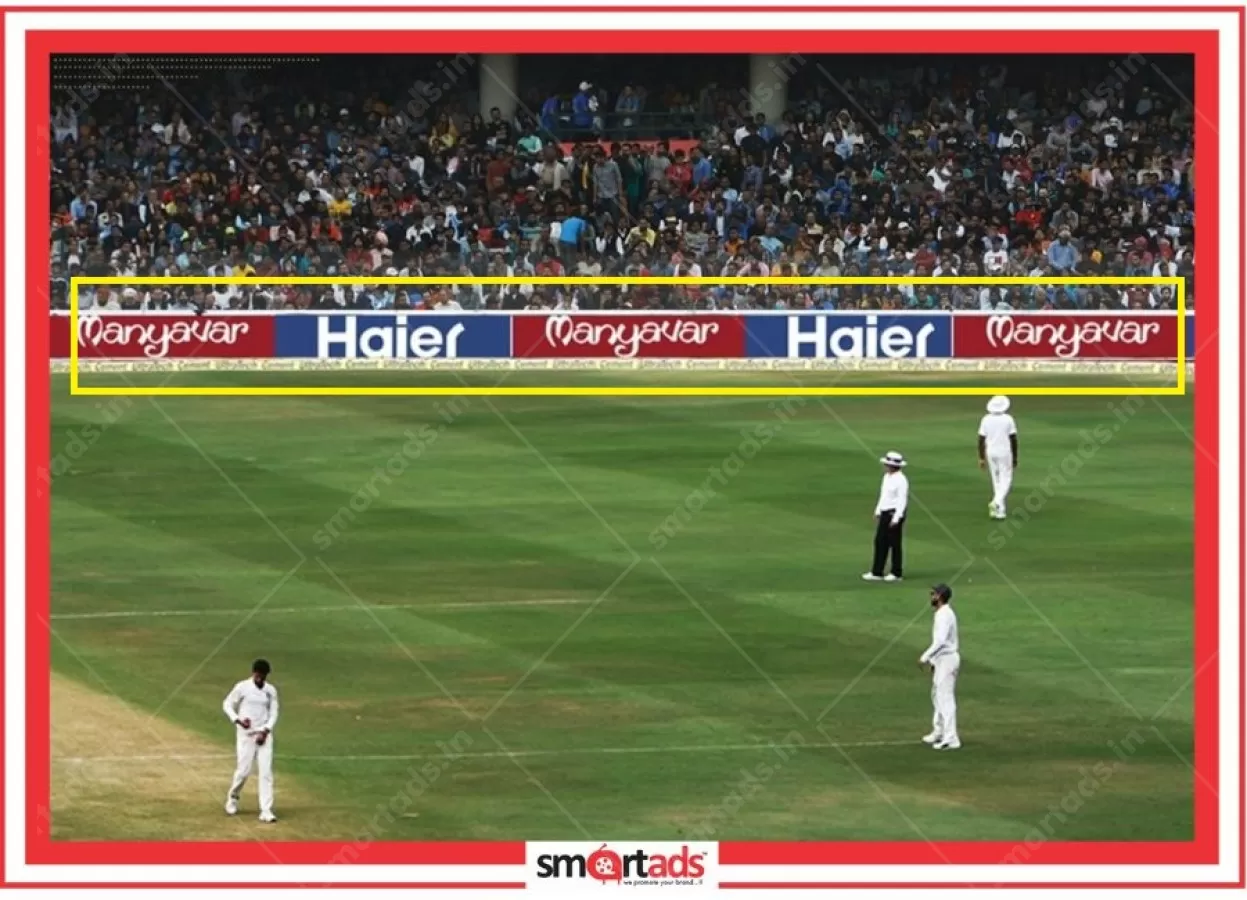
Various Sizes
1 Ball In Every 10 Balls : 50% Of The Gr
Rate per Digital Screen / Per match
At Time Only 2 Display Name.
₹1700000.00
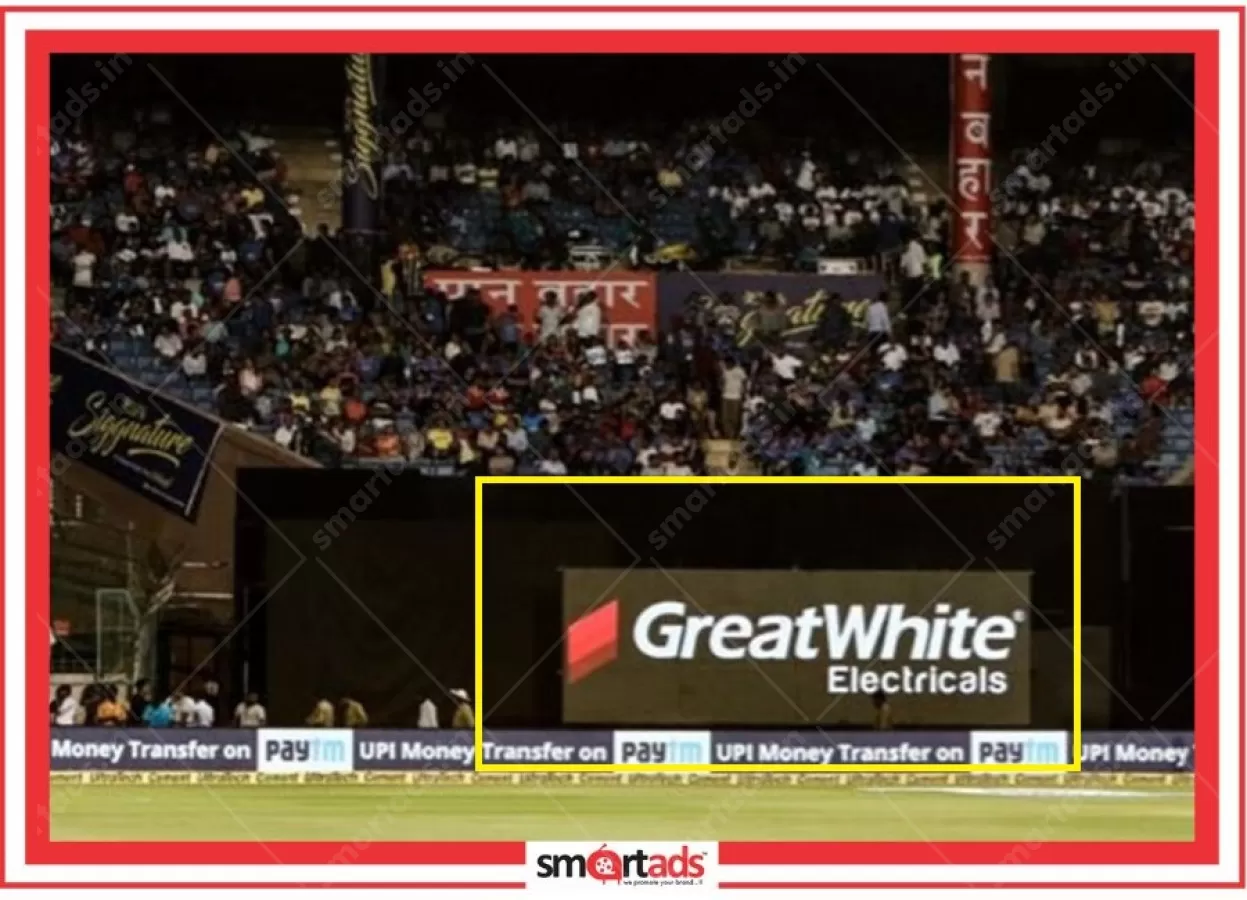
Various Sizes
5 Overs Per ODI Match , 2 Overs Per T20
Rate per Digital Screen / Per match
At Time Only 1 Display Name.
₹1150000.00
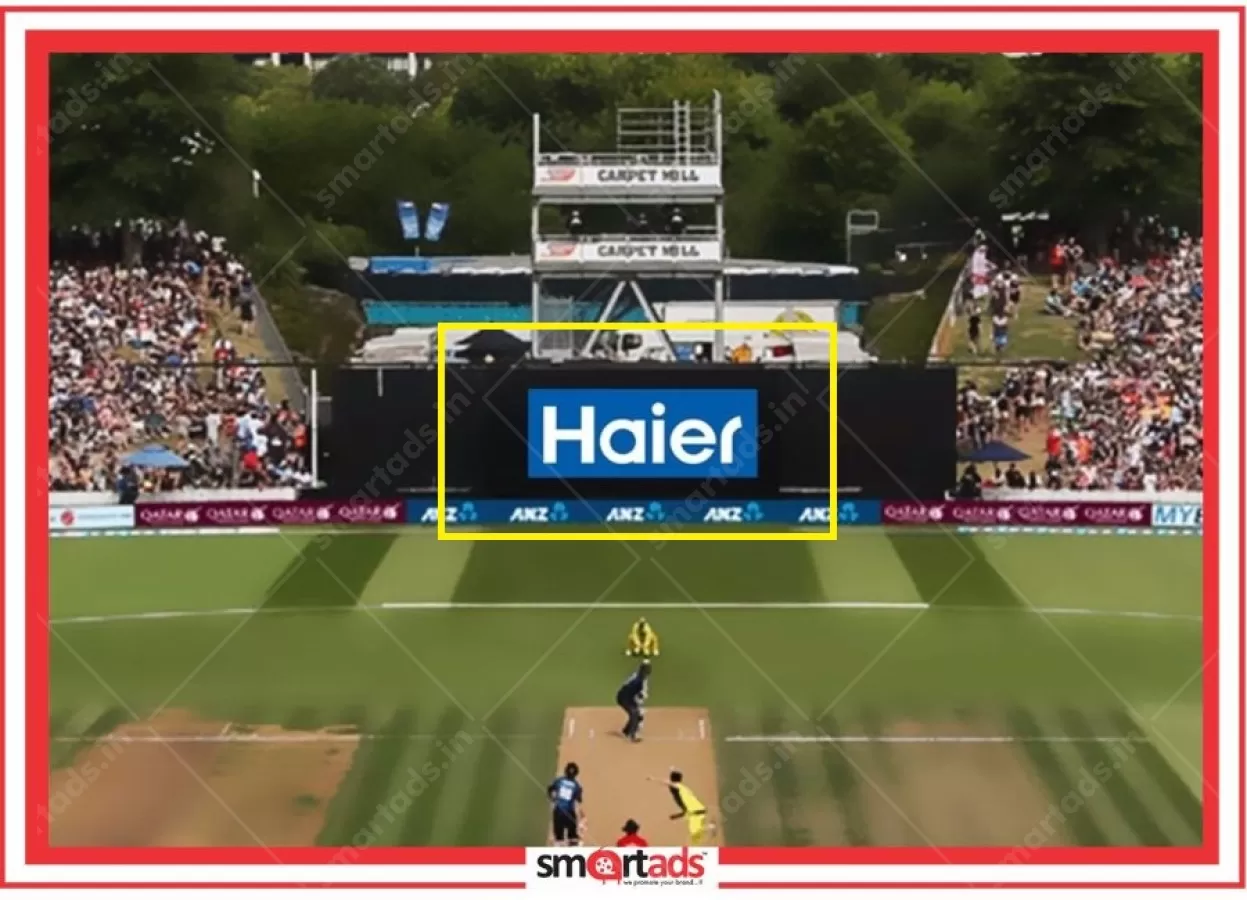
Various Sizes
5 Overs Per ODI Match , 2 Overs Per T20
Rate per Digital Screen / Per match
At Time Only 1 Display Name.
₹1150000.00
MEDIA REACH

MinimumQty :
1
EstimateReachPeople :
65000

Most brands that approach us about cricket advertising in Kerala have already spent weeks agonising over television spots and digital campaigns — and then they discover that a single match at Greenfield International Stadium can deliver captive audience exposure to fifty thousand people in one afternoon, at a fraction of what a thirty-second prime-time television slot costs. What makes cricket stadium advertising in Thiruvananthapuram genuinely different from almost every other OOH format in the state is the combination of emotional context, dwell time, and broadcast visibility that no bus shelter or highway hoarding can replicate. At SmartAds, we have worked with brands across Kerala who initially dismissed in-stadium branding as a "big-brand-only" play — and almost every one of them changed their mind after seeing the numbers.
The Sports Hub Trivandrum, which houses Greenfield International Stadium at Kariavattom, is not just another cricket venue — it is the largest multi-purpose sports complex in Kerala, and one of the few stadiums in South India with a seating capacity of 50,000 that is also purpose-built for modern broadcast infrastructure. That combination matters enormously for advertisers, because it means that every match played here reaches two distinct audiences simultaneously: the fifty thousand fans inside the bowl, and the millions watching on Star Sports, FanCode, or regional broadcast feeds. For brands considering BTL advertising, this dual-reach dynamic is something we rarely see in any other below the line advertising format in the state.
The stadium is managed under a lease arrangement between the Kerala Cricket Association and Karyavattom Sports Facilities Limited, which is the state-owned entity that operates the broader Sports Hub Trivandrum complex. The University of Kerala owns the underlying land at Kariavattom, which adds a layer of institutional credibility to the venue and also means that advertising rights flow through a structured approval process rather than an informal arrangement. What a lot of people miss is that this governance structure — KCA managing cricket-specific rights, KSFL managing facility-level permissions — actually protects advertisers, because it means the rights you purchase are clean, documented, and enforceable.
Frankly speaking, Thiruvananthapuram as a market is underestimated by national advertisers who tend to cluster their Kerala budgets around Kochi. The capital city has a highly educated, aspirational consumer base; it is home to government employees, IT sector professionals, defence personnel, and a large student population — demographics that index exceptionally well for categories like banking and financial services, consumer electronics, automobiles, insurance, and education. When a brand chooses cricket stadium advertising in Thiruvananthapuram, it is not just buying eyeballs at a match; it is buying relevance with one of the most discerning urban audiences in South India.
The range of in-stadium branding formats at Greenfield International Stadium is broader than most brands expect when they first approach us. Perimeter boards — both static and LED — run along the boundary rope and represent the most visible and most sought-after format at any cricket ground; at Trivandrum, these are positioned to ensure maximum camera pickup during broadcast, which means a brand on the perimeter boards is not just visible to fans in the stands but is also captured repeatedly in wide-angle and mid-on camera shots throughout the match. Boundary board advertising at this venue is sold in panel segments, and the pricing varies depending on which segment falls within the primary broadcast frame.
Beyond perimeter boards, the stadium offers LED display advertising on the giant scoreboard screens, which are visible from virtually every seat in the house and carry enormous brand recall value during breaks in play, drinks breaks, and the strategic timeouts that are now standard in T20 formats. Ground mural advertising — which involves painted or vinyl-applied branding on the pitch-side areas and outfield — is available for select matches and delivers strong in-pitch branding visibility, particularly during aerial drone shots that have become a standard part of broadcast production. On top of that, digital screen advertising on the concourse-level displays and entry gate screens reaches fans during the high-engagement pre-match and innings-break periods, when attention is high and phones are often pocketed.
For brands that want something more tactile and interactive, fan zone activations inside the Sports Hub Trivandrum premises offer a completely different category of engagement; these include branded standees, sampling counters, product demonstration zones, contest booths, and merchandise displays that are set up in the designated fan activation areas outside the main bowl. Experiential marketing at this level is genuinely powerful in a cricket context, because fans arrive early, linger during intervals, and are in an emotionally receptive state that no digital ad impression can manufacture. We have also facilitated jersey sponsorship discussions for domestic Kerala Cricket League matches, which is a format that delivers both on-ground visibility and broadcast visibility at a significantly lower investment than international match perimeter boards.
Perimeter boards at Greenfield International Stadium come in two primary variants, and understanding the difference between them is essential before any media planning conversation. Static perimeter boards — which are the traditional vinyl-flex panels mounted on the boundary board frames — are the more affordable entry point; they are fixed for the duration of the match and deliver consistent, unchanging brand messaging to both the in-stadium audience and the broadcast camera. LED perimeter boards, by contrast, are dynamic display systems that rotate between multiple advertisers on a timed cycle, typically showing each brand's creative for somewhere between eight and fifteen seconds per rotation, which means your brand appears multiple times per over across the full duration of the match.
The broadcast visibility question is where LED display advertising gets genuinely interesting. Because LED boards are brighter and more visually distinct than static vinyl, they tend to be picked up more crisply in broadcast footage — particularly in the HD and 4K feeds that Star Sports now uses as standard for international matches at Thiruvananthapuram. Virtual boundary board advertising is a more recent development that is worth mentioning here: this technology allows feed-specific ads to be digitally overlaid on the broadcast image, which means a regional Kerala brand can appear on the perimeter boards in the television broadcast without actually having a physical board at the stadium. This is a meaningful option for smaller advertisers who want television viewership advertising reach without the full cost of physical in-stadium branding.
At SmartAds, we always tell our clients that the choice between static and LED perimeter boards should be driven by their creative strategy, not just their budget. A brand with a single, bold, high-contrast visual — a logo, a product shot, a short tagline — often performs better on a static board, because the image has time to register with the audience and the broadcast camera. A brand with a campaign that involves multiple messages, a countdown, or a call-to-action benefits more from the LED format, which allows creative rotation across the match duration. What we have found, across multiple campaigns at cricket grounds in South India, is that brands which invest in creative specifically designed for the stadium environment consistently outperform those that repurpose their television or print artwork without adaptation.
This is the question that every brand manager asks first, and the honest answer is that advertising rates at Greenfield International Stadium vary considerably depending on the match type, the format, the panel position, and the duration of the campaign. For an international match — an ODI match advertising Thiruvananthapuram or a T20 International — perimeter board advertising on the LED system works out to somewhere in the ballpark of eight to fifteen lakh rupees per panel per match, depending on position; panels that fall within the primary broadcast frame command a premium over those in the secondary arc. For domestic cricket matches — Ranji Trophy, Vijay Hazare, or Kerala Cricket League fixtures — the advertising cost drops substantially, with static boundary board advertising available in the range of roughly one to three lakh per match, which makes cricket ground advertising genuinely accessible for mid-sized Kerala businesses.
Fan zone activation spaces and experiential marketing setups at the Sports Hub Trivandrum are priced differently, typically on a per-event basis with costs that depend on the size of the activation footprint, the duration, and whether the brand requires structural builds or just branded standees and display counters. Ground mural advertising and in-pitch branding are generally bundled into larger sponsorship packages rather than sold as standalone formats, and these packages are negotiated directly through KCA's commercial team. Digital screen advertising on concourse displays is often available as an add-on to a primary perimeter board booking, and in our experience, this combination delivers meaningfully better brand recall than either format alone.
One thing that surprises most clients when we walk them through the numbers is how the advertising cost per thousand impressions compares to other Kerala OOH formats. A premium outdoor hoarding on a major Thiruvananthapuram arterial road might deliver a CPM that works out to roughly four to six rupees — but it delivers that reach over thirty days, with no guarantee of engagement or attention. A perimeter board at an international cricket match at Greenfield International Stadium, reaching fifty thousand captive, emotionally engaged fans in three to four hours, works out to a CPM that is higher in absolute terms but dramatically more valuable in terms of attention quality; the captive audience dynamic is something that outdoor advertising Kerala simply cannot replicate. For brands in categories where brand recall and emotional association matter — automobiles, beverages, financial services, consumer durables — this distinction is not academic; it is the difference between a campaign that moves the needle and one that merely generates impressions.
The BTL versus ATL distinction inside a cricket stadium context is one that confuses even experienced marketers, partly because the stadium environment blurs the line in interesting ways. Above the line advertising in a cricket context typically refers to broadcast-linked formats — television commercials aired during the match broadcast, sponsorship mentions in the commentary feed, or digital overlays on the streaming platform — which reach a mass audience that extends far beyond the stadium. BTL advertising, by contrast, refers to the direct, experiential, venue-specific formats: perimeter boards, fan zone activations, sampling counters, standees, ground murals, and in-stadium digital screens that engage the audience physically present at the match.
What a lot of people miss is that the most powerful cricket stadium campaigns are the ones that use both layers simultaneously, creating a reinforcement loop where the fan in the stands sees the brand on the perimeter boards, and then sees the same brand in a television commercial during the drinks break on the giant scoreboard screen, and then encounters the brand again at a sampling counter on the way out. This kind of multi-touchpoint architecture is what below the line advertising at a stadium uniquely enables — no other BTL format in Kerala offers the same opportunity to layer experiential, visual, and broadcast touchpoints within a single consumer journey. Non-traditional advertising formats like fan zone activations and ground murals work precisely because they interrupt the fan's experience in a way that feels contextually appropriate rather than intrusive.
To be fair, not every brand needs the full ATL-plus-BTL stack. For a local Kerala business — a regional bank, a jewellery chain, an educational institution — a well-executed BTL advertising campaign at Greenfield International Stadium, focused on perimeter boards during domestic matches and a fan zone activation during one or two international fixtures, can deliver brand visibility that rivals what a much larger ATL spend would achieve. At SmartAds, our media planning approach for regional brands typically starts with identifying which match types align with the brand's seasonal calendar, and then building a non-traditional advertising package that maximises reach per rupee rather than simply maximising format count.
The honest answer is that almost any brand that sells to urban Kerala consumers can find a relevant format and match type at Greenfield International Stadium — but some categories are structurally better suited to cricket ground advertising than others. Automobile brands, which have historically been among the heaviest investors in sports marketing in India, benefit from the aspirational context that cricket creates; a car brand's perimeter board at an international cricket match in Thiruvananthapuram is seen by fifty thousand people who are already in an elevated emotional state, which is precisely the context in which brand associations are formed most durably. Financial services brands — banks, insurance companies, mutual fund houses — similarly benefit from the trust and credibility that association with a prestigious venue like Greenfield International Stadium confers.
Consumer electronics brands, particularly those targeting the 18-to-35 male demographic, find cricket stadium advertising in Thiruvananthapuram to be one of the most cost-efficient ways to reach that audience at scale; the cricket fan demographics in Kerala skew strongly toward young, urban, digitally active men, which is a profile that is expensive to reach through programmatic digital advertising but arrives naturally and in volume at every match. Education brands — universities, coaching institutes, professional certification providers — have also been effective users of in-stadium branding at Trivandrum, particularly for matches that fall in the June-to-August period when students are making course selection decisions. FMCG brands with regional distribution strength in Kerala have used fan zone activations and sampling counters to drive trial in a context where the audience is receptive, relaxed, and not rushing past a display as they might in a retail environment.
One campaign we worked on involved a regional financial services brand in Thiruvananthapuram that was trying to build brand visibility among the salaried professional segment — a demographic that is notoriously hard to reach through traditional outdoor advertising because they spend limited time on the streets and consume most of their media digitally. We placed the brand on two LED perimeter board panels during an international T20 match at Greenfield International Stadium, combined with a branded activation zone in the fan area; the brand's own post-campaign research showed a brand recall lift of roughly thirty-five percent among match attendees compared to a control group, which was a number that justified the investment several times over and led to a multi-match sponsorship package in the following season.
The booking process for cricket stadium advertising in Thiruvananthapuram is more structured than most brands expect, and understanding the approval chain is essential to avoid last-minute disappointments. The primary rights holder for cricket-specific advertising at Greenfield International Stadium is the Kerala Cricket Association, which holds the lease for cricket operations at the venue from Karyavattom Sports Facilities Limited. For international matches — ODIs and T20Is that fall under BCCI's calendar — advertising rights are governed by BCCI guidelines, and certain categories of in-stadium branding require BCCI approval in addition to KCA approval; this is particularly true for formats that appear within the broadcast frame, including perimeter boards and ground murals. For domestic matches — Ranji Trophy, Vijay Hazare, Syed Mushtaq Ali, and Kerala Cricket League fixtures — KCA manages the rights directly, and the approval process is somewhat faster.
The planning timeline is something we are very direct about with our clients: for international match advertising at Greenfield International Stadium, brands should ideally be in conversation with their cricket advertising agency at least eight to twelve weeks before the match date. This is not arbitrary caution; it reflects the reality that perimeter board panels for high-profile international matches are frequently committed to sponsors two to three months in advance, and late-arriving brands often find that the premium broadcast-frame positions are already taken. For domestic match advertising, the lead time is shorter — roughly four to six weeks is workable — but even here, brands that approach us with less than three weeks to go are often working with constrained format options.
At SmartAds, our process for booking cricket stadium advertising in Thiruvananthapuram begins with a match calendar review, which we share with clients at the start of each season so they can align their brand activation windows with the fixtures that best match their target audience and campaign objectives. We handle the KCA and KSFL liaison, the creative specifications compliance review, and the on-ground production coordination — which matters more than brands often realise, because stadium advertising production has specific material requirements, installation windows, and removal protocols that differ from standard OOH production. The thing is, a poorly produced perimeter board or a creative that does not meet broadcast specifications can end up being cropped or obscured in the feed, which defeats the entire purpose of the investment.
The in-stadium audience at Greenfield International Stadium for international cricket matches typically fills to capacity or near-capacity, which means the captive audience for a single match day is in the range of forty-five to fifty thousand people — a number that represents a significant concentration of Thiruvananthapuram's urban population in one place at one time. But the more interesting reach figure, from an advertiser's perspective, is the broadcast reach; international matches at Trivandrum are carried on Star Sports across its network of channels, and the cumulative television viewership advertising reach for a single T20 International or ODI match can run into millions of viewers across Kerala, Tamil Nadu, and the broader national audience. BARC viewership data for South India consistently shows that cricket matches on Star Sports draw among the highest per-match ratings of any programming in the region.
For the Kerala Cricket League, which was broadcast on Star Sports and streamed on FanCode in its 2024 edition, the reach figures are more modest but the audience composition is arguably more relevant for regional Kerala brands; the KCL audience is concentrated in Kerala, which means the broadcast visibility achieved by a perimeter board or boundary board advertising during a KCL match is essentially a targeted Kerala-state media buy. Sanju Samson's association with Thiruvananthapuram cricket adds a layer of celebrity endorsement value that is particularly powerful in the capital city, where he is genuinely beloved — and brands that appear alongside his on-field presence benefit from that emotional halo in ways that are difficult to quantify but very real in terms of brand recall.
The dwell time dimension of in-stadium audience reach is something that rarely appears in competitor analyses but is central to how we think about cricket stadium advertising at SmartAds. A fan at Greenfield International Stadium for a T20 match typically arrives sixty to ninety minutes before play begins, watches three to four hours of cricket, and spends additional time in the fan zones and concourse areas during breaks and after the match; the total venue dwell time for a typical attendee is somewhere between four and six hours. Compare that to the three to five seconds of attention that a highway hoarding commands, or the average of one-point-eight seconds that a digital display ad receives before a user scrolls past, and the value of that sustained in-stadium exposure becomes very clear.
Fan zone activations at the Sports Hub Trivandrum are, in our experience, one of the most underutilised tools in the Kerala brand marketer's toolkit — and the brands that do use them tend to generate the kind of organic social media amplification that money cannot easily buy through paid channels. The fan activation zones at Greenfield International Stadium are designated areas within the Sports Hub premises where brands can set up interactive experiences: product sampling, games and contests, selfie booths, merchandise giveaways, and live demonstrations. Because these zones are positioned in areas where fans naturally congregate before the match and during innings breaks, the foot traffic is high and the audience is genuinely idle, which is a rare and valuable combination.
Experiential marketing in a cricket stadium context works on a different psychological register than traditional advertising; when a fan tries a product sample, plays a branded game, or takes a photo at a branded installation, they are creating a memory that is linked to the positive emotional experience of watching cricket. This association is durable in a way that a visual impression from a perimeter board is not, which is why we typically recommend that brands with experiential marketing objectives use fan zone activations as the centrepiece of their campaign and treat perimeter boards as the awareness layer that drives fans toward the activation. Brand activation at this level also generates user-created content — fans posting photos and videos from the activation zone — which extends the campaign's reach into social media audiences that were not present at the match.
One campaign we executed for a consumer electronics brand at the Sports Hub Trivandrum involved a product demonstration zone where fans could try a new device in a hands-on environment; over the course of two match days, the activation recorded over three thousand individual interactions, generated several hundred pieces of user-created social content, and resulted in a measurable spike in the brand's regional search volume in the week following the matches. The cost of the fan zone activation, including the build, staffing, and materials, worked out to a fraction of what an equivalent reach through paid digital advertising would have cost — and the quality of the engagement was incomparably higher. This is where the real value of experiential marketing at cricket venues lies: not in the raw impression count, but in the depth and durability of the brand experience created.
This is a comparison we are asked to make regularly, and the answer depends on what the brand is trying to achieve — but for most brand visibility objectives, in-stadium branding at Greenfield International Stadium outperforms outdoor advertising Kerala in several important dimensions. A premium static hoarding on a major Thiruvananthapuram road — say, on the Palayam-Karamana corridor or near the Technopark approach — delivers continuous exposure over a thirty-day period to a diverse audience that includes commuters, pedestrians, and vehicle passengers; the reach is broad but the attention is fleeting, and there is no emotional context attached to the exposure. OOH advertising in this format is excellent for building frequency and geographic coverage, but it does not create the kind of engaged, contextual brand experience that in-stadium branding delivers.
A perimeter board at Greenfield International Stadium, by contrast, reaches a smaller audience in absolute terms over a single match day — but that audience is captive, emotionally engaged, and spending several hours in close proximity to the brand message. The brand recall rates that we have observed for well-executed in-stadium branding consistently outperform those for comparable outdoor hoarding spends, which aligns with what the broader sports marketing literature suggests about the relationship between emotional context and memory encoding. On top of that, the broadcast visibility dimension means that in-stadium branding at Trivandrum reaches a television audience that a static hoarding on a Thiruvananthapuram road simply cannot touch.
The static hoarding vs LED board question within the stadium itself is also worth addressing: static boundary boards offer a lower entry cost and are appropriate for brands with a single, clear message, while LED display advertising offers creative flexibility and the ability to rotate multiple messages — which is particularly valuable for brands running time-sensitive promotions or multi-product campaigns. What we tell our clients is that the right answer is almost never "one or the other"; a campaign that combines a static perimeter board for sustained brand visibility with a fan zone activation for experiential depth, and layers in digital screen advertising on the concourse displays for frequency, will consistently outperform any single-format approach at a comparable total budget.
Understanding the regulatory and commercial framework that governs cricket stadium advertising in Thiruvananthapuram is not optional for brands that want to avoid costly mistakes. The Board of Control for Cricket in India sets the overarching guidelines for in-stadium branding at all international matches played in India, and these guidelines specify which product categories are permitted to advertise within the broadcast frame, what creative content is acceptable, and which positions on the ground are restricted for BCCI's own commercial partners. Certain categories — tobacco, alcohol, and betting-adjacent products — are subject to strict restrictions under both BCCI guidelines and Indian broadcasting regulations, and brands in adjacent categories should seek specific legal and commercial clearance before booking perimeter boards at international matches.
The Kerala Cricket Association manages advertising rights for domestic matches and has its own commercial framework for KCL and other KCA-sanctioned events at Greenfield International Stadium; the approval process for domestic match advertising is less complex than for international fixtures, but KCA still requires creative approval and format compliance before any in-stadium branding is installed. Karyavattom Sports Facilities Limited, as the venue operator, has its own set of permissions related to structural installations, fan zone build-outs, and anything that involves physical modification of the Sports Hub Trivandrum premises; brands planning experiential marketing activations need KSFL approval in addition to KCA commercial approval, which is a step that is frequently overlooked by brands working without an experienced cricket advertising agency.
Stadium naming rights at Greenfield International Stadium are a separate and significantly larger commercial proposition; the stadium has operated without a title sponsor for extended periods, which represents an opportunity for a brand seeking maximum long-term brand visibility in Thiruvananthapuram, though the investment involved is of a different order of magnitude than match-specific advertising. Jersey sponsorship for KCA teams in domestic tournaments is another avenue that is managed through KCA's commercial team and offers sustained brand visibility across multiple matches and broadcast appearances. At SmartAds, we have navigated the KCA and KSFL approval processes across multiple campaigns, and our experience is that having an agency that understands the specific requirements of each body saves brands significant time and prevents the creative and compliance rework that inevitably happens when brands try to manage this process independently.
ROI measurement for cricket stadium advertising is an area where the industry has historically been weak, and frankly speaking, any agency that promises you a precise, single-number ROI figure for an in-stadium branding campaign without explaining the methodology should be treated with scepticism. What we can measure, and what we recommend our clients track, falls into several distinct categories: broadcast visibility, which can be quantified through post-match media monitoring services that count the number of seconds a brand's perimeter board or boundary board appears in the broadcast frame; in-stadium reach, which is the match attendance figure; fan zone activation engagement, which can be tracked through interaction counts, lead captures, and sample distributions; and downstream brand metrics, which include brand recall lift, consideration scores, and search volume changes in the post-match period.
The broadcast visibility measurement is particularly important for brands that are using cricket stadium advertising in Thiruvananthapuram as a television viewership advertising strategy; TAM AdEx and specialised sports media monitoring services can provide second-by-second brand exposure data from the broadcast feed, which allows brands to calculate an effective CPM for their broadcast exposure and compare it against what they would have paid for equivalent television commercial time. In our experience, well-positioned perimeter boards at international matches at Greenfield International Stadium typically accumulate between eight and twenty minutes of broadcast frame time over the course of a match, which — when valued at the equivalent television commercial rate — often represents a significant implicit return on the in-stadium advertising cost.
For fan zone activations and experiential marketing, the ROI cricket advertising calculation is more direct: lead capture rates, trial conversion rates, and post-activation purchase intent surveys provide concrete performance data that can be tied to campaign investment. One retail client we worked with in Thiruvananthapuram used a fan zone activation at two international matches at Greenfield International Stadium to launch a new product line; by tracking redemption of a match-specific promotional code distributed at the activation, they were able to attribute roughly four hundred and fifty direct sales to the campaign in the thirty days following the matches — a return that exceeded the total campaign cost by a meaningful margin and made the case for a full-season sponsorship package in the subsequent year.
Q: What is cricket stadium advertising in Thiruvananthapuram and how does it work?
Cricket stadium advertising in Thiruvananthapuram refers to the placement of brand messages across the various advertising formats available at Greenfield International Stadium — including perimeter boards, LED display advertising, digital screens, ground murals, fan zone activations, and standees — during cricket matches hosted at the venue. The way it works, in practical terms, is that brands purchase advertising rights for specific formats and match dates through the Kerala Cricket Association's commercial team (for domestic matches) or through BCCI-aligned commercial arrangements (for international matches); an experienced cricket advertising agency typically manages the booking, creative compliance, production, and on-ground execution on the brand's behalf. The brand's message is then exposed to the in-stadium audience throughout the match, and — for broadcast-frame formats like perimeter boards — to the television and streaming audience watching on Star Sports, FanCode, or regional channels.
Q: How much does it cost to advertise at Greenfield International Stadium in Thiruvananthapuram?
Advertising rates at Greenfield International Stadium vary considerably by match type and format. For international matches, LED perimeter board advertising is in the ballpark of eight to fifteen lakh rupees per panel per match for broadcast-frame positions, while static boundary board advertising is somewhat lower. For domestic matches — Ranji Trophy, Vijay Hazare, and Kerala Cricket League — advertising cost drops significantly, with static perimeter boards available in the range of roughly one to three lakh per match; this makes cricket ground advertising genuinely accessible for regional Kerala businesses. Fan zone activation costs depend on the scale of the build and the match type, and are typically negotiated separately. We always recommend that brands contact a cricket advertising agency like SmartAds for a customised rate card, because the final cost depends on factors including panel position, creative format, and whether the booking is for a single match or a multi-match sponsorship package.
Q: What BTL advertising formats are available at the Sports Hub Trivandrum?
The Sports Hub Trivandrum offers a wide range of BTL advertising formats, including LED perimeter boards and static boundary boards along the playing boundary, digital screen advertising on the giant scoreboard and concourse displays, ground mural advertising and in-pitch branding on the outfield and pitch-side areas, branded standees and display counters in the concourse and fan areas, fan zone activation spaces for experiential marketing and product sampling, and entry gate branding. Below the line advertising at this venue is particularly versatile because the Sports Hub's large premises allow for activation zones that are separate from the playing field, giving brands space to create immersive experiences rather than just static displays.
Q: How do perimeter board and LED screen advertising differ at Trivandrum cricket stadium?
Perimeter boards are positioned along the boundary rope and are primarily visible to the in-stadium audience and the broadcast camera; they come in static (vinyl-flex) and LED (dynamic, rotating) variants. LED perimeter boards rotate between multiple advertisers on a timed cycle and are brighter and more broadcast-friendly than static boards. LED display advertising on the scoreboard screens, by contrast, is visible to the entire stadium from any seat and is used during breaks in play — drinks breaks, innings intervals, and strategic timeouts — rather than during live play. The two formats serve complementary purposes: perimeter boards build sustained brand visibility throughout the match, while scoreboard LED screens deliver high-impact burst messaging during the moments when fan attention is most concentrated.
Q: Who approves and manages advertising rights at Greenfield Stadium — KCA or KSFL?
Both organisations are involved, but in different capacities. The Kerala Cricket Association manages cricket-specific advertising rights — perimeter boards, boundary boards, ground murals, and any branding within the playing field perimeter — for all matches it hosts at Greenfield International Stadium. Karyavattom Sports Facilities Limited, as the venue operator, manages facility-level permissions, which include fan zone activation builds, structural installations, and any branding on the Sports Hub Trivandrum premises outside the playing field boundary. For international matches, BCCI guidelines add a further layer of approval for broadcast-frame formats. Brands working through an experienced cricket advertising agency will typically have all three layers of approval managed on their behalf.
Q: Can small Kerala businesses afford cricket stadium advertising in Thiruvananthapuram?
Yes — and this is a point we make repeatedly, because the assumption that cricket stadium advertising is exclusively for large national brands is simply not accurate. During domestic matches — Ranji Trophy, Vijay Hazare, and Kerala Cricket League fixtures — static boundary board advertising and standee placements are available at rates that are well within the reach of regional businesses; a static perimeter board for a KCL match, for example, can be booked for roughly one to two lakh rupees, which compares favourably with a month-long outdoor hoarding in a premium Thiruvananthapuram location. Fan zone activations during domestic matches can also be structured at modest budgets if the brand is willing to keep the activation simple — a branded standee, a sampling table, and a contest mechanic can be executed for a fraction of what a full experiential build costs.
Q: How many spectators does Greenfield International Stadium hold and what is the advertising reach?
Greenfield International Stadium has a seating capacity of 50,000, making it one of the largest cricket venues in South India. For international matches, attendance typically reaches near-capacity, meaning the in-stadium captive audience for a single match day is in the range of forty-five to fifty thousand people. The broadcast reach extends this significantly — international matches at Trivandrum are carried on Star Sports and reach millions of viewers across Kerala and nationally, while KCL matches on Star Sports and FanCode reach a concentrated Kerala-state audience. Total campaign reach for a well-positioned perimeter board at an international T20 match at Greenfield International Stadium — combining in-stadium and broadcast audiences — can be in the range of several million impressions from a single match day.
Q: What is the difference between in-stadium BTL advertising and traditional outdoor hoarding in Thiruvananthapuram?
The fundamental difference is audience quality and context. Traditional outdoor hoarding in Thiruvananthapuram delivers broad reach over a thirty-day period to a diverse, largely passive audience whose attention is divided between the road, their phone, and their destination; dwell time is measured in seconds. In-stadium BTL advertising at Greenfield International Stadium delivers a smaller but captive, emotionally engaged audience that spends four to six hours at the venue; brand recall rates for in-stadium branding consistently outperform those for outdoor hoarding at equivalent spend levels. Additionally, in-stadium branding at international matches delivers broadcast visibility that no outdoor hoarding can provide, effectively turning a BTL investment into a partial ATL buy.
Q: Is cricket stadium advertising in Thiruvananthapuram available during domestic matches like Ranji Trophy and KCL?
Yes, and this is one of the most important points for regional Kerala brands to understand. Greenfield International Stadium hosts a range of domestic cricket matches throughout the year, including Ranji Trophy, Vijay Hazare Trophy, Syed Mushtaq Ali Trophy, and Kerala Cricket League fixtures; advertising rights for these matches are managed by KCA and are available at rates that are significantly lower than international match rates. The audience for domestic matches is smaller — attendance for Ranji Trophy matches, for example, is typically a few thousand rather than fifty thousand — but the advertising cost is proportionally lower, and the audience that does attend is often a highly engaged, cricket-knowledgeable fan base. For brands building long-term
