
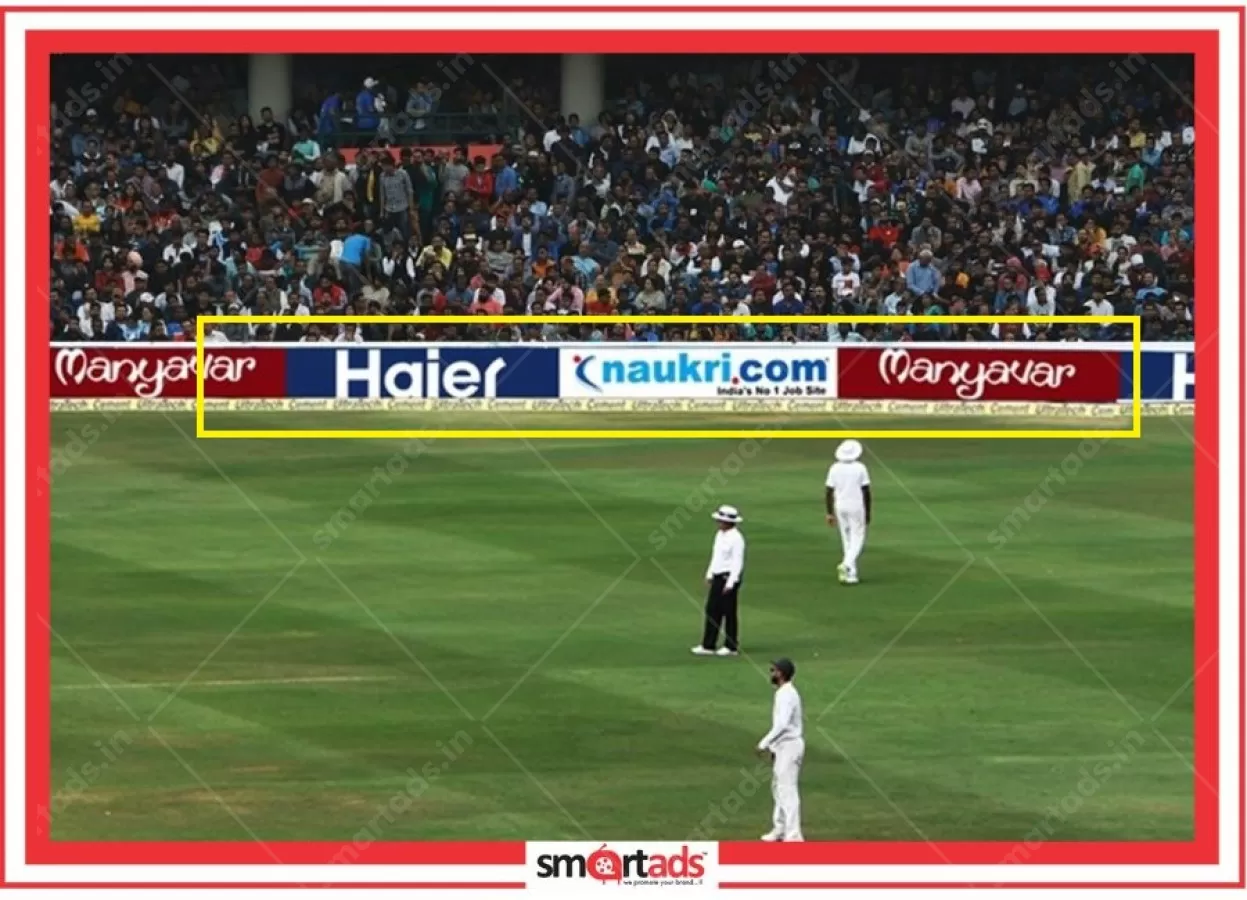
Silver HD Perimeter Signage
Various Sizes
1 ball in every 10 Balls : 50% of the Gr
Rate per Digital Screen / Per match
At Time Only 3 Display Name.
₹1100000.00
Showing 1 to 4 of 4 Results
MEDIA DETAILS
Various Sizes
1 ball in every 10 Balls : 50% of the Gr
Rate per Digital Screen / Per match
At Time Only 3 Display Name.
₹1100000.00
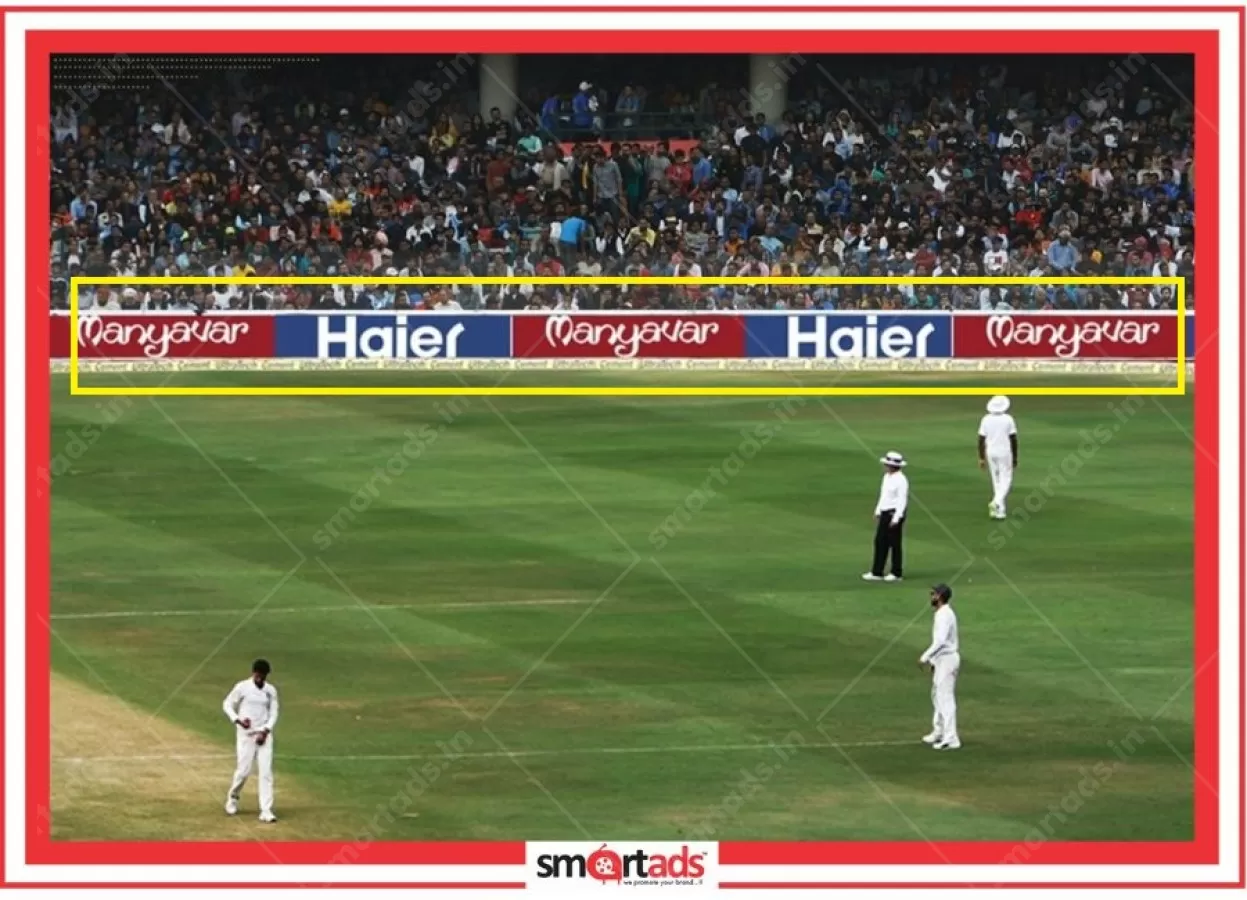
Various Sizes
1 Ball In Every 10 Balls : 50% Of The Gr
Rate per Digital Screen / Per match
At Time Only 2 Display Name.
₹1700000.00
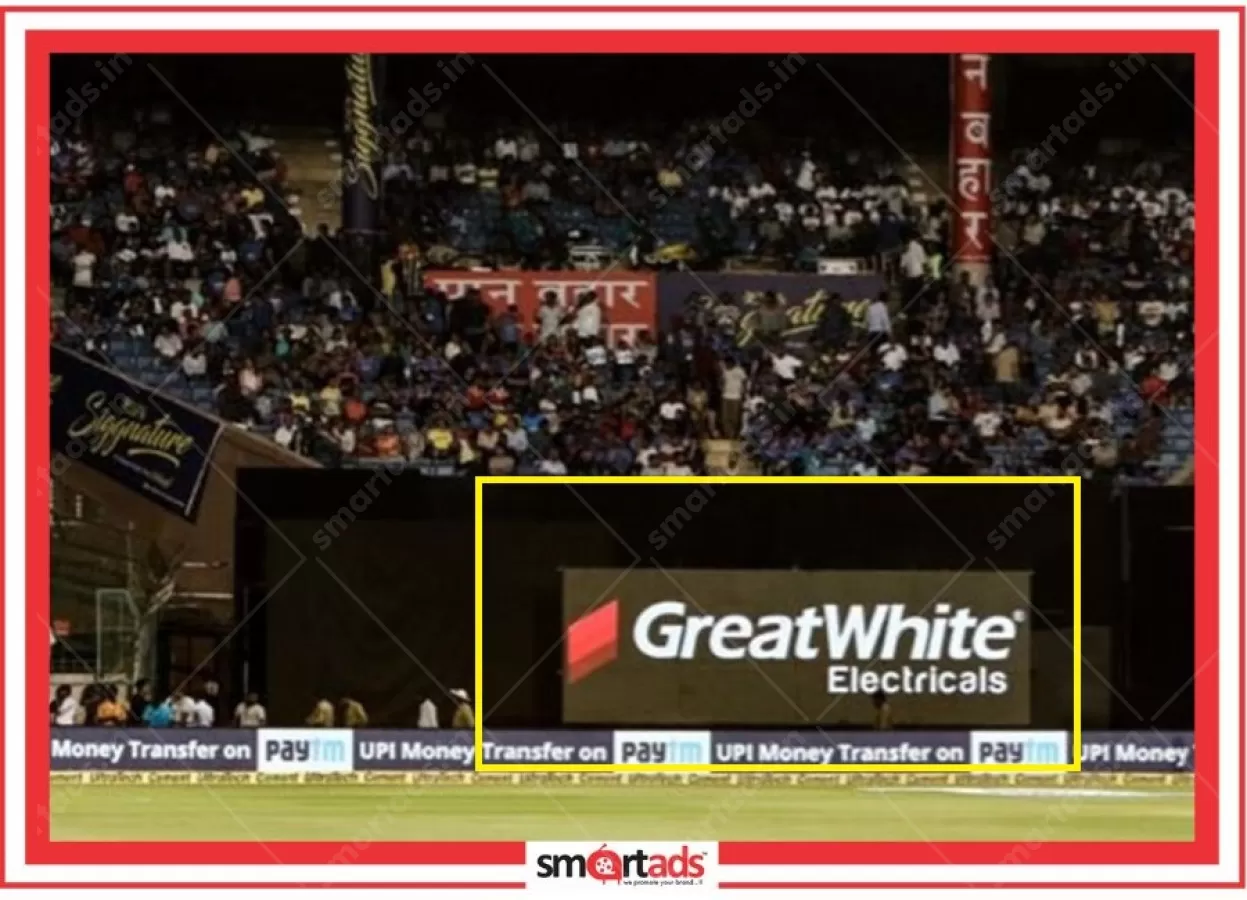
Various Sizes
5 Overs Per ODI Match , 2 Overs Per T20
Rate per Digital Screen / Per match
At Time Only 1 Display Name.
₹1150000.00
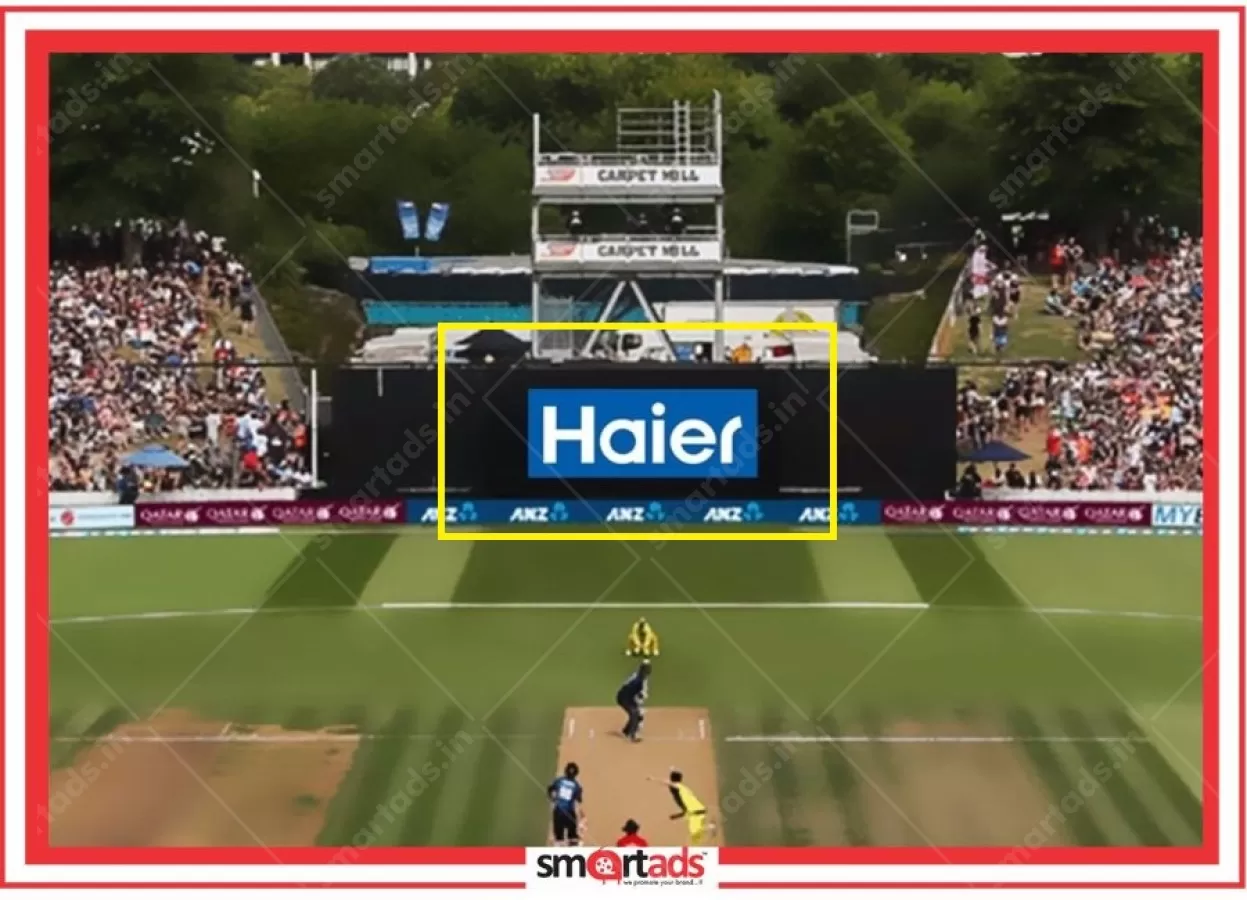
Various Sizes
5 Overs Per ODI Match , 2 Overs Per T20
Rate per Digital Screen / Per match
At Time Only 1 Display Name.
₹1150000.00
MEDIA REACH

MinimumQty :
1
EstimateReachPeople :
70000

Few advertising environments in India deliver the kind of raw, undivided attention that a packed cricket stadium does — and at Rajiv Gandhi International Cricket Stadium in Uppal, that attention comes wrapped in a fervour that is uniquely Hyderabadi. The stadium regularly draws crowds of 50,000-plus for IPL matches, which means a single match-day exposure can outperform a week's worth of digital impressions in terms of genuine, eyes-on-the-brand contact. What surprises most brand managers we speak to is that cricket stadium advertising in Hyderabad remains significantly underutilised by mid-sized regional brands, even as national advertisers have quietly been locking up perimeter boards and LED screens season after season.
There is a particular quality to the attention a cricket fan gives to the stadium environment that no other media format can replicate. When someone sits in the stands at Uppal Stadium for three hours watching a T20 match, they are not scrolling past your ad or muting your pre-roll; they are physically surrounded by your brand, and that brand presence is reinforced every time the camera sweeps across the boundary or the giant screen flashes between overs. We have found, across multiple campaigns planned through SmartAds, that brand recall scores from in-stadium branding consistently outperform equivalent spends on outdoor advertising Hyderabad city campaigns — sometimes by a factor of two or three, depending on the format and placement.
The contextual advertising advantage here is worth dwelling on. Cricket is not just a sport in Hyderabad; it is a cultural touchstone, particularly during the IPL season when the Orange Army — the passionate fan base of Sunrisers Hyderabad — turns every home match into something closer to a festival than a sporting event. A brand that appears within that emotional context benefits from what psychologists call affect transfer, which is the tendency of positive emotions to attach themselves to whatever stimuli are present at the moment. Frankly speaking, this is the mechanism that makes sports advertising hyderabad so disproportionately effective relative to its cost, and it is something that a straightforward billboard on the Outer Ring Road simply cannot manufacture.
On top of that, the reach mathematics are genuinely compelling when you factor in television viewers. Rajiv Gandhi International Cricket Stadium is a BCCI-approved venue for international fixtures, which means matches played here — whether Test match advertising opportunities, ODI advertising Hyderabad, or T20 match branding Hyderabad — are broadcast to national and international audiences running into tens of millions of households. A perimeter board placed at the right angle relative to the broadcast camera positions effectively becomes a television commercial that runs for the entire duration of the match, which is a cost-efficiency argument that is very difficult to dismiss once you have done the CPM arithmetic.
The format landscape at Rajiv Gandhi International Cricket Stadium is considerably more varied than most advertisers assume when they first approach us. The most visible and widely discussed option is the perimeter board — those rectangular panels that ring the boundary rope and appear constantly in broadcast footage — but in-stadium branding at Uppal extends well beyond the playing surface. Ground murals, which are painted or vinyl-applied designs on the outfield itself, offer a format that is essentially invisible to the in-person crowd but extraordinarily prominent on aerial broadcast shots; we have seen ground murals deliver impression values that rival prime-time television spots for certain categories of national advertisers.
LED screens and digital screens represent the format category that has grown most aggressively at the stadium over the past three to four IPL seasons. The giant screen advertising positions — primarily the large scoreboards and the replay screens positioned at either end of the ground — allow for dynamic creative that can be updated between overs, which gives advertisers a flexibility that static perimeter boards cannot offer. A food and beverage brand, for instance, can run a thirst-cue creative during a hot afternoon session and switch to a dinner-occasion message as the evening progresses; this kind of contextual responsiveness is something we actively recommend to clients who have the creative infrastructure to support it.
Beyond the playing arena, stadium hoarding positions exist throughout the Uppal Stadium concourse, at entry gates, in the concourse passages, and — less glamorously but more effectively than most people expect — in washroom and concession areas where dwell time is genuinely high. In-pitch branding, which involves the wicket area and crease markings being adapted for sponsor visibility, is typically reserved for title sponsors and requires specific BCCI clearance, but ground-level boards and boundary rope branding are more accessible to mid-tier advertisers. Jersey branding and title sponsorship with the Sunrisers Hyderabad franchise itself represents a separate, higher-investment category that we will address in its own section; for now, it is worth noting that the media options available across the full stadium environment are rich enough to support campaigns at almost any budget level.
This is the question every brand manager asks first, and it is also the question that most competitor pages dodge entirely — so we will be direct. Advertising rates at Rajiv Gandhi International Cricket Stadium vary significantly depending on the format, the match type, and the duration of the campaign, but we can share the ballpark figures that our campaign planning experience at SmartAds has established as reliable benchmarks. For a standard perimeter board during an IPL home match of Sunrisers Hyderabad, a single board for the duration of one match works out to somewhere in the range of ₹3 lakh to ₹8 lakh, depending on the board's position relative to the broadcast camera angles — with the premium positions, particularly those behind the bowler's arm and at the sightscreen ends, commanding the higher end of that range.
For LED screen and digital screens advertising during IPL season, the rate structure shifts to a per-slot model, with a 10-second slot on the giant screen advertising positions running in the ballpark of ₹50,000 to ₹1.5 lakh per match, which sounds steep until you calculate the effective CPM against the 50,000-plus stadium footfall plus the television viewers simultaneously watching the broadcast. International match advertising — for Test match advertising, ODI advertising Hyderabad, and T20I formats — tends to be priced differently; the per-match cost is often lower than IPL advertising because the commercial intensity around BCCI international fixtures is structured differently, but the broadcast reach for a bilateral series can actually exceed an IPL match if the series involves high-profile touring sides. Ground murals for international fixtures are typically negotiated as part of a broader stadium sponsorship package and can range from ₹10 lakh to ₹40 lakh per series, which is a number that surprises most first-time advertisers when they compare it to what they are paying for equivalent outdoor advertising Hyderabad coverage.
What a lot of people miss is that the booking process for IPL advertising involves two separate commercial relationships: one with the Hyderabad Cricket Association (HCA) for the physical stadium infrastructure, and one with the Sunrisers Hyderabad franchise for any branding that is considered part of the team's commercial inventory. These two channels have different rate cards, different approval timelines, and different creative specifications, which is why working with an advertising agency Hyderabad that has established relationships on both sides of that equation genuinely saves time and money. For below-the-line advertising formats like concourse hoardings and entry gate panels, the HCA rate card is the primary reference point, and these formats tend to be the most cost-effective advertising entry point for brands that are new to stadium branding Hyderabad.
The audience profile at Uppal Stadium is one of the strongest arguments for cricket stadium advertising in Hyderabad that we consistently make to clients who are on the fence. The 55,000 capacity stadium draws a crowd that skews decisively toward the 18-to-45 male demographic — which, in Hyderabad's context, means a significant concentration of IT sector professionals, entrepreneurs, and business owners from the city's booming tech corridor, many of whom have household incomes that place them firmly in the SEC A and SEC B categories. This is not a mass-market crowd in the way that a free outdoor event might be; ticket prices for IPL matches at Rajiv Gandhi International Cricket Stadium range from ₹500 to upwards of ₹5,000 for premium seating, which creates a natural income filter that is genuinely valuable for brands targeting aspirational or premium audiences.
The Telugu-speaking regional audience dimension is something that almost no competitor page addresses, and it is a real strategic advantage for brands with regional ambitions in Telangana and Andhra Pradesh. Sunrisers Hyderabad has built an intensely loyal fan base across both states, and the in-stadium audience on match days includes a significant proportion of fans who have travelled from Warangal, Vijayawada, Nalgonda, and other Telangana and AP cities — which means the audience reach of a single match effectively extends the brand's geographic footprint well beyond Hyderabad city. For a regional brand looking to establish credibility across the Telugu-speaking market, the association with SRH and the Rajiv Gandhi International Cricket Stadium carries a cultural endorsement value that is very difficult to price but very easy to observe in brand recall surveys conducted post-campaign.
The female audience segment, which has grown substantially at IPL matches over the past five seasons according to BARC viewership data trends, is also worth factoring into the planning equation. The Orange Army fan culture is inclusive and family-oriented in a way that earlier cricket crowds were not, and brands in categories like consumer electronics, fashion, food delivery, and financial services have found that the Uppal Stadium audience is considerably more gender-balanced than the aggregate cricket viewership data might suggest. Our experience shows that campaigns planned with this broader audience profile in mind — rather than defaulting to a narrow male sports-fan assumption — consistently achieve better brand recall scores and higher post-campaign purchase intent metrics.
IPL advertising at Uppal Stadium operates through a layered commercial structure that is worth understanding before you begin any campaign planning conversation. At the top of the hierarchy sits the BCCI, which controls the global broadcast rights and the on-ground commercial framework for the IPL as a tournament; below that, the Sunrisers Hyderabad franchise manages its own commercial inventory, which includes jersey branding, title sponsorship, team-associated digital assets, and certain in-stadium branding rights that the franchise controls as part of its franchise agreement. The Hyderabad Cricket Association manages the stadium infrastructure itself, which covers the physical perimeter boards, the concourse advertising, the gate branding, and the non-franchise LED screen positions.
What this means practically is that an advertiser wanting to appear on the SRH team jersey needs to negotiate with the franchise's commercial team, while an advertiser wanting a perimeter board at the Rajiv Gandhi International Cricket Stadium during the same match negotiates with the HCA. These are separate conversations with separate timelines, and the approval process for in-pitch branding or any format that appears within the playing area also requires BCCI sign-off, which adds another layer of lead time to the booking process. We have seen campaigns fall through because brands came to us six weeks before the IPL season expecting to secure premium perimeter board positions that had already been locked up by category-exclusive advertisers four months earlier — which is why we are very direct with clients about the importance of early engagement.
The IPL season typically runs from late March through May, and our recommendation at SmartAds is to begin the campaign planning conversation no later than December of the preceding year for any format that involves the franchise's commercial inventory, and no later than January for HCA-controlled stadium positions. The match-day advertising environment during IPL season is genuinely different from international fixtures in terms of commercial intensity; the broadcast production values are higher, the camera coverage is more extensive, and the social media amplification of in-stadium moments is dramatically greater, which means the effective impression value of a perimeter board during an IPL match is significantly higher than the same board during a bilateral ODI series, even if the in-person stadium footfall numbers are similar.
This is the comparison that generates the most debate in our campaign planning sessions, and the honest answer is that the right choice depends entirely on what the brand is trying to achieve. Perimeter boards — specifically the ground-level boards that ring the boundary rope — are the format that delivers the highest television viewer impression value per rupee spent, because they appear in virtually every broadcast frame during live play and are essentially unavoidable for anyone watching the match on television. The static nature of perimeter boards is actually an advantage in this context, because a consistent visual presence across three-plus hours of broadcast creates a depth of brand recall that a rotating digital slot cannot match; the brand name becomes associated with the match itself in the viewer's memory, which is a form of contextual advertising that is deeply undervalued in most ROI calculations.
LED screens and digital screens, on the other hand, deliver something that perimeter boards cannot: creative dynamism and audience targeting within the stadium environment. A brand running on the giant screen advertising positions can deploy multiple creative executions across a single match, respond to match situations in real time, and drive specific calls to action — a QR code, a promotional offer, a product launch announcement — in a way that a static board simply cannot support. We worked with a consumer electronics brand that launched a new product at an SRH home match using a combination of giant screen advertising and a brand activation counter in the concourse; the campaign generated a measurable spike in the brand's Hyderabad city search volume in the 48 hours following the match, which is a direct attribution outcome that would have been impossible to achieve with perimeter boards alone.
To be fair, the most effective campaigns we have planned for cricket stadium advertising in Hyderabad use both formats in a complementary way — perimeter boards for sustained television viewer brand recall, and digital screens for in-stadium fan engagement and conversion-oriented messaging. The budget split we typically recommend is roughly 60% toward perimeter board positions and 40% toward digital screens and activation, though this shifts depending on whether the brand's primary objective is awareness or engagement. Stadium hoarding in the concourse and entry gate positions adds a third layer that is often overlooked, but which delivers genuine value for brands that want to intercept fans during the pre-match and interval periods when dwell time is high and attention is relatively unstructured.
The booking process for cricket stadium advertising in Hyderabad involves more steps than most outdoor advertising Hyderabad campaigns, and understanding the sequence matters if you want to avoid the common mistakes we see brands make. The first step is identifying which commercial channel controls the format you want: HCA for stadium infrastructure advertising, the SRH franchise for team-associated inventory, or BCCI for any format that falls within the playing area or the broadcast-controlled environment. Each of these bodies has its own commercial team, its own rate card, and its own approval timeline, and the documentation requirements differ significantly between them.
For HCA-controlled formats — which include most of the perimeter boards, concourse hoardings, entry gate branding, and the non-franchise digital screens — the booking process typically involves submitting a formal proposal that includes the brand category, the creative specifications, and the campaign duration, followed by a category exclusivity check to ensure that the brand does not conflict with existing category-exclusive sponsors. This exclusivity check is something that catches first-time advertisers off guard; if a competing brand in your category has already secured category exclusivity for the IPL season, your booking will be declined regardless of budget, which is another reason why early engagement with the booking process is not optional but essential. For BCCI-governed formats like in-pitch branding and certain broadcast-adjacent positions, the approval process additionally involves submitting creative for review against BCCI's commercial guidelines, which have specific restrictions on certain product categories.
At SmartAds, we manage this multi-channel booking process on behalf of our clients, which means we handle the HCA liaison, the franchise commercial conversation, and the BCCI documentation simultaneously rather than sequentially — which typically reduces the total booking lead time by three to four weeks compared to a brand attempting to navigate the process independently. Our media planning Hyderabad team also conducts a pre-booking audit of available positions and category exclusivity status, which prevents the situation where a client invests time in campaign planning only to discover that their category is locked out. The practical advice we give every client approaching stadium branding Hyderabad for the first time: treat the booking process like a real estate transaction, not a media buy — the best positions are finite, they go to whoever moves first, and the price does not come down by waiting.
Below-the-line advertising at cricket stadiums occupies a genuinely interesting position in the media mix because it combines the mass reach of traditional broadcast media with the experiential intimacy of BTL advertising. The captive audience dynamic is the foundation of everything: a fan who has paid for a ticket, travelled to Uppal Hyderabad, and settled into their seat for a three-hour match is not going anywhere, and they are not multitasking in the way that digital audiences invariably are. This is the core advantage of non-traditional advertising in stadium environments — the audience is physically present, emotionally engaged, and surrounded by your brand in a way that no other format can manufacture.
Brand activation opportunities within the stadium extend the BTL advertising proposition considerably beyond passive brand visibility. Sampling counters in the concourse, interactive kiosks near the entry gates, fan zone activations in the outer stadium areas, and sponsored fan experiences tied to match moments — all of these represent brand activation formats that create genuine human interactions between the brand and the consumer, which is the gold standard of below-the-line advertising. We ran a brand activation campaign for a regional food brand at an SRH home match that involved a product sampling station and a social media photo opportunity; the activation reached roughly 8,000 fans directly during the match, generated over 400 organic social media posts with the brand's hashtag, and produced a measurable increase in the brand's retail offtake in Hyderabad stores in the following fortnight — which is the kind of attribution story that justifies the investment to even the most sceptical CFO.
The 360-degree campaign potential of cricket stadium advertising in Hyderabad is something that we actively encourage clients to think about rather than treating the stadium as an isolated media channel. A brand that combines in-stadium perimeter boards with outdoor advertising Hyderabad city placements around the Uppal area — on the roads leading to the stadium, at the metro station, and along the key fan travel corridors — creates a brand environment that surrounds the fan from the moment they leave home to the moment they return, which multiplies the brand recall effect significantly. This kind of integrated sports advertising Hyderabad planning, which connects the stadium environment to the broader city media landscape, is where the real value lies for brands that are willing to think beyond the single-format buy.
The answer is yes, and the scale of that secondary reach is what makes the CPM economics of cricket stadium advertising in Hyderabad so compelling when calculated correctly. During an IPL match at Rajiv Gandhi International Cricket Stadium, the Star Sports broadcast reaches a national audience of tens of millions of television viewers simultaneously; perimeter boards positioned at the broadcast camera angles appear in virtually every ball-by-ball shot, which means the effective reach of a single perimeter board across a three-hour match is not 55,000 in-stadium fans but potentially several million television viewers. The CPM for that television viewer reach, when calculated against the cost of the perimeter board, works out to a number that is genuinely competitive with mid-tier television advertising — which is a calculation that most brands have never done because they think of stadium advertising purely as an on-ground medium.
The digital amplification layer has grown substantially over the past three IPL seasons, driven by the explosion of social media cricket content. Every boundary, every wicket, and every dramatic moment at Uppal Stadium generates dozens of social media clips, highlights reels, and fan videos that circulate across Instagram, YouTube, and X — and in all of these clips, the perimeter boards and in-stadium branding are visible in the background. TAM AdEx data has consistently shown that the earned media value of in-stadium brand appearances in social media cricket content is a meaningful multiplier on the paid media investment, though the exact multiplier varies by brand category and creative execution. A brand with a visually distinctive colour scheme or logo will naturally extract more value from this earned media effect than a brand with a generic visual identity.
What a lot of people miss is that the digital screens and giant screen advertising positions at Rajiv Gandhi International Cricket Stadium are increasingly being integrated into the broadcast production itself, with certain screen positions being shot deliberately by broadcast cameras during strategic moments — which means digital screen advertising can now deliver television viewer impressions in addition to in-stadium fan impressions, blurring the line between BTL advertising and broadcast media in a way that is genuinely new and genuinely valuable. The FICCI-EY Media Report has noted the growing convergence of live sports, broadcast, and digital media as one of the defining trends in Indian sports marketing, and cricket stadium advertising in Hyderabad sits right at the intersection of all three.
The Sunrisers Hyderabad franchise represents a co-branding opportunity that is particularly underexplored by Telangana and Andhra Pradesh-based regional brands, which tend to assume that SRH commercial partnerships are exclusively the domain of national advertisers with crore-level budgets. The reality is more nuanced. While title sponsorship of the SRH team is indeed a high-investment proposition — the kind of deal that requires a sustained commitment across multiple IPL seasons — the franchise also offers a range of smaller association formats that are accessible to regional brands with more modest budgets, including associate sponsorship, digital content partnerships, and fan zone co-branding at the stadium.
The Orange Army fan base is one of the most geographically concentrated and culturally cohesive fan communities in the IPL, which makes Sunrisers Hyderabad an unusually precise vehicle for reaching the Telugu-speaking consumer. A regional brand that establishes even a modest association with SRH — through concourse branding at Rajiv Gandhi International Cricket Stadium, a co-branded social media series, or a fan zone activation — benefits from the franchise's brand equity in a market where that equity is genuinely substantial. We have observed that regional brands which activate around SRH home matches, even without formal franchise partnerships, achieve significantly higher brand recall among the Orange Army fan base than equivalent spends on conventional outdoor advertising Hyderabad placements, simply because the contextual advertising alignment is so strong.
Jersey branding and official team partnerships require formal negotiation with the SRH franchise's commercial team, and the process involves category exclusivity checks similar to those conducted by the HCA for stadium positions. The minimum investment for associate jersey branding is typically in the range of ₹50 lakh to ₹1 crore for a full IPL season, which puts it beyond the reach of most SMEs but within the planning horizon of established regional brands with meaningful marketing budgets. For brands at that investment level, the combination of jersey visibility across all broadcast matches, in-stadium perimeter board presence at Uppal Stadium, and digital content integration with the SRH social media channels creates a genuinely powerful sports marketing platform that reaches the Telugu-speaking consumer across every screen and every touchpoint simultaneously.
Q: What is the cost of advertising at the cricket stadium in Hyderabad?
The advertising rates at Rajiv Gandhi International Cricket Stadium vary considerably depending on the format, the match type, and the specific position within the stadium. For perimeter boards during IPL season, the cost per board per match works out to somewhere between ₹3 lakh and ₹8 lakh for standard positions, with premium broadcast-facing positions commanding the higher end of that range. Digital screen slots during IPL matches are typically priced on a per-slot basis, with a 10-second slot running in the ballpark of ₹50,000 to ₹1.5 lakh per match. Concourse hoardings and entry gate branding, which are the most cost-effective advertising entry points, are priced significantly lower — typically in the range of ₹50,000 to ₹2 lakh per match depending on size and position. For international fixtures like ODI advertising Hyderabad or Test match advertising, the per-match rates are often lower than IPL advertising, though the series-level investment can be comparable depending on the number of matches involved. We recommend reaching out to SmartAds for a customised rate card based on your specific campaign objectives and budget.
Q: Which ad formats are available for in-stadium branding at Rajiv Gandhi International Cricket Stadium?
The full range of in-stadium branding formats at Rajiv Gandhi International Cricket Stadium includes perimeter boards along the boundary rope, ground-level boards at the outfield edges, ground murals applied to the playing surface, LED screens and digital screens at the scoreboards and replay positions, giant screen advertising slots, stadium hoarding in the concourse and passageways, entry gate branding panels, in-pitch branding near the wicket area (subject to BCCI approval), washroom and concession area advertising, and fan zone branding in the outer stadium areas. Jersey branding and title sponsorship with the Sunrisers Hyderabad franchise represent a separate category of formats that are negotiated directly with the SRH commercial team rather than the Hyderabad Cricket Association. Each format has different creative specifications, different booking lead times, and different approval requirements, which is why working with an experienced advertising agency Hyderabad is genuinely valuable in navigating the options.
Q: How do I book cricket stadium advertising in Hyderabad?
The booking process involves identifying which commercial authority controls your preferred format — the HCA for stadium infrastructure advertising, the SRH franchise for team-associated inventory, or BCCI for playing-area formats — and then initiating a formal proposal that includes your brand category, creative specifications, and campaign duration. A category exclusivity check is conducted before any booking is confirmed, which means brands in categories already locked by existing sponsors may find certain formats unavailable. The practical recommendation is to begin the booking process at least four to five months before the IPL season for premium formats, and at least two to three months in advance for international fixture advertising. SmartAds manages this multi-channel booking process on behalf of clients, handling HCA, franchise, and BCCI liaisons simultaneously to reduce lead times and avoid category conflicts.
Q: What is the audience reach of Uppal Stadium during an IPL match?
The in-stadium audience at Uppal Stadium during an IPL match is typically in the range of 50,000 to 55,000 fans — the 55,000 capacity stadium is regularly sold out for SRH home matches during the IPL season. Beyond the in-stadium footfall, the broadcast reach on Star Sports extends to a national and international audience of tens of millions of television viewers per match, and the digital reach through official IPL streaming platforms and social media amplification adds a further substantial layer of impressions. The effective total reach of a single perimeter board across one IPL match, when television viewers and digital impressions are factored in alongside stadium footfall, is genuinely in the multi-million range — which fundamentally changes the CPM calculation for brands that are used to thinking of cricket stadium advertising as a purely on-ground medium.
Q: Does cricket stadium advertising in Hyderabad also reach TV viewers?
Yes, and this is one of the most underappreciated aspects of in-stadium branding at Rajiv Gandhi International Cricket Stadium. Perimeter boards positioned at the broadcast camera angles — particularly those behind the bowler's arm and at the sightscreen ends — appear in virtually every ball-by-ball broadcast frame, which means they are visible to every television viewer watching the match on Star Sports or streaming on JioCinema. The broadcast production for IPL matches is particularly camera-rich, with multiple angles ensuring that perimeter board positions receive comprehensive coverage throughout the match. Ground murals are specifically designed for aerial broadcast visibility and deliver impression values that are almost entirely driven by television viewer reach rather than in-stadium footfall. The convergence of in-stadium, broadcast, and digital reach is what makes cricket stadium advertising in Hyderabad one of the most genuinely multi-channel media options available in the Indian market.
Q: What is the minimum budget required to advertise at Hyderabad's cricket stadium?
The minimum entry point for cricket stadium advertising in Hyderabad depends on the format chosen. Concourse hoardings and entry gate branding panels represent the most accessible formats, with investments possible from roughly ₹50,000 per match for smaller positions — which puts stadium branding Hyderabad within reach of established SMEs and regional brands, not just national advertisers. For perimeter board positions, the minimum realistic investment for a single match is in the range of ₹3 lakh to ₹4 lakh for non-premium positions. A meaningful campaign that combines concourse branding with one or two perimeter boards across a block of three to four IPL home matches can be planned for a total investment in the range of ₹15 lakh to ₹30 lakh, which is the budget range where we see the best balance between visibility and cost-effectiveness for mid-sized brands. Below-the-line advertising formats like fan zone activations and sampling counters can be planned independently of the stadium's formal rate card and are often the most cost-effective advertising option for brands prioritising direct consumer engagement over broadcast visibility.
Q: How is the advertising rate different for IPL matches vs. international matches in Hyderabad?
IPL advertising rates at Rajiv Gandhi International Cricket Stadium are consistently higher than rates for international fixtures, driven by the commercial intensity of the IPL broadcast ecosystem, the higher television viewer engagement metrics during IPL matches, and the significantly greater social media amplification that IPL matches generate compared to bilateral series. The premium for IPL advertising over equivalent international match advertising is typically in the range of 40% to 80% depending on the format, with broadcast-facing perimeter boards commanding the largest premium. However, international fixtures — particularly high-profile bilateral series involving England, Australia, or South Africa — offer a broadcast reach that can rival or exceed IPL matches for certain audience segments, and the lower commercial clutter during international matches means that individual brand presences are less competed for and potentially more memorable. For brands targeting a more premium, cricket-purist audience, Test match advertising and ODI advertising Hyderabad can actually deliver better brand recall per rupee than the commercially saturated IPL environment.
Q: Can small and medium businesses afford cricket stadium advertising in Hyderabad?
The honest answer is: it depends on the format and the match type. For SMEs with marketing budgets in the range of ₹5 lakh to ₹20 lakh, cricket stadium advertising in Hyderabad is accessible through concourse hoardings, entry gate branding, and fan zone activations, which do not require the same level of investment as perimeter boards or digital screen slots. International fixture advertising, which is priced lower than IPL advertising, is a more accessible entry point for SMEs that want the brand association with Rajiv Gandhi International Cricket Stadium without the IPL season price premium. What we tell SME clients is that a well-placed concourse hoarding at Uppal Stadium, combined with outdoor advertising Hyderabad placements on the key fan travel routes around the stadium, can create a genuinely impactful local brand presence for a total investment that is competitive with a month's worth of mid-tier digital advertising — and the brand recall outcomes are typically superior.
Q: What permissions are required from HCA or BCCI to advertise inside Rajiv Gandhi Stadium?
The permissions required depend on the format. For HCA-controlled formats — concourse hoardings, entry gate branding, and most perimeter board positions — the approval process is managed through the Hyderabad Cricket Association's commercial department, which conducts a category exclusivity check and reviews the creative against the HCA's advertising guidelines. For formats within the playing area, including in-pitch branding, ground murals, and boundary rope branding, additional BCCI approval is required, and the creative must comply with BCCI's commercial guidelines, which include restrictions on certain product categories including alcohol, tobacco, and certain financial products. For SRH franchise-associated inventory, the approval process runs through the franchise's commercial team independently of the HCA. The documentation requirements for BCCI-governed formats include brand category declarations, creative artwork in specific formats, and a signed commercial agreement that includes BCCI's standard indemnity clauses — which is why having an experienced advertising agency Hyderabad manage the process is genuinely time-saving.
Q: Is perimeter board advertising or LED screen advertising better for brand recall at Uppal Stadium?
Both formats deliver strong brand recall, but through different mechanisms and for different brand objectives. Perimeter boards deliver superior brand recall among television viewers because of their sustained, unavoidable presence across the broadcast duration; research on sports advertising consistently shows that static, high-frequency brand exposures in broadcast contexts produce stronger unaided brand recall than rotating digital formats. LED screens and digital screens, on the other hand, deliver stronger in-stadium fan engagement and are significantly more effective for driving specific consumer actions — promotional offers, product launches, QR code interactions — because of their dynamic creative capability. Our recommendation for most brands is a combination of both: perimeter boards for the broadcast-driven brand recall objective, and digital screens for the in-stadium fan engagement objective. The budget split between the two should be guided by the brand's primary campaign objective, with awareness-focused campaigns weighting toward perimeter boards and conversion-focused campaigns weighting toward digital screens and brand activation.
Q: How early should I book cricket stadium advertising in Hyderabad for IPL season?
For premium perimeter board positions and franchise-associated inventory, the booking conversation should begin no later than December of the year preceding the IPL season — which typically means December to January for a March-May IPL. Category-exclusive positions are often locked by repeat advertisers well before the official booking window opens, and waiting until February or March to initiate the booking process for IPL advertising at Rajiv Gandhi International Cricket Stadium is a reliable way to find that the best positions are already gone. For HCA-controlled formats like concourse hoardings and entry gate branding, the booking window is somewhat more flexible, but we still recommend initiating the process by January to ensure adequate time for creative approvals and installation logistics. For international fixtures, the booking timeline is typically shorter — two to three months in advance is usually sufficient — but the same principle of early engagement applies, particularly for broadcast-facing perimeter board positions that are limited in number.
Q: What are the brand activation and fan engagement options available at Rajiv Gandhi Cricket Stadium?
Brand activation options at Rajiv Gandhi International Cricket Stadium extend well beyond passive branding into genuine fan engagement territory. Sampling counters and product demonstration stations can be set up in the concourse areas, giving brands direct physical access to
