
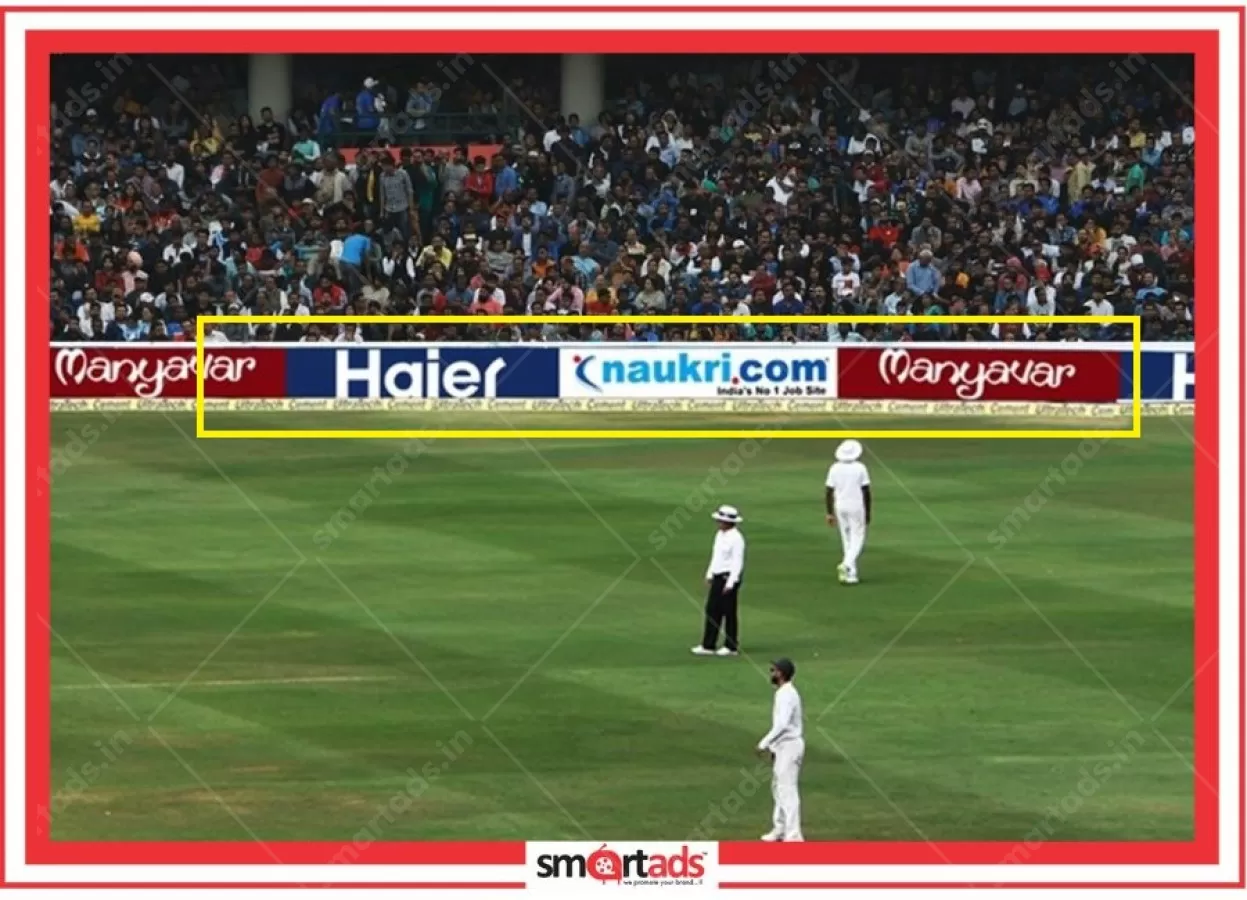
Silver HD Perimeter Signage
Various Sizes
1 ball in every 10 Balls : 50% of the Gr
Rate per Digital Screen / Per Match
At Time Only 3 Display Name.
₹1100000.00
Showing 1 to 4 of 4 Results
MEDIA DETAILS
Various Sizes
1 ball in every 10 Balls : 50% of the Gr
Rate per Digital Screen / Per Match
At Time Only 3 Display Name.
₹1100000.00
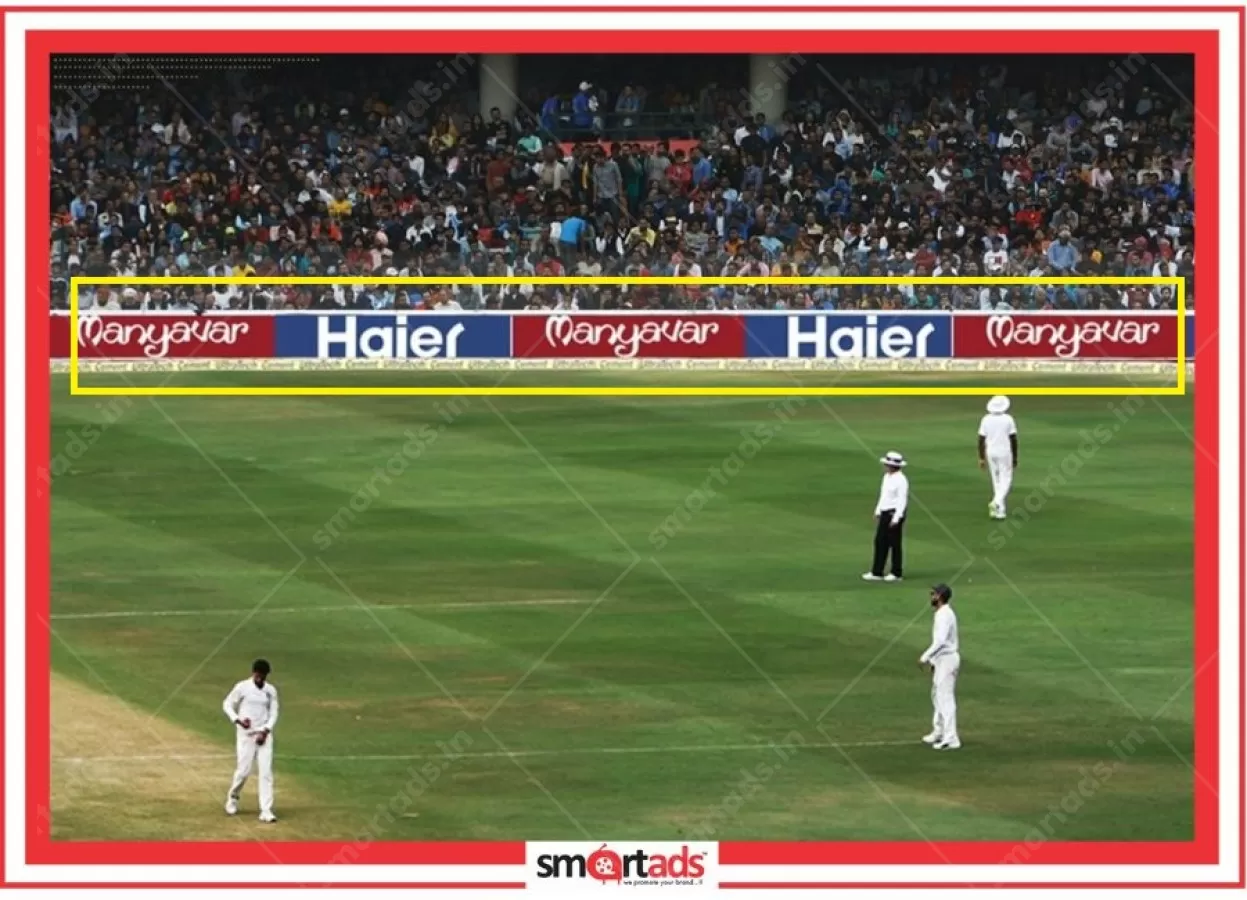
Various Sizes
1 Ball In Every 10 Balls : 50% Of The Gr
Rate per Digital Screen / Per Match
At Time Only 2 Display Name.
₹1700000.00
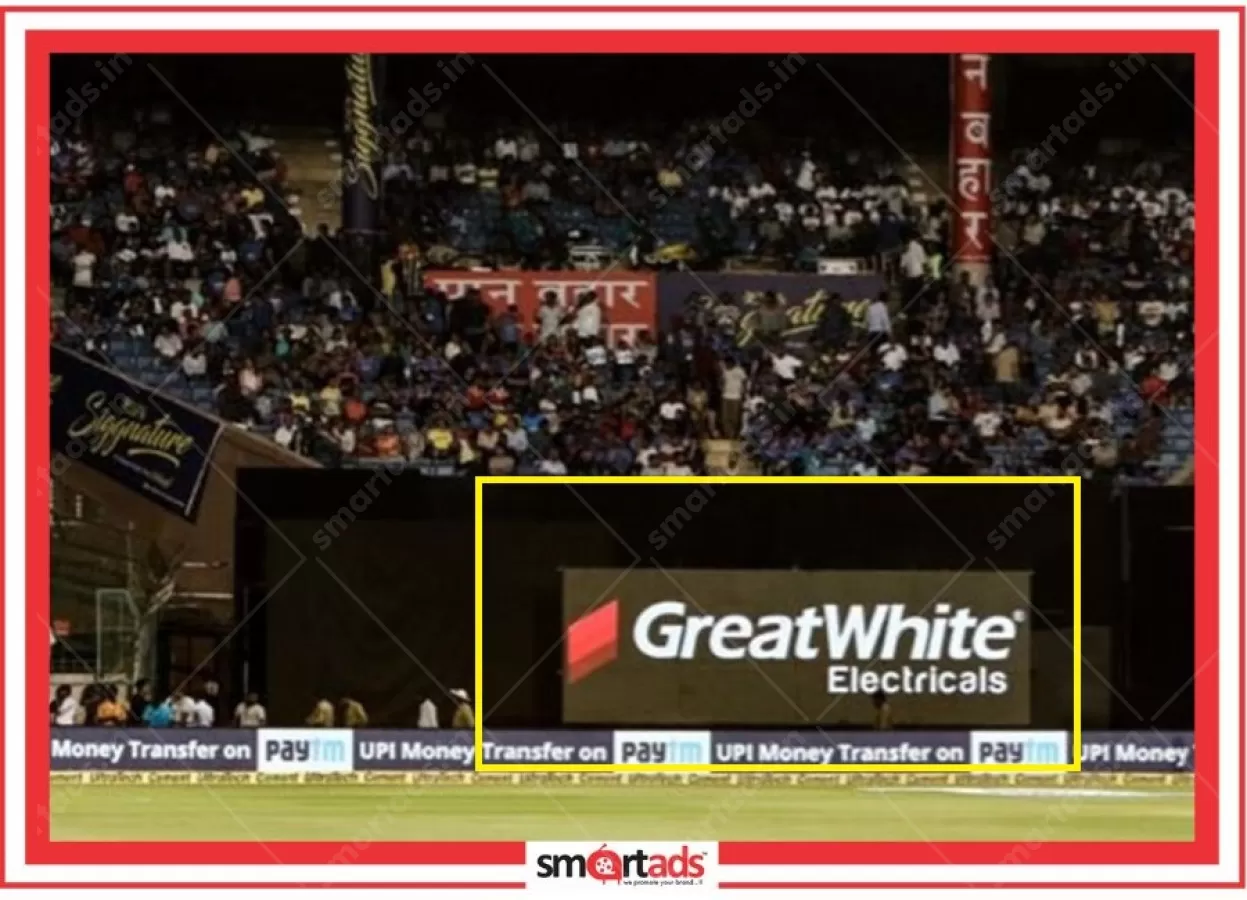
Various Sizes
5 Overs Per ODI Match , 2 Overs Per T20
Rate per Digital Screen / Per Match
At Time Only 1 Display Name.
₹1150000.00
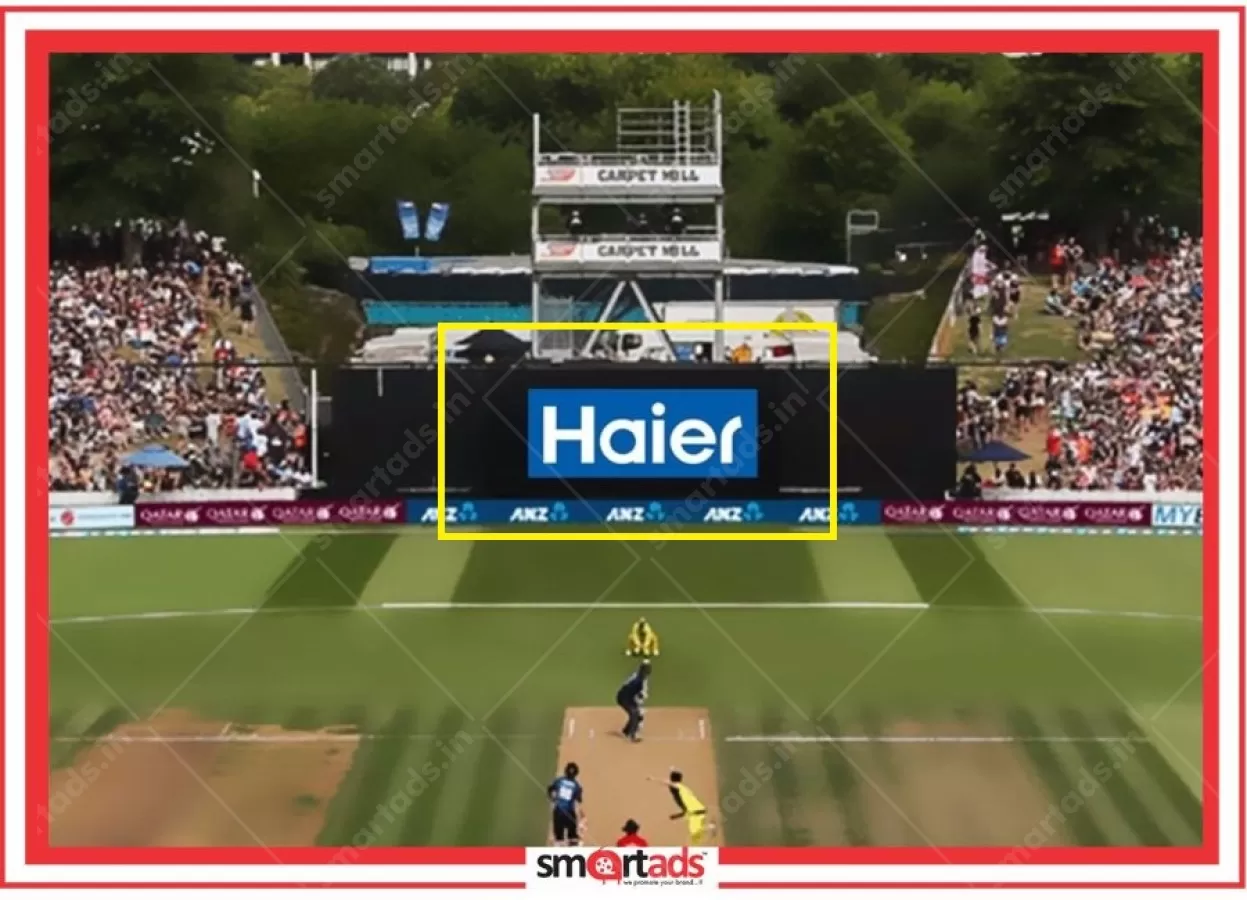
Various Sizes
5 Overs Per ODI Match , 2 Overs Per T20
Rate per Digital Screen / Per Match
At Time Only 1 Display Name.
₹1150000.00
MEDIA REACH

MinimumQty :
1
EstimateReachPeople :
1000000

Few advertising environments in the world match the raw intensity of a packed Indian cricket stadium — 80,000 people, unified attention, and a broadcast feed reaching hundreds of millions more. What surprises most brand managers we speak to is that this medium, which sits firmly in the below-the-line advertising category, often delivers broadcast-level visibility at a fraction of what a television spot costs during a marquee match.
The FICCI-EY Media & Entertainment Report has consistently flagged sports sponsorship as one of the fastest-growing segments within Indian advertising, and cricket — which commands somewhere between 85 and 90 percent of all sports media consumption in the country — sits at the absolute centre of that growth. Yet a large number of brands still treat cricket stadium advertising as an afterthought, something bolted onto a TV buy rather than a standalone strategic channel.
Most people, when they first hear the term, picture the rotating LED boards around the boundary. That is accurate, but it is only one piece of a much larger ecosystem. Cricket stadium advertising in India refers to the full range of brand placement opportunities within a cricket ground — from the physical perimeter to the pitch surface, the sight screens, the dressing room tunnels, the fan zones, the stadium naming rights, and the player uniforms — all of which constitute what the industry calls in-stadium branding.
The classification of this medium as BTL advertising, or below-the-line advertising, is important to understand because it shapes how budgets are allocated and how ROI is measured. Unlike ATL advertising, which broadcasts a message to an undifferentiated mass audience, BTL advertising is designed to engage a specific, physically present audience in a controlled environment; cricket stadiums offer precisely this — a captive audience advertising scenario where every person in the stands has chosen to be there, is emotionally invested in the event, and is therefore far more receptive to brand messaging than someone passively watching television. At SmartAds, we always tell our clients that the attention quality inside a stadium is fundamentally different from any other medium, because the audience is not trying to skip the ad or walk away from it.
The mechanics of how cricket ground advertising works involve multiple stakeholders. The BCCI controls rights for international matches and IPL, while state cricket associations — affiliated to BCCI — manage domestic fixtures like the Ranji Trophy, the Syed Mushtaq Ali Trophy, and the Duleep Trophy. Brands must secure permissions either through official BCCI sponsorship channels for top-tier properties, or through authorised media vendors who hold inventory rights for specific stadiums and series. This approval and compliance layer is something many first-time advertisers underestimate, and getting it wrong can result in last-minute rejections or creative specifications being refused on match day.
The perimeter board is the workhorse of cricket ground advertising, and the shift from static vinyl boards to LED boundary boards over the past decade has been one of the most significant changes in how stadium advertising india functions. Static boundary boards, which were once the only option available, offered fixed messaging for the duration of a match or series; LED perimeter boards, by contrast, can rotate multiple brand messages every few seconds, which means a single board position can be sold to several advertisers simultaneously, and each advertiser's message appears multiple times per over.
The broadcast visibility advantage of LED boundary boards is substantial. A well-positioned LED perimeter board at a venue like the Narendra Modi Stadium or Wankhede Stadium will appear in the broadcast frame dozens of times per session, which effectively converts a BTL placement into what the industry calls non-FCT advertising — brand exposure delivered through the broadcast feed without purchasing a television spot. Our experience at SmartAds shows that during a T20 match, a brand running on LED boundary boards at a major venue can accumulate somewhere in the ballpark of 200 to 350 broadcast exposures across a single innings, depending on camera angles and the specific board position.
The cost differential between static boards and LED boundary boards is real but often misunderstood. Static perimeter boards at domestic match venues can be booked for roughly ₹50,000 to ₹2 lakh per match depending on the venue and the series; LED boundary boards at the same venues command a premium of anywhere between 40 and 80 percent over static rates, which most brands find entirely justified once they understand the broadcast pickup rate. For IPL stadium branding, the numbers are in a completely different bracket, which we will address separately.
Pitch mat branding is one of the most underrated formats in the entire cricket stadium advertising toolkit, and frankly speaking, it is one of the first things we recommend to clients who want guaranteed broadcast visibility without the budget commitment of a full perimeter board package. The pitch mat — the covering placed over the pitch during drinks breaks, strategic time-outs, and innings changeovers — sits directly in the centre of the ground, which means every wide-angle broadcast shot during a break will feature it prominently.
The exposure window for pitch mat branding is concentrated but intense; during a T20 match, a brand on the pitch mat will receive several minutes of uninterrupted broadcast airtime during breaks, which is time when commentators are actively filling the silence and cameras are holding wide shots of the ground. One FMCG client we worked with in Bengaluru used pitch mat branding across a domestic T20 series at M. Chinnaswamy Stadium and reported that their brand logo appeared in broadcast frames for an average of four to six minutes per match — a figure that, when converted to equivalent television spot cost, made the pitch mat investment look extremely efficient.
Creative specifications for pitch mat branding are strict and worth understanding before you finalise your artwork. The mat dimensions vary by venue, but the standard format requires a high-resolution print that remains legible from both the broadcast camera positions and the upper-tier stands; most venues require artwork at a minimum of 150 DPI at actual size, and the colour reproduction must account for the fact that the mat will be viewed under floodlights, which can shift warm tones significantly.
The large digital screens positioned at both ends of the ground — commonly called sight screens — represent one of the most visible and flexible formats in stadium branding. Sight screen advertising in Indian cricket stadiums has evolved considerably; modern venues like the Narendra Modi Stadium and the Rajiv Gandhi International Cricket Stadium in Hyderabad now run full-colour LED sight screens which can display animated content, video, and dynamic brand messaging between deliveries and during breaks.
Digital screens within the stadium bowl — the scoreboards, the replay screens, and the in-stadium entertainment screens — offer a different kind of visibility from the sight screens; they command the attention of the in-stadium audience specifically, which makes them particularly valuable for brands running concurrent fan zone activation or experiential marketing cricket campaigns where the goal is to drive on-ground engagement rather than broadcast pickup. At SmartAds, we have found that combining sight screen advertising with a fan zone activation creates a reinforcement loop — the screen drives awareness, and the activation converts that awareness into a direct brand interaction.
This is the question we get asked most often, and it is also the question that has the most unsatisfying answer until you understand the variables involved. Cricket stadium advertising rates in India span an enormous range — from a few lakh rupees for a single domestic match at a Tier II venue to several crore for a full IPL season package at a marquee stadium — and the advertising cost per match depends on the format, the venue, the series, and the broadcast profile of the match.
For domestic cricket match advertising — Ranji Trophy, Syed Mushtaq Ali Trophy, or Duleep Trophy fixtures — static perimeter boards at a venue like the Arun Jaitley Stadium in Delhi or Eden Gardens in Kolkata can be secured for somewhere between ₹75,000 and ₹3 lakh per match, which is a number that surprises most first-time advertisers when they compare it to what they are paying for a single full-page newspaper ad in a national daily. LED boundary boards at the same venues for domestic fixtures typically work out to roughly ₹1.5 lakh to ₹5 lakh per match, depending on the number of board positions and the broadcast status of the match.
For IPL advertising — which is where the real premium sits — the cricket stadium advertising rates are structured very differently. A single LED perimeter board position for one IPL match at a venue like the Wankhede Stadium or Eden Gardens works out to somewhere in the ballpark of ₹8 lakh to ₹25 lakh depending on the board position and the match's broadcast profile; high-visibility positions directly behind the batting crease command the highest premiums because they appear in virtually every delivery shot. Full-season IPL stadium branding packages at major venues, which include multiple board positions across all home matches, are typically negotiated at the crore-plus level. The CPM for LED boundary board advertising during an IPL match — when you factor in the broadcast audience — works out to roughly ₹8 to ₹15 per thousand impressions, which is a number that surprises most first-time advertisers when they compare it to what they are paying for Instagram reach or programmatic display.
The gap between IPL stadium advertising and domestic match advertising is not just a question of price — it is a question of audience scale, broadcast reach, and the commercial ecosystem surrounding the event. An IPL match at the Narendra Modi Stadium draws a live audience of 80,000 to 1,00,000 people, with a television viewership cricket india figure that can exceed 3 to 4 crore viewers for a marquee fixture; a domestic Ranji Trophy match at the same venue might draw a few thousand spectators, with limited or no broadcast coverage.
What a lot of people miss is that this difference in scale does not automatically make domestic cricket match advertising a poor choice — it makes it a different choice. For brands with regional or city-level targeting objectives, domestic match advertising offers a highly targeted demographic cricket audience at a cost that is genuinely accessible for mid-size and smaller advertisers. A regional bank, a local real estate developer, or a state-level FMCG brand can build meaningful brand visibility within a specific city by running in-stadium branding across a domestic T20 series at their home venue, reaching a cricket fan engagement audience that is both locally relevant and highly engaged.
The IPL advertising ecosystem is also more complex from a rights perspective; BCCI sponsorship structures for IPL involve multiple tiers — official IPL sponsors, team sponsors, and venue-level inventory — and navigating these tiers requires an understanding of what rights are available at each level and what exclusivity restrictions apply. Frankly speaking, this is where working with an experienced cricket advertising agency india becomes genuinely important, because the rights landscape changes every season and what was available last year may be restricted this year due to category exclusivity agreements.
The brand recall data from cricket stadium advertising consistently outperforms what most media planners expect. The CrispInsights & Kadence eDART-IPL24 report, which tracked aided and unaided brand recall among IPL viewers and stadium attendees, found that in-stadium brands achieved significantly higher unaided recall scores compared to brands that only ran television spots during the same broadcast — a finding that aligns with what we have observed in our own campaign tracking at SmartAds.
The reason for this is rooted in the psychology of the captive audience advertising environment. A person watching cricket on television is simultaneously managing their phone, their family, and their attention; a person in the stadium is physically present, emotionally invested, and looking at the ground for three to four hours continuously. This sustained, high-attention exposure is what drives the GRP brand recall advantage of in-stadium branding — the impressions are not just more numerous, they are more deeply encoded. One automotive brand we worked with ran a combination of LED boundary boards and pitch mat branding across six IPL matches at a major metro stadium; their post-campaign brand tracking showed a 23 percent lift in unaided recall among stadium attendees compared to a matched control group who had only seen the TV broadcast.
The ROI cricket advertising calculation also needs to account for the broadcast visibility multiplier, which is the value of the non-FCT impressions generated when in-stadium branding appears in the broadcast feed. Nielsen Sports research on cricket sponsorship ROI has consistently shown that well-positioned stadium branding generates broadcast exposure equivalent to several times the cost of the in-stadium placement itself; when this broadcast visibility is factored in, the effective CPM of cricket stadium advertising in india often compares favourably with direct television buys, particularly for brands that cannot afford the premium rates of IPL broadcast spots.
The classification of cricket ground advertising as non-traditional advertising or BTL advertising is worth examining carefully because it affects how media plans are structured and how budgets are approved internally. ATL advertising — television, radio, print, cinema — is characterised by mass, undifferentiated reach delivered through broadcast channels; BTL advertising, by contrast, is defined by its direct, targeted, and environment-specific nature, which is precisely what stadium advertising india delivers.
The non-traditional advertising label also reflects the fact that cricket stadium advertising does not fit neatly into the standard media planning frameworks that most brand managers use. It is not a GRP-based buy in the traditional sense; it is not a print circulation buy; it is a physical presence buy that generates both live audience impressions and broadcast visibility simultaneously. This dual nature is what makes it genuinely distinctive as a medium — and it is also what makes it difficult to evaluate using standard media metrics, which is why many brands underinvest in it despite its demonstrable effectiveness.
At SmartAds, our media planning team always positions cricket stadium advertising as a complement to, rather than a replacement for, ATL spends. The most effective campaigns we have run have combined in-stadium branding with a television presence during the same match broadcast, creating a reinforcement effect where viewers see the brand both in the ad break and on the ground — a combination that the FICCI-EY Media Report has identified as one of the highest-impact configurations in sports marketing. This is where the real value lies: not in choosing between ATL and BTL, but in understanding how they amplify each other.
The answer depends entirely on what you are trying to achieve, and we have seen brands make expensive mistakes by choosing venues based on prestige rather than strategic fit. That said, certain venues consistently deliver the highest combination of live audience scale, broadcast visibility, and demographic quality, which makes them the default choice for national brands with significant sports sponsorship india budgets.
The Narendra Modi Stadium in Ahmedabad — with a capacity of over 1,30,000 — is the single largest cricket venue in the world, and cricket stadium advertising ahmedabad at this venue during an IPL match or an international fixture delivers live audience numbers that no other venue can match. Cricket stadium advertising mumbai at the Wankhede Stadium offers a different kind of value: a smaller capacity of around 33,000 but an audience demographic that skews significantly towards high-income urban consumers, which makes it particularly attractive for premium brand categories. Eden Gardens in Kolkata — one of the most storied venues in world cricket — delivers cricket stadium advertising kolkata opportunities with an audience that is among the most passionate and loyal in the country, which translates into higher emotional engagement with brands present at the ground.
Cricket stadium advertising bangalore at M. Chinnaswamy Stadium, cricket stadium advertising hyderabad at the Rajiv Gandhi International Cricket Stadium, cricket stadium advertising chennai at the MA Chidambaram Stadium, cricket stadium advertising delhi at the Arun Jaitley Stadium, and cricket stadium advertising lucknow at the Ekana Cricket Stadium all offer distinct audience profiles and rate structures; Ekana in Lucknow, for instance, has emerged as a particularly interesting venue for brands targeting the large and commercially underserved UP market, with rates that are considerably more accessible than Mumbai or Delhi. Pan india stadium advertising campaigns — which we structure across multiple venues simultaneously — are typically the most cost-efficient approach for national brands because they allow for volume negotiation and consistent brand visibility across multiple cities and audience segments.
The booking process for cricket stadium advertising in india is more structured than most brands expect, and understanding it upfront saves a significant amount of time and frustration. The first thing to understand is that inventory availability is not uniform — for IPL matches, the most visible positions (particularly the LED boundary boards directly behind the batting crease and the pitch mat) are typically sold months in advance, sometimes before the season schedule is even announced, which means brands that wait until the schedule is published are often left with secondary positions.
The process typically begins with a brief to a cricket advertising agency india — either directly to a media buying agency like SmartAds or through a vendor who holds inventory rights for specific venues. The agency will assess availability based on the client's target cities, budget, and campaign objectives, and will present a media plan cricket proposal that includes specific board positions, match dates, format options, and rate cards. Once the plan is approved, the booking is confirmed through a formal purchase order, after which the creative specifications are shared — and this is where many first-time advertisers run into delays, because the creative approval process for BCCI-regulated properties involves a review of artwork for brand category conflicts, content appropriateness, and technical compliance with LED board specifications.
For domestic cricket match advertising outside IPL — Ranji Trophy, Syed Mushtaq Ali Trophy, or women's cricket WPL fixtures — the booking process is somewhat simpler because the rights structure is less complex; state cricket associations typically manage their own venue inventory, and the lead time required is shorter. The WPL, which has emerged as a genuinely exciting advertising opportunity over the past two seasons, offers cricket sponsorship packages at rates that are considerably more accessible than IPL, with an audience that skews younger and more urban — a demographic that many FMCG, fintech, and lifestyle brands find highly attractive. At SmartAds, we have been actively recommending WPL in-stadium branding to clients who want the emotional association of cricket sponsorship without the IPL price tag.
This is the question we hear most often from regional and mid-size clients, and to be honest, the answer is more encouraging than most people expect. The assumption that cricket stadium advertising is exclusively for large national brands with crore-level budgets is simply not accurate — it is a perception that persists because most of the visible examples of in-stadium branding involve large corporations, but the inventory reality is quite different.
Domestic match advertising at Tier II and Tier III venues — cities like Indore, Nagpur, Rajkot, Visakhapatnam, Cuttack, and Dharamsala — offers static perimeter board positions that can be booked for a few lakh rupees per series, which is genuinely within reach for regional businesses. A retail client we worked with in Pune wanted to build brand visibility among the city's cricket-following population; we placed them on static boundary boards across a domestic T20 series at their home venue for a total investment of roughly ₹4 lakh, which delivered an estimated live audience reach of over 60,000 people across three matches — a cost per thousand impressions that compared very favourably with outdoor advertising india options in the same city.
The key for smaller brands is to be strategic about format selection and venue choice; trying to compete with national brands on LED boundary board positions at IPL venues is not the right approach, but owning a strong static board position at a domestic venue in your target city, combined with a fan zone activation that drives direct consumer engagement, can deliver brand awareness sports india results that are disproportionate to the budget invested. The impression value per rupee at domestic venues is, in our experience, consistently higher than at IPL venues — simply because the competition for inventory is lower and the negotiating room is greater.
Measurement is the area where cricket stadium advertising has historically been weakest, and it is also the area where the industry has made the most progress over the past three to four years. The traditional approach — counting live audience attendance and estimating broadcast impressions — has been supplemented by more sophisticated methodologies that give brand managers the data they need to justify ROI cricket advertising investments to management.
Broadcast visibility tracking, which involves frame-by-frame analysis of the match broadcast to count the number of seconds a brand's in-stadium branding appears on screen, is now offered by several measurement firms; this data can be converted into an equivalent advertising value by applying the cost-per-second rate for a television spot during the same broadcast, which gives a direct comparison between what was spent on in-stadium branding and what equivalent television visibility would have cost. Television viewership cricket india data from BARC provides the audience denominator for this calculation, and when the numbers are run, the results are frequently compelling — we have seen cases where the broadcast visibility value of an in-stadium placement exceeded the cost of the placement by a factor of three to five.
Brand recall measurement — typically conducted through post-match surveys among stadium attendees and broadcast viewers — is the other key metric, and it is one that we strongly recommend clients invest in for at least one campaign cycle so they have baseline data for future planning. The GRP brand recall methodology, adapted for sports environments, provides a standardised way to compare in-stadium branding recall against other media channels; the OTT cricket advertising jio hotstar and JioCinema integrated buys, which extend stadium branding into the digital broadcast environment, can also be tracked through platform-level impression and view-through data, giving a more complete picture of total campaign reach across the live and digital audience.
The rate and availability landscape for cricket stadium advertising in india varies considerably by city, and understanding these differences is essential for efficient media plan cricket construction. Mumbai — home to the Wankhede Stadium and the Mumbai Indians — commands the highest rates for IPL stadium branding, with the premium reflecting both the audience quality and the intense competition for inventory from national brands headquartered in the city. Cricket stadium advertising mumbai is typically the most expensive line item in any pan india stadium advertising plan, but the demographic quality of the Wankhede audience — which skews heavily towards SEC A and A+ consumers — justifies the premium for premium brand categories.
Delhi's Arun Jaitley Stadium offers cricket stadium advertising delhi opportunities that are slightly more accessible in rate terms than Mumbai, with an audience that is politically and commercially influential; the stadium's central location in the capital makes it a natural choice for brands targeting government, corporate, and high-income consumer segments. Cricket stadium advertising kolkata at Eden Gardens carries a unique cultural weight — the Bengal cricket audience is among the most knowledgeable and passionate in the country, and brands that associate themselves with Eden Gardens benefit from a strong emotional halo that extends beyond the match day itself.
Cricket stadium advertising ahmedabad at the Narendra Modi Stadium is, in terms of sheer audience volume, unmatched anywhere in the world; the stadium's capacity means that a single match delivers live audience numbers that would take weeks to accumulate through most other BTL advertising channels. Cricket stadium advertising hyderabad, cricket stadium advertising bangalore, and cricket stadium advertising chennai each offer distinct regional audience profiles, and for brands with strong southern market objectives, a combination of these three venues across a domestic series can deliver meaningful reach at a combined investment that is considerably lower than a comparable Mumbai or Delhi IPL buy.
Q: What is cricket stadium advertising in India and how is it classified as BTL?
Cricket stadium advertising in India refers to all brand placement formats within a cricket ground — including perimeter boards, LED boundary boards, pitch mat branding, sight screen advertising, digital screens, fan zone activation, and stadium naming rights. It is classified as BTL advertising, or below-the-line advertising, because it targets a specific, physically present audience in a controlled environment rather than broadcasting to an undifferentiated mass; the audience at a cricket stadium has self-selected into that environment, which makes the engagement quality fundamentally different from passive television viewing. The non-traditional advertising classification also reflects the fact that cricket ground advertising generates both live audience impressions and broadcast visibility simultaneously — a dual-channel impact that does not fit neatly into standard ATL media frameworks.
Q: How much does cricket stadium advertising cost in India?
Cricket stadium advertising rates in India span a very wide range depending on the format, venue, series, and match profile. For domestic match advertising at Tier II venues, static perimeter boards can be booked for somewhere between ₹50,000 and ₹2 lakh per match; LED boundary boards at major domestic venues typically work out to ₹1.5 lakh to ₹5 lakh per match. For IPL stadium branding at marquee venues like Wankhede Stadium or Narendra Modi Stadium, a single LED board position for one match is typically in the ballpark of ₹8 lakh to ₹25 lakh, with full-season packages at the crore-plus level. Pitch mat branding, sight screen advertising, and fan zone activation carry separate rate structures which vary by venue and series.
Q: What are the different types of cricket stadium advertising formats available in India?
The main formats available in Indian cricket stadiums are LED boundary boards and static perimeter boards along the boundary fence, pitch mat branding on the covers placed over the pitch during breaks, sight screen advertising on the large screens at either end of the ground, digital scoreboards and in-stadium entertainment screens, fan zone activation spaces within the stadium precinct, player jersey sponsorship and uniform branding, and stadium naming rights for long-term brand association. Each format delivers a different combination of live audience visibility and broadcast pickup, and the most effective campaigns typically combine two or more formats to create a reinforcement effect across the match day experience.
Q: Which cricket stadiums in India offer the best advertising visibility and reach?
For sheer live audience scale, the Narendra Modi Stadium in Ahmedabad is unmatched, with a capacity exceeding 1,30,000. For demographic quality and broadcast prominence, Wankhede Stadium in Mumbai and Eden Gardens in Kolkata are consistently the top performers. M. Chinnaswamy Stadium in Bengaluru, MA Chidambaram Stadium in Chennai, Rajiv Gandhi International Cricket Stadium in Hyderabad, Arun Jaitley Stadium in Delhi, and Ekana Cricket Stadium in Lucknow each offer strong regional reach with distinct audience profiles. The best venue for a specific brand depends on its target geography, audience demographic, and budget — there is no universally correct answer, which is why a structured media plan cricket exercise is always the right starting point.
Q: Is cricket stadium advertising effective for small businesses and local brands?
Frankly speaking, yes — provided the approach is calibrated to the budget. Domestic match advertising at regional venues offers static perimeter board positions that are accessible for businesses spending a few lakh rupees on advertising, and the live audience quality at cricket grounds is consistently higher in terms of engagement and dwell time than most comparable outdoor advertising india options. The key is to focus on venues and series that are relevant to the brand's target geography, to choose formats that maximise visibility within the available budget, and to combine in-stadium branding with some form of fan zone activation or on-ground engagement to convert awareness into direct consumer interaction.
Q: How do I book cricket stadium advertising in India?
The booking process begins with identifying a cricket advertising agency india or authorised media vendor who holds inventory rights for the target venues and series. The agency will assess availability, present a media plan with specific board positions and rate options, and manage the creative approval process with the relevant rights holder — BCCI for international and IPL matches, or the relevant state cricket association for domestic fixtures. Artwork must comply with technical specifications for the specific format and venue, and bookings for high-demand IPL positions should ideally be initiated several months before the season begins. At SmartAds, we manage the full booking and compliance process on behalf of our clients, which significantly reduces the lead time and the risk of last-minute creative rejections.
Q: What is the difference between IPL stadium advertising rates and domestic match rates?
The rate differential between IPL stadium advertising and domestic match advertising reflects the difference in live audience scale, broadcast reach, and commercial demand for inventory. IPL matches at major venues draw 30,000 to 1,00,000 live attendees and generate television viewership cricket india figures in the crore range; domestic Ranji Trophy or Syed Mushtaq Ali Trophy matches at the same venues might draw a few hundred to a few thousand spectators with limited broadcast coverage. The advertising cost per match for IPL LED boundary boards is typically five to fifteen times higher than for domestic match advertising at the same venue, but the audience delivered is proportionally larger — and for brands seeking broadcast visibility, the IPL premium is often justified by the non-FCT impression value generated through the broadcast feed.
Q: How does in-stadium branding help build brand recall compared to TV advertising?
In-stadium branding operates in a fundamentally different attention environment from television advertising. A stadium audience is physically present, emotionally engaged, and looking at the ground for several hours without the ability to change the channel or skip the ad; this sustained, high-attention exposure produces brand recall scores that consistently outperform equivalent television exposures. The CrispInsights & Kadence eDART-IPL24 report found that in-stadium brands achieved higher unaided recall than brands present only in the broadcast; the combination of live presence and broadcast visibility — which in-stadium branding delivers simultaneously — is the most powerful configuration for brand recall in the cricket advertising ecosystem.
Q: What is the minimum budget required to advertise in an Indian cricket stadium?
For domestic match advertising at Tier II or Tier III venues, a minimum budget of roughly ₹1 lakh to ₹2 lakh per match is sufficient to secure a static perimeter board position; a series-level commitment across three to five matches at such a venue would require a total investment in the range of ₹3 lakh to ₹8 lakh, which is genuinely accessible for regional and mid-size brands. For IPL stadium branding at major metro venues, the effective minimum for a meaningful presence — at least one LED board position for a single match — is in the range of ₹8 lakh to ₹15 lakh. Fan zone activation and experiential marketing cricket formats can sometimes be structured at lower entry points, particularly at domestic venues where the rights structure is more flexible.
Q: Can cricket stadium advertising in India be tracked and measured for ROI?
Yes, and the measurement tools available have improved considerably. Broadcast visibility tracking provides frame-by-frame analysis of how many seconds a brand's in-stadium branding appeared on the match broadcast, which can be converted into an equivalent advertising value using BARC viewership data and the prevailing cost-per-second for television spots during the same broadcast. Post-match brand recall surveys among stadium attendees and broadcast viewers provide direct measurement of the brand awareness sports india impact. For campaigns that include a digital or OTT cricket advertising jio hotstar component — where the in-stadium branding is extended into the JioCinema broadcast environment — platform-level impression and view-through data adds another measurable layer to the overall ROI cricket advertising calculation.
Q: What is the audience reach of advertising at major Indian cricket stadiums like Wankhede or Narendra Modi Stadium?
The Narendra Modi Stadium in Ahmedabad has a capacity of over 1,30,000, making it the largest cricket venue in the world; a sold-out IPL match or international fixture delivers live audience numbers that are simply unmatched by any other single-event BTL advertising opportunity in India. Wankhede Stadium in Mumbai has a capacity of around 33,000, but the broadcast audience for a Mumbai Indians home match can reach several crore viewers on television and OTT platforms. When the live audience and broadcast audience are combined, a single match at either of these venues delivers total reach that competes directly with a prime-time television spot buy — at a cost that is frequently lower on a per-impression basis.
Q: What are perimeter LED boards in cricket stadiums and how do they work for advertisers?
LED boundary boards are the illuminated rotating display panels positioned along the inner boundary fence of a cricket ground. They display digital content — static images, animated graphics, or short video loops — which rotates between multiple advertisers on a programmed cycle, typically showing each brand's message for a few seconds per rotation. The key advantage for advertisers is that these boards appear directly in the broadcast camera frame on virtually every delivery shot, generating non-FCT advertising impressions through the broadcast feed without the advertiser purchasing a television spot. The brightness and resolution of modern LED boundary boards ensures that brand messaging is clearly visible both in the live stadium environment and on the broadcast, including HD and 4K streams on OTT platforms like Jio Hotstar.
Q: How does pitch mat branding work in Indian cricket stadiums?
Pitch mat branding involves placing a brand's logo or messaging on the large covers that are laid over the cricket pitch during drinks breaks, strategic time-outs, and innings changeovers. During these breaks, the pitch mat is visible to the entire stadium audience and, more importantly, to the broadcast cameras which typically hold wide-angle shots of the ground during these intervals. The exposure is concentrated — a few minutes per break — but highly visible, because the pitch mat sits at the centre of the ground and the broadcast camera has nothing else to focus on during the interval period. Creative specifications require high-resolution print artwork that reads clearly from broadcast camera distance, and the brand's logo must be positioned to be legible in the standard wide-angle broadcast frame.
Q: What is the difference between stadium naming rights and in-stadium branding?
Stadium naming rights involve a brand paying for the right to have the stadium itself named after them — a long-term, high-investment association that places the brand's name in every reference to the venue across all media, commentary, and official communications. In-stadium branding, by contrast, refers to the placement of brand messaging within the stadium environment — on boards, screens, mats, and other surfaces — for the duration of a specific match or series. Stadium naming rights are typically multi-year commitments at the crore-plus level and are structured as formal sponsorship agreements with the venue owner or managing body; in-stadium branding is transactional and campaign-based, available to multiple brands simultaneously within the same event.
Q: Which brands should consider cricket stadium advertising in India?
Any brand whose target audience overlaps with the cricket fan demographic — which, given that cricket commands the majority of sports media consumption in India, is a very broad category — should at minimum evaluate cricket stadium advertising as part of their media mix. FMCG brands, automotive brands, financial services companies, telecom brands, real estate developers, and consumer electronics manufacturers are the most frequent advertisers in this space; but we have also seen strong results for healthcare brands, educational institutions
