
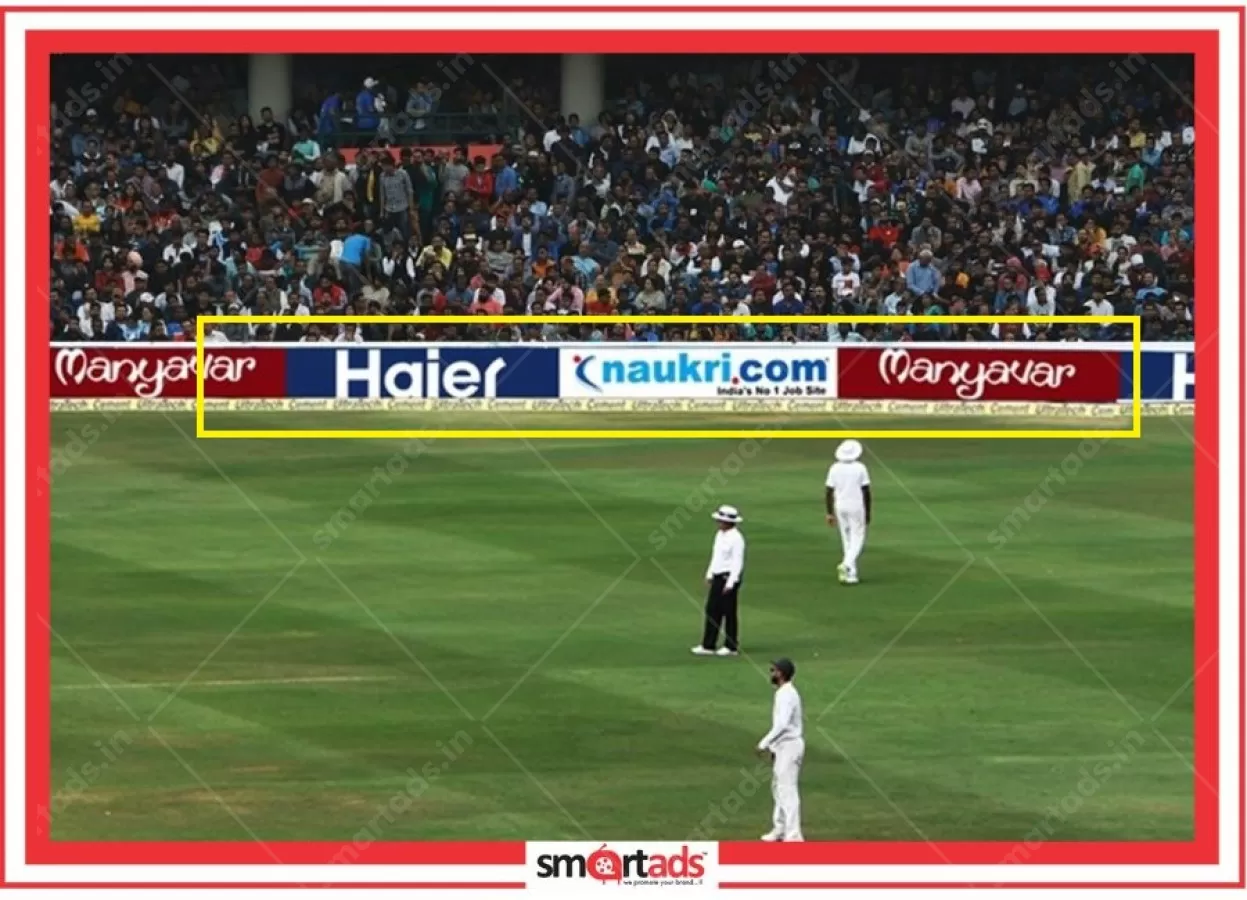
Silver HD Perimeter Signage
Various Sizes
1 ball in every 10 Balls : 50% of the Gr
Rate per Digital Screen / Per match
At Time Only 3 Display Name.
₹1100000.00
Showing 1 to 4 of 4 Results
MEDIA DETAILS
Various Sizes
1 ball in every 10 Balls : 50% of the Gr
Rate per Digital Screen / Per match
At Time Only 3 Display Name.
₹1100000.00
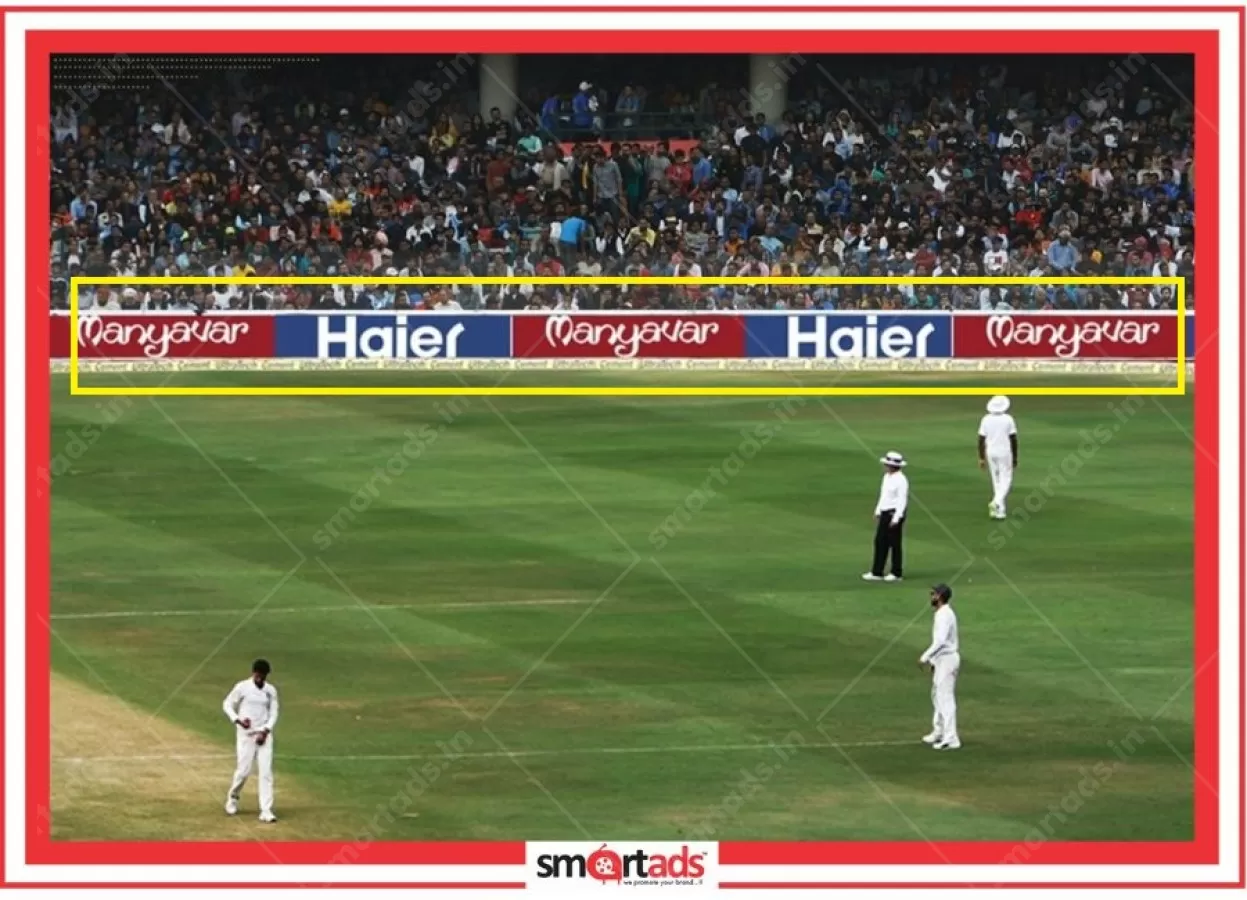
Various Sizes
1 Ball In Every 10 Balls : 50% Of The Gr
Rate per Digital Screen / Per match
At Time Only 2 Display Name.
₹1700000.00
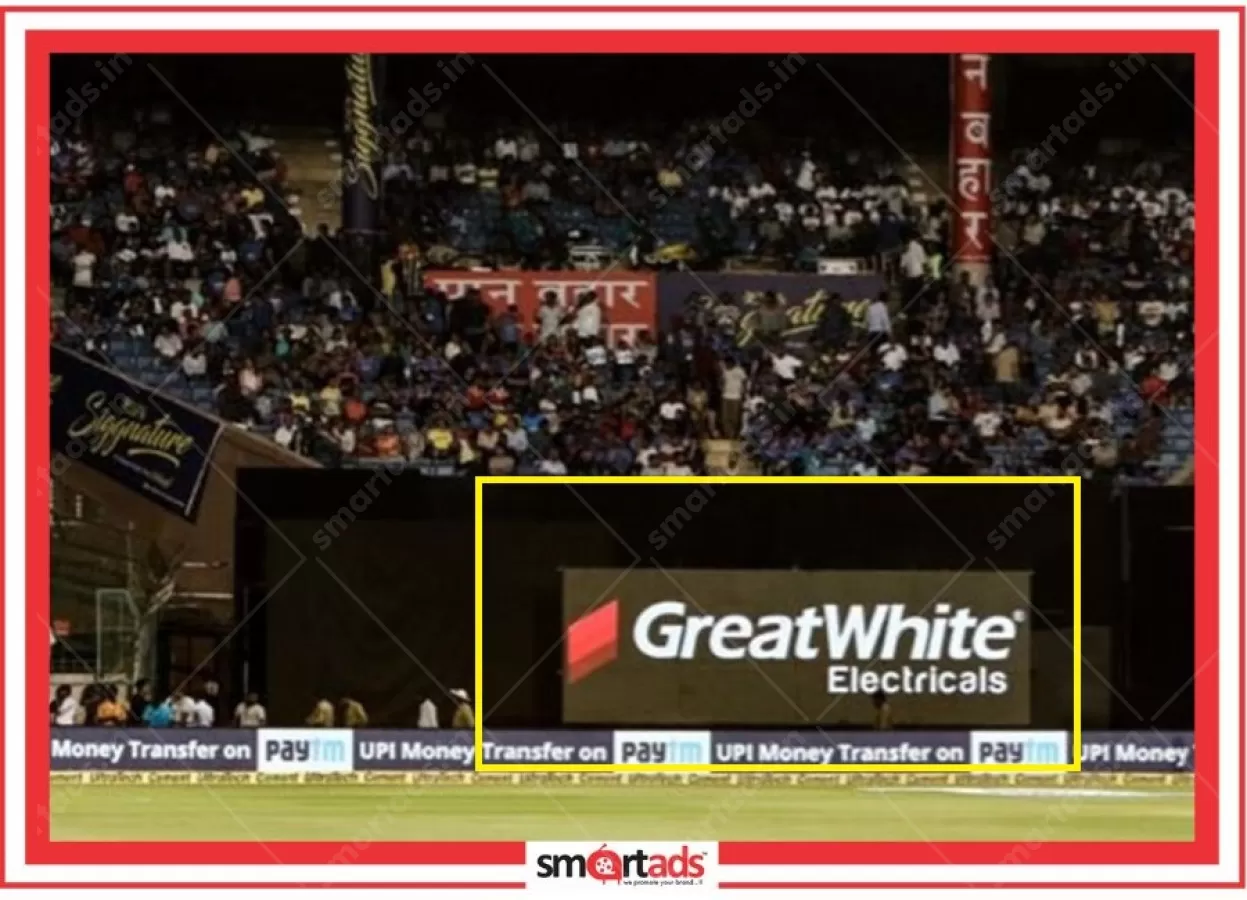
Various Sizes
5 Overs Per ODI Match , 2 Overs Per T20
Rate per Digital Screen / Per match
At Time Only 1 Display Name.
₹1150000.00
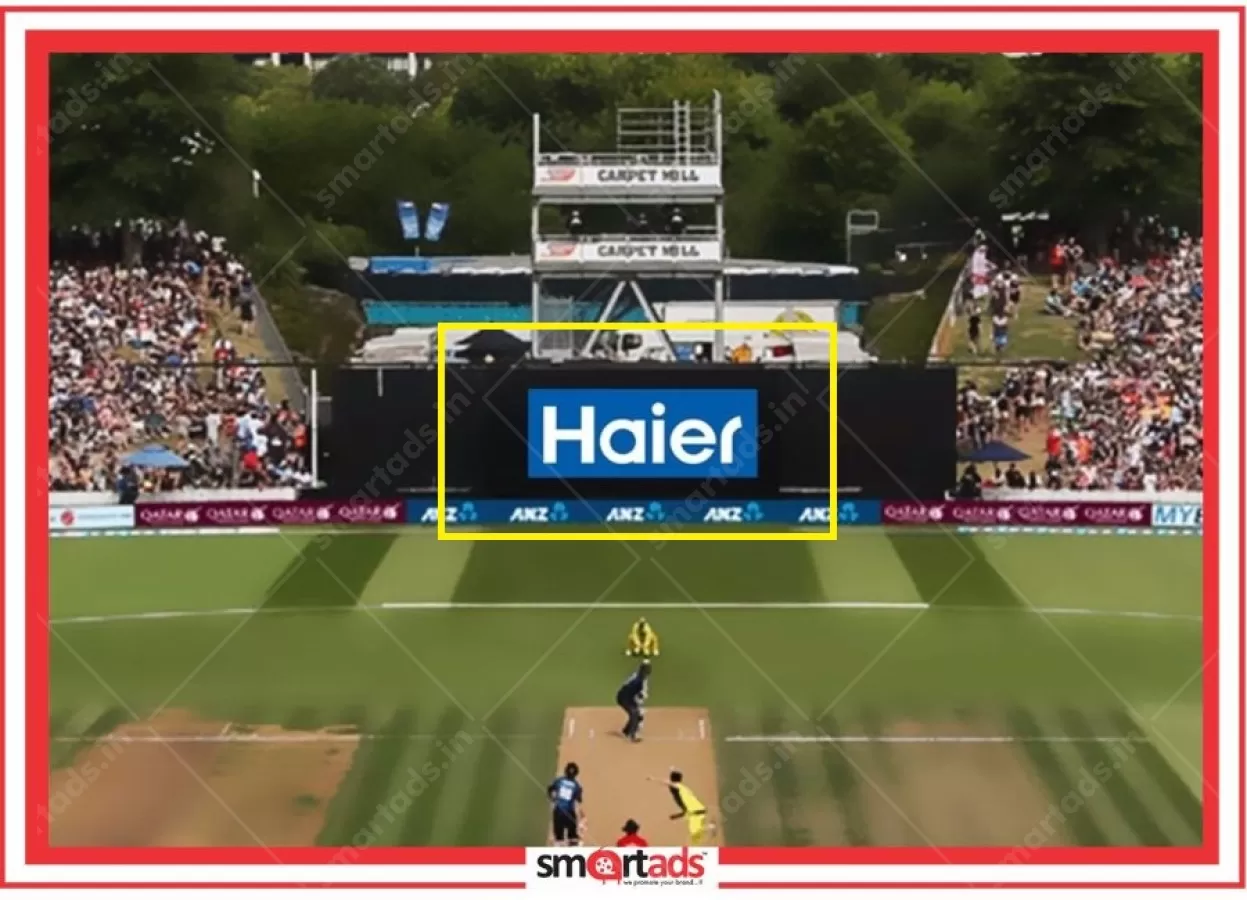
Various Sizes
5 Overs Per ODI Match , 2 Overs Per T20
Rate per Digital Screen / Per match
At Time Only 1 Display Name.
₹1150000.00
MEDIA REACH

MinimumQty :
1
EstimateReachPeople :
60000

Barabati Stadium has hosted more than 50 international matches, and yet most brand managers we speak to still treat it as a secondary venue — which is, frankly, one of the more expensive miscalculations a media planner can make in eastern India. The stadium sits in the heart of Cuttack, draws crowds that regularly touch 45,000 for a single match, and delivers a captive audience that no digital banner, no matter how well-targeted, can replicate. What follows is a ground-level look at how cricket stadium advertising in Cuttack actually works, what it costs, and why the brands getting it right are doing things that most agencies never think to recommend.
There is a particular kind of brand visibility that only a live cricket ground can produce, and Barabati Stadium in Cuttack produces it at a scale that surprises even experienced media planners. The stadium has a seating capacity that works out to somewhere around 45,000 to 65,000 spectators depending on the configuration and the match format — which means a single ODI or T20I can deliver more direct human impressions in four hours than a week-long outdoor campaign on the busiest junction in Bhubaneswar. On top of that, Barabati Stadium is a BCCI-approved venue with a long history of hosting international fixtures, which gives any brand associated with it an implicit layer of credibility that is genuinely difficult to manufacture through other channels.
What a lot of people miss is the television multiplier. When a ground-side hoarding or an LED perimeter board appears at Barabati Stadium during a live international match, it is not just the 45,000 people inside the ground who see it — it is the tens of millions watching on broadcast television, which transforms what looks like a local BTL advertising investment into something with genuine national audience cricket branding value. The BARC viewership data for India-Pakistan and India-Australia ODIs consistently shows that Odisha contributes a disproportionately large share of the national cricket viewership, and Cuttack specifically skews toward the kind of engaged, match-going demographic that brands in the FMCG, automobile, and financial services categories actively want to reach. We have found, across campaigns we have managed at this venue, that the television visibility cricket hoarding delivers is often worth three to four times what a client originally budgeted for.
The stadium's location on Stadium Road, Cuttack — close to the Mahanadi River End and flanked by the Kathajodi River End — also gives it a distinctive visual identity that makes on-ground branding live match footage instantly recognisable to television audiences. The Sachin Tendulkar Indoor Hall and the surrounding infrastructure upgrades have progressively made Barabati Stadium one of the better-maintained venues in eastern India; and while redevelopment plans under the Government of Odisha and the Odisha Cricket Association have been discussed for several years, the venue continues to be a fully operational, internationally certified ground with active advertising inventory available for each match cycle.
The range of in-stadium advertising formats at Barabati Stadium is broader than most brands realise when they first approach us, and the choice of format has a direct bearing on both the cost and the type of visibility achieved. The most prominent format is the LED perimeter board, which runs along the boundary rope and is the format most visible to television cameras; a 10-second slot on the LED perimeter board during an international match at Cuttack is the closest thing to television advertising that a BTL budget can buy, and the cost per impression stadium-wide works out to a fraction of what a comparable GRP on a national sports channel would cost. Ground-side hoarding, which is the static flex or vinyl board placed at boundary-level, is a more affordable entry point and still delivers strong brand recall stadium-wide because spectators in the lower galleries are looking directly at it for the duration of the match.
Beyond the perimeter, there are several formats that brands tend to underuse. Digital sight screen advertising — the branding that appears on the large screens at either end of the pitch — is one of the highest-attention formats available, because every spectator in the ground turns to look at the sight screen between overs and at wicket-fall moments; we have seen brand recall scores from post-match surveys run significantly higher for sight screen advertisers than for perimeter-only campaigns. In-pitch branding, which involves the application of brand logos or messaging directly onto the playing surface at designated zones, is a format that the Odisha Cricket Association permits for select sponsors and which delivers extraordinary television visibility cricket hoarding-level exposure because cameras are pointed at the pitch for the majority of the broadcast. Gallery hoarding, placed along the upper tiers and visible to the crowd from across the ground, is a cost-effective format for brands that want presence without the premium associated with boundary-level placements.
There are also experiential and activation-based formats which fall squarely within the BTL advertising Cuttack category — fan zone activation setups outside the stadium gates, team tunnel branding visible during player entry and exit, hospitality package stadium arrangements for VIP clients, and ground painting branding on the concourse areas. Pitch center branding, which is applied near the wicket area and appears prominently in aerial drone shots as well as wide-angle broadcast frames, is a format that very few brands have explored at Barabati Stadium despite its exceptional television multiplier. At SmartAds, we always tell our clients that the combination of an LED perimeter board for television visibility and a fan zone activation for on-ground engagement is the most cost-efficient media mix for a brand making its first entry into cricket ground advertising in Cuttack.
Frankly speaking, the absence of published rate cards for Barabati Stadium advertising is one of the biggest frustrations for brand managers trying to plan a campaign without going through an agency — and it is also why so many brands end up either overpaying or walking away from a format that would have worked well for them. The cricket stadium advertising cost at Barabati Stadium varies significantly depending on the match format, the format of the advertisement, and whether the booking is for a single match or a series, so giving a single number is genuinely misleading; but we can share the ballpark figures that our media planning team works with.
For an international ODI or T20I at Barabati Stadium, LED perimeter board advertising for a single match works out to somewhere in the ballpark of ₹8 to ₹15 lakh for a standard slot package, which includes a defined number of 10-second rotations per over across the broadcast duration — a number that surprises most clients when they compare it to what they are paying for a week of digital video advertising and realise the reach differential is enormous. Ground-side hoarding for a single international match is typically available in the range of ₹3 to ₹7 lakh per panel depending on the location within the ground, with boundary-adjacent panels commanding a premium over mid-gallery positions. Digital sight screen advertising, which is among the most sought-after formats, is priced in the range of roughly ₹5 to ₹12 lakh per match for the full duration, and it is the format that tends to sell out earliest once a fixture is confirmed.
For domestic matches — Ranji Trophy, Vijay Hazare Trophy, and particularly the Odisha Premier League or Odisha Pro T20 League fixtures — the stadium advertising rates India-wide for domestic cricket are considerably more accessible, with ground-side hoarding packages available for as low as ₹50,000 to ₹1.5 lakh per match; which makes Odisha Premier League advertising a genuinely viable option for small and medium-sized Cuttack businesses that want the association with cricket without the international match budget. Series-level packages, which cover all matches in a bilateral series played at Barabati Stadium, typically offer a discount of somewhere between 15 and 25 percent compared to per-match rates, and we have found that negotiating a series package also tends to secure better panel positions. The OCA branding rights for certain premium formats — including in-pitch branding and stadium naming rights — are managed through a separate tendering process and represent a longer-term commitment that is more appropriate for large national or regional brands.
The cricket fan demographic at Barabati Stadium is one of the most clearly defined captive audience stadium profiles in eastern India, and it is worth understanding in some detail before making format decisions. The in-stadium crowd at a Cuttack international match skews heavily male — roughly 70 to 75 percent — with the largest age cohort falling between 18 and 40 years, which maps almost perfectly onto the primary target audience for categories like two-wheelers, smartphones, packaged foods, beverages, and financial products. Income profiling of ticket-buying cricket audiences, which has been studied in various forms through IRS and BARC supplementary research, consistently shows that stadium-going cricket fans in Tier 2 cities like Cuttack index higher on disposable income than the general urban population of the same city — which is a data point that tends to shift budget conversations considerably.
The reach 65,000 Cuttack stadium figure that is sometimes cited refers to the maximum capacity configuration for major international fixtures, and while the average attended match may draw somewhere between 35,000 and 50,000 spectators, even at the lower end this is a single-event reach that most outdoor advertising formats in Cuttack cannot match across an entire month. On top of that, the television visibility multiplier for a BCCI-approved international match at Barabati Stadium adds tens of millions of impressions for boundary-level formats, which is why national audience cricket branding through stadium advertising has been growing as a budget line in the media plans of major FMCG and automobile brands, as tracked in the FICCI-EY Media and Entertainment Report. The brand awareness cricket fans carry out of a live match is also qualitatively different from passive media exposure; the emotional intensity of a live match creates stronger memory encoding, which translates into higher brand recall stadium metrics in post-campaign research.
We worked with a regional financial services brand based in Bhubaneswar that was sceptical about cricket advertising in Cuttack because they assumed the audience was too young for their product category; after running a gallery hoarding and fan zone activation combination across a three-match domestic T20 series, their post-campaign brand recall survey showed a 34 percent uplift in unaided brand awareness among respondents who had attended the matches, and a 19 percent uplift in the broader Cuttack market that was attributable to the television visibility of their boundary hoarding. The numbers were good enough that they renewed for the following season's Odisha Pro T20 League branding, this time adding a digital sight screen package.
The honest answer is that almost any brand with a mass-market consumer audience in Odisha or eastern India can find a format and a budget level that works at Barabati Stadium — but the categories that consistently see the strongest advertising ROI cricket outcomes are the ones where purchase decisions are influenced by aspiration, peer visibility, and brand trust rather than pure rational evaluation. Automobile brands, particularly two-wheeler and entry-level four-wheeler manufacturers, have historically been among the heaviest investors in stadium branding Odisha because the cricket-watching demographic maps almost exactly onto their primary buyer profile; and the association between a vehicle brand and the excitement of a live international match creates exactly the kind of aspirational linkage that television commercials spend crores trying to manufacture.
FMCG brands — particularly beverages, snacks, and personal care products — benefit from the combination of in-stadium advertising and fan zone activation, because the concourse areas of Barabati Stadium during a match are genuinely high-traffic retail-like environments where sampling and direct engagement are possible alongside the passive hoarding visibility. Financial services brands, including insurance companies, banks, and fintech platforms, have been increasing their cricket match sponsorship spend in Tier 2 Odisha markets significantly over the past two to three years, which is consistent with the broader trend documented in the Dentsu e4m Advertising Report on the growth of sports marketing India as a budget category. Educational institutions, real estate developers, and healthcare brands have also found that the local Cuttack market responds well to stadium advertising because the audience is concentrated, attentive, and geographically relevant.
What we tell our clients at SmartAds is that the question is not really "is my brand right for stadium advertising?" but rather "which format and which match type gives me the best cost-per-impression for my specific audience?" — and that is a question that requires actual planning rather than a generic rate card. A jewellery brand, for instance, might find that a hospitality package stadium arrangement for VIP guests generates more qualified leads than a boundary hoarding, while a mobile phone brand might prioritise the LED perimeter board for its television visibility. The format decision should follow the audience strategy, not the other way around.
The booking process for stadium advertising Cuttack is more layered than most clients expect, and getting it wrong — particularly on the approvals side — can result in significant delays or, in the worst cases, having materials ready but no permission to install them. The primary rights holder for advertising at Barabati Stadium is the Odisha Cricket Association, which manages the ground on behalf of the BCCI for international fixtures and independently for domestic matches; any advertising booking at the venue must go through OCA-authorised channels, either directly through the OCA's commercial division or through an accredited advertising agency that has an existing relationship with the association.
For international matches — ODIs, T20Is, and Test matches — the BCCI exercises overarching authority over the advertising inventory, and the OCA branding rights are subject to BCCI's central sponsorship agreements, which means that certain categories of advertising may be restricted or excluded depending on the official sponsors of the Indian cricket team or the specific series. This is a nuance that catches a lot of first-time stadium advertisers off guard; a brand in a category that conflicts with a BCCI central sponsor — say, a competing telecom or a rival paint brand — may find that certain premium formats are simply not available to them for international matches, even if they have the budget. For domestic matches and state-level tournaments like the Odisha Premier League, the OCA has considerably more flexibility, and the advertising booking process Cuttack is correspondingly more straightforward.
The practical timeline for booking, which we have refined through repeated experience managing campaigns at this venue, works out to roughly six to eight weeks for international matches and four to six weeks for domestic fixtures — and that includes the time needed for creative approval, material production, and installation logistics. At SmartAds, we manage the entire OCA coordination, BCCI approval verification, and on-ground installation process on behalf of our clients, which removes the single biggest friction point in the booking process. One automotive brand we worked with had tried to book directly and spent three weeks going back and forth on paperwork before approaching us; we completed the same process in eleven days because the relationships and the documentation workflow were already in place.
The stadium permission approval process at Barabati Stadium involves multiple layers of authority, and understanding which layer governs which format is essential before any commitment is made. For international matches, the BCCI-approved venue advertising framework requires that all on-ground branding — including perimeter boards, sight screen advertising, and in-pitch branding — be approved by the BCCI's commercial team in Mumbai, with the OCA acting as the local coordinating body. This means that a brand wanting to advertise during an India international match at Barabati Stadium is effectively seeking approval from a national governing body, not just a local one; and the BCCI's approval criteria include category exclusivity checks against existing central sponsors, creative content review, and technical specification compliance for LED and digital formats.
For formats that are outside the playing area — gallery hoarding, concourse branding, fan zone activation, and team tunnel branding — the OCA's own commercial and operations teams have primary authority, subject to the stadium's general safety and structural guidelines. Ground painting branding on concourse areas requires a separate clearance from the OCA's ground management committee, and the specifications for paint type and application method are strictly defined to protect the playing surface and the permanent infrastructure. The Government of Odisha, through the Odisha Olympic Association and related bodies, also has a nominal oversight role for certain categories of public event advertising within the stadium precinct, particularly for events that involve state government co-sponsorship.
From a practical standpoint, the documentation required for a standard stadium advertising Cuttack booking includes the brand's GST registration, a signed indemnity agreement with the OCA, creative files in the specified technical formats, and — for international matches — a no-objection confirmation from the BCCI's commercial division. We have found that brands which approach this process without agency support typically underestimate the lead time required for BCCI coordination, which is why we build a minimum of three weeks into every international match booking timeline specifically for the approvals stage.
This is the question we get asked most often by clients who are new to in-stadium advertising, and the honest answer is that they serve genuinely different objectives — which means the "better" format depends entirely on what the brand is trying to achieve. Ground-side hoarding is a static format, which means it is always present and always visible to spectators in the ground regardless of the broadcast schedule; it is the format that delivers the strongest in-stadium impressions for the live audience, and it is the format that works best for brands whose primary goal is local market presence in Cuttack and the surrounding Odisha catchment. The cost is lower, the production timeline is shorter, and the creative execution is simpler — all of which makes ground-side hoarding the natural entry point for brands doing cricket advertising in Cuttack for the first time.
The LED perimeter board, by contrast, is fundamentally a television advertising format that happens to be located inside a cricket ground; it is dynamic, it rotates between multiple advertisers, and its primary value is the television visibility cricket hoarding delivers to the national broadcast audience. A brand that buys LED perimeter board time at Barabati Stadium during an international match is effectively buying a form of sports television advertising at a fraction of the cost of a comparable spot on a national sports channel — and the contextual relevance of appearing on the boundary rope during a live match is something that a post-production television commercial simply cannot replicate. The CPM for LED perimeter board advertising at Barabati Stadium, when calculated against the combined in-stadium and television audience, works out to somewhere in the range of ₹6 to ₹10, which is a number that makes most brand managers pause when they compare it to what they are paying for programmatic digital video.
The format we recommend most often for brands with a mid-range budget — somewhere between ₹10 and ₹25 lakh for a series — is a combination of a ground-side hoarding for the in-stadium audience and a digital sight screen package for the television visibility, which together cover both the live crowd and the broadcast audience without requiring the full investment of a premium LED perimeter board package. One retail chain client in Cuttack used exactly this combination across a bilateral ODI series and reported that their footfall in the Cuttack stores increased by roughly 22 percent in the two weeks following the match — a number they attributed partly to the stadium advertising and partly to the social media amplification that the sight screen appearances generated when fans shared match footage online.
Barabati Stadium has hosted IPL matches in the past — most notably as a venue for Deccan Chargers, Kolkata Knight Riders, and Kings XI Punjab fixtures during various IPL seasons — and while the current IPL franchise allocation does not include a Cuttack-based team, the possibility of playoff fixtures or neutral-venue matches being hosted here remains a live consideration that brands should track. IPL advertising Cuttack, when it has been available, has commanded a significant premium over standard international match rates, with LED perimeter board packages for IPL fixtures running at roughly two to three times the equivalent ODI rate; the premium is justified by the IPL's extraordinary television ratings and the younger, more digitally active demographic that IPL matches attract relative to bilateral international series.
For ODI advertising Barabati and T20 match advertising Cuttack, which represent the most reliably available international match formats at this venue, the brand visibility cricket opportunity is substantial and consistent. Barabati Stadium ODI T20 fixtures have historically drawn near-capacity crowds, and the Odisha cricket fan base — which is among the most passionate in eastern India — creates an in-stadium atmosphere that translates well on television and amplifies the brand association for any advertiser present at the ground. The cricket match sponsorship opportunities available for bilateral series include not just the advertising formats described earlier but also moment sponsorship options like powerplay moment sponsorship, which attaches a brand's name to a specific phase of the game in the broadcast commentary and on-screen graphics; this is a format that delivers exceptionally high brand recall stadium outcomes because the moment is called out repeatedly during the broadcast.
At SmartAds, we have managed ODI advertising campaigns at Barabati Stadium for brands in the banking, telecom, and consumer electronics categories, and what we have consistently found is that the brands which plan their creative specifically for the cricket context — rather than repurposing generic brand advertising — see meaningfully better recall outcomes. A campaign that references cricket in its creative, that uses the energy of the match as a visual and emotional backdrop, performs significantly better in post-campaign research than one that simply places a standard brand logo on a hoarding and hopes the context does the work.
The comparison between Barabati Stadium Cuttack and other Odisha venues — most notably the Kalinga Stadium in Bhubaneswar, which has emerged as a major sports venue for football and athletics — is one that comes up regularly in media planning conversations for brands operating across Odisha, and the two venues serve genuinely different advertising objectives. Barabati Stadium is a cricket-specific venue with a long international match history, a deeply loyal cricket fan base, and an advertising infrastructure that has been built around the specific requirements of cricket broadcasting; stadium branding Odisha at Barabati is, at its best, a cricket advertising play that reaches the Odisha cricket audience in the most direct and emotionally resonant way possible. Kalinga Stadium, by contrast, is a multi-sport venue that has hosted the Hockey World Cup and various athletics events, which gives it a different audience profile and a different advertising context.
For brands whose target audience is the cricket fan demographic — which, in Odisha, skews toward the 18-to-40 male audience in Cuttack, Bhubaneswar, Berhampur, and the surrounding districts — Barabati Stadium is the clear choice; the cricket advertising Cuttack opportunity is more focused, the audience is more specifically defined, and the television visibility during international cricket is considerably higher than what multi-sport venues typically deliver. For brands that want broader sports association or that are targeting a more diverse demographic including women and older audiences, a multi-sport venue strategy might complement the Barabati Stadium buy rather than replace it. The outdoor advertising Cuttack market more broadly — which includes hoardings, transit advertising, and mall activations — can be layered on top of a stadium advertising campaign to extend reach beyond the match-going audience; and we have found that combining stadium advertising with a targeted outdoor burst in the two weeks around a match fixture significantly amplifies the brand recall outcomes.
Frankly speaking, the Bhubaneswar market is larger in terms of total population and corporate concentration, which makes it attractive for certain categories; but Cuttack has a density and a cricket-specific passion that makes stadium advertising there punch well above its weight in terms of brand impact. The cuttack Odisha advertising market is underserved relative to its actual consumer potential, which means that brands willing to invest in cricket stadium advertising in Cuttack are often operating in a less cluttered environment than they would find in a comparable Bhubaneswar campaign.
Below the line advertising India has evolved considerably over the past decade, and the cricket stadium environment at Barabati Stadium offers a range of non-traditional advertising Cuttack options that go well beyond the standard hoarding and perimeter board formats. Fan zone activation — the creation of branded experience zones in the areas outside the stadium gates where fans congregate before and after matches — is one of the most underutilised formats available at Barabati Stadium, and it is particularly effective for FMCG, beverage, and consumer electronics brands that benefit from direct product interaction. A well-designed fan zone can generate thousands of direct brand interactions per match, with the added benefit that fans who have just had a positive brand experience are entering the stadium in a heightened emotional state that makes subsequent in-stadium advertising more effective.
Sports event marketing Cuttack at the stadium level also includes options like branded merchandise distribution, ticket co-branding, and social media integration through stadium-wide Wi-Fi branding — formats that are increasingly available at Barabati Stadium as the OCA has invested in digital infrastructure. The sports sponsorship Cuttack opportunity is not limited to the match itself; pre-match events, player practice sessions that are open to media, and post-match press conferences all offer branding touchpoints that are available to title and associate sponsors at rates that are negotiable through the OCA's commercial team. These formats are particularly relevant for brands in the B2B or professional services category that want the association with cricket but whose target audience is more likely to be reached through media coverage than through the general admission crowd.
The distinction between BTL advertising Cuttack at the stadium level and traditional outdoor advertising is, at its core, a distinction between passive and active audience engagement; a hoarding on a highway is seen by people who are doing something else, while a fan zone activation at Barabati Stadium is experienced by people who have specifically chosen to be there and are in a heightened state of attention and excitement. Sports marketing India research, including data cited in the GroupM TYNY Report on sports advertising growth, consistently shows that sports event marketing delivers higher brand engagement scores than equivalent investments in static outdoor formats — which is the fundamental case for why brands should be considering cricket stadium advertising in Cuttack as a serious line item in their media plan rather than an experimental add-on.
Q: What types of advertising are available at Barabati Stadium in Cuttack?
The advertising formats available at Barabati Stadium span a wide range from broadcast-facing to purely in-stadium options. LED perimeter board advertising runs along the boundary rope and is the most television-visible format; ground-side hoarding provides static brand presence at boundary level; digital sight screen advertising appears on the large screens at either end of the pitch; in-pitch branding involves logo application on the playing surface itself; gallery hoarding covers the upper tier seating areas; and ground painting branding is applied to concourse and walkway surfaces. Beyond these, experiential formats include fan zone activation outside the stadium gates, team tunnel branding, hospitality package stadium arrangements for VIP clients, and moment sponsorship options like powerplay moment sponsorship that integrate the brand into the broadcast narrative. The OCA manages most of these formats directly, with BCCI oversight applying specifically to international match inventory.
Q: How much does cricket stadium advertising at Barabati Stadium Cuttack cost?
The cricket stadium advertising cost at Barabati Stadium varies significantly by format and match type. For international ODI or T20I fixtures, LED perimeter board packages are typically in the range of ₹8 to ₹15 lakh per match, ground-side hoarding runs somewhere between ₹3 and ₹7 lakh per panel, and digital sight screen advertising is priced at roughly ₹5 to ₹12 lakh for the full match duration. Domestic match rates are considerably more accessible — ground-side hoarding for Odisha Premier League or Odisha Pro T20 League fixtures can be available from as low as ₹50,000 per match, which makes stadium advertising a realistic option for small and medium businesses in Cuttack. Series packages typically offer a discount of 15 to 25 percent compared to per-match rates, and premium formats like in-pitch branding and stadium naming rights are priced through separate negotiation with the OCA.
Q: How do I book advertising space at Barabati Stadium for an ODI or T20 match?
The booking process for international match advertising at Barabati Stadium requires coordination with the Odisha Cricket Association's commercial division, with additional BCCI approval required for on-ground formats during international fixtures. The practical timeline works out to six to eight weeks minimum for international matches, and the documentation required includes GST registration, a signed OCA indemnity agreement, creative files in specified technical formats, and BCCI category clearance. For domestic matches, the process is simpler and can be completed in four to six weeks. Working through an accredited advertising agency Cuttack with an existing OCA relationship significantly compresses this timeline and removes the administrative burden from the brand's internal team.
Q: What is the audience reach of Barabati Stadium during a cricket match?
The in-stadium audience at Barabati Stadium for a major international match works out to somewhere between 35,000 and 65,000 spectators depending on the fixture and the configuration, which represents one of the largest single-event captive audience stadium concentrations available in eastern India. The television audience multiplier for boundary-level formats during an international match adds tens of millions of additional impressions through broadcast coverage, making the total reach of a well-positioned LED perimeter board or ground-side hoarding campaign substantially larger than the in-stadium number alone. The audience profile skews 70 to 75 percent male, with the 18-to-40 age cohort representing the largest segment, and stadium-going cricket fans in Cuttack index above the city average on disposable income and brand awareness.
Q: Do I need BCCI or OCA permission to advertise at Barabati Stadium Cuttack?
Yes — and the specific permissions required depend on the match format and the advertising format chosen. For international matches, BCCI approval is required for all on-ground advertising formats including perimeter boards, sight screen advertising, and in-pitch branding; the OCA coordinates this process locally but the final authority rests with the BCCI's commercial division. For formats outside the playing area — gallery hoarding, concourse branding, fan zone activation — OCA approval is sufficient. For domestic matches and state-level tournaments, the OCA has primary authority across all formats. Brands in categories that conflict with BCCI central sponsors may find certain formats restricted during international fixtures, which is an important consideration to verify before committing to a booking.
Q: What is the difference between a ground-side hoarding and an LED perimeter board at Cuttack cricket stadium?
A ground-side hoarding is a static printed or vinyl display placed at boundary level, visible to the in-stadium audience throughout the match; it is the more affordable format and is best suited for brands whose primary goal is local market presence and in-stadium brand visibility. An LED perimeter board is a dynamic digital display that rotates between multiple advertisers in defined time slots, is specifically positioned for television camera capture, and delivers its primary value through broadcast visibility to the national audience. The LED perimeter board costs more — often two to three times the equivalent static hoarding — but the CPM when calculated against the combined in-stadium and television audience is frequently lower than the static format's CPM calculated against the in-stadium audience alone. The choice between the two should be driven by whether the brand's primary objective is local in-stadium presence or national television visibility.
Q: Can small and medium businesses advertise at Barabati Stadium during local or domestic matches?
Absolutely, and this is one of the most underutilised opportunities in the Cuttack advertising market. Domestic matches — including Vijay Hazare Trophy, Ranji Trophy, and particularly Odisha Premier League and Odisha Pro T20 League fixtures — offer ground-side hoarding and gallery hoarding packages at rates that are accessible to businesses with advertising budgets starting from as low as ₹50,000 per match. The in-stadium audience for domestic matches is smaller than for international fixtures but is still a concentrated, cricket-engaged crowd that is highly relevant for local Cuttack and Odisha brands. Fan zone activation outside the stadium gates is another format that works well at lower budgets for domestic matches, particularly for food and beverage brands, retail businesses, and local service providers.
Q: How does advertising at Barabati Stadium compare to other venues in Odisha like Bhubaneswar?
Barabati Stadium is specifically optimised for cricket advertising, with an infrastructure, audience profile, and broadcasting setup that is built around the sport; it delivers the most concentrated cricket fan demographic available in Odisha, with a television visibility multiplier that no other Odisha venue can match for cricket-specific campaigns. Venues in Bhubaneswar, including Kalinga Stadium, serve a different audience and a different sports context — they are more appropriate for brands targeting a multi-sport or football-specific audience, or for campaigns that want to associate with the broader Odisha sports identity rather than specifically with cricket. For cricket advertising in Odisha, Barabati Stadium is the primary venue; for broader sports marketing in the state, a multi-venue strategy that includes both Cuttack and Bhubaneswar may be appropriate depending on the brand's audience and objectives.
Q: What is the best format for maximum TV camera visibility during a cricket match at Cuttack?
The LED perimeter board is the format with the highest television camera capture rate at Barabati Stadium, because it is positioned specifically along the boundary rope where broadcast cameras are pointed for the majority of the match; a well-positioned LED perimeter board slot during an international match at Barabati Stadium will appear in broadcast footage dozens of times per hour. The digital sight screen is the second-highest television visibility format, because cameras cut to the sight screen during wicket-fall moments and over breaks; and in-pitch branding, while available only to select sponsors, delivers extraordinary aerial and wide-angle broadcast visibility. Ground-side hoarding at the Mahanadi River End or Kathajodi River End positions also captures television camera coverage during fielding and batting shots, though less consistently than the perimeter board.
Q: Are there advertising opportunities during the Odisha Pro T20 League at Barabati Stadium?
Yes, and Odisha Pro T20 League branding represents one of the most accessible and cost-effective entry points into cricket stadium advertising in Cuttack
