
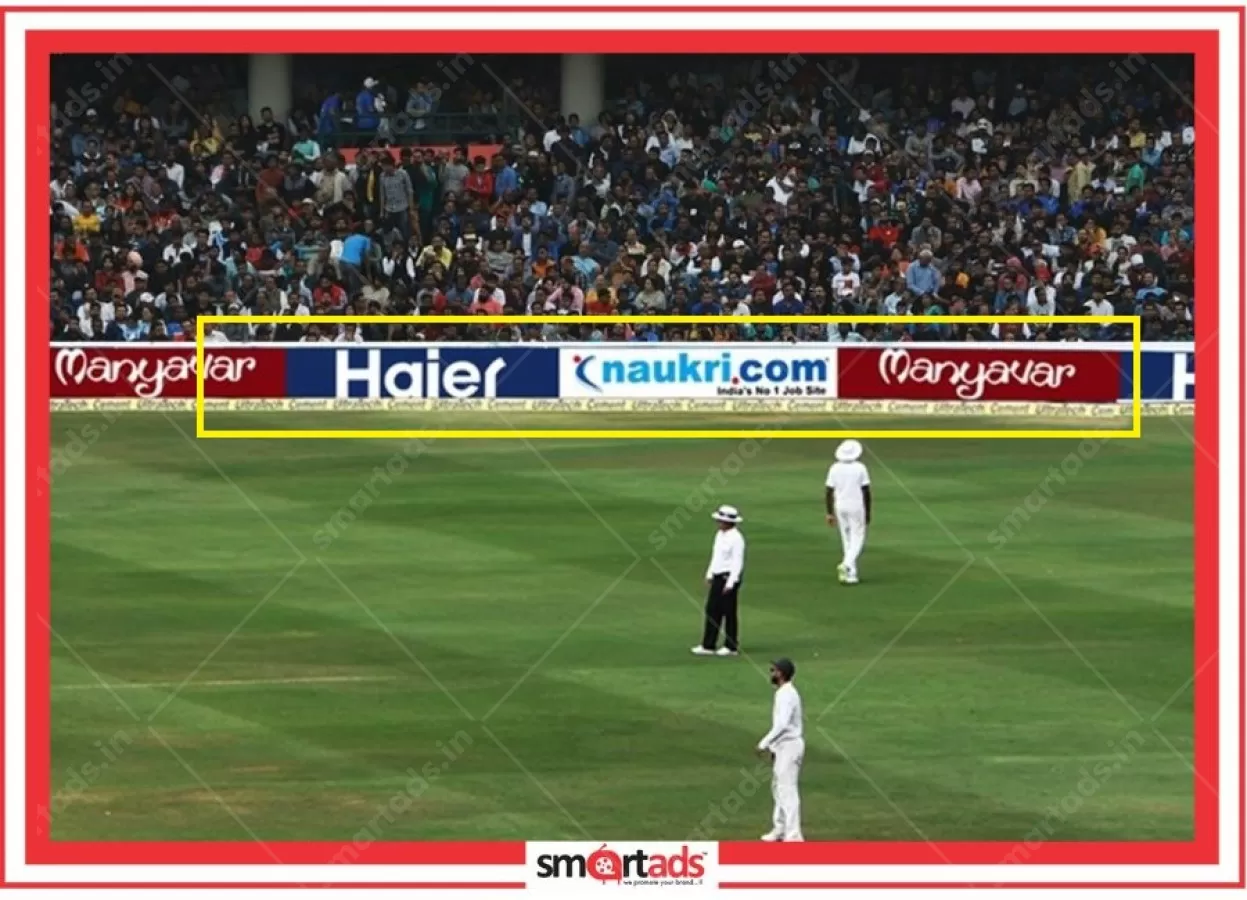
Silver HD Perimeter Signage
Various Sizes
1 ball in every 10 Balls : 50% of the Gr
Rate per Digital Screen / Per match
At Time Only 3 Display Name.
₹1100000.00
Showing 1 to 4 of 4 Results
MEDIA DETAILS
Various Sizes
1 ball in every 10 Balls : 50% of the Gr
Rate per Digital Screen / Per match
At Time Only 3 Display Name.
₹1100000.00
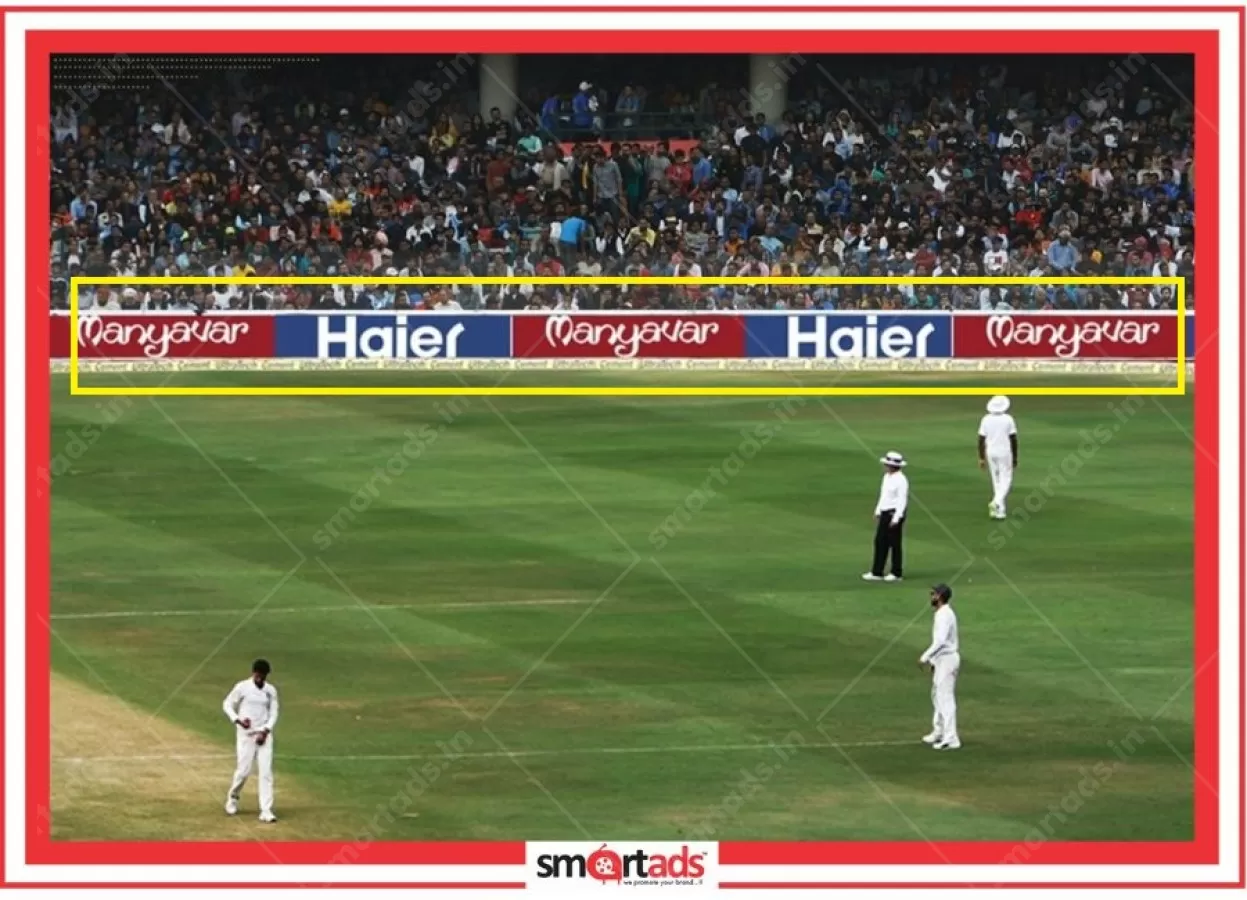
Various Sizes
1 Ball In Every 10 Balls : 50% Of The Gr
Rate per Digital Screen / Per match
At Time Only 2 Display Name.
₹1700000.00
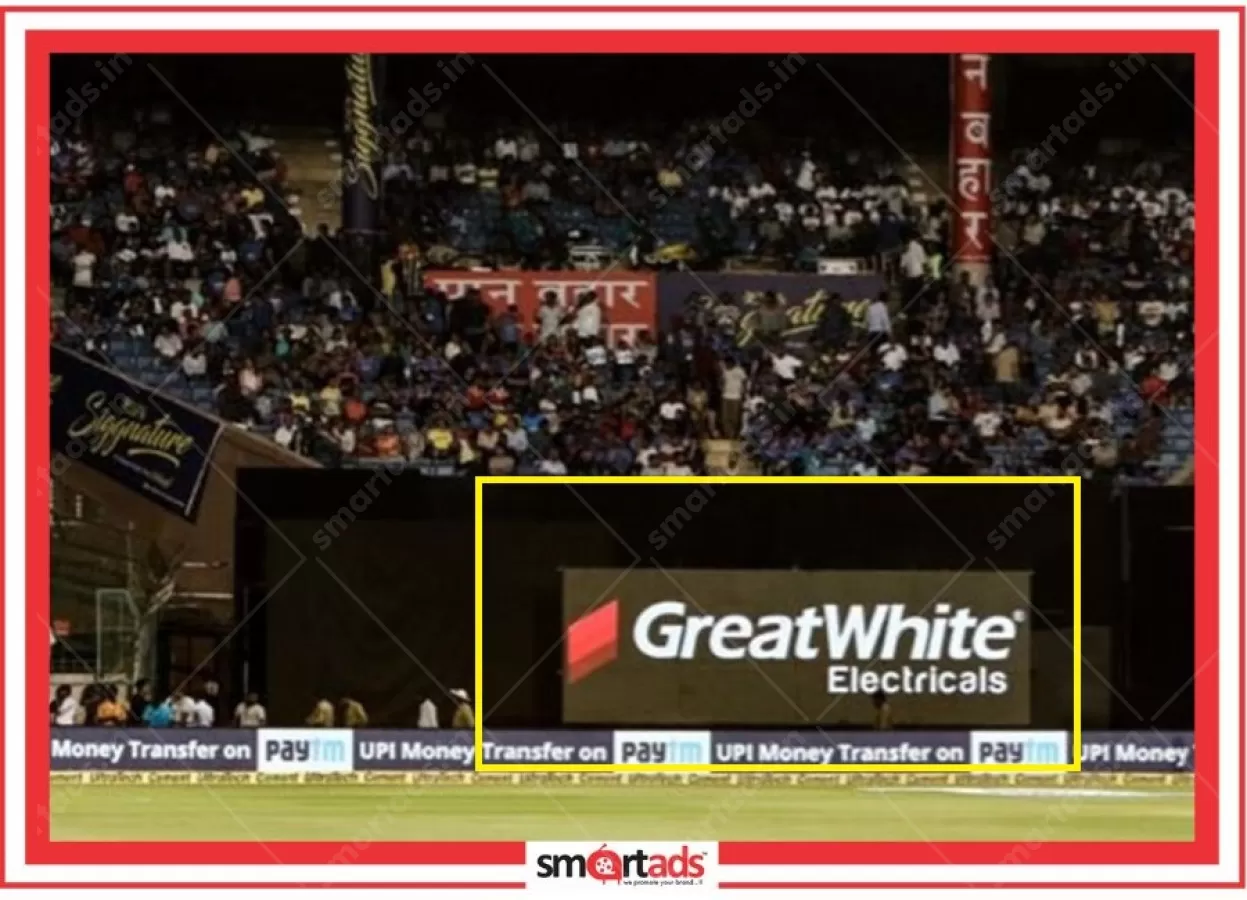
Various Sizes
5 Overs Per ODI Match , 2 Overs Per T20
Rate per Digital Screen / Per match
At Time Only 1 Display Name.
₹1150000.00
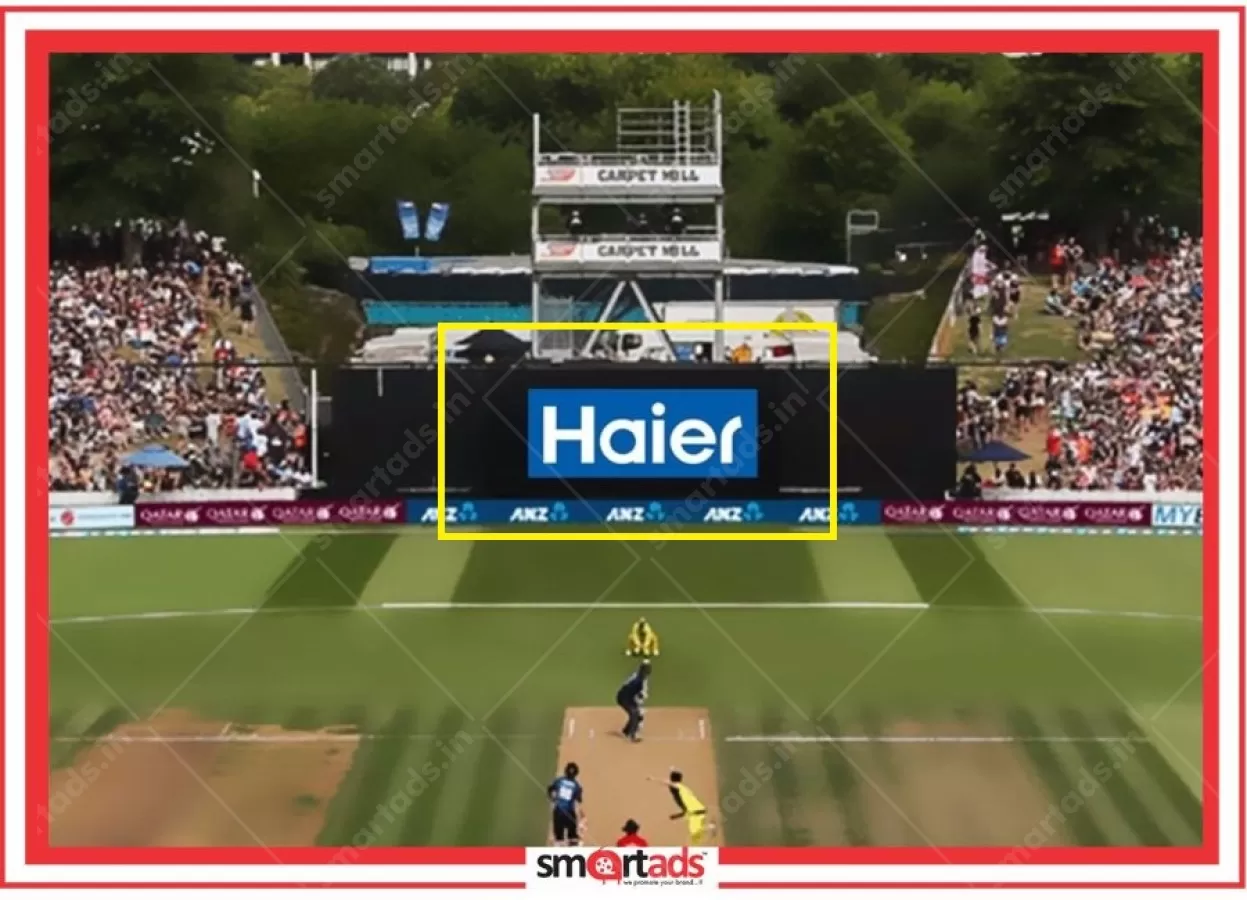
Various Sizes
5 Overs Per ODI Match , 2 Overs Per T20
Rate per Digital Screen / Per match
At Time Only 1 Display Name.
₹1150000.00
MEDIA REACH

MinimumQty :
1
EstimateReachPeople :
40000

Most brand managers we speak to are surprised to learn that a single perimeter board at Sawai Mansingh Stadium during an IPL match reaches not just the 24,000-odd fans inside the ground, but potentially millions of television and OTT viewers across the country — all within a two-to-three-hour window that commands undivided attention in a way that no billboard on MI Road ever could. Cricket stadium advertising in Jaipur has quietly become one of the most efficient BTL investments available to brands operating in Rajasthan, and yet the category remains genuinely underutilised by regional advertisers who assume it is territory reserved for national giants. The truth, as we have found through years of campaign planning at SMS Stadium, is considerably more accessible than most people expect.
Sawai Mansingh Stadium sits at the heart of Jaipur's sporting and cultural identity in a way that very few venues in India can claim for their respective cities. Located near Lalkothi and Rambagh Circle, the stadium is not merely a cricket ground — it is a civic landmark, which means that brand presence here carries an associative weight that ordinary outdoor advertising in Jaipur simply cannot replicate. When fans walk through those gates, they are already in a heightened emotional state, which is precisely the condition that makes brand recall lift measurably higher inside a stadium than on any roadside hoarding.
The numbers that underpin this argument are worth understanding in context. SMS Stadium has a seating capacity of roughly 30,000 spectators, and during Rajasthan Royals IPL home matches, attendance consistently approaches that ceiling; the atmosphere is electric, the dwell time is long, and the audience is — frankly speaking — far more affluent and brand-aware than a typical outdoor audience. Research consistently cited in FICCI-EY Media Reports has shown that sports audiences skew heavily toward the 18-to-45 age bracket, with a significant proportion falling in the SEC A and SEC B income categories, which makes SMS Stadium advertising a remarkably precise targeting instrument for brands in categories like automobiles, financial services, consumer electronics, and FMCG.
At SmartAds, we always tell our clients that the venue itself does half the brand-building work for you. There is a reason why companies like Waaree Energies and JK Lakshmi Cement have committed to principal sponsorship of the Rajasthan Royals — the halo effect of being associated with a beloved cricket franchise in the Pink City is something that years of conventional outdoor advertising cannot manufacture. For brands that are not at the title or principal sponsor level, cricket stadium advertising in Jaipur through perimeter boards, LED screens, and in-stadium branding offers a genuinely accessible entry point into that same emotional ecosystem.
The format landscape at Sawai Mansingh Stadium is considerably more varied than most advertisers realise when they first approach us, and the choice of format has a significant bearing on both the cost and the nature of the brand exposure you achieve. Perimeter boards — the rectangular panels that line the boundary of the playing field — are the most visible format during live play, which is why they command the highest rates and get booked earliest in the season; these are the boards that appear in virtually every broadcast camera angle, giving your brand simultaneous television visibility alongside the in-stadium audience.
LED screens and digital screens installed around the stadium offer a different kind of value: they allow dynamic creative, which means your brand message can be updated between overs, adapted for specific match moments, or even made interactive during strategic timeouts. In-pitch branding, which includes ground murals painted directly on the outfield or the pitch surrounds, is a format that generates enormous television visibility because cameras frequently capture wide-angle shots of the ground; a well-designed ground mural at SMS Stadium during a Rajasthan Royals match can appear dozens of times in a single broadcast. Boundary boards, which are the shorter panels placed closer to the boundary rope, complement the perimeter boards and are often bundled into packages for brands seeking saturation coverage.
Beyond these broadcast-facing formats, SMS Stadium also offers in-stadium branding opportunities that are purely experiential — gate branding, concourse displays, seat branding in specific stands, and toilet block displays, which may sound unglamorous but actually achieve remarkable dwell-time exposure given how long fans spend in those areas. On top of that, there are fan activation zones and on-ground promotion spaces near the stadium entry points and parking areas, which allow brands to create physical touchpoints with the audience before and after the match. Our experience shows that combining two or three of these formats — say, a perimeter board for television reach paired with a fan activation zone for experiential engagement — produces brand recall scores that are substantially higher than any single format can achieve alone.
This is the question that almost every client asks first, and to be honest, it is also the question that is most frequently answered evasively by other agencies. We prefer to be direct about the rate landscape, because transparency in advertising cost planning is what allows brands to make genuinely informed decisions rather than discovering surprises mid-campaign. Stadium advertising rates at SMS Stadium vary considerably depending on the match type, the format chosen, the duration of the campaign, and whether the booking is made directly through the Rajasthan Cricket Association or through an authorised agency partner.
For IPL matches — which represent the premium tier of cricket stadium advertising in Jaipur — perimeter board packages for a single match work out to somewhere in the ballpark of ₹3 lakh to ₹8 lakh per board per match, depending on the board's position relative to the broadcast camera angles; boards in the sightscreen zone or directly opposite the main broadcast camera command the higher end of that range. LED screen advertising during IPL matches at SMS Stadium is typically priced on a per-slot or per-match basis, with a full-match package for a prominent digital screen position falling somewhere between ₹5 lakh and ₹12 lakh, which is a number that surprises many first-time advertisers when they consider that the same budget might buy them a month of mediocre hoarding space on Tonk Road with a fraction of the audience quality. Ground murals and in-pitch branding, being the most broadcast-visible formats, are generally available only as part of larger integrated packages and are priced accordingly — typically in the range of ₹10 lakh to ₹25 lakh for an IPL home-match series.
For domestic matches — Ranji Trophy games, Syed Mushtaq Ali T20 tournaments, and ODI matches that are occasionally hosted at SMS Stadium — the advertising rates drop to a considerably more accessible level, which is where we often direct our SME clients and regional Jaipur brands. A perimeter board for a domestic T20 match at SMS Stadium can be secured for roughly ₹50,000 to ₹1.5 lakh per match, and full-season domestic packages — which bundle multiple matches across a tournament — work out to even better value on a per-impression basis. One retail client we worked with in Jaipur, a mid-sized jewellery brand from the Johari Bazaar area, ran a domestic T20 branding campaign at SMS Stadium for a total investment of around ₹4 lakh across the season; the brand recall lift they measured through post-campaign surveys was significant enough that they doubled their stadium advertising budget the following year. These rates are indicative and subject to change based on season, inventory availability, and negotiation — but they give you a realistic planning baseline that most competitor pages simply refuse to provide.
This is a debate we have internally at SmartAds almost every planning season, and the honest answer is that it depends entirely on what you are trying to achieve — which is a less satisfying answer than most clients want, but it is the accurate one. IPL advertising at SMS Stadium delivers something that domestic match advertising cannot: simultaneous national and international audience reach through broadcast television and OTT platforms like JioCinema, which means your perimeter board or LED screen creative is not just seen by 24,000 people in Jaipur but potentially by tens of millions of viewers across India and beyond. The GroupM TYNY Report has consistently highlighted IPL as one of the highest-reach media events in the Indian calendar, and the broadcast multiplier effect is real.
That said, domestic cricket match advertising at Sawai Mansingh Stadium offers a targeting precision that IPL sometimes dilutes. The audience at a Ranji Trophy match or a domestic T20 at SMS Stadium is overwhelmingly local — Jaipur residents, Rajasthan cricket enthusiasts, families from surrounding districts — which makes it a far more geographically precise vehicle for brands whose distribution or service area is concentrated in the region. A financial services brand launching a new product in Rajasthan, or a real estate developer with projects in Jaipur's periphery, will find that domestic match advertising delivers a more relevant audience per rupee spent than the premium IPL slot, where a significant portion of the broadcast audience is geographically irrelevant to their business.
What we have found through campaign planning across both match types is that the smartest approach — for brands with budgets that allow it — is a layered strategy: secure a perimeter board or LED screen presence during IPL home matches for the national reach and brand stature, then supplement it with a more intensive on-ground activation and fan engagement programme during domestic matches, where the smaller crowd size actually makes experiential marketing more manageable and more personal. One automotive brand we worked with followed exactly this model at SMS Stadium, combining an IPL perimeter board with a test-drive activation zone during domestic matches; the combined campaign delivered a cost-per-qualified-lead that was significantly lower than what their conventional outdoor advertising in Jaipur had been achieving.
The booking process for cricket stadium advertising in Jaipur is more structured than many advertisers expect, and understanding it in advance saves considerable time and prevents the frustration of missing inventory windows. The primary authority governing advertising rights at Sawai Mansingh Stadium is the Rajasthan Cricket Association, which works in coordination with the BCCI for international and IPL matches; for domestic matches, the RCA has more direct control over inventory allocation. Brands seeking to advertise during Rajasthan Royals IPL home matches need to be aware that certain advertising categories are subject to exclusivity clauses tied to the Royals' existing sponsor relationships — categories like energy drinks (Red Bull holds a Rajasthan Royals sponsorship), telecom (Jio is associated with the franchise), and cement (JK Lakshmi Cement is a principal sponsor) may have restricted availability for competing brands.
The practical booking timeline matters enormously. For IPL season advertising at SMS Stadium, we strongly recommend initiating the booking process at least four to six months before the season begins — which typically means approaching the agency or RCA by October or November for the following year's IPL. Premium inventory like the broadcast-camera-facing perimeter boards and LED screen prime slots are genuinely limited, and they are claimed early by brands that understand the value; waiting until January or February for an April IPL season is a recipe for getting whatever is left rather than what you actually want. For domestic matches, the booking window is somewhat shorter — typically six to eight weeks ahead of the match or tournament — but even here, early movers get better positioning.
At SmartAds, we manage the end-to-end booking process for our clients, which includes liaising with the RCA, navigating the BCCI approval requirements for international matches, ensuring creative compliance with stadium specifications, and coordinating the physical installation of perimeter boards and other materials. The creative specifications for SMS Stadium advertising are specific — perimeter boards have defined dimensions and material standards, LED screen content must meet brightness and resolution requirements, and ground murals require special paint formulations that do not damage the playing surface. These are details that an experienced SMS Stadium advertising agency handles routinely, but they can become significant obstacles for brands attempting to book directly without agency support.
The brand roster at Sawai Mansingh Stadium during IPL season tells an interesting story about which categories have recognised the value of cricket ground advertising in Jaipur. At the top tier, the Rajasthan Royals' own sponsor portfolio — which includes Waaree Energies as title sponsor, JK Lakshmi Cement as a principal sponsor, and brands like Jio and Red Bull in associate positions — occupies the most prominent inventory. These are brands that have made a calculated decision to associate their identity with one of the IPL's most storied franchises, and the stadium branding that accompanies those deals is simply one component of a broader sponsorship architecture.
Below the franchise sponsorship level, the in-stadium advertising inventory at SMS Stadium has historically attracted a mix of national brands and regional Rajasthan advertisers. Financial services companies, real estate developers, consumer electronics brands, and educational institutions have all been regular presences at the ground; the category diversity is actually one of the things that makes cricket stadium advertising in Jaipur interesting from a planning perspective, because it means that most brand categories still have open inventory available. What a lot of people miss is that the brands getting the best return from SMS Stadium advertising are often not the ones with the biggest boards — they are the ones whose creative is designed specifically for the stadium environment, with bold colours, minimal text, and a message that can be absorbed in the two to three seconds that a fan's gaze passes across a perimeter board.
The lesson we draw from observing successful in-stadium branding campaigns at SMS Stadium is that brand visibility at a cricket ground is not a passive medium — it rewards active creative thinking. One FMCG brand we worked with at SMS Stadium had previously run generic product advertising on their perimeter boards, achieving decent impressions but unremarkable recall; when we redesigned their creative to feature a bold, single-colour brand mark with no product imagery — essentially a brand awareness campaign rather than a product campaign — their post-match recall scores improved by a margin that justified the creative investment many times over.
The physics of cricket stadium advertising are worth understanding properly, because they explain why perimeter boards and LED screens at SMS Stadium deliver a fundamentally different kind of brand exposure than any other outdoor advertising format in Jaipur. When a match is in progress at Sawai Mansingh Stadium, the broadcast cameras are almost continuously pointed at the playing field, which means that the perimeter boards lining the boundary are in frame for the vast majority of the broadcast duration; TAM AdEx data on cricket broadcasts has consistently shown that in-stadium advertising assets accumulate thousands of seconds of on-screen time during a single match, which translates into a television visibility equivalent that would cost many multiples more if purchased as conventional television commercial airtime.
LED screens at SMS Stadium add a dimension that static perimeter boards cannot match: the ability to change the message in real time, which allows brands to create contextually relevant moments during the match. A brand that sells sports nutrition products, for instance, can time its LED screen content to appear during a batting power play; a financial services brand can display a specific product message during the strategic timeout when television cameras frequently cut to wide-angle stadium shots. The creative flexibility of digital screens at cricket grounds is something that the FICCI-EY Media Report has highlighted as a growing area of sports marketing investment in India, and we have seen this translate into measurably higher engagement metrics for brands that use it thoughtfully.
The dual-screen amplification effect — where an SMS Stadium advertising campaign reaches both the live in-stadium audience and the broadcast television and OTT audience simultaneously — is perhaps the single most compelling argument for cricket ground advertising in Jaipur. A brand that places a perimeter board at Sawai Mansingh Stadium during an IPL match is effectively running two campaigns at once: a hyper-local, captive audience campaign for the 30,000 fans in the ground, and a national brand awareness campaign for the millions watching on television. The CPM — cost per thousand impressions — when calculated across both audiences works out to a figure that is genuinely competitive with standalone television advertising, which is a number that surprises most first-time advertisers when they do the math properly.
Fan activation is where cricket stadium advertising in Jaipur moves from passive brand exposure into something genuinely experiential, and it is an area that we believe is significantly underutilised by most brands currently active at SMS Stadium. The zones outside the stadium — the parking areas, the fan entry queues, the merchandise stalls near the Lalkothi gate — represent a captive audience that is in a uniquely receptive mood: they are excited, they are in groups, and they have time to spare before the match begins. On-ground promotion in these areas, whether through branded sampling stations, interactive games, photo opportunities, or product demonstrations, creates a physical brand memory that outlasts anything a perimeter board can achieve.
The Rajasthan Cricket Association has designated specific areas around SMS Stadium for fan activation activities, and securing these spaces requires a separate permissions process from the in-stadium advertising booking; it is worth noting that the regulatory environment around outdoor advertising in Jaipur's Pink City heritage zones can be restrictive for conventional OOH formats, but stadium-adjacent fan activation areas are generally exempt from those heritage zone restrictions, which makes them a particularly valuable option for brands that have found conventional outdoor advertising in central Jaipur difficult to execute. Below-the-line marketing through fan activation at SMS Stadium effectively bypasses those regulatory constraints while delivering audience quality that no roadside hoarding can match.
Experiential marketing at SMS Stadium can take many forms beyond the basic sampling table — jersey sponsorship activations where fans can have their name printed on a Rajasthan Royals-style jersey, augmented reality photo experiences, skill challenge zones, and even branded food and beverage counters are all formats that have been executed at Indian cricket stadiums and that generate significant social media amplification when fans share their experiences online. At SmartAds, we have planned fan activation campaigns at cricket venues that generated social media reach several times larger than the in-stadium footfall, because fans documenting their experience effectively become brand ambassadors for the duration of the match day. This social amplification layer is something that below-the-line marketing at cricket grounds delivers almost automatically, and it is a dimension that traditional outdoor advertising in Jaipur simply cannot replicate.
The comparison between cricket stadium advertising in Jaipur and conventional OOH advertising — hoardings on Tonk Road, bus shelter panels near Sindhi Camp, transit advertising on Jaipur Metro — is one that comes up in almost every media planning conversation we have with Rajasthan-based brands, and the answer is not as straightforward as either camp would have you believe. Conventional outdoor advertising in Jaipur offers something that SMS Stadium advertising cannot: continuous, year-round presence. A hoarding on Tonk Road near the stadium is visible every day of the year, accumulating impressions from the daily traffic flow that passes through one of Jaipur's busiest arterial roads; cricket stadium advertising in Jaipur is, by definition, episodic — it exists only during matches, which during an IPL season might mean seven to eight home games.
The counterargument — and it is a compelling one — is that the quality of attention during those match-day windows is categorically different from the quality of attention a hoarding receives from a commuter stuck in traffic on Tonk Road. Research on audience engagement in sports environments, cited in multiple BARC viewership studies, consistently shows that sports audiences demonstrate higher brand recall than audiences exposed to the same brand message in passive media environments; the emotional intensity of a live cricket match at SMS Stadium creates a neurological context that makes brand impressions stickier. The CPM for a hoarding on Tonk Road might look attractive on a spreadsheet — somewhere in the range of ₹8 to ₹15 per thousand impressions — but the effective CPM, adjusted for recall and engagement quality, narrows the gap considerably when compared to cricket ground advertising in Jaipur.
For brands with the budget and the strategic clarity to use both, the combination of a prominent cricket stadium advertising presence at SMS Stadium during the IPL season and a sustained outdoor advertising campaign on the arterial roads surrounding the stadium — Bhawani Singh Road, Tonk Road, the stretch near Rambagh Circle — creates a surround-sound brand experience that is particularly effective for launches and high-intensity awareness campaigns. We have found that brands which coordinate their SMS Stadium in-stadium branding with complementary BTL formats in the surrounding geography consistently outperform brands that use either channel in isolation, because the repeated exposure across multiple touchpoints accelerates the brand recall curve in a way that single-channel campaigns rarely achieve.
Measurement is the area where cricket stadium advertising in Jaipur has historically been weakest, and to be fair, it is a legitimate concern that any serious brand manager should raise before committing budget. The good news is that the measurement toolkit for in-stadium branding campaigns has improved substantially, and a well-structured campaign at SMS Stadium can now be evaluated across multiple dimensions that give a genuinely meaningful picture of return on investment. The starting point is impressions measurement: combining the verified attendance figure for each match — which the Rajasthan Cricket Association and BookMyShow ticketing data can confirm with reasonable accuracy — with the broadcast television and OTT viewership data from BARC and platform analytics gives you a total impressions number that is auditable and defensible.
Beyond raw impressions, brand recall measurement through pre- and post-campaign surveys is the most direct way to assess whether your cricket stadium advertising in Jaipur has actually moved the needle. We recommend commissioning a structured brand recall study — surveying a sample of SMS Stadium match attendees before the campaign begins and a matched sample after the final match — to measure the lift in unaided and aided brand awareness. One financial services brand we worked with at SMS Stadium used exactly this methodology and recorded an unaided brand recall lift of roughly 18 percentage points among match attendees over the course of an IPL home season, which translated into a measurable increase in inbound inquiries from the Jaipur catchment area in the weeks following each match. Social listening tools can also capture the organic social media amplification that stadium advertising generates, particularly when fan activation activities are part of the campaign mix.
Television visibility measurement — tracking the number of seconds your perimeter board or LED screen appears in the broadcast feed — is a more technical but increasingly accessible measurement approach; specialist media monitoring agencies can provide second-by-second broadcast analysis that converts your in-stadium advertising presence into an equivalent television advertising value, which is a metric that resonates strongly with marketing directors who are accustomed to evaluating television ROI. At SmartAds, we provide our clients with a post-campaign measurement report that combines attendance impressions, broadcast visibility analysis, social amplification data, and brand recall survey results into a single ROI dashboard — because we believe that the return on investment case for cricket stadium advertising in Jaipur is genuinely strong, but it needs to be demonstrated with data rather than asserted with enthusiasm.
Frankly speaking, the assumption that cricket stadium advertising at SMS Stadium is exclusively the territory of large national brands is one of the most persistent and most damaging myths in Jaipur's advertising market. It is true that the premium IPL inventory — title board positions, LED screen prime slots, ground murals — is priced at a level that requires a meaningful budget commitment; but the full inventory spectrum at Sawai Mansingh Stadium includes formats and match types that are accessible to regional Jaipur businesses, SMEs, and even ambitious local brands that are serious about building brand awareness in the Pink City. The domestic match advertising rates we outlined earlier — perimeter boards from roughly ₹50,000 per match — are within reach of businesses that would never consider themselves "stadium advertisers" under the conventional assumption.
The more relevant question is not whether you can afford cricket stadium advertising in Jaipur, but whether the audience at SMS Stadium matches your target audience. If your business serves the Jaipur metropolitan area and your target customer is a male between 18 and 45 years old with disposable income and brand awareness — which describes the SMS Stadium match attendee profile with reasonable accuracy — then the targeting efficiency of even a modest domestic match perimeter board is likely to outperform a much larger investment in conventional outdoor advertising that reaches a broader but less qualified audience. A local Jaipur coaching institute, for instance, found that a single domestic T20 match perimeter board at SMS Stadium generated more direct inquiries than three months of auto-rickshaw branding across the city — a result that surprised even us when the client reported it.
The honest caveat is that cricket stadium advertising in Jaipur works best as part of a broader brand awareness campaign rather than as a standalone direct-response medium. If you are expecting the phone to ring the moment your perimeter board appears on screen, you will likely be disappointed; if you are building brand familiarity and association with the energy and aspiration of cricket in Jaipur over a season, the cumulative effect is genuinely powerful. Below-the-line marketing at SMS Stadium is a brand-building investment, and the brands that get the best return are the ones that approach it with that strategic clarity from the outset.
Q: What is cricket stadium advertising and how does it work at SMS Stadium in Jaipur?
Cricket stadium advertising refers to the placement of brand messages within and around a cricket ground, using formats that are visible to both the live in-stadium audience and the broadcast television and OTT audience. At Sawai Mansingh Stadium in Jaipur, this works through a rights structure managed by the Rajasthan Cricket Association for domestic matches and by the BCCI in coordination with the RCA for international and IPL matches; brands secure advertising inventory — perimeter boards, LED screens, ground murals, in-stadium displays — through authorised agencies or directly through the rights holder, and the creative material is installed before the match and removed after. The dual-audience nature of SMS Stadium advertising is what distinguishes it from conventional outdoor advertising: your brand is simultaneously visible to the captive audience of up to 30,000 fans inside the ground and to the potentially millions of viewers watching the broadcast on television or streaming platforms.
Q: How much does it cost to advertise at Sawai Mansingh Stadium during an IPL match in Jaipur?
IPL match advertising at SMS Stadium represents the premium tier of cricket stadium advertising in Jaipur, and the rates reflect that premium. Perimeter board positions for a single IPL home match are priced somewhere between ₹3 lakh and ₹8 lakh per board, depending on position relative to the broadcast camera; LED screen packages for a full IPL home match fall in the ballpark of ₹5 lakh to ₹12 lakh for prime positions. Ground murals and in-pitch branding, which deliver the highest television visibility, are typically available only as part of integrated packages priced upward of ₹10 lakh. Full-season IPL home-match packages — covering all Rajasthan Royals home games at SMS Stadium — offer better per-match value and are the format most commonly chosen by brands that are serious about sustained brand exposure during the IPL window. These figures are indicative benchmarks; actual rates are subject to negotiation, inventory availability, and the specific match schedule.
Q: What advertising formats are available at SMS Stadium Jaipur?
The format inventory at Sawai Mansingh Stadium is broader than most advertisers expect. Perimeter boards along the boundary line are the most broadcast-visible format; LED screens and digital screens around the stadium allow dynamic creative that can be updated during the match; boundary boards provide additional boundary-level brand exposure; ground murals and in-pitch branding are painted directly on the outfield and pitch surrounds for maximum television visibility; in-stadium displays in concourses, gates, and stands reach the live audience during their entire time in the venue; and fan activation zones in the stadium precincts allow experiential and on-ground promotion. Each format serves a different strategic purpose, and the most effective campaigns at SMS Stadium typically combine two or three formats to achieve both broadcast reach and experiential engagement.
Q: Who do I contact to book a cricket stadium advertising slot at SMS Stadium Jaipur?
Booking can be done through the Rajasthan Cricket Association directly for domestic match inventory, or through authorised advertising agencies that hold relationships with both the RCA and the BCCI for IPL and international match inventory. Working through an experienced SMS Stadium advertising agency is strongly recommended, because the approval process involves creative compliance checks, installation coordination, and — for IPL matches — navigation of the Rajasthan Royals' sponsor exclusivity clauses; an agency that has done this before will save you significant time and prevent costly errors. SmartAds.in manages end-to-end cricket stadium advertising bookings at SMS Stadium and can advise on format selection, creative requirements, and optimal booking timing.
Q: Is cricket stadium advertising in Jaipur available only during IPL, or also during domestic matches?
Advertising inventory at SMS Stadium is available across all match types hosted at the ground, including IPL home matches, domestic T20 tournaments like the Syed Mushtaq Ali Trophy, Ranji Trophy matches, ODIs, and T20 Internationals when they are scheduled at the venue. Domestic match advertising is considerably more affordable than IPL advertising and offers a more geographically targeted audience, which makes it the preferred entry point for regional Jaipur brands and SMEs. The trade-off is that domestic matches do not carry the same broadcast reach as IPL games, so the audience is primarily the in-stadium crowd rather than a national television audience; for brands whose target market is concentrated in Jaipur and Rajasthan, this is often a perfectly acceptable trade-off given the cost difference.
Q: How many people will see my brand if I advertise at SMS Stadium Jaipur?
The reach calculation for SMS Stadium advertising has two components. The in-stadium audience for IPL matches at Sawai Mansingh Stadium approaches the venue's seating capacity of roughly 30,000 per match; for domestic matches, attendance varies but typically ranges from a few thousand to fifteen or twenty thousand for popular fixtures. The broadcast audience component is significantly larger: IPL matches on JioCinema and Star Sports regularly attract millions of concurrent viewers, and the cumulative viewership across a full Rajasthan Royals home season runs into the tens of millions, according to BARC viewership data. For international matches at SMS Stadium — T20 Internationals and ODIs — the broadcast audience is both national and international, extending the reach further. The combined in-stadium and broadcast audience makes cricket ground advertising in Jaipur one of the highest-reach BTL formats available in Rajasthan.
Q: Does advertising at SMS Stadium Jaipur also appear on television broadcasts?
Yes, and this is one of the most important features of in-stadium branding at Sawai Mansingh Stadium. Perimeter boards, LED screens, and ground murals positioned within the camera sightlines are captured in the broadcast feed throughout the match; TAM AdEx data on cricket broadcasts has shown that prominent in-stadium advertising assets can accumulate thousands of seconds of on-screen time during a single match, which translates into a television advertising equivalent value that is significant. The television visibility is not guaranteed for every format — in-stadium concourse displays, for instance, are not visible in the broadcast — but for the boundary-facing formats, television exposure is a core part of the value proposition and should be factored into any ROI calculation.
Q: What is the minimum budget needed to run a cricket stadium advertising campaign in Jaipur?
The minimum viable budget for cricket stadium advertising in Jaipur depends on the match type. For domestic matches at SMS Stadium, a single perimeter board can be secured for roughly ₹50,000 to ₹1.5 lakh per match, which means a modest multi-match domestic season campaign can be structured for a total investment in the range of ₹3 lakh to ₹8 lakh. For IPL advertising at SMS Stadium, the minimum meaningful investment — a single perimeter board for a single match — starts at around ₹3 lakh, with full-season packages representing a more significant commitment. Fan activation and on-ground promotion activities can be added at varying costs depending on the scale and complexity of the activation. For SME and local Jaipur brands, we generally recommend starting with a domestic match package to test the format before committing to IPL-level investment.
Q: How far in advance do I need to book advertising space at SMS Stadium Jaipur for IPL season?
For IPL season advertising at Sawai Mansingh Stadium, we recommend beginning the booking process four to six months before the season starts — which means approaching your agency or the RCA by October or November for the following year's IPL, which typically runs from March to May. Premium inventory positions, particularly the broadcast-camera-facing perimeter boards and LED screen prime slots, are claimed early and are genuinely limited; waiting until January or February for an April IPL season means accepting whatever inventory remains, which is rarely the best positioning. For domestic matches, the booking window is shorter — typically six to eight weeks ahead — but even here, popular fixtures can see inventory move quickly.
Q: What is the difference between BTL advertising at SMS Stadium and traditional outdoor advertising in Jaipur?
Traditional outdoor advertising in Jaipur — hoardings, bus shelters, transit panels — delivers continuous, year-round impressions from a broad, general audience passing through public spaces. BTL advertising at SMS Stadium delivers episodic but intensely engaged impressions from a highly specific, self-selected audience that has actively chosen to attend a cricket match; the emotional context of that choice makes the brand exposure qualitatively different from passive roadside exposure. Below-the-line marketing at SMS Stadium also offers television visibility, which no conventional outdoor advertising format in Jaipur provides. The practical difference in planning terms is that stadium advertising requires match-day scheduling and creative that works in a high-stimulation environment, while outdoor advertising requires sustained creative presence and frequency to build recall.
Q: Can small or local Jaipur businesses afford cricket stadium advertising, or is it only for big brands?
Local and regional Jaipur businesses can absolutely participate in cricket stadium advertising at SMS Stadium, particularly through domestic match packages and fan activation opportunities. The domestic match rate structure — perimeter boards from roughly ₹50,000 per match — is accessible to businesses that would never consider themselves candidates for stadium advertising under the assumption that it requires crore-level budgets. The key is matching the match type and format to the budget: a local Jaipur brand that cannot afford IPL perimeter boards can
