
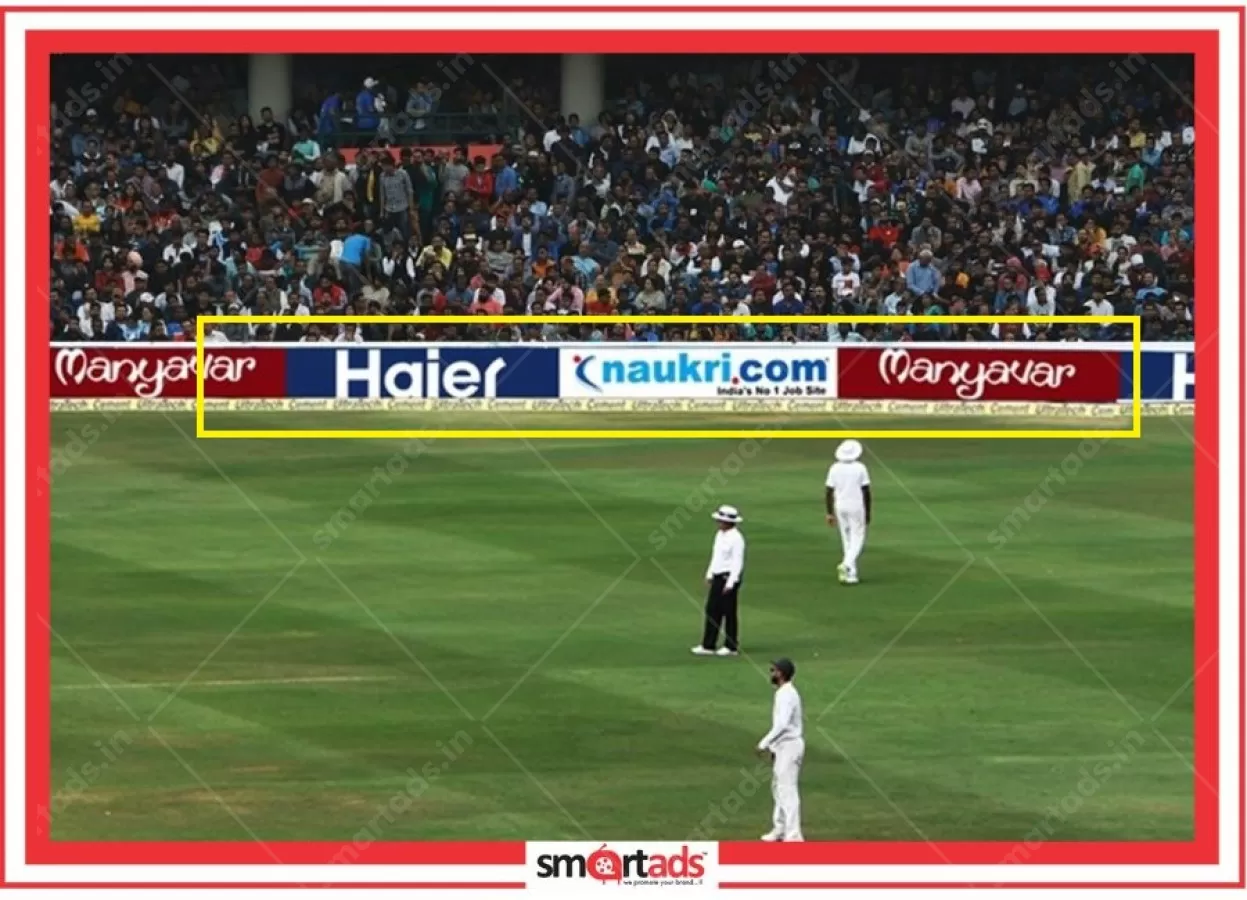
Silver HD Perimeter Signage
Various Sizes
1 ball in every 10 Balls : 50% of the Gr
Rate per Digital Screen / Per match
At Time Only 3 Display Name.
₹1100000.00
Showing 1 to 4 of 4 Results
MEDIA DETAILS
Various Sizes
1 ball in every 10 Balls : 50% of the Gr
Rate per Digital Screen / Per match
At Time Only 3 Display Name.
₹1100000.00
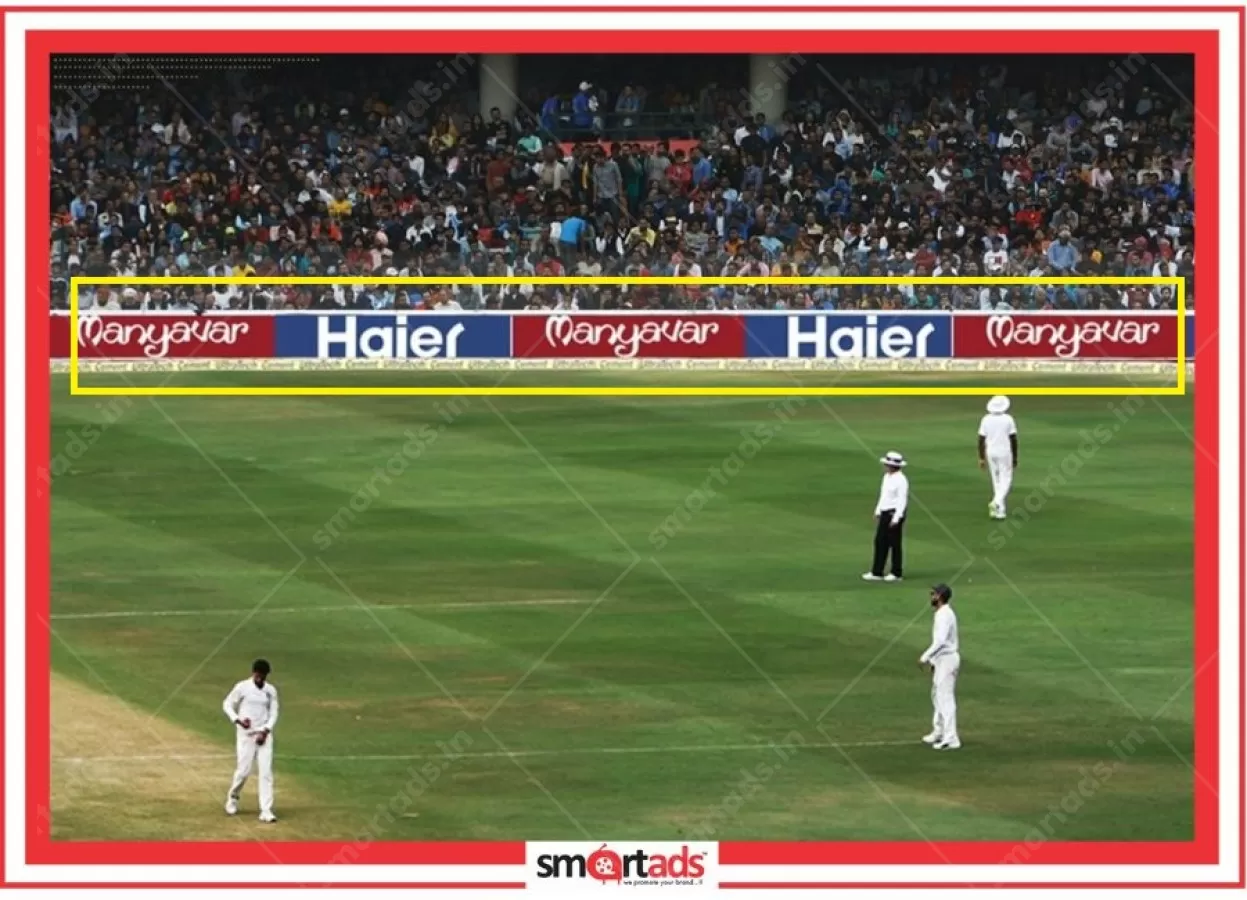
Various Sizes
1 Ball In Every 10 Balls : 50% Of The Gr
Rate per Digital Screen / Per match
At Time Only 2 Display Name.
₹1700000.00
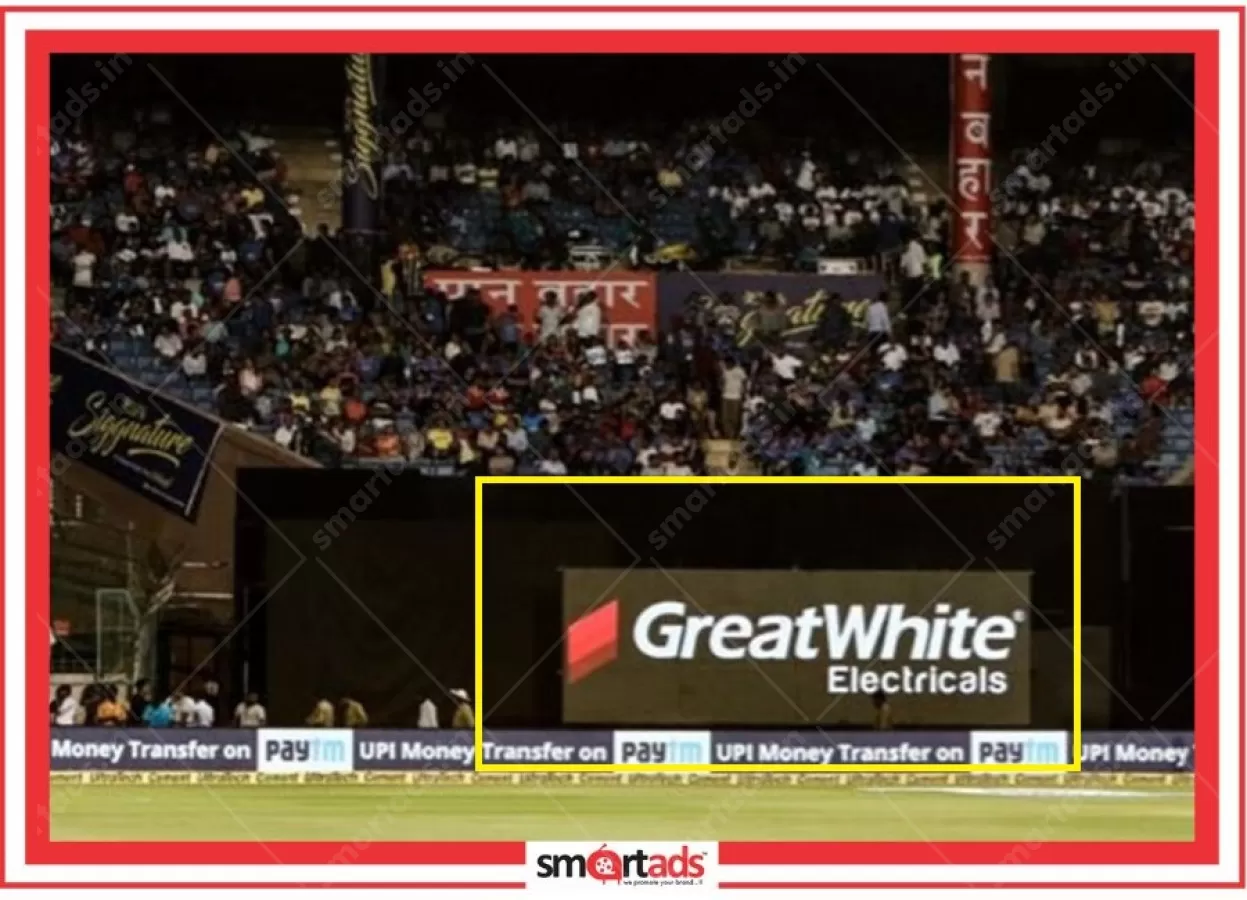
Various Sizes
5 Overs Per ODI Match , 2 Overs Per T20
Rate per Digital Screen / Per match
At Time Only 1 Display Name.
₹1150000.00
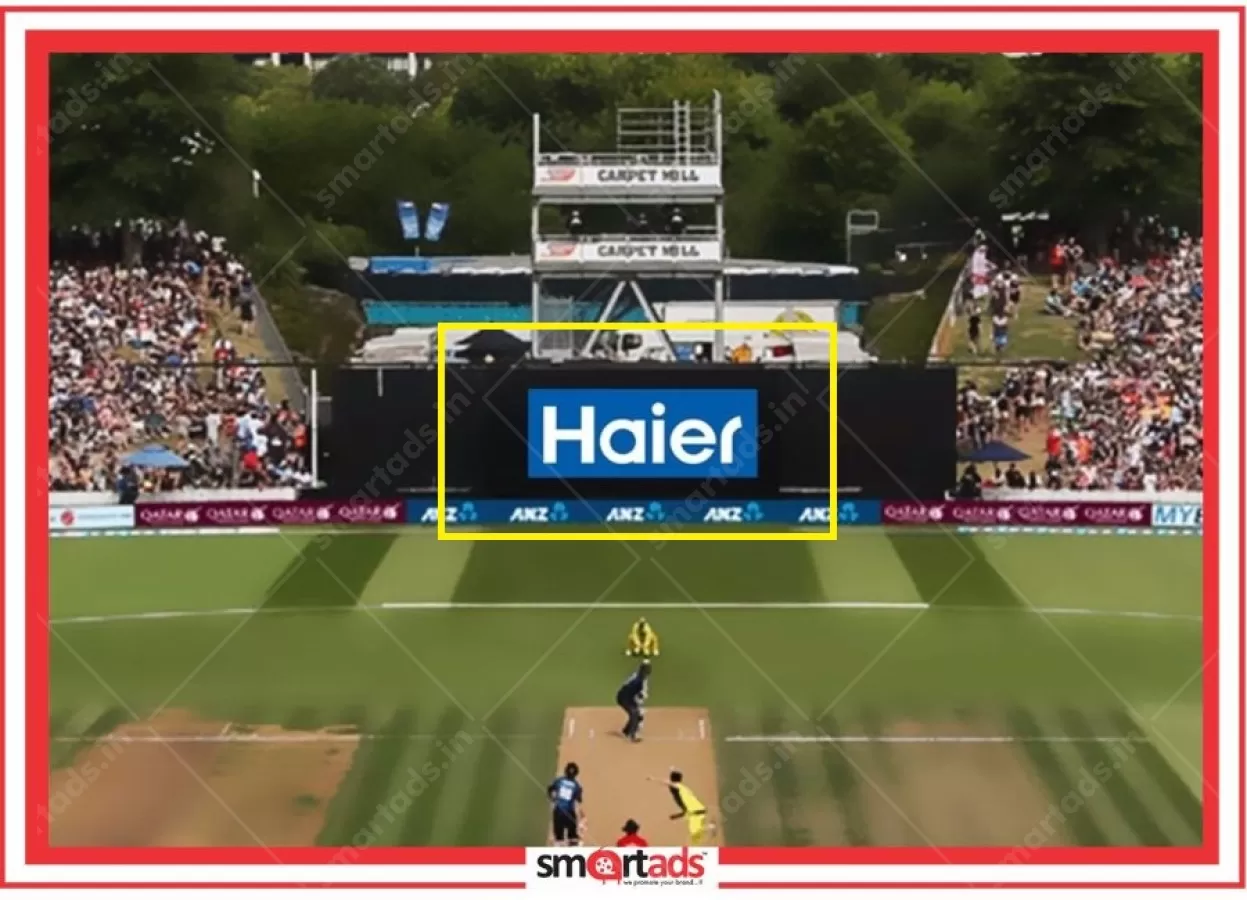
Various Sizes
5 Overs Per ODI Match , 2 Overs Per T20
Rate per Digital Screen / Per match
At Time Only 1 Display Name.
₹1150000.00
MEDIA REACH

MinimumQty :
1
EstimateReachPeople :
40000

Few advertising environments in western India match what a live cricket match creates — a captive audience of passionate fans, a high-dwell-time venue, and a broadcast lens that can carry your brand into millions of homes simultaneously. Rajkot, often underestimated as a media market, quietly hosts some of the most valuable in-stadium branding inventory in Gujarat, and brands that have figured this out are quietly locking in long-term positions at Niranjan Shah Stadium before the rest of the market catches on.
There is a version of this conversation we have had dozens of times at SmartAds — a brand manager walks in asking about digital campaigns, and by the end of the meeting, they are genuinely surprised to learn that cricket ground advertising in Rajkot can deliver a cost-per-impression that rivals, and sometimes beats, what they are spending on programmatic display. The reason is structural: when 28,000 spectators fill Niranjan Shah Stadium for an international cricket match, they are not scrolling past your ad or skipping a pre-roll; they are sitting in a bowl-shaped venue where your boundary board or perimeter LED display is literally part of the visual landscape for three to eight hours.
What a lot of people miss is the psychological dimension of in-stadium branding. Research cited in the FICCI-EY Media and Entertainment Report consistently shows that brand recall in live sports environments is significantly higher than in passive media consumption, because the emotional arousal of watching cricket live primes audiences to encode surrounding brand signals more deeply. When Rajkot's crowd erupts after a six, your brand name on the perimeter board is captured in that moment of joy — and that association is not easily undone by a competitor's Instagram ad the next morning. This is the core argument for below-the-line advertising in cricket venues, and it is one that the numbers tend to support once you actually model the reach.
On top of that, Rajkot's catchment geography makes this market particularly interesting. The stadium draws spectators not just from the city itself but from across the Saurashtra region — Junagadh, Bhavnagar, Jamnagar, Amreli — and from parts of Kutch, which means the effective audience for cricket stadium advertising in Rajkot extends well beyond the city's own population of roughly 1.4 million. For brands trying to build brand awareness across western Gujarat without running separate campaigns in six different towns, a single well-executed in-stadium branding campaign at Niranjan Shah Stadium can do the heavy lifting across the entire region.
Niranjan Shah Stadium — also referred to as the Khandheri Cricket Stadium, since it is located in the Khandheri area of Rajkot — offers a wider menu of advertising formats than most brands initially expect. The most visible, and the most frequently requested, are the perimeter boards that run along the boundary rope; these come in both static hoarding format and, increasingly, as LED perimeter display panels that rotate brand creatives every few seconds. Beyond the boundary, the stadium also carries options for stadium hoarding placement on the outer walls and entry gates, which captures audiences during the high-traffic pre-match and post-match windows when dwell time is still significant but the in-play restrictions are lifted.
Inside the venue, in-pitch branding — the logo placement visible on the pitch cover and the square-leg area — is among the most televised positions in the entire stadium, which is why it commands a premium and tends to be booked well in advance by national brands. Scoreboard advertising at the Rajkot cricket venue is another format that deserves more attention than it gets; every time a score update flashes, your brand name appears alongside it, and during a T20I or ODI, that can mean several hundred exposures across a single match. Seat back advertising, where brand creatives are placed on the reverse of spectator seats, delivers a more intimate, eye-level impression that works particularly well for brands targeting the mid-income family segment that makes up a large share of Rajkot's match-day footfall.
Digital screen ads on the large video screens inside the stadium represent the newest and arguably most dynamic format available at Niranjan Shah Stadium; these screens are used for replays, match graphics, and entertainment content between overs, which means a 10-second brand slot on the big screen gets seen by the entire stadium simultaneously. We have found that brands which combine two or three of these formats — say, a perimeter LED display position plus a digital screen ad slot — tend to generate significantly stronger brand recall scores than those running a single format in isolation, because the audience encounters the brand across multiple visual contexts throughout the same match.
Frankly speaking, this is where most online searches hit a wall, because almost no agency or media owner publishes actual rate cards for Niranjan Shah Stadium — and that opacity frustrates brand managers who need to build a business case before they can even get a conversation started internally. So let us be direct about what we know from our own bookings and market experience, with the caveat that rates shift based on match type, season, and inventory availability.
For a static hoarding along the boundary perimeter during a domestic match — say, a Ranji Trophy game or a Vijay Hazare Trophy fixture — the advertising cost per match works out to somewhere in the ballpark of ₹50,000 to ₹1.5 lakh per panel, depending on panel size and position. For international fixtures, specifically T20I and ODI matches, the same static hoarding positions are priced considerably higher, typically in the range of ₹3 lakh to ₹8 lakh per match per panel, which reflects the broadcast exposure those matches carry. LED perimeter display slots, because they rotate multiple brands within a single physical panel, are priced differently — a brand typically buys a share of the rotation cycle, and the effective cost per brand per match for a prominent LED position during an international match is somewhere between ₹2 lakh and ₹6 lakh, depending on the share of rotation purchased.
At SmartAds, we always tell our clients that the real value calculation for cricket stadium advertising in Rajkot has to account for the television viewership multiplier. A match at Niranjan Shah Stadium that is broadcast live on a major sports channel — which most international matches are — means your boundary board is being seen not just by the 28,000 people in the stadium but by a television audience that can run into several crore viewers nationally. When you divide the total campaign cost by that combined reach figure, the CPM often works out to a number that surprises even experienced media planners who assumed outdoor or digital would be more efficient. That said, we would caution against over-indexing on the TV exposure argument for domestic matches, where broadcast reach is more limited and the in-stadium impression becomes the primary value driver.
The distinction matters more than most brands initially appreciate, and we have seen this choice made wrong enough times that it is worth spending a moment on it. A static hoarding at the Rajkot cricket ground is exactly what it sounds like — a fixed, printed creative that stays in place for the duration of the match or the campaign period. Its advantage is simplicity: the production cost is lower, the booking process is more straightforward, and the creative has a constant, uninterrupted presence for anyone looking in that direction. For brands with a single, clean visual message — a product launch, a store address, a logo-and-tagline — static hoardings remain a perfectly effective format.
LED perimeter display panels, on the other hand, are dynamic by design; they cycle through multiple brand creatives in a rotation, which means your brand shares the physical space with other advertisers but gains the ability to run animated or video-format creatives that catch the eye far more effectively than a static print. The television camera, which sweeps the boundary regularly during play, tends to capture LED panels in motion, which means the visual impact on broadcast is often stronger than a static equivalent. The trade-off is that you are buying a share of attention rather than exclusive ownership of that panel — and during a high-intensity match moment, a rotation that puts your competitor's creative on screen during a wicket celebration is a real possibility.
Our experience shows that for brand awareness cricket campaigns where the goal is maximum impression frequency, LED perimeter display is typically the stronger choice; for campaigns where the creative message is complex or requires sustained reading time — a QR code, a detailed product claim, a phone number — static hoardings tend to perform better because the audience has time to process the message without it rotating away. The smartest approach, which we have used successfully for a consumer finance brand in Rajkot, is to run a static hoarding in a high-dwell position like the sightscreen end while simultaneously booking an LED slot for the main perimeter, effectively getting both the sustained exposure and the dynamic broadcast impact within a single campaign budget.
This is a question we genuinely enjoy answering, because the honest answer is more encouraging than most local brands expect. The assumption that cricket stadium advertising in Rajkot is exclusively the domain of national FMCG giants or telecom brands is simply not accurate — particularly when you factor in domestic match inventory, which is priced at a fraction of international fixture rates and still delivers meaningful match-day footfall and regional brand visibility.
A local jewellery brand in Rajkot, for instance, could run a static hoarding campaign across a full Ranji Trophy home series at Niranjan Shah Stadium for a total investment that is comparable to what they might spend on a month of newspaper insertions in a regional daily — somewhere in the range of ₹3 lakh to ₹8 lakh for a season of domestic fixtures, depending on panel count and position. The audience at domestic matches skews heavily local and regional, which is precisely the demographic a Rajkot-based brand wants to reach; these are Saurashtra cricket fans who follow the home team with genuine passion, which means the brand environment carries emotional resonance that a newspaper ad simply cannot replicate.
To be fair, there are real constraints for smaller advertisers: the minimum booking periods, the creative production requirements for LED formats, and the advance planning timelines that Saurashtra Cricket Association fixtures demand can feel burdensome for a business that is used to booking newspaper ads a week before publication. This is where working with a stadium branding agency that already has relationships with the SCA and understands the booking calendar becomes genuinely valuable — not just as a convenience but as a way to access inventory that is not always publicly listed. At SmartAds, we have helped several Rajkot-based businesses — including a regional real estate developer and a local automotive dealership — enter the stadium advertising space for the first time at budget levels they did not think were possible, by packaging domestic match inventory with complementary outdoor placements near the stadium.
Niranjan Shah Stadium has hosted a meaningful range of international and domestic cricket, which gives advertisers a broader calendar of opportunities than the venue's mid-tier reputation might suggest. On the international side, the ground has hosted T20I and ODI matches, as well as Test match cricket — and it is worth noting that Test matches, while slower-paced, actually offer some of the most sustained brand exposure of any format, since five days of play means five days of boundary board visibility and broadcast coverage. The audience profile for Test matches also skews older and more affluent than T20I crowds, which can be a useful demographic consideration depending on the brand's target segment.
The Saurashtra Premier League, which is the state-level T20 competition organised under the auspices of the Saurashtra Cricket Association, represents what we consider one of the most underutilised advertising opportunities in the entire Gujarat sports calendar. SPL matches draw passionate local crowds, the inventory is priced at a level that makes it accessible to regional brands, and the association with Saurashtra cricket — which carries deep cultural significance in this part of Gujarat — gives brands a local-hero positioning that national properties simply cannot offer. We have seen brands use SPL sponsorship as a stepping stone to building genuine brand equity in the Saurashtra market before scaling up to international match inventory.
Ranji Trophy advertising at Niranjan Shah Stadium, along with Vijay Hazare Trophy branding opportunities, round out the domestic calendar and deserve serious consideration from brands that are working with measured budgets. The Irani Cup, when hosted in Rajkot, is another fixture that carries national broadcast attention without the premium pricing of a full international series. What a lot of brands get wrong is treating domestic matches as a fallback option rather than a deliberate strategic choice; the reality is that for a brand whose core customer is a cricket-loving middle-class family in Saurashtra, a Ranji Trophy match at the home ground is arguably a more contextually relevant environment than an IPL match in a different city.
Below-the-line advertising, as a discipline, is defined by its directness — it reaches a specific, identifiable audience in a controlled environment rather than broadcasting a message to a mass audience and hoping the right people see it. Cricket stadium advertising sits at an interesting intersection: it has the mass audience reach of above-the-line media but the environmental specificity and captive audience quality of BTL. This is why the industry has increasingly classified in-stadium branding as non-traditional advertising or BTL advertising, even though the reach numbers can rival traditional broadcast placements.
The cricket stadium environment amplifies BTL advertising effectiveness through several mechanisms that work simultaneously. The captive audience dynamic — where spectators are physically present in the venue for the duration of the match — means that unlike a billboard on a highway, which a driver passes in three seconds, a boundary board at Niranjan Shah Stadium is in the sightline of a fan for potentially four to six hours. The emotional intensity of live cricket creates what sports marketing researchers describe as a heightened state of receptivity, where brand messages encountered during exciting moments are encoded more strongly in memory. And the social dimension of attending a match — going with family, friends, or colleagues — means that brand encounters at the venue are often discussed and shared, extending the effective reach beyond the stadium itself.
On top of that, the BTL advertising toolkit available at cricket grounds in Rajkot extends well beyond the boundary boards. Brand activation cricket stadium opportunities — where a brand sets up an experiential marketing zone in the concourse or entry area — allow for direct consumer engagement that no traditional media channel can replicate. We have executed brand activation campaigns at cricket venues in Gujarat where a consumer finance client set up a loan calculator kiosk in the stadium concourse, generating over 800 qualified leads across a single two-day domestic series — a result that would have cost several times more to achieve through a conventional digital lead generation campaign. Experiential marketing at the Rajkot cricket venue is still relatively underdeveloped compared to stadiums in Mumbai or Bengaluru, which actually means the competition for activation space is lower and the audience novelty factor is higher.
The booking process for cricket ground advertising in Rajkot runs through the Saurashtra Cricket Association, which holds the advertising rights for Niranjan Shah Stadium and manages the allocation of in-stadium inventory across all match types. For international fixtures — T20I, ODI, and Test matches — BCCI oversight adds an additional layer to the approval process, since the Board of Control for Cricket in India sets guidelines around brand categories, creative content standards, and the proportion of inventory that can be sold to non-title sponsors. This does not mean brands need BCCI approval for every booking, but it does mean that certain category restrictions apply — alcohol brands, for instance, face significant restrictions on in-stadium visibility during BCCI-sanctioned matches — and that the SCA's own approval timelines need to be factored into campaign planning.
For domestic matches and SCA-organised tournaments like the Saurashtra Premier League, the advertising rights Saurashtra Cricket Association holds are managed more directly, with fewer BCCI-level constraints and faster approval timelines. In our experience, bookings for domestic match inventory at Niranjan Shah Stadium can typically be confirmed within two to three weeks of application, provided the creative materials meet the SCA's specifications and the brand category is not restricted. International match inventory, by contrast, is often allocated months in advance — sometimes as part of a series-level package — which means brands that wait until a match is announced and then try to book are frequently finding that the best positions are already taken.
Working with a stadium branding agency that has an established relationship with the SCA is the most reliable way to navigate this process, particularly for first-time advertisers who are unfamiliar with the documentation requirements and creative specification formats. At SmartAds, we manage the end-to-end booking process for our clients — from initial inventory assessment and rate negotiation through creative adaptation, SCA submission, and on-ground installation verification — which means the brand manager on the other side does not need to become an expert in stadium advertising logistics. What we would caution against is approaching the SCA directly without understanding the rate structure and available inventory, because without market benchmarks, it is very easy to pay above-market rates for a suboptimal position.
The Saurashtra Cricket Association is the governing body for cricket in the Saurashtra region of Gujarat, and it functions as the primary rights holder for commercial activities at Niranjan Shah Stadium, which is also sometimes referred to in historical records as the Madhavrao Scindia Cricket Ground — a naming history that occasionally causes confusion in booking documentation. The SCA's commercial rights include the sale of in-stadium advertising inventory, ground-level branding, digital screen ad slots, and experiential marketing zones, all of which are managed through the association's commercial operations team.
For international matches sanctioned by the BCCI, the advertising framework becomes more structured: the BCCI's host association guidelines specify which categories of inventory are available for local sale by the SCA and which are reserved for title sponsors and official partners of the national board. This means that brands looking to advertise during an India international match at Niranjan Shah Stadium need to work within the residual inventory that the SCA is permitted to sell locally — which still represents a significant volume of visible positions, including many of the perimeter boards and entry gate hoardings, but may exclude certain premium positions that are pre-allocated to BCCI commercial partners. Understanding this structure is essential for any brand planning a cricket stadium advertising campaign in Rajkot, because it determines both what is available and what the realistic pricing range looks like.
The SCA also manages advertising rights for its own domestic competitions, including Ranji Trophy home matches, Vijay Hazare Trophy fixtures, and SPL games, where the commercial framework is entirely under the association's control and the available inventory is broader. Stadium naming rights — the most premium form of sports sponsorship Rajkot has to offer — are also managed at the SCA level, and while the stadium currently carries Niranjan Shah's name in honour of the former BCCI secretary and SCA administrator, the naming rights framework for future arrangements would be negotiated directly with the association. For most brands, naming rights represent a multi-year, multi-crore commitment that is beyond typical campaign budgets, but it is worth knowing that the conversation starts with the SCA.
Return on investment for stadium advertising is genuinely harder to measure than digital channels, and we would rather be honest about that than pretend otherwise. The absence of a click-through rate or a conversion pixel means that brands need to be thoughtful about how they define and measure success before the campaign begins, not after. The good news is that there are several well-established methodologies that, when applied rigorously, give a reasonably reliable picture of campaign effectiveness.
The most direct measurement approach for in-stadium branding is brand recall research — pre- and post-campaign surveys conducted among the target audience in the Rajkot market, which measure unaided and aided brand recall, message association, and purchase intent. When we ran a post-campaign brand study for a consumer durables brand that had run perimeter boards at Niranjan Shah Stadium across an ODI series, the unaided brand recall among Rajkot residents who attended the match was roughly 34 percentage points higher than among a matched control group who had not attended — a figure that, when translated into reach and frequency terms, represented a cost-per-recall that was significantly more efficient than the brand's concurrent television campaign in the Gujarat market. The television viewership cricket component adds another measurable layer: TAM AdEx data on broadcast reach for specific matches can be used to estimate the total audience that saw the brand's boundary board on screen, which when combined with the in-stadium footfall gives a total gross impression figure for the campaign.
Mass audience reach metrics, combined with brand awareness cricket surveys and sales data from the Rajkot market in the weeks following a campaign, give a reasonably complete picture of return on investment stadium advertising delivers. What a lot of brands get wrong is expecting immediate, attributable sales uplift from a single match's worth of exposure — in-stadium branding is fundamentally a brand-building medium, which means the ROI case is built over a series of matches and a sustained presence, not a single activation. Our recommendation is always to commit to at least a full domestic series or a minimum of three to four match-day exposures before drawing conclusions about campaign performance, because the brand recall and consumer engagement cricket generates tends to compound with repeated exposure rather than delivering its full value in a single hit.
The digital infrastructure at Niranjan Shah Stadium has been upgraded progressively over the past several years, and the venue now operates large-format video screens that are used for match replays, player statistics, and entertainment content during breaks in play. Scoreboard advertising at the Rajkot cricket venue — where brand names appear alongside score displays — is one of the most consistently visible formats in the entire stadium, because every spectator checks the scoreboard repeatedly throughout a match; it is one of those formats where the audience actively seeks out the display rather than passively encountering it. The brand that occupies the scoreboard naming position is, in effect, getting a free mention every time a commentator or spectator references the score.
Digital screen ads on the main video screens operate on a slot-based model, where brands purchase a defined number of 10- to 30-second slots distributed across the match day — during drinks breaks, over changes, the innings interval, and the pre-match and post-match windows. The production requirements for these slots are more demanding than static hoardings, since the content needs to be optimised for large-format display and must meet the SCA's content guidelines, but the creative impact is substantially higher; a well-produced 15-second brand film on a 40-foot screen in a packed stadium is a genuinely powerful brand moment. We have found that brands which repurpose their existing television commercials for stadium screen slots often underperform compared to brands that create content specifically for the live stadium environment — the audience is different, the context is different, and the creative needs to reflect that.
On-ground branding at the Rajkot cricket venue also extends to the pitch-side logo positions visible during ground preparation and pitch inspection footage, which is broadcast during the pre-match window and tends to receive sustained camera attention. Pitch-side logo Rajkot placements are limited in number and consequently command a premium, but for brands that prioritise broadcast visibility over in-stadium footfall reach, they represent one of the most cost-efficient ways to get brand exposure on the cricket broadcast without buying a full television advertising package. Integrated marketing communication strategies that combine a pitch-side logo with a concurrent social media campaign — amplifying the in-stadium moment through digital channels — have, in our experience, delivered brand awareness multipliers that neither channel could achieve independently.
Q: How much does cricket stadium advertising at Niranjan Shah Stadium in Rajkot cost?
The honest answer is that it depends significantly on the match type, the specific format, and the position within the stadium. For static boundary hoardings during domestic matches — Ranji Trophy, Vijay Hazare Trophy, or SPL fixtures — the advertising cost per match works out to somewhere in the range of ₹50,000 to ₹1.5 lakh per panel, which makes it genuinely accessible for regional brands. International match inventory — T20I, ODI, or Test match fixtures — is priced considerably higher, with perimeter board positions typically falling somewhere between ₹3 lakh and ₹8 lakh per match per panel, depending on the position and the broadcast profile of the specific fixture. LED perimeter display slots, which rotate multiple brands, are priced on a share-of-rotation basis and can range from ₹2 lakh to ₹6 lakh per brand per match for a prominent position during an international game. Scoreboard advertising and digital screen ad slots carry their own rate structures, which are best discussed directly with a stadium branding agency that has current rate card access from the SCA. At SmartAds, we provide our clients with a detailed rate comparison across match types and formats before any commitment is made.
Q: What types of advertising formats are available at the Rajkot cricket stadium?
Niranjan Shah Stadium offers a range of in-stadium branding formats that span the full spectrum from large-format outdoor to digital and experiential. The primary formats include static boundary hoardings, LED perimeter display panels, scoreboard advertising, digital screen ad slots on the main video boards, seat back advertising, entry gate hoardings, in-pitch branding positions, and pitch-side logo placements. Beyond these fixed formats, the stadium also accommodates brand activation zones in the concourse and entry areas, where brands can set up experiential marketing installations that allow direct consumer engagement with match-day attendees. Each format has different pricing, creative specifications, and booking lead times, which is why working with an agency that understands the full inventory matrix is considerably more efficient than trying to navigate the options independently.
Q: Who do I contact to book advertising space at the Saurashtra Cricket Association Stadium?
Advertising rights at Niranjan Shah Stadium are managed by the Saurashtra Cricket Association, which is the primary point of contact for all in-stadium commercial bookings. For international matches, the BCCI's host association guidelines add a layer of approval that the SCA manages on behalf of advertisers, so brands do not typically need to approach the BCCI directly. The most practical route for most advertisers is to engage a stadium branding agency or an advertising agency in Rajkot with an established SCA relationship, which streamlines the booking process, ensures accurate rate information, and handles the creative submission and approval workflow. SmartAds manages the complete booking process for our clients, from initial inventory identification through to on-ground installation confirmation, which removes the administrative burden from the brand's internal team.
Q: Is cricket stadium advertising in Rajkot suitable for small and local businesses?
Yes, and more so than most local business owners realise. The key is choosing the right match type and format for the budget available. Domestic match inventory — Ranji Trophy games, Vijay Hazare Trophy fixtures, and SPL matches — is priced at a level that is genuinely accessible for Rajkot-based SMEs, and the audience at these matches is overwhelmingly local and regional, which is exactly the demographic a local brand wants to reach. A static hoarding campaign across a full domestic series can be executed for a total investment that is comparable to a mid-sized newspaper campaign, but with the added dimensions of emotional environment, captive audience quality, and the brand-building association that comes from appearing alongside live cricket. We have helped several Rajkot-based businesses — including a regional jewellery retailer and a local real estate developer — enter the stadium advertising space for the first time at budget levels they found comfortable, by packaging domestic match inventory with complementary outdoor placements near the stadium.
Q: What is the seating capacity and match-day footfall at Niranjan Shah Stadium?
Niranjan Shah Stadium has a seating capacity of approximately 28,000 spectators, which makes it a mid-sized venue by Indian cricket standards — larger than several Ranji Trophy grounds but smaller than the major Test centres in Mumbai, Chennai, or Kolkata. For international matches, the stadium typically operates at or near full capacity, which means match-day footfall of somewhere between 25,000 and 28,000 people per day of play. For domestic matches, attendance varies considerably — popular Ranji Trophy fixtures against strong opposition can draw 8,000 to 15,000 spectators, while weekday domestic games may see lower turnout. The important point for advertisers is that even at 50% capacity, a domestic match at Niranjan Shah Stadium delivers a captive audience of 12,000 to 14,000 people who are present in the venue for the full duration of play, which is a level of sustained brand exposure that very few other BTL advertising environments can match.
Q: What is the difference between static hoardings and LED perimeter board advertising at the Rajkot ground?
Static hoardings are fixed, printed creatives that occupy a defined panel position for the duration of the campaign; they offer exclusive ownership of that panel, lower production costs, and are particularly effective for messages that require sustained reading time — a brand logo, a store address, a product image. LED perimeter display panels are dynamic, rotating through multiple brand creatives in a cycle, which means a brand shares the physical panel with other advertisers but gains the ability to run animated or video-format content that is more eye-catching and performs better on broadcast camera capture. The choice between the two depends on the brand's creative strategy, budget, and primary objective: for maximum broadcast visibility and dynamic creative impact, LED perimeter display is generally the stronger choice; for sustained, exclusive presence and message clarity, static hoardings tend to deliver better results.
Q: Can my brand get TV exposure through in-stadium advertising at Rajkot during international matches?
Yes, and this is one of the most compelling aspects of cricket ground advertising in Rajkot for brands with national or regional aspirations. International matches at Niranjan Shah Stadium — T20I, ODI, and Test matches — are broadcast live on major sports channels, and the boundary perimeter boards, in-pitch branding positions, and scoreboard advertising are all within the camera's regular field of view. The television viewership cricket generates for India international matches can run into several crore viewers nationally, which means a brand's boundary board is effectively receiving broadcast media exposure as a secondary benefit of the in-stadium placement. The key caveat is that broadcast exposure is not guaranteed for every creative position — only those within the standard camera angles receive consistent television visibility — and this is something a knowledgeable stadium branding agency should be able to advise on before the booking is confirmed.
Q: What is BTL advertising and how does it apply to cricket stadium branding in Rajkot?
Below-the-line advertising refers to targeted, direct-to-consumer brand communication that reaches a specific, defined audience in a controlled environment, as distinct from above-the-line mass media like television or newspaper advertising. Cricket stadium branding sits within the BTL and non-traditional advertising category because it reaches a specific, self-selected audience — cricket fans who have chosen to attend a live match — in a high-engagement, high-dwell-time environment that is fundamentally different from passive media consumption. The application at Niranjan Shah Stadium is straightforward: brands use the various in-stadium formats — perimeter boards, scoreboard advertising, seat back advertising, brand activation zones — to reach a captive audience of cricket fans with a level of contextual relevance and emotional resonance that traditional media channels cannot replicate. The BTL advertising framework also encompasses the experiential and activation elements, where brands move beyond passive display to create direct consumer interactions at the venue.
Q: Which tournaments and matches are held at Niranjan Shah Stadium that offer advertising opportunities?
Niranjan Shah Stadium has hosted a broad range of cricket across formats and competition levels. On the international side, the ground has hosted T20I matches, ODI matches, and Test match cricket involving the Indian national team. Domestically, the stadium serves as the home ground for the Saurashtra Ranji Trophy team, which means it hosts Ranji Trophy advertising opportunities across the domestic season; it also hosts Vijay Hazare Trophy branding opportunities during the domestic one-day competition and has been a venue for the Irani Cup when Saurashtra has been involved. The Saurashtra Premier League, the state-level T20 competition, uses the stadium as its primary venue and represents one of the most accessible and underutilised advertising opportunities in the Rajkot sports calendar. Each of these match types offers different audience profiles, pricing levels, and brand visibility dynamics, which is why a well-planned cricket stadium advertising campaign in Rajkot typically considers the full annual calendar rather than a single fixture.
Q: Do I need BCCI approval to advertise inside the Rajkot cricket stadium?
For international matches sanctioned by the BCCI, brands do not typically need to approach the BCCI directly — the Saurashtra Cricket Association manages the local advertising inventory within the framework that the BCCI sets for host associations, and the SCA's approval is the operative one for most in-stadium positions. However, certain brand categories are restricted under BCCI guidelines — alcohol brands face significant visibility restrictions during BCCI-sanctioned matches, and some other categories may require additional clearance. For domestic matches and SCA-organised competitions like the SPL, the BCCI's commercial framework does not apply directly, and the SCA manages the advertising rights independently. The practical advice is to work with a stadium branding agency that understands the current BCCI and SCA guidelines, because the specific restrictions and approval requirements can change between seasons and are not always publicly documented.
Q: How is ROI measured for cricket stadium advertising in Rajkot?
ROI measurement for in-stadium branding combines several methodologies, none of which are as immediate as a digital click-through but all of which, when applied rigorously, give a meaningful picture of campaign effectiveness. Brand recall surveys — conducted pre- and post-campaign among the target audience in the Rajkot market — measure the change in unaided and aided brand awareness that the campaign has driven. Broadcast reach data from TAM AdEx or BARC viewership reports can be used to estimate the total television audience that saw the brand's boundary board during a specific match, which when combined with the in-stadium footfall figure gives a total gross impression count. Sales data from the Rajkot market in the weeks following a campaign provides the most direct commercial signal, though attributing sales uplift to a specific in-stadium campaign requires careful baseline analysis. At SmartAds, we build a measurement framework for each campaign before it launches, so the brand has a clear definition of success and a methodology for evaluating it — rather than trying to reverse-engineer the ROI calculation after the fact.
**Q: Can brands activate experiential
