
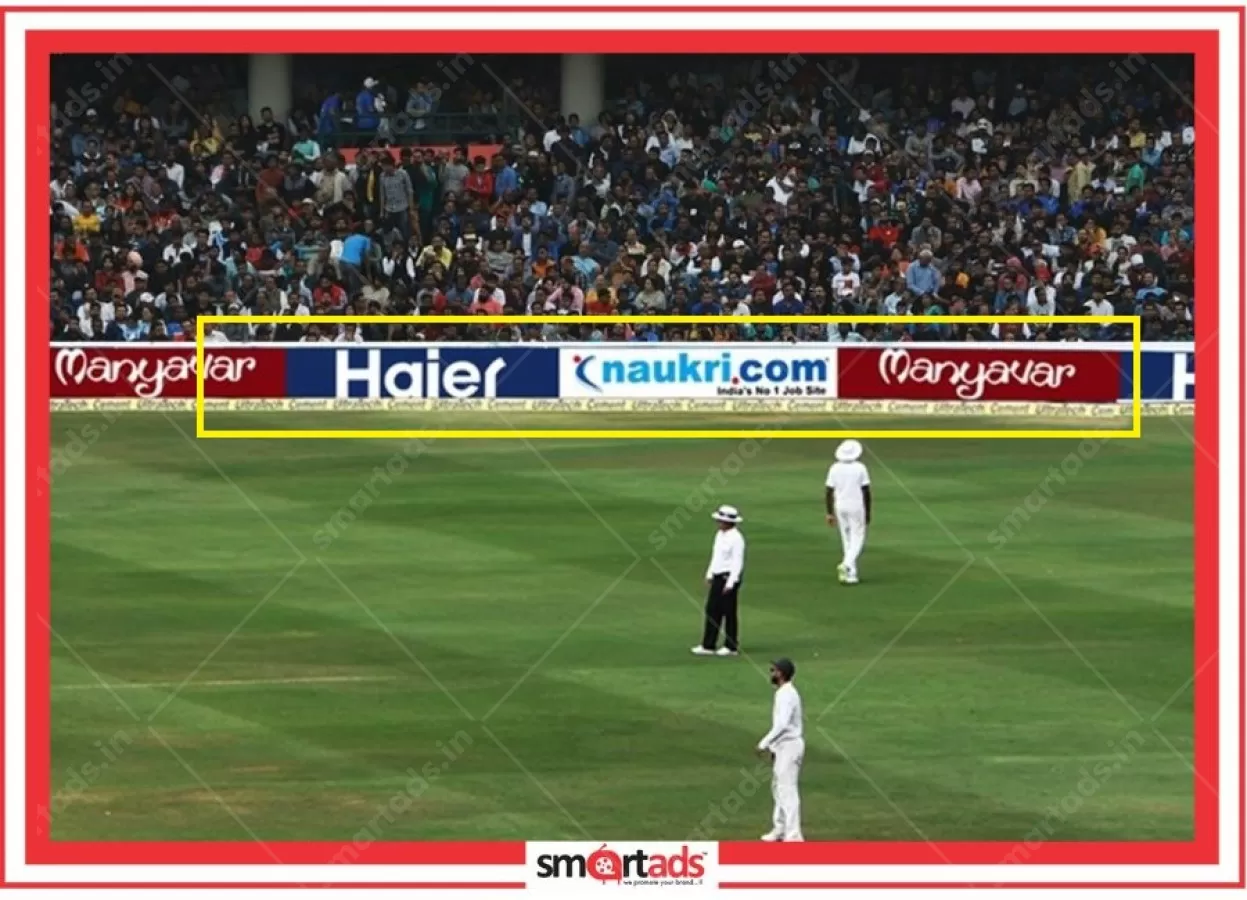
Silver HD Perimeter Signage
Various Sizes
1 ball in every 10 Balls : 50% of the Gr
Rate per Digital Screen / Per match
At Time Only 3 Display Name.
₹1100000.00
Showing 1 to 4 of 4 Results
MEDIA DETAILS
Various Sizes
1 ball in every 10 Balls : 50% of the Gr
Rate per Digital Screen / Per match
At Time Only 3 Display Name.
₹1100000.00
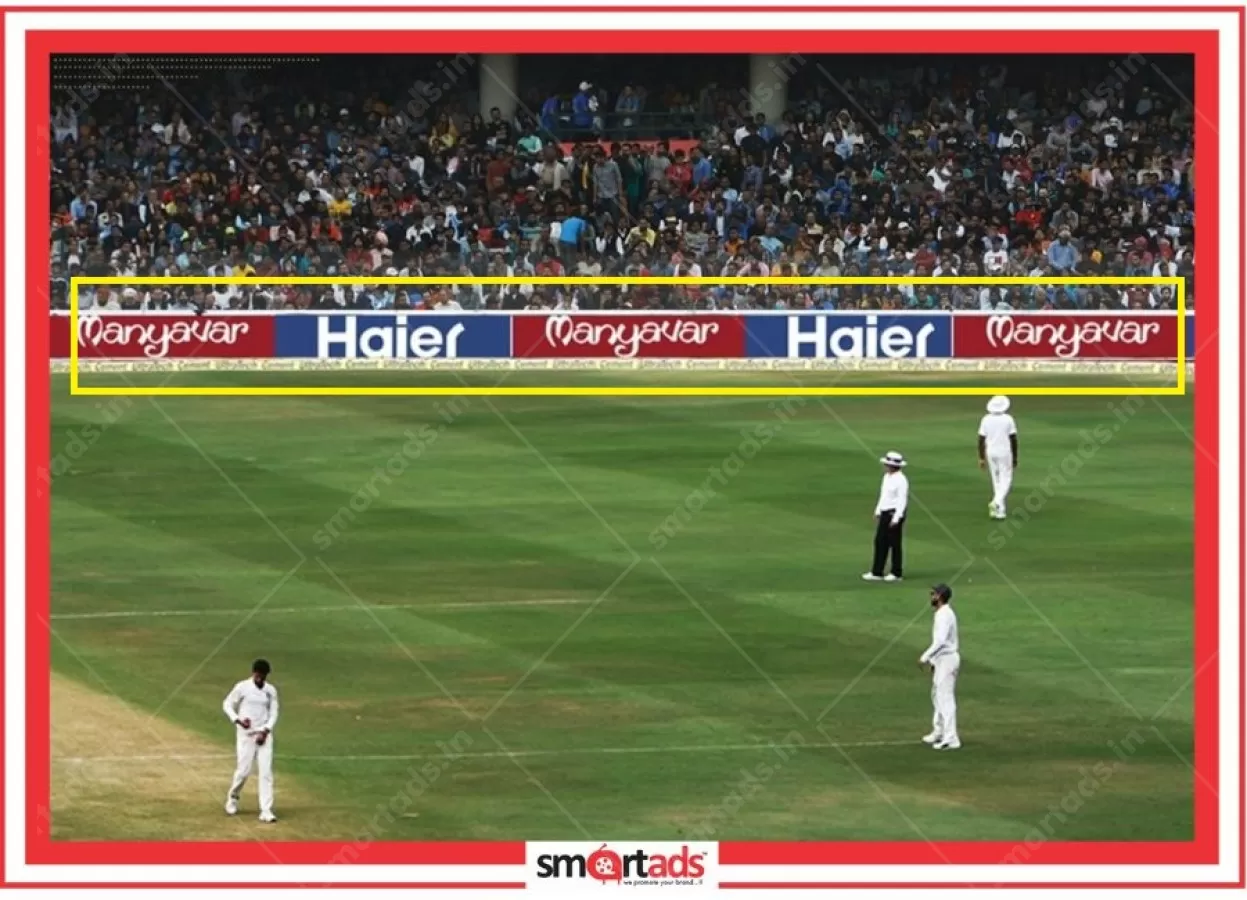
Various Sizes
1 Ball In Every 10 Balls : 50% Of The Gr
Rate per Digital Screen / Per match
At Time Only 2 Display Name.
₹1700000.00
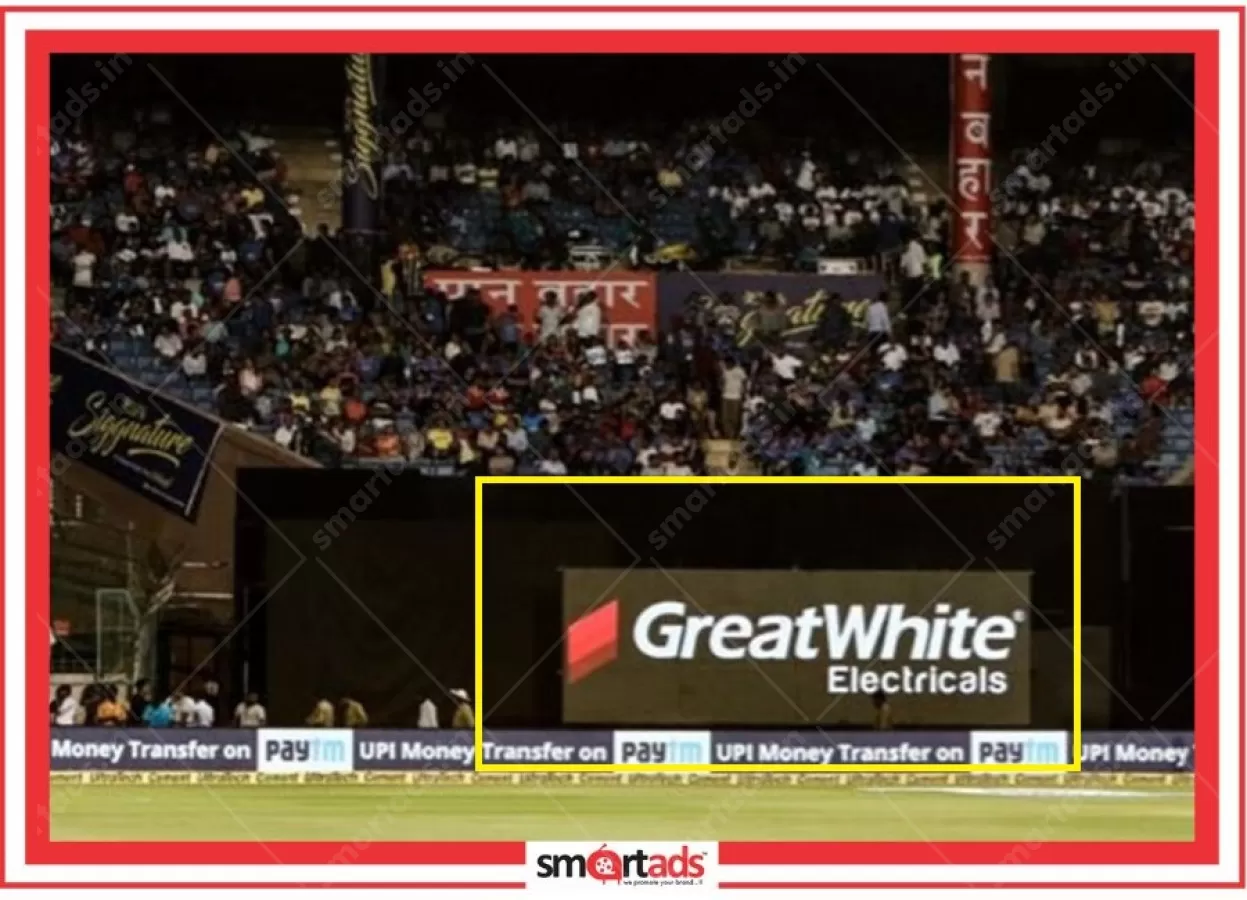
Various Sizes
5 Overs Per ODI Match , 2 Overs Per T20
Rate per Digital Screen / Per match
At Time Only 1 Display Name.
₹1150000.00
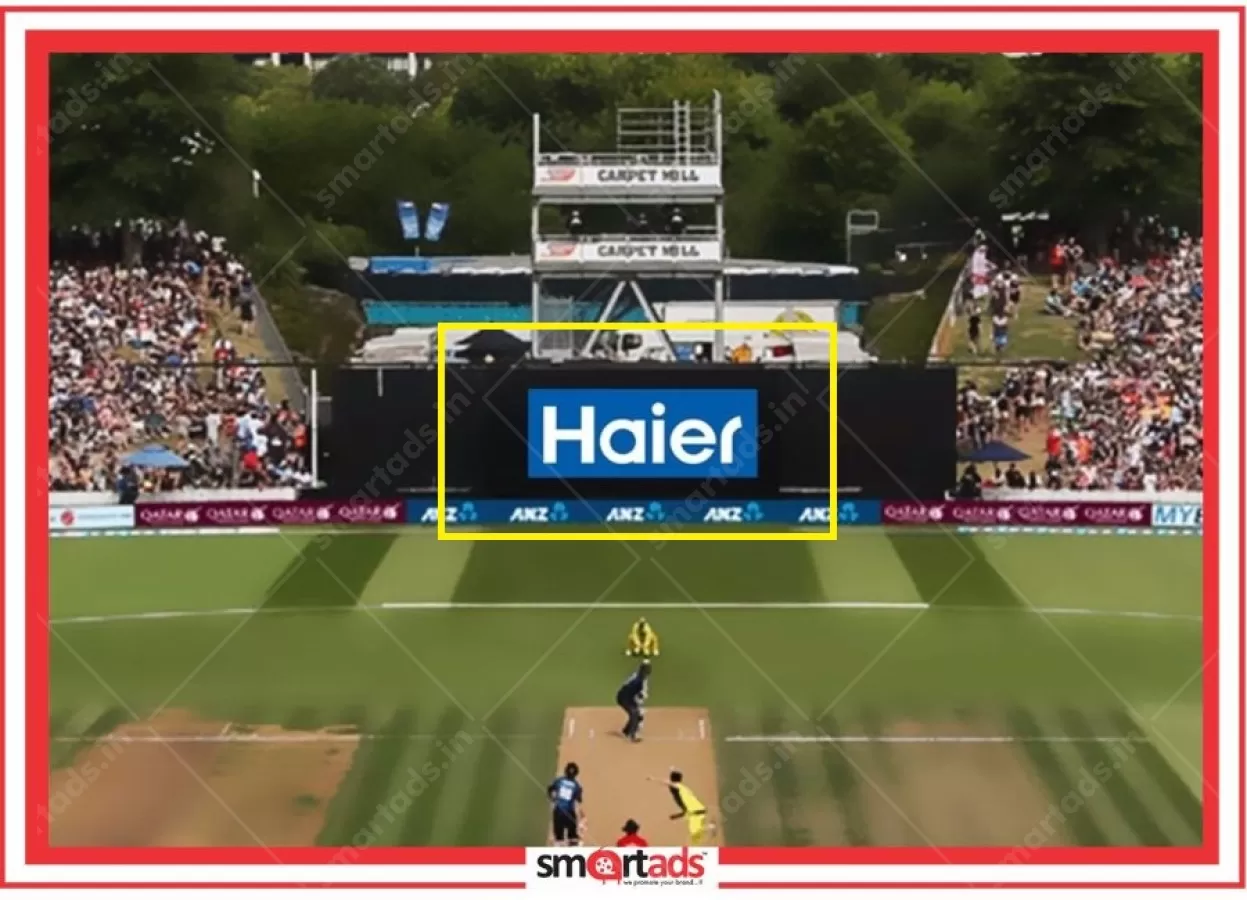
Various Sizes
5 Overs Per ODI Match , 2 Overs Per T20
Rate per Digital Screen / Per match
At Time Only 1 Display Name.
₹1150000.00
MEDIA REACH

MinimumQty :
1
EstimateReachPeople :
70000

Most brand managers who walk into a conversation about Ekana Cricket Stadium advertising come in expecting it to be expensive, complicated, and out of reach for anyone below a certain budget threshold. What surprises them — consistently — is that cricket stadium advertising in Lucknow is not only accessible at multiple investment levels, but that the captive audience quality at BRSABV Ekana Cricket Stadium is genuinely difficult to replicate through any other medium in Uttar Pradesh. When 50,000 people sit in a stadium for four hours with nowhere else to look, something interesting happens to brand recall numbers.
There is a reason that brands ranging from regional cement companies to national FMCG players have been drawn to in-stadium advertising at Ekana Cricket Stadium over the past several IPL seasons. The BRSABV Ekana Cricket Stadium — formally known as the Bharat Ratna Shri Atal Bihari Vajpayee Ekana Cricket Stadium — sits in the heart of Gomti Nagar Extension along Amar Shaheed Path, which places it squarely in one of Lucknow's fastest-growing residential and commercial corridors; the catchment area alone spans a population that skews young, aspirational, and economically active. Uttar Pradesh is not a homogeneous market, and Lucknow, as its capital, draws fans from across the state — from Kanpur and Varanasi to Gorakhpur and Agra — which means that stadium branding at Ekana carries a geographic multiplier that most outdoor advertising in the city simply cannot match.
What a lot of people miss is the psychographic dimension of a cricket audience. These are not passive commuters glancing at a billboard from a moving vehicle; they are emotionally invested, socially engaged, and — critically — present for an extended dwell time that works out to somewhere between three and five hours per match. Our experience at SmartAds shows that brand engagement metrics collected from stadium environments consistently outperform equivalent spends on transit media or even prime-time radio in the same city, particularly when the creative is contextually relevant to the sport or the occasion. A fan who sees your brand on the LED perimeter boards during a Lucknow Super Giants boundary is in a fundamentally different mental state than someone who sees your hoarding on the Hazratganj flyover on a Tuesday morning.
The Lucknow Super Giants franchise — owned by the RPSG Group and having rapidly built one of the more passionate fan bases in the IPL — adds a layer of emotional association that pure out-of-home advertising cannot manufacture. When a brand appears alongside LSG's identity, whether through perimeter boards, scoreboard advertising, or in-pitch branding, it borrows from that emotional equity; and in markets like Uttar Pradesh, where cricket is not merely entertainment but something closer to a shared cultural religion, that borrowed equity has real commercial value. The FICCI-EY Media and Entertainment Report has consistently highlighted sports as one of the highest-engagement content categories in India, and Lucknow's stadium environment is one of the more compelling proofs of that thesis.
Ekana Sportz City offers a wider inventory of advertising formats than most brands initially expect, and the choice of format matters enormously in terms of both broadcast visibility and on-ground impact. The most prominent and sought-after format is the LED perimeter board — those rotating digital screens that ring the boundary and are, frankly, the primary reason that in-stadium advertising translates so powerfully into television and OTT reach. At BRSABV Ekana Cricket Stadium, the LED perimeter boards run along the full boundary perimeter and rotate brand creatives at intervals of roughly eight to twelve seconds per slot, which means that a single brand can appear multiple times per over across the broadcast feed on Jio Hotstar and Star Sports.
Beyond LED perimeter boards, the stadium inventory includes static boundary boards positioned in zones that do not carry digital screens — these are lower-cost entry points for brands that want physical presence without the premium associated with broadcast-visible digital real estate. In-pitch branding, which covers the area around the wicket and the pitch mat advertising zones, is among the most coveted formats precisely because camera angles during deliveries and replays make this zone almost unavoidable for television viewers; it is also one of the more tightly regulated formats, requiring explicit clearance through the Board of Control for Cricket in India and the Uttar Pradesh Cricket Association. Sightscreen branding — the large panels behind the bowler's arm — offers a clean, uncluttered canvas that appears in virtually every ball-by-ball broadcast shot, which is why it commands a premium even relative to other high-visibility formats.
Other formats worth considering include dugout branding, which places a sponsor logo in the team dugout areas visible during player cutaways and strategic timeouts; scoreboard advertising, which carries strong top-of-mind awareness value because fans look at the scoreboard repeatedly throughout a match; and digital screens positioned at entry gates, concourse areas, and food and beverage zones, which reach fans during pre-match and interval periods when they are relaxed and receptive. At SmartAds, we often recommend that clients think about their format mix in terms of two distinct goals — broadcast visibility, which requires LED perimeter boards and in-pitch or sightscreen branding, and on-ground fan engagement, which is better served by concourse screens, experiential marketing activations, and gate branding. The two goals are not mutually exclusive, but conflating them leads to suboptimal budget allocation.
Advertising rates at Ekana Cricket Stadium are structured around match type, format, and duration — and the range is wider than most brands assume. For a single IPL home match during the Lucknow Super Giants' season, LED perimeter board slots are typically priced somewhere in the ballpark of ₹8 lakh to ₹25 lakh per match depending on the number of rotation slots purchased and the specific zone on the boundary, with premium zones facing the broadcast cameras commanding the higher end of that range. Static boundary boards, by contrast, work out to roughly ₹2 lakh to ₹5 lakh per match, which makes them a genuinely viable entry point for regional brands and mid-size businesses that want a physical presence at cricket ground advertising in Lucknow without committing to broadcast-grade budgets.
In-pitch branding and sightscreen branding are priced differently because they are sold as series packages rather than per-match units — a full IPL home leg at Ekana, which typically covers seven to eight home matches per season, can run anywhere from ₹40 lakh to ₹1.5 crore for these premium formats, depending on exclusivity and creative size. Scoreboard advertising packages tend to be more accessible, with per-match rates in the neighbourhood of ₹1.5 lakh to ₹4 lakh, while dugout branding sits at a premium because of its jersey-adjacent visibility. For international cricket matches — bilateral series, T20 internationals, or ODIs hosted at BRSABV Ekana Cricket Stadium — advertising rates are generally lower per match than IPL advertising, but the broadcast audience composition shifts toward a different demographic, which can actually be more valuable for certain categories.
What a lot of brands get wrong is treating Ekana stadium branding cost as a standalone line item rather than evaluating it against the blended CPM it delivers. When you factor in the television viewers reached through broadcast visibility on Jio Hotstar and Star Sports, the in-stadium captive audience of up to 50,000 people per match, and the social media amplification that comes from fan-generated content featuring branded boards, the effective CPM for cricket stadium advertising in Lucknow works out to roughly ₹8 to ₹18 per thousand impressions — a number that surprises most first-time advertisers when they compare it to what they are paying for Instagram reach or programmatic display. We have found, through multiple campaigns planned across Ekana and other Indian cricket venues, that the blended ROI calculation almost always tilts in favour of stadium advertising once broadcast reach is properly attributed.
This is where the real value lies, and it is also where most conversations about below-the-line advertising and non-traditional advertising at cricket stadiums get genuinely interesting. The conventional classification of stadium advertising as BTL advertising or below-the-line advertising is technically accurate — it is not a mass media buy in the traditional sense, and it does not involve purchasing airtime on a broadcaster — but it is also somewhat misleading, because the broadcast spillover from in-stadium advertising at a venue like BRSABV Ekana Cricket Stadium is enormous. During an IPL match broadcast on Jio Hotstar, camera coverage of the boundary and outfield means that LED perimeter boards and boundary boards appear in frame for a significant proportion of total broadcast time; TAM AdEx data on sports broadcast advertising has consistently shown that sponsor logos appearing on perimeter boards during IPL matches accumulate hundreds of exposure seconds per match across the broadcast feed.
The distinction between BTL advertising and above-the-line advertising matters less to a smart media planner than the question of what the money actually buys. On-ground advertising at Ekana delivers something that a television spot cannot: physical presence in the same space as the audience, which creates a fundamentally different kind of brand recall. We tell our clients that in-stadium advertising operates on two simultaneous planes — the broadcast plane, where TV viewers and OTT audiences absorb the brand through repeated visual exposure during the match, and the experiential plane, where the 50,000 people inside the stadium experience the brand as part of the live event itself. Non-traditional advertising formats like this are categorised separately from conventional media buys precisely because they operate on this dual-channel logic, which makes them harder to measure using standard GRP or reach metrics but also harder to replicate through any single conventional medium.
One automotive brand we worked with during an IPL season at Ekana chose to combine LED perimeter board slots with a concourse experiential marketing activation — a test-drive zone and interactive brand experience set up outside the stadium gates — and the results were instructive. The perimeter board exposure generated measurable brand recall lift among television viewers in Uttar Pradesh and neighbouring states, while the experiential activation generated direct leads and footfall data that the brand could track through its dealer network in Lucknow. The combination of broadcast visibility and on-ground fan engagement produced a return on investment that neither channel could have delivered independently, which is exactly the kind of integrated thinking that makes sports marketing at venues like Ekana worth taking seriously.
The stadium capacity of BRSABV Ekana Cricket Stadium is approximately 50,000 — making it one of the larger cricket venues in northern India — and during IPL season, home matches of the Lucknow Super Giants routinely sell out or come close to it. That in-stadium figure is, frankly, just the starting point. BARC viewership data for IPL matches consistently shows that individual high-profile matches draw television audiences in the range of 10 to 30 million viewers per match across linear TV and OTT platforms, with Jio Hotstar carrying a substantial share of the streaming audience; brands with LED perimeter board presence at Ekana are, in effect, reaching a fraction of that broadcast audience every time the camera sweeps across the boundary. The cumulative impression count across a full IPL home leg — seven or eight matches — can reasonably be estimated in the hundreds of millions of impressions when broadcast reach is included.
The audience profile of Ekana Cricket Stadium advertising is worth examining carefully, because it differs in important ways from what you would find at, say, a Mumbai or Bengaluru venue. The fan base for Lucknow Super Giants draws heavily from Uttar Pradesh and the broader Hindi heartland — which means the audience skews toward Hindi-speaking consumers, with a strong representation from Tier-II and Tier-III cities in the state who travel to Lucknow for matches. Income segmentation within the stadium tends to be broad, ranging from premium box holders who represent upper-middle-class and affluent consumers to general stand attendees who represent a more mass-market demographic; this range is actually an advantage for brands whose target audience cuts across income segments, which includes most FMCG, telecom, and financial services advertisers. Uttar Pradesh, with a population exceeding 240 million, is a market that national brands cannot afford to treat as a secondary consideration, and cricket ground advertising in Lucknow at Ekana gives you a concentrated, high-engagement entry point into that market.
At SmartAds, we have planned campaigns for brands specifically targeting the UP and Uttarakhand consumer base, and our experience shows that the Ekana audience — particularly the fans who travel from outside Lucknow for IPL matches — has a word-of-mouth multiplier that is difficult to quantify but very real. A fan who sees your brand at a live match, associates it with the excitement of a Lucknow Super Giants victory, and then returns to their home city in Kanpur or Bareilly carries that association with them; the brand recall effect extends well beyond the stadium walls and the broadcast feed, into social conversations and community contexts that no media plan can fully capture but every experienced planner knows is happening.
The distinction between IPL advertising and international cricket match advertising at BRSABV Ekana Cricket Stadium is one that brands frequently underestimate, and getting it wrong can mean either overpaying for reach you do not need or missing an opportunity that fits your budget and objectives more precisely. IPL season — which typically runs from late March through late May — is the peak period for in-stadium advertising at Ekana, and it commands the highest advertising rates precisely because the broadcast reach is at its maximum, the emotional intensity of the audience is highest, and the competition for inventory among brands is most intense. The Lucknow Super Giants' home matches during IPL season are the primary driver of demand for cricket stadium advertising in Lucknow, and inventory for premium formats like LED perimeter boards and sightscreen branding tends to get committed months in advance.
International cricket matches — bilateral T20 series, ODI series, or Test matches hosted at Ekana — operate under a different commercial structure. Advertising rates for these matches are generally lower than IPL advertising on a per-match basis, partly because the broadcast audience is smaller and partly because the advance booking pressure is less acute. However, international matches carry their own strategic advantages: the audience composition tends to skew slightly older and more affluent, the regulatory environment for in-stadium advertising is managed directly through the BCCI rather than through the IPL franchise commercial team, and the creative flexibility for certain formats can be greater. For brands in categories like financial services, insurance, or premium consumer durables — categories where the older, higher-income demographic is the primary target — international match advertising at Ekana can deliver a better-quality audience at a more accessible price point than peak IPL season inventory.
Domestic cricket — Ranji Trophy matches, Vijay Hazare Trophy games, and other UPCA-organised fixtures at Ekana — represents the most accessible entry point for brands that want a physical presence at cricket ground advertising in Lucknow without the budget requirements of IPL or international match inventory. Frankly speaking, the broadcast reach for domestic matches is limited, and the in-stadium attendance is a fraction of what IPL matches draw; but for hyper-local brands, regional businesses, and companies testing stadium advertising for the first time, domestic match inventory offers a low-risk way to understand the medium before committing to larger packages during IPL season.
The booking process for cricket stadium advertising in Lucknow is more structured than most brands expect, and understanding the approval chain is essential to avoiding delays that can result in missed match windows. The commercial rights for advertising at BRSABV Ekana Cricket Stadium are managed through multiple stakeholders depending on the match type: for IPL matches, the primary commercial authority rests with the Lucknow Super Giants franchise, which operates under BCCI's IPL commercial framework; for international matches, the rights are managed through the BCCI's commercial division in coordination with the Uttar Pradesh Cricket Association; and for domestic matches, the UPCA is the primary point of contact. Brands that approach the stadium directly without understanding this structure often find themselves in conversations with the wrong party, which is one reason working with an experienced advertising agency that has established relationships across these entities is genuinely valuable.
The practical booking timeline for IPL season advertising at Ekana runs roughly as follows: serious conversations about inventory availability should begin at least three to four months before the season opens, with formal proposals and creative submissions typically required six to eight weeks before the first home match. BCCI compliance requirements for in-stadium advertising — particularly for formats like in-pitch branding, sightscreen branding, and LED perimeter board content — include category exclusivity checks, creative approval for brand messaging, and logo size and placement specifications that must be met before any material goes into production. The UPCA coordinates with BCCI on these approvals for international matches, and the process can take anywhere from two to four weeks, which means brands that wait until a month before the match to initiate the process are almost certainly going to miss the window.
At SmartAds, we manage the end-to-end booking and approval process for clients looking to book stadium ads in Lucknow — from initial inventory assessment and rate negotiation through creative compliance, production coordination, and on-ground installation supervision. A retail client in Pune that we worked with for an Ekana IPL campaign initially underestimated the lead time required for BCCI creative approval; by the time they came to us, they had less than five weeks before the first home match. We were able to fast-track the process through our existing relationships with the franchise commercial team and get their boundary board creative approved and installed in time for the opening home game, but it was a closer call than it needed to be — and the lesson we took from it is that early engagement is not optional, it is the difference between getting the format you want and settling for whatever inventory remains.
Return on investment from cricket stadium advertising is a question that deserves a more honest answer than most vendors provide, and we have seen this backfire when brands go in with unrealistic expectations in either direction — either assuming that stadium advertising is a magic bullet for sales, or dismissing it as a brand-building luxury with no measurable commercial outcome. The truth, as our experience across multiple IPL seasons and international match campaigns at Ekana shows, is that the ROI profile of in-stadium advertising is genuinely strong when it is matched to the right objectives and measured against the right metrics. Brand recall lift — measured through pre- and post-campaign survey research — consistently shows double-digit percentage improvements for brands with sustained LED perimeter board presence across a full IPL home leg; the BARC-commissioned sports viewership studies have supported similar findings at the aggregate level.
The ROI calculation changes significantly depending on whether you are counting only in-stadium impressions or also attributing broadcast visibility. A brand that runs LED perimeter board advertising across eight IPL home matches at Ekana, reaching a cumulative in-stadium audience of roughly 3 to 4 lakh people across the season, is also generating broadcast impressions that — when estimated against BARC viewership data for the matches in question — can push the total impression count into the tens of millions. When that blended impression figure is divided into the campaign cost, the effective CPM works out to a figure that is competitive with, and in many cases superior to, what the same brand would pay for equivalent reach through digital display or regional television spots in Uttar Pradesh. The GroupM TYNY Report has repeatedly flagged sports sponsorship as one of the higher-ROI categories in the Indian advertising market, and our own campaign data from Ekana is consistent with that finding.
One financial services brand we worked with ran a six-match perimeter board campaign at Ekana during an IPL season, supplemented by scoreboard advertising and gate branding. Post-campaign brand tracking showed a 23-percentage-point increase in unaided brand awareness among cricket fans in Lucknow and surrounding UP districts — a figure that the brand's own research team described as the strongest single-campaign awareness lift they had recorded in the market. The total campaign investment was in the range of ₹45 lakh, which works out to a cost-per-awareness-point that the brand's media director told us was significantly lower than what they had achieved through television or digital campaigns targeting the same geography. That is not an atypical outcome; it is, in our experience, a reasonable expectation for brands that plan their cricket ground advertising in Lucknow with clear objectives and appropriate creative investment.
The honest answer is that Ekana Cricket Stadium occupies a genuinely interesting position in the Indian cricket venue landscape — it is not the largest stadium in the country, nor does it command the broadcast premium of venues in Mumbai, Chennai, or Kolkata, but it offers something that those venues cannot: access to the Uttar Pradesh market at a price point that is meaningfully lower than what comparable formats cost at Wankhede, M. Chinnaswamy, or Eden Gardens. Stadium advertising cost in India varies enormously by venue, and brands that have been priced out of LED perimeter board inventory at Tier-I venues often find that Ekana offers comparable broadcast visibility — particularly for matches that are nationally significant — at rates that are somewhere between 30 and 50 percent lower than the equivalent format in Mumbai or Bengaluru.
The audience composition argument is equally important. Advertising at Ekana reaches a consumer base that is predominantly from Uttar Pradesh and the Hindi heartland — a market that is, by any measure, one of the most commercially significant in India and one that is historically underserved by premium sports marketing activations. Brands that are building market share in UP, launching new products in the Hindi-speaking belt, or trying to establish relevance with a younger, cricket-passionate demographic in northern India will find that stadium advertisement in Lucknow delivers a more precisely targeted audience than a Mumbai venue, where the fan base is more cosmopolitan and the competitive advertising noise is considerably higher.
To be fair, there are categories where a Mumbai or Kolkata venue genuinely outperforms Ekana — premium luxury brands targeting ultra-high-net-worth consumers, for instance, or global brands whose primary interest is in the broadcast audience rather than the in-stadium demographic. But for the vast majority of brands operating in FMCG, telecom, financial services, consumer durables, real estate, and education — categories where UP is a priority market — cricket stadium advertising in Lucknow at BRSABV Ekana Cricket Stadium represents a more efficient and more strategically aligned investment than chasing inventory at venues where the audience does not match the brand's geographic priorities.
This is a question we get more often than you might expect, and the answer is nuanced in ways that matter for budget planning. The Lucknow Super Giants franchise — owned by the RPSG Group — has its own separate sponsorship structure that is distinct from the stadium advertising inventory managed through the venue. Principal sponsors like JK Super Cement and KEI Industries, along with associate sponsors such as SBI Life Insurance, which holds the helmet sponsorship, have negotiated franchise-level deals that include jersey branding, team IP usage rights, digital content integration, and co-branded marketing rights; these are fundamentally different commercial arrangements from buying perimeter board or boundary board inventory at Ekana. The franchise sponsorship route is a legitimate and powerful option for brands that want deep integration with the Lucknow Super Giants identity, but the entry cost is substantially higher than standard in-stadium advertising.
That said, there are co-branding opportunities that sit between full franchise sponsorship and pure stadium advertising, and these are worth exploring for brands with mid-range budgets. Some of these involve official partnerships with the franchise for specific match-day activations — fan zone branding, official merchandise co-branding, or digital content collaborations — that can be structured at lower investment levels than principal or associate sponsorships. The RPSG Group's commercial team has, in our experience, been open to creative partnership structures for brands that bring genuine value to the fan experience, particularly for local Uttar Pradesh brands that have strong regional resonance with the LSG fan base. Jersey branding and naming rights are firmly in the territory of large national or multinational advertisers, but experiential marketing tie-ins and digital co-branding can be structured for brands working with budgets in the ₹20 lakh to ₹1 crore range.
What we tell our clients who are interested in the LSG co-branding route is that the most effective approach is to start with in-stadium advertising to establish a physical presence at Ekana, and then use that as a platform for a broader conversation with the franchise commercial team about deeper integration. A brand that is already visible on the perimeter boards and boundary boards at Ekana has a credible story to tell when approaching the franchise about co-branding; it is not starting from zero, which makes the commercial negotiation considerably more productive. Sports marketing at this level is as much about relationship-building as it is about media buying, and the brands that do it well understand that the two conversations — stadium advertising and franchise partnership — are most powerful when they are conducted in parallel rather than in sequence.
Q: What advertising formats are available at Ekana Cricket Stadium in Lucknow?
The primary formats available for cricket stadium advertising in Lucknow at BRSABV Ekana Cricket Stadium include LED perimeter boards along the full boundary perimeter, static boundary boards in non-digital zones, in-pitch branding and pitch mat advertising in the central playing area, sightscreen branding behind the bowler's arm, dugout branding in the team technical areas, scoreboard advertising on the main scoreboard panels, and digital screens positioned across concourse areas, entry gates, and food and beverage zones. Each format serves a different combination of broadcast visibility and on-ground audience engagement objectives, and the right mix depends on the brand's campaign goals, budget, and target audience. Experiential marketing activations — branded fan zones, sampling stations, and interactive installations — can also be arranged in the stadium precincts for match-day engagement, though these require separate permissions from the venue management and the relevant cricket authority.
Q: How much does cricket stadium advertising in Lucknow cost per match?
Advertising rates at Ekana vary significantly by format and match type. For a single IPL home match, LED perimeter board slots typically run somewhere between ₹8 lakh and ₹25 lakh depending on zone and rotation frequency, while static boundary boards are more accessible at roughly ₹2 lakh to ₹5 lakh per match. Scoreboard advertising packages work out to approximately ₹1.5 lakh to ₹4 lakh per match, and sightscreen branding is generally sold as a series package across multiple matches. International cricket match rates are typically lower than IPL advertising on a per-match basis, and domestic match inventory is the most accessible entry point for smaller brands. The most accurate way to get current advertising rates is to work with an advertising agency that has active relationships with the venue and franchise commercial teams, as rates are negotiated and can vary based on season, match significance, and package structure.
Q: Can small businesses book cricket stadium ads at Ekana Stadium Lucknow?
Yes — and this is one of the most important things to clarify, because the perception that cricket stadium advertising in Lucknow is only for large national brands is simply not accurate. Static boundary boards, concourse digital screen slots, and gate branding formats are priced at levels that are accessible to regional businesses, local retailers, and mid-size companies with advertising budgets in the ₹5 lakh to ₹20 lakh range for a match or a short series. Domestic cricket matches at Ekana — Ranji Trophy fixtures, UPCA-organised tournaments — offer the lowest entry point of all, making them a practical testing ground for businesses that want to understand the medium before committing to IPL season inventory. The key for smaller brands is to be strategic about format selection and to work with an agency that can negotiate efficiently on their behalf rather than paying rack rates.
Q: What is the seating and broadcast reach of Ekana Cricket Stadium?
The stadium capacity of BRSABV Ekana Cricket Stadium is approximately 50,000, making it one of the larger cricket venues in northern India and the largest in Uttar Pradesh. During IPL season, Lucknow Super Giants home matches regularly draw near-capacity crowds, which means in-stadium advertising reaches a live audience of up to 50,000 people per match. The broadcast reach extends this significantly — BARC viewership data for IPL matches shows that individual matches on Jio Hotstar and Star Sports draw audiences ranging from 10 million to 30 million viewers per match, and brands with LED perimeter board or sightscreen branding at Ekana accumulate substantial broadcast impressions across the match duration. Across a full IPL home leg of seven to eight matches, the combined in-stadium and broadcast reach can run into the hundreds of millions of impressions when properly measured.
Q: How is cricket stadium advertising in Lucknow categorised as BTL or non-traditional advertising?
Stadium advertising is classified as below-the-line advertising and non-traditional advertising because it does not involve purchasing airtime or space through conventional mass media channels — it is a direct, venue-based brand placement rather than a broadcast or print media buy. The BTL advertising classification reflects the fact that the primary audience engagement happens at the point of experience — the stadium — rather than through a mediated broadcast channel. However, the broadcast spillover from LED perimeter boards and other formats means that in-stadium advertising at Ekana effectively functions as both BTL advertising and a de facto broadcast media placement simultaneously, which is one of the reasons it delivers a blended ROI that is difficult to achieve through any single conventional channel.
Q: When is the best time to book cricket stadium advertising at Ekana Lucknow?
The optimal booking window for IPL season advertising at Ekana is three to four months before the season begins — typically between November and January for a season that opens in late March. This timeline allows for inventory selection before the best formats are committed, adequate time for BCCI and franchise creative approval, and sufficient production lead time for physical materials. For international matches, the booking window is somewhat more flexible, but two to three months of advance notice is still recommended for premium formats. Domestic match inventory can often be booked with shorter lead times, sometimes four to six weeks before the fixture, though popular formats can get committed quickly when a high-profile domestic series is announced. The worst thing a brand can do is try to book in-stadium advertising at Ekana two or three weeks before a match — at that point, the best inventory is almost certainly gone.
Q: What is the difference between perimeter LED boards and static boundary boards at Ekana Stadium?
LED perimeter boards are dynamic digital screens that rotate multiple brand creatives at intervals of roughly eight to twelve seconds, are positioned along the full boundary perimeter, and are directly visible to broadcast cameras throughout the match — making them the primary vehicle for broadcast visibility and the most premium format in the stadium advertising inventory. Static boundary boards are fixed physical panels positioned in zones not covered by the LED perimeter system; they display a single creative for the duration of the match and are visible to the in-stadium audience but have limited broadcast exposure compared to the LED perimeter boards. The cost differential reflects this distinction — LED perimeter boards command significantly higher rates because of their broadcast reach, while static boundary boards offer a more accessible price point for brands prioritising in-stadium presence over television and OTT visibility.
Q: How do I get BCCI/UPCA approval for in-stadium advertising at Lucknow?
The approval process depends on the match type. For IPL matches, creative approvals for in-stadium advertising at Ekana are managed through the Lucknow Super Giants franchise commercial team, which operates within BCCI's IPL commercial framework — this includes category exclusivity checks, logo placement specifications, and content compliance review. For international matches, the BCCI's commercial division handles approvals in coordination with the Uttar Pradesh Cricket Association. The process typically takes two to four weeks from submission of final creative materials, which means brands need to have their artwork ready well in advance of the match date. Working with an advertising agency that has established relationships with the franchise and the UPCA significantly accelerates this process and reduces the risk of compliance-related delays.
Q: Does advertising at Ekana Cricket Stadium appear on TV and OTT broadcasts?
Yes — this is one of the most compelling aspects of cricket stadium advertising in Lucknow. LED perimeter boards, sightscreen branding, and in-pitch branding at BRSABV Ekana Cricket Stadium are directly visible to broadcast cameras and appear on Star Sports and Jio Hotstar during match coverage. The frequency and duration of brand exposure on the broadcast feed depends on the format and zone — sightscreen branding appears in virtually every ball-by-ball shot, while LED perimeter board exposure accumulates across boundary and wide-angle shots throughout the match. TAM AdEx data on sports broadcast advertising has documented the significant impression volumes generated by in-stadium brand placements during IPL matches, and brands that factor this broadcast reach into their ROI calculation consistently find that the effective CPM of their stadium advertising investment is highly competitive relative to conventional media buys.
Q: How does Ekana Stadium advertising compare to billboard or Lucknow Metro advertising in terms of ROI?
The comparison is instructive. A premium billboard on a high-traffic Lucknow arterial road — say, on Amar Shaheed Path or the Hazratganj-Ashok Marg corridor — might generate daily vehicular impressions in the range of 50,000 to 1.5 lakh, with a monthly cost that works out to roughly ₹1.5 lakh to ₹4 lakh depending on size and location. Lucknow Metro advertising — station panels, train wraps, and platform screens — offers high daily frequency but relatively short dwell times and a commuter audience that is not in a high-engagement emotional state. Cricket stadium advertising in Lucknow, by contrast, delivers up to 50,000 captive, emotionally engaged audience members per match event, plus the broadcast multiplier — and the brand recall rates in an event environment consistently outperform transit or outdoor media in independent research. The trade-off is that stadium advertising is episodic rather than continuous, which is why we typically recommend it as part of a broader media mix rather than a standalone channel.
Q: Can I co-brand with Lucknow Super Giants as part of my in-stadium advertising campaign?
Co-branding with the Lucknow Super Giants franchise is possible but involves a separate commercial conversation from
