
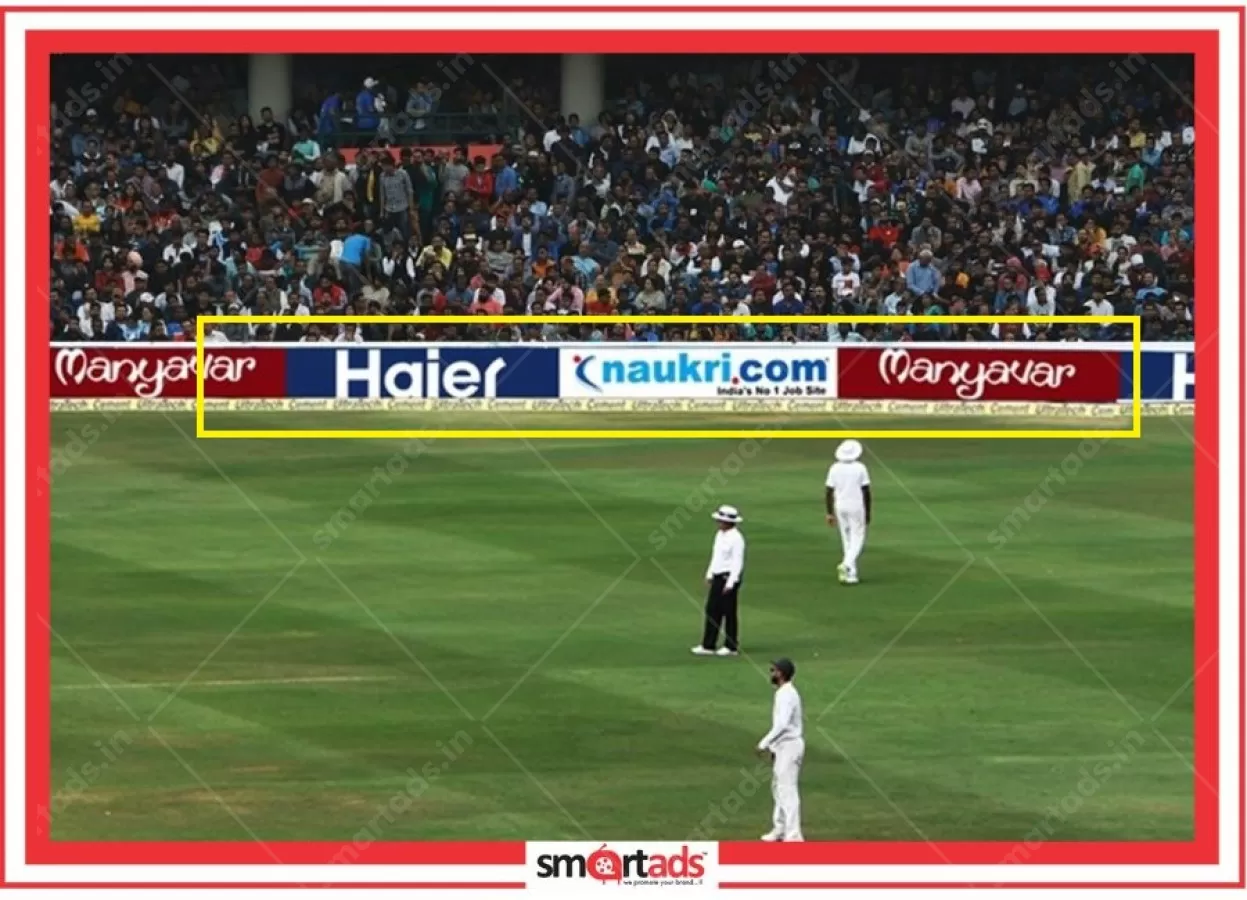
Silver HD Perimeter Signage
Various Sizes
1 ball in every 10 Balls : 50% of the Gr
Rate per Digital Screen / Per match
At Time Only 3 Display Name.
₹1100000.00
Showing 1 to 4 of 4 Results
MEDIA DETAILS
Various Sizes
1 ball in every 10 Balls : 50% of the Gr
Rate per Digital Screen / Per match
At Time Only 3 Display Name.
₹1100000.00
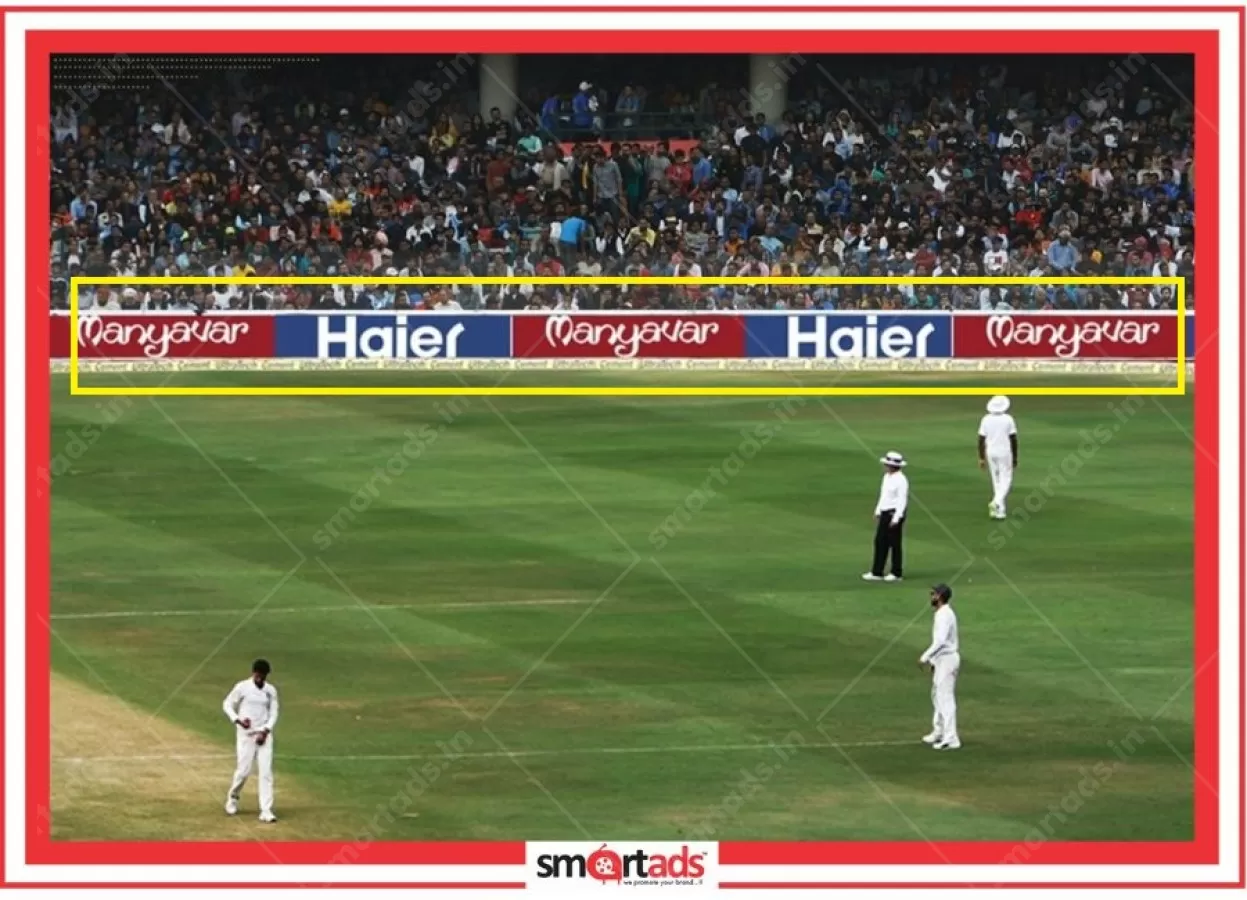
Various Sizes
1 Ball In Every 10 Balls : 50% Of The Gr
Rate per Digital Screen / Per match
At Time Only 2 Display Name.
₹1700000.00
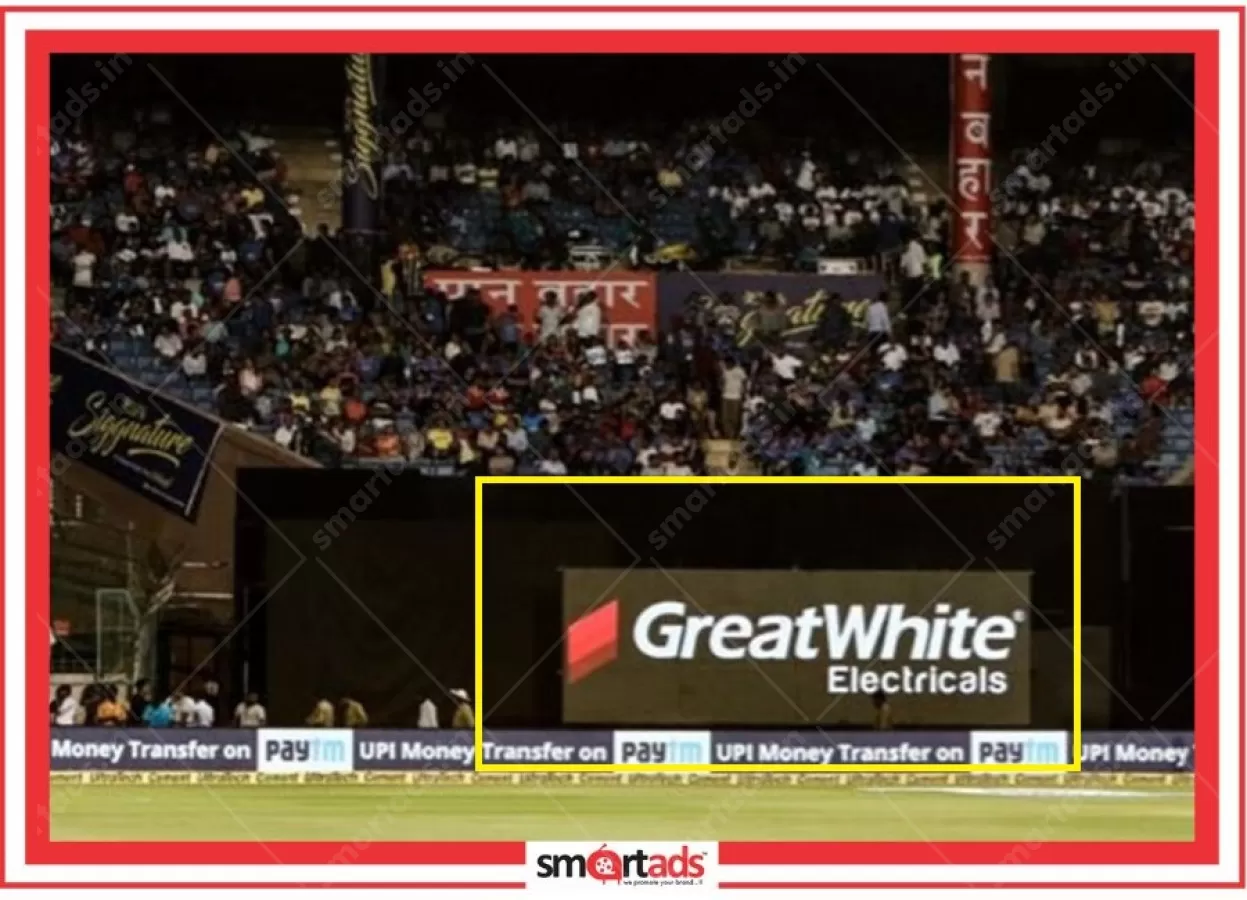
Various Sizes
5 Overs Per ODI Match , 2 Overs Per T20
Rate per Digital Screen / Per match
At Time Only 1 Display Name.
₹1150000.00
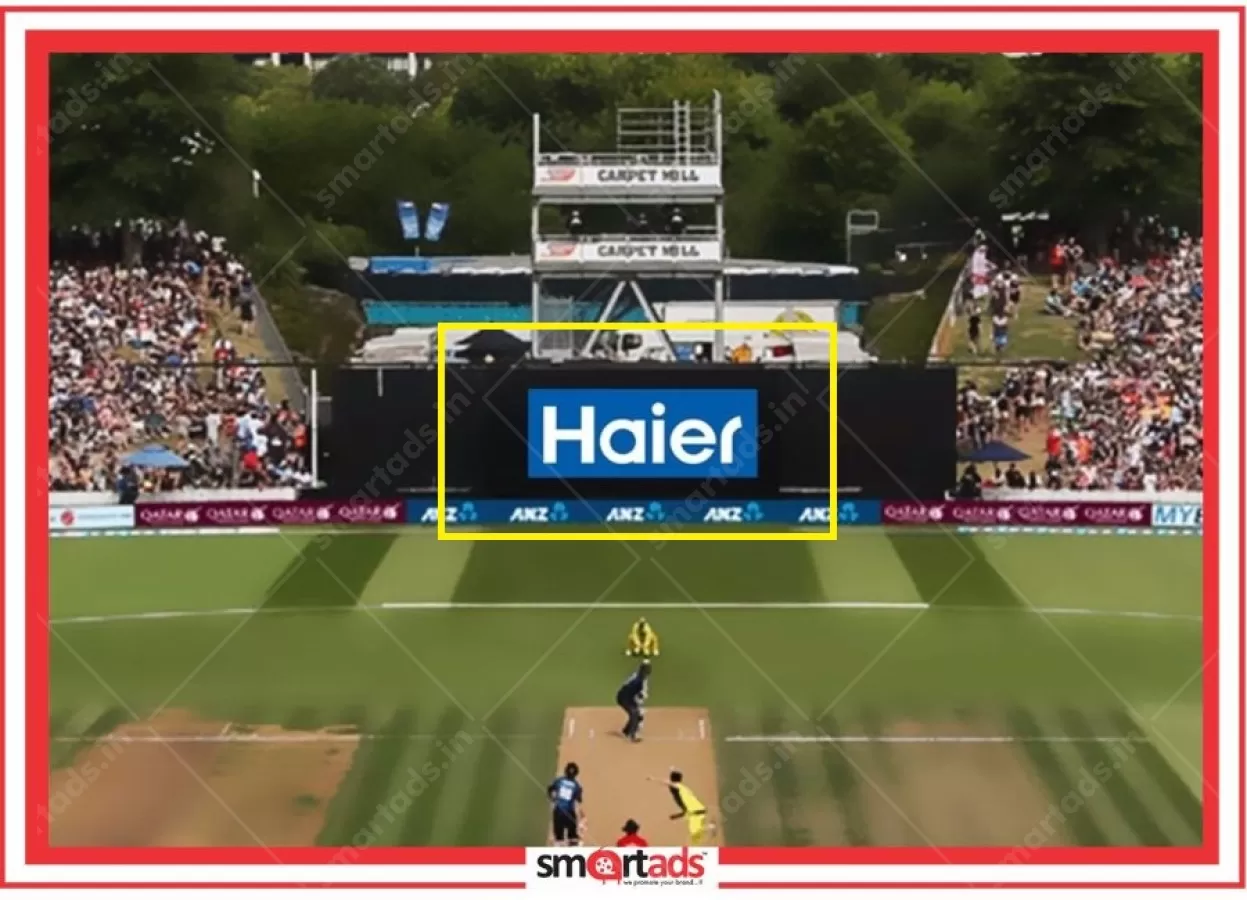
Various Sizes
5 Overs Per ODI Match , 2 Overs Per T20
Rate per Digital Screen / Per match
At Time Only 1 Display Name.
₹1150000.00
MEDIA REACH

MinimumQty :
1
EstimateReachPeople :
45000

Most brand managers we speak to are surprised to learn that a single Test match at Green Park Stadium Kanpur can generate somewhere between 60,000 and 70,000 in-person impressions per day — and that the television broadcast reach for an international fixture here routinely crosses several crore viewers across BARC-monitored households. What makes cricket stadium advertising in Kanpur particularly interesting is not just the numbers; it is the quality of attention that no digital banner or newspaper insert can replicate. When a brand appears on a perimeter board at Green Park during a tense over, it is not competing with a scroll or a skip button.
Green Park Stadium — formally located in Civil Lines, Kanpur, and historically known as Modi Stadium during an earlier era — is one of India's oldest Test venues, having hosted international cricket since 1952. That history carries weight, and frankly speaking, it translates into something advertisers rarely talk about openly: emotional legitimacy. When your brand appears at a venue that has witnessed decades of Indian cricket, the association is not manufactured; it is inherited. Kanpur's cricket fans are among the most passionate in Uttar Pradesh, and the stadium's geography — sitting at the heart of a city of nearly 30 lakh people — means that match-day footfall draws from across the industrial belt, the university corridors, and the residential colonies of Civil Lines Kanpur simultaneously.
The Uttar Pradesh Cricket Association (UPCA) has been actively investing in Green Park's infrastructure, and the renovation work initiated under UPCA's NIT 2025 process has introduced upgraded advertising infrastructure including modernised perimeter board tracks, improved floodlighting for day-night match visibility, and new digital screen placements. This is where it gets interesting for media planners: the renovation has effectively expanded the premium inventory available for in-stadium branding, which means brands that might have been priced out of certain positions previously now have more options at Green Park Stadium than at any point in the last decade. At SmartAds, we always tell our clients that the best time to lock in a venue like Green Park is precisely when infrastructure upgrades are fresh — because inventory demand catches up fast, and rates follow.
Kanpur's audience profile is also genuinely distinctive. The city's economy is anchored in leather manufacturing, textiles, and a significant FMCG distribution network, which means the stadium fills with a cross-section that includes factory owners from the industrial belt, students from IIT Kanpur and CSJM University who occupy the more affordable gallery sections, and middle-to-upper-middle-class families from Civil Lines Kanpur who hold reserved and pavilion tickets. This demographic range is rare — you are essentially reaching SEC A, B, and C audiences within the same venue simultaneously, which is something that outdoor advertising Kanpur or even mall branding rarely achieves with the same efficiency.
The range of media options at Green Park Stadium is broader than most advertisers initially assume, and we have seen brands consistently underutilise formats beyond the obvious perimeter boards. The most visible and sought-after format is LED perimeter board advertising — specifically the 360-degree HD digital LED boards that run along the boundary, which are visible both to the in-stadium audience and to television broadcast cameras. These 360° HD Digital LED Boards rotate brand creatives across a slot system, with each brand typically allocated a specific number of seconds per over; the impression value here is compounded by the fact that the same board appears in broadcast feeds reaching national audiences, making this format a rare hybrid of BTL advertising and broadcast media exposure.
Beyond LED perimeter boards, Green Park Stadium offers static boundary boards — which are the traditional fixed hoardings placed at intervals along the rope — and these remain popular with local Kanpur brands that want sustained visual presence without the premium cost of digital rotation slots. Sight screen advertising is another format that deserves more attention than it gets; the sight screen sits directly in the line of the batsman's eyeline, which means camera cuts to the bowler's end almost always capture it, giving the brand repeated close-up broadcast exposure. Pitch mat advertising — the branded material placed on the pitch covers during breaks — is a format that functions almost like a product placement, appearing prominently during drinks breaks and lunch intervals when broadcast cameras pan across the ground. On top of that, ground mural advertising on the outfield or near the boundary rope creates large-format visual impact that is particularly effective during aerial drone shots, which have become standard in international broadcast productions.
Break-time loop branding is a format that most competitors simply do not explain clearly, so let us be specific about how it works at Green Park. During lunch breaks, tea breaks, and strategic timeouts in T20 formats, the stadium's PA and screen system runs a loop of brand visuals and messages that are seen by the captive audience in the stands; this is distinct from perimeter board slots because it occupies the full attention of the crowd during a period when they are not watching live play, which means the contextual advertising environment is actually more focused than during active overs. We have found that break-time loop branding works exceptionally well for FMCG and food brands, because the break periods align naturally with consumption behaviour — people are eating, drinking, and moving around, which makes them more receptive to product messaging.
This is the question that every client asks first, and it is also the question that most agency websites deliberately avoid answering — which we think is a disservice to media planners trying to build an honest budget. Cricket stadium advertising rates in Kanpur vary significantly depending on match type, format, and position, but we can share the ballpark figures that our team works with when building a media plan for Green Park Stadium.
For LED perimeter board advertising during an international match — a Test or ODI — the advertising cost for a full-match slot works out to somewhere in the range of ₹8 lakh to ₹25 lakh depending on the position (pavilion-end boards command a premium over the Hostel End or Media End positions) and the duration of the slot allocation per over. Static boundary boards for a full international match are considerably more accessible, typically falling in the ballpark of ₹2 lakh to ₹6 lakh for the match duration, which makes them a realistic entry point for mid-sized Kanpur brands. Domestic cricket matches — Ranji Trophy fixtures and UPCA-organised tournaments — are priced at roughly 30 to 50 percent of international match rates, which is a number that surprises most first-time advertisers when they compare it to what they are paying for a week of outdoor advertising Kanpur hoardings.
Break-time loop branding at Green Park Stadium Kanpur is typically priced per match-day and works out to somewhere between ₹75,000 and ₹2 lakh depending on the loop frequency and the match type; sight screen advertising and pitch mat advertising are usually bundled into sponsorship packages rather than sold individually, which means they are more accessible than brands assume when they approach the UPCA or an authorised advertising agency. At SmartAds, our experience shows that the most cost-efficient entry point for a Kanpur SMB is a combination of domestic match boundary boards and break-time loop branding, which can be structured for a total campaign budget in the ballpark of ₹3 to ₹5 lakh — a figure that delivers genuine brand recall among a captive audience of 15,000 to 25,000 per domestic fixture.
Green Park Stadium has a seating capacity of roughly 32,000, though the effective attendance for international matches — particularly Tests and ODIs — tends to fill the venue to somewhere between 25,000 and 30,000 per day, depending on the fixture and the competing team. The India v Bangladesh Test held at Green Park in 2024 is a useful reference point: the match generated significant national broadcast attention and drew strong attendance across all four days of play, which confirmed that Green Park Stadium Kanpur retains its status as a premium domestic Test venue even in an era when T20 formats dominate. For advertisers, the critical distinction is between in-stadium reach and broadcast reach — and for international matches, the broadcast reach is the larger number by a significant margin.
BARC viewership data consistently shows that international cricket on Indian television commands some of the highest viewership figures of any content category, with Test matches on BCCI-partnered broadcast channels reaching audiences in the crores across urban and rural households. This means that LED perimeter board advertising and sight screen advertising at Green Park during an international fixture is not purely a BTL advertising investment — it is simultaneously a national audience reach play, which fundamentally changes the return on investment calculation. What a lot of people miss is that the cost-per-impression for cricket stadium advertising, when broadcast reach is factored in, often works out to be more competitive than a comparable television spot buy, particularly for brands that cannot afford national TV rates but want national-scale visibility.
The demographic profile of Green Park's in-stadium audience skews male — roughly 70 to 75 percent, based on our on-ground observations across multiple campaigns — with the largest age cohort falling between 18 and 40 years, which aligns well with the target audience for categories like two-wheelers, smartphones, financial services, and FMCG products. The student gallery, which is a distinct section at Green Park Stadium, draws heavily from Kanpur's university population, making it a particularly valuable touchpoint for brands targeting youth and first-time buyers. On top of that, the pavilion and corporate box sections attract the city's business community, which is relevant for B2B brands and premium consumer categories.
The honest answer is that they serve different purposes, and the mistake we see most often is brands treating cricket stadium advertising as a substitute for traditional advertising rather than as a complement to it. A newspaper ad in a Kanpur daily reaches a broad, passive audience; an in-stadium branding placement at Green Park reaches a smaller but intensely engaged audience that has voluntarily spent money and time to be present. The emotional engagement at a live cricket match is genuinely different from any other media environment — which is something that TAM AdEx data on sports advertising has repeatedly highlighted as a driver of above-average brand recall scores.
To be fair, traditional advertising in Kanpur has its own strengths. Outdoor advertising Kanpur on high-traffic routes like the GT Road corridor or Naveen Market reaches daily commuters in the lakhs; newspaper advertising in regional editions reaches older, more affluent readers who may not attend matches. The FICCI-EY Media Report has consistently noted that below-the-line advertising and non-traditional advertising formats are growing faster than traditional media in Tier 2 and Tier 3 markets, and Kanpur — despite being a large city — behaves more like a Tier 2 market in terms of media consumption patterns, which makes non-traditional advertising Kanpur a relatively undercrowded space compared to Mumbai or Delhi. What this means practically is that the share-of-voice a brand can achieve through cricket stadium advertising in Kanpur is disproportionately high relative to the investment.
One automotive brand we worked with in the UP market ran a parallel campaign — outdoor advertising on Kanpur's main arterial roads alongside LED perimeter board advertising at Green Park during a domestic Ranji fixture. The post-campaign brand recall survey showed that the stadium advertising placement generated roughly 2.4 times the unaided recall of the outdoor placements, despite reaching a fraction of the raw impression count; the quality of attention at a live cricket match simply cannot be replicated by a billboard that someone passes at 60 kilometres per hour. This is where the real value lies in BTL advertising at cricket venues — not in the volume of impressions, but in the depth of the impression made.
This is a distinction that matters enormously for budget allocation, and we find that most brands do not fully understand the trade-offs until they have run both formats. LED perimeter boards — specifically the 360° HD Digital LED Boards that have been installed at Green Park Stadium — are dynamic, rotating displays that cycle through multiple brand creatives within each over, with each advertiser allocated a specific time slot measured in seconds per over. The key advantage is broadcast visibility: because these boards are backlit and high-contrast, they appear clearly on television even in varying light conditions, which means the national audience reach is built into the format. The HD perimeter signage at Green Park is calibrated to broadcast camera specifications, which is a technical detail that directly affects how well your brand creative reads on screen.
Static boundary boards, by contrast, are fixed hoardings that remain in place for the duration of the match; they do not rotate, which means your brand has 100 percent share-of-voice in its specific position for the entire match day. For a local Kanpur brand that wants to be associated with a specific end of the ground — say, the Mill Pavilion End, which is the more photographed end during certain match conditions — a static board can actually deliver stronger positional brand recall than a rotating LED slot. The advertising cost difference is significant: static boards are priced at a fraction of LED perimeter board rates, which makes them the preferred format for brands running their first cricket stadium advertising campaign and wanting to test the medium before committing to a larger investment.
At SmartAds, we generally recommend a hybrid approach for clients with budgets above ₹5 lakh: a primary LED perimeter board slot for broadcast visibility combined with a static boundary board at a premium position for sustained in-stadium presence. This combination ensures that the brand is seen by both the in-stadium audience and the television audience, which maximises the return on investment without doubling the budget. The media plan we built for a retail client in Kanpur using exactly this approach during a domestic T20 fixture resulted in a reach figure that was roughly three times what the client had achieved through a comparable outdoor advertising Kanpur spend the previous quarter.
Frankly speaking, the categories that have historically extracted the most value from cricket stadium advertising in Kanpur are those whose target audience overlaps most naturally with the Green Park Stadium demographic. Two-wheeler brands — particularly those with strong presence in the UP market — find the audience profile almost perfectly aligned, because the 18-to-35 male demographic that dominates Green Park's stands is also the primary buyer of motorcycles and scooters in Uttar Pradesh. FMCG brands, particularly those in beverages, snacks, and personal care, benefit from the consumption context of a match-day environment; people at a cricket match are eating, drinking, and socialising, which creates a natural receptivity to product messaging that is difficult to manufacture in other media environments.
Kanpur's industrial identity creates some specific advertiser categories that are under-represented in cricket stadium advertising nationally but make enormous sense locally. The leather industry — which has made Kanpur one of India's most significant manufacturing hubs — includes brands that are increasingly investing in consumer marketing, and a Green Park Stadium campaign during an international match gives them a platform that simultaneously reaches local consumers and, through broadcast, signals brand ambition to a national audience. Similarly, textile and apparel brands from the Kanpur industrial belt have used in-stadium branding at Green Park to build brand awareness in a market where their products are already distributed but their brand identity is underdeveloped. Sports branding in UP is still a relatively nascent category compared to Maharashtra or Karnataka, which means early movers get disproportionate share-of-voice.
Financial services brands — insurance companies, NBFCs, and payment platforms — have been among the fastest-growing categories in cricket stadium advertising nationally, and the pattern holds in Kanpur, where financial inclusion and digital payment adoption are accelerating. Educational institutions, particularly engineering and management colleges targeting UP students, have also found Green Park Stadium advertising effective for admission season campaigns, because the student gallery section provides a concentrated touchpoint with exactly the 17-to-22-year-old audience they are trying to reach. What we tell our clients at SmartAds is that the question is not whether your category fits cricket advertising — it is whether you are reaching your target audience at a moment of high emotional engagement, and at Green Park, the answer is almost always yes.
The booking process for cricket stadium advertising at Green Park is more structured than most brands expect, and understanding the process upfront saves significant time and budget. The Uttar Pradesh Cricket Association manages the advertising rights for Green Park Stadium, and the primary inventory — particularly for international matches — is typically allocated through BCCI-approved broadcast and venue partners, which means that brands approaching UPCA directly without an established relationship often find the process slow and the inventory already committed. Working through an authorised advertising agency that has existing relationships with UPCA and the relevant broadcast partners is, in our experience, the most reliable way to secure premium inventory, particularly for international fixtures where demand exceeds supply.
The booking timeline matters enormously. For international matches — Tests and ODIs — the premium LED perimeter board slots are typically committed six to twelve weeks before the match, and for high-profile fixtures involving the India national cricket team, the timeline can extend to three to four months. Domestic cricket matches, including Ranji Trophy and UPCA-organised tournaments, have a shorter booking window, typically four to six weeks, which makes them more accessible for brands that are working with shorter campaign planning cycles. At SmartAds, we maintain an active pipeline of upcoming match schedules at Green Park Stadium and other UP venues, which allows us to alert clients to booking windows before inventory becomes constrained.
The campaign execution process involves creative specification compliance — the HD perimeter signage at Green Park has specific resolution and aspect ratio requirements for LED board creatives, and static boundary board artwork must conform to BCCI and UPCA guidelines for size, content, and brand category eligibility. Certain categories — tobacco, alcohol, and some pharmaceutical products — face restrictions on in-stadium advertising under BCCI regulations, which is a compliance detail that needs to be confirmed before campaign execution begins. Ad booking for domestic matches is generally more flexible in terms of creative specifications and category restrictions, which is one reason why domestic fixtures are often the preferred entry point for brands new to cricket stadium advertising in Kanpur.
Return on investment measurement for stadium advertising is an area where the industry has genuinely improved in recent years, and the old complaint that BTL advertising is "unmeasurable" is increasingly outdated. The primary measurement frameworks used for cricket stadium advertising are impression-based — calculating the total number of in-stadium audience contacts plus the estimated broadcast reach based on BARC viewership data for the specific match and channel — and these are combined to produce a cost-per-thousand impressions figure that can be compared against other media in the plan. For international matches at Green Park Stadium, the combined impression value (in-stadium plus broadcast) typically works out to a CPM that is competitive with mid-tier television spots, which is a number that surprises most first-time advertisers when they see it laid out in a media plan.
Brand recall measurement is the more nuanced layer, and this is where cricket stadium advertising consistently outperforms its CPM-equivalent alternatives. Post-match brand recall surveys — which we conduct for clients as part of campaign evaluation — consistently show recall rates for perimeter board advertising at live cricket matches that are significantly higher than recall rates for comparable outdoor advertising or digital display formats. The GroupM TYNY Report and Dentsu e4m Report have both noted that sports marketing environments generate above-average brand recall due to the emotional engagement of the audience, and our own campaign data from UP market activations supports this finding. A retail client in Kanpur whose campaign we tracked across a two-match domestic series showed a 34 percent increase in unaided brand awareness within the stadium's catchment area over the campaign period, which was measured through pre- and post-campaign consumer surveys.
On top of that, digital tracking has added a new dimension to ROI measurement for cricket stadium advertising. QR codes embedded in pitch mat advertising or break-time loop branding creatives allow brands to track direct response from the stadium audience; geo-fenced digital ads served to mobile devices within the Green Park Stadium perimeter on match days can be correlated with in-stadium advertising exposure to measure cross-channel impact. At SmartAds, we build multi-touch attribution frameworks for clients running integrated campaigns that combine cricket stadium advertising with digital and outdoor, which gives a much clearer picture of how the stadium placement contributes to the overall campaign ROI rather than treating it as an isolated spend.
Sponsorship packages at Green Park Stadium go beyond individual format bookings and represent a more integrated form of brand association with the venue and the UPCA. The most prominent package category is title or presenting sponsorship for specific match series or tournaments — which gives the brand naming rights to the event or series in broadcast and print communications, along with a comprehensive suite of in-stadium branding placements including LED perimeter board priority slots, sight screen advertising, pitch mat advertising, and ground mural advertising. These packages are negotiated directly with UPCA and are typically reserved for brands with budgets in the range of ₹50 lakh and above for a full series, though the exact structure depends on the match type and the duration of the series.
Below the title level, there are associate and official partner sponsorship packages which bundle together a defined set of advertising formats — typically including perimeter board slots, break-time loop branding, and digital screen advertising — at a package rate that is more cost-efficient than booking each format individually. These packages are particularly well-suited for brands that want consistent presence across a multi-day Test match or a multi-match domestic series, because the bundled pricing typically works out to a 15 to 25 percent saving compared to format-by-format ad booking. Stadium sponsorship at this level also typically includes hospitality benefits — corporate box access and match tickets — which have their own value for brands using cricket as a client entertainment platform.
For smaller brands and local Kanpur advertisers, there are match-day advertising packages that bundle boundary boards and break-time loop branding for a single fixture, which represent the most accessible entry point into stadium sponsorship without requiring a long-term commitment. The Kanpur Superstars and UPCA-organised tournaments also offer sponsorship packages that are priced more accessibly than international match packages, and these are worth considering for brands whose target audience is primarily the Kanpur and UP region rather than a national audience. At SmartAds, we have structured sponsorship packages for clients across all budget levels at Green Park Stadium, and our experience shows that the return on investment scales well even at the entry-level package tier when the campaign is executed with the right creative and timing strategy.
The difference between advertising at an international match and a domestic match at Green Park Stadium Kanpur is not just a matter of audience size — it is a fundamentally different media proposition. International cricket matches, particularly Tests involving the India national cricket team, generate national broadcast reach that transforms in-stadium advertising into a hybrid BTL-and-broadcast investment; the LED perimeter boards and sight screen advertising at Green Park appear on television feeds that are watched by audiences across the country, which means a brand appearing at a Kanpur international fixture is effectively running a national campaign from a Kanpur venue. This is the core value proposition of international match advertising, and it is why the advertising cost premium over domestic matches is justified for brands with national distribution and national brand-building objectives.
Domestic cricket matches — Ranji Trophy games, Vijay Hazare Trophy fixtures, and UPCA-organised tournaments — serve a different purpose, and to be honest, they are underrated as an advertising vehicle for local and regional brands. The audience at a domestic match is smaller, typically in the range of 5,000 to 15,000 per day at Green Park, but it is a highly engaged local audience that is specifically interested in UP cricket, which makes it an ideal environment for brands whose primary market is Kanpur and the surrounding districts. The advertising rates for domestic matches are significantly lower than international rates, and the competition for inventory is less intense, which means local brands can secure premium positions — including the Mill Pavilion End boundary boards — that would be unavailable or unaffordable during an international fixture.
IPL advertising at Green Park is a separate conversation, because the IPL franchise model means that Kanpur has historically not hosted IPL matches regularly — the primary UP franchise, which has operated under various names including associations with Lucknow, has played its home matches at Lucknow's BRSABV Ekana Cricket Stadium. However, when IPL matches are hosted at Green Park for specific reasons, the advertising rates and broadcast reach are at a different scale entirely, and the inventory is typically committed through BCCI-approved partners well in advance. For brands planning cricket advertising Kanpur across a full year, the practical strategy is to anchor the plan around international fixtures at Green Park and supplement with domestic match placements, which provides both national reach and local frequency.
This is a question we get asked regularly, and the honest answer is: more often than people think. The perception that cricket stadium advertising is exclusively for large national brands is a legacy of how the medium was historically sold — as premium, high-minimum packages that were genuinely out of reach for SMBs. The reality at Green Park Stadium today is more nuanced; the expansion of advertising formats and the availability of domestic match inventory has created genuine entry points for Kanpur SMBs with budgets that would not get a second look from a national broadcast sales team.
A leather goods brand from Kanpur's industrial belt, for example, can run a boundary board campaign across a two-day domestic Ranji Trophy fixture at Green Park for a total advertising cost that is in the ballpark of ₹2 to ₹3 lakh — which is comparable to what a mid-size outdoor advertising Kanpur campaign costs for a month of hoarding presence, but with the added credibility of cricket association and a captive audience of 10,000 to 20,000 per day. We worked with a textile manufacturer from Kanpur who had never done cricket advertising before; they ran a single-match boundary board and break-time loop branding package during a domestic T20 fixture, and the post-match feedback from their distribution network was that the brand had "suddenly become visible" in conversations — which is an anecdotal measure, but one that reflects the genuine brand awareness impact of even a single match-day advertising investment.
The key for SMBs is to be strategic about match selection and format combination. Domestic matches offer the most accessible advertising cost entry points; combining a static boundary board with break-time loop branding maximises the in-stadium impact without requiring the budget for LED perimeter board slots; and booking through a BTL advertising agency Kanpur that has existing UPCA relationships ensures that the available inventory is secured at the best possible rate. At SmartAds, we have specifically developed entry-level cricket stadium advertising packages for Kanpur SMBs that are structured around domestic fixtures, and we have found that the return on investment for these campaigns is often higher than what the same brands achieve through their existing outdoor advertising Kanpur and print spends.
The UP cricket advertising market is anchored by two primary venues: Green Park Stadium Kanpur and the BRSABV Ekana Cricket Stadium in Lucknow. The Ekana Stadium in Lucknow is newer, larger, and has hosted IPL matches, which means its advertising rates — particularly for premium LED perimeter board positions — are generally higher than Green Park's, and the competition for inventory is more intense. For brands that want to advertise at a UP venue but are working with a budget that does not stretch to Lucknow's international match rates, Green Park Stadium Kanpur offers a genuinely competitive alternative with comparable broadcast reach for international fixtures and a distinct audience profile that Lucknow cannot replicate.
Varanasi and Agra are also part of the UP cricket landscape, but neither city has a venue that hosts regular international cricket, which means their advertising opportunities are limited to domestic fixtures and are priced accordingly. For brands with a specifically western UP focus, Agra's domestic cricket advertising can be a cost-efficient option; for brands targeting the eastern UP and Purvanchal market, Varanasi's domestic fixtures offer local reach. But for brands that want both national broadcast reach and strong Kanpur and central UP market penetration, Green Park Stadium remains the most strategically valuable venue in the state.
The comparison that our clients find most useful is not between UP cities but between cricket stadium advertising and other BTL channels in the Kanpur market. Auto-rickshaw branding in Kanpur reaches a broad daily audience but with low dwell time and minimal emotional engagement; railway station advertising at Kanpur Central reaches a transient audience that is difficult to profile by SEC or interest; mall branding at venues like Z Square or Rave Moti reaches a more affluent audience but with a smaller daily footprint than a match-day crowd at Green Park. Non-traditional advertising Kanpur across all these formats has its place in a media plan, but none of them deliver the combination of captive audience, emotional engagement, and broadcast amplification that cricket stadium advertising at Green Park provides.
The single most common mistake we see brands make with cricket stadium advertising in Kanpur is treating it as a passive visibility exercise rather than an active brand-building investment. A perimeter board at Green Park is not a billboard — it is a piece of content that appears in a specific emotional context, and the creative needs to be designed with that context in mind. Creatives that work well in this environment are those that are high-contrast, legible at distance, and brand-forward without being cluttered; the LED perimeter board format in particular rewards simplicity, because the board is in motion and the audience's primary attention is on the game, not the advertisement.
Match-day advertising planning should be aligned with the specific fixture type and the audience composition of that match. For an international Test match, where the audience skews older and more affluent and the broadcast reach is national, the creative and messaging should reflect national brand positioning; for a domestic Ranji fixture, where the audience is more local and the demographic skews younger, a more locally relevant message — referencing Kanpur, UP cricket, or the local team — will generate stronger brand recall. We have found that brands which localise their Green Park Stadium creative — even subtly, by including Kanpur references or UP cricket team colours — consistently outperform brands running generic national creatives in post-match recall surveys.
The timing of the booking relative to the match schedule is also a significant lever for maximising value. Brands that book early — ideally six to eight weeks before an international fixture — get first choice of perimeter board positions, which matters because the Mill Pavilion End and the Media End boards have meaningfully different broadcast camera exposure frequencies; the positions closest to the sight screen at each end get the most broadcast camera time, and these are the positions that sell first. For domestic matches, booking three to four weeks in advance is generally sufficient to secure preferred positions, and the rates are less subject to last-minute premium pricing. At SmartAds, our media planning team tracks upcoming Green Park Stadium fixtures across the BCCI and UPCA match calendar, and we proactively advise clients on the optimal booking windows for the specific match types that align with their campaign objectives and budget.
Q: What is cricket stadium advertising in Kanpur and how does it work?
Cricket stadium advertising in Kanpur refers to brand placements within and around Green Park Stadium during cricket matches — encompassing formats like LED perimeter boards, static boundary boards, sight screen advertising, pitch mat advertising, break-time loop branding, and ground mural advertising. The way it works is that brands secure specific advertising slots or positions through UPCA-approved channels or authorised advertising agencies, with the creative displayed either continuously (for static formats) or in rotation (for LED digital formats) throughout the match. The exposure is dual-layered: the in-stadium audience sees the advertising directly, while broadcast cameras capture the perimeter boards and sight screens, extending the reach to the television viewership of the match. The booking process involves creative specification compliance, format selection, match type selection, and payment terms that vary depending on whether the fixture is international or domestic.
Q: How much does it cost to advertise at Green Park Stadium in Kanpur?
Green Park Stadium advertising cost varies significantly by format and match type. For international matches, LED perimeter board slots are priced somewhere in the range of ₹8 lakh to ₹25 lakh for a full match, depending on position and slot duration; static boundary boards for the same fixture are more accessible, typically in the range of ₹2 lakh to ₹6 lakh. Domestic match rates are roughly 30 to 50 percent lower, making them the preferred entry point for SMBs and local Kanpur brands. Break-time loop branding for a single match day works out to somewhere between ₹75,000 and ₹2 lakh. Sponsorship packages that bundle multiple formats are available at rates that typically represent a 15 to 25 percent saving over individual format bookings. The most accurate rates are confirmed at the time of booking because they are subject to match schedule, inventory availability, and UPCA-approved rate cards for the specific season.
Q: Which advertising formats are available at Green Park Stadium Kanpur?
The primary formats available at Green Park Stadium include 360-degree HD Digital LED perimeter boards, static boundary boards, sight screen advertising, pitch mat advertising, break-time loop branding on stadium screens and PA systems, ground mural advertising, and digital screen advertising on the stadium's internal display infrastructure. Each format serves a different purpose in the media plan: LED perimeter boards maximise broadcast reach, static boundary boards provide sustained in-stadium presence, and break-time loop branding captures audience attention during the high-dwell periods of match intervals. Sponsorship packages typically bundle several of these formats together, and the specific inventory available at any given fixture depends on the match type and the UPCA's seasonal advertising plan.
Q: What is the audience reach and capacity of Green Park Stadium Kanpur?
Green Park Stadium has a seating capacity of roughly 32,000, with typical international match attendance in the range of 25,000 to 30,000 per day. Domestic match attendance varies more widely, typically between 5,000 and 20,000 depending on the fixture significance and the competing teams. Beyond in-stadium reach, the broadcast reach for international matches extends to several crore television viewers across BARC-monitored households, which transforms the effective reach of perimeter board and sight screen advertising into a national-scale proposition. The demographic profile of the in-stadium audience skews male (approximately 70 to 75 percent), with the dominant age cohort between 18 and 40 years, and a mix of SEC profiles ranging from students in the gallery sections to business professionals in the pavilion and corporate box areas.
Q: How do I book BTL advertising at Green Park Stadium through an agency?
Booking BT
