
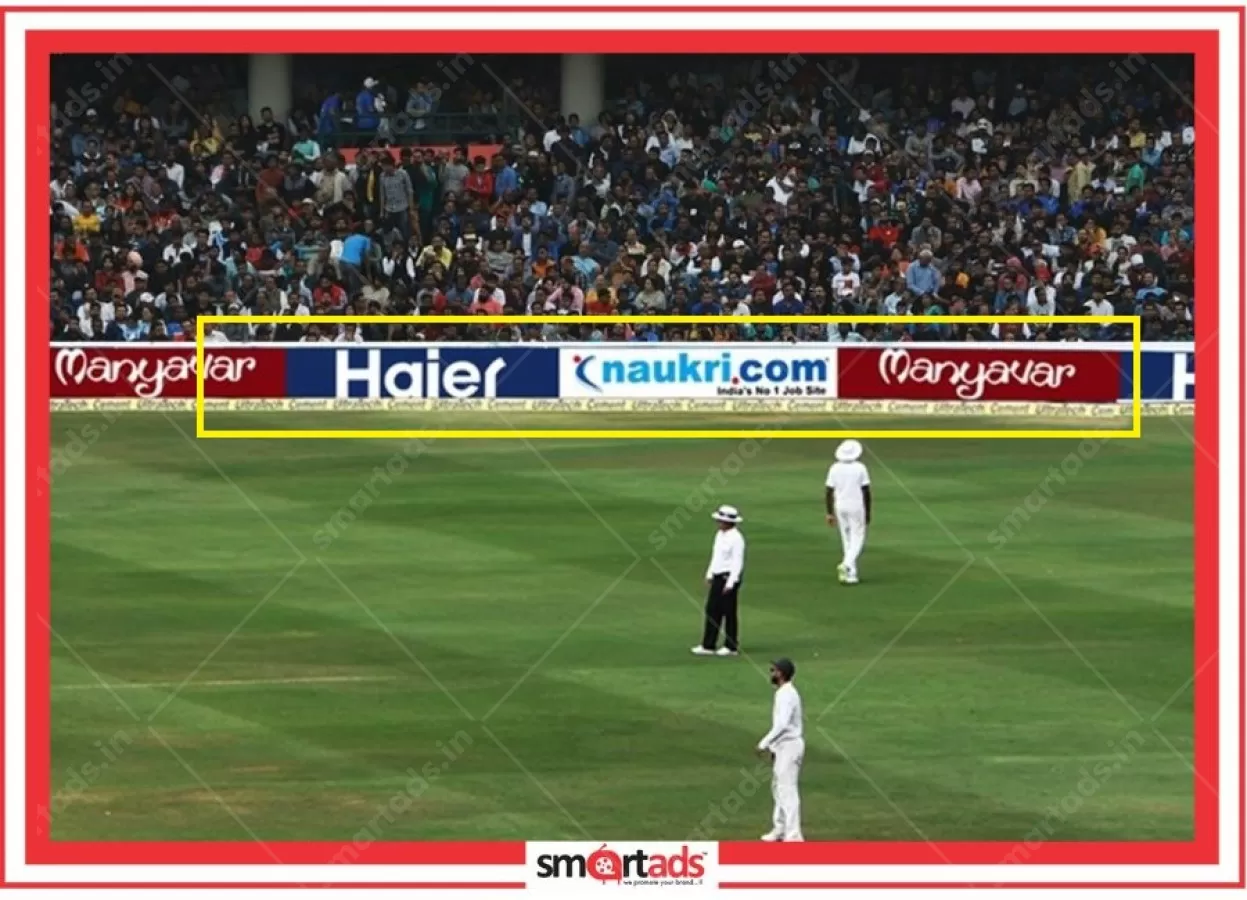
Silver HD Perimeter Signage
Various Sizes
1 ball in every 10 Balls : 50% of the Gr
Rate per Digital Screen / Per match
At Time Only 3 Display Name.
₹1100000.00
Showing 1 to 4 of 4 Results
MEDIA DETAILS
Various Sizes
1 ball in every 10 Balls : 50% of the Gr
Rate per Digital Screen / Per match
At Time Only 3 Display Name.
₹1100000.00
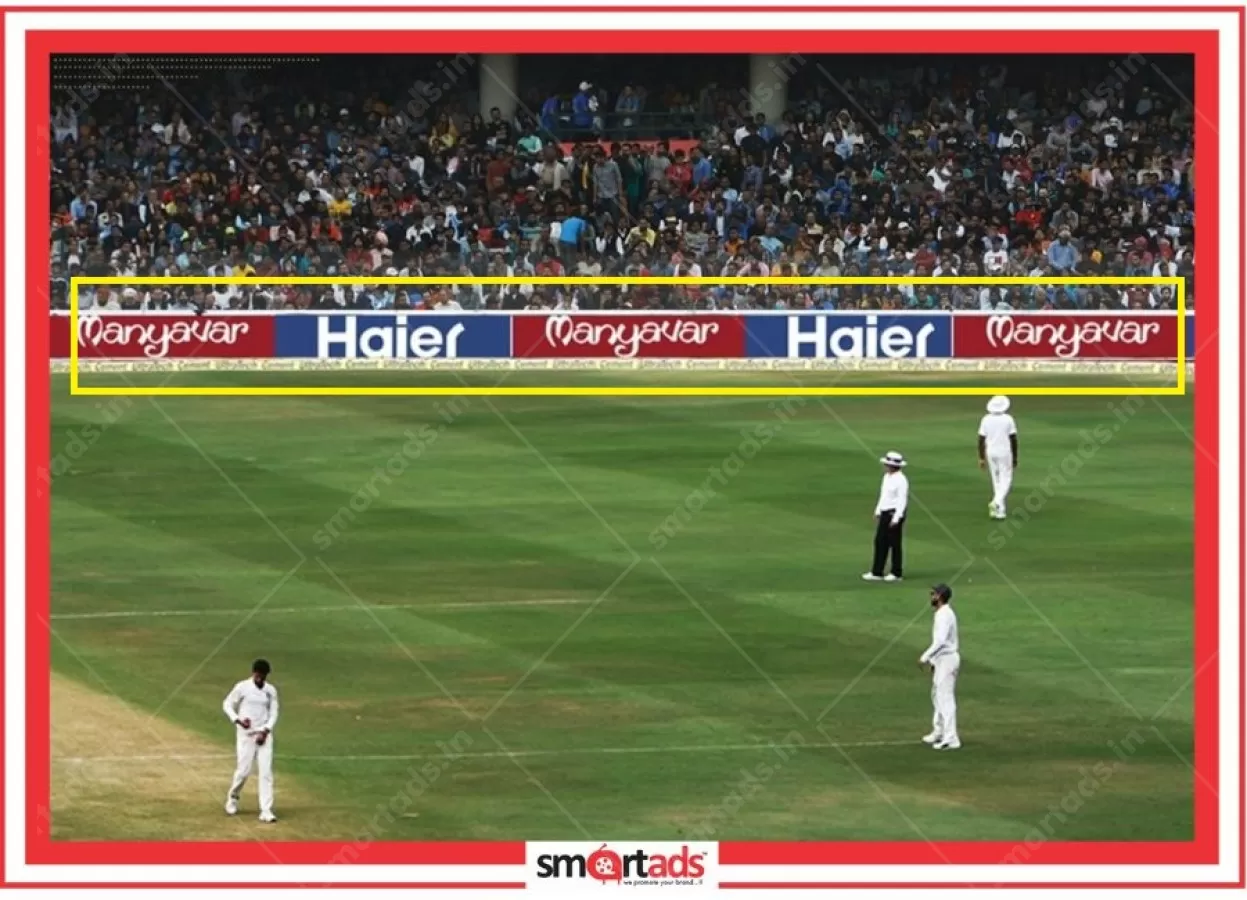
Various Sizes
1 Ball In Every 10 Balls : 50% Of The Gr
Rate per Digital Screen / Per match
At Time Only 2 Display Name.
₹1700000.00
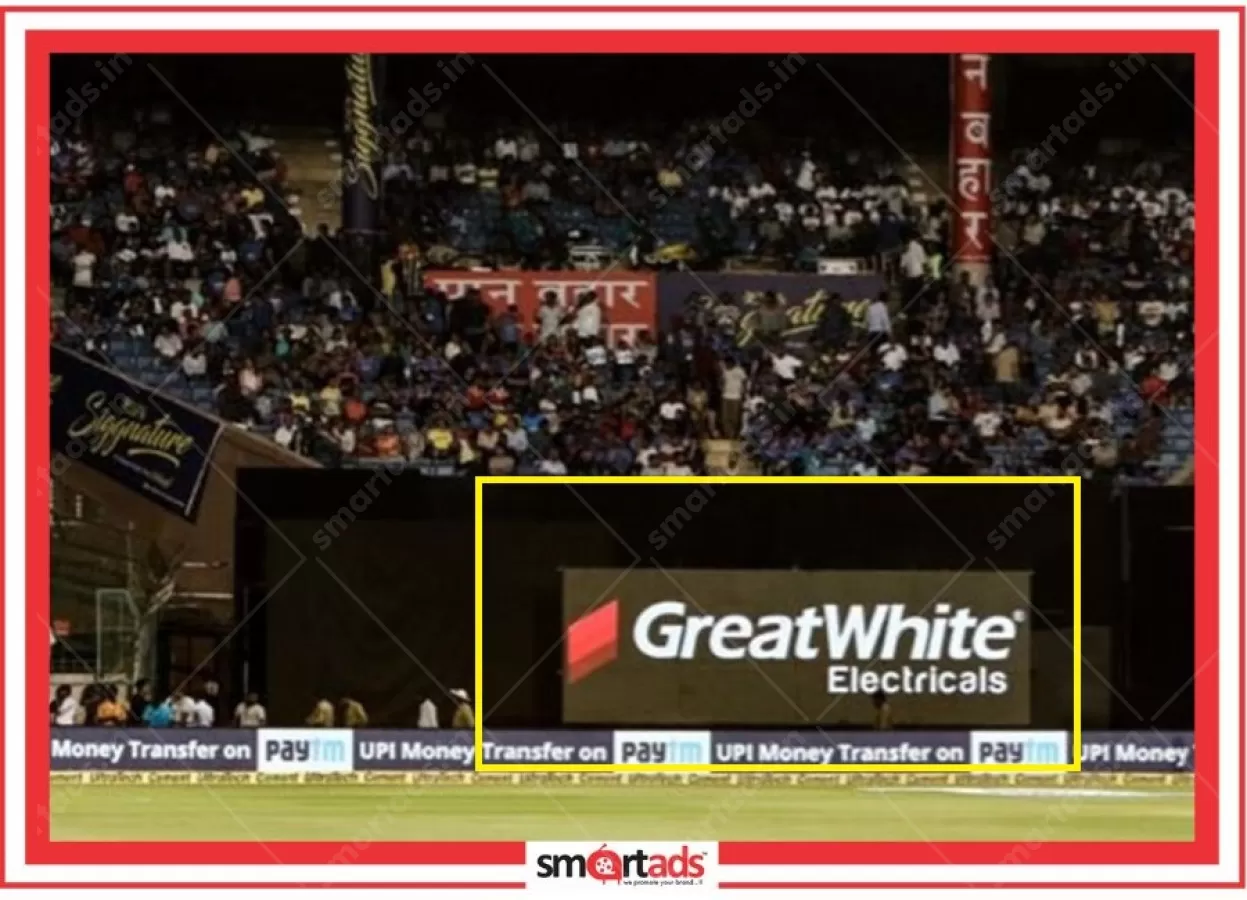
Various Sizes
5 Overs Per ODI Match , 2 Overs Per T20
Rate per Digital Screen / Per match
At Time Only 1 Display Name.
₹1150000.00
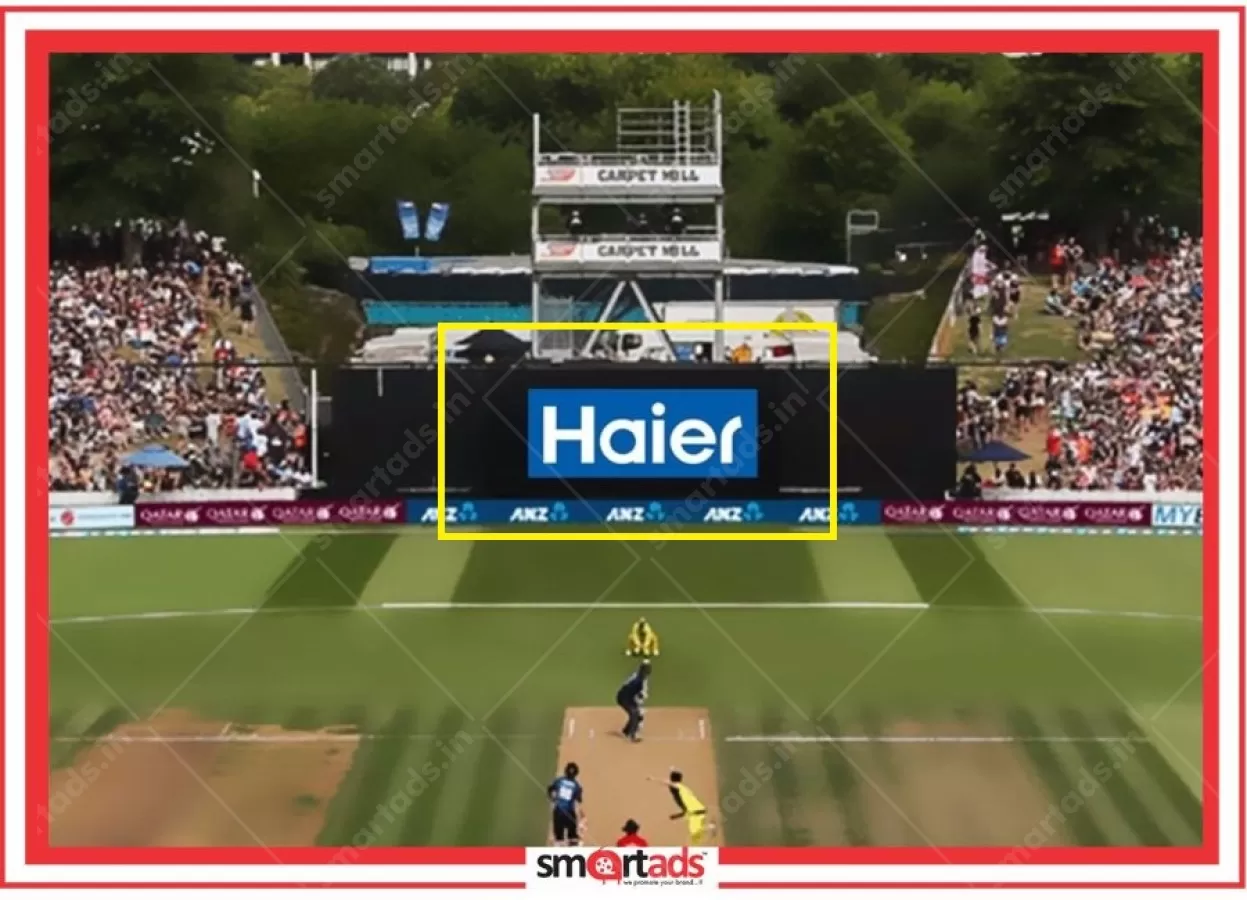
Various Sizes
5 Overs Per ODI Match , 2 Overs Per T20
Rate per Digital Screen / Per match
At Time Only 1 Display Name.
₹1150000.00
MEDIA REACH

MinimumQty :
1
EstimateReachPeople :
50000

There is a moment, roughly three seconds after a Royal Challengers Bengaluru batsman smashes a six at M. Chinnaswamy Stadium, when every camera in the ground swings wide — and every perimeter board, every LED screen, every piece of in-stadium branding suddenly appears on televisions across the country. That moment, which most brand managers never fully account for when calculating their media value, is precisely why cricket stadium advertising in Bangalore delivers a return that few below-the-line formats can match. The stadium holds roughly 35,000 spectators on match day; the broadcast audience it feeds into runs into tens of millions.
Frankly speaking, most brands that come to us are thinking about the crowd inside the ground — which is understandable, because 35,000 engaged, emotionally invested fans in one place is already a remarkable advertising opportunity. What a lot of people miss is the secondary amplification: every IPL match at M. Chinnaswamy Stadium is broadcast live on Star Sports and streamed on JioStar, which means your perimeter boards and LED screens are essentially appearing on a national television channel for the duration of the match. At SmartAds, we always tell our clients that you are not buying access to one audience; you are buying access to three — the live crowd, the television audience, and increasingly the OTT audience watching on JioCinema.
The Bengaluru cricket fan is also a particularly valuable demographic for advertisers. Based on the audience composition data we have observed across campaigns, the typical M. Chinnaswamy Stadium attendee skews heavily towards the 22-to-45 age bracket, with a significant concentration of tech professionals, entrepreneurs, and senior corporate employees — which makes sense given the stadium's location near MG Road and Cubbon Park, right in the commercial heart of the city. Karnataka's capital has one of the highest per-capita income levels among Indian metros, and the fan base that fills Chinnaswamy reflects that; these are people with genuine purchasing power across categories from automobiles and financial services to consumer electronics and premium lifestyle brands. The psychographic profile of the RCB fan base — aspirational, urban, digitally active, brand-conscious — is one that most advertisers in Bengaluru would pay significant premiums to reach through any other channel.
On top of that, cricket stadium advertising in Bangalore benefits from what we call the "captive audience" advantage, which is genuinely rare in modern media planning. A person sitting in the stands for three to four hours during a T20 match has no scroll button, no skip option, no ad blocker; their eyes return to the boundary boards and digital screens dozens of times per session, which produces brand recall figures that passive media simply cannot replicate. The FICCI-EY Media and Entertainment Report has consistently highlighted sports as one of the highest-engagement advertising environments in India, and our own campaign measurement data across multiple in-stadium branding Bangalore assignments confirms that brand awareness lift among exposed audiences typically runs well ahead of comparable OOH formats.
The format landscape at M. Chinnaswamy Stadium is considerably more varied than most first-time advertisers expect, and choosing the right combination is genuinely where the strategic work happens. The most visible and most frequently booked format is perimeter boards — the rectangular panels that ring the playing boundary and appear in virtually every broadcast camera angle. These boards, which are available in both static and rotating configurations, deliver what is arguably the highest broadcast visibility of any in-stadium advertising format, because the camera is almost always pointed toward the boundary during live play; a well-positioned perimeter board at Chinnaswamy can appear on screen for several minutes across a single T20 innings.
LED screens inside the stadium represent a different kind of opportunity; they allow for dynamic creative — video, animation, countdown timers, real-time messaging — which static formats cannot accommodate. The main scoreboard advertising at M. Chinnaswamy Stadium commands a premium for obvious reasons: it is the one screen that every spectator looks at repeatedly and voluntarily throughout the match. Digital screens positioned at entry points, concourses, and food courts offer a different touchpoint — they reach fans during the dwell time before the match and during breaks, which is when purchasing intent for food, beverages, and merchandise tends to be highest. Concourse advertising, in our experience, is consistently undervalued by brands that focus exclusively on boundary-facing formats.
Beyond the boards and screens, in-pitch branding — the logos and brand marks painted or projected directly onto the playing surface — delivers extraordinary broadcast visibility precisely because the pitch is the single most-filmed surface in the stadium; cameras return to it between every delivery. Ground-level branding in the form of pitch-side advertising panels, sight-screen branding, and dugout-area displays rounds out the inventory. For brands with larger budgets and longer-term ambitions, stadium sponsorship packages offered through KSCA can include naming rights for specific stands or facilities, jersey sponsorship discussions at the team level (which involve BCCI and RCB commercial teams separately), and integrated fan activation zones where experiential marketing executions — product sampling, interactive installations, contest mechanics — can be built into the match-day experience. One FMCG client we worked with in Bengaluru combined a concourse activation zone with perimeter board presence and found that the experiential component drove a 34% higher brand interaction rate compared to their previous pure-OOH campaigns in the city.
This is the question we get asked first in almost every briefing, and to be honest, the answer is more nuanced than a single rate card can capture — because advertising rates at M. Chinnaswamy Stadium vary significantly depending on the type of fixture, the format selected, the duration of the booking, and the time of year. That said, we believe in giving clients real numbers rather than asking them to fill out a form to find out, so here is what the market actually looks like.
For a domestic T20 match or a Ranji Trophy fixture at Bangalore cricket stadium, perimeter board advertising costs work out to somewhere in the ballpark of ₹2 lakh to ₹5 lakh per match for a standard panel, depending on position and rotation frequency — which is a number that surprises many clients when they realise it includes broadcast exposure to a television audience that can be several times the size of the live crowd. For IPL advertising Bangalore, which is where demand is highest and inventory most competitive, perimeter board rates during RCB home matches at M. Chinnaswamy Stadium typically run considerably higher — in the range of ₹8 lakh to ₹25 lakh per match for premium positions, with LED screen packages and scoreboard advertising commanding their own separate premiums on top of that. International fixtures — Test matches, ODIs, and T20 Internationals sanctioned by BCCI — fall in a middle band, roughly between ₹5 lakh and ₹15 lakh per match for comparable formats, reflecting the longer duration and the prestige of the fixture type.
Stadium sponsorship packages for an entire IPL season, which cover all RCB home matches at Chinnaswamy, are negotiated at a package level and can range from ₹50 lakh to several crore depending on the scope of formats included — which makes them the domain of larger advertisers but also the most cost-efficient on a per-match, per-impression basis when the numbers are worked through properly. For brands that want to advertise during IPL in Bangalore without committing to a full-season package, individual match bookings are available, though inventory sells out quickly; we have seen clients lose preferred positions because they waited too long to confirm. The cricket stadium advertising cost per match for digital screen placements on concourses and entry points tends to be more accessible — often in the range of ₹75,000 to ₹2 lakh per match — which makes in-stadium branding Bangalore genuinely viable for mid-sized brands and not just large national advertisers.
IPL 2025 demonstrated, once again, that the Indian Premier League is not merely a cricket tournament — it is the single largest annual sports media event in the country, and Bengaluru's RCB home matches at M. Chinnaswamy Stadium consistently rank among the most-watched fixtures of the season. BARC viewership data has repeatedly shown IPL matches to be among the highest-rated programmes on Indian television across any category; during peak IPL weeks, match broadcasts on Star Sports routinely outperform prime-time fiction programming, which means the broadcast visibility component of in-stadium advertising during IPL is genuinely significant. For IPL 2026, which is expected to see continued growth in both live attendance and streaming numbers on JioStar, the case for early booking of stadium advertising positions is stronger than it has ever been.
What makes IPL advertising Bangalore particularly powerful from a brand recall perspective is the emotional intensity of the environment. Royal Challengers Bengaluru has one of the most passionate and loyal fan bases in the IPL, and that emotional engagement transfers directly to brands that are present in the stadium — a phenomenon that sports marketing researchers refer to as "affect transfer," where the positive emotions associated with the sport and team attach themselves to the brands that share the space. At SmartAds, we have measured post-campaign brand recall scores for clients who ran in-stadium branding Bangalore during RCB home matches, and the numbers consistently show aided recall rates running 40% to 60% higher than the same brand's recall scores from comparable OOH campaigns in Bengaluru that ran in the same period.
The broadcast amplification effect during IPL is also worth quantifying more precisely. A perimeter board positioned at the boundary of M. Chinnaswamy Stadium during an RCB match will typically appear in broadcast frames for somewhere between 8 and 15 minutes of actual on-screen time across a T20 match — which, when expressed as a television audience equivalent, represents a media value that often exceeds the cost of the placement itself. One automotive brand we worked with during an IPL season calculated that their stadium branding at Chinnaswamy delivered a television audience impression count that would have cost them roughly three times as much to purchase directly through spot advertising on the broadcast channel; that kind of media efficiency is what makes cricket stadium advertising in Bangalore so compelling for brands that are willing to think beyond the obvious metrics.
The distinction matters more than most brand managers initially think, and it has real implications for how campaigns are budgeted, measured, and reported internally. BTL advertising — below-the-line advertising — refers to targeted, direct, and experiential communication that does not use mass broadcast media as its primary vehicle; in-stadium branding Bangalore, fan activation zones, concourse displays, and experiential marketing executions at M. Chinnaswamy Stadium all fall squarely into the BTL advertising category. ATL advertising, by contrast, involves mass media channels like television, radio, and print — which is where the broadcast component of stadium advertising creates an interesting overlap.
The thing is, cricket stadium advertising in Bangalore operates in a genuinely hybrid space: the physical placements are BTL by nature, but the broadcast visibility they generate is effectively ATL reach. This is what makes non-traditional advertising in cricket stadiums so strategically interesting — you are executing a below-the-line advertising placement that simultaneously generates above-the-line media value through television and OTT broadcast. For brands that have separate ATL and BTL budgets and need to justify spend across both, this dual-channel nature of in-stadium advertising is actually a significant advantage in internal budget conversations; we have helped several clients make exactly this argument to their finance teams, and it holds up when the media value calculations are done properly.
From a practical standpoint, the BTL components of a cricket stadium branding campaign — the experiential marketing activations, the fan engagement zones, the on-ground sampling and interactive installations — are where brands can create genuinely memorable moments that translate into social media content and word-of-mouth amplification. Non-traditional advertising Bangalore in the stadium context is not just about passive exposure; it is about creating experiences that fans photograph, share, and talk about, which extends the campaign's reach far beyond the match-day audience. We have found that campaigns which combine passive in-stadium advertising formats with active fan activation components consistently outperform pure-placement campaigns on brand awareness and brand recall metrics, even when the total budget is comparable.
The honest answer is that the format is not equally well-suited to every category, and we would rather tell a client that upfront than take a booking that does not deliver results. The industries that benefit most from cricket stadium advertising in Bangalore are those whose target audience overlaps significantly with the Bengaluru cricket fan demographic — which, as we described earlier, skews towards urban, educated, relatively affluent 22-to-45-year-olds with strong brand consciousness and high disposable income.
Automobile brands — particularly in the two-wheeler, SUV, and premium sedan segments — have historically been among the most active advertisers at M. Chinnaswamy Stadium, and for good reason; the aspirational, achievement-oriented profile of the RCB fan base aligns well with the positioning of most mid-to-premium automotive products. Financial services brands, including banks, insurance companies, mutual fund houses, and fintech platforms, find the stadium audience particularly valuable because the income and education profile of Bengaluru cricket fans makes them genuinely relevant prospects rather than a mass audience that needs to be filtered. Consumer electronics, particularly smartphones and laptops, have a natural fit given the tech-professional concentration in the Bengaluru fan base; we have seen several consumer electronics campaigns at Chinnaswamy deliver measurable sales lift in Karnataka in the weeks following IPL home matches.
Beyond these obvious categories, real estate developers targeting Bengaluru's premium residential segment, education brands including ed-tech platforms and professional certification programmes, FMCG brands in the premium personal care and packaged foods segments, and beverage companies — both alcoholic and non-alcoholic, subject to applicable advertising regulations — all find meaningful return on investment from in-stadium advertising in Bangalore. To be fair, even brands that might seem like a less obvious fit can perform well if the creative execution is right and the format selection is thoughtful; a B2B software company we worked with used concourse digital screens at Chinnaswamy to run brand awareness messaging targeted at the significant number of IT decision-makers who attend RCB matches, and their post-campaign survey data showed meaningful brand familiarity lift among exactly the audience segment they were trying to reach.
This is genuinely one of the most underappreciated aspects of cricket stadium branding, and it is something we spend a lot of time explaining to clients who are new to the format. The live crowd at M. Chinnaswamy Stadium on any given match day is roughly 35,000 people — which is already a substantial captive audience advertising opportunity; but the total audience that sees your in-stadium branding Bangalore placement across all channels is a multiple of that figure.
The broadcast visibility channel is the most significant amplifier. Star Sports and JioStar broadcast every IPL match live, and the camera angles used in cricket broadcasting are inherently brand-friendly — the boundary camera, the mid-on camera, and the wide-angle establishing shots all capture perimeter boards and LED screens prominently and repeatedly. The television audience for a single RCB home match at Chinnaswamy can run into several million viewers across the broadcast and OTT platforms, which means the effective reach of your in-stadium advertising placement is not 35,000 but potentially 35 lakh or more when the broadcast audience is factored in. For international fixtures like Test matches and ODIs, where BCCI-sanctioned broadcasts reach global audiences, the amplification effect is even more pronounced.
Social media represents a third amplification channel that is increasingly significant, particularly for brands that invest in visually distinctive creative executions. Fans at M. Chinnaswamy Stadium photograph and video their experience constantly — and branded elements that appear in those images and videos travel organically across Instagram, Twitter/X, and YouTube. A well-designed perimeter board or LED screen creative that is visually interesting enough to appear in fan content can generate thousands of organic impressions at zero additional media cost; we have seen this happen repeatedly with clients who invested in creative quality rather than treating the stadium placement as a commodity format. Match-day advertising that generates social content is, in our view, one of the most undervalued aspects of the entire in-stadium advertising ecosystem.
First-time advertisers often find the booking process more involved than they expect, which is why having an experienced advertising agency Bangalore on your side makes a material difference — not just in terms of paperwork, but in terms of securing the right positions before they are taken. Here is how the process actually works, based on our experience managing multiple in-stadium branding Bangalore campaigns.
The starting point is understanding what you are trying to achieve — which sounds obvious but is frequently skipped. The format selection, the match selection, and the creative brief all flow from the campaign objective; a brand that wants broadcast visibility should prioritise perimeter boards and in-pitch branding, while a brand that wants direct fan engagement should weight its budget toward experiential marketing activations and concourse digital screens. Once the objective is clear, the next step is availability assessment — checking which formats and positions are open for the specific matches or fixtures you want to cover. For IPL advertising Bangalore, this step needs to happen well in advance; premium perimeter board positions for RCB home matches at M. Chinnaswamy Stadium are often fully booked months before the season begins, and brands that approach us in February for April matches frequently find themselves working with whatever inventory remains.
The formal booking process involves submitting a campaign brief and creative specifications to the relevant rights holder — which, depending on the format, may be KSCA for venue-level inventory, the IPL franchise for team-associated formats, or BCCI for international fixture inventory. Creative artwork needs to meet specific technical specifications for each format, particularly for LED screens and digital displays where resolution, aspect ratio, and file format requirements are non-negotiable. Payment terms and campaign confirmation timelines vary by fixture type and format, but as a general rule, campaigns should be confirmed and creatives submitted at least four to six weeks before the first match date. At SmartAds, we manage the entire booking process on behalf of our clients — from availability checks and rate negotiation through creative specification compliance and post-campaign reporting — which removes the operational complexity that can make first-time stadium advertisers hesitant to proceed.
Outdoor advertising Bangalore is a crowded and competitive market, and brands have no shortage of options — hoardings on Outer Ring Road, metro rail advertising across the Namma Metro network, mall branding at Phoenix Marketcity and Orion Mall, bus shelter advertising across the city, and airport advertising at Kempegowda International Airport, among others. Each of these OOH advertising formats has its own audience profile, cost structure, and reach characteristics, and the honest answer is that cricket stadium advertising in Bangalore is not always the right choice — but when it is the right choice, it tends to be significantly more effective than the alternatives.
The key differentiator is audience quality versus audience quantity. A large hoarding on Outer Ring Road might generate several lakh impressions per day, but those impressions are distributed across a broad, demographically mixed audience with no particular engagement or dwell time; the CPM works out to a relatively low number, but the audience is passive and the brand recall is correspondingly modest. Cricket stadium advertising in Bangalore, by contrast, delivers a smaller but far more engaged and demographically concentrated audience; the captive audience advertising effect means that a spectator who sees your perimeter board 40 times during a match is far more likely to remember your brand than a commuter who glances at a hoarding for two seconds from a moving vehicle. Metro rail advertising in Bengaluru is a reasonable comparison point — it offers a captive, urban, educated audience at a relatively accessible cost — but it lacks the emotional intensity and broadcast amplification that make stadium branding so distinctive.
When we run the numbers for clients who are deciding between cricket stadium branding and other OOH advertising Bangalore options, we typically find that the cost-per-engaged-impression for stadium advertising is competitive with or better than premium outdoor formats, once the broadcast audience and the depth of engagement are factored in. The comparison shifts even more in favour of stadium advertising when the brand's target audience is specifically the urban, affluent, 22-to-45 Bengaluru professional — because no other single OOH format in the city concentrates that audience as effectively as a sold-out RCB match at M. Chinnaswamy Stadium.
Return on investment from in-stadium advertising is genuinely measurable, though the measurement framework needs to be set up correctly before the campaign begins — which is something we insist on with every client, because post-hoc ROI claims without pre-campaign baselines are not worth much. The metrics that matter most for cricket stadium advertising in Bangalore campaigns are brand awareness lift, brand recall scores, reach and frequency across live and broadcast audiences, and — where applicable — direct response indicators like website traffic spikes, search volume increases, and sales data from Karnataka during and after the campaign period.
A retail client we worked with in Bengaluru — a premium consumer electronics brand running in-stadium branding Bangalore across four RCB home matches during an IPL season — saw a 28% increase in branded search volume in Karnataka during the six weeks of their campaign, compared to a flat trend in comparable southern markets where they were not running stadium advertising. Their post-campaign brand recall survey showed that 62% of respondents who attended matches where the brand was present could correctly identify the brand from prompted recall, compared to a 31% baseline from a control group of non-attendees in the same city; that is a recall multiplier of roughly 2x, which is a number that is very difficult to achieve through conventional OOH advertising. A financial services brand we placed at Chinnaswamy during an international ODI series reported that their lead generation volumes from Karnataka jumped by roughly 19% in the month following the campaign, which they attributed — based on their own customer survey data — primarily to the stadium and broadcast exposure.
The thing is, ROI from sports advertising is not always immediate and not always linear; brand awareness built through cricket stadium advertising in Bangalore tends to accumulate over multiple exposures and multiple seasons, which means brands that commit to sustained presence over two or three IPL seasons typically see compounding returns rather than a single-campaign spike. We have seen this pattern clearly with clients who have maintained consistent in-stadium advertising at M. Chinnaswamy Stadium across multiple years — their brand familiarity scores in Karnataka grow year-on-year in a way that single-season advertisers do not replicate. The FICCI-EY Media Report and various sports marketing industry analyses have consistently noted that sports sponsorship and stadium advertising deliver among the highest brand equity returns of any advertising format in India, particularly in markets like Bengaluru where cricket fandom is deeply embedded in the city's cultural identity.
There is one development that most competitor pages are not discussing, and which we think is genuinely important for any brand planning a medium-to-long-term cricket stadium advertising strategy in Bengaluru: the proposed new international cricket stadium that has been in planning for the city. With M. Chinnaswamy Stadium's capacity capped at roughly 35,000 — which, by comparison, is considerably smaller than Narendra Modi Stadium in Ahmedabad or even Eden Gardens in Kolkata — there has been sustained discussion about a new, larger-capacity venue for Bengaluru, potentially in the 80,000-seat range, which would fundamentally change the scale of in-stadium advertising opportunities in the city. Brands that are building relationships with KSCA and establishing a presence in Bengaluru's cricket advertising ecosystem now will be well-positioned to secure premium inventory in any new venue from the outset.
M. Chinnaswamy Stadium also has a distinction that is worth noting from a brand positioning perspective: it is one of India's first solar-powered cricket stadiums, which gives eco-conscious brands a genuinely meaningful context for their in-stadium messaging. For brands in the sustainability, renewable energy, electric vehicles, or responsible consumer goods space, advertising at a solar-powered stadium in Bengaluru is not just a media placement — it is a brand alignment statement, which is something that resonates particularly well with the city's tech-savvy, environmentally aware professional demographic. We have not seen any competitor in the stadium advertising space articulate this angle clearly, and we think it represents a real opportunity for the right brand.
Q: How much does cricket stadium advertising in Bangalore cost per match?
The cost varies significantly based on the format selected and the type of fixture. For domestic T20 matches at M. Chinnaswamy Stadium, perimeter board advertising typically works out to somewhere between ₹2 lakh and ₹5 lakh per match for a standard panel position. For IPL advertising Bangalore — specifically RCB home matches — premium perimeter board positions command rates in the range of ₹8 lakh to ₹25 lakh per match, reflecting the significantly higher broadcast audience and the competitive demand for inventory. International fixtures like ODIs and Test matches sanctioned by BCCI fall in a middle range, roughly ₹5 lakh to ₹15 lakh per match for comparable formats. Digital screen and concourse advertising tends to be more accessible — often ₹75,000 to ₹2 lakh per match — which makes in-stadium branding Bangalore viable for brands with more modest budgets. Full-season IPL packages covering all RCB home matches are negotiated at a package level and represent the most cost-efficient option on a per-match basis for brands with the budget to commit.
Q: What advertising formats are available at M. Chinnaswamy Stadium in Bangalore?
The format inventory at M. Chinnaswamy Stadium is broader than most advertisers initially expect. The primary formats include perimeter boards — both static and rotating — which ring the playing boundary and deliver the highest broadcast visibility; LED screens and digital screens positioned at the scoreboard, concourses, and entry points, which allow for dynamic video and animated creative; in-pitch branding, where logos are applied to the playing surface itself; pitch-side advertising panels positioned at the boundary edge; sight-screen branding; and dugout-area displays. Beyond these passive formats, KSCA and IPL franchise commercial teams also offer stadium sponsorship packages that can include stand naming rights, fan activation zones for experiential marketing executions, and integrated match-day brand presence across multiple touchpoints. Jersey sponsorship and player uniform branding are separate commercial arrangements managed through RCB's own sponsorship team in coordination with BCCI guidelines.
Q: How do I book in-stadium branding at Bangalore's cricket stadium?
The booking process begins with defining your campaign objective and preferred match fixtures — which determines whether you are approaching KSCA for domestic match inventory, the IPL franchise for RCB home match formats, or BCCI commercial channels for international fixture advertising. Availability needs to be checked early, particularly for IPL advertising Bangalore, where premium positions are often committed months in advance. Once availability is confirmed, a formal booking involves submitting campaign briefs, creative specifications, and payment terms; creatives typically need to be submitted four to six weeks before the first match date to allow for technical compliance checks. Working with an experienced advertising agency Bangalore — one that has established relationships with the relevant rights holders and understands the technical specifications for each format — significantly simplifies the process and reduces the risk of losing preferred inventory to faster-moving competitors.
Q: What is the audience reach of cricket stadium advertising in Bangalore?
The live audience at M. Chinnaswamy Stadium is roughly 35,000 per match, but the total reach of in-stadium advertising in Bangalore extends far beyond that figure. IPL matches at Chinnaswamy are broadcast live on Star Sports and streamed on JioStar, reaching a television and OTT audience that can run into several million viewers for a single RCB match. International fixtures broadcast by BCCI reach global audiences. On top of the broadcast reach, social media amplification from fan-generated content — photographs and videos that capture branded elements in the stadium — generates additional organic impressions. When all three audience layers are combined, the effective reach of a well-positioned in-stadium branding Bangalore campaign during an IPL match is typically several multiples of the live attendance figure.
Q: Is cricket stadium advertising in Bangalore considered BTL or ATL?
Cricket stadium advertising in Bangalore is primarily classified as BTL advertising — below-the-line advertising — because the physical placements are targeted, venue-specific, and non-mass-media by nature. However, the broadcast visibility generated through Star Sports and JioStar coverage effectively creates ATL reach as a secondary benefit of the BTL placement, which is what makes in-stadium branding Bangalore such an unusual and valuable hybrid format. For budget allocation and campaign reporting purposes, most clients classify the stadium placement as BTL or non-traditional advertising, while accounting for the broadcast media value separately as an earned media benefit.
Q: What is the difference between perimeter board and LED screen advertising at Bangalore cricket stadium?
Perimeter boards are fixed or rotating panels positioned along the playing boundary; they deliver consistent, high-frequency broadcast visibility because they appear in virtually every camera angle during live play, but they are limited to static or sequentially rotating creative. LED screens and digital screens, by contrast, allow for fully dynamic creative — video, animation, real-time messaging, and countdown content — which enables more engaging and time-sensitive brand communication. Perimeter boards at M. Chinnaswamy Stadium tend to command higher premiums for broadcast-facing positions, while LED screens offer more creative flexibility and are better suited for brands that want to run multiple messages or adapt their content during the match. The most effective campaigns typically combine both formats to capture the broadcast visibility of perimeter boards and the creative dynamism of digital screens.
Q: Can small and medium businesses afford cricket stadium advertising in Bangalore?
To be honest, the full-season IPL packages and premium perimeter board positions at M. Chinnaswamy Stadium are primarily within the reach of larger advertisers. However, there are genuinely accessible entry points for smaller brands: concourse digital screen advertising, entry-point displays, and single-match bookings for domestic fixtures or non-IPL international matches offer in-stadium branding Bangalore at rates that many mid-sized businesses can accommodate within a reasonable marketing budget. A single-match concourse display placement can be secured for somewhere in the range of ₹75,000 to ₹1.5 lakh, which is comparable to a week's worth of mid-tier outdoor advertising Bangalore and delivers a considerably more engaged audience. The key for SMEs is to be strategic about match selection — targeting high-profile fixtures where the audience concentration justifies the investment — rather than trying to match the presence of large national advertisers across an entire season.
Q: How does in-stadium advertising in Bangalore reach TV and OTT audiences beyond live spectators?
Every IPL match at M. Chinnaswamy Stadium is broadcast live on Star Sports and simultaneously streamed on JioStar, which means perimeter boards, LED screens, and in-pitch branding placed inside the stadium appear on national television and OTT platforms throughout the broadcast. The camera angles used in cricket broadcasting are inherently boundary-facing for much of the match, which means well-positioned perimeter boards can accumulate several minutes of actual on-screen broadcast time across a single T20 match. For international fixtures, the BCCI broadcast feed reaches international audiences as well. This broadcast amplification is the single most important reason why the effective CPM of in-stadium advertising in Bangalore is often significantly lower than the face-value cost suggests when the total audience — live plus broadcast plus OTT — is properly accounted for.
Q: What is the best time of year to advertise at Bangalore's cricket stadium?
IPL season — which typically runs from March through May — is the peak period for cricket stadium advertising in Bangalore, offering the highest audience volumes, the greatest broadcast reach, and the most emotionally engaged fan base. RCB home matches during this period represent the most premium in-stadium advertising opportunity in Bengaluru. However, the off-peak periods — international fixtures like Test matches, ODIs, and T20 Internationals scheduled at M. Chinnaswamy Stadium throughout the year — offer meaningful audience reach at lower advertising rates, which makes them attractive for brands that want in-stadium branding Bangalore presence without the IPL price premium. Brands planning for IPL 2026 should begin their booking conversations well in advance, ideally in the final quarter of the preceding year, to secure preferred positions before the most competitive inventory is committed.
Q: How does cricket stadium advertising in Bangalore compare to billboard or metro rail advertising?
Billboard advertising on Bengaluru's major arterials delivers high impression volumes but low engagement depth; the audience is mobile, the dwell time is measured in seconds, and the demographic targeting is broad. Metro rail advertising on Namma Metro offers a more captive, urban, educated audience and longer dwell times, but lacks the emotional intensity and broadcast amplification of cricket stadium advertising. Cricket stadium advertising in Bangalore delivers a smaller raw audience than either of these formats but a far more engaged, demographically concentrated, and emotionally receptive one — and the broadcast visibility component adds a reach multiplier that neither billboards nor metro advertising can match. For brands targeting Bengaluru's urban professional demographic with a brand awareness or brand recall objective, in-stadium advertising typically delivers a better return on investment than comparable OOH advertising spends, particularly during IPL season.
Q: Can brands advertise during both IPL matches and international fixtures at M. Chinnaswamy Stadium?
Yes — and in our experience, brands that maintain presence across both fixture types build significantly stronger brand familiarity in Karnataka than those that concentrate exclusively on IPL. The rights holders and booking channels are different for each fixture type: IPL advertising Bangalore involves the franchise and IPL commercial teams, while international fixture advertising at M. Chinnaswamy Stadium involves KSCA and BCCI commercial channels. A brand that appears at Chinnaswamy during both an IPL season and a subsequent international ODI series is reinforcing its association with cricket in Bengaluru across a much longer calendar window, which compounds the brand recall benefits considerably. We always recommend that clients with the budget to do so consider a multi-fixture strategy rather than concentrating all their spend on IPL alone.
Q: What ROI can a brand expect from cricket stadium advertising in Bangalore?
ROI from cricket stadium advertising in Bangalore depends heavily on the campaign objective, the measurement framework, and the quality of creative execution — but the benchmarks we have observed across our
