
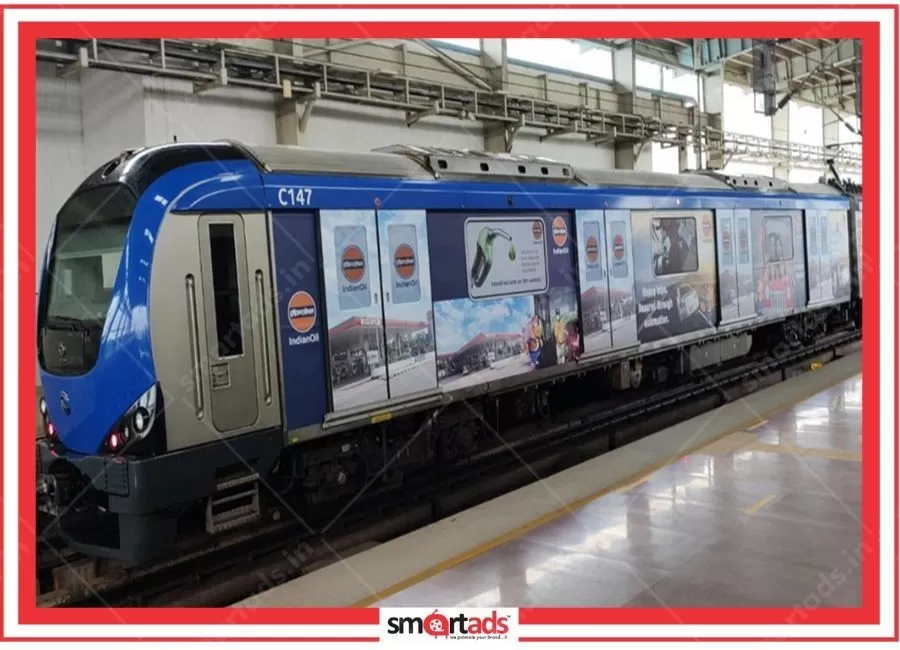
Exterior Metro Wrap
Custom
The advertisement spans the whole train,
Rate per Metro Display Cost / 1 Month
Route : Tirusulam To WIMCO Nagar
₹1000000.00
Showing 1 to 5 of 5 Results
MEDIA DETAILS
Custom
The advertisement spans the whole train,
Rate per Metro Display Cost / 1 Month
Route : Tirusulam To WIMCO Nagar
₹1000000.00
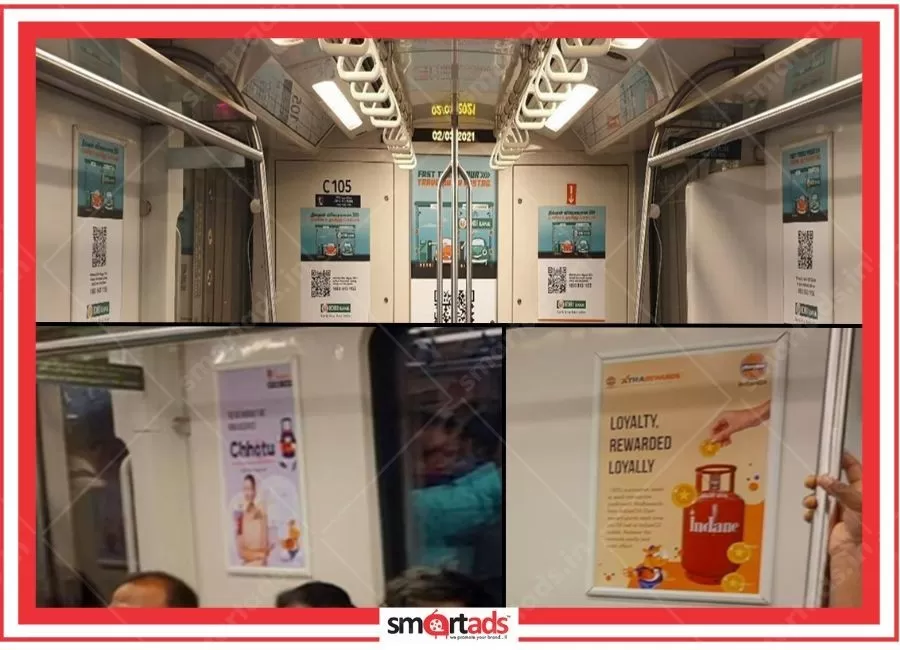
Custom
On the inside of the metro train the adv
Rate per Metro Display Cost / 1 Month
Route : Tirusulam To WIMCO Nagar
₹500000.00
20 Sec Audio
A jingle is a song or a phrase, and the
Rate per Metro Jingle Cost / 1 Month
Route :Tirusulam to WIMCO Nagar
₹400000.00

10 Sec Video
Digital screen on the metro station will
Rate per Metro Digital Display Cost / 1
Route :Tirusulam to WIMCO Nagar
₹600000.00

1 Metro Train
On the outside of the metro train the ad
Rate per Metro Display Cost / 1 Month
Route :Tirusulam to WIMCO Nagar
₹1500000.00
MEDIA REACH

MinimumQty :
1
EstimateReachPeople :
150000000
Mumbai's metro network carried over 650,000 passengers on a single day in early 2024 — a number that most outdoor media planners hadn't quite anticipated when they were drawing up their annual budgets. What makes this figure genuinely interesting isn't the footfall itself, but the profile of who those passengers are: working professionals, college students, and urban consumers who are largely unreachable through the traditional media channels that dominated Mumbai's advertising landscape for the past two decades.
The metro, in other words, has quietly built an audience that television misses, that outdoor hoardings can only partially capture, and that digital advertising increasingly struggles to reach without significant frequency waste.
There's a particular quality of attention that metro advertising commands which very few other formats can replicate. When a commuter steps into a metro coach or walks through a station concourse, they are in a defined physical space with limited distraction options — their phone, the view outside, and the advertising around them. What our experience at SmartAds shows, consistently, is that dwell time in metro environments produces recall rates that outperform most comparable out-of-home formats by a meaningful margin.
Mumbai's metro currently operates across multiple corridors — Line 1 (the original Versova–Andheri–Ghatkopar stretch), Line 2A and 7 which opened progressively through 2022 and 2023, and the newer underground corridors which are transforming connectivity between the western suburbs, the central business district, and the eastern reaches of the city. Each corridor carries a distinct passenger demographic, which means that a brand planning a metro campaign in Mumbai isn't buying a single homogeneous audience; it's buying access to several micro-markets within one unified transit system. A fast-moving consumer goods brand targeting homemakers in Dahisar will find a very different audience profile on Line 2A than a fintech startup targeting mid-level professionals on the Ghatkopar–Versova corridor.
The FICCI-EY Media and Entertainment Report has consistently highlighted transit advertising as one of the fastest-growing segments within out-of-home media in India, and Mumbai's metro expansion is a significant part of that story. We have found, through our own campaign planning across this network, that the combination of physical proximity to the advertising surface, enforced dwell time, and the relative absence of competitive clutter — compared to, say, a highway hoarding strip — creates a media environment that genuinely rewards brands willing to invest thoughtfully in the format.
Most brands, when they first approach us about metro advertising in Mumbai, assume it means putting up a poster inside a train. The reality is considerably more varied, which is both an opportunity and a planning challenge.
Station advertising covers a wide spectrum: platform panels, concourse lightboxes, escalator side panels, entry gate wraps, and the increasingly popular full-station takeover format where a single brand dominates the visual environment of an entire station. Train advertising includes interior coach panels, overhead dangler strips, door panels, and the exterior train wrap — which is arguably the most dramatic format available in the entire Mumbai out-of-home market, given that a wrapped train travels across multiple corridors and generates impressions far beyond the metro's own passenger base, reaching pedestrians, motorists, and residents along the entire route.
Digital screens are now a significant part of the Mumbai metro advertising inventory, particularly at the newer stations on Lines 2A and 7, where dynamic content can be scheduled, updated remotely, and targeted by time of day. A retail brand running a lunchtime offer, for instance, can schedule its creative to appear on concourse screens during the 11 AM to 2 PM window, which is something that a static panel simply cannot do. On top of that, the newer underground stations on the under-construction corridors are being designed with advertising infrastructure built in from the start, which means the quality and variety of formats will only expand over the next two to three years as the network grows.
Frankly speaking, this is the question we get asked most often, and it's also the one that produces the most surprise in the room when we share actual numbers.
Station panel advertising on the Mumbai metro — for a standard lightbox or backlit panel at a mid-traffic station — works out to somewhere in the ballpark of ₹40,000 to ₹80,000 per panel per month, which varies significantly depending on the station's footfall ranking, the specific location within the station, and the format size. High-footfall interchange stations like Andheri, DN Nagar, or Ghatkopar command a premium that can push costs to ₹1.2 lakh or more per panel per month; these are stations where daily footfall runs into tens of thousands, and the audience quality — in terms of income profile and purchase intent — justifies the premium for most consumer brands.
Interior coach panels are generally more accessible from a budget standpoint, with costs working out to roughly ₹15,000 to ₹30,000 per panel per month depending on panel size and coach position. The exterior train wrap, which is the format that generates the most conversation, is priced significantly higher — campaigns we have executed have typically involved investments in the range of ₹5 lakh to ₹12 lakh for a full wrap over a four-week period, which sounds substantial until you calculate the total impressions delivered across the entire route and compare that CPM to what the same brand was paying for digital video. The CPM on a well-executed metro train wrap in Mumbai works out to roughly ₹8 to ₹15, which is a number that genuinely surprises most clients when they see it laid out against their digital media costs. At SmartAds, we always tell our clients that the comparison to digital CPMs is imperfect — the quality of a physical, unskippable impression in a captive environment is categorically different — but the raw number helps frame the conversation.
This is where the real value of working with an experienced media planning team becomes apparent, because the answer is not simply "the busiest stations."
The Andheri station on Line 1 remains the single highest-footfall point on the Mumbai metro network, functioning as a major interchange between the metro, the Western Railway suburban line, and the auto-rickshaw and taxi ecosystem that serves the western suburbs. Advertising here reaches a genuinely mixed audience — IT professionals heading to SEEPZ and Marol, students connecting to colleges in Vile Parle and Santacruz, and shoppers heading to the Andheri market area. For a brand with broad urban consumer appeal, Andheri station offers reach that few other single locations in Mumbai can match.
That said, we have found that some of the most efficient campaigns we have planned were concentrated not at the top-tier stations but at a cluster of mid-tier stations that served a specific catchment area relevant to the client's business. A retail client in Goregaon, for instance, achieved significantly better in-store traffic attribution from a campaign concentrated across the four stations closest to their outlet than from a city-wide station buy that included Andheri and Ghatkopar but spread the budget too thin to generate meaningful frequency at any single point. The lesson we take from that campaign is that metro advertising in Mumbai rewards geographic precision — it is a format where knowing your audience's commute pattern matters as much as knowing their demographic profile.
Line 2A and Line 7, which together connect Dahisar to Andheri and DN Nagar to Andheri respectively, have brought a new catchment into the metro advertising universe: the western suburbs north of Andheri, which were previously underserved by transit advertising. The audience on these corridors skews toward upper-middle-income households in areas like Borivali, Kandivali, and Malad — a demographic that is highly attractive to FMCG, retail, banking, and real estate advertisers.
Mumbai's out-of-home market is one of the most competitive in Asia, which means that any media planner worth their rate card has to justify every format choice against a field of strong alternatives.
The traditional comparison is between metro advertising and the large-format hoardings that line the Western Express Highway, the Eastern Freeway, and the major arterial roads of South Mumbai. Hoardings on premium locations — Bandra-Worli Sea Link approaches, the Mahim Causeway, or the Pedder Road stretch — command rates that can run from ₹8 lakh to ₹25 lakh per month for a single site, which is a significant investment for a format that delivers impressions primarily to vehicular traffic moving at speed. The recall quality of a hoarding impression, by definition, is limited by the three to five seconds a driver or passenger can engage with the creative; metro advertising, by contrast, delivers a captive audience that may spend anywhere from two to eight minutes in proximity to the same panel.
Bus shelter advertising and BEST bus advertising remain important parts of the Mumbai out-of-home ecosystem, and we regularly recommend them as complementary formats rather than alternatives. The thing is, metro advertising occupies a specific strategic position that neither hoardings nor bus shelters can replicate: it reaches a premium urban commuter audience in a high-attention environment, with the ability to deliver sequential messaging across multiple touchpoints within a single journey. A commuter who sees a brand message at the entry gate, again on the platform panel, and again inside the coach has received three impressions in a single journey — which is a frequency efficiency that no other single out-of-home format can match.
To be honest, we have seen campaigns from almost every category run through the Mumbai metro, and the format is genuinely versatile — but some categories consistently outperform others, and it's worth being direct about that.
Financial services brands — banks, insurance companies, mutual funds, and the newer fintech players — have found the metro environment particularly productive, because the audience skews toward salaried professionals who are actively making financial decisions. One fintech brand we worked with ran a three-month campaign across twelve stations on Lines 1 and 2A, combining platform panels with interior coach panels, and reported app download attribution that was meaningfully higher from the metro campaign than from comparable spends on digital display. The creative strategy was simple: short, benefit-led messages that could be absorbed in under ten seconds, which is the right approach for a transit environment where passengers are often in motion.
Real estate advertising is another category that has found strong traction on the Mumbai metro, which makes intuitive sense given that many of the corridors pass through or adjacent to major residential development zones. Developers targeting buyers in the Thane, Navi Mumbai, and western suburbs catchments have used metro advertising to reach aspirational buyers at the precise moment when those buyers are experiencing the commute that their potential new home would require — a context-relevance that no digital retargeting campaign can fully replicate. FMCG brands, retail chains, and educational institutions round out the categories that we have consistently seen generate strong results; the common thread is that all of these categories benefit from high-frequency, high-attention exposure to a defined urban consumer audience.
The booking process for Mumbai metro advertising involves working through the authorized concessionaire for the respective metro line, which in practice means navigating different rate structures and availability systems for different corridors. This is one of the areas where working with an integrated media buying agency genuinely saves time and money — not because the process is opaque, but because availability windows, package structures, and negotiation norms vary considerably across the network.
Campaign planning should ideally begin four to six weeks before the intended launch date, particularly for formats like exterior train wraps or full-station takeovers which require production lead time and may have limited availability windows. The production requirements for metro advertising are specific — materials need to meet fire safety and adhesion standards set by the metro authority, and creative dimensions vary by format and station, which means that a brand reusing creative from another out-of-home campaign will almost certainly need to adapt artwork rather than simply repurpose it. We have seen campaigns delayed by two to three weeks because the production specifications weren't confirmed early enough in the process, which is an avoidable problem with proper planning.
At SmartAds, our approach to metro campaign planning always begins with a footfall and audience analysis across the relevant corridors, matched against the client's target consumer profile, before we make any format or station recommendations. The media plan comes out of the audience data — not the other way around. Clients who come to us having already decided they want "the Andheri station" often find, after we run the numbers, that a different station cluster delivers a better match to their actual target audience at a lower cost per relevant impression.
Creative strategy for metro advertising is a discipline that deserves more attention than it typically gets in the planning process, and what a lot of people miss is that the rules are quite different from those governing press, television, or even conventional outdoor.
The fundamental constraint is time — or rather, the variability of time. A commuter waiting on a platform may spend four minutes in front of a panel; a commuter walking through a concourse may spend four seconds. Creative that works in both contexts needs to communicate its primary message instantly while rewarding extended engagement with secondary information. This means that headline-led design, high contrast, and a single dominant visual element are not just aesthetic preferences but functional requirements. We have seen beautifully produced campaigns underperform simply because the primary message required more than two seconds to decode — a problem that would have been caught in a proper creative review against the specific format environment.
Sequential storytelling is one of the most underused creative strategies in metro advertising, and it's something we actively recommend to clients with sufficient budget to occupy multiple touchpoints across a station or corridor. A brand that tells one part of its story on the entry gate panel, advances the narrative on the platform panel, and delivers a call to action on the interior coach panel is using the metro environment in a way that no other medium can replicate — it's essentially a three-act story delivered across a single commute, which creates a brand experience rather than just an impression.
This is the question that tends to come up in every planning meeting, and to be fair, it's a legitimate one — particularly for brands that are accustomed to the attribution models available in digital advertising.
Metro advertising measurement has improved considerably over the past three years. Footfall data from the metro authority provides a baseline for impression estimation, and independent audience measurement — including passenger profile surveys commissioned through research agencies — gives advertisers a reasonable picture of the audience they are reaching. The TAM AdEx and BARC frameworks that govern television and digital measurement don't directly apply to transit advertising, but the industry has developed its own measurement conventions, including panel-level footfall attribution and recall studies conducted among metro passengers. We have found that brand recall studies conducted among metro commuters typically show aided recall rates in the range of 60 to 75 percent for campaigns that maintain presence across a corridor for four weeks or more — a figure that compares very favourably with recall benchmarks for digital display advertising.
For brands that need harder attribution, the most effective approach is to use metro advertising in combination with a trackable response mechanism — a dedicated landing page URL, a QR code on the panel, or a promotional offer code that is exclusive to the metro campaign. One consumer electronics brand we worked with ran a campaign across eight stations with a QR code linking to a product page, and the QR scan data provided a direct, unambiguous measure of engagement that the client could present to their management as campaign ROI evidence. The scan rate was modest in absolute terms — as it always is with QR codes in transit environments — but the cost per scan worked out to a fraction of what the brand was paying for equivalent engagement on paid social, which made the case for continued investment in the format.
Q: What is the minimum budget required to run a metro advertising campaign in Mumbai?
The minimum viable budget depends heavily on the format and duration you're planning for. A single interior coach panel campaign across one corridor for four weeks can be executed for somewhere in the range of ₹1.5 lakh to ₹3 lakh including production, which makes the format accessible to mid-sized brands and even well-funded startups. That said, we generally advise clients that a campaign budget of ₹8 lakh to ₹15 lakh — spread across a combination of station panels and coach panels on two or three corridors over six to eight weeks — is the threshold at which metro advertising begins to generate the frequency and reach needed to produce measurable brand impact. Below that level, the campaign can still deliver value, but it functions more as a tactical activation than a brand-building exercise.
Q: Can small and medium businesses afford metro train advertising in Mumbai?
Absolutely, and this is a misconception we encounter regularly. The perception that metro advertising is exclusively a large-brand format is outdated; the availability of individual panel bookings, shorter campaign durations, and the option to concentrate spend on a single high-relevance station means that a local business with a catchment area near a metro station can run a meaningful campaign for a budget that would be considered modest in any other premium media context. A coaching institute in Andheri, a retail store in Malad, or a co-working space near a business district station can all find a format and station combination that delivers genuine value within a budget of ₹2 lakh to ₹5 lakh.
Q: How far in advance should a brand book metro advertising space in Mumbai?
For standard formats — platform panels, concourse lightboxes, and interior coach panels — a booking lead time of three to four weeks is generally sufficient, though popular stations and high-demand periods like Diwali, year-end, and major retail seasons can see availability tighten considerably. For premium formats like exterior train wraps, full-station takeovers, or digital screen campaigns that require custom scheduling, we recommend initiating the booking process six to eight weeks in advance. Production timelines are often the binding constraint rather than media availability — metro authority approvals for creative materials and physical installation require time that brands frequently underestimate.
Q: What are the creative size specifications for Mumbai metro advertising formats?
Specifications vary by format and by the specific metro line, which is one reason why working with a media buying partner who has current relationships with the concessionaires is genuinely useful. As a general reference: platform panel sizes typically range from 4 feet by 3 feet to 6 feet by 4 feet for standard formats, while concourse lightboxes can run considerably larger. Interior coach panels are generally standardised within each train type, and the exact dimensions need to be confirmed at the time of booking. Digital screen content is typically produced in landscape format at standard HD resolution, with the specific aspect ratio confirmed by the station operator. We always recommend getting the official specification sheet from the concessionaire before commissioning any creative production — it saves the cost of reprinting.
Q: Is metro advertising in Mumbai available for short-term or event-based campaigns?
Yes, and this is an area where the format has become considerably more flexible over the past two years. While the traditional booking model was structured around monthly campaigns, most concessionaires now offer shorter booking windows for specific formats, particularly digital screens, which can be booked for as little as a week or even for specific dayparts. Event-based campaigns — product launches, film releases, IPO announcements, or seasonal retail pushes — have become a significant use case for short-duration metro advertising, precisely because the format delivers high-frequency exposure to a premium urban audience within a compressed timeframe. One entertainment brand we worked with used a two-week metro campaign across five stations to support a streaming platform launch, concentrating the budget on evening peak hours when the target audience of young professionals was most active on the network.
Q: How does Mumbai metro advertising fit into a broader integrated media plan?
Metro advertising works best when it functions as part of a layered media strategy rather than a standalone buy, and this is something we are quite direct about with our clients. The format excels at building frequency and attention among a specific urban commuter audience, but it reaches only the subset of the target population that uses the metro — which, even as the network expands, represents a defined rather than universal audience. The most effective campaigns we have planned use metro advertising to anchor awareness among the core urban professional segment, while using digital channels for retargeting and conversion, and radio or local newspaper advertising to extend reach into adjacent audiences. The combination of metro's high-attention environment with digital's targeting precision creates a media mix that is genuinely more effective than either channel alone.
Mumbai's metro network is not a niche or experimental media channel anymore — it is a mature, growing, and increasingly well-measured platform that reaches a premium urban audience at a cost efficiency that is difficult to match through any other format in the city. The expansion of the network over the next three to five years, as the underground corridors connecting the island city to the suburbs come online, will only increase the strategic importance of this medium for brands that are serious about reaching Mumbai's urban consumer.
What we have learned from years of planning and executing metro campaigns across this city is that the brands which get the most from the format are those that treat it as a strategic investment rather than a tactical add-on — those that commit to meaningful duration, invest in quality creative that is built for the transit environment, and integrate the metro buy into a broader media plan that amplifies rather than isolates the campaign. The brands that treat it as an afterthought, booking a handful of panels at the last minute with repurposed creative, consistently underperform — and then draw the wrong conclusion about the format's effectiveness.
If you are planning a campaign in Mumbai and haven't yet modelled metro advertising as part of your media mix, it is worth doing the numbers before you finalise your plan. At SmartAds, we work with brands across every category and budget level to build media plans that include metro advertising where it makes strategic sense — and we are equally direct when a client's brief is better served by a different channel combination. For a customised Mumbai metro advertising plan built around your specific audience, geography, and budget, reach out to the SmartAds team at SmartAds.in; the planning conversation is always free, and the numbers tend to be more interesting than most clients expect.
