
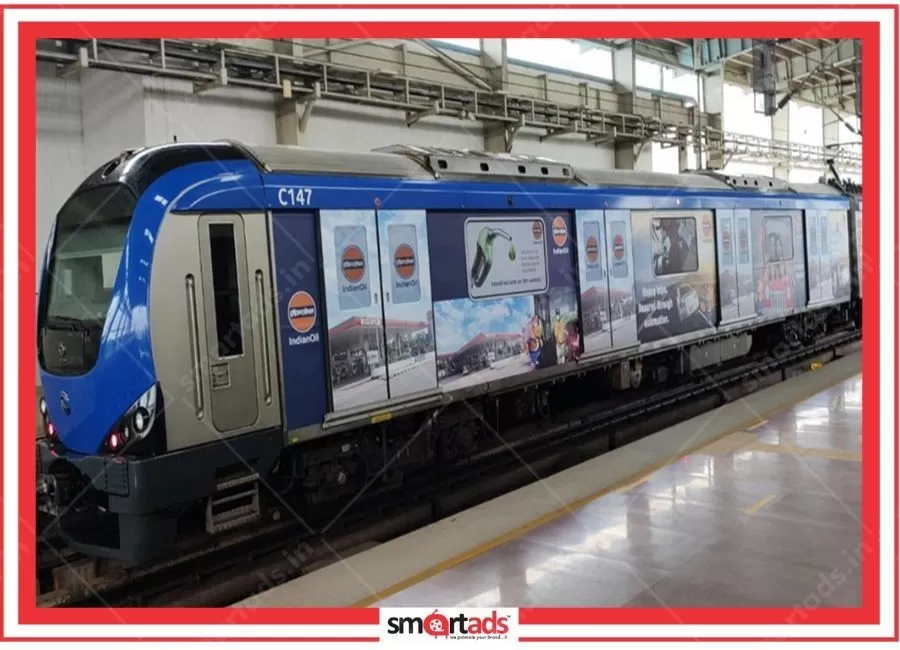
Exterior Metro Wrap
Custom
The advertisement spans the whole train,
Rate per Metro Display Cost / 1 Month
Route : Tirusulam To WIMCO Nagar
₹1000000.00
Showing 1 to 5 of 5 Results
MEDIA DETAILS
Custom
The advertisement spans the whole train,
Rate per Metro Display Cost / 1 Month
Route : Tirusulam To WIMCO Nagar
₹1000000.00
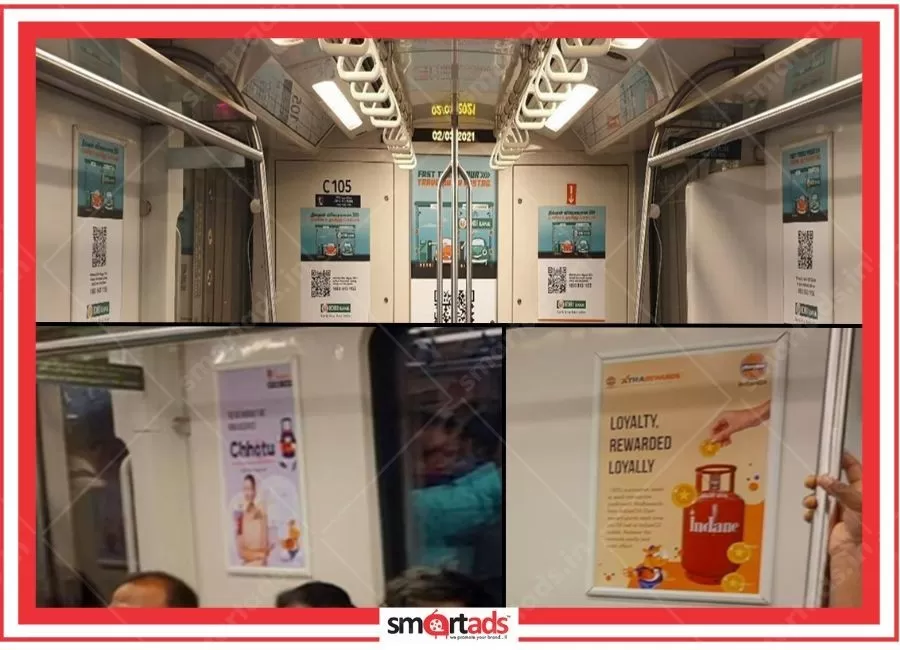
Custom
On the inside of the metro train the adv
Rate per Metro Display Cost / 1 Month
Route : Tirusulam To WIMCO Nagar
₹500000.00
20 Sec Audio
A jingle is a song or a phrase, and the
Rate per Metro Jingle Cost / 1 Month
Route :Tirusulam to WIMCO Nagar
₹400000.00

10 Sec Video
Digital screen on the metro station will
Rate per Metro Digital Display Cost / 1
Route :Tirusulam to WIMCO Nagar
₹600000.00

1 Metro Train
On the outside of the metro train the ad
Rate per Metro Display Cost / 1 Month
Route :Tirusulam to WIMCO Nagar
₹1500000.00
MEDIA REACH

MinimumQty :
1
EstimateReachPeople :
150000000
Most media planners we speak to still treat Gandhinagar as an extension of the Ahmedabad market — a secondary city that gets whatever budget is left after the big metro allocations are done. That assumption is costing brands real reach. The GIFT City corridor and the Gandhinagar Metro, which connects seamlessly into the broader Ahmedabad Metro Rail network, now carries a captive, upwardly mobile audience that is genuinely difficult to reach through conventional outdoor or digital channels alone.
Frankly speaking, the instinct to bundle Gandhinagar with Ahmedabad for planning purposes is understandable — the two cities share a metro network, and the administrative boundary between them is not always obvious to someone sitting in a Mumbai or Delhi planning office. But the audiences are meaningfully different, and the advertising environment inside the Gandhinagar Metro stations and trains reflects that difference in ways that matter to brands.
The Gandhinagar Metro serves a corridor that includes government offices, the GIFT City financial district, the state secretariat, and a rapidly expanding residential belt; which means the commuter profile skews heavily toward salaried professionals, government employees, financial services workers, and students attending institutions like the National Forensic Sciences University and the Pandit Deendayal Energy University. This is not the same audience you reach at a roadside hoarding on the Sarkhej-Gandhinagar Highway. The dwell time inside a metro station — which typically runs somewhere between four and eight minutes per commute leg — creates an advertising environment that outdoor formats simply cannot replicate.
At SmartAds, we always tell our clients that the real value of transit advertising is not just the volume of impressions; it is the quality of attention that a captive environment forces. A commuter waiting on a platform has nowhere else to look, which is a fundamentally different situation from someone driving past a billboard at 60 kilometres per hour. That attentional advantage, combined with the demographic profile of the Gandhinagar Metro corridor, is what makes this format worth a serious budget conversation rather than a footnote allocation.
The format inventory on the Gandhinagar-Ahmedabad Metro is broader than most first-time transit advertisers expect, and understanding what is available — and where each format performs — is essential before any rate negotiation begins. Station branding, which involves wrapping pillars, concourses, and platform walls, tends to deliver the highest visual impact because the creative is encountered at eye level during the dwell period; train panel advertising, by contrast, delivers frequency because the same commuter sees it on every journey.
Inside the train coaches, you have options ranging from overhead panel inserts — which run along the luggage rack area and are read by standing passengers — to full door decals and window graphics. Station domination packages, which allow a single advertiser to own all visible surfaces within a particular station for a defined period, are particularly effective for product launches and brand relaunch campaigns; we have seen FMCG and financial services brands use the GIFT City station domination format to very strong effect, precisely because the audience density there is high and the professional profile matches their target customer exactly.
Digital screens, which are increasingly being installed across the network, add a dynamic layer to what was previously a static inventory; these screens allow time-of-day targeting, which means a breakfast cereal brand can run creatives in the morning peak and a fintech app can target the evening commute when professionals are mentally transitioning from work to personal decisions. The production requirements are different for each format — static vinyls need to be printed to specific size tolerances, while digital content needs to be formatted to the screen resolution specifications provided by the concessionaire — and getting these details right at the brief stage saves significant time and money later.
This is the question every client asks first, and to be honest, it is also the question that most agency pages dodge by hiding behind a "contact us for rates" disclaimer. We will not do that here. The rate structure for Gandhinagar Metro advertising is tied to the Ahmedabad Metro Rail Corporation's concessionaire agreements, and while rates are subject to revision, we can share the ballpark figures that our planning team works with.
A standard platform panel — roughly 4 feet by 3 feet — on a Gandhinagar corridor station works out to somewhere in the range of ₹15,000 to ₹25,000 per month per panel, depending on the station footfall tier and the specific location within the station. Train panel advertising, which covers the interior coach panels, tends to be priced in packages rather than individually; a full-coach interior package across a rake typically runs in the ballpark of ₹80,000 to ₹1.5 lakh per month, which when you calculate the CPM against the daily ridership figures works out to a number that surprises most first-time transit advertisers when they compare it to what they are paying for Instagram reach in the same geography. Station domination packages — which are the premium end of the inventory — are negotiated on a case-by-case basis and can range from ₹3 lakh to ₹8 lakh per month for a full-station takeover, depending on the station's commercial importance and the duration of the booking.
What a lot of people miss is that the minimum booking period for most metro advertising formats is 30 days, and the real cost efficiency kicks in at the 90-day mark; concessionaires typically offer meaningful discounts — in the range of 15 to 25 percent — for quarterly bookings, which is something our team actively negotiates on behalf of clients. A pharmaceutical brand we worked with in 2023 initially wanted a 30-day burst campaign around a product launch; after we modelled the CPM across a 90-day booking versus the 30-day rate, they shifted to a longer commitment and effectively got an additional month of exposure at no extra cost after the negotiated discount was applied.
Not all stations on the Gandhinagar-Ahmedabad Metro corridor are created equal from an advertising perspective, and understanding the footfall hierarchy is something that separates a well-planned transit campaign from a budget that gets spread too thin across low-traffic locations. The stations serving the GIFT City area and the Gandhinagar Capital complex consistently show the highest professional commuter density; which makes them the priority locations for financial services, insurance, real estate, and B2B brands that are trying to reach decision-makers rather than mass consumers.
The interchange stations — where the Gandhinagar corridor connects with the broader Ahmedabad Metro network — carry disproportionately high footfall because they serve passengers transferring between lines, which means the dwell time at these stations is longer and the advertising exposure window is correspondingly wider. Our experience shows that interchange station inventory books out faster than any other format on this network, and clients who wait until the last minute to confirm their plans often find that the best positions are already committed. We recommend confirming bookings at least six to eight weeks ahead of the intended campaign start date, particularly for Q4 campaigns when multiple advertisers are competing for the same premium positions.
The route itself also matters strategically. The Gandhinagar Metro primarily serves a commuter population that is making a daily round trip between residential areas and employment hubs; which means frequency of exposure is naturally built into the format without any additional media planning effort. A commuter who passes your platform panel twice a day for 30 days has received 60 exposures to your creative — a frequency figure that would cost significantly more to achieve through digital retargeting in the same geography, particularly given the increasing cost of programmatic inventory in Tier 1 and Tier 1-adjacent Indian markets.
The outdoor advertising market in Gandhinagar is not as developed as Ahmedabad, which creates an interesting strategic situation. The traditional hoarding inventory along key arterials like the Gandhinagar-Ahmedabad Expressway and the Sector Road network is reasonably priced — a 40x20 unipole on a major arterial works out to roughly ₹40,000 to ₹70,000 per month — but the audience measurement is essentially estimated, based on traffic counts that are not always current or granular.
Metro advertising, by contrast, operates in an environment where ridership data is actually tracked by the metro operator; which gives advertisers a more defensible basis for calculating reach and frequency. The Ahmedabad Metro Rail Corporation publishes ridership data periodically, and while the Gandhinagar corridor figures are not always broken out separately, the combined network ridership has been growing consistently since commercial operations expanded — a trend that is well documented in the FICCI-EY Media and Entertainment Report's transit media section. For a brand manager who needs to justify a media spend to a CFO, having actual ridership numbers to anchor the reach calculation is meaningfully more credible than saying "we estimate X lakh vehicles pass this hoarding per month."
Radio, which remains a strong medium in the Ahmedabad-Gandhinagar market, reaches a broad audience but lacks the visual impact and dwell-time advantage of transit advertising; newspaper advertising in Gujarati-language dailies like Sandesh and Divya Bhaskar delivers high reach among older demographics but skews away from the young professional audience that the metro corridor delivers. Our view is that metro advertising works best not as a replacement for these formats but as a precision layer within a broader media mix — particularly for brands that need to reach the professional and government employee segment that is disproportionately represented in the Gandhinagar Metro's commuter base.
We have seen this backfire when brands try to run the same creative in metro stations that they are running on roadside hoardings. The viewing context is completely different; a platform panel is read at close range, often by someone who is standing still and has nothing else to demand their attention, which means the creative can carry more information than a highway billboard where the message needs to land in under three seconds.
That said, more information does not mean cluttered design. The most effective metro creatives we have planned around tend to follow a principle our creative team calls "one thought, fully expressed" — a single message that is given enough space and copy to actually land with depth rather than just register as a logo impression. A financial services client we worked with in Gandhinagar used their GIFT City station domination to run a campaign that included a QR code linking to a product explainer video; the scan rate on that campaign was meaningfully higher than what the same client had seen on outdoor QR codes in other markets, which we attribute to the fact that metro commuters are already holding their phones and are in a mental state that is more receptive to a digital follow-through action.
At SmartAds, our creative brief for transit formats always specifies the viewing distance and dwell time for each specific placement, because a pillar wrap that is read from 2 metres is a different creative problem from a train panel that is read from 50 centimetres. Getting this right at the brief stage means the production team is designing for the actual viewing experience rather than for a generic "OOH" specification, and the difference in campaign effectiveness is substantial.
There is a persistent assumption that transit advertising is only for large national brands with significant media budgets, and to be fair, that assumption was largely accurate ten years ago when the minimum booking requirements and production costs made the format inaccessible to smaller advertisers. The situation has changed considerably. The concessionaire model on the Gandhinagar-Ahmedabad Metro has evolved to include smaller format options — single panel bookings, limited-station packages, and shared-display formats — which bring the entry point down to a level that regional brands and local businesses can genuinely consider.
A retail client in Gandhinagar's Sector 11 commercial area came to us with a budget that was, frankly, modest by metro advertising standards — somewhere in the range of ₹1.5 lakh for a 30-day campaign. We structured a plan that concentrated the spend on two stations closest to their target customer's residential and commute patterns, using interior coach panels rather than the more expensive station domination format; the campaign generated a measurable increase in footfall to their store, which the client tracked through a simple offer code that was featured in the creative. The point is not that metro advertising is cheap — it is not — but that it is no longer exclusively a large-brand medium.
The key for smaller brands is to be strategic about format selection and station concentration rather than trying to achieve network-wide coverage on a limited budget. Spreading ₹1.5 lakh across ten stations produces negligible frequency at each location; concentrating it on two or three stations that are genuinely relevant to your audience produces a campaign that actually registers. This is a principle that applies across all transit advertising, but it is particularly important in a market like Gandhinagar where the audience is geographically concentrated and the station network is still developing.
ROI measurement in transit advertising is one of those areas where the industry has historically been weaker than digital channels, and it is worth being honest about that rather than overpromising. The measurement frameworks that are available — and that we use at SmartAds for our transit campaigns — rely on a combination of ridership-based reach calculations, brand tracking surveys, and attribution proxies like offer codes, QR scan rates, and search volume uplift.
The TAM AdEx data, which tracks advertising expenditure and activity across media categories, shows transit advertising as a growing segment within the broader OOH category; which is consistent with what we observe in terms of advertiser demand for metro inventory in cities like Gandhinagar where the network is relatively new and the audience profile is attractive. For brands that have a digital presence, running a concurrent search campaign targeting the Gandhinagar geography during a metro advertising flight is a practical way to capture the intent that the transit exposure generates; we have seen search volume for brand terms increase by somewhere between 15 and 30 percent during periods when a metro campaign is active, which provides at least a directional signal on the awareness impact.
The honest answer is that transit advertising, like most brand-building media, does not lend itself to the kind of precise attribution that a performance digital campaign does; which is why it is best evaluated as part of a broader media mix rather than in isolation. What it does deliver — reliably, measurably, and at a competitive CPM — is high-frequency exposure to a defined audience in a captive environment, and that is a media objective that has genuine strategic value for brands that are building awareness and consideration in the Gandhinagar market.
The booking process for metro advertising in Gandhinagar runs through the concessionaire that holds the advertising rights for the Ahmedabad Metro Rail Corporation network; which means the first step is identifying the current concessionaire and understanding their inventory management system. This sounds straightforward, but in practice the concessionaire landscape for Indian metro networks changes periodically as contracts are renewed or reassigned, and working through an agency that maintains active relationships with the current rights-holder saves significant time and avoids the frustration of approaching an outdated contact.
Once the concessionaire relationship is established, the booking process involves selecting formats and stations, confirming availability for the desired campaign period, submitting creative files in the specified formats, and completing the purchase order and advance payment process. Most concessionaires require a 50 percent advance at the time of booking confirmation, with the balance due before the campaign goes live; which means cash flow planning for the campaign needs to account for this payment structure rather than assuming the standard 30-day credit terms that apply in some other media categories.
Production lead times are a detail that first-time transit advertisers consistently underestimate. Vinyl printing and installation for station panels typically requires a minimum of seven to ten working days after creative approval; digital screen content, while faster to deploy, still requires concessionaire approval and scheduling. Our standard recommendation to clients is to have final creative approved at least three weeks before the intended campaign start date, which provides enough buffer for production, installation scheduling, and any last-minute creative revisions that inevitably arise.
Q: What is the minimum budget required to run a metro advertising campaign in Gandhinagar?
The practical minimum for a meaningful metro advertising campaign on the Gandhinagar corridor is somewhere in the range of ₹1 lakh to ₹1.5 lakh for a 30-day period, which would typically cover a small number of interior coach panels or a limited station panel booking at a single mid-tier station. Below this level, the frequency generated is unlikely to be sufficient to produce measurable brand impact; which is why we generally advise clients with budgets below this threshold to consider whether transit advertising is the right format for their current campaign objective, or whether the budget would work harder in a more concentrated format. That said, the entry point has come down significantly from where it was three to four years ago, and the format is genuinely accessible to regional brands and local businesses that are willing to be strategic about format and station selection.
Q: Can I target specific audience segments through metro advertising in Gandhinagar?
Direct demographic targeting in the way that digital platforms allow is not available in transit advertising — you cannot exclude certain age groups or income brackets from seeing your platform panel. What you can do, however, is use station and route selection as a proxy for audience targeting, which is a form of contextual targeting that is actually quite powerful when the audience profile of specific stations is well understood. The GIFT City stations, for example, deliver a disproportionately high concentration of financial services professionals and high-net-worth individuals; the stations serving the government secretariat area deliver a concentration of government employees and their families. At SmartAds, our planning process for transit campaigns always starts with a station-by-station audience profile analysis before any format or rate conversation begins, because the targeting logic is built into the geography rather than into the technology.
Q: How far in advance should I book metro advertising space in Gandhinagar?
For standard formats at non-premium stations, a booking lead time of four to six weeks is generally sufficient; for premium positions — interchange stations, GIFT City area, station domination packages — we recommend a minimum of eight weeks, and for Q4 campaigns running from October through December, which is the peak advertising period in India, we advise clients to confirm bookings by August to avoid losing their preferred positions to competitors. The Gandhinagar Metro advertising inventory is not yet as constrained as the Mumbai or Delhi Metro networks, but the premium positions fill up faster than most clients expect, particularly as awareness of the format's effectiveness grows among Gujarat-based advertisers.
Q: Is metro advertising in Gandhinagar suitable for a national brand campaign?
Metro advertising in Gandhinagar works particularly well as a geographic amplifier for national campaigns that need to demonstrate local presence in the Gujarat market; which is a use case we see frequently with national FMCG, financial services, and real estate brands that are running a broad national campaign but want to add a layer of local relevance in a market that matters to their growth strategy. The GIFT City corridor is especially relevant for financial services brands that want to be visible to the concentration of banking, insurance, and fintech professionals working in that district. A national campaign that runs on television and digital can be given meaningful local reinforcement through a well-placed metro campaign in Gandhinagar, and the combined effect on brand salience in the Gujarat market is typically greater than the sum of the individual media investments.
Q: What types of businesses benefit most from metro train advertising in Gandhinagar?
From our experience planning campaigns on this network, the categories that consistently generate the strongest results from Gandhinagar Metro advertising are financial services — particularly banking, insurance, and investment products — real estate developers targeting the GIFT City and Gandhinagar residential markets, educational institutions recruiting students from the professional commuter demographic, healthcare brands targeting the upper-middle-income segment, and consumer durables brands that are seeking to build consideration among the aspirational professional audience that the corridor delivers. FMCG brands can also benefit, particularly at the frequency levels that a 90-day campaign generates, but the CPM economics work best for categories where the average transaction value justifies the brand investment. Government and public service campaigns are also a natural fit, given the concentration of government employees and their families in the Gandhinagar Metro's catchment area.
Q: How does SmartAds handle the end-to-end process for metro advertising campaigns?
At SmartAds, our process for metro advertising campaigns covers everything from the initial audience and station analysis through to campaign monitoring and post-campaign reporting. We maintain active relationships with the concessionaires operating on the Ahmedabad-Gandhinagar Metro network, which means our clients benefit from current rate intelligence, advance notice of inventory availability, and the negotiating leverage that comes from aggregating bookings across multiple clients. Our planning team handles the creative specification briefs, coordinates with the client's creative agency or our in-house production team on format compliance, manages the booking and payment process with the concessionaire, and conducts installation verification to confirm that the creative has gone up correctly and in the right positions. Post-campaign, we provide a reach and frequency analysis based on ridership data and, where applicable, attribution data from digital proxies like QR scans and search volume tracking.
The brands that get the most out of metro advertising in Gandhinagar are the ones that treat it as a precision instrument within a broader media mix rather than as a standalone channel. Our experience across hundreds of campaigns in Gujarat shows that transit advertising performs best when it is running concurrently with at least one other medium — television for mass reach, digital for performance follow-through, or radio for frequency reinforcement — because the metro environment creates awareness and consideration that the complementary channels can then convert into action.
The Gandhinagar market is at an interesting inflection point. The GIFT City development has brought a new category of high-value professionals into the corridor, the metro network is still expanding its reach and ridership, and the advertising inventory has not yet been fully discovered by the broader advertiser community; which means the cost efficiency available right now is unlikely to persist as the market matures. Brands that establish a presence on this network in the current period are building familiarity with an audience that is going to be increasingly valuable as GIFT City's financial ecosystem grows.
If you are a brand manager or media planner evaluating the Gandhinagar market, the honest advice from our team is to run a 90-day test campaign on the metro corridor before dismissing it as a secondary market afterthought. The numbers, when you model them properly against the audience profile and the CPM benchmarks, tend to make a compelling case on their own. And if you want help building that model — or negotiating the rates and formats that make the most sense for your specific campaign objectives — the SmartAds team is available to work through the planning with you. You can reach us through [SmartAds.in](https://smartads.in/services/traditional/metro-train-advertising-in-gandhinagar), where our media planning team handles enquiries across all 500+ cities we cover, including the full Gandhinagar-Ahmedabad Metro corridor.
