
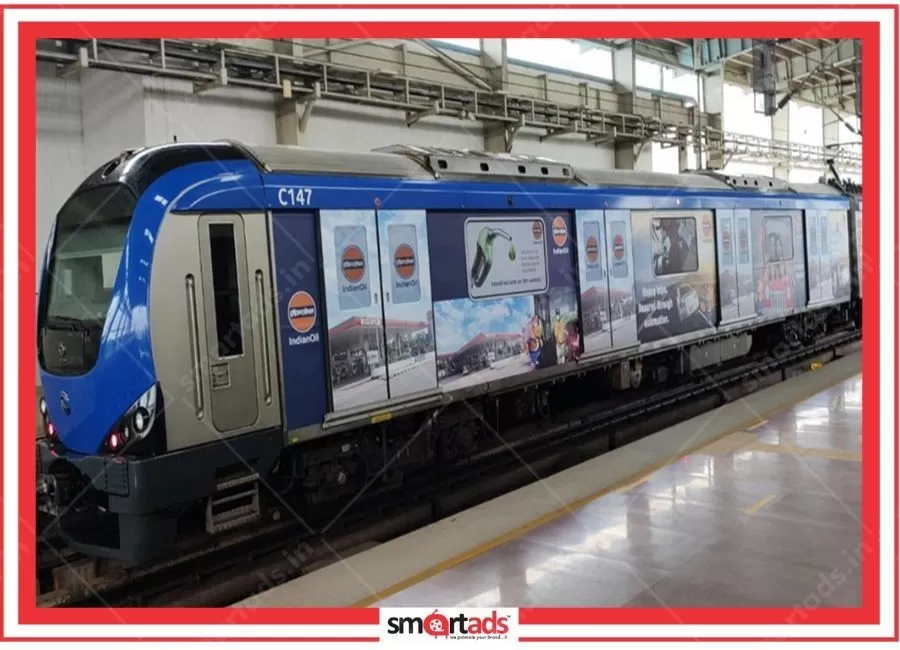
Exterior Metro Wrap
Custom
The advertisement spans the whole train,
Rate per Metro Display Cost / 1 Month
Route : Tirusulam To WIMCO Nagar
₹1000000.00
Showing 1 to 5 of 5 Results
MEDIA DETAILS
Custom
The advertisement spans the whole train,
Rate per Metro Display Cost / 1 Month
Route : Tirusulam To WIMCO Nagar
₹1000000.00
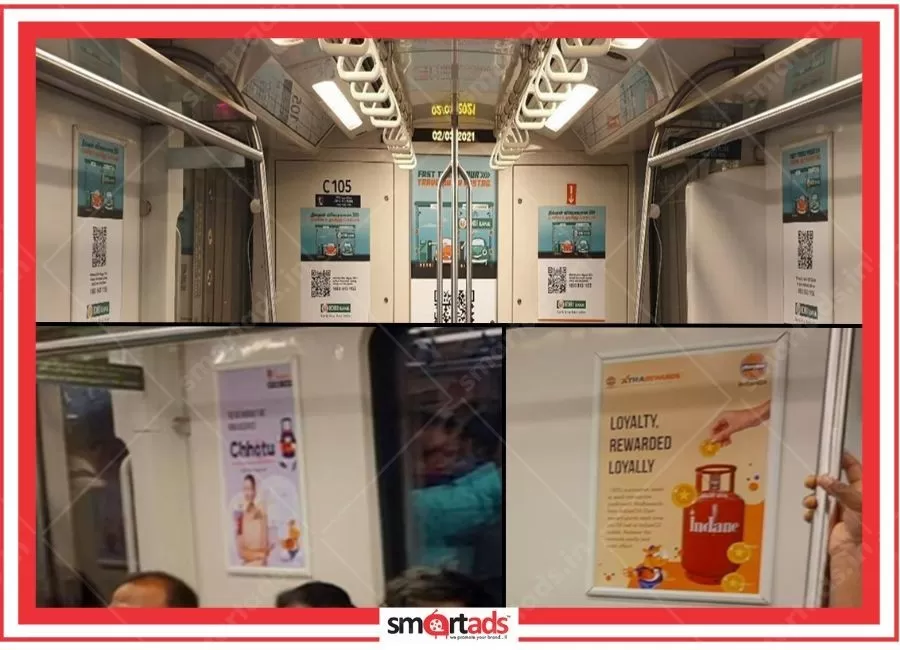
Custom
On the inside of the metro train the adv
Rate per Metro Display Cost / 1 Month
Route : Tirusulam To WIMCO Nagar
₹500000.00
20 Sec Audio
A jingle is a song or a phrase, and the
Rate per Metro Jingle Cost / 1 Month
Route :Tirusulam to WIMCO Nagar
₹400000.00

10 Sec Video
Digital screen on the metro station will
Rate per Metro Digital Display Cost / 1
Route :Tirusulam to WIMCO Nagar
₹600000.00

1 Metro Train
On the outside of the metro train the ad
Rate per Metro Display Cost / 1 Month
Route :Tirusulam to WIMCO Nagar
₹1500000.00
MEDIA REACH

MinimumQty :
1
EstimateReachPeople :
150000000
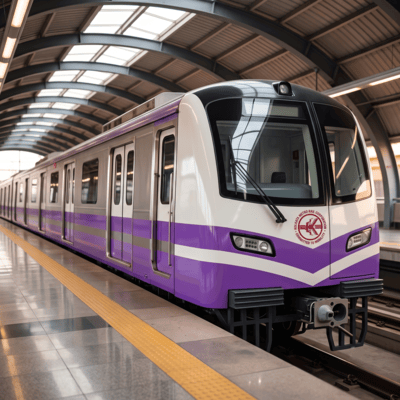
Kolkata's metro carries somewhere in the range of 6 to 7 lakh daily commuters on an average weekday — a number that has been climbing steadily since the East-West Metro Corridor opened new sections, and one that most brand managers in the city are still significantly underestimating when they plan their media mix. What makes metro train advertising in Kolkata genuinely different from most other out-of-home advertising formats is not just the volume of eyeballs; it is the quality of the dwell time, which runs to an average of 25 to 40 minutes per journey and creates a captive audience environment that a roadside hoarding simply cannot replicate. We have been planning transit media campaigns across this network for years, and frankly speaking, the gap between what this medium can deliver and what most brands are actually spending on it remains one of the more persistent inefficiencies we see in Kolkata's advertising market.
Metro Railway Kolkata operates one of India's oldest urban rail networks, and the advertising ecosystem built around it has grown considerably more sophisticated than most people outside the transit media space realise. The network is managed across two primary entities — Metro Railway Kolkata, which operates the legacy Blue Line running from Noapara in the north to Kavi Subhash in the south, and the Kolkata Metro Rail Corporation (KMRC), which manages the newer lines including the Green Line connecting Howrah Maidan to Salt Lake Sector V. Each entity has its own advertising concession arrangements, which is one reason why brands often find the booking process confusing when they approach it without an experienced metro advertising agency in Kolkata by their side.
The mechanics of how metro train advertising works are worth understanding clearly before any budget conversation begins. Advertising inventory on the Kolkata Metro exists at three distinct levels — on the trains themselves (both interior and exterior surfaces), within the stations (platforms, concourses, pillars, and digital screens), and in the entry-exit zones where footfall is highest and dwell time is lowest but frequency of exposure is at its peak. A brand running interior branding on a train coach is reaching the same commuter repeatedly over multiple journeys through the week, which creates a compounding effect on brand recall that is very different from the single-impression logic of a newspaper or a 30-second radio spot. At SmartAds, we always tell our clients that metro advertising is not a one-touch medium — it is a frequency medium, and the campaign planning should reflect that from day one.
What a lot of people miss is that the advertising permissions and rate structures differ between Metro Railway Kolkata and KMRC, which means a brand wanting to run a truly pan-network campaign needs to navigate two separate approval processes and two separate creative specifications. This is not as complicated as it sounds when you have the right agency handling it, but it is absolutely the kind of detail that can cause a campaign to be delayed by weeks if a brand tries to book directly without understanding the structure. The concession rights for train-body advertising and station branding are typically held by authorised vendors — names like Global Media Outdoor Pvt Ltd and Acme Advertising Co. have historically held positions in this space — and an experienced metro advertising agency in Kolkata will already have working relationships with these concessionaires, which dramatically shortens the booking timeline.
The range of formats available for metro train advertising in Kolkata is considerably wider than most advertisers initially assume, and the choice of format has a significant bearing on both the cost and the strategic outcome of a campaign. Starting from the most visible end of the spectrum, the full train branding or full train wrap is exactly what it sounds like — the entire exterior of a metro train, across all coaches, is covered in a single brand's creative, turning the train into a moving billboard that travels the entire length of the Blue Line or Green Line multiple times each day. This is the format that generates the most conversation and the highest brand visibility, but it is also the most expensive and the most logistically demanding in terms of creative production.
Below full train branding, the exterior train wrap format allows a brand to take one or more coaches rather than the entire rake, which brings the cost down substantially while still delivering the impact of a moving billboard on the streets and elevated sections of the route. The exterior wrap uses vinyl wrap material applied to the train body, and the creative specifications here are demanding — artwork needs to account for the curvature of the train body, the placement of windows and doors, and the bleed areas that ensure the design reads cleanly at speed. For brands that want exterior visibility without the full train branding commitment, a coach wrap on two or three coaches of a rake is often the most cost-efficient entry point into this format. The vinyl wrap material used must meet KMRC and Metro Railway Kolkata specifications for adhesion and removal, which is something the agency and the production vendor need to coordinate carefully.
Interior branding is, in our experience, where the real strategic value lies for most advertisers — particularly those whose target audience is the daily commuter making a 20-to-40-minute journey. Interior branding encompasses several distinct sub-formats: overhead panels positioned above the seating rows and visible to seated passengers, seat-back stickers placed on the reverse of each seat and readable by the passenger behind, door panels on the interior of coach doors, and the grab-handle branding which is among the most tactile and memorable formats in the entire metro advertising inventory. On top of that, digital screens inside newer Green Line coaches allow for dynamic content, which opens up the possibility of time-of-day targeting and sequential messaging — a capability that brings metro advertising closer to DOOH territory and makes digital remarketing integration genuinely feasible. Station-level formats including platform branding, pillar branding, concourse advertising, and station domination packages round out the inventory, and a well-planned campaign will typically combine train-level and station-level formats for maximum frequency of exposure.
Advertising rates for metro train advertising in Kolkata are not publicly listed in any standardised way, which is one of the genuine frustrations for brand managers trying to build a media plan without agency support. What we can share, based on our experience planning and executing campaigns on this network, is a realistic sense of the ballpark figures that brands should be working with when they approach this medium. Full train branding on the Blue Line — covering the exterior of an entire rake across all coaches — works out to somewhere in the range of ₹8 to ₹15 lakh per month depending on the rake, the season, and the negotiation, which is a number that surprises most clients when they compare it to what a comparable-reach hoarding campaign in Kolkata would cost them.
Interior branding packages are considerably more accessible, with overhead panel campaigns on a single coach running in the ballpark of ₹40,000 to ₹80,000 per month per coach, and full-coach interior branding — which covers overhead panels, seat-back stickers, and door panels across an entire coach — typically sitting somewhere between ₹1.5 lakh and ₹3 lakh per month depending on the line and the coach position within the rake. Station branding rates vary enormously by station; a high-traffic station like Esplanade or Park Street commands a significant premium over a quieter station, and a station domination package at Esplanade — which covers pillars, concourse advertising, platform branding, and digital screens — can run to ₹5 lakh or more per month. These are working estimates, not catalogue prices, and the actual rates are subject to negotiation, campaign duration, and the concession holder's current inventory availability.
The minimum campaign duration for most metro advertising formats is typically 30 days, though some concessionaires will consider a 15-day campaign for specific formats during peak seasons like Durga Puja or the year-end period. What we tell our clients at SmartAds is that a 30-day campaign on metro train advertising is really the floor for seeing meaningful brand recall impact — the frequency of exposure model that makes this medium work requires enough time for the daily commuter to encounter the creative multiple times across their weekly journey pattern. A seasonal campaign timed around Durga Puja, for instance, benefits enormously from a booking that starts at least two weeks before the festival period, because inventory at high-traffic stations like Tollygunge and Gitanjali gets absorbed quickly as the festival approaches and competing brands scramble for visibility.
The Blue Line, running from Noapara in the north to Kavi Subhash in the south and passing through central Kolkata stations including Esplanade, Park Street, and Tollygunge, is the original metro corridor and carries the highest daily ridership of any line in the network. For brands targeting a broad cross-section of Kolkata's urban population — which includes daily office commuters, students, shoppers, and residents of the dense residential corridors along the north-south spine — Blue Line advertising remains the highest-reach option in the metro advertising inventory. The stations along this corridor, particularly the central stretch from Noapara to Tollygunge, include some of the most commercially valuable advertising locations in all of West Bengal's out-of-home advertising market.
What makes Blue Line advertising particularly interesting from a media planning perspective is the sheer variety of commuter profiles across different station catchments; the northern stations around Noapara serve a predominantly working-class and lower-middle-class commuter base, while the central stations around Park Street and Esplanade attract a more premium urban audience, and the southern stations around Tollygunge and Gitanjali serve a mix of residential and commercial footfall. This means that station-level targeting on the Blue Line can be used quite precisely to reach different demographic segments within a single campaign, which is a capability that broad-reach formats like television or radio simply cannot offer at a comparable cost.
The Green Line — formally the East-West Metro Corridor — connecting Howrah Maidan to Salt Lake Sector V through a mix of underground and elevated sections, is the newer and in many ways more strategically interesting line for advertisers targeting Kolkata's professional and technology sector audience. Salt Lake Sector V is Kolkata's primary IT and business process hub, and the commuters who board and alight at Salt Lake Sector V station represent a premium audience of technology professionals, young urban workers, and business executives, which is a demographic that many brands in the EdTech, fintech, financial services, and consumer durables categories are actively trying to reach. The East-West Metro has also significantly changed commute patterns for residents of Howrah, connecting them to the city's commercial east in a way that was not previously possible.
Interior branding on Green Line coaches is particularly valuable because the newer rolling stock on this corridor includes digital screens, which means the interior advertising environment is more dynamic and offers creative possibilities that the older Blue Line coaches do not. A campaign that combines seat-back stickers and overhead panels with dynamic digital screen content on the Green Line can deliver a genuinely multi-format interior branding experience within a single coach, which is something we have seen work very effectively for brands in the financial services and consumer electronics categories. The advertising rates on the Green Line are broadly comparable to the Blue Line for equivalent formats, though Salt Lake Sector V and Howrah Maidan tend to command a premium for station-level inventory given their footfall volumes and the premium nature of their commuter profiles.
The audience profile of Kolkata Metro's daily commuters is one of the most compelling arguments for metro rail advertising in Kolkata, and it is an argument that is often undersold by agencies that focus too heavily on the raw ridership numbers rather than the qualitative characteristics of the audience. Metro commuters in Kolkata skew significantly towards the 18-to-45 age bracket, are predominantly employed in formal-sector jobs, and have household incomes that place them in the SEC A and B categories — which is precisely the target audience for most consumer brands operating in the premium and mid-premium segments. The GroupM TYNY Report and the Dentsu e4m Report have both consistently highlighted urban transit media as an underpenetrated channel relative to the quality of audience it delivers, and Kolkata Metro is a strong example of this dynamic.
What a lot of people miss when they look at metro advertising audience data is the distinction between daily commuters and occasional users. The daily commuter — someone who takes the metro five days a week for work — is exposed to interior branding on their train coach somewhere between 40 and 80 times over the course of a 30-day campaign, which creates a level of repeated exposure and frequency of exposure that no other advertising format in Kolkata's media market can match at a comparable cost per contact. Occasional users — weekend shoppers, students travelling for coaching classes, visitors to the city — add incremental reach on top of this core frequency base, which means the effective audience for a metro advertising campaign is both deep (in terms of frequency with core commuters) and broad (in terms of total unique reach across the month).
Students and young professionals are particularly well-represented on the Kolkata Metro, and this makes the network an exceptionally efficient channel for brands in the education, EdTech, banking, insurance, and FMCG categories. One FMCG brand we worked with ran a 45-day interior branding campaign across 10 coaches on the Blue Line, targeting the morning peak hour commuter corridor between Noapara and Tollygunge; the brand tracking study conducted post-campaign showed a statistically significant uplift in unaided brand awareness among the 18-to-35 urban audience segment in Kolkata, which validated the media investment and led to the campaign being renewed for the following quarter.
Kolkata Metro's daily ridership — which KMRC and Metro Railway Kolkata data suggests sits in the range of 6 to 7 lakh passengers per day across all lines on a typical weekday — translates into a monthly audience reach that is genuinely impressive when expressed in impression terms. A full train branding execution on the Blue Line, where the train completes multiple return journeys each day on a corridor passing through some of the most densely populated parts of the Kolkata Metropolitan Region, generates exterior impressions from pedestrians, motorists, and bystanders at grade crossings and elevated sections, on top of the captive interior audience. The total impression count for a full train branding campaign over 30 days, combining interior and exterior exposure, can be estimated in the range of 50 to 80 lakh impressions — a number that, when divided by the campaign cost, produces a CPM that works out to roughly ₹8 to ₹15, which is a figure that surprises most first-time metro advertisers when they compare it to what they are paying for Instagram reach or programmatic display.
The concept of dwell time is central to understanding why metro advertising delivers such strong brand recall relative to its cost. A commuter sitting in a metro coach for 30 minutes is not scrolling past an advertisement in a fraction of a second — they are sitting in a physical environment where the brand creative on the overhead panel above them or the seat-back sticker in front of them is simply present, unavoidable, and visible for the entire duration of the journey. This is a fundamentally different attention environment from digital advertising, and the brand communication impact reflects that difference. Research on transit media globally, including data from markets comparable to Kolkata, consistently shows brand recall rates for metro interior advertising that are significantly higher than for equivalent-spend digital or print campaigns, which is a finding that aligns with what we observe in our own post-campaign brand lift studies.
Platform branding and concourse advertising at high-traffic stations add another layer of reach to any metro advertising campaign, capturing commuters during the boarding and alighting moments when they are physically moving through the station environment. Esplanade station, which serves as an interchange between the Blue Line and the proposed extensions, sees footfall that makes it one of the most valuable single-location advertising sites in Kolkata's entire out-of-home advertising market; a station domination package at Esplanade effectively makes the station a branded environment for the duration of the campaign, which creates an immersive brand experience that no other format in the city can replicate.
Frankly speaking, the comparison between metro train advertising in Kolkata and conventional billboard or hoarding advertising is not as straightforward as most media planning conversations make it sound, because the two formats are doing fundamentally different things in terms of the audience relationship they create. A large-format hoarding on the Eastern Metropolitan Bypass or the EM Bypass flyover delivers a single impression to a motorist travelling at speed — the exposure lasts perhaps two to three seconds, the audience is distracted by traffic, and the frequency of exposure depends entirely on how often that particular motorist uses that particular route. Metro advertising, by contrast, delivers repeated exposure to a captive audience in a low-distraction environment, which is why the brand recall metrics for transit media consistently outperform those for equivalent-spend OOH advertising in most market studies.
That said, OOH advertising in Kolkata serves a different strategic purpose — it is a mass-reach, high-visibility format that works well for brand awareness campaigns targeting the broadest possible audience, including those who never use the metro. A well-planned media mix for a brand launching in Kolkata might use large-format hoardings at key arterial intersections for broad awareness, metro train advertising for deep frequency with the urban commuter segment, and digital advertising for retargeting and conversion — which is a three-layer approach that we have found consistently outperforms any single-format strategy. The BTL advertising nature of metro advertising means it complements ATL spending rather than replacing it, and the most effective campaigns we have planned treat these as reinforcing rather than competing channels.
The cost comparison is also worth addressing directly. A premium hoarding at a high-traffic location like Ultadanga or the Science City junction in Kolkata can cost anywhere from ₹2 lakh to ₹8 lakh per month depending on size and location, delivering reach that is broad but shallow in terms of frequency and audience quality. A comparable spend on metro train advertising — interior branding across several coaches plus station branding at two or three key stations — delivers a smaller but much more precisely defined audience with dramatically higher frequency of exposure and significantly better brand recall metrics. Non-traditional advertising formats like metro transit media are increasingly being recognised in FICCI-EY Media Reports as offering superior cost-per-engagement metrics compared to conventional out-of-home advertising, particularly in Tier 1 Indian cities where the quality of the metro commuter audience is high.
Station-level targeting is one of the genuinely underutilised capabilities of metro rail advertising in Kolkata, and it is an area where we see most brands either ignoring the opportunity entirely or making choices based on intuition rather than footfall data. The most commercially valuable stations for advertising on the Blue Line are, broadly speaking, the central corridor stations — Esplanade, Park Street, and Maidan — which serve the highest concentration of office workers, shoppers, and tourists; these stations command premium rates for platform branding and concourse advertising, but the audience quality and footfall justify the premium for brands targeting the SEC A urban consumer.
Tollygunge and Gitanjali stations in the south serve large residential catchments with strong middle-class and upper-middle-class household profiles, which makes them particularly effective for real estate advertising, consumer durables, and financial services brands targeting family decision-makers. We worked with a real estate developer in the southern Kolkata market who ran a six-week platform branding campaign at Tollygunge and Gitanjali, combining pillar branding with concourse advertising and overhead panels on trains stopping at these stations; the campaign generated a measurable spike in site visits and enquiry calls that the client directly attributed to the metro advertising, and the cost per qualified lead worked out to be substantially lower than what the same brand was achieving through newspaper inserts.
On the Green Line, Salt Lake Sector V is the standout station for brands targeting the technology and professional services audience — the footfall here is dominated by IT sector employees, many of whom are in the 22-to-35 age bracket with high disposable incomes and strong propensity to engage with financial products, consumer electronics, and lifestyle brands. Howrah Maidan, at the western end of the Green Line, serves a different but equally valuable audience — the dense commercial and residential catchment of Howrah district, which is significantly underserved by premium advertising formats and represents a genuine opportunity for brands willing to look beyond the traditional Kolkata advertising corridors. Audio advertising through the PA system jingles at key stations is another format that deserves mention here; while it is less commonly used than visual formats, it adds an audio layer to the brand communication that reinforces visual creative and improves overall campaign recall.
Return on investment measurement for metro train advertising is an area where the industry as a whole has lagged behind the measurement sophistication of digital advertising, and we will be honest that this is a genuine limitation of the medium — but it is a limitation that is increasingly being addressed through creative campaign measurement frameworks. The most straightforward ROI measurement approach for metro advertising in Kolkata involves pre- and post-campaign brand tracking studies, which measure unaided brand awareness, brand recall, and brand preference among a sample of metro commuters before and after the campaign period. This methodology, while not as granular as digital attribution, provides statistically robust evidence of brand lift that can be used to justify media investment to senior management.
On top of brand lift studies, we have found that search volume uplift is a particularly useful proxy metric for metro advertising effectiveness — a well-executed metro train branding campaign in Kolkata will typically generate a measurable increase in branded search queries on Google during and immediately after the campaign period, which can be tracked through Google Search Console and used as a digital signal of offline advertising impact. This is where digital remarketing integration becomes genuinely powerful: a brand running interior branding on Kolkata Metro trains can simultaneously run geofenced digital campaigns targeting the catchment areas of key metro stations, creating a full-funnel campaign where the metro advertising builds awareness and the digital advertising captures the intent that the metro creative has generated. One automotive brand we worked with used exactly this approach — metro interior branding on the Green Line combined with mobile retargeting targeting users in the Salt Lake and New Town corridors — and the combined campaign delivered a cost per test drive booking that was significantly lower than the brand's national average for comparable campaigns.
Footfall correlation is another measurement approach that works well for retail and real estate brands; by tracking store visit data or enquiry volumes from catchment areas served by specific metro stations during and after a campaign, it is possible to establish a reasonable correlation between metro advertising exposure and commercial outcomes. The BARC viewership data methodology, while designed for television, has informed the development of transit media audience measurement frameworks that are gradually being adopted by Indian out-of-home advertising players, and we expect to see more standardised metro advertising measurement tools emerge in the Indian market over the next two to three years.
The ad booking process for metro train advertising in Kolkata involves more steps than most advertisers expect, and understanding the sequence upfront saves a significant amount of time and frustration. The first step is identifying which line and which formats are relevant to the campaign — Blue Line inventory is managed through Metro Railway Kolkata's authorised advertising concessionaires, while Green Line and East-West Metro inventory goes through KMRC's designated vendors. A metro advertising agency in Kolkata with established relationships on both sides can handle this navigation, but a brand approaching the process directly needs to contact both entities separately and deal with different rate cards, different approval processes, and different creative specifications.
Once the format and line are confirmed, the creative specifications need to be met precisely before any production begins. For exterior train wrap and full train branding, artwork files need to be supplied at 1:1 scale at a resolution of at least 72 DPI (for large-format vinyl output), with bleed areas of at least 50mm on all sides and colour profiles in CMYK rather than RGB to ensure accurate colour reproduction on vinyl. Interior branding formats like overhead panels and seat-back stickers have their own dimension specifications which vary by coach type and by line — the older Blue Line coaches have different interior dimensions from the newer Green Line rolling stock, and this is a detail that catches out first-time advertisers who supply a single artwork file expecting it to work across both lines. The agency should supply a format-specific creative brief to the brand's design team before any artwork is produced.
The approval timeline from artwork submission to installation is typically somewhere between two and four weeks for most formats, though full train branding and exterior train wrap require additional technical inspection of the vinyl application and can take longer. Campaign planning should therefore build in a minimum of four to six weeks between briefing and go-live for any exterior format, and two to three weeks for interior branding formats. At SmartAds, our media planning team manages the entire booking and approval process on behalf of clients, including creative specification briefing, vendor coordination, installation supervision, and post-installation quality checks — which is the kind of end-to-end campaign management that makes the difference between a campaign that goes live on time and one that misses its launch window.
This is a question we get asked more often than any other when it comes to metro advertising, and the honest answer is: it depends on what the small business is trying to achieve and how creatively they approach the format mix. Full train branding and station domination packages are, frankly, not designed for small business budgets — these are formats that require investments in the range of several lakh rupees per month and are better suited to established brands with significant marketing budgets. However, the metro advertising inventory includes formats that are genuinely accessible to smaller advertisers, particularly interior branding options like seat-back stickers and overhead panels on individual coaches, which can be booked at costs that are within reach of a well-funded small business or a local brand with a focused geographic target.
A coaching institute in Salt Lake, for example, could run seat-back sticker advertising on two or three coaches of a Green Line train for a 30-day period at a cost that is broadly comparable to a mid-sized newspaper advertisement — but with dramatically better frequency of exposure among the student and young professional audience that the institute is trying to reach. The key for small businesses is to be precise about the station catchment and the commuter profile they are targeting, rather than trying to achieve broad network coverage that requires a budget they do not have. Station-specific concourse advertising at a single high-relevance station can be a very cost-effective entry point into metro rail advertising in Kolkata for a local brand, and we have seen this approach work well for businesses in the food and beverage, education, and local retail categories.
To be fair, there are also minimum spend thresholds and minimum campaign duration requirements that small businesses need to be aware of before they commit to a booking. Most concessionaires will not accept bookings below a certain value — typically in the range of ₹50,000 to ₹1 lakh for interior branding formats — and the 30-day minimum duration means that the total commitment is always at least one month's spend plus production costs. For a small business considering metro advertising for the first time, we recommend starting with a single-station concourse advertising or pillar branding execution at a high-footfall station relevant to their catchment, running it for 30 days, and measuring the response before scaling up to train-level formats.
The premium positioning of Kolkata Metro as a BTL advertising platform rests on three factors that, taken together, make it genuinely different from most other non-traditional advertising options available in the city. The first is audience quality — metro commuters in Kolkata are, as a group, more educated, more employed in formal-sector jobs, and more digitally active than the average Kolkata resident, which makes them a disproportionately valuable target audience for most consumer brands. The second is the captive audience dynamic — unlike almost every other advertising format, metro advertising reaches its audience in an environment where they cannot skip, scroll past, or physically avoid the creative, which is an increasingly rare quality in an era of ad-blocking and content fragmentation. The third is the urban audience concentration — the Kolkata Metropolitan Region's population is increasingly concentrated along the metro corridors, and advertising on these corridors reaches a disproportionate share of the city's economically active population.
The FICCI-EY Media and Entertainment Report has consistently highlighted transit media as one of the fastest-growing segments within India's out-of-home advertising market, and the expansion of the Kolkata metro network — with the Orange Line and Purple Line adding new corridors and new audience catchments in the coming years — means that the inventory available for metro train advertising in Kolkata is set to grow significantly. Brands that establish a presence on this network now, while it is still relatively underpenetrated from an advertising perspective, are likely to benefit from first-mover advantages in terms of audience familiarity and brand association with the metro environment. The impactful advertising that the metro format enables — particularly full train branding and station domination — creates brand communication moments that generate social media amplification and word-of-mouth, extending the effective reach of the campaign beyond the direct audience.
Pan-India metro advertising is also a consideration for brands operating across multiple cities; the experience and relationships built through metro rail advertising in Kolkata translate directly to campaigns on the Delhi Metro, Mumbai Metro, Bengaluru Metro, and other networks, and an agency with pan-India metro advertising capabilities can negotiate more effectively across multiple networks than a brand trying to manage each city independently. At SmartAds, our presence across 500+ Indian cities means that a brand running metro train branding in Kolkata can extend the same campaign framework to other metro networks without having to rebuild the creative, the booking process, or the measurement framework from scratch — which represents a meaningful operational efficiency for brands with national advertising programmes.
Q: What is the cost of metro train advertising in Kolkata?
Metro advertising rates in Kolkata vary significantly by format and location. Interior branding formats like overhead panels and seat-back stickers on individual coaches typically work out to somewhere between ₹40,000 and ₹3 lakh per month per coach depending on the format mix and the line. Exterior train wrap on a single coach sits in the ballpark of ₹1.5 to ₹4 lakh per month, while full train branding covering an entire rake can range from ₹8 to ₹15 lakh per month or higher depending on the season and negotiation. Station-level formats like platform branding, pillar branding, and concourse advertising are priced by station, with premium stations like Esplanade and Park Street commanding significantly higher rates than lower-footfall stations. These figures are working estimates based on our campaign experience; actual rates are subject to current inventory availability and the specific concession holder's pricing.
Q: Which formats are available for metro train advertising in Kolkata?
The available formats span both train-level and station-level inventory. On the trains themselves, exterior formats include full train branding (full rake wrap), exterior train wrap (single or multiple coach wrap), and coach wrap; interior formats include overhead panels, seat-back stickers, door panels, grab-handle branding, and digital screens on newer Green Line coaches. At the station level, formats include platform branding, pillar branding, concourse advertising, digital screens (DOOH), and station domination packages which combine multiple formats at a single station. Audio advertising through PA system announcements is also available at select stations as a complementary BTL format.
Q: How many trains are available for advertising on Kolkata Metro?
Metro Railway Kolkata operates a fleet of rakes across the Blue Line, while KMRC operates a separate fleet on the Green Line and East-West Metro Corridor. The total number of rakes available for advertising at any given time depends on operational requirements and existing bookings, and not all rakes in the fleet are available for exterior branding at all times due to maintenance schedules. A metro advertising agency in Kolkata with active relationships with the concession holders will be able to provide current availability; as a general guide, brands should expect to have access to somewhere between 5 and 15 rakes for interior branding campaigns and a smaller number for exterior wrap and full train branding, depending on timing and competition for inventory.
Q: What is the daily ridership and audience reach of Kolkata Metro?
Daily ridership across the Kolkata Metro network sits in the range of 6 to 7 lakh passengers on a typical weekday, with the Blue Line accounting for the majority of this volume and the Green Line adding a growing share as the East-West Metro Corridor extends its reach. Monthly unique reach for a network-wide campaign — combining train-level and station-level formats — can be estimated in the range of 50 to 80 lakh impressions when exterior visibility from pedestrians and motorists is included alongside the direct commuter audience. The daily commuter base, which represents the high-frequency core of this audience, is estimated at somewhere between 2 and 3 lakh regular users who travel on the metro five or more days per week.
Q: What is the difference between interior branding and exterior train wrap advertising on Kolkata Metro?
Interior branding refers to advertising placed inside the train coaches — overhead panels, seat-back stickers, door panels, and digital screens — which is visible only to passengers travelling on the train. The key advantage of interior branding is the captive audience dynamic and the extended dwell time; a commuter is exposed to the creative for the entire duration of their journey, which creates high frequency of exposure and strong brand recall. Exterior train wrap, by contrast, refers to vinyl wrap applied to the outside surface of the coach, which is visible to pedestrians, motorists, and bystanders along the entire route of the train — including elevated sections and at-grade crossings. The exterior wrap functions as a moving billboard, delivering broad reach to audiences who never board the train, while interior branding delivers deep frequency to the commuter audience. Full train branding combines both, wrapping the exterior of every coach while also branding the interior, for maximum impact across both audience types.
Q: How do I book metro train advertising in Kolkata?
The booking process involves several steps: first, identify the line and format relevant to your campaign; second, contact the authorised advertising concessionaire for that line (Metro Railway Kolkata's concessionaire for the Blue Line, KMRC's concessionaire for the Green Line); third, confirm inventory availability and rates for your desired period; fourth, submit artwork files meeting the specific creative specifications for your chosen format; fifth, obtain approval from the concessionaire and the metro authority; and sixth, coordinate installation with the production vendor. Working through an experienced metro advertising agency in Kolkata simplifies this process considerably, as the agency manages vendor relationships, creative specifications, approval timelines, and installation supervision
