
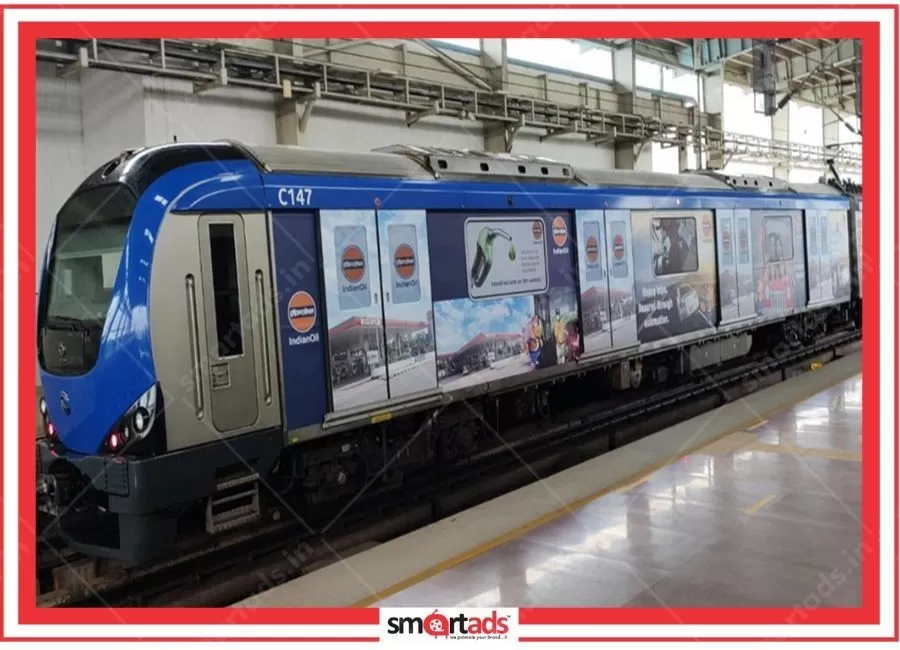
Exterior Metro Wrap
Size & Printing Cost as per actual
On the outside of metro Train, advertise
Rate per Metro Display Cost / 1 Month
Route:Chennai Central To St Thomas Mount
₹660000.00
Showing 1 to 3 of 3 Results
MEDIA DETAILS
Size & Printing Cost as per actual
On the outside of metro Train, advertise
Rate per Metro Display Cost / 1 Month
Route:Chennai Central To St Thomas Mount
₹660000.00
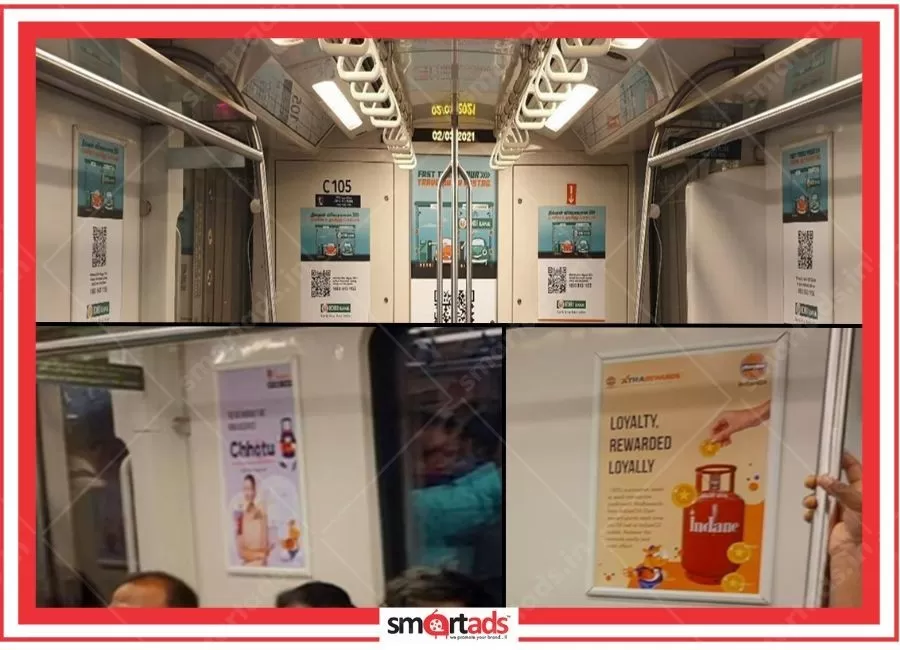
Size & Printing Cost as per actual
On the outside of metro Train, advertise
Rate per Metro Display Cost / 1 Month
Route:Chennai Central To St Thomas Mount
₹230000.00
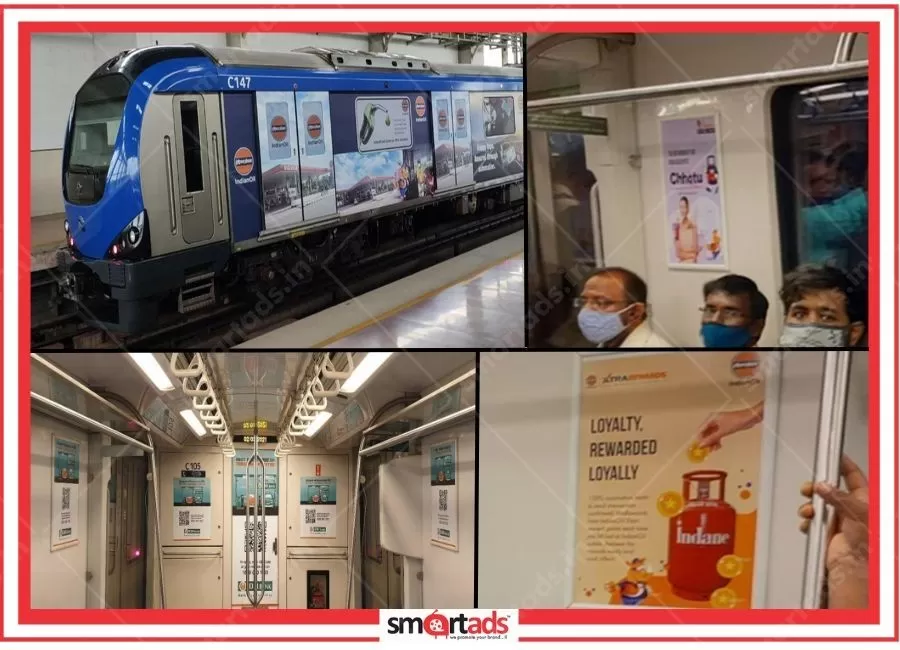
Size & Printing Cost as per actual
On the outside of metro Train, advertise
Rate per Metro Display Cost / 1 Month
Route:Chennai Central To St Thomas Mount
₹780000.00
MEDIA REACH

MinimumQty :
1
EstimateReachPeople :
150000000
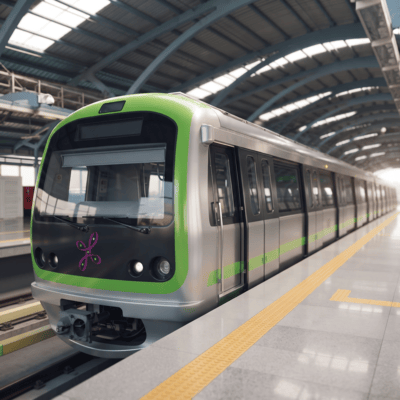
Chennai's Green Line carries somewhere in the ballpark of 3 to 4 lakh passengers every single day across its 22-kilometre stretch from MGR Central to St Thomas Mount — and yet, a surprisingly large number of brand managers we speak to have never seriously evaluated it as a media channel. That is a mistake we have seen cost brands real market share in one of Tamil Nadu's most commercially active urban corridors. The Green Line is not just a commuter rail route; it is a moving, captive, high-dwell-time media environment that runs through the commercial spine of Chennai.
The honest answer is that most brands approach metro train advertising in Chennai Green Line the same way they approach a billboard — as a passive awareness medium — which is a significant underestimation of what the format actually delivers. When a commuter boards a Green Line train at Koyambedu and rides through to Alandur or Guindy, they are inside that train for anywhere between 18 and 35 minutes depending on their journey length; that is dwell time that no roadside hoarding, no 30-second radio spot, and no pre-roll ad can replicate. The audience is physically present, the environment is controlled, and the creative has their attention in a way that outdoor advertising simply cannot guarantee.
What a lot of people miss is the audience composition on this particular line. The Chennai Green Line runs directly through Koyambedu — which is home to one of the largest bus terminals in Asia, the CMBT — and through commercial hubs like Vadapalani, Arumbakkam, and Ashok Nagar, before connecting into the employment corridors around Guindy and St Thomas Mount. This means the daily commuters on this route are a genuinely mixed, high-value urban audience: IT professionals, retail workers, students, business travellers connecting from the CMBT, and daily wage earners who still represent a significant FMCG consumption base. At SmartAds, we have found that this audience diversity is actually a selling point for certain categories — FMCG metro advertising, fintech brands metro advertising, and real estate metro advertising all perform well here precisely because the route covers multiple income brackets within a single commute.
On top of that, there is the question of brand recall. Research consistently shows — and our own campaign tracking bears this out — that enclosed transit environments produce significantly higher brand recall than open-air OOH advertising, because the audience has fewer competing stimuli. A commuter waiting on the platform at Arumbakkam or sitting inside a train carriage between Vadapalani and Ashok Nagar is not being pulled in twelve directions simultaneously the way they would be on a busy road. The creative has room to breathe, and the brand has room to register.
The format range available for metro train advertising in Chennai Green Line is considerably wider than most advertisers realise when they first come to us, and each format serves a meaningfully different strategic purpose. The most visible — and frankly the most talked-about — is the full train wrap or metro wrap, which involves applying vinyl graphics across the entire exterior of a rake, effectively turning the train into a moving billboard that travels the full 22-kilometre route multiple times a day. A single rake on the Green Line covers every station between MGR Central and St Thomas Mount, which means the exterior branding reaches not just passengers but also platform audiences, pedestrians near elevated sections, and road traffic at grade crossings.
Interior panel advertising is where the real dwell-time value is captured, though. These are the backlit or non-backlit panels placed inside train coaches — above windows, on partition walls, and at coach ends — which passengers stare at for the duration of their journey. We have worked with a retail client in Chennai who ran a 90-day interior panel campaign across Green Line rakes, and the brand recall numbers from their post-campaign survey were almost embarrassingly good; the cost per recalled impression worked out to a fraction of what they were spending on digital display. Door and window branding is a related format — vinyl or perforated film applied to train doors and windows — which creates a striking visual effect both from inside and outside the carriage. Platform branding covers the station environment itself: pillar advertising, concourse panels, ticket gate surrounds, and station branding elements at high-footfall points like Koyambedu, Vadapalani, and CMBT.
Digital screen advertising is the newest and fastest-growing format on the CMRL network, with DOOH screens placed at station concourses and on platforms which allow for dynamic creative rotation, time-of-day targeting, and campaign flexibility that static formats cannot offer. The screens at Koyambedu and MGR Central in particular attract significant dwell audiences because of the interchange traffic at those stations. Frankly speaking, digital screen advertising on the Green Line is still underpriced relative to the audience quality it delivers, which is something we actively point out to clients who are comparing it against programmatic digital buys.
Station selection is one of the most consequential decisions in any metro advertising campaign, and it is also the area where we see the most uninformed choices being made. Not all 17 stations on the Green Line are equal in terms of commuter traffic, and a brand that spends its entire station branding budget at a mid-route station when it should be at Koyambedu or MGR Central is leaving a significant portion of its potential reach on the table.
Koyambedu is, by a considerable margin, the highest-footfall station on the Green Line — which makes intuitive sense when you consider that it serves as the interchange point for the CMBT, one of the busiest inter-city bus terminals in South India. Daily footfall at Koyambedu runs somewhere between 25,000 and 35,000 passengers, drawing in travellers from across Tamil Nadu who connect to the metro for onward city travel. MGR Central, at the eastern terminus, is the second anchor — it connects to Chennai Central railway station and sees a similarly high volume of interchange traffic, with daily footfall in the ballpark of 20,000 to 28,000. Vadapalani, which sits in the middle of a dense commercial and residential zone, consistently ranks third in terms of daily commuters, with footfall estimated at roughly 15,000 to 20,000 per day; it is also a station we frequently recommend for FMCG metro advertising and startups metro advertising because of its catchment's demographic mix.
Arumbakkam, Ashok Nagar, and Guindy each pull between 8,000 and 14,000 daily commuters, which is still a substantial audience for platform branding and pillar advertising. Ekkatuthangal and Alandur are worth noting for their interchange value — Alandur is the Blue Line interchange station, which means any brand running a coordinated campaign across both lines can achieve a meaningful network effect at that single point. Saidapet, which sits between Guindy and the central stretch, attracts a mix of office-goers and retail shoppers. At SmartAds, our standard recommendation for brands with a medium-scale budget is to anchor their station branding at Koyambedu and Vadapalani while using train interior panels for the full-route coverage — this combination gives them both the high-footfall concentration and the dwell-time reach without requiring a network-wide station buy.
Pricing transparency is something most metro advertising agency pages deliberately avoid, which is frustrating for media planners who need to build a budget before they can even have a meaningful conversation with a vendor. We are going to be more direct about this than most.
A full train wrap on the Chennai Green Line — exterior branding across an entire rake — is priced somewhere in the range of ₹8 to ₹14 lakh per month depending on the number of rakes, the duration of the campaign, and the negotiation leverage that comes with booking through an experienced media buying partner. Interior panel advertising costs are considerably more accessible: a set of panels across a single rake works out to roughly ₹1.5 to ₹3 lakh per month, which is a number that surprises many clients when they realise how many commuter impressions that buys relative to, say, a comparable digital display spend. Platform branding at a high-footfall station like Koyambedu — covering pillars, concourse panels, and gate surrounds — is priced in the ballpark of ₹2 to ₹5 lakh per month for a reasonably prominent package, with the exact figure varying based on the size and placement of the units.
Digital screen advertising on CMRL's DOOH network is typically sold on a cost-per-spot or monthly package basis; a prominent screen slot at a major interchange station works out to somewhere between ₹50,000 and ₹1.5 lakh per month for a standard rotation, though premium placements at MGR Central command a higher rate. Door and window branding, which is often overlooked in initial media plans, is priced at roughly ₹80,000 to ₹1.8 lakh per rake per month — and the visual impact relative to cost makes it one of the better-value formats in the BTL advertising toolkit. It is worth noting that advertising costs on the Green Line have been rising modestly year on year as ridership grows, which means brands that lock in longer-duration campaigns now are effectively buying future audience growth at today's rates. At SmartAds, we negotiate campaign packages that bundle formats across train and station environments, which typically yields a 15 to 25 percent cost efficiency compared to booking individual formats separately.
This is a comparison we have to make for almost every new client, and the answer is more nuanced than a simple "one is better than the other." The Blue Line — which runs from Wimco Nagar to Chennai Airport — covers a different demographic corridor, with a heavier concentration of industrial workers, airport travellers, and northern Chennai residential catchments. The Green Line, by contrast, runs through the commercial and retail heart of the city, which gives it a stronger profile for consumer-facing categories like FMCG, fintech, real estate, and retail. The interchange at Alandur means the two lines are not mutually exclusive — a brand can run a coordinated campaign that captures both corridors — but if we had to choose one line for a consumer brand targeting urban middle-class Chennai, we would recommend the Green Line almost every time.
Compared to traditional OOH advertising — hoardings, bus shelters, and unipoles — metro train advertising in Chennai Green Line offers something that out-of-home advertising on roads fundamentally cannot: a captive audience in an enclosed environment. A roadside hoarding competes with traffic, other signage, and the general visual noise of a Chennai street; an interior panel inside a Green Line coach has the passenger's attention by default, because there is simply not much else to look at. The CPM for metro interior advertising works out to roughly ₹8 to ₹15 per impression when you factor in the daily ridership numbers, which is competitive with mid-range digital display and significantly more cost-effective than premium OOH sites in South Chennai. Bus advertising in Chennai — another transit media option — offers broader geographic coverage but much lower dwell time and a less defined audience profile; it is a reach play, whereas metro advertising is a recall play.
One automotive brand we worked with ran a parallel test — identical creative on Green Line interior panels and on a set of bus-side panels in the same catchment zones — and the brand recall differential was striking. The metro campaign produced nearly twice the unaided recall at roughly 60 percent of the cost per recalled impression. That is the kind of data point that tends to shift media planning conversations quite quickly.
Frankly speaking, the question of who should advertise here is easier to answer by looking at the route geography and the audience it assembles. The Green Line passes through some of Chennai's densest commercial zones — Vadapalani's retail belt, Arumbakkam's mixed residential and commercial catchment, the CMBT interchange at Koyambedu, and the employment hubs around Guindy and St Thomas Mount — which makes it a natural fit for brands whose target audience is urban, working-age, and economically active.
Fintech brands metro advertising on the Green Line has been growing steadily, and for good reason: the daily commuters on this route are heavy smartphone users who are already accustomed to digital financial products, and the dwell time inside the train gives fintech creative enough exposure to actually communicate a value proposition rather than just flash a logo. Real estate metro advertising is another strong performer — projects in West Chennai, Porur, and the emerging corridors along the Phase 2 extension route are particularly well-served by Green Line campaigns, since the audience includes professionals who are actively making housing decisions. FMCG metro advertising works well at the station level, particularly at Koyambedu and CMBT, where the audience includes a significant proportion of consumers from smaller Tamil Nadu towns who are aspirational buyers for national FMCG brands.
Startups metro advertising is something we actively encourage at SmartAds, because the Green Line offers a cost structure that makes brand-building genuinely accessible to companies that cannot afford a citywide OOH campaign. A well-planned interior panel campaign across a handful of rakes, run for 60 to 90 days, can deliver the kind of urban brand visibility that would cost three to four times as much through traditional media channels. Edtech platforms, health and wellness brands, and D2C consumer brands have all found strong ROI on this line — and the audience's transit routine means they see the creative repeatedly over the campaign period, which compounds the brand recall effect.
The booking process for metro train advertising in Chennai Green Line is more structured than most first-time advertisers expect, and understanding it upfront saves a significant amount of time and frustration. Chennai Metro Rail Limited has appointed Mark Metro as the exclusive advertising concessionaire for station environments on the CMRL network, which means station branding, platform advertising, and concourse panels are booked through that channel. Train-side and interior advertising — covering the rolling stock itself — operates under a separate concessionaire arrangement, and the specific rights holder can change at contract renewal points, which is one reason working with an experienced metro advertising agency matters: we track these concession arrangements so our clients don't have to.
The standard campaign booking lead time on the Green Line is somewhere between three and six weeks for static formats — train wraps, interior panels, and station branding — and slightly shorter for digital screen advertising slots, which can sometimes be activated within two weeks of creative approval. Creative submission requirements are specific: artwork must be provided in the correct format and resolution for the relevant surface, and CMRL's approval process typically takes seven to ten working days, during which the creative is reviewed for compliance with content guidelines. We always build this approval window into our campaign timelines, because brands that submit creative late tend to lose installation slots and end up with a shorter effective campaign duration than they planned for.
At SmartAds, our campaign booking process for Green Line metro advertising typically involves a media planning consultation first — where we map the client's target audience against the station footfall data and recommend a format mix — followed by rate negotiation with the relevant concessionaires, creative briefing and production coordination, and end-to-end campaign monitoring. A fintech client we worked with in 2024 came to us with a 45-day campaign brief and a budget that they assumed would only cover digital; we restructured their media plan to include Green Line interior panels and a Koyambedu station pillar package, which delivered a reach of roughly 18 lakh unique commuter impressions over the campaign period at a blended CPM that was significantly lower than their digital benchmark.
This is an area where we see a lot of campaigns get delayed or rejected, and it is almost always because the brand's creative team was not briefed properly on the compliance requirements before they started production. CMRL guidelines for metro train advertising are not arbitrary — they reflect the public-facing nature of the network and the need to maintain a certain standard of visual and content quality across a government-operated infrastructure.
Content restrictions are the starting point: advertising on the Chennai Green Line cannot carry political content, content that is communally sensitive, or material that violates the Advertising Standards Council of India's (ASCI) code. Alcohol and tobacco advertising is not permitted on the CMRL network, which is standard across most Indian metro systems. Comparative advertising that names competitors is generally not approved, and content that could be considered misleading under consumer protection regulations is subject to rejection. The approval authority for Green Line advertising content sits with CMRL's commercial division, which reviews submissions against these guidelines before issuing a no-objection certificate that is required before installation can proceed.
On the technical side, CMRL guidelines specify minimum print resolution requirements — typically 720 DPI or higher for vinyl applications — and require that all exterior branding materials meet safety and durability standards for outdoor use, including UV resistance and weatherproofing. Interior panel materials must comply with fire safety standards applicable to rolling stock, which means not all standard print substrates are acceptable. Creative dimensions must match the exact specifications provided by the concessionaire for each format, and any deviation — even a few millimetres in bleed area — can result in a reprint request that delays installation. We maintain a current specification sheet for all Green Line formats at SmartAds, which we share with clients' creative teams at the start of every campaign to prevent exactly these kinds of delays.
The Chennai Metro Phase 2 expansion is one of the most significant developments in the city's transit advertising landscape, and it is receiving far less attention from brand managers than it deserves. The Green Line extension — running from the current western terminus toward Porur and eventually to Poonamallee — will add roughly 10 new stations to the network, opening up advertising inventory in some of Chennai's fastest-growing residential and commercial corridors. The Porur junction area, in particular, has seen substantial real estate and retail development over the past five years, and the metro phase 2 expansion will bring a new daily commuter base through that catchment that currently has very limited transit media options.
For advertisers, the Poonamallee extension represents a first-mover opportunity that is rarely available in mature transit media markets. When a new metro corridor opens, the initial advertising rates are typically set at levels that reflect the projected ridership rather than the eventual actual ridership — which means brands that commit to campaigns in the early months of a new corridor's operation are effectively buying audience growth at a discount. We have seen this pattern play out on other Indian metro expansions, and our advice to clients who are planning 12-to-18-month brand-building campaigns in Chennai is to factor the Phase 2 corridor into their media planning now, even if the stations are not yet operational.
The annual ridership figure for the Chennai Metro network crossed 111.9 million riders in a recent reporting year, which is a number that puts the scale of this medium in perspective — and the Phase 2 expansion is projected to add meaningfully to that figure as new corridors bring in catchments that currently rely entirely on road transport. The DOOH infrastructure being planned for Phase 2 stations is also expected to be more advanced than the existing network, with larger format screens and better placement, which will expand the digital screen advertising inventory available to brands on the Green Line.
We want to be honest about this, because the temptation in any agency-authored content is to oversell outcomes. Metro train advertising in Chennai Green Line is not a direct-response channel — it is a brand-building medium, and it should be evaluated on brand recall, audience reach, and frequency of exposure rather than on click-through rates or immediate conversion metrics.
What we have consistently observed across campaigns is that a 60-to-90-day interior panel campaign on the Green Line, covering four to six rakes, delivers somewhere in the range of 15 to 25 lakh commuter impressions per month — with the important caveat that a significant proportion of those impressions are repeat exposures from the same daily commuters, which compounds the brand recall effect over time. One FMCG brand we worked with ran a 90-day Green Line campaign combined with a digital remarketing layer targeting mobile users in the station catchment zones; the integrated approach produced a 34 percent uplift in aided brand recall and a measurable increase in retail offtake in the Koyambedu and Vadapalani catchment areas, which the brand's sales team attributed partly to the metro campaign's role in priming consumer recognition.
The ROI calculation for metro advertising is most defensible when it is framed as a cost-per-quality-impression metric rather than a cost-per-conversion metric. When you divide the monthly campaign cost by the number of dwell-time impressions — impressions where the audience is physically present and stationary, not scrolling past — the numbers compare very favourably against premium digital formats. At SmartAds, we build this comparison into every campaign proposal we present, because we have found it is the most effective way to help brand managers justify the spend to their management teams. Non-traditional advertising and BTL advertising channels like metro rail often face a higher internal justification burden than digital, simply because the measurement frameworks are less familiar — but the underlying audience quality is frequently superior.
Q: What is metro train advertising on the Chennai Green Line?
Metro train advertising on the Chennai Green Line refers to the placement of brand communications across the physical and digital surfaces of the CMRL Green Line network — which runs 22 kilometres from MGR Central in the east to St Thomas Mount in the west, covering 17 stations through some of Chennai's most commercially active zones. This includes advertising on the exterior and interior of train coaches, on station platforms and concourses, on digital screens at interchange stations, and across structural elements like pillars and gate surrounds. It is classified as a BTL advertising and non-traditional advertising medium, sitting within the broader transit media and out-of-home advertising categories; what distinguishes it from conventional OOH advertising is the captive, enclosed audience environment and the high dwell time that comes with a 20-to-35-minute commute.
Q: Which ad formats are available for advertising on Chennai Green Line metro trains?
The format range covers exterior train wraps — which turn an entire rake into a moving billboard — interior panels placed above windows and on coach walls, door and window branding using perforated vinyl, platform branding including pillar advertising and concourse panels, and digital screen advertising on DOOH units at major stations. Each format serves a different strategic purpose: exterior branding maximises reach and visibility across the full route, interior panels deliver dwell-time brand recall, and digital screens allow for dynamic creative and time-of-day flexibility. Station branding formats at high-footfall points like Koyambedu, Vadapalani, and MGR Central are particularly effective for brands targeting the interchange audience.
Q: How much does it cost to advertise on the Chennai Metro Green Line?
Advertising costs on the Green Line vary by format and duration. A full exterior train wrap runs somewhere between ₹8 and ₹14 lakh per month per rake; interior panel packages across a single rake are in the ballpark of ₹1.5 to ₹3 lakh per month; station branding packages at major stations like Koyambedu range from roughly ₹2 to ₹5 lakh per month depending on the number and size of units; and digital screen advertising slots at interchange stations work out to somewhere between ₹50,000 and ₹1.5 lakh per month for a standard rotation. Brands that book multi-format, multi-month packages through an experienced metro advertising agency typically achieve 15 to 25 percent cost efficiencies compared to single-format bookings.
Q: Which stations on the Chennai Green Line have the highest passenger footfall?
Koyambedu leads by a significant margin, with daily footfall in the range of 25,000 to 35,000 passengers driven by its role as the CMBT interchange. MGR Central follows with roughly 20,000 to 28,000 daily commuters as the eastern terminus and railway station interchange. Vadapalani ranks third at approximately 15,000 to 20,000 daily, followed by Arumbakkam, Ashok Nagar, and Guindy in the 8,000 to 14,000 range. Alandur is strategically important as the Blue Line interchange point, making it valuable for brands running cross-line campaigns. Station selection should be driven by the brand's target audience profile mapped against each station's catchment demographics, not just raw footfall numbers.
Q: What is the daily and monthly audience reach for Chennai Green Line metro ads?
The Green Line carries somewhere between 3 and 4 lakh passengers daily across its 17 stations, which translates to a monthly commuter audience of roughly 90 lakh to 1.2 crore passenger journeys. An interior panel campaign covering four to six rakes delivers in the region of 15 to 25 lakh impressions per month, with a significant frequency multiplier from repeat commuters who see the creative on multiple journeys. The annual ridership figure for the Chennai Metro network as a whole has crossed 111.9 million riders, which gives a sense of the scale of the medium. Reach estimates should always be contextualised by the distinction between total impressions and unique audience reach, since daily commuters generate multiple exposures per campaign period.
Q: How long should a metro advertising campaign run on the Green Line to see results?
Our experience at SmartAds is that 60 days is the practical minimum for a brand recall impact to register meaningfully, and 90 days is the sweet spot for most brand-building objectives. The reason is the repeat exposure dynamic: a commuter who takes the Green Line five days a week will see a well-placed interior panel or station branding unit 20 to 25 times over a 30-day period, which is a frequency level that drives recall — but the first two to three weeks of any campaign are essentially the audience building familiarity with the creative. Campaigns shorter than 30 days tend to produce awareness spikes that decay quickly; campaigns of 90 days or more produce the kind of embedded brand recognition that influences purchase behaviour.
Q: What are the CMRL creative guidelines and approval process for Green Line ads?
CMRL guidelines prohibit political content, communally sensitive material, alcohol and tobacco advertising, and content that violates ASCI standards. All creative must be submitted to CMRL's commercial division for approval before installation, and the review process typically takes seven to ten working days. Technical requirements include minimum print resolution of 720 DPI for vinyl applications, fire-safety-compliant materials for interior coach formats, and exact dimensional compliance with concessionaire-provided specifications. Brands should build the approval window into their campaign timeline — submitting creative at least three weeks before the intended launch date is the safe standard.
Q: Can small businesses and startups afford to advertise on the Chennai Green Line?
Yes — and this is something we actively advocate for at SmartAds, because the perception that metro advertising is only for large national brands is simply not accurate. A focused interior panel campaign on two to three rakes, run for 60 days, is accessible at a budget that many growth-stage startups and regional businesses can accommodate; the cost works out to a fraction of what a comparable digital campaign targeting the same urban Chennai audience would cost. The key for smaller advertisers is format selection and station focus: rather than trying to cover the entire network, a well-chosen combination of interior panels and a single high-footfall station branding unit can deliver strong brand visibility within a defined geographic and demographic target.
Q: How does Green Line metro advertising compare to Blue Line or bus advertising in Chennai?
The Green Line covers the commercial heart of Chennai — Koyambedu, Vadapalani, Arumbakkam, Ashok Nagar, Guindy — which gives it a stronger profile for consumer and retail brands than the Blue Line's more industrial and airport-oriented corridor. Blue Line advertising is better suited for brands targeting northern Chennai catchments, airport travellers, or industrial sector audiences. Bus advertising offers broader geographic reach across Chennai but significantly lower dwell time and a less defined audience profile; it is a reach medium, whereas metro advertising is a recall medium. For most consumer brands targeting urban, working-age Chennai audiences, the Green Line delivers a better quality-of-impression metric than either the Blue Line or bus transit media.
Q: What industries benefit most from advertising on the Chennai Metro Green Line?
Fintech brands, real estate developers, FMCG companies, edtech platforms, D2C consumer brands, and retail chains consistently perform well on the Green Line. Fintech brands metro advertising works because the audience is smartphone-native and financially active. Real estate metro advertising benefits from the route's coverage of high-growth residential corridors in West Chennai and the emerging Porur-Poonamallee catchment. FMCG metro advertising at Koyambedu and CMBT captures a broad consumer base including aspirational buyers from smaller Tamil Nadu towns. Startups metro advertising is effective because the format delivers repeated exposure to a defined urban audience at a cost structure that makes sustained brand-building feasible.
Q: Is the Chennai Green Line expanding, and will there be new advertising spaces available?
The Phase 2 Green Line extension from the current western terminus toward Porur and Poonamallee will add approximately 10 new stations, opening advertising inventory in some of Chennai's fastest-growing residential and commercial zones. For advertisers, this represents a first-mover opportunity: early campaigns on new corridor stations are typically priced at rates that reflect projected rather than actual ridership, meaning brands that commit early are buying future audience growth at today's rates. The DOOH infrastructure planned for Phase 2 stations is expected to be more advanced than the existing network, with larger format screens and improved placement.
Q: How do I book a metro train advertising campaign on the Chennai Green Line?
Campaign booking involves working with the relevant concessionaires — Mark Metro handles station advertising rights on the CMRL network, while train-side and interior formats operate under separate arrangements. The practical path for most brands is to work with an experienced metro advertising agency that maintains current relationships with all concessionaires and can negotiate bundled packages across formats. Lead time for static formats is three to six weeks from creative approval; digital screen slots can sometimes be activated within two weeks. At SmartAds, we manage the full process — media planning, rate negotiation, creative compliance briefing, installation coordination, and campaign monitoring — so brands can focus on their creative and commercial objectives rather than the logistics of concessionaire management.
Metro train advertising in Chennai Green Line sits at an interesting inflection point right now. Ridership is growing, the Phase 2 Poonamallee extension is adding new inventory, and the DOOH infrastructure on the network is maturing — all of which means the medium is becoming more measurable, more flexible, and more competitive with digital channels on the metrics that matter to modern brand managers. At the same time, the market is not yet saturated; there are still campaign windows available at rates that will not last once the expansion stations come online and the audience numbers grow further.
What we tell our clients at SmartAds is that the brands which win in transit media are the ones that treat it as a strategic channel rather than a tactical add-on. A train wrap booked for two weeks because there was leftover budget at the end of a quarter is not metro advertising — it is a missed opportunity dressed up as a media buy. The real value of the Chennai Green Line as a media environment comes from sustained presence, thoughtful format selection, and creative that is built for the dwell-time context rather than repurposed from a digital banner. The commuter who sees your interior panel every morning for three months is not just aware of your brand; they have had a relationship with it, which is something no algorithm can manufacture.
The FICCI-EY Media Report and the GroupM TYNY Report have both flagged transit and OOH media as among the most resilient and growing segments of the Indian advertising market, and the Chennai Metro network is one of the clearest examples of why. For brands operating in Tamil Nadu — whether they are national players looking to build regional depth or local businesses looking to establish urban credibility — the Green Line is one of the most cost-efficient, high-recall, and strategically versatile BTL advertising channels available in the market today.
If you are ready to explore what a Green Line metro campaign could look like for your brand — with actual rate benchmarks, format recommendations, and a media plan built around your specific audience and objectives — the SmartAds team is available to walk you through it. Visit [SmartAds.in](https://smartads.in/services/traditional/metro-train-advertising-in-chennai-green-line) to connect with our media planning team, and let us show you what this medium can actually do.
