
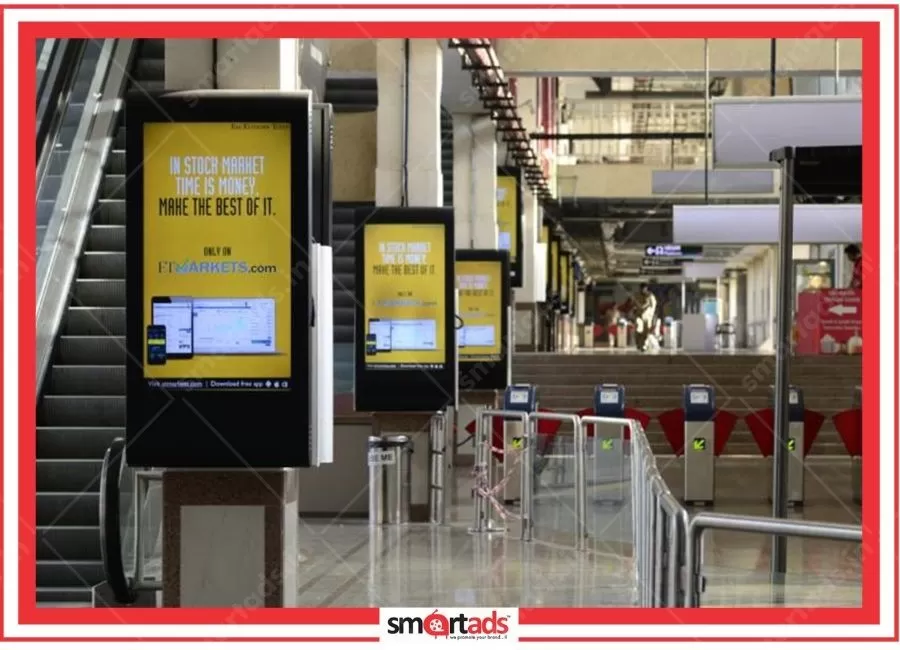
Entry Exit Panel
8 ft x 4 ft
Bright and vibrant multicolored letterin
Rate per Panel / Month
Min Requirement is 3 Panel.
₹48000.00
Showing 1 to 4 of 4 Results
MEDIA DETAILS
8 ft x 4 ft
Bright and vibrant multicolored letterin
Rate per Panel / Month
Min Requirement is 3 Panel.
₹48000.00
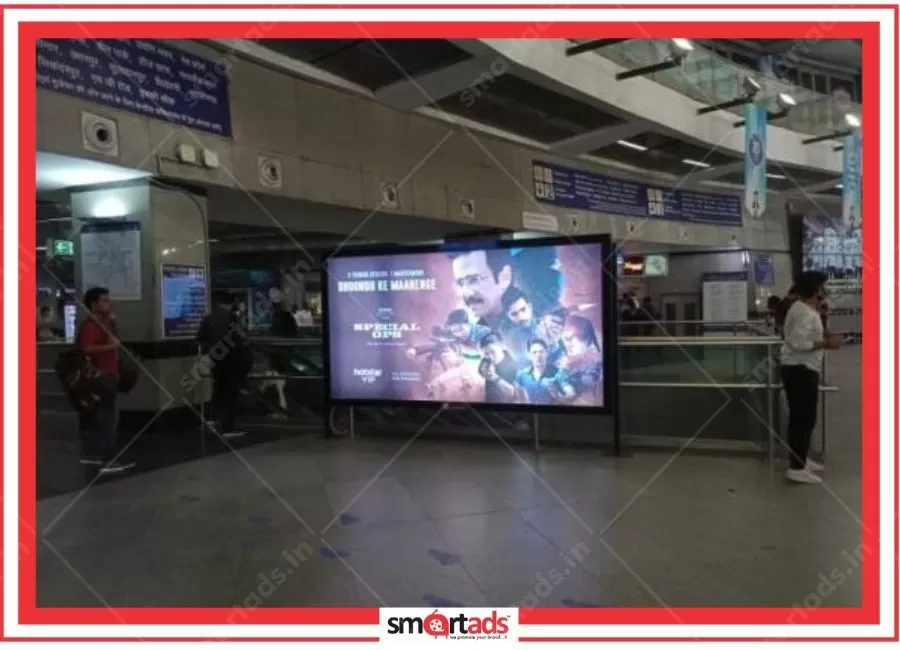
10 ft x 5 ft
A new wide wall system designed to accom
Rate per Panel / Month
Min Requirement is 3 Panel.
₹50000.00
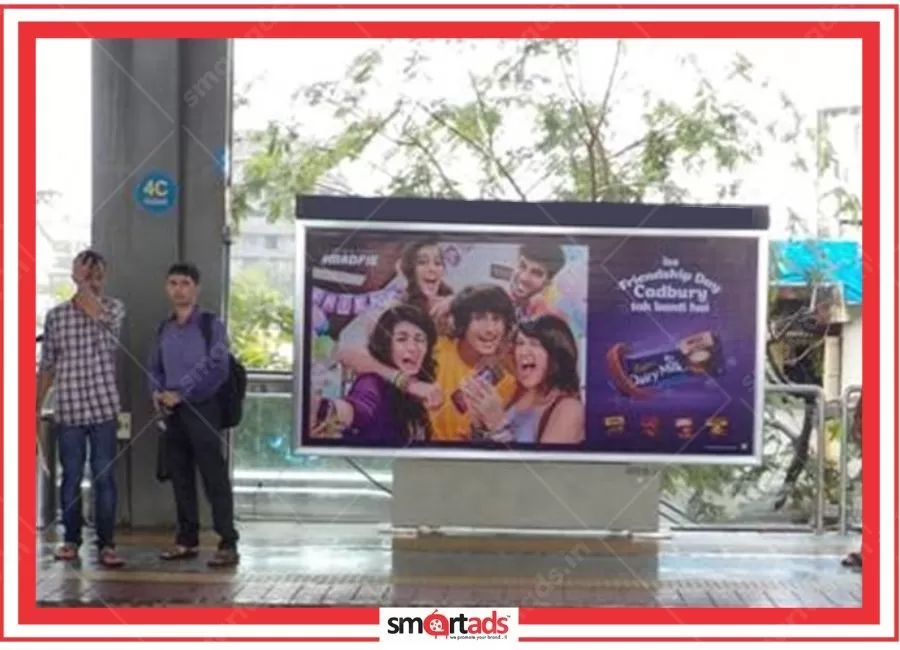
8 ft x 4 ft
A raised flooring or other horizontal su
Rate per Panel / Month
Min Requirement is 3 Panel.
₹35000.00
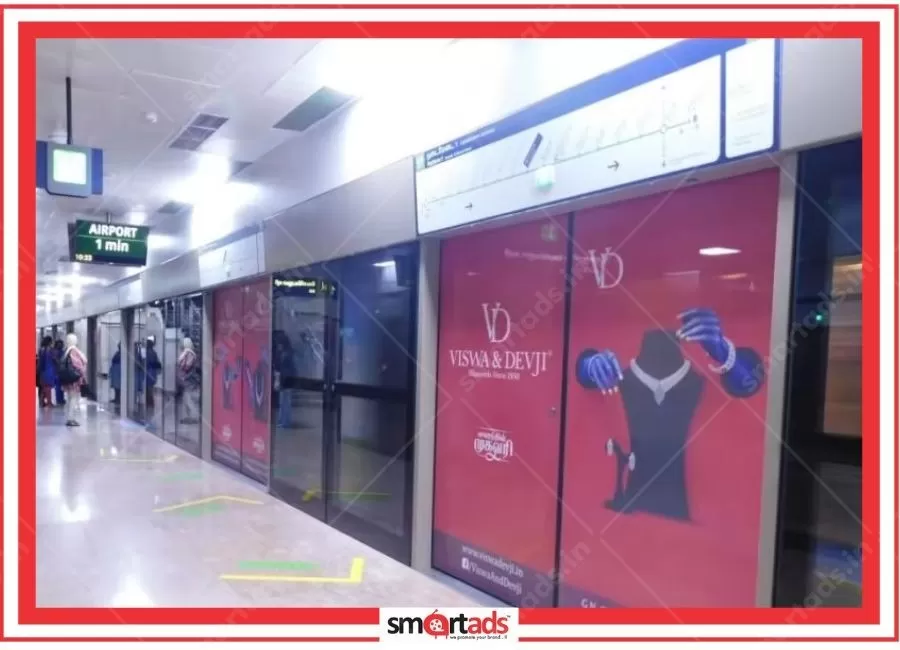
7 ft x 4 ft
Also known as platform edge doors (PEDs)
Rate per Plateform / Month
Min Requirement is 1 Stations.
₹1200000.00
MEDIA REACH

MinimumQty :
10
EstimateReachPeople :
15 Million
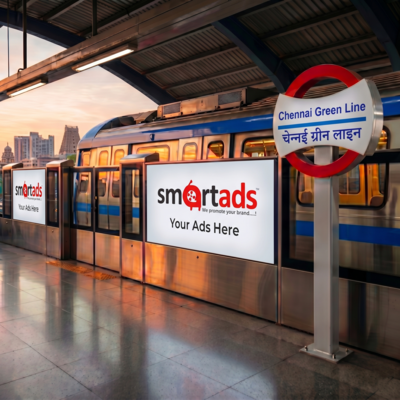
The Chennai Metro Green Line carries somewhere in the range of 1.5 to 2 lakh daily commuters through some of the city's most commercially active neighbourhoods — and yet, most brands still treat it as an afterthought in their media plans, defaulting to hoardings on Anna Salai or bus shelters on Poonamallee High Road. That is a significant missed opportunity, particularly when you consider that metro station advertising in Chennai Green Line delivers a captive, educated, urban audience that is almost impossible to reach through traditional outdoor formats with the same frequency and dwell time. At SmartAds, we have been planning and executing CMRL advertising campaigns for brands across categories, and what we consistently find is that the Green Line corridor — running from Wimco Nagar in the north through the commercial heart of Chennai to St. Thomas Mount in the south — punches well above its weight in terms of brand recall and cost efficiency.
Frankly speaking, the Green Line's value as a BTL advertising corridor comes down to geography more than anything else. The line cuts through Thirumangalam, Anna Nagar Tower, Arumbakkam, Vadapalani, Ashok Nagar, and Koyambedu — which are not peripheral residential zones but genuinely high-density commercial and residential hubs that generate enormous daily footfall independent of the metro itself. When you place a brand at Anna Nagar Tower metro station, you are not just reaching metro riders; you are reaching the hundreds of thousands of people who pass through that intersection every single day, many of whom walk through the station's entry-exit zones even without boarding a train.
The thing is, BTL advertising Chennai has evolved considerably over the last five years, and transit advertising Chennai has emerged as the format that smart planners are increasingly recommending to clients who need urban reach without the clutter of traditional OOH. Out-of-home advertising on hoardings in Chennai suffers from a genuine problem — the city's roads are congested, which means dwell time in front of a hoarding is theoretically high but practically low because drivers are focused on navigating traffic rather than reading brand messages. Inside a metro station, that dynamic reverses entirely; the commuter is stationary, mildly bored, and visually receptive in a way that is genuinely rare in any other advertising environment. Our experience at SmartAds shows that brand recall scores from metro station advertising campaigns in Chennai regularly outperform equivalent-budget hoarding campaigns by a factor of 1.5 to 2 times, which is a number we have validated across multiple post-campaign studies.
On top of that, the Green Line's demographic skew is particularly valuable. The corridor passes through neighbourhoods that house a disproportionate share of Chennai's working professionals, college students, and middle-to-upper-income households — which means the audience profile aligns closely with what most consumer brands, financial services companies, and educational institutions are actually trying to reach. Non-traditional advertising formats that used to be considered experimental are now firmly mainstream in Chennai's media planning conversations, and the Green Line is at the centre of that shift.
Not all stations are created equal, and this is where a lot of brands get their media plans wrong. Anna Nagar Tower metro advertising is consistently one of the highest-demand inventory categories on the entire CMRL network, which is not surprising given that Anna Nagar is one of Chennai's most affluent and commercially active residential zones; the station sees footfall that is significantly higher than the network average, and the entry-exit zone advertising opportunities here command premium rates that are entirely justified by the numbers. Vadapalani metro station advertising is another category that we recommend almost reflexively to entertainment, retail, and FMCG clients, because Vadapalani's position as a major commercial junction — with the Vadapalani bus terminus, the Kasi Theatre complex, and a dense concentration of retail — means that the station's audience is genuinely diverse and high-volume.
Koyambedu metro advertising deserves special mention because the CMBT (Puratchi Thalaivi Dr. J. Jayalalithaa) metro station branding opportunity is unique in the Indian transit advertising context. Koyambedu is not just a metro station; it is the gateway to one of Asia's largest wholesale markets and a bus terminal that handles inter-city traffic from across Tamil Nadu and neighbouring states. The audience at this station is broader than at most other Green Line stations, encompassing traders, out-of-town visitors, and daily commuters simultaneously — which makes it a strong choice for brands that want Tamil Nadu metro advertising reach rather than purely Chennai-city reach. Arumbakkam metro station sits between these two major nodes and tends to be underestimated; our experience shows that pillar branding metro Chennai at Arumbakkam delivers excellent frequency to a predominantly working-professional audience that commutes daily between Anna Nagar and Vadapalani.
Ashok Nagar metro advertising and Thirumangalam metro advertising round out what we consider the Green Line's "power corridor" for brand investment. Thirumangalam, in particular, is a station where we have seen strong performance for financial services and insurance brands, given the neighbourhood's concentration of business owners and self-employed professionals. At the southern end, Arignar Anna Alandur metro station branding and St. Thomas Mount metro advertising offer access to the airport corridor audience — which skews heavily toward business travellers and frequent flyers, making these stations particularly valuable for premium and aspirational brands.
The range of formats available through CMRL advertising is considerably wider than most brands realise when they first approach us, and the choice of format matters enormously for campaign effectiveness. Wall wrap advertising metro is arguably the most visually impactful option — a full wall wrap at a high-footfall station like Anna Nagar Tower or Koyambedu creates an immersive brand environment that is simply not replicable in any other out-of-home advertising context in Chennai; the creative canvas is large, the dwell time is high, and the format has an inherent premium quality that reflects well on the brand. Backlit board metro station placements are the workhorses of the format portfolio — they are consistently visible, cost-effective relative to their reach, and available at virtually every station on the Green Line.
Platform screen door advertising is a format that we find consistently underutilised by brands, which is frankly a missed opportunity because platform screen doors are the last thing a commuter looks at before boarding a train and the first thing they see when alighting — two moments of high attentiveness that most other formats cannot replicate. Interior metro panel advertising, placed inside train coaches, works differently from station advertising in that it reaches the same commuter multiple times across a journey rather than once at a fixed location; the CPM for interior metro panel advertising works out to roughly ₹8 to ₹12, which is a figure that surprises most clients when they compare it to what they are spending on digital display advertising for a comparable urban audience. Digital screen advertising metro is increasingly available at major Green Line stations and offers the flexibility of time-based scheduling — which means a quick-service restaurant can run breakfast messaging in the morning rush and dinner promotions in the evening peak, something that static formats simply cannot do.
Metro pillar advertising CMRL is a format that deserves its own paragraph because it is genuinely distinctive. Pillar branding metro Chennai — which involves wrapping the structural pillars of station concourses and platforms with brand creative — creates a three-dimensional brand presence that is visible from multiple angles simultaneously; MudraOOH holds exclusive CMRL pillar advertising rights, which means booking this format requires going through the right authorised channel. Full train branding Chennai, where the exterior of an entire train set is wrapped in brand creative, is the most premium format on the network and is managed by JCDecaux India, which holds exclusive rolling stock rights for CMRL; the cost is significant, but the reach — given that a branded train travels the full length of both the Green and Blue Lines throughout the day — is extraordinary. Kiosk advertising metro station and interactive metro station advertising are emerging formats that we are seeing more brands experiment with, particularly in the technology and financial services categories, where the ability to engage commuters directly at the point of contact adds a dimension that passive formats cannot provide.
We are going to give you actual numbers here, because the lack of transparent pricing in this category is genuinely frustrating for media planners trying to build business cases for their management. That said, it is important to understand that metro advertising cost per month on the Green Line varies considerably based on station, format, and placement zone — so treat these as planning benchmarks rather than fixed quotes.
For backlit board metro station placements at mid-tier Green Line stations like Arumbakkam or Ashok Nagar, the monthly cost works out to somewhere between ₹40,000 and ₹80,000 per unit, which is broadly comparable to a mid-size hoarding on a secondary road in Chennai but delivers a fundamentally different audience quality. At premium stations like Anna Nagar Tower or Koyambedu, the same backlit format can run in the ballpark of ₹80,000 to ₹1.5 lakh per month per unit, reflecting the higher footfall and audience quality at those locations. Wall wrap advertising metro and full concourse takeovers are significantly more expensive — a major wall wrap at a premium station is typically priced somewhere between ₹2 lakh and ₹5 lakh per month depending on the size and location — but the creative impact justifies the premium for brands that are launching a new product or building awareness in a specific neighbourhood.
The advertising rates Chennai metro for digital screen advertising metro tend to be structured differently from static formats; digital screens are often sold on a per-spot basis across a network of screens, with a typical 10-second spot on a loop of roughly 6 to 8 spots costing in the range of ₹15,000 to ₹30,000 per screen per month at major stations. Full train branding Chennai, which is the most premium format, is typically negotiated on a campaign basis rather than a monthly rate, with costs that can range from ₹15 lakh to ₹40 lakh for a full exterior wrap running across the network for a month — which sounds significant until you calculate the CPM, which works out to a genuinely competitive number given the daily reach across both lines. At SmartAds, we always tell our clients that the campaign ROI metro advertising delivers is best understood not by comparing absolute costs to other formats but by comparing cost-per-qualified-contact, and on that metric, Green Line metro station advertising consistently performs in the top quartile of any Chennai media plan.
The metro commuter demographics Chennai Green Line presents are, in our experience, one of the most consistently misunderstood aspects of this medium — and getting the audience profile right is the difference between a campaign that works and one that wastes money. The daily commuters Chennai metro Green Line attracts skew heavily toward the 22-to-45 age bracket, which encompasses both young working professionals and mid-career executives; income levels are predominantly in the middle and upper-middle segments, reflecting the fact that metro usage in Chennai requires a degree of urban mobility and digital literacy (for ticketing and navigation) that correlates with higher socioeconomic status. The urban audience Chennai metro reaches is also notably more gender-balanced than most other transit formats in the city, because the metro's safety and reliability make it a preferred choice for working women in a way that bus travel historically has not been.
Professionally, the Green Line audience is dominated by IT and tech-adjacent workers commuting to offices in the Anna Nagar, Vadapalani, and Ashok Nagar corridors; retail and trade professionals using the Koyambedu interchange; and students travelling to the several colleges and coaching institutes clustered around the Thirumangalam and Arumbakkam catchments. This is not a homogeneous audience, which is actually a strength rather than a weakness — it means the Green Line can serve as a planning vehicle for a wide range of brand categories simultaneously, and a well-placed campaign at a station like Koyambedu reaches genuinely diverse consumer segments within a single media buy. The footfall metro station Chennai data published by CMRL suggests that peak-hour concentration at major stations is intense, with the morning rush between 8 and 10 AM and the evening rush between 5:30 and 8 PM accounting for a disproportionate share of daily footfall — which has implications for format selection, because formats that are visible during these peaks deliver outsized frequency to the core commuter audience.
What a lot of people miss is the secondary audience effect — the people who enter metro station premises to use facilities, drop off or pick up commuters, or simply use the station as a pedestrian shortcut through busy junctions. This secondary audience adds meaningfully to the effective reach of metro branding Chennai campaigns, and it is an audience that is not captured in CMRL's official ridership numbers but is very real in terms of brand exposure. Our experience at SmartAds suggests that accounting for this secondary audience effect, the true reach of a well-placed Green Line metro station advertising campaign is typically 20 to 30 percent higher than the ridership numbers alone would suggest.
To be honest, this is a comparison we get asked to make in almost every client briefing, and the answer is more nuanced than a simple ranking. OOH advertising Chennai in the traditional hoarding format has the advantage of scale — a large-format hoarding on a major arterial road can deliver very high gross impressions — but it suffers from the fundamental limitation of passive exposure to an audience that is primarily focused on something else (driving, walking, talking). Transit advertising Chennai in the metro format inverts this dynamic; the audience is captive, the dwell time is measured in minutes rather than seconds, and the environment is controlled in a way that roadside hoardings simply are not. When we have run parallel campaigns for clients — one on traditional OOH advertising Chennai hoardings and one on metro station advertising in Chennai Green Line — the post-campaign brand recall data has consistently favoured the metro format, even when the hoarding campaign had a larger gross reach.
Bus shelter advertising is probably the closest comparable format in terms of audience profile and cost structure; a good bus shelter on a busy Chennai road costs somewhere in the range of ₹25,000 to ₹60,000 per month, which puts it in the same ballpark as mid-tier metro station backlit boards. The difference is in audience quality and environment — bus shelters are exposed to weather, vandalism, and visual clutter from surrounding signage in a way that metro station advertising is not, and the audience at a bus shelter is significantly more heterogeneous in terms of income and demographics. Non-traditional advertising formats like mall activations and cinema lobby branding are strong complements to metro station advertising but tend to be more expensive per contact and less frequent in terms of audience exposure. Frankly speaking, if we had to recommend a single BTL advertising Chennai format for a brand trying to build awareness among urban, working-age Chennai consumers, metro station advertising on the Green Line would be our starting point in most cases.
The metro advertising booking process for Green Line stations runs through a specific set of authorised channels, which is something that catches a lot of first-time advertisers off guard. Chennai Metro Rail Limited has granted exclusive advertising rights to different vendors for different format categories — Mark Metro holds exclusive Phase 1 station branding rights for most static formats at Green Line stations, MudraOOH holds exclusive CMRL pillar advertising rights, and JCDecaux India manages rolling stock branding — which means that booking metro station advertising in Chennai Green Line is not as simple as calling a single number. Navigating this vendor landscape is one of the areas where working with an authorised metro advertising agency Chennai genuinely saves time and money, because an experienced agency already has established relationships with all the relevant rights holders and can consolidate a multi-format campaign into a single booking process.
The typical lead time for a Green Line metro station advertising campaign is somewhere between three and six weeks from brief to execution, depending on the complexity of the creative and the formats involved; wall wraps and large-format installations require longer lead times because they involve physical installation at the station, which must be coordinated with CMRL's operational schedule to avoid disruption to commuter services. Creative artwork must be submitted for CMRL compliance review before production begins — the Commissioner of Metro Railway Safety (CMRS) guidelines apply to certain structural and installation aspects, and CMRL has its own brand environment standards that govern things like colour contrast, font legibility, and the prohibition of certain content categories. The metro advertising minimum duration for most Green Line station formats is typically one month for static formats and two weeks for digital screen placements, though longer campaigns of three to six months attract meaningful rate discounts that can make a significant difference to the overall campaign economics.
At SmartAds, our standard process for a Green Line metro advertising campaign begins with a footfall and audience analysis for the specific stations being considered, followed by format recommendations based on the client's creative assets and budget, and then a consolidated booking submission to the relevant rights holders on the client's behalf. We have found that clients who come to us with a clear brief on target audience and campaign objectives get to execution significantly faster than those who approach the rights holders directly without agency support, which is not a criticism of the rights holders but simply a reflection of the fact that the booking system rewards familiarity with its processes.
This is a question we genuinely enjoy answering, because the honest answer is more encouraging than most small business owners expect. Metro advertising for small business Chennai is entirely viable, particularly for businesses that are geographically proximate to a specific Green Line station and can benefit from hyperlocal advertising metro targeting; a restaurant in Anna Nagar, a coaching institute near Thirumangalam, or a retail store in Vadapalani can run a meaningful backlit board or pillar branding campaign at their nearest station for a monthly investment that is comparable to what they might spend on a modest digital advertising campaign. The metro advertising minimum duration of one month for most static formats means that a small business can test the medium with a limited commitment before scaling up.
One retail client we worked with — a mid-size clothing brand with two stores in the Anna Nagar and Vadapalani catchments — ran a three-month Green Line metro station advertising campaign across four stations with a total budget of roughly ₹8 lakh, which included creative production, installation, and media costs. The campaign generated a measurable increase in walk-in traffic at both stores, with the Vadapalani store seeing a particularly strong response that the client attributed directly to the metro campaign based on customer feedback collected at the point of sale. That kind of hyperlocal advertising metro effectiveness is difficult to replicate with any other format at a comparable budget, and it is a case study we reference regularly when advising small and mid-size businesses on BTL advertising Chennai options.
To be fair, there are genuine constraints for very small budgets — if a business has less than ₹2 to ₹3 lakh available for a media campaign, metro station advertising in Chennai Green Line may not be the most efficient use of those funds, and we would typically recommend digital or hyperlocal OOH alternatives instead. But for businesses in the ₹3 lakh to ₹15 lakh annual media budget range, the Green Line offers a genuinely competitive option that delivers brand visibility metro station quality that is hard to match in Chennai's cluttered media environment.
Chennai metro Phase 2 advertising is a topic that is generating significant interest among forward-thinking media planners, and rightly so. The Phase 2 expansion — which includes the Poonamallee–Vadapalani corridor, among other extensions — will substantially increase the Green Line's catchment area and daily ridership when operational, opening up metro station advertising in Chennai Green Line to neighbourhoods that are currently underserved by transit advertising Chennai options. The Poonamallee corridor, in particular, passes through areas with high concentrations of manufacturing and logistics workers, which will meaningfully diversify the audience profile of the Green Line beyond its current professional-and-student skew.
What is strategically interesting about Tamil Nadu metro advertising in the Phase 2 context is that early-mover brands that establish presence on the Green Line now will have a significant advantage when Phase 2 stations come online; the rights holders are expected to offer existing advertisers preferential access to new inventory, and brands that have already built familiarity with the booking process and CMRL compliance requirements will be able to scale their campaigns faster than competitors who are starting from scratch. South India metro branding as a category is growing rapidly — Hyderabad, Bangalore, and Kochi have all seen significant increases in metro advertising investment over the last three years, according to data referenced in the FICCI-EY Media Report — and Chennai is expected to follow the same trajectory as Phase 2 brings new ridership and new advertising inventory online.
At SmartAds, we are already advising several clients to treat their current Green Line campaigns as pilot investments that will inform their Phase 2 strategy, rather than standalone campaigns; the learnings from a three-month campaign at Vadapalani or Koyambedu today will directly inform decisions about which Phase 2 stations to prioritise when that inventory becomes available. Metro station advertising Green Line 2 Chennai is a category that does not yet exist in its full form, but the brands that are building institutional knowledge of the medium now will be the ones best positioned to capitalise on it.
The honest answer is that the format works for a wider range of brand categories than most planners initially assume, but there are some categories where the fit is particularly strong. Financial services brands — banks, insurance companies, mutual fund houses, and fintech platforms — have consistently been among the most active advertisers on the Green Line, and the performance data supports this; the working-professional audience that dominates Green Line ridership is precisely the demographic that financial services brands are most eager to reach, and the captive audience metro environment gives complex financial messages the dwell time they need to register. One financial services client we worked with ran a six-month campaign across five Green Line stations, using a combination of backlit board metro station placements and digital screen advertising metro; the campaign generated a cost-per-lead that was roughly 35 percent lower than what the same client was achieving through digital channels, which was a result that genuinely surprised their marketing team.
Educational institutions and coaching institutes are another category that we find consistently well-suited to Green Line metro station advertising, particularly during the January-to-April admission season when competition for student attention is at its most intense. The student audience on the Green Line is substantial, and the corridor's proximity to several major educational institutions means that well-placed creative at stations like Thirumangalam and Arumbakkam can deliver extraordinary frequency to exactly the right audience at exactly the right time. FMCG brands, retail chains, and quick-service restaurants have also found strong value in the format, particularly when campaigns are structured around specific station catchments rather than the full network — a QSR with an outlet near Ashok Nagar metro advertising, for instance, can drive meaningful footfall by placing directional creative at the station's entry-exit zone.
The distinction between paid zone and unpaid zone advertising at Chennai Green Line stations is one that a surprising number of advertisers overlook, and it matters considerably for both pricing and audience quality. The paid zone — which encompasses the concourse level, platforms, and train interiors beyond the fare gates — reaches only ticketed passengers, which means the audience is definitionally composed of people who have made a deliberate decision to use the metro; this is a higher-quality audience in terms of engagement and attentiveness, and formats in the paid zone command premium rates accordingly. Entry exit zone ads metro, which are placed in the unpaid zone before the fare gates, reach a broader audience that includes non-commuters passing through the station, which makes them better suited for mass-awareness campaigns where reach is prioritised over audience precision.
Within the paid zone, platform screen door advertising and platform-level wall wraps are the formats that deliver the highest dwell-time exposure, because commuters waiting for trains have nothing to do but look at their surroundings; a well-designed creative at platform level at a busy station like Koyambedu or Anna Nagar Tower can generate extraordinary frequency among daily commuters who pass through the same station every working day. The concourse level — where backlit boards, pillar branding metro Chennai, and kiosk advertising metro station placements are concentrated — is the highest-traffic zone in terms of footfall, because all commuters pass through the concourse regardless of their destination. Cotton flex metro advertising, which is a lower-cost format used for temporary campaigns and event promotions, is typically placed in the unpaid zone and is a viable option for brands with limited budgets or short campaign windows, though the production quality is noticeably lower than backlit or digital formats. 3D display metro branding is an emerging format that we have seen deployed at select major stations and which generates disproportionate attention and social media sharing — one automotive brand we worked with used a 3D display installation at Anna Nagar Tower to launch a new vehicle model, and the installation was photographed and shared organically by commuters in a way that extended the campaign's reach well beyond the station itself.
Green line metro station branding is not just a reach play; it is a brand-building investment that compounds over time in a way that most other BTL formats do not. A brand that maintains consistent presence at two or three key Green Line stations over a period of six months or more builds a level of familiarity with the daily commuter audience that is genuinely difficult to replicate through any other medium; the daily commuter who sees the same brand creative at their home station every morning develops an associative relationship with that brand that influences purchase decisions in ways that are hard to measure but very real. Brand recall metro advertising data from post-campaign studies we have conducted consistently shows that campaigns running for three months or longer generate recall scores that are roughly double those of one-month campaigns, which suggests that the medium rewards sustained investment over short-burst activity.
The brand visibility metro station environment also has a quality dimension that is worth acknowledging explicitly. Metro stations in Chennai are clean, well-maintained, and associated in commuters' minds with modernity, efficiency, and urban aspiration — which means that brands that advertise in this environment benefit from a positive halo effect that is not available in more cluttered or lower-quality OOH environments. This is not a trivial point; the context in which a brand message is seen influences how that message is received, and the premium environment of a Chennai Metro Green Line station is a meaningful asset for brands that are trying to position themselves as quality, aspirational, or innovative. Non-traditional advertising in transit environments has been shown in multiple studies — including research cited in the Dentsu e4m Report on Indian media consumption — to generate higher brand affinity scores than equivalent-budget traditional OOH campaigns, and our own campaign experience at SmartAds is consistent with this finding.
Q: What advertising formats are available at Chennai Metro Green Line stations?
The format portfolio at Green Line stations is genuinely extensive and covers both static and dynamic options across different zones of each station. Static formats include backlit boards of various sizes, wall wraps, pillar branding, cotton flex panels, and entry-exit zone displays; dynamic formats include digital screen advertising at major stations, which allows time-based scheduling and creative rotation. Within the paid zone, platform screen door advertising and platform-level wall wraps are available at most stations, while train interior panels and full exterior train wraps are managed through JCDecaux India as the exclusive rolling stock rights holder. Kiosk advertising and interactive installations are available at select premium stations on a case-by-case basis, and 3D display installations can be negotiated for major campaign launches at high-footfall stations like Anna Nagar Tower and Koyambedu. The right format mix depends on the campaign objective, budget, and target audience — which is why we recommend beginning with a media planning consultation before committing to a specific format.
Q: How much does it cost to advertise at a Chennai Metro Green Line station?
Advertising rates Chennai metro vary by station tier, format, and placement zone, but to give useful planning benchmarks: backlit board placements at mid-tier stations run in the range of ₹40,000 to ₹80,000 per unit per month, while the same format at premium stations like Anna Nagar Tower or Koyambedu can run from ₹80,000 to ₹1.5 lakh per month. Wall wraps and large-format installations at premium stations are priced somewhere between ₹2 lakh and ₹5 lakh per month depending on size. Digital screen spots are typically priced per screen per month in the range of ₹15,000 to ₹30,000 at major stations. Full train exterior branding is the most premium option, with costs that can range from ₹15 lakh to ₹40 lakh for a full-network campaign running for a month. Longer campaign durations of three months or more typically attract rate discounts in the range of 10 to 20 percent, which can meaningfully improve the overall campaign economics.
Q: Which stations on the Chennai Green Line have the highest footfall for advertising?
Based on CMRL ridership data and our own campaign experience, the consistently highest-footfall stations on the Green Line are Koyambedu (CMBT), Anna Nagar Tower, Vadapalani, and Arignar Anna Alandur. Koyambedu benefits from its role as a major bus interchange and wholesale market hub, which generates footfall that extends well beyond the metro's own ridership. Anna Nagar Tower is the anchor station for one of Chennai's most affluent residential and commercial zones. Vadapalani's position at a major road junction with dense retail and entertainment infrastructure drives strong secondary audience numbers. Alandur is significant for its interchange function and its position on the airport corridor. For brands targeting the student and young professional demographic specifically, Thirumangalam and Arumbakkam are also strong performers despite lower absolute footfall numbers.
Q: How do I book an advertising slot at a Chennai Metro Green Line station?
The metro advertising booking process runs through authorised rights holders rather than directly through CMRL for most format categories. Mark Metro holds exclusive Phase 1 station branding rights for most static formats; MudraOOH holds exclusive CMRL pillar advertising rights; and JCDecaux India manages rolling stock branding. Working with an authorised metro advertising agency Chennai that has established relationships with all these rights holders is the most efficient approach, as it consolidates the booking process and ensures that creative compliance requirements are met before production begins. The typical lead time from brief to campaign live is three to six weeks, and the metro advertising minimum duration for most static formats is one month.
Q: What is the minimum duration for a metro station ad campaign on the Green Line?
For most static formats — backlit boards, wall wraps, pillar branding, and cotton flex panels — the metro advertising minimum duration is one month. Digital screen advertising metro placements can sometimes be booked for shorter periods of two weeks, particularly for event-based or seasonal campaigns. That said, we consistently recommend a minimum of three months for any brand-building campaign, because the frequency and recall benefits of metro station advertising compound significantly over time; a one-month campaign is better than nothing, but a three-month campaign delivers a meaningfully different level of brand familiarity with the daily commuter audience.
Q: Who holds the exclusive advertising rights for Chennai Metro Green Line stations?
The advertising rights for CMRL Green Line stations are divided across multiple authorised vendors by format category. Mark Metro holds exclusive rights for Phase 1 station branding across most static formats at Green Line stations. MudraOOH holds exclusive CMRL pillar advertising rights. JCDecaux India holds exclusive rights for rolling stock (train exterior and interior) branding. Digital screen networks at stations may be managed through separate arrangements. This fragmented rights structure is one of the reasons that working with an experienced metro advertising agency Chennai is valuable — an agency that works regularly with all these rights holders can navigate the booking process efficiently and ensure that a multi-format campaign is coordinated across vendors without gaps or conflicts.
Q: Can small businesses advertise at Chennai Metro Green Line stations on a limited budget?
Metro advertising for small business Chennai is genuinely viable for businesses with a monthly media budget of ₹50,000 or more, particularly if the campaign is focused on one or two stations that are geographically proximate to the business's location. A backlit board at a mid-tier Green Line station for one month is accessible at ₹40,000 to ₹80,000, which is comparable to a modest digital advertising spend but delivers a fundamentally different quality of brand exposure. The key for small businesses is to focus hyperlocal advertising metro investment on the specific station or stations that serve their immediate catchment area, rather than trying to cover the full Green Line network, which would require a significantly larger budget.
Q: What is the difference between paid zone and unpaid zone advertising at Chennai Green Line stations?
The paid zone encompasses all areas beyond the fare gates — concourse level (post-security), platforms, and train interiors — and reaches only ticketed passengers who have made a deliberate decision to use the metro. This is a higher-quality audience in terms of engagement and attentiveness, and paid zone formats command premium rates accordingly. The unpaid zone covers entry-exit areas before the fare gates and reaches a broader audience that includes non-commuters passing through the station premises. Entry exit zone ads metro in the unpaid zone are generally priced lower than paid zone formats and are better suited for mass-awareness campaigns where reach is prioritised. For most brand-building campaigns, we recommend a mix of both zones to capture both the broad reach of the unpaid zone and the high-quality engagement of the paid zone audience.
Q: How does Chennai Green Line metro station advertising compare to hoarding or bus shelter advertising in Chennai?
The key differences are audience quality, dwell time, and environment. OOH advertising Chennai hoardings deliver high gross impressions but passive exposure to an audience that is primarily focused on driving or walking; the average effective dwell time in front of a hoarding is measured in seconds. Metro station advertising in Chennai Green Line delivers a captive audience with dwell times measured in minutes — commuters waiting on platforms or moving through concourses have time to actually read and process brand messages. Bus shelter advertising is the closest comparable format in terms of cost, but metro stations offer a cleaner, more premium environment with less competitive clutter. Post-campaign brand recall data from campaigns we have run at SmartAds consistently shows that metro station advertising outperforms equivalent-
