
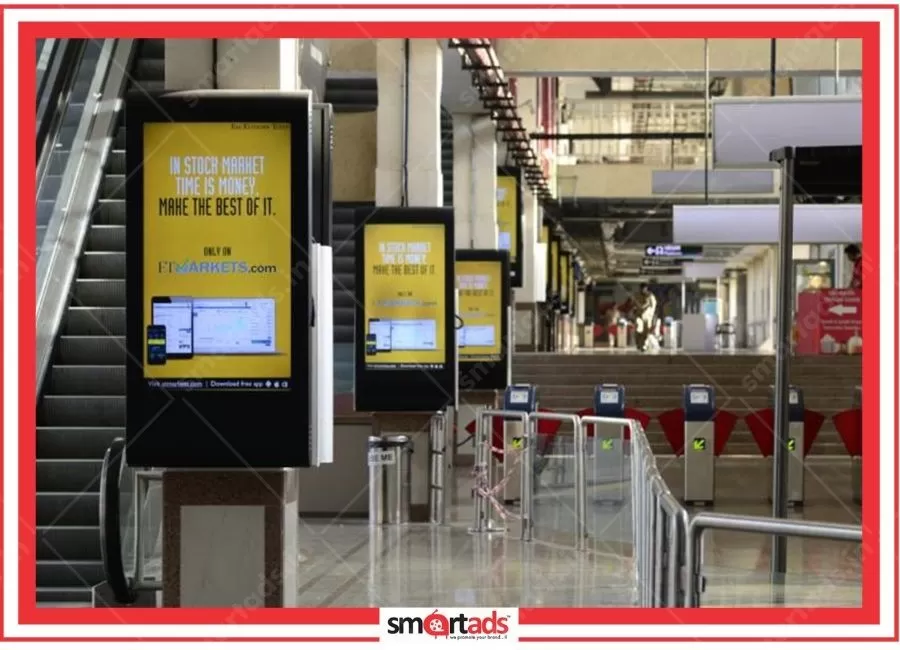
Entry Exit Panel
8 ft x 4 ft
Bright and vibrant multicolored letterin
Rate per Panel / 1 Month
Min Requirement is 3 Panel
₹48000.00
Showing 1 to 4 of 4 Results
MEDIA DETAILS
8 ft x 4 ft
Bright and vibrant multicolored letterin
Rate per Panel / 1 Month
Min Requirement is 3 Panel
₹48000.00
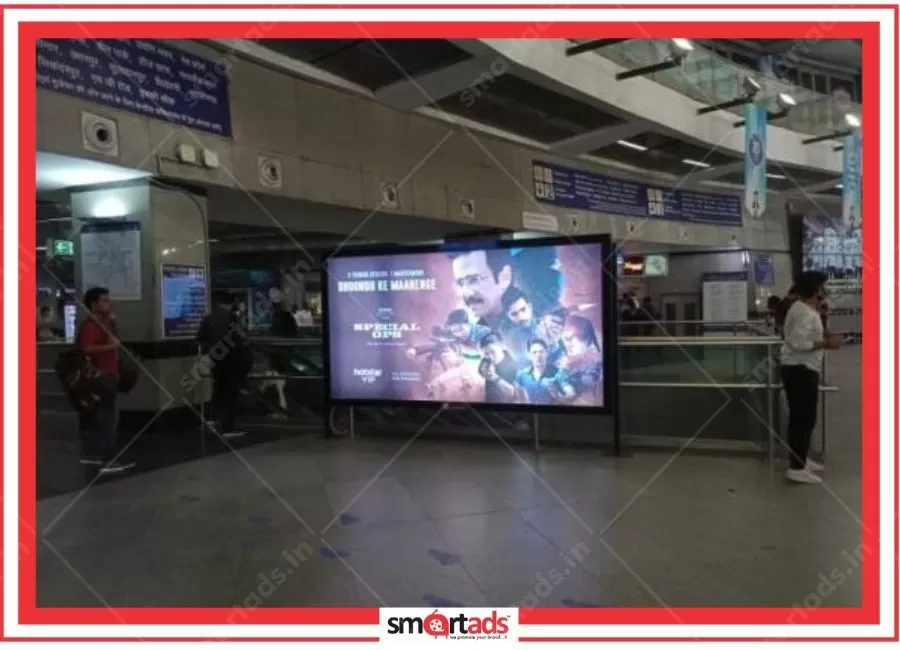
10 ft X 5 ft
A new wide wall system designed to accom
Rate per Panel / 1 Month
Min Requirement is 3 Panel
₹50000.00
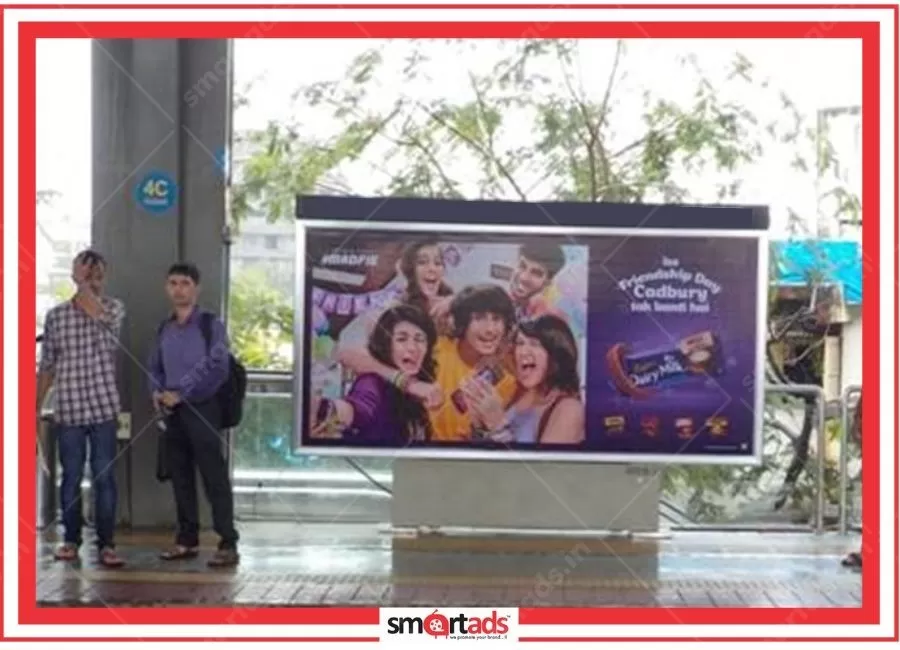
8 ft x 4 ft
A raised flooring or other horizontal su
Rate per Panel / 1 Month
Min Requirement is 3 Panel
₹35000.00
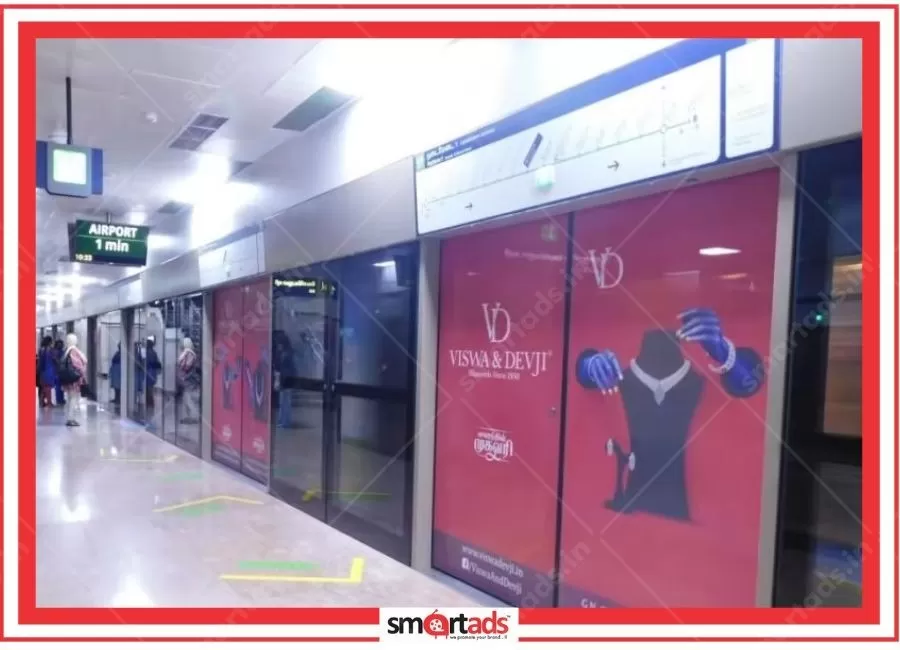
7 ft x 4 ft
Also known as platform edge doors (PEDs)
Rate per Plateform / 1 Month
Min Requirement is 1 Station
₹1200000.00
MEDIA REACH

MinimumQty :
10
EstimateReachPeople :
15 Million
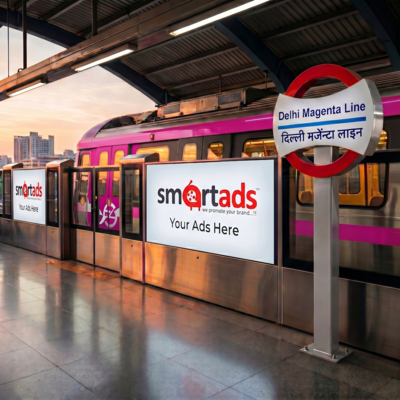
The Magenta Line carries something most advertisers consistently underestimate: a captive, educated, upwardly mobile audience that is trapped in a clean, distraction-reduced environment for anywhere between twelve and forty minutes per journey. Roughly 3.5 to 4 lakh commuters use Line 8 on a typical weekday, which means a well-placed campaign at a high-footfall station can generate more qualified impressions in a single day than many digital campaigns deliver in a week. What makes this particularly interesting is that the Magenta Line's specific catchment — threading through IIT Delhi, South Delhi's residential corridors, the Okhla industrial belt, and directly into Noida — creates a demographic concentration that most OOH advertising formats simply cannot replicate.
Most brand managers we speak to think of Delhi metro advertising as a single monolithic product — you put up a poster, commuters walk past it, and something vaguely good happens. The reality is considerably more structured and, frankly, more interesting than that. Metro station advertising on the Magenta Line refers to a range of paid media placements across the physical and digital inventory managed by DMRC and its authorized concessionaires — covering everything from platform panel advertising and pillar branding to station domination packages, train interior branding, digital screen advertising, entry gate co-branding, and in-train audio advertising, all of which are governed by specific DMRC approval processes and creative guidelines.
The Magenta Line, officially designated as Line 8 in the Delhi Metro network, was inaugurated in phases between 2017 and 2018 and holds the distinction of being India's first fully driverless metro corridor, operating on CBTC technology — Communication-Based Train Control — which means trains run at tighter headways and carry higher passenger volumes per hour than manually operated lines. This operational characteristic matters for advertisers because it translates directly into higher footfall density and, consequently, more impressions per advertising unit. The rolling stock, manufactured by Hyundai Rotem and Alstom Metropolis, runs in 6-coach configurations, which defines the available inventory for train interior branding and sets the parameters for any wrap or panel campaign inside the coaches.
At SmartAds, we position Magenta Line metro station advertising as a BTL advertising format that sits at the intersection of transit media and hyperlocal targeting — it is not quite traditional out-of-home advertising, and it is not quite experiential, but it borrows the best qualities of both. The dwell time at stations, combined with the frequency of repeat exposure among regular commuters, creates a brand recall environment that most non-traditional advertising formats struggle to match. What we tell our clients is this: if your brand needs to own a corridor between South Delhi, West Delhi, and Noida, there is no more efficient vehicle than a sustained Magenta Line campaign.
A lot of planners simply fold Magenta Line inventory into a broader Delhi Metro advertising plan without thinking about what makes Line 8 genuinely different, and we have seen this approach produce mediocre results when a more targeted strategy would have delivered significantly better brand visibility. The Magenta Line runs approximately 37 kilometres from Janakpuri West in West Delhi to Botanical Garden in Noida, passing through some of the most commercially and educationally significant zones in the NCR — including Hauz Khas, which is an interchange station with the Yellow Line and sits adjacent to IIT Delhi, and Kalkaji Mandir, which connects to the Violet Line and serves one of South Delhi's densest residential catchments.
What separates Line 8 from, say, the Blue Line or the Yellow Line is the audience composition rather than the raw ridership numbers. The Magenta Line's route cuts through established South Delhi neighbourhoods — Chirag Delhi, Palam, Dashrathpuri, Okhla Bird Sanctuary, Jamia Millia Islamia — which collectively represent a working professional and student demographic that is younger, more digitally engaged, and more brand-responsive than the average Delhi Metro commuter. The IGI Airport Terminal 1 station on this line also adds an interesting dimension: a meaningful proportion of daily commuters at that station are either frequent flyers or airport workers, which creates a natural fit for travel, hospitality, and financial services brands. On top of that, the Noida end of the line — anchored by Botanical Garden, which is itself an interchange with the Aqua Line — pulls in a significant IT and corporate services workforce from the Noida-Greater Noida technology corridor.
The FICCI-EY Media and Entertainment Report has consistently highlighted transit media as one of the fastest-growing OOH advertising segments in India, and our experience at SmartAds confirms this directionally: brands that commit to a dedicated Magenta Line strategy rather than treating it as one element of a generic Delhi Metro advertising buy tend to see meaningfully better campaign outcomes, particularly on brand recall metrics. The line's underground stations, which dominate the South Delhi stretch, create a particularly controlled visual environment — no sunlight glare, no competing street-level signage, no weather interference — which makes backlit panel advertising and digital screen advertising perform noticeably better here than on elevated stations.
Footfall on the Magenta Line is not distributed evenly, and understanding this distribution is probably the single most important input into any media planning decision for this corridor. Hauz Khas station consistently records among the highest daily entries and exits on the entire line — driven by its dual function as an interchange station connecting Line 8 to the Yellow Line, its proximity to IIT Delhi, and its location at the heart of one of South Delhi's most active commercial and residential zones. On a typical weekday, Hauz Khas handles a footfall volume that is meaningfully higher than most other Magenta Line stations, which is why advertising inventory here commands a premium and tends to get booked months in advance by brands that understand its value.
Botanical Garden, at the Noida end of the line, is the second critical footfall node — it serves as an interchange with the Aqua Line connecting to Greater Noida, which means commuters from a much larger catchment area funnel through this station before dispersing into the Magenta Line network. Janakpuri West, at the western terminus, is the third major footfall anchor, drawing commuters from West Delhi's densely populated residential areas who are boarding Line 8 for the first time on their journey toward South Delhi or Noida. Kalkaji Mandir, as a Violet Line interchange, adds another layer of transfer traffic that makes it a high-value station for brands seeking Delhi NCR-wide reach from a single location.
Beyond the interchange stations, Okhla Bird Sanctuary and Jamia Millia Islamia stations carry significant footfall from the Okhla industrial and institutional belt, while IGI Airport Terminal 1 delivers a more niche but commercially valuable audience. What we tell clients at SmartAds is that the choice of station should be driven by audience fit first and footfall volume second — a campaign at Jamia Millia Islamia targeting an education brand will outperform the same budget spent at Hauz Khas, even though Hauz Khas has higher raw numbers, simply because the audience alignment is sharper.
The advertising inventory on the Magenta Line is considerably more varied than most brands realise when they first approach DMRC or an authorized advertising agency, and each format serves a different strategic purpose within a campaign. Platform panel advertising — the backlit panel units mounted along station platforms and concourse areas — is the foundational format; these panels offer high dwell time exposure because commuters waiting for trains have little else to look at, and the backlit quality ensures visibility even in the underground stations that dominate the South Delhi stretch of Line 8. Pillar branding, which involves wrapping the structural columns on platforms and concourses, extends visual presence across the station environment and works particularly well for brand awareness campaigns that need omnipresence rather than a single focal point.
Station domination is the format that generates the most excitement among brand managers and the most logistical complexity for media planners — it involves booking essentially all available advertising inventory at a single station for a defined campaign duration, creating a complete brand environment that commuters cannot avoid. We have executed station domination campaigns on the Magenta Line for a financial services client based in Gurugram, and the brand recall numbers reported in post-campaign research were, frankly, striking — unaided recall among commuters who passed through the dominated station three or more times during the campaign period was significantly higher than the same brand's recall from a concurrent digital campaign that had a larger absolute budget. Train interior branding covers the panels inside 6-coach train sets — door panels, overhead panels, and grab-handle areas — which offer a captive audience environment during the journey itself, when commuters are stationary and have limited visual alternatives.
Digital screen advertising at Magenta Line stations, particularly the DOOH units in concourse areas, represents the fastest-growing format in this inventory; these screens allow dynamic content, daypart scheduling, and near-real-time creative updates, which gives brands a flexibility that static backlit panel advertising simply cannot match. Entry gate branding and AFC co-branding — placing brand messaging on or around the Automatic Fare Collection gates — is one of the most underutilised formats on the Magenta Line, despite the fact that every single commuter must physically interact with these gates on entry and exit; the dwell time is short, but the mandatory engagement makes it a powerful format for simple, high-impact messages. Escalator branding and staircase branding round out the station environment, offering sequential visual exposure as commuters move between levels — a format that works particularly well for storytelling campaigns where the message can be broken into progressive panels.
Station domination is, in our view, the most misunderstood format in the entire Delhi metro advertising inventory — not because it is complicated, but because brands consistently either overestimate its reach or underestimate its depth. A station domination package on the Magenta Line does not give you the broadest reach in the network; what it gives you is complete ownership of a single commuter's visual environment for the entire duration of their time at that station, which on a busy interchange like Hauz Khas or Botanical Garden can mean five to fifteen minutes of uninterrupted brand exposure per visit. When you multiply that by the number of repeat commuters who use the same station five days a week, the cumulative brand recall effect is genuinely substantial.
DMRC's station domination packages for Magenta Line stations typically include platform panels, pillar branding, concourse displays, entry gate branding, and in some configurations, digital screen advertising — the exact inventory varies by station and availability, which is why working with an authorized advertising agency that has current inventory knowledge matters considerably. We have seen brands attempt to book station domination directly and encounter significant delays in DMRC approval because their creative submissions did not meet the format-specific guidelines; an experienced agency navigates this process faster and avoids the wasted time. The campaign duration for station domination packages on the Magenta Line generally starts at a minimum of one month, though we recommend a minimum of two months for meaningful brand recall accumulation, particularly for new brands entering the market.
One automotive brand we worked with chose Hauz Khas for a station domination campaign timed around a new model launch, specifically because the IIT Delhi proximity meant a high concentration of young, technically educated professionals — precisely the target audience for a performance-oriented vehicle. The campaign ran for six weeks, and the post-campaign brand awareness survey showed unaided awareness among surveyed Hauz Khas commuters at levels that compared favourably with the brand's television campaign running simultaneously. The lesson we draw from that experience is that station domination on the right Magenta Line station, for the right brand, can punch well above its weight relative to its cost.
The 6-coach configuration of Magenta Line trains creates a specific and quite valuable interior branding environment — each coach offers door panels, overhead longitudinal panels, and in some configurations, wrap-format branding on interior surfaces, which collectively give a brand presence throughout the journey rather than just at stations. Train interior branding on the Magenta Line is particularly effective because the dwell time inside a coach is entirely determined by journey length, which for commuters travelling the full Janakpuri West to Botanical Garden stretch works out to roughly 55 to 60 minutes round trip — a captive audience exposure duration that no other transit media format on this line can match.
What a lot of planners miss is that train interior branding reaches a different sub-segment of the Magenta Line audience than station advertising does — specifically, it reaches through-commuters who may board at a station where the brand has no station-level presence, which means it extends campaign reach across the entire line rather than concentrating it at specific nodes. The CBTC technology on Line 8 means trains run at tighter intervals than on older lines, which translates into higher coach utilisation rates and, consequently, more impressions per panel per day than equivalent interior branding on less frequent services. Our experience shows that combining train interior branding with station-level platform panel advertising at two or three key stations creates a surround-sound brand presence that significantly amplifies brand recall compared to either format used in isolation.
The creative requirements for train interior branding are distinct from station advertising — the close-proximity viewing distance inside a coach rewards detailed, information-rich creative executions that would be illegible on a platform panel seen from ten metres away; this is a format where QR codes, detailed product specifications, and long-form brand storytelling actually work. DMRC's approval process for train interior branding requires creative submissions that meet specific dimensional tolerances and material specifications, and the lead time for approval and installation is typically longer than for static station panels — something brands frequently underestimate when planning campaign timelines.
If station domination is the premium product and train interior branding is the immersive format, then platform panel advertising and pillar branding are the reliable, scalable workhorses of any Magenta Line campaign — and frankly, for most brands with budgets in the range of ten to thirty lakh rupees, these two formats will form the core of what is actually achievable and measurable. Platform panels on the Magenta Line come in backlit format at most underground stations, which is a significant quality advantage over elevated stations on other lines where ambient light conditions vary dramatically through the day and across seasons; the consistent illumination in underground stations means creative quality is reproduced faithfully at all hours, which matters more than most creative teams realise.
Pillar branding extends the visual footprint of a campaign across the station environment in a way that single-panel placements cannot achieve — a commuter approaching the platform from the concourse level will encounter pillar branding before they reach the platform panels, creating a sequential brand touchpoint that reinforces the message. We have found that pillar branding works best when the creative is designed specifically for the cylindrical or rectangular format of the pillar rather than adapted from a flat-panel execution; brands that invest in format-specific creative consistently outperform those that resize existing assets. The combination of platform panel advertising and pillar branding across two or three Magenta Line stations typically represents the most cost-efficient entry point for brands new to Delhi metro advertising, delivering meaningful brand visibility without the commitment of a full station domination package.
The digital screen advertising inventory at Magenta Line stations has grown considerably since the line's inauguration, and it now represents one of the more sophisticated DOOH advertising environments in the Delhi NCR market. Digital screens in concourse areas allow brands to run dynamic creative that changes by time of day — morning commute content targeting professionals heading to work, evening content targeting the same audience in a different mindset — which is a capability that static backlit panel advertising simply cannot offer. The cost per impression for digital screen advertising on the Magenta Line works out to a figure that surprises most first-time buyers when they compare it to what they are paying for programmatic digital display; the absolute cost is higher per unit, but the quality of attention — from a physically present, non-scrolling commuter in a low-distraction environment — is fundamentally different from a browser-based impression.
DOOH advertising on the Magenta Line also benefits from the network's underground station environment, which eliminates the washout problem that affects digital screens on elevated outdoor sites during daylight hours; screens in stations like Hauz Khas, Kalkaji Mandir, and Okhla Bird Sanctuary deliver consistent visual quality throughout the operating day. What we tell brands considering digital screen advertising on the Magenta Line is that the format rewards creative agility — the ability to update content quickly in response to events, promotions, or seasonal triggers — and brands that treat it like a static format by running the same creative for the full campaign duration are leaving significant value on the table. The minimum booking period for digital screen advertising at Magenta Line stations is typically shorter than for static formats, which makes it a useful option for tactical, short-duration campaigns around product launches or promotional windows.
Entry gate branding and AFC co-branding on the Magenta Line represent what we consider one of the most undervalued formats in the entire Delhi metro advertising ecosystem — and the reason they are undervalued is simply that most brands and agencies do not think carefully about the mandatory engagement that these touchpoints create. Every single commuter who enters or exits a Magenta Line station must physically interact with the Automatic Fare Collection gates, which means the brand message placed on or around these gates receives a guaranteed, unavoidable impression from one hundred percent of the station's footfall, not just the percentage who happen to look in the right direction at the right moment.
AFC co-branding typically involves brand messaging on the gate fascia panels and the surrounding entry zone, and DMRC's guidelines for this format are specific about size, placement, and content — co-branding with financial services brands, particularly payment and fintech companies, has been particularly common on this format because the association with fare payment creates a natural contextual relevance. Entry gate branding works best for brands with simple, high-impact messages that can be absorbed in under two seconds, since the commuter interaction with the gate is brief; it is not a format for complex product explanations but is exceptionally effective for brand name reinforcement, tagline recall, and promotional announcements. A retail client in Pune that was expanding into Delhi used AFC co-branding at three Magenta Line stations as part of their market entry campaign, and the brand recognition numbers among surveyed commuters at those stations were notably higher than at control stations where only platform panel advertising was used.
Escalator branding on the Magenta Line is one of those formats that media planners frequently include as an add-on without fully thinking through its creative potential, which is a missed opportunity because the escalator environment offers something genuinely unique: a captive audience that is physically moving through a defined space at a controlled speed, with a predictable sightline and a dwell time of roughly thirty to sixty seconds per escalator ride. The sequential nature of escalator branding — where a series of panels can tell a progressive story as the commuter ascends or descends — makes it one of the few out-of-home advertising formats that can genuinely support narrative creative rather than just brand awareness messaging.
Staircase branding, which involves step-riser panels and wall panels along staircase routes, extends the sequential storytelling opportunity to commuters who choose stairs over escalators — a segment that tends to skew younger and more physically active, which is a useful demographic insight for certain brand categories. The underground stations on the Magenta Line's South Delhi stretch have multi-level station designs that create particularly long escalator and staircase runs, giving brands more sequential panel positions than shallower stations on elevated lines. Our experience shows that escalator branding performs best when it is integrated into a broader station-level campaign rather than booked in isolation; a commuter who has already seen the brand on a platform panel and then encounters the same campaign on the escalator experiences a reinforcement effect that measurably improves brand recall.
In-train audio advertising is probably the least discussed format in the Magenta Line advertising inventory, which is surprising given how effective it can be — and frankly, how cost-efficient it is relative to the impression volume it delivers. The Magenta Line's train audio system broadcasts announcements across all coaches simultaneously, and DMRC has made available a commercial audio advertising inventory within this system, typically structured around short audio spots of fifteen to thirty seconds that are played between station announcements during the journey. The captive audience quality of in-train audio advertising is arguably higher than any visual format on the line, because a commuter can look away from a panel but cannot easily tune out an audio message in the enclosed coach environment.
The advertising inventory for in-train audio advertising on the Magenta Line is managed through DMRC's authorized concessionaire structure, and the booking process requires specific audio creative submissions that meet DMRC's content guidelines — no competitive comparative claims, no content that could be construed as political or religious, and audio quality specifications that ensure clarity on the train's speaker system. The total daily audio inventory on the Magenta Line works out to a meaningful number of spots across the operating hours, and because this format remains relatively underutilised compared to visual formats, the competitive pressure for booking slots is lower and lead times tend to be shorter. We recommend in-train audio advertising particularly for brands in the FMCG, financial services, and education categories, where a spoken message with a clear call to action can drive response among commuters who are already in a receptive, low-distraction state.
Advertising rates on the Magenta Line are structured around format, station tier, and campaign duration, and the honest answer is that they vary more than most rate card summaries suggest — which is why we always recommend getting a current quote rather than relying on figures that are more than a few months old. That said, we can share the ballpark figures that our media planning team works with for 2026 campaigns. Platform panel advertising at a standard Magenta Line station — a single backlit panel for a one-month campaign — works out to somewhere in the range of twenty-five thousand to sixty thousand rupees depending on the station tier, with premium stations like Hauz Khas and Botanical Garden commanding rates at the higher end of that range; the cost per impression at these rates is genuinely competitive when benchmarked against comparable OOH advertising formats in the Delhi NCR market.
Pillar branding packages typically start in the ballpark of forty thousand to eighty thousand rupees per station per month for a multi-pillar execution, while train interior branding for a full coach set runs somewhere between one lakh fifty thousand and three lakh rupees per month depending on the number of coaches and panel positions booked. Station domination packages — which bundle multiple formats across a single station — are priced on a case-by-case basis but typically start at around five to eight lakh rupees per month for a mid-tier Magenta Line station; Hauz Khas station domination, given its footfall and interchange status, commands a premium that can push the monthly cost into the twelve to fifteen lakh range for a comprehensive package. Digital screen advertising at Magenta Line stations is priced per spot per day rather than per panel per month, with individual spot costs in the range of five hundred to fifteen hundred rupees depending on screen location and daypart, which makes the cost per impression work out to roughly eight to twelve rupees — a number that compares favourably to many premium digital formats when you account for the quality of attention.
The minimum campaign duration for most Magenta Line advertising formats is typically four weeks, though digital screen advertising can sometimes be booked for shorter windows of two weeks for tactical campaigns; the booking lead time that we recommend to clients is a minimum of three to four weeks for standard formats and six to eight weeks for station domination or train interior branding, to allow adequate time for DMRC approval and installation. Brands that approach us with shorter lead times are not necessarily out of options, but the creative flexibility and station choice become constrained, and we have seen last-minute bookings result in less-than-ideal placements that underperform relative to what a properly planned campaign would have delivered.
The target audience profile of the Magenta Line is one of the strongest arguments for prioritising this corridor over other Delhi Metro lines for certain brand categories, and it is worth spending some time on the specifics rather than defaulting to the generic "urban commuters" description that appears in most transit media pitches. The Magenta Line's route through South Delhi — passing through or near IIT Delhi at Hauz Khas, Jamia Millia Islamia University, the Okhla industrial and commercial belt, and the residential neighbourhoods of Chirag Delhi, Palam, and Dashrathpuri — creates a commuter base that skews heavily toward working professionals between the ages of twenty-two and forty-five, with above-average household incomes and high digital literacy.
The IRS and NCAER household survey data, which tracks media consumption and consumer behaviour across urban India, consistently shows that South Delhi and the Noida technology corridor — both of which are directly served by the Magenta Line — have among the highest concentrations of SEC A and SEC B households in the NCR. This demographic reality translates directly into advertising effectiveness for premium consumer categories: financial services, insurance, real estate, automotive, consumer electronics, EdTech, and lifestyle brands all find a highly receptive audience on this corridor. The IGI Airport Terminal 1 station adds a further dimension — frequent flyers, airline staff, and hospitality workers represent a distinct sub-segment with specific consumption patterns that are valuable for travel, premium credit card, and hospitality brands.
On the Noida end, Botanical Garden station draws a significant IT and corporate services workforce from the Noida-Greater Noida technology corridor, which adds a younger, tech-savvy, high-income demographic to the mix; this is an audience that is simultaneously hard to reach through traditional television advertising and highly responsive to well-executed metro station advertising and transit media. What our experience at SmartAds shows is that the Magenta Line's audience is not just large — it is unusually concentrated in terms of purchase intent for premium categories, which is why the cost per qualified impression on this line compares favourably to most other OOH advertising options in the Delhi NCR market, even when the absolute advertising rates appear higher than on other corridors.
The DMRC approval process for metro station advertising is one of those things that looks straightforward on paper and turns out to be considerably more involved in practice — and we say this not to discourage brands from pursuing Magenta Line campaigns, but to set realistic expectations about timelines and the value of working with an authorized advertising agency that knows the process well. DMRC manages its advertising inventory through a concessionaire structure, meaning that advertising space on the Magenta Line is not booked directly through DMRC's commercial department in most cases, but rather through authorized concessionaires who hold the rights to specific station or line inventories; understanding which concessionaire holds the relevant inventory for your desired stations is the first step in any booking process.
The creative approval process requires submission of artwork in DMRC-specified formats, with dimensional accuracy, material specifications, and content compliance all subject to review; content restrictions include prohibitions on political content, religious content, competitive comparative advertising, and any messaging that DMRC deems inconsistent with its public service character. The approval timeline for standard platform panel advertising and pillar branding is typically in the range of ten to fifteen working days from complete submission, while more complex formats like station domination, train interior branding, and AFC co-branding can require twenty to thirty working days for full approval. Our team at SmartAds has developed a pre-submission review process that catches the most common creative compliance issues before formal submission, which has consistently reduced our clients' approval timelines and eliminated the frustrating back-and-forth that brands experience when they submit through less experienced intermediaries.
Installation scheduling is the final step after approval, and this is where coordination with the station management team becomes critical — installations must be scheduled during non-peak hours, typically in the early morning window before the first service or in the late-night window after the last service, and the logistics of getting materials and installation teams into an underground metro station are more complex than most brand managers anticipate. We recommend building a minimum of one additional week into the campaign timeline beyond the DMRC approval period to account for installation scheduling; campaigns that are announced to the market before the installation is confirmed have a way of creating unnecessary pressure that leads to shortcuts and quality compromises.
This is probably the question we get asked most frequently by brand managers who are new to Magenta Line advertising, and the honest answer is that it depends entirely on what the campaign is trying to achieve — which sounds like a diplomatic non-answer but is actually a meaningful strategic distinction. Station domination on the Magenta Line is the right choice when the campaign objective is brand experience and deep recall among a specific station's regular commuter base; it creates a total environment that is qualitatively different from any single-format placement, and the brand recall data from post-campaign research consistently supports this. Platform panel advertising, on the other hand, is the right choice when the objective is reach across multiple stations or the budget does not support the premium required for domination.
The thing is, the most effective Magenta Line campaigns we have planned at SmartAds have almost always combined elements of both approaches — a station domination at the single most strategically relevant station for the brand, combined with platform panel advertising at three to five additional stations to extend reach along the corridor. This hybrid approach captures the depth of the domination format at the key station while ensuring that commuters who board at other stations also encounter the campaign; the total cost is typically in the range of fifteen to twenty-five lakh rupees per month for a well-constructed hybrid campaign, which represents a significant but justifiable investment for brands with serious brand visibility objectives in the Delhi NCR market. The GroupM TYNY Report and Dentsu e4m Report have both noted the growing share of transit media in overall OOH advertising budgets in India, and our experience confirms that brands which invest consistently in metro station advertising over multiple campaign cycles build a cumulative brand awareness advantage that is very difficult for competitors to dislodge quickly.
This is a comparison that comes up in almost every media planning conversation about Delhi metro advertising, and the answer is more nuanced than the simple "Yellow Line has more ridership, therefore it is better" logic that often dominates these discussions. The Yellow Line, running from Samaypur Badli to HUDA City Centre via Connaught Place and Rajiv Chowk, does carry higher absolute daily ridership than the Magenta Line — the Rajiv Chowk interchange alone handles a footfall volume that dwarfs any single Magenta Line station. But raw ridership is only one variable in a media planning decision, and for many brand categories it is not even the most important one.
The Blue Line, connecting Dwarka to Noida and Vaishali, offers a different audience mix — more diverse in terms of socioeconomic profile, with a broader age range and a wider geographic spread — which makes it a better fit for mass-market FMCG and consumer durables campaigns but a less precise vehicle for premium brand targeting. The Magenta Line's audience concentration in the SEC A and SEC B professional demographic, combined with its specific catchment of educational institutions, technology corridors, and airport proximity, makes it the most targeted option among the three lines for premium brand categories; the advertising rates on the Magenta Line are generally somewhat lower than equivalent Yellow Line inventory, which means the cost per qualified impression for premium brands is actually better on Line 8 than on the network's busier corridors. To be fair, a brand seeking maximum absolute reach in the Delhi Metro network will always prioritise Yellow Line and Blue Line inventory; a brand seeking precision targeting of a specific high-value demographic will find the Magenta Line delivers better value per rupee spent.
The brand categories that consistently deliver the strongest results from Magenta Line advertising campaigns are those whose target customers align closely with the line's core demographic — and based on our campaign history at SmartAds, this list is more specific than the generic "all premium brands" answer that most transit media pitches offer. Financial services brands — particularly in the investment, insurance, and credit card categories — perform exceptionally well on the Magenta Line because the working professional demographic that dominates this corridor is actively making financial decisions and is receptive to brand messaging that speaks to wealth building, financial security, and lifestyle aspirations. EdTech and higher education brands benefit from the IIT Delhi and Jamia Millia Islamia proximity, which concentrates a student and early-career professional audience at specific stations that can be targeted with precision.
Automotive brands, particularly in the passenger car and two-wheeler categories, find a highly engaged audience on the Magenta Line — the South Delhi and Noida commuter base has above-average vehicle ownership aspirations and the income levels to act on them, and the relatively long journey times on this corridor give automotive creative sufficient dwell time to communicate model features and emotional brand values. Real estate developers targeting South Delhi, Noida, and the broader NCR market have been among the most consistent users of Magenta Line station advertising in our experience; the audience's geographic familiarity with the corridor's catchment areas makes real estate messaging contextually relevant in a way that is difficult to achieve through city-wide media. Consumer electronics, premium FMCG, healthcare, and e-commerce brands round out the categories that we would recommend for Magenta Line campaigns, with the specific station selection within the line varying based on whether the brand's priority is the South Delhi residential audience, the Noida technology workforce, or the airport-adjacent traveller segment.
The Phase IV extension of the Delhi Metro network includes a significant expansion of the Magenta Line, which will extend the corridor and add new stations that create fresh advertising inventory in catchment areas that are currently underserved by the metro network. The Phase IV Magenta Line extension is planned to connect Janakpuri West to RK Ashram Marg via Majlis Park, which will bring Line 8 into direct connection with several new residential and commercial zones in West Delhi and North Delhi — areas that currently have limited metro connectivity and represent untapped advertising territory for brands seeking Delhi NCR coverage. The new stations on the Phase IV extension will carry the same DMRC advertising inventory structure as existing
