
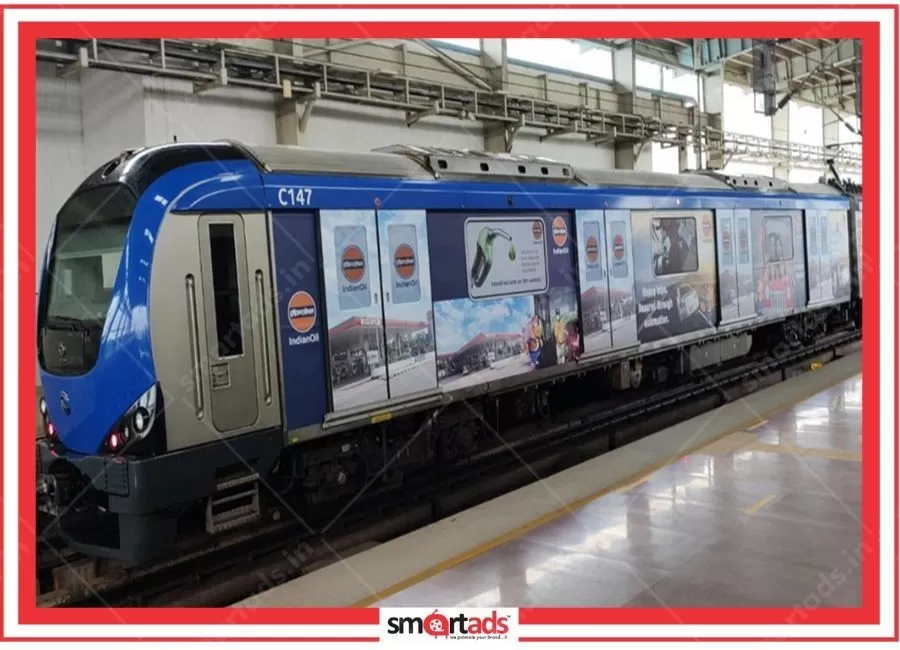
Exterior Metro Wrap
Size & Printing Cost as per actual
On the outside of metro Train, advertise
Rate per Metro Display Cost / 1 Month
Route:Janakpuri To Botanical Garden
₹900000.00
Showing 1 to 4 of 4 Results
MEDIA DETAILS
Size & Printing Cost as per actual
On the outside of metro Train, advertise
Rate per Metro Display Cost / 1 Month
Route:Janakpuri To Botanical Garden
₹900000.00
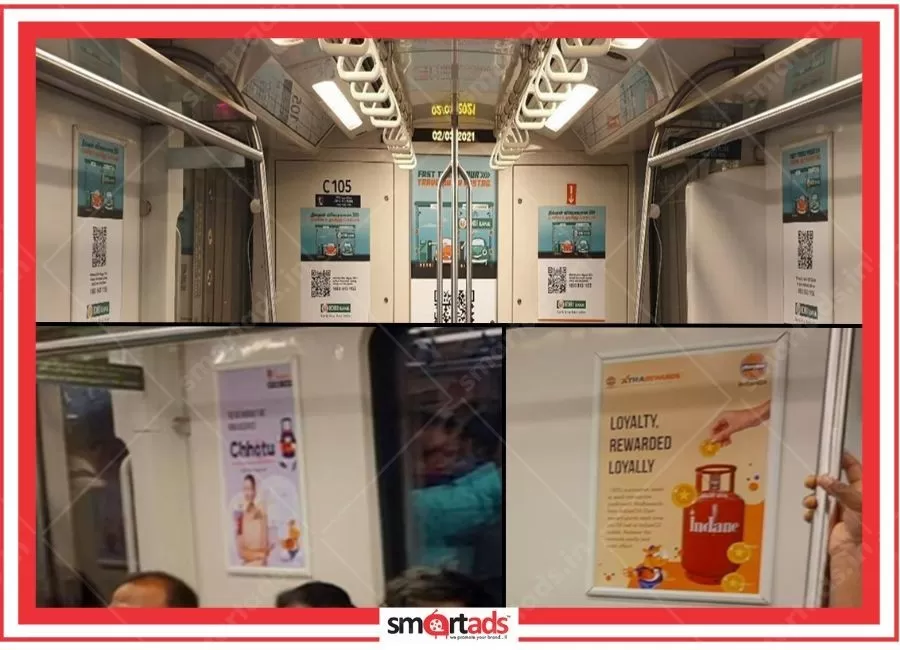
Size & Printing Cost as per actual
On the outside of metro Train, advertise
Rate per Metro Display Cost / 1 Month
Route:Janakpuri To Botanical Garden
₹500000.00

20 Sec Jingle
On the outside of metro Train, advertise
Rate per Metro Display Cost / 1 Month
Route:Janakpuri To Botanical Garden
₹400000.00
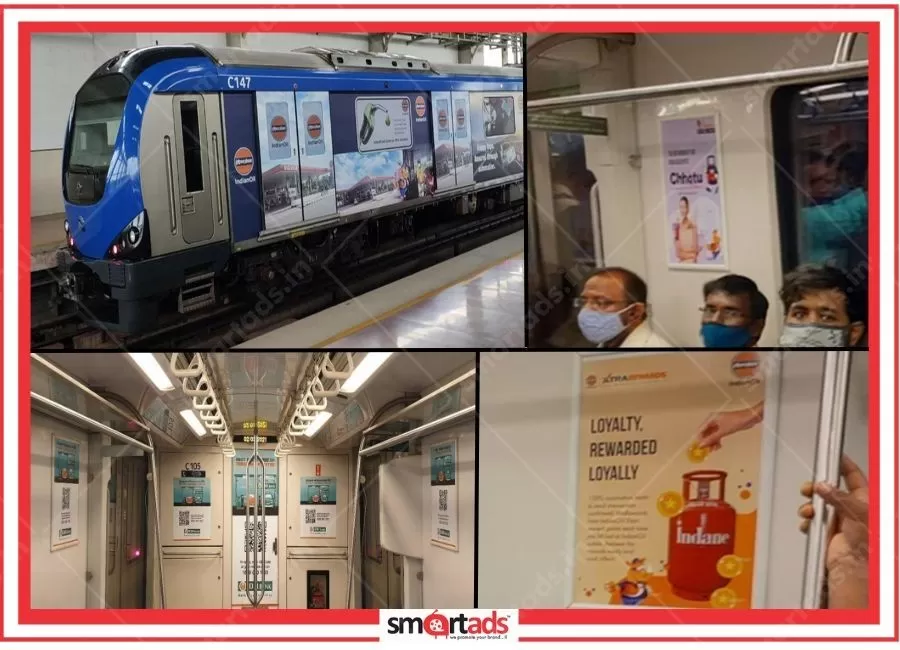
Size & Printing Cost as per actual
On the outside of metro Train, advertise
Rate per Metro Display Cost / 1 Month
Route:Janakpuri To Botanical Garden
₹1300000.00
MEDIA REACH

MinimumQty :
1
EstimateReachPeople :
150000000
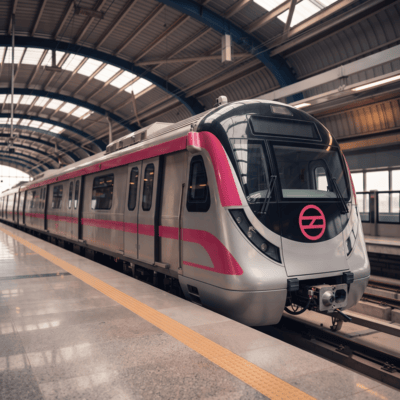
Most advertisers who come to us asking about Delhi Metro advertising start with the Blue Line or the Yellow Line — and we understand why. Those corridors have the ridership numbers that make finance teams feel safe. But what a lot of people miss is that the Magenta Line, officially Line 8 of the Delhi Metro Rail Corporation network, quietly serves one of the most valuable commuter demographics in the entire NCR: the South Delhi tech-and-finance belt, the IIT Delhi academic cluster, the Kalkaji–Jasola business corridor, and — this is the part that genuinely surprises clients — passengers connecting directly to IGI Airport Terminal 1. The Delhi Metro Magenta Line is not the loudest corridor in the network, but in our experience, it is one of the most underpriced and underutilised advertising opportunities available to brands targeting urban, high-income, working professionals in Delhi NCR today.
Metro train advertising on the Delhi Magenta Line refers to paid brand placements executed directly on the rolling stock — the trains themselves — and, in some formats, within the station environments along Line 8's corridor between Janakpuri West and Botanical Garden. Unlike conventional out-of-home advertising, which relies on passive exposure from a moving audience, metro train advertising works on the principle of a captive audience: commuters who are physically inside or alongside the train for an average dwell time of somewhere between 25 and 45 minutes per journey, with no option to skip, scroll past, or change the channel.
The formats that fall under metro train advertising in Delhi Magenta Line campaigns range from full exterior train wraps — where the entire outer skin of a six-coach train is branded — to interior train branding across panels, overhead strips, door decals, and digital screens inside metro coaches. On top of that, DMRC has been progressively expanding in-train audio advertising to additional lines, with the Magenta Line among the corridors included in the July 2025 tender cycle. What this means practically is that a brand can now build a genuinely multi-sensory transit advertising experience on Line 8, which is something that was not possible even two years ago.
At SmartAds, we always tell our clients that the distinction between "advertising on the metro" and "advertising on a specific metro line" is not just a geographic technicality — it is a targeting decision. The Delhi Metro Magenta Line serves a fundamentally different commuter profile than, say, the Red Line or the Green Line, and that demographic specificity is precisely where the real value lies for brands in the BFSI, EdTech, real estate advertising, and premium consumer categories. Choosing the right line is as important as choosing the right format.
The Delhi Metro Magenta Line runs across 25 stations, stretching from Janakpuri West in West Delhi through the heart of South Delhi and terminating at Botanical Garden in Noida. The corridor passes through or near some of the most commercially and institutionally significant zones in the NCR: Hauz Khas, which sits at the interchange with the Yellow Line and draws proximity to AIIMS and the IIT Delhi campus; Kalkaji Mandir, which serves as another interchange node; and the critically important IGI Airport Terminal 1 station, which makes Line 8 the only metro corridor with a direct rail connection to domestic terminal travellers.
For advertisers, the station geography of the Delhi Metro Magenta Line translates into something more useful than raw ridership figures — it translates into audience intent. A commuter boarding at Janakpuri West is likely a working professional commuting toward South Delhi's office clusters; a passenger at IGI Airport Terminal 1 is a traveller with demonstrated purchase capacity in hospitality, travel accessories, insurance, and premium retail; and someone alighting at Botanical Garden is entering the Noida technology and services corridor. This kind of journey-level audience profiling is what makes metro train advertising in Delhi Magenta Line campaigns genuinely targetable in a way that a billboard on the Ring Road simply cannot match.
What a lot of people miss is the Phase IV extension dimension. DMRC's Phase IV project includes a planned extension of the Magenta Line toward Krishna Park Extension and, in a separate corridor, toward Majlis Park, which will add new stations and substantially expand the daily ridership catchment. When this inventory comes online — and the construction timelines suggest meaningful progress through 2025–2026 — the advertising inventory on Line 8 will expand accordingly, meaning brands that establish relationships and creative templates on this corridor now will be positioned ahead of the inventory rush that typically follows new station openings. We have seen this pattern play out on the Pink Line, and the Magenta Line is following a similar trajectory.
The breadth of advertising formats available on Delhi Metro Magenta Line trains is wider than most brand managers realise when they first approach us. The formats broadly divide into exterior placements — which are visible to platform-level audiences and bystanders along the elevated sections of the route — and interior placements, which target the captive audience inside the coaches. Each format serves a different strategic purpose, and the most effective campaigns we have planned for clients on this corridor have combined at least two format types to build both awareness and recall.
Exterior formats include the full train wrap, which covers the outer panels of the entire six-coach train in brand graphics; partial exterior wraps, which cover one or two coaches rather than the full rake; and door panel decals. Interior formats include overhead strip panels, seat-back panels, door-area panels, interior panels along the coach walls, and — increasingly — digital screens inside metro coaches, which DMRC has been installing progressively across newer rolling stock. The Magenta Line's trains, which were manufactured by Hyundai Rotem for the Phase III DMRC Project, are among the more modern rolling stock in the network and carry a higher proportion of digital screen inventory than older lines.
Beyond the train itself, station-level formats that complement a metro train advertising campaign on Line 8 include escalator panel advertising, smart card advertising — where brand messaging appears on the physical metro smart cards issued at Line 8 stations — and station domination packages, which allow a brand to take over all advertising real estate at a single high-footfall station like Hauz Khas or Kalkaji Mandir. QR code metro ads are an increasingly popular addition to interior panel campaigns, where a static panel carries a QR code that commuters — who are stationary and have their phones in hand — can scan to access brand content, offers, or landing pages; the dwell time on Magenta Line journeys makes this format unusually effective compared to outdoor QR placements.
A full train wrap on the Delhi Metro Magenta Line is, frankly speaking, one of the most visually dominant advertising formats available in the Delhi NCR market. When a six-coach Magenta Line train is fully wrapped in brand graphics, it becomes a moving billboard that is seen not just by the passengers inside the train but by every person standing on a platform as it arrives, every pedestrian near an elevated section of the route, and — in the case of the underground stations — by commuters waiting on the platform as the train pulls in. The sheer scale of the visual impression is something that most brands underestimate until they see a wrapped train in person.
The production process for a full train wrap involves vinyl application across the exterior panels of all six coaches, which are each roughly 22 metres long, giving a total branded surface area that works out to somewhere in the range of 800 to 1,000 square metres of exterior branding. The creative brief for a full train wrap needs to account for the fact that the train is viewed in motion as often as it is viewed stationary, which means high-contrast design, minimal text, and bold brand identifiers perform significantly better than copy-heavy executions. We have seen this backfire when clients insist on carrying detailed product specifications on the exterior wrap — by the time the train has moved three metres past a platform observer, the message is gone.
One automotive brand we worked with ran a full train wrap campaign on the Magenta Line timed to coincide with a new model launch, and the results were instructive: the campaign generated an estimated 18 to 22 lakh impressions over a 30-day campaign duration, with brand recall scores — measured through a post-campaign intercept survey at Hauz Khas and Kalkaji Mandir stations — running roughly 34 percentage points higher among Magenta Line commuters than among a matched control group exposed only to the brand's digital campaign. The exterior train branding, in other words, was doing work that the digital spend alone was not achieving.
Interior train branding on the Delhi Metro Magenta Line operates on a different logic than exterior formats — it is not about scale of impression but about depth of engagement. A commuter who is inside a branded coach for 30 minutes is not just seeing your brand; they are living inside it, which creates a qualitatively different kind of brand recall than a two-second outdoor exposure. The interior panels, overhead strips, door decals, and digital screens inside metro coaches collectively create an environment that a brand can own completely if the campaign is designed with that intent.
The interior of a standard Magenta Line coach offers multiple placement zones: overhead longitudinal panels running the length of the coach ceiling, which are visible to seated and standing passengers alike; vertical panels at the coach ends and above the doors; seat-back panels in the priority seating sections; and the digital screens inside metro coaches, which cycle through brand content alongside DMRC's own informational messaging. A well-designed interior train branding campaign on Line 8 will use these zones in a coordinated way — the overhead panels for brand awareness, the door panels for product-specific messaging, and the digital screens for dynamic content or offers that can be updated during the campaign duration.
The thing is, interior train branding on the Magenta Line is particularly effective for brands whose purchase journey involves research and consideration — EdTech brands, BFSI advertising, real estate advertising, and insurance products all benefit from the extended dwell time that Line 8 journeys provide. A commuter travelling from Janakpuri West to Botanical Garden has roughly 55 minutes inside the train, which is enough time to read a detailed message, scan a QR code metro ad, and take a meaningful action on their phone. We have planned campaigns for an EdTech client in this format where the QR code scan rate from interior panels on Line 8 was nearly three times higher than the same brand's outdoor QR placements, which tells you something important about the quality of attention that interior train branding commands.
In-train audio advertising is the newest and, in some ways, the most interesting format addition to the Delhi Metro Magenta Line advertising inventory. DMRC ran a pilot of in-train audio advertising on the Violet Line in December 2023, which was received well enough that the format was included in the expanded tender scope for additional lines — including Line 8 — in the July 2025 tender cycle. What this means for advertisers is that the Magenta Line now offers a genuinely multi-channel transit advertising environment: visual, digital, and audio formats can be combined within a single campaign on a single line.
In-train audio advertising works through the existing public address system inside metro coaches, which is the same system used for station announcements and safety messages. A brand's audio spot — typically a metro jingle or a short spoken message of 15 to 30 seconds — is played between station announcements at defined intervals during the journey. The format is non-skippable, which is its primary advantage over digital audio, and it reaches every passenger in the coach simultaneously, regardless of whether they are looking at their phone or reading. The metro jingle format in particular has shown strong brand recall performance in the Violet Line pilot data that DMRC has shared with agency partners; the combination of a distinctive audio cue with the visual environment of a branded coach creates a multi-sensory brand memory that neither format achieves alone.
At SmartAds, we have been advising clients to treat in-train audio advertising on the Magenta Line as a frequency booster rather than a standalone medium — it works best when the audio message reinforces a visual campaign that is already running on the same trains. A retail client in Gurugram who was running interior train branding on Line 8 added a metro jingle to their campaign mid-flight, and the post-campaign brand recall data showed a statistically meaningful uplift in unaided brand recall among commuters who reported hearing the audio versus those who only saw the visual panels. The incremental cost of adding the audio layer was modest relative to the recall improvement it delivered.
Advertising cost on the Delhi Metro Magenta Line is one of those topics where the industry has done a poor job of being transparent with buyers, and we think that needs to change. The rates are structured through the DMRC tender process, with Proactive holding the exclusive advertising rights for Line 7 and Line 8 under the current concession arrangement. Agencies like SmartAds work with Proactive and other authorised vendors to access this inventory on behalf of clients, and the pricing is influenced by format type, campaign duration, number of coaches branded, and the specific stations included in a station-level buy.
For a full train wrap on the Magenta Line, the advertising cost for a 30-day campaign duration works out to somewhere in the ballpark of ₹8 to ₹12 lakh, depending on production costs, the number of rakes covered, and whether the campaign includes both elevated and underground station exposures. Interior train branding campaigns — covering overhead panels and door panels across a full rake — are priced somewhat lower, typically in the range of ₹3 to ₹6 lakh for a 30-day period, which is a number that surprises most first-time advertisers when they compare it to what they are paying for equivalent reach on programmatic display. The cost per impression on interior train branding, when calculated against the daily ridership figures for Line 8 — which DMRC data suggests runs at roughly 1.5 to 2 lakh daily boardings — works out to a CPM that is genuinely competitive with mid-tier digital inventory, but with a quality of attention that digital simply cannot replicate.
In-train audio advertising rates on the Magenta Line are still being formalised under the 2025 tender framework, but early indications suggest that a standard 15-second spot running at defined intervals across a campaign period is priced in the range of ₹1.5 to ₹3 lakh per month, which positions it as an accessible add-on for brands already running a visual campaign on Line 8. Station-level buys — including escalator panel advertising and smart card advertising at individual stations like Hauz Khas or Kalkaji Mandir — can be accessed at lower entry points, with individual station packages starting at somewhere around ₹50,000 to ₹1.5 lakh per month depending on the specific format and station footfall. This is important for SMEs and smaller brands, because it means that metro train advertising in Delhi Magenta Line campaigns are not exclusively the domain of large advertisers — a hyperlocal reach strategy built around two or three key stations is entirely viable on a modest budget.
Return on investment from metro train advertising is a conversation that the industry has historically avoided, partly because the measurement frameworks for transit advertising are less standardised than those for digital or television. But the data that exists — from BARC viewership data on transit video formats, TAM AdEx tracking of brand activity on metro networks, and the FICCI-EY Media Report's transit advertising benchmarks — consistently points to metro advertising delivering brand recall rates that outperform equivalent-spend outdoor campaigns by a meaningful margin.
Our experience with Magenta Line campaigns specifically suggests that the brand recall advantage is driven by two factors that are unique to this corridor. First, the dwell time on Line 8 is among the highest in the Delhi Metro network — the full Janakpuri West to Botanical Garden journey takes roughly 55 minutes, which means commuters are exposed to interior train branding for an extended period that far exceeds the two to five seconds of typical outdoor advertising exposure. Second, the commuter profile on the Delhi Metro Magenta Line skews heavily toward working professionals in the 25–45 age bracket, with above-average household incomes and high digital engagement — exactly the audience that BFSI advertising, real estate advertising, and premium consumer brands are willing to pay a premium to reach on digital platforms. The transit advertising format reaches them in a context where they are not actively filtering out advertising, which is a meaningful distinction from the ad-blocked, scroll-fatigued environment of social media.
A financial services brand we worked with ran a three-month metro train advertising campaign on the Magenta Line combining full train wrap and interior train branding, with a QR code metro ad driving traffic to a product landing page. Over the campaign period, the landing page received roughly 4,200 QR-attributed visits from Line 8 placements alone — a conversion rate from impression to click that was nearly four times higher than the same brand's LinkedIn campaign targeting a comparable professional demographic. The return on investment calculation, when the cost per qualified visit was compared across channels, made the Magenta Line campaign look remarkably efficient; frankly speaking, it changed how that client thought about their media mix going forward.
The honest answer is that not every brand is equally well-suited to the Magenta Line, and we think it is worth being direct about this rather than claiming that Line 8 is the right choice for everyone. The corridor's audience profile — urban, educated, working professionals, with a significant proportion of airport travellers and South Delhi residents — makes it an excellent fit for specific categories, and a less efficient choice for others.
FMCG brands with mass-market positioning, for instance, may find that the Yellow Line or Blue Line deliver better value because of their higher absolute ridership and broader demographic spread. But for EdTech brands targeting working professionals seeking upskilling; for BFSI advertising — insurance, mutual funds, credit cards — where the audience's income profile matters as much as their numbers; for real estate advertising targeting the South Delhi and Noida premium residential market; and for travel, hospitality, and luxury brands who want to reach the airport traveller segment at IGI Airport Terminal 1, the Delhi Metro Magenta Line is genuinely one of the most precisely targeted transit advertising environments in the country.
The airport connectivity angle deserves particular attention, because it is a content gap that most discussions of Magenta Line advertising completely ignore. IGI Airport Terminal 1 is the primary domestic terminal for SpiceJet and IndiGo operations, handling a substantial volume of business and leisure travellers daily; these are passengers who are, by definition, in a travel mindset, with purchase intent for travel insurance, hotel bookings, car rentals, premium luggage, and airport retail categories. A brand in any of these categories that runs metro train advertising on the Magenta Line with creative specifically designed for the airport traveller segment is accessing a hyperlocal reach opportunity that no other Delhi Metro line can replicate.
The metro line advertising comparison question comes up in almost every planning conversation we have with new clients, and the answer is more nuanced than a simple ranking. Each Delhi Metro line serves a distinct geographic corridor and, therefore, a distinct audience profile; the right line for a given brand depends on where their target audience lives and works, not just on which line has the highest ridership.
The Yellow Line — running from Samaypur Badli to HUDA City Centre — carries the highest daily ridership in the network and passes through the central business district, Connaught Place, and the Gurugram corridor, making it the default choice for mass-market brands and financial services. The Blue Line connects Dwarka to Noida and Vaishali, serving the large middle-income commuter population of West Delhi and Noida. The Magenta Line occupies a different strategic position: lower absolute ridership than Yellow or Blue, but a significantly more premium audience profile, a longer average journey time that increases dwell time for interior formats, and the unique IGI Airport Terminal 1 connectivity that no other line offers.
In terms of advertising cost comparison, the Yellow Line commands a premium — full train wrap rates on the Yellow Line can run 20 to 30 percent higher than equivalent Magenta Line placements, reflecting the higher ridership and demand for inventory. This means that for brands targeting the premium South Delhi and Noida professional demographic, metro train advertising in Delhi Magenta Line campaigns can deliver comparable audience quality at a lower advertising cost, which is a compelling efficiency argument that we make regularly to clients who default to Yellow Line without considering the alternatives. The metro line advertising comparison, in other words, often resolves in favour of Line 8 once the audience quality adjustment is applied.
The DMRC tender process for advertising rights is structured around exclusive concession agreements, under which a single vendor is awarded the right to manage and sell all advertising inventory on a defined set of lines for a fixed period. For the Delhi Metro Magenta Line — along with Line 7, the Pink Line — the exclusive advertising rights are currently held by Proactive, which won the relevant DMRC tender through the competitive bidding process that DMRC conducts periodically as part of its non-fare revenue strategy.
What this means practically for advertisers and their agencies is that all metro train advertising in Delhi Magenta Line campaigns must ultimately be routed through Proactive as the rights holder, either directly or through an authorised agency partner. Other vendors — including The Media Ant, CASHurDRIVE, Exopic Media, Litost India, Metro Spaces, and Ginger Media Group — may offer Magenta Line inventory as part of broader Delhi Metro packages, but they are accessing that inventory through Proactive's concession rather than independently. The DMRC's 85%-15% revenue-sharing model, under which 85% of advertising revenue flows to DMRC and 15% is retained by the concessionaire, is a structural factor that influences how pricing is set and why rate cards for metro advertising tend to have less room for negotiation than, say, outdoor media.
Understanding the tender structure matters for buyers because it affects both pricing transparency and campaign execution timelines. Proactive's exclusive advertising rights mean that last-minute inventory is limited — popular formats like full train wraps on Line 8 are often booked weeks or months in advance, particularly for high-demand periods like festive season and the January-to-March corporate planning cycle. At SmartAds, we typically advise clients planning a Magenta Line campaign to initiate the booking process at least six to eight weeks before their desired campaign start date, which gives sufficient time for DMRC approval, creative production, and installation scheduling.
The booking process for metro train advertising on the Delhi Magenta Line involves several steps that are worth understanding before you begin, because the process is more structured than booking outdoor media and requires DMRC creative approval at a stage that many first-time buyers do not anticipate. The process begins with a brief — format selection, campaign duration, target stations or full-line coverage, and budget — which is then used to generate a rate proposal from the authorised vendor or agency.
Once the proposal is accepted and a purchase order is raised, the creative artwork must be submitted for DMRC approval, which is a mandatory step for all metro advertising formats. DMRC's creative guidelines cover content restrictions — no political messaging, no content that could be considered offensive or misleading — as well as technical specifications for vinyl production, digital screen content, and audio scripts. The approval process typically takes somewhere between five and ten working days, after which production and installation can be scheduled. For a full train wrap, the installation itself takes one to two days per rake, which needs to be factored into the campaign launch timeline.
At SmartAds, our experience managing metro advertising campaigns across Delhi NCR means we handle the DMRC approval process, vendor coordination, and installation supervision on behalf of our clients, which removes a significant administrative burden from the brand's internal team. We have found that the campaigns which run most smoothly are those where the creative is developed with DMRC's technical specifications in mind from the outset — adapting an existing TVC or print campaign to metro formats at the last minute almost always results in approval delays or compromised creative quality. If you are planning a metro train advertising campaign on the Magenta Line, the single most useful thing you can do is brief your creative team on the format dimensions and viewing conditions before the artwork is developed, not after.
DMRC's advertising policy is governed by a set of guidelines that balance the Corporation's commercial interests — non-fare revenue from advertising is a meaningful and growing component of DMRC's revenue model — with its obligations as a public utility operator. The policy sets out approved advertising categories, content restrictions, and the technical standards that all advertising materials must meet before they are installed on trains or in stations. For Line 8 specifically, the policy is administered through Proactive's concession agreement, which runs for a defined period before being re-tendered through the DMRC tender process.
The Phase IV DMRC Project adds an important dimension to the advertising policy discussion, because new stations and new rolling stock — including Alstom Metropolis trains being introduced for some Phase IV corridors — bring updated technical specifications and potentially expanded digital inventory. The Alstom Metropolis rolling stock, in particular, is designed with a higher proportion of digital screen real estate than the Hyundai Rotem trains currently operating on the Magenta Line, which means that digital screens inside metro coaches will become a more significant part of the Line 8 advertising inventory as Phase IV extensions come into service.
Frankly speaking, the DMRC's 85%-15% revenue-sharing model is not something that gets discussed openly in most agency conversations with clients, but it is directly relevant to understanding why metro advertising rates are structured the way they are. The concessionaire's margin is constrained by the revenue-sharing obligation, which means that the pricing flexibility available on metro inventory is structurally lower than on privately-owned outdoor or digital inventory. Buyers who understand this dynamic are better positioned to negotiate on campaign duration, format bundling, and value-added inclusions rather than on headline rate cards, which have limited room to move.
Q: What is metro train advertising on the Delhi Magenta Line?
Metro train advertising on the Delhi Magenta Line refers to paid brand placements on the trains and stations of Line 8, which runs between Janakpuri West and Botanical Garden across 25 stations. The formats include exterior train wraps, interior train branding across panels and digital screens, in-train audio advertising, and station-level formats like escalator panel advertising and smart card advertising. The defining characteristic of this medium is the captive audience it delivers — commuters who are inside or alongside the train for extended dwell times, with no ability to skip or scroll past the advertising. The Delhi Metro Magenta Line is particularly valued by advertisers for its premium commuter demographic, which skews toward working professionals, South Delhi residents, and airport travellers.
Q: How much does it cost to advertise on the Delhi Metro Magenta Line in 2025?
Advertising rates on the Magenta Line vary by format and campaign duration. A full train wrap for a 30-day period works out to roughly ₹8 to ₹12 lakh including production, while interior train branding campaigns covering panels across a full rake are typically in the range of ₹3 to ₹6 lakh per month. In-train audio advertising is priced in the ballpark of ₹1.5 to ₹3 lakh per month for a standard spot schedule. Station-level buys — escalator panels, smart card advertising — can start at around ₹50,000 per month at individual stations, making them accessible for smaller advertisers. All rates are subject to DMRC tender framework pricing and may vary based on the specific vendor, campaign timing, and inventory availability.
Q: What advertising formats are available on Magenta Line trains?
The Magenta Line offers a range of formats: full train wraps covering the exterior of all six coaches, partial exterior wraps covering one or two coaches, interior panels including overhead strips and door-area decals, digital screens inside metro coaches, in-train audio advertising through the PA system, and QR code metro ads integrated into interior panel campaigns. At the station level, escalator panel advertising, smart card advertising, and station domination packages are also available. The combination of visual, digital, and audio formats makes Line 8 one of the more versatile transit advertising environments in the Delhi Metro network.
Q: Who holds the exclusive DMRC advertising rights for the Magenta Line?
Proactive holds the exclusive advertising rights for the Delhi Metro Magenta Line (Line 8) under the current DMRC tender concession. All metro train advertising on this corridor must be routed through Proactive, either directly or through authorised agency partners. Other media vendors may offer Magenta Line inventory as part of bundled packages but are accessing it through Proactive's concession. The DMRC tender process is competitive and periodic; the current concession terms reflect the 85%-15% revenue-sharing model between DMRC and the concessionaire.
Q: How many stations does the Magenta Line cover and what is the daily ridership?
The Delhi Metro Magenta Line covers 25 stations from Janakpuri West to Botanical Garden, passing through key nodes including Hauz Khas, Kalkaji Mandir, and IGI Airport Terminal 1. Daily ridership on Line 8 is estimated at roughly 1.5 to 2 lakh boardings per day based on DMRC operational data, a figure that is expected to grow as the Phase IV extension adds new stations and catchment areas. While this is lower than the Yellow or Blue Line ridership, the audience quality — in terms of income profile and purchase intent — is considered premium relative to the network average.
Q: What is the difference between interior train branding and a full train wrap on the Magenta Line?
A full train wrap covers the exterior surfaces of all six coaches of a Magenta Line train in brand graphics, making the train itself a moving outdoor advertisement visible to platform audiences and bystanders along the route. Interior train branding, by contrast, refers to placements inside the coaches — overhead panels, door decals, seat-back panels, and digital screens — which target the passengers riding the train. The two formats serve different strategic purposes: exterior train branding maximises scale of impression and brand visibility to a broad audience, while interior train branding maximises depth of engagement and dwell time with the captive audience inside the coaches. The most effective campaigns typically combine both.
Q: What is in-train audio advertising on the Magenta Line and how does it work?
In-train audio advertising on the Magenta Line uses the train's existing PA system to broadcast brand messages — typically a metro jingle or a short spoken spot of 15 to 30 seconds — between station announcements during the journey. The format was piloted on the Violet Line in December 2023 and was included in the July 2025 DMRC tender expansion to additional lines including Line 8. Audio spots are non-skippable and reach all passengers in the coach simultaneously. The format works best as a complement to a visual campaign running on the same trains, where the audio message reinforces the brand identity established by the interior or exterior branding.
Q: Is Magenta Line advertising effective for brand recall?
The evidence consistently suggests yes. The extended dwell time on Magenta Line journeys — up to 55 minutes for the full route — means that interior train branding achieves a depth of exposure that outdoor advertising cannot match. Post-campaign intercept surveys conducted for campaigns we have managed on Line 8 have shown brand recall rates among Magenta Line commuters running 30 to 40 percentage points higher than among control groups exposed only to digital campaigns. The commuter engagement profile on the Delhi Metro Magenta Line — educated, urban, working professionals who are attentive during their commute — further amplifies recall performance relative to formats that target passive or distracted audiences.
Q: Which brands are best suited for advertising on the Delhi Metro Magenta Line?
Brands in BFSI advertising, EdTech, real estate advertising, travel and hospitality, premium consumer goods, and luxury categories are best suited to the Magenta Line. The corridor's audience — South Delhi working professionals, IIT Delhi and AIIMS-adjacent academic community, and IGI Airport Terminal 1 travellers — has above-average income and high purchase intent in considered categories. FMCG brands seeking mass reach may find better efficiency on the Yellow or Blue Lines, but for brands where audience quality matters more than raw numbers, the Delhi Metro Magenta Line is consistently one of the most efficient transit advertising environments in the network.
Q: How do I book a metro train advertising campaign on the Magenta Line?
The booking process involves selecting your format and campaign duration, obtaining a rate proposal from an authorised vendor or agency partner, submitting creative artwork for DMRC approval, and scheduling production and installation. DMRC creative approval typically takes five to ten working days, and full train wrap installation requires one to two days per rake. We recommend initiating the booking process at least six to eight weeks before your desired campaign start date. Working with a metro advertising agency in Delhi that has an established relationship with Proactive and experience navigating the DMRC approval process will significantly reduce friction and timeline risk.
Q: How does Magenta Line advertising compare to Blue Line or Yellow Line advertising?
The Yellow Line offers the highest ridership and broadest demographic reach, at a correspondingly higher advertising cost. The Blue Line serves the large middle-income commuter population of West Delhi and Noida. The Magenta Line occupies a premium niche: lower absolute ridership but a significantly more valuable audience profile, longer average journey times that increase dwell time, and the unique IGI Airport Terminal 1 connectivity. For brands targeting the premium South Delhi and Noida professional segment, metro train advertising in Delhi Magenta Line campaigns often delivers better cost-per-qualified-impression than Yellow Line placements, which is a case we make regularly when clients default to the higher-ridership lines without considering the audience quality adjustment.
Q: Can small businesses advertise on the Delhi Metro Magenta Line?
Yes — station-level buys make Magenta Line advertising accessible to smaller advertisers. Escalator panel advertising and smart card advertising at individual stations like Hauz Khas or Kalkaji Mandir can be accessed at entry points starting around ₹50,000 per month
