
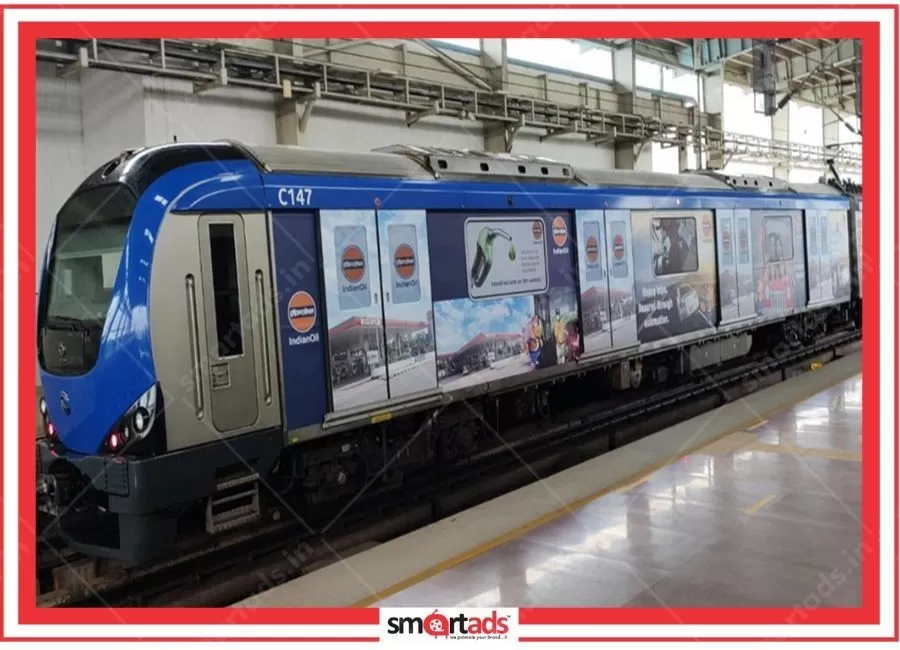
Exterior Metro Wrap
Size & Printing Cost as per actual
On the outside of metro Train, advertise
Rate per Metro Display Cost / 1 Month
Route:Dwarka To Dhansa Bus Stand
₹900000.00
Showing 1 to 4 of 4 Results
MEDIA DETAILS
Size & Printing Cost as per actual
On the outside of metro Train, advertise
Rate per Metro Display Cost / 1 Month
Route:Dwarka To Dhansa Bus Stand
₹900000.00
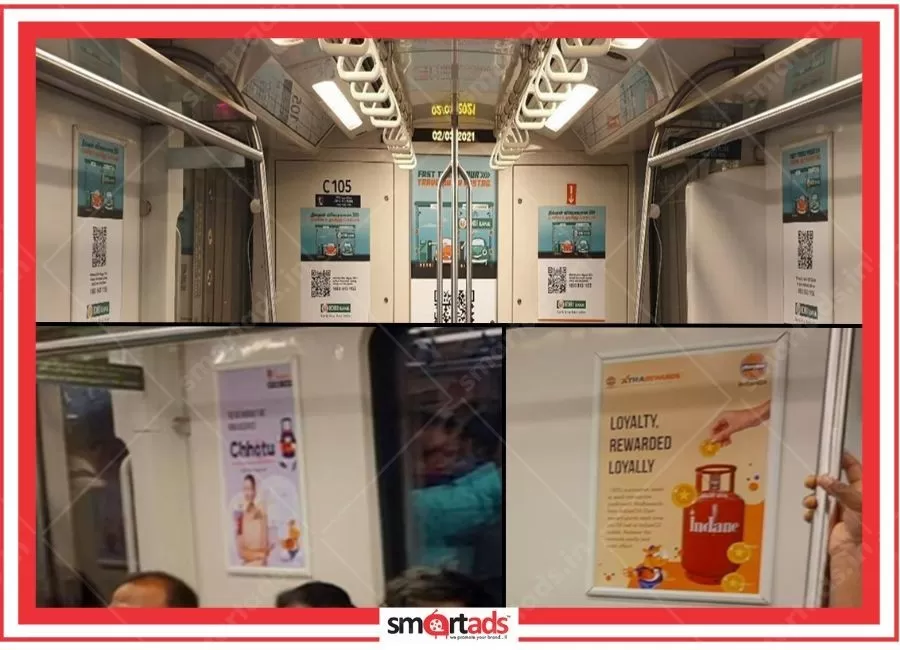
Size & Printing Cost as per actual
On the outside of metro Train, advertise
Rate per Metro Display Cost / 1 Month
Route:Dwarka To Dhansa Bus Stand
₹500000.00

20 Sec Jingle
On the outside of metro Train, advertise
Rate per Metro Display Cost / 1 Month
Route:Dwarka To Dhansa Bus Stand
₹400000.00
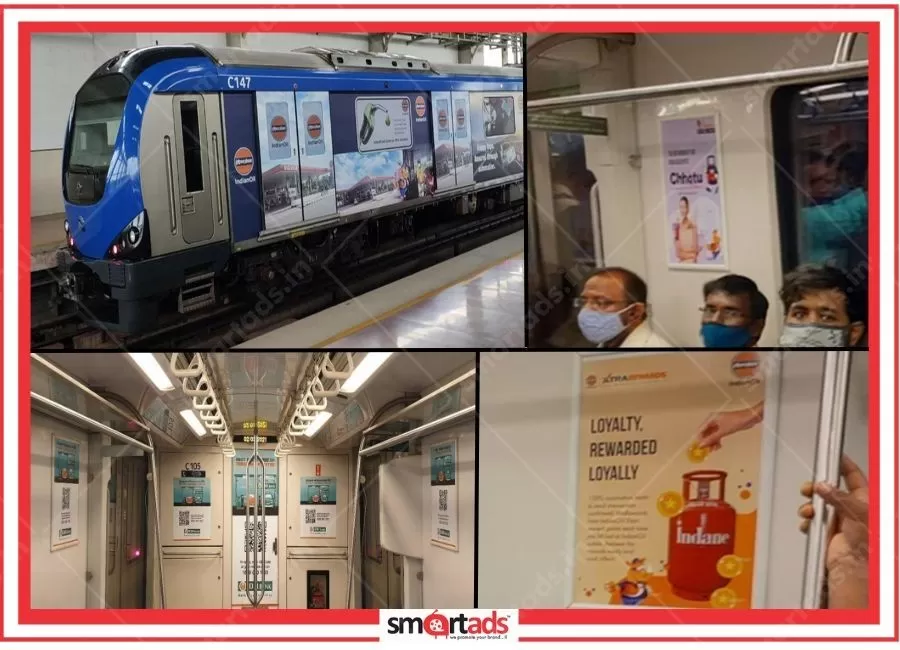
Size & Printing Cost as per actual
On the outside of metro Train, advertise
Rate per Metro Display Cost / 1 Month
Route:Dwarka To Dhansa Bus Stand
₹1300000.00
MEDIA REACH

MinimumQty :
1
EstimateReachPeople :
150000000
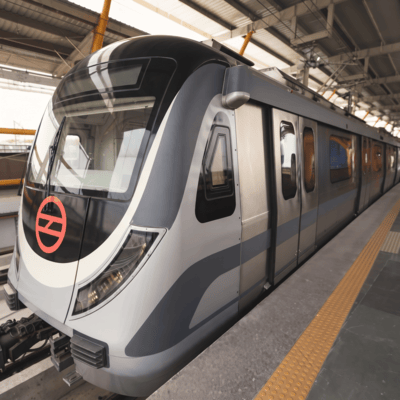
Most media planners, when they think about Delhi Metro advertising, default to the Yellow Line or the Blue Line — the big-volume corridors with lakhs of daily footfalls and well-established advertising inventories. What gets missed, consistently, is that the Delhi Metro Grey Line (Line 9) offers something those corridors fundamentally cannot: a captive, geographically concentrated audience in west Delhi and south-west Delhi, moving through a short, high-frequency corridor where your brand has almost nowhere to hide. The Grey Line is not the biggest line on the DMRC network, but in our experience at SmartAds, it is one of the most underestimated.
The Delhi Metro Grey Line, officially designated Line 9 by the Delhi Metro Rail Corporation, is a Phase III metro corridor stretching approximately 5.19 kilometres between Dwarka and Dhansa Bus Stand — passing through Nangli and Najafgarh along the way. It is, by design, a short feeder corridor; but that brevity is precisely what makes metro train advertising in Delhi Grey Line so strategically interesting. When a commuter boards at Dwarka and exits at Dhansa Bus Stand, they spend the entire journey inside a train where your brand occupies the panels, the overhead spaces, or — in the case of a full train wrap — the entire exterior surface. There is no competing clutter, no next-page scroll, no mute button.
Metro train advertising, as a category, sits firmly within BTL advertising and non-traditional advertising — it is transit media that works on the principle of repeated exposure during a commuter's daily routine. On the Grey Line specifically, that routine is remarkably consistent: the line primarily serves daily commuters travelling between the residential and semi-urban catchment areas of Najafgarh, Nangli, and Dhansa Bus Stand, connecting them to the broader DMRC network via the Dwarka interchange, which links directly to the Blue Line (Line 3/4). What this means for a brand is that the audience profile is tight, the geography is defined, and the frequency of exposure — because these are the same people riding the same trains every working day — is genuinely high.
At SmartAds, we always tell our clients that transit advertising on a short, high-frequency corridor like the Grey Line behaves more like outdoor media with a captive audience than it does like traditional metro station advertising. The dwell time per journey is lower than on longer lines, yes — but the repetition across a campaign duration of four to eight weeks means that a working professional commuting daily between Najafgarh and Dwarka will see your brand creative somewhere between forty and sixty times over a single month, which is a frequency figure that most digital media planners would find difficult to match at the same cost.
The advertising formats available for grey line metro train branding broadly mirror what DMRC offers across its other Phase III corridors, though the specific inventory depends on the current DMRC tender status and the rolling stock deployed on the line. The Grey Line operates Bombardier Cityflo 650 CBTC trains — a four-coach configuration — which determines the total number of branding surfaces available per train. Interior train branding options typically include overhead panel ads (the longitudinal panels running above the seating rows), door-adjacent panels, grab-handle inserts, and floor graphics; exterior train branding options include full train wrap, partial side panels, and end-coach branding, which functions effectively as a mobile billboard moving through the west Delhi catchment.
Interior train branding is the more accessible entry point for most brands; it does not require the same level of DMRC approval complexity as a full train wrap, and the advertising cost is correspondingly lower. Panel ads inside the coaches offer sustained visibility throughout the journey — a commuter seated or standing in a coach will inevitably read whatever is in front of them, which is a behavioural reality that makes interior branding particularly effective for message-heavy creatives, QR code campaigns, or brand awareness content that benefits from longer reading time. We have run interior coach branding campaigns for an FMCG client targeting the Dwarka-Najafgarh corridor, and the brand recall scores measured through post-campaign surveys were, frankly, higher than what the same client was seeing from their roadside hoarding spend in the same geography.
Full train wrap — the exterior train branding format where the entire outer surface of the train is covered in branded vinyl — is the premium format, and it is also the one that functions most powerfully as a mobile billboard. A fully wrapped Grey Line train moving between Dwarka and Dhansa Bus Stand is visible not just to passengers inside, but to pedestrians, motorists, and residents along the elevated corridor — which extends the reach of the campaign well beyond the ticketed commuter base. Beyond these, DMRC's non-fare revenue framework has historically included metro smart card back advertising on active lines, though availability of this format specifically on the Grey Line is subject to the current tender cycle and should be confirmed at the time of booking.
This is the question that almost every media planner asks first, and it is also the one where most competitor pages fall short — either citing outdated figures or simply saying "contact for rates" without providing any useful benchmark. To be honest, Grey Line advertising rates in 2025 are somewhat in flux, because the DMRC tender for advertising rights on this corridor has had a more complex history than on the mainline corridors; but we can share the benchmarks that inform our planning conversations.
For interior train branding — panel ads across one coach of a four-coach Grey Line train — the advertising cost works out to somewhere in the ballpark of ₹80,000 to ₹1.5 lakh per month, depending on the number of panels booked, the specific positions within the coach, and whether the campaign is part of a multi-month commitment. Full train branding, which covers all four coaches on the interior, runs in the range of roughly ₹3 lakh to ₹5 lakh per month — a figure that surprises most first-time advertisers when they compare it to what they might spend on a single large-format hoarding in Dwarka, which can command similar rates without the mobility or frequency advantages. Exterior train wrap — the full train wrap format — is the most premium option, with metro advertising cost per month typically ranging from somewhere between ₹8 lakh and ₹15 lakh for a complete exterior execution, depending on the duration, the creative complexity, and the production cost of the vinyl application itself.
What a lot of people miss is that these advertising rates are almost always negotiable when booked through a metro advertising agency with an established DMRC relationship, and that multi-month campaign bookings typically attract meaningful discounts — sometimes in the range of fifteen to twenty-five percent off the card rate. At SmartAds, we have been able to secure significantly better terms for clients who committed to a minimum campaign duration of three months on grey line advertising, compared to clients who approached DMRC directly for a single-month booking. The production cost of the creative — particularly for a full train wrap, where the vinyl printing and application is a substantial line item — also needs to be factored into the total advertising cost, and is something that a good grey line metro advertising agency will help you plan for upfront rather than discover midway through the campaign.
The honest answer is that not every brand should — and we will say that plainly, because it is the kind of honest advice that actually builds trust with clients. The Grey Line is a hyperlocal reach vehicle; it serves a specific geographic catchment in west Delhi and south-west Delhi, and if your target audience does not live or work in that catchment, the line's limited footfall numbers will not justify the spend. But for brands that are genuinely targeting the Dwarka-Najafgarh-Nangli corridor — real estate developers, educational institutions, local retail chains, healthcare providers, financial services companies with branch presence in west Delhi, or FMCG brands trying to build brand awareness in semi-urban Delhi — the Grey Line offers something rare in Delhi NCR advertising: a clutter-free environment with a captive audience and genuine frequency.
The clutter-free environment point deserves emphasis. On a mainline corridor like the Blue Line or Yellow Line, your brand is competing with dozens of other advertisers across the station, the train, the platforms, and the digital screens. On the Grey Line, the inventory is smaller and the competition for that inventory is correspondingly lower — which means your brand can achieve a dominant share of voice within the corridor without the budget that dominance would require on a busier line. We have seen this dynamic play out particularly well for a real estate client in west Delhi who ran grey line metro train branding for a new residential project in the Dwarka-Najafgarh belt; the campaign reached the exact audience profile they needed — urban commuters with household incomes in the ₹6 lakh to ₹15 lakh range — and the site visits attributable to the campaign were measurably higher than what the same client saw from their newspaper insertions in the same period.
On top of that, the Dwarka metro station interchange — where the Grey Line connects to the Blue Line (Line 3/4) — creates an interesting amplification opportunity. Commuters transferring between lines at Dwarka are exposed to Grey Line trains at the platform, which means the exterior train branding on a full train wrap is visible to Blue Line passengers as well, extending the effective reach of the campaign beyond the Grey Line's own ridership. This is a nuance that most media planners miss when they first look at the line's footfall numbers in isolation, and it is one of the reasons we consistently recommend considering grey line advertising as part of a broader Delhi Metro advertising mix rather than as a standalone buy.
The Delhi Metro Grey Line runs from Dwarka (Station 1) through Nangli (Station 2) and Najafgarh (Station 3) to Dhansa Bus Stand (Station 4) — four stations across 5.19 kilometres, all elevated, all in the south-west Delhi administrative district. The line was inaugurated as part of Phase III of the DMRC expansion, and it was specifically designed to connect the densely populated but previously metro-unserved areas of Najafgarh and Nangli to the main DMRC network via the Dwarka interchange. Najafgarh, in particular, is a significant urban agglomeration — one of the largest towns in Delhi by population — and the Grey Line's extension to Dhansa Bus Stand further deepens the catchment into areas that had limited public transit access before Phase III.
The daily ridership on the Grey Line is lower than on the mainline corridors — figures from DMRC operational data suggest ridership in the range of roughly 25,000 to 40,000 daily commuters during peak periods, though this number has been growing steadily as awareness of the line increases and residential development in the Najafgarh-Nangli belt continues. What matters more than the raw ridership number, for advertising purposes, is the audience composition: the Grey Line's daily commuters are predominantly working professionals and students from west Delhi and south-west Delhi, travelling into central Delhi via the Blue Line interchange at Dwarka. This is an audience that skews toward the 22-to-45 age bracket, with household incomes that are solidly middle-class — which makes grey line advertising particularly relevant for categories like banking and insurance, consumer durables, educational services, and healthcare.
The hyperlocal reach of the Grey Line is, in our view, one of its most underappreciated attributes. Brands that want to build brand visibility specifically in the Najafgarh, Nangli, and Dwarka catchment areas — without paying for the broader Delhi NCR reach of a mainline metro corridor — will find that advertising on Delhi Metro Grey Line trains gives them a precision that is genuinely difficult to replicate through other media. A newspaper insert, for instance, cannot be targeted to just these four stations' catchment; a digital campaign can be geo-targeted, but it competes with every other digital advertiser in the same geography. Metro train advertising in Delhi Grey Line, by contrast, reaches the specific people who live and commute in this corridor, in a format they cannot skip or scroll past.
This is a question we get asked regularly, and the honest answer is that it depends entirely on what you are trying to achieve — which sounds like a hedge but is actually a meaningful strategic distinction. Interior train branding on the Grey Line works best for brands that need to communicate a message: a product launch with multiple features, a service offering that requires explanation, a QR code or contact detail that commuters need time to read and retain. The dwell time inside a coach — even on a short corridor like the Grey Line — is sufficient for a commuter to read a panel ad two or three times per journey, which is the kind of repeated exposure that drives brand recall for message-heavy content.
Exterior train branding — the full train wrap format — works best for brands that prioritise visual impact and broad awareness over message depth. A fully wrapped Grey Line train is, functionally, a mobile billboard that travels the same route multiple times a day, every day, for the duration of the campaign; it is seen by commuters on the platform, by pedestrians near the elevated sections, by motorists at grade crossings, and by Blue Line passengers at the Dwarka interchange. The advertising cost is higher, the production lead time is longer (vinyl application typically requires two to three days and needs to be coordinated with DMRC's maintenance schedule), and the creative needs to work at distance — which means simpler, bolder visuals rather than the text-heavy content that works well inside the coach.
What we tell our clients is that the most effective grey line metro train branding campaigns we have executed have combined both formats: a full train wrap for awareness and visual dominance, paired with interior panel ads that carry the detailed message. One automotive brand we worked with used this combination for a new model launch targeting the Dwarka-Najafgarh corridor — the exterior wrap created immediate visual impact and brand recognition, while the interior panels carried the model specifications, EMI details, and dealership location information. The campaign ran for six weeks, and the dealership in Dwarka reported a measurable uptick in walk-ins from the Najafgarh and Nangli areas during that period, which they attributed directly to the metro campaign.
The DMRC approval process for advertising on Delhi Metro trains — including the Grey Line — operates through a formal tender and licensing framework under the Delhi Metro Rail Corporation's non-fare revenue division. DMRC periodically issues tenders for advertising rights across its network, and the rights for specific lines or formats are awarded to empanelled advertising concessionaires for defined contract periods. The Grey Line's advertising tender history has been somewhat more complex than the mainline corridors, partly because the line was commissioned later (Phase III) and partly because its relatively lower ridership made it a less commercially attractive standalone tender for large concessionaires — which has, at various points, created gaps in the formal advertising inventory.
What this means practically for brands and media planners is that DMRC approval for Grey Line train advertising is best navigated through a metro advertising agency that has an existing relationship with the current concessionaire and is familiar with the specific approval requirements for this corridor. The documentation required for DMRC approval typically includes the creative artwork (in DMRC-specified dimensions and file formats), a brand safety declaration, and the formal booking agreement through the empanelled agency; for exterior train wrap campaigns, an additional structural approval for the vinyl application process is required, which can add one to two weeks to the lead time. We recommend building a minimum of four to six weeks into the campaign timeline from brief to launch, to account for DMRC approval, production, and application.
At SmartAds, we maintain active relationships with DMRC's empanelled advertising partners across multiple Delhi Metro lines, which allows us to advise clients on the current tender status for the Grey Line and to navigate the approval process efficiently. The DMRC tender cycle is something that most brands are not equipped to track independently; a grey line metro advertising agency with current market intelligence can tell you whether inventory is available, what the current card rates are, and whether there are any format restrictions in place for the specific campaign period — which is information that can make the difference between a campaign that launches on schedule and one that gets delayed by weeks.
To be fair, the Grey Line is not going to win a head-to-head comparison with the Yellow Line or Blue Line on raw reach numbers — and any media planner who tells you otherwise is not being straight with you. The Yellow Line (Line 2) carries upwards of six to seven lakh daily commuters; the Blue Line (Line 3/4) is similarly high-volume; both lines have well-established advertising inventories with multiple format options and a deep pool of competing advertisers. Metro train advertising in Delhi Grey Line, by contrast, is a niche buy — smaller audience, tighter geography, lower absolute reach.
But the comparison changes significantly when you look at cost-per-relevant-impression rather than gross reach. For a brand targeting west Delhi and south-west Delhi specifically, the Grey Line delivers a higher proportion of relevant impressions per rupee spent than a mainline corridor, where a substantial fraction of the audience may be outside the target geography. The advertising rates on the Grey Line are also meaningfully lower than on the Blue or Yellow lines, which means that a brand with a defined geographic objective can achieve dominant brand visibility within the Grey Line corridor at a fraction of what dominance on a mainline corridor would cost. Delhi metro advertising on the Grey Line is, in this sense, a more efficient buy for hyperlocal objectives — not a substitute for mainline reach, but a complement to it.
The Dwarka interchange is the point where these two worlds intersect most productively. Dwarka is a major Blue Line station — it serves one of Delhi's largest planned residential townships — and the Grey Line platform at Dwarka is positioned within the same station complex. This means that grey line station branding at Dwarka, combined with train branding on the Grey Line itself, creates a touchpoint that is visible to both Grey Line commuters and Blue Line commuters transferring at Dwarka, which effectively extends the campaign's reach without requiring a separate Blue Line booking. We have used this strategy for several clients who wanted Dwarka-specific brand visibility without committing to a full Blue Line buy, and the results have consistently justified the approach.
The commuter profile on the Grey Line is one of the most distinctive on the DMRC network, and it is one that most media planning conversations undervalue. The line's catchment — Najafgarh, Nangli, Dhansa Bus Stand, and the western edge of Dwarka — is a mix of established middle-class residential areas and rapidly urbanising semi-urban neighbourhoods; the daily commuters are predominantly working professionals employed in central Delhi, students travelling to colleges and coaching institutes, and small business owners who use the metro for daily errands and commercial travel. The audience skews male (reflecting broader metro usage patterns in outer Delhi), with a significant proportion in the 22-to-40 age bracket — which is, frankly, one of the most commercially valuable demographic segments for most consumer categories.
What makes this audience particularly interesting for advertisers is its aspirational orientation. Residents of Najafgarh and Nangli who have adopted metro commuting are, by definition, urban commuters who have opted into a modern transit system — they are digitally connected, brand-aware, and actively making purchasing decisions in categories like financial services, consumer electronics, healthcare, and education. The IRS (Indian Readership Survey) data and BARC viewership patterns for this geography suggest a media consumption profile that skews toward digital and mobile, with significant television consumption in the evenings — which means metro train advertising in Delhi Grey Line can serve as an effective touchpoint in a broader media mix that also includes digital and television.
One thing we have observed across multiple campaigns targeting this corridor is that the Grey Line audience responds particularly well to local relevance cues — brand creatives that reference Dwarka, Najafgarh, or Nangli by name, or that feature imagery consistent with west Delhi's visual landscape, consistently outperform generic national creatives in post-campaign recall studies. This is a hyperlocal reach advantage that is unique to transit advertising in a defined geographic corridor, and it is something that a good grey line metro advertising agency will help you build into the creative strategy from the outset.
The booking process for metro train advertising in Delhi Grey Line follows a sequence that is more structured than most outdoor media, and understanding it upfront saves a significant amount of time and frustration. The first step is confirming inventory availability — because the Grey Line's advertising rights are managed through DMRC's empanelled concessionaire network, and the available formats and positions can vary depending on what is already booked for your target campaign period. This is where working with a metro advertising agency that has current market intelligence makes a material difference; rather than approaching DMRC directly (which is possible but slower), an agency with an established relationship can confirm availability, share current advertising rates, and provide a formal proposal within a few days.
Once the format and campaign duration are confirmed, the creative artwork needs to be prepared to DMRC's technical specifications — which vary by format and are more exacting than most clients expect. Interior panel ads require artwork at specific dimensions with bleed allowances; exterior train wrap requires high-resolution files at the full coach dimensions, typically in the range of several hundred square feet of print area, with specific requirements for the vinyl material grade and application method. DMRC approval of the creative is a mandatory step before production begins, and this approval can take anywhere from one to two weeks depending on the current processing load at DMRC's non-fare revenue division. For a full train wrap, the production and application process adds another week to ten days, which is why we recommend the four-to-six-week lead time mentioned earlier.
At SmartAds, our metro advertising booking process for Grey Line campaigns includes a pre-campaign brief review, format recommendation based on the client's objective and budget, creative specification guidance, DMRC approval coordination, production supervision, and post-launch monitoring — which is a level of end-to-end management that most clients find significantly reduces the friction of their first metro advertising campaign. The minimum campaign duration we recommend for meaningful brand recall is four weeks; shorter campaigns are possible but tend to underperform on frequency, particularly on a corridor where the daily commuter base is relatively stable and needs multiple exposures to register and retain the brand message.
Q: Is metro train advertising currently available on the Delhi Grey Line?
Metro train advertising in Delhi Grey Line is available, though the specific formats and inventory depend on the current DMRC tender status and the empanelled concessionaire for this corridor. The Grey Line's advertising rights have historically been managed differently from the mainline corridors, and availability can vary by period. The most reliable way to confirm current availability is through a metro advertising agency with an active DMRC relationship — at SmartAds, we can typically confirm Grey Line inventory status within 48 hours of an enquiry, which saves clients the time of navigating DMRC's procurement process independently.
Q: What is the cost of advertising on Delhi Metro Grey Line trains in 2025?
Grey Line advertising rates in 2025 vary by format: interior panel ads across a single coach work out to roughly ₹80,000 to ₹1.5 lakh per month, while full interior train branding across all four coaches runs in the range of ₹3 lakh to ₹5 lakh per month. Exterior train wrap — the full train branding format — is the premium option, with advertising cost per month typically in the range of ₹8 lakh to ₹15 lakh, inclusive of production. These figures are benchmarks rather than fixed card rates; actual advertising rates depend on campaign duration, format combination, and the current DMRC tender terms, and multi-month bookings typically attract meaningful discounts.
Q: What ad formats are available for Grey Line metro train branding?
The available advertising formats for grey line metro train branding include interior panel ads (overhead longitudinal panels, door-adjacent panels, and grab-handle inserts), floor graphics inside coaches, exterior partial side panels, and full train wrap — the exterior train branding format that covers the entire outer surface of the train. Coach branding, which covers all interior surfaces within a single coach, is also available as a mid-tier format between individual panel ads and full train branding. Metro smart card back advertising has been available on other DMRC lines and may be available on the Grey Line depending on the current concessionaire arrangement; this should be confirmed at the time of booking.
Q: Can I book a single coach for advertising on the Delhi Grey Line, or do I need to book the entire train?
This is a question we get asked frequently, and the answer for the Grey Line is that single-coach bookings are generally not available as a standard option — the minimum booking unit for train branding on the Grey Line is typically the full train, which comprises four coaches. This is different from some mainline corridors where individual coach bookings have historically been offered. The reason is partly operational (DMRC's production and approval process is more efficient at the full-train level) and partly commercial (the Grey Line's smaller inventory makes individual coach bookings less viable for the concessionaire). Interior panel ads within a coach can be booked at the individual panel level, but coach branding as a format requires a full-train commitment on this corridor.
Q: What is the route and how many stations does the Delhi Metro Grey Line have?
The Delhi Metro Grey Line (Line 9) runs from Dwarka to Dhansa Bus Stand, covering four stations — Dwarka, Nangli, Najafgarh, and Dhansa Bus Stand — across a total route length of approximately 5.19 kilometres. All four stations are elevated. The line connects to the broader DMRC network via the Blue Line (Line 3/4) interchange at Dwarka, which is one of the major residential metro stations in west Delhi. The Grey Line was commissioned as part of Phase III of the Delhi Metro expansion, and it was specifically designed to extend metro connectivity to the densely populated south-west Delhi areas of Najafgarh and Nangli, which had previously been underserved by public transit.
Q: Who are the typical commuters on the Delhi Metro Grey Line?
The daily commuters on the Delhi Metro Grey Line are predominantly working professionals and students from the Najafgarh, Nangli, and Dhansa Bus Stand catchment areas, travelling into central Delhi via the Blue Line interchange at Dwarka. The audience skews toward the 22-to-45 age bracket, with household incomes in the middle-class range — broadly ₹5 lakh to ₹18 lakh annually — and a strong orientation toward digital media and mobile consumption. They are urban commuters who have opted into metro travel, which signals a degree of modernity and brand awareness that makes them a commercially valuable audience for categories including financial services, consumer durables, healthcare, education, and FMCG.
Q: How does Grey Line metro advertising compare to advertising on the Blue or Yellow lines?
Grey Line advertising delivers lower absolute reach than the Blue or Yellow lines — the daily commuter numbers are smaller, and the geographic footprint is tighter. But for brands targeting west Delhi and south-west Delhi specifically, the Grey Line delivers a higher proportion of relevant impressions per rupee spent, because the audience is geographically concentrated in exactly the catchment that matters. The advertising rates are also meaningfully lower than on mainline corridors, which means that a brand can achieve dominant brand visibility within the Grey Line corridor at a fraction of what dominance on the Blue or Yellow line would cost. The two approaches are not mutually exclusive; in fact, some of the most effective Delhi metro advertising campaigns we have planned have used the Grey Line for hyperlocal precision alongside a mainline corridor for broader reach.
Q: What is the DMRC tender and approval process for advertising on the Grey Line?
DMRC manages advertising rights across its network through a formal tender and licensing framework, under which empanelled concessionaires hold the rights to sell advertising inventory on specific lines or formats for defined contract periods. For the Grey Line, the advertising tender has had a more complex history than the mainline corridors, and the current concessionaire arrangement should be confirmed at the time of booking. The DMRC approval process for a specific campaign involves creative artwork review, brand safety clearance, and — for exterior train wrap — a structural approval for the vinyl application. Total lead time from brief to campaign launch is typically four to six weeks, including DMRC approval, production, and application.
Q: How long should I run a metro train advertising campaign on the Grey Line for maximum brand recall?
Our experience across multiple transit advertising campaigns is that a minimum of four weeks is required to achieve meaningful brand recall among daily commuters — this is the threshold at which the frequency of exposure (typically twenty to thirty times per commuter over four weeks) is sufficient to move the needle on unaided recall. Eight to twelve weeks is the sweet spot for campaigns where brand awareness building is the primary objective; campaigns of this duration consistently show significantly higher recall scores than four-week campaigns in our post-campaign research. Shorter campaigns — two weeks or less — are possible but tend to underperform on recall, because the frequency is insufficient to overcome the natural attrition of attention in a commuter environment.
Q: Which industries and brands benefit most from advertising on the Delhi Metro Grey Line?
The industries that benefit most from grey line advertising are those whose target audience overlaps with the line's commuter profile: real estate developers with projects in west Delhi and south-west Delhi (Dwarka, Najafgarh, Nangli), educational institutions and coaching institutes targeting students in this catchment, healthcare providers and hospitals with facilities in west Delhi, financial services companies (banks, NBFCs, insurance providers) targeting middle-class urban commuters, and FMCG brands seeking to build brand awareness in a semi-urban Delhi geography. Local and regional brands — rather than purely national advertisers — often find the Grey Line's hyperlocal reach particularly valuable, because it allows them to concentrate their advertising spend in the specific geography where their business operates.
Q: What is the difference between interior train branding and exterior train wrap on the Grey Line?
Interior train branding refers to advertising placed inside the coaches — panel ads on the overhead longitudinal surfaces, door-adjacent panels, grab-handle inserts, and floor graphics — which is seen exclusively by passengers travelling inside the train. Exterior train branding, or full train wrap, refers to branded vinyl covering the outer surface of the train, which is visible to people on the platform, pedestrians near the elevated sections, motorists at grade crossings, and commuters on other lines at interchange stations like Dwarka. Interior branding is better suited to message-heavy content that benefits from sustained reading time; exterior train wrap is better suited to visual impact and broad awareness, functioning effectively as a mobile billboard. The most effective campaigns combine both formats.
Q: How do I get a quote for metro train advertising on the Delhi Metro Grey Line?
The most direct route to a quote for metro train advertising in Delhi Grey Line is through a metro advertising agency with a current DMRC relationship and knowledge of the Grey Line's specific inventory and rates. At SmartAds.in, we provide customised media planning proposals for Grey Line campaigns — including format recommendations, rate benchmarks, creative specifications, and DMRC approval guidance — typically within 48 to 72 hours of receiving a brief. You can reach us through SmartAds.in to start the conversation; we will need your target audience profile, campaign objective, approximate budget range, and preferred campaign period to provide a meaningful proposal.
The Delhi Metro Grey Line will not solve every advertising objective — and we would be doing our clients a disservice if we suggested otherwise. But for brands that are genuinely trying to reach the working professionals and urban commuters of west Delhi and south-west Delhi, metro train advertising in Delhi Grey Line offers a combination of captive audience, clutter-free environment, and hyperlocal precision that is genuinely difficult to replicate through any other single medium in this geography. The line's short corridor is not a weakness; it is a feature, because it concentrates your brand's presence in a defined catchment where the same audience encounters it repeatedly, day after day, for the duration of the campaign.
What we have seen, across the campaigns we have planned and executed on the Grey Line and across the broader DMRC network, is that the brands which perform best in transit advertising are the ones that treat it as a frequency medium rather than a reach medium — they commit to a sufficient campaign duration, they invest in creative that is built for the format, and they integrate the metro campaign into a broader media mix that reinforces the message across multiple touchpoints. A Grey Line metro campaign paired with targeted digital advertising in the Dwarka-Najafgarh geography, for instance, creates a level of brand saturation within the corridor that neither medium achieves alone; the metro campaign drives awareness and recall, while the digital campaign captures intent and drives conversion.
The FICCI-EY Media and Entertainment Report has consistently highlighted transit media as one of the fastest-growing segments within India's out-of-home advertising industry, and the GroupM TYNY Report's data on Delhi NCR advertising expenditure reflects a steady increase in BTL and non-traditional advertising as brands seek alternatives to the increasingly cluttered digital and television environments. The Grey Line is a small but genuinely valuable piece of that landscape — one that rewards brands willing to look beyond the obvious inventory choices and invest in the precision that a well-planned hyperlocal transit campaign can deliver.
If you are evaluating grey line advertising for an upcoming campaign — or if you are building a broader Delhi metro advertising plan and want to understand how the Grey Line fits into the mix — the SmartAds media planning team is available to walk you through the options, the rates, and the creative considerations in detail. Visit SmartAds.in to share your brief, and we will come back to you with a customised proposal that reflects the current market reality, not a generic rate card.
