
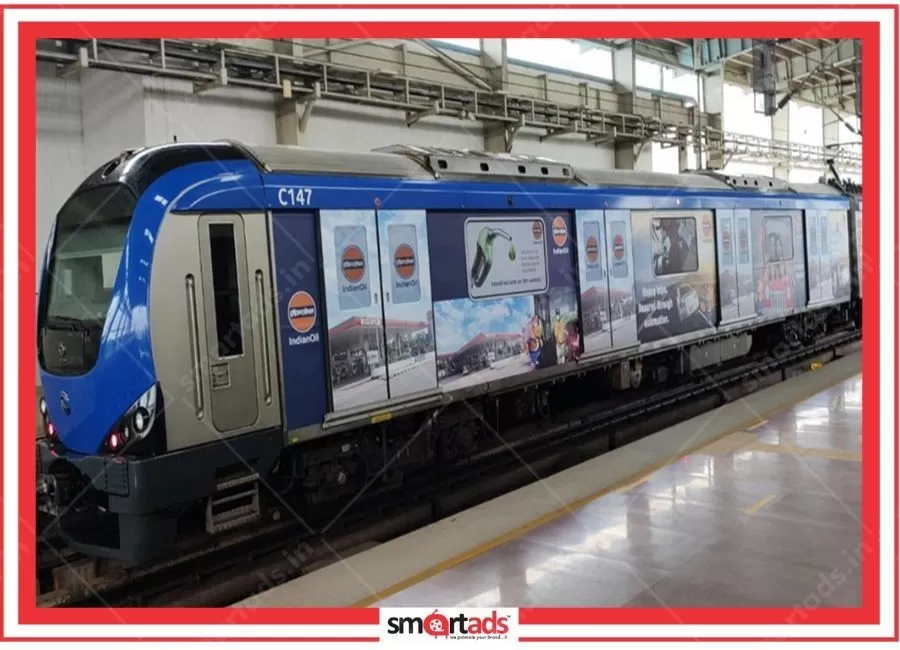
Exterior Metro Wrap
Size & Printing Cost as per actual
On the outside of metro Train, advertise
Rate per Metro Display Cost / 1 Month
Route:Miyapur To LB Nagar
₹860000.00
Showing 1 to 5 of 5 Results
MEDIA DETAILS
Size & Printing Cost as per actual
On the outside of metro Train, advertise
Rate per Metro Display Cost / 1 Month
Route:Miyapur To LB Nagar
₹860000.00
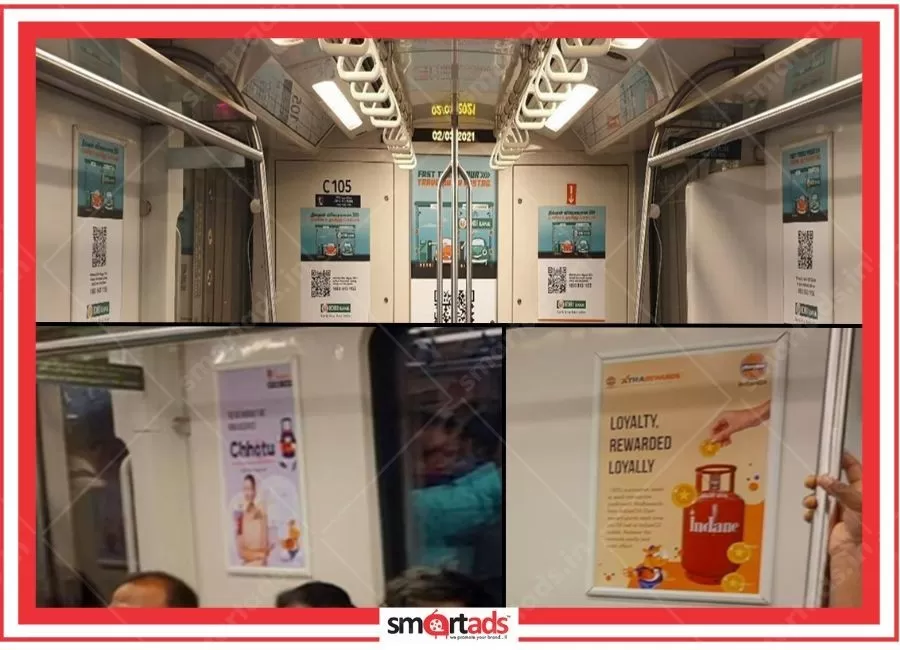
Size & Printing Cost as per actual
On the outside of metro Train, advertise
Rate per Metro Display Cost / 1 Month
Route:Miyapur To LB Nagar
₹480000.00

10 Sec Video
On the outside of metro Train, advertise
Rate per Metro Display Cost / 1 Month
Route:Miyapur To LB Nagar
₹135000.00
20 Sec Jingle
On the outside of metro Train, advertise
Rate per Metro Display Cost / 1 Month
Route:Miyapur To LB Nagar
₹400000.00

Size & Printing Cost as per actual
On the outside of metro Train, advertise
Rate per Metro Display Cost / 1 Month
Route:Miyapur To LB Nagar
₹1330000.00
MEDIA REACH

MinimumQty :
1
EstimateReachPeople :
150000000
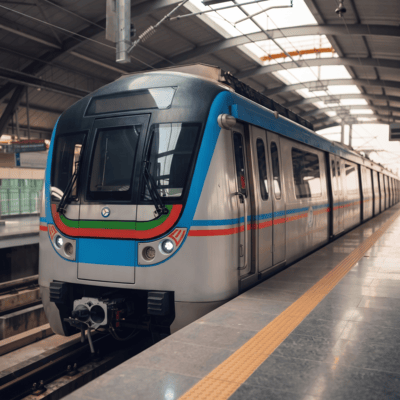
The Hyderabad Metro Red Line carries somewhere in the ballpark of 5.36 lakh daily commuters through 27 stations spanning 29.21 kilometres — and yet, most brand managers we speak to have never seriously considered it as a primary media channel. That is a significant oversight, because the captive audience quality on this corridor is arguably better than anything a roadside hoarding in Hyderabad can deliver. At SmartAds, we have run campaigns across every major transit medium in the country, and the Red Line consistently surprises clients with its return on investment when the planning is done right.
Most people, when they think of outdoor advertising in Hyderabad, picture the large hoardings along Jubilee Hills Road or the digital screens at Banjara Hills intersections. Metro train advertising on the Hyderabad Red Line operates on an entirely different logic — one that is built around dwell time, repetition, and a captive audience that cannot scroll past your message. The Red Line, formally designated as Corridor 1 of the Hyderabad Metro Rail network, runs from Miyapur in the northwest to LB Nagar in the southeast, passing through some of the city's most commercially dense neighbourhoods including HITEC City, Ameerpet, Nampally, and Dilsukhnagar.
The advertising inventory on this corridor is managed under the framework of L&T Metro Rail Hyderabad Limited, which holds the concession for the metro network and controls all commercial space across the rolling stock and station infrastructure. What that means practically is that every format — whether it is a full coach wrap on the outside of a train, seat-back panels inside the coaches, digital screens at platform level, or entry exit zone ads at the fare gates — is part of a unified media property with consistent audience measurement. This is fundamentally different from the fragmented OOH landscape where you are dealing with dozens of vendors for a single city campaign.
What a lot of people miss is that metro train advertising in Hyderabad is classified as both BTL advertising and transit advertising simultaneously, which gives it a unique positioning in media plans. It delivers the mass reach of traditional OOH advertising while offering the targeting precision of below the line advertising — you can choose specific stations, specific train sets, or specific times of day, which is something a static billboard simply cannot offer. At SmartAds, we always tell our clients that this format sits at the intersection of brand building and audience targeting, and that is a rare combination in any media category.
Frankly speaking, the debate between the three Hyderabad Metro corridors — Red Line, Blue Line, and Green Line — is one we have had with dozens of clients, and the answer almost always comes back to the Red Line. The reason is straightforward: Corridor 1 is the longest operational corridor in the network, covering 29.21 km with 27 stations, which means your brand travels further and is seen by more people per train journey than on either of the other two lines. The Blue Line (Corridor 3) runs from Nagole to Raidurg, while the Green Line (Corridor 2) connects Jubilee Bus Station to Falaknuma — both are important, but neither matches the Red Line's combination of length, ridership, and commercial catchment.
The demographic profile of the Red Line commuter is what makes Hyderabad metro red line advertising particularly attractive to premium brands. The western stretch of the corridor, from Miyapur through KPHB Colony, Kukatpally, Balanagar, and Moosapet, serves a high-density residential population of daily commuters, students, and office-goers; the central section through Erragadda, Ameerpet, and Nampally connects the old city commercial belt to the new business districts; and the eastern stretch from Ameerpet through Madhapur and HITEC City delivers what is arguably the highest concentration of IT professionals and knowledge economy workers of any transit corridor in South India. That combination — working-age, digitally aware, economically active — is exactly the audience that most national and regional brands are trying to reach.
The GroupM TYNY Report and the FICCI-EY Media Report have both noted the accelerating growth of transit advertising as a category in India, driven specifically by metro rail expansion in Tier 1 cities; Hyderabad is consistently cited as one of the fastest-growing metro advertising markets in the country, which reflects the city's broader economic trajectory as a technology and pharmaceutical hub. Our experience at SmartAds shows that brand recall scores for campaigns run on the Hyderabad Metro Red Line tend to outperform comparable-budget outdoor campaigns by a meaningful margin — a pattern we attribute to the enclosed, distraction-reduced environment inside the coaches.
The format menu on the Red Line is considerably richer than most advertisers expect, and choosing the right combination is where the real strategic work happens. Train wrap advertising — which involves applying a full vinyl graphic to the exterior of one or more coaches — is the most visually dramatic option and functions as a moving billboard that travels the entire 29.21 km corridor multiple times a day; a single full coach wrap on the Red Line generates impressions across all 27 stations on every run, which is an exposure frequency that no static format can replicate. A full train wrap, which covers all coaches of a rake, takes this further and essentially turns the entire train into a branded asset.
Inside the coaches, the options include in-coach branding across multiple surfaces — overhead panels, seat-back panels, window decals, and grab-handle branding — each of which targets the commuter during the average 20 to 35-minute journey time on the Red Line. Seat-back panels are particularly effective for long-copy messages, QR code campaigns, or anything that requires the audience to engage for more than a few seconds; we have found that financial services brands and EdTech platforms do especially well with this format because the commuter has both the time and the mental bandwidth to process a detailed message. Digital screens within coaches and at stations represent the DOOH inventory on the corridor, which allows for dynamic creative rotation, time-of-day targeting, and — in some cases — integration with mobile retargeting campaigns.
At the station level, the formats expand further: platform signage, metro pillar advertising along the concourse and platform areas, entry exit zone ads at the fare gates, and station domination packages which allow a single brand to take over all visible surfaces at a high-footfall station for a defined campaign period. The Ameerpet station, being the interchange between the Red Line and the Blue Line, is the most sought-after station domination location in the entire network because it captures passengers from both corridors simultaneously. Digital out-of-home screens at key stations are increasingly being integrated into hybrid campaign strategies — something we will discuss in more detail later — and represent one of the more interesting growth areas in metro advertising Hyderabad right now.
Not all 27 stations on the Red Line are equal from an advertising standpoint, and understanding the footfall hierarchy is essential to allocating your budget intelligently. Ameerpet station sits at the top of that hierarchy by a considerable margin — it is the interchange point between the Red Line and the Blue Line, which means it captures not just Red Line daily commuters but also passengers transferring between corridors, making it the single busiest node in the Hyderabad Metro network. Any campaign that includes Ameerpet in its station mix is effectively buying access to the highest-concentration footfall point in the system.
HITEC City metro station is the second station we consistently recommend to brands targeting the technology and professional services audience; the catchment area includes Madhapur, Kondapur, and the broader HITEC City technology park cluster, which is home to hundreds of multinational companies and their combined workforce of hundreds of thousands of IT professionals and office-goers. KPHB Colony and Kukatpally stations serve the densely populated residential belt on the northwestern corridor, which is particularly valuable for FMCG brands, consumer durables, and retail advertisers targeting middle-income families. Miyapur metro station, as the western terminus of the Red Line, generates strong footfall from the rapidly developing residential zones of the outer northwest, while LB Nagar at the eastern terminus serves the older, commercially active southeastern suburbs.
Nampally station deserves special mention because it connects to the Nampally railway station and the old city commercial district, which means its audience profile skews differently from the IT-corridor stations — it captures traders, small business owners, and a broader socioeconomic cross-section of the city. Dilsukhnagar, on the eastern stretch of the Red Line, serves a high-density residential and commercial area with strong footfall from daily commuters travelling toward the city centre. What we tell clients at SmartAds is that the station selection strategy should mirror the brand's customer geography — if your target audience lives or works in the western tech corridor, anchor your plan at HITEC City and KPHB Colony; if you are chasing the city-wide mass market, Ameerpet and Nampally give you the broadest cross-section.
This is the question every client asks first, and it is also the question that most agency websites refuse to answer — which is frustrating for anyone trying to do serious media planning. We will be direct: the advertising cost on the Red Line varies significantly by format, duration, and the specific inventory selected, but we can share the benchmarks that our planning team works with regularly. A single coach exterior wrap on the Red Line works out to roughly ₹3 to ₹5 lakh per month depending on the train set and the season, which sounds substantial until you calculate the CPM — the cost per thousand impressions works out to somewhere between ₹6 and ₹12, a number that genuinely surprises most clients when they compare it to what they are paying for comparable reach through digital display or traditional OOH hoardings in Hyderabad.
A full train wrap, which covers all coaches of a rake and turns the entire train into a moving billboard, is priced in the ballpark of ₹15 to ₹25 lakh per month; this is the format that delivers the most dramatic brand visibility and is typically used by large FMCG brands, automobile manufacturers, or financial services companies running city-wide brand awareness campaigns. In-coach branding packages — which bundle seat-back panels, overhead panels, and grab-handle branding across one or more coaches — are available in a range that starts at roughly ₹1.5 to ₹2 lakh per coach per month, making them accessible to mid-sized brands with more targeted objectives. Platform signage and metro pillar advertising at individual stations can be booked for somewhere between ₹50,000 and ₹2 lakh per station per month depending on the station's footfall tier and the size of the format.
Station domination packages at premium locations like Ameerpet or HITEC City are priced at a premium — typically in the range of ₹8 to ₹15 lakh for a four-week campaign — but the concentration of brand impact at a single high-traffic node justifies the investment for brands that are specifically targeting those catchment areas. The minimum campaign duration for most Red Line advertising formats is 15 days, though most serious brand campaigns run for 30 to 90 days to build the frequency needed for meaningful brand recall. At SmartAds, we always recommend a minimum of 30 days for any transit advertising campaign, because the audience builds cumulatively — the commuter who sees your train wrap on day one will see it again on day seven, day fifteen, and day twenty-eight, and it is that repetition which drives the recall scores that justify the investment to your management.
The honest answer is that the Red Line works for a wider range of categories than most advertisers assume, but it works exceptionally well for specific verticals — and knowing which category you fall into changes how you should plan the campaign. Real estate brands targeting the residential markets along the western corridor, from Miyapur through Kukatpally and KPHB Colony, have consistently delivered strong results in our experience; the audience travelling this stretch is predominantly aspirational middle-class and upper-middle-class families who are actively in the market for residential properties in the outer northwest of Hyderabad. One real estate developer we worked with ran a 45-day in-coach branding campaign across the western stretch of the Red Line, and the campaign generated a measurable uplift in site visits from the KPHB Colony and Kukatpally catchment areas — the client attributed roughly 18% of their site visit volume during that period to the metro campaign.
EdTech and professional education brands find the Red Line particularly valuable because the corridor's student and young professional audience is precisely the demographic that is actively evaluating upskilling and certification programmes; the HITEC City to Ameerpet stretch is especially effective for this category because it captures IT professionals during their commute — a moment when they are mentally receptive and not yet in the work-mode distraction of their office environment. Financial services brands — banks, insurance companies, mutual fund platforms, and payment apps — have found that the in-coach branding formats on the Red Line deliver strong QR code scan rates and app download attribution, which is a measurable outcome that helps justify the advertising cost to digital-first marketing teams. FMCG brands, consumer electronics companies, and retail chains benefit from the sheer mass reach of the full train wrap format, which delivers brand visibility across all 27 stations and all socioeconomic segments of the Red Line's daily commuter base.
To be fair, there are categories where the Red Line is not the optimal primary channel — hyperlocal restaurant brands, for instance, may find that the geographic spread of the corridor works against them if their outlets are concentrated in just one or two neighbourhoods. But even in those cases, a targeted station domination campaign at the nearest Red Line station can be highly effective. At SmartAds, we have seen this work particularly well for quick-service restaurant chains that combined a station domination at their nearest metro station with a train wrap campaign on the coaches serving that catchment — the combination of station-level impact and train-level reach created a surround-sound effect that drove measurable footfall increases.
Return on investment in transit advertising is a topic that the industry has historically handled poorly — most agencies give you reach numbers and leave you to do the maths yourself, which is not particularly useful when you are trying to justify a media spend to a CFO. Our approach at SmartAds is to frame ROI in terms of three distinct metrics: CPM compared to alternative channels, brand recall lift, and attribution to business outcomes where measurable. On the CPM front, the Hyderabad Metro Red Line is one of the most cost-efficient mass-reach media options in the city; with a daily ridership of approximately 5.36 lakh and an annual ridership figure in the ballpark of 170 million, the impression volume generated by even a single coach wrap is substantial, and the CPM — as noted earlier — works out to a range that compares very favourably against both traditional OOH hoardings and digital display in the Hyderabad market.
Brand recall is harder to quantify without primary research, but the structural logic is compelling: a commuter on the Red Line spends an average of 20 to 35 minutes on the train, during which they are in an enclosed environment with limited competing stimuli, which means your brand message has a dwell time advantage that no roadside hoarding can match. TAM AdEx data has consistently shown that transit advertising as a category generates higher brand recall per rupee spent than static outdoor in urban markets, a finding that aligns with what we observe in post-campaign surveys conducted for our clients. One automotive brand we worked with ran a simultaneous campaign — a full train wrap on the Red Line alongside a comparable-budget hoarding buy in Hyderabad — and the post-campaign recall scores for the metro execution were roughly 2.3 times higher than for the hoarding campaign, despite the two formats having similar impression counts on paper.
Attribution to business outcomes is the frontier that the industry is still working toward, but the tools are improving. QR codes on seat-back panels and in-coach branding have become a reliable attribution mechanism for e-commerce and app-based brands; one fintech client we worked with tracked over 4,200 unique QR code scans from a 30-day in-coach branding campaign on the Red Line, which translated directly into app downloads and — after the standard conversion funnel — a measurable return on the advertising investment. Digital out-of-home screens at stations add another layer of measurability through audience analytics tools that are increasingly being integrated into the DOOH ecosystem, which means the measurement gap between metro advertising and digital is narrowing faster than most traditional media planners realise.
The comparison between metro train advertising in Hyderabad and traditional outdoor advertising — hoardings, unipoles, bus shelters — is one that comes up in almost every planning conversation we have, and the answer is more nuanced than a simple "one is better than the other." Traditional OOH advertising in Hyderabad has the advantage of geographic flexibility; you can place a hoarding at any major intersection in the city, which means you can target specific neighbourhoods with precision that the metro network's fixed route cannot replicate. On the other hand, a hoarding on a busy Hyderabad road is competing with traffic, other signage, pedestrian activity, and the driver's need to focus on the road — the actual dwell time on a typical hoarding is measured in seconds.
Metro train advertising on the Hyderabad Red Line inverts that equation entirely. The captive audience inside a coach has nowhere to go and nothing else demanding their visual attention, which means dwell times are measured in minutes rather than seconds; this is the fundamental structural advantage of non-traditional advertising in the metro environment, and it is why brand recall scores consistently favour transit formats over static outdoor. On top of that, the Red Line's audience is predominantly urban, working-age, and economically active — a demographic profile that skews more premium than the broad cross-section captured by a roadside hoarding on a national highway. BTL advertising on the metro also tends to generate stronger word-of-mouth and social media documentation — commuters photograph and share striking train wraps, which creates earned media value that extends the campaign's reach beyond the metro network itself.
The cost comparison is where the picture gets interesting. A premium hoarding at a high-traffic Hyderabad location — say, along the Banjara Hills Road No. 12 or at a major Secunderabad junction — can cost anywhere from ₹3 to ₹8 lakh per month, which is broadly comparable to a coach wrap on the Red Line; but the metro format delivers a measurably longer dwell time, a more defined audience profile, and the moving billboard effect that multiplies impressions across the entire corridor. Below the line advertising through metro formats also avoids the weather-dependency and visibility issues that affect outdoor advertising during Hyderabad's monsoon season, when heavy rain and reduced visibility can significantly diminish the impact of a hoarding campaign. Our recommendation at SmartAds is not to treat these as competing channels but to plan them as complementary — a metro campaign builds frequency with a defined urban audience, while outdoor extends reach into areas the metro network does not cover.
The booking process for metro train advertising in Hyderabad is more structured than most people expect, and understanding it upfront saves a significant amount of time and prevents the creative rework that derails many campaigns. The commercial advertising rights on the Red Line are managed through L&T Metro Rail Hyderabad Limited, which has established a formal approval process for all advertising creatives and formats; this means that unlike booking a hoarding through a local vendor, the metro advertising process involves a compliance review that can take anywhere from five to fifteen working days depending on the format and the complexity of the creative. HMRL and L&TMRHL have specific guidelines around content — political advertising, competitive comparisons, and certain product categories are restricted — and creatives must meet technical specifications for print quality, material standards, and installation safety before approval is granted.
The practical steps for booking a campaign on the Red Line begin with format selection and station or train set identification, followed by a rate negotiation and booking confirmation with the authorised media partner; the creative submission and approval process runs in parallel, and installation is typically scheduled once both the booking and the approval are confirmed. Campaign durations, as noted, start at a minimum of 15 days for most formats, with pricing structured on a monthly basis for longer campaigns. Working with an experienced metro advertising agency in Hyderabad — one that has an established relationship with the L&T Metro Rail Hyderabad Limited commercial team — significantly smooths this process, because the agency can anticipate compliance issues before the creative is submitted and negotiate better inventory availability based on their track record with the property.
At SmartAds, our team handles the entire booking process end to end — from format recommendation and rate negotiation through creative compliance review and installation supervision — which means clients do not need to navigate the HMRL approval process independently. We have found that first-time metro advertisers often underestimate the lead time required, particularly for train wrap formats where the vinyl production and installation process adds to the timeline; our standard recommendation is to begin the booking process at least four to six weeks before the intended campaign start date, and to have the creative finalised at least three weeks before installation. This is not bureaucratic caution — it is the practical reality of working with a regulated transit infrastructure, and planning around it is simply good media management.
The regulatory framework governing advertising on the Hyderabad Metro Red Line is something that most agency content ignores entirely, which is a disservice to advertisers who are trying to plan campaigns seriously. Hyderabad Metro Rail Limited and L&T Metro Rail Hyderabad Limited have established a set of commercial advertising guidelines that govern what can be advertised, how it can be displayed, and what technical standards must be met for installation. The content restrictions are broadly aligned with the Advertising Standards Council of India guidelines, with additional restrictions specific to the transit environment — advertising for tobacco, alcohol, and certain financial products faces category-specific restrictions, and any creative that could be construed as distracting to train operations or offensive to the diverse commuter population is subject to rejection.
Technical compliance is equally important and often catches advertisers off guard. Vinyl materials used for train wraps and coach branding must meet specific fire-retardancy standards because they are being applied to rolling stock that carries passengers; the print resolution requirements for large-format station signage are higher than for standard outdoor formats; and the installation process must be carried out by approved vendors during designated maintenance windows, which affects the campaign start date. Digital screens within the network have their own specifications for file formats, resolution, and content loop duration, which must be adhered to exactly for the creative to be accepted into the DOOH rotation.
The approval timeline, as mentioned, runs between five and fifteen working days for most formats, but complex executions — full train wraps, multi-station domination campaigns, or integrated static-plus-digital campaigns — can take longer, particularly if revisions are required after the initial review. Our experience at SmartAds is that the most common reasons for creative rejection are insufficient safety margins around the train's operational markings, use of materials that do not meet the fire-retardancy specification, and content that inadvertently references competing transit services or government entities in a manner that the HMRL team finds inappropriate. Knowing these pitfalls in advance — and designing creatives that account for them from the outset — is one of the practical advantages of working with an agency that has navigated this process many times.
This is a question we get asked regularly, and the answer depends almost entirely on what the brand is trying to achieve and who they are trying to reach. The Blue Line (Corridor 3), running from Nagole to Raidurg, covers a different demographic corridor — it passes through Uppal, L.B. Nagar (via a different alignment), and the Raidurg area near the financial district, which means its audience profile skews toward the eastern residential belts and the financial district professional community. The Green Line (Corridor 2), connecting Jubilee Bus Station to Falaknuma, serves the old city and the southern residential areas, with an audience that is more mixed in terms of income and profession than either the Red or Blue lines.
The Red Line's advantage over both is its combination of length, ridership volume, and the quality of the commercial catchment it passes through; no other corridor in the Hyderabad Metro network offers the same combination of western tech-corridor professionals, central city commercial traffic, and eastern residential density in a single 29.21 km run. For brands targeting the IT and technology professional audience specifically, the Red Line's HITEC City and Madhapur stations are irreplaceable — the Blue Line's Raidurg station serves a similar audience but with lower footfall. For brands targeting the mass market across Hyderabad, the Red Line's 27 stations and daily ridership of approximately 5.36 lakh give it a scale advantage that neither the Blue nor Green line can match in the current network configuration.
That said, there are scenarios where the Blue or Green Line is the smarter buy. A brand specifically targeting the Secunderabad and eastern Hyderabad market might find the Blue Line more cost-efficient; a brand targeting the old city and southern Hyderabad demographics might find the Green Line's Falaknuma corridor more relevant. What we typically recommend at SmartAds is a Red Line anchor with selective Blue or Green Line additions — using the Red Line for mass reach and brand awareness, and the other corridors for targeted geographic reinforcement in specific catchment areas. The multi-line approach is particularly effective for city-wide campaigns where the brief requires both breadth of reach and depth of audience penetration.
One of the most significant developments on the horizon for metro train advertising in Hyderabad is the planned Phase 2 extension of the Red Line — specifically, the proposed extension from Miyapur westward to Patancheru, and from LB Nagar eastward toward Hayathnagar. These extensions, when operational, will add new stations to the Red Line corridor and extend the network's reach into areas that are currently underserved by metro connectivity; from an advertising standpoint, this means new inventory, new audiences, and new geographic catchments that will become accessible to brands for the first time.
The Patancheru extension is particularly interesting from an industrial and FMCG advertising perspective, because the corridor passes through areas with significant manufacturing and industrial activity; the Hayathnagar extension, on the other hand, opens up a growing residential belt on the eastern periphery of Hyderabad that is currently experiencing significant real estate development. Advertisers who establish relationships with the metro advertising ecosystem now — before these extensions are operational — will be better positioned to access early-mover inventory on the new stations, which historically carries a pricing advantage before demand catches up with supply.
The broader trajectory of the Hyderabad Metro network, as outlined in the Government of Telangana's urban mobility plans, points toward a significantly expanded system over the next decade; the city's population growth, its status as a major technology and pharmaceutical hub, and the ongoing migration of economic activity to the outer ring road zones all support continued ridership growth. For brands thinking about long-term media planning in Hyderabad, building a metro advertising presence on the Red Line now — while the CPM remains in the highly competitive range it currently occupies — is a strategic decision that is likely to look very smart in retrospect.
Q: What is metro train advertising on the Hyderabad Red Line?
Metro train advertising on the Hyderabad Red Line refers to the placement of brand communications across the physical and digital advertising inventory of Corridor 1 of the Hyderabad Metro network, which runs from Miyapur to LB Nagar across 27 stations and 29.21 kilometres. The inventory includes exterior train wraps, in-coach branding formats such as seat-back panels and overhead panels, platform signage, metro pillar advertising, digital out-of-home screens at stations, entry exit zone ads, and station domination packages. The commercial rights for this advertising inventory are managed by L&T Metro Rail Hyderabad Limited, which operates the network under a public-private partnership with the Government of Telangana. It is classified as both transit advertising and BTL advertising, which gives it a distinctive position in media planning frameworks — delivering mass reach with a degree of audience targeting that traditional outdoor formats cannot match.
Q: What advertising formats are available on the Hyderabad Metro Red Line?
The format range on the Red Line is broader than most advertisers initially assume. On the exterior of the trains, the primary formats are full coach wraps and full train wraps — the former covers one coach, the latter covers all coaches of a rake — both of which function as moving billboards travelling the entire 29.21 km corridor. Inside the coaches, the formats include seat-back panels, overhead panels, window decals, and grab-handle branding, all of which target the captive audience during their journey. At the station level, the inventory includes platform signage, metro pillar advertising in the concourse and platform areas, entry exit zone ads at the fare gates, and digital screens which form the DOOH component of the network. Station domination packages, which allow a single brand to take over all visible surfaces at a premium station, are available at high-footfall locations like Ameerpet and HITEC City. Hybrid campaigns combining static and digital formats are increasingly common and are something our team at SmartAds actively recommends for brands with both awareness and engagement objectives.
Q: How much does metro train advertising on the Hyderabad Red Line cost?
The advertising cost on the Red Line varies by format and duration, but to give useful benchmarks: a single coach exterior wrap works out to roughly ₹3 to ₹5 lakh per month; a full train wrap covering all coaches of a rake is in the ballpark of ₹15 to ₹25 lakh per month; in-coach branding packages start at approximately ₹1.5 to ₹2 lakh per coach per month; and platform signage at individual stations ranges from roughly ₹50,000 to ₹2 lakh per station per month depending on the station's footfall tier. Station domination packages at premium locations like Ameerpet are typically priced between ₹8 and ₹15 lakh for a four-week campaign. The minimum campaign duration is 15 days for most formats, though 30-day campaigns are standard for serious brand-building objectives. The CPM across most Red Line formats works out to somewhere between ₹6 and ₹12, which compares very favourably to both traditional outdoor and digital display in the Hyderabad market.
Q: Which stations on the Red Line have the highest footfall for advertisers?
Ameerpet station is the highest-footfall location on the Red Line by a significant margin, because it serves as the interchange between the Red Line and the Blue Line and captures passengers from both corridors. HITEC City metro station is the second most valuable for brands targeting the technology and professional services audience, given its catchment of IT professionals and multinational company employees. KPHB Colony and Kukatpally stations are the top picks for FMCG, retail, and consumer durables brands targeting the dense residential population of the northwest corridor. Miyapur, as the western terminus, captures strong footfall from the rapidly developing outer northwest residential zones. Nampally connects to the main railway station and the old city commercial district, giving it a broader socioeconomic audience profile. LB Nagar at the eastern terminus serves the commercially active southeastern suburbs. The station selection strategy should always be driven by the brand's target customer geography and the specific campaign objective.
Q: What is the daily ridership of the Hyderabad Metro Red Line?
The Hyderabad Metro Red Line, as part of the broader Hyderabad Metro network, contributes to a combined daily ridership that has been reported at approximately 5.36 lakh passengers across the network, with the Red Line accounting for the largest share given its status as the longest and most heavily used corridor. The annual ridership figure for the broader Hyderabad Metro network is in the ballpark of 170 million, a number that reflects the system's position as one of the most heavily used metro networks in South India. These figures, which have been reported in the context of HMRL operational data and referenced in industry analyses, represent the post-pandemic ridership recovery trajectory; the network's ridership has been growing consistently as the city's population and economic activity continue to expand.
Q: How long is the Hyderabad Metro Red Line and how many stations does it cover?
The Red Line, formally designated as Corridor 1 of the Hyderabad Metro Rail network, spans 29.21 kilometres and serves 27 stations from Miyapur in the northwest to LB Nagar in the southeast. It is the longest of the three operational corridors in the Hyderabad Metro network and passes through some of the city's most commercially significant areas, including KPHB Colony, Kukatpally, Balanagar, Erragadda, Ameerpet, Nampally, Madhapur, HITEC City, Banjara Hills, and Dilsukhnagar. The rolling stock on the Red Line consists of trains manufactured by Hyundai Rotem, which operate under the management of Keolis Hyderabad Mass Rapid Transit System, the operational partner for the network.
Q: What is the difference between a full train wrap and in-coach branding on the Red Line?
A full train wrap is an exterior format — it involves applying a full vinyl graphic to the outside of all coaches in a rake, turning the entire train into a moving billboard that is visible to pedestrians, motorists, and bystanders along the entire 29.21 km corridor. In-coach branding, by contrast, is an interior format — it targets the passengers who are already inside the train, using seat-back panels, overhead panels, window decals, and other surfaces to communicate with a captive audience during their journey. The two formats serve different communication objectives: train wraps are primarily brand awareness and visibility tools, designed to generate impressions from outside the metro system as well as from platform-level viewers; in-coach branding is a deeper engagement format, suited to messages that require dwell time, detailed copy, or a call to action such as a QR code scan or a phone number. For most
