
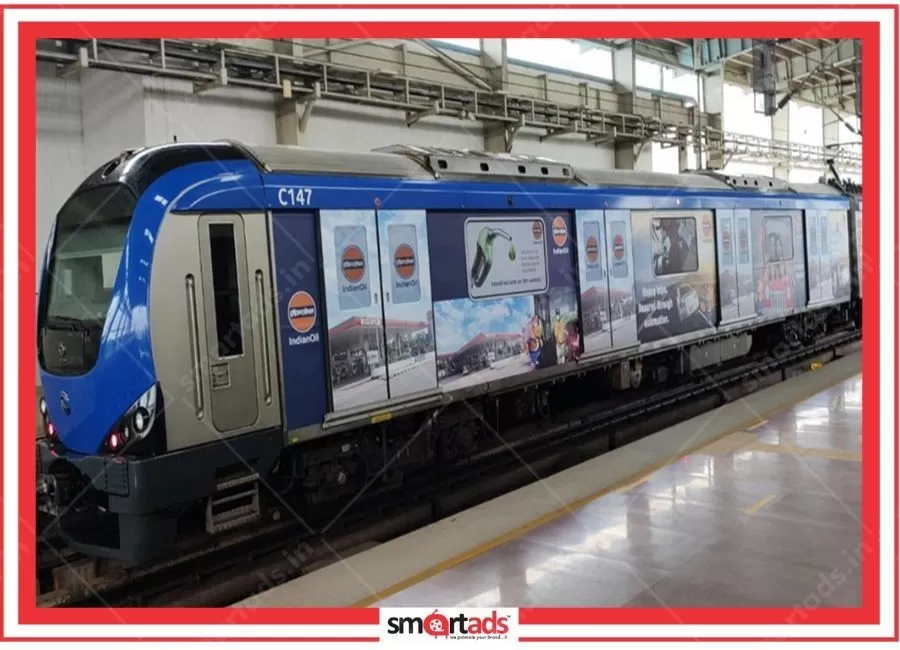
Exterior Metro Wrap
Size & Printing Cost as per actual
On the outside of metro Train, advertise
Rate per Metro Display Cost / 1 Month
Route:Baiyappanahalli To Kengeri
₹1000000.00
Showing 1 to 3 of 3 Results
MEDIA DETAILS
Size & Printing Cost as per actual
On the outside of metro Train, advertise
Rate per Metro Display Cost / 1 Month
Route:Baiyappanahalli To Kengeri
₹1000000.00
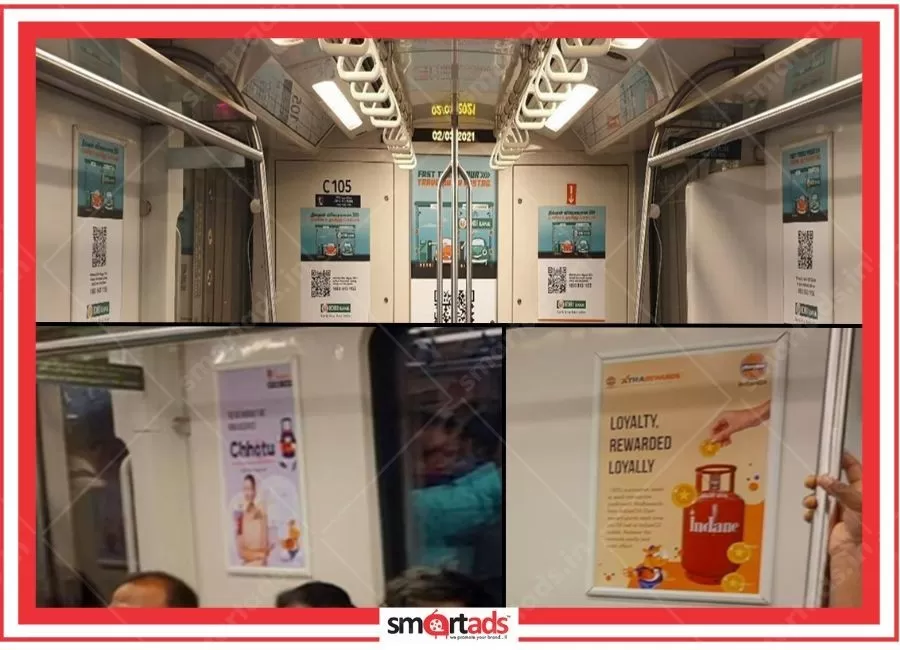
Size & Printing Cost as per actual
On the outside of metro Train, advertise
Rate per Metro Display Cost / 1 Month
Route:Baiyappanahalli To Kengeri
₹195000.00
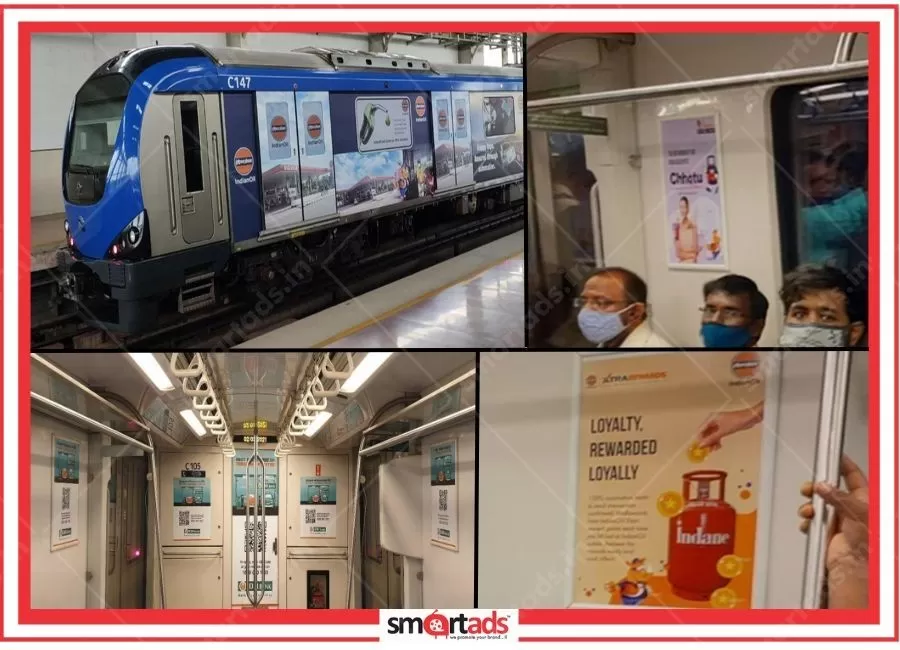
Size & Printing Cost as per actual
On the outside of metro Train, advertise
Rate per Metro Display Cost / 1 Month
Route:Baiyappanahalli To Kengeri
₹1500000.00
MEDIA REACH

MinimumQty :
1
EstimateReachPeople :
150000000
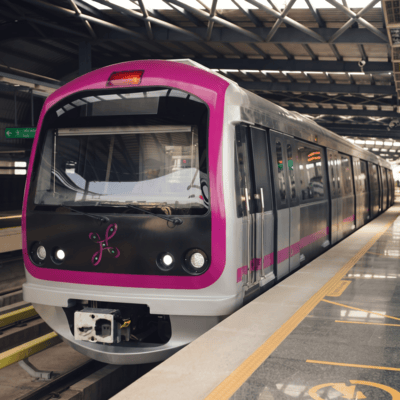
Fewer advertising formats in India put your brand inside a moving, air-conditioned room with 1,200 captive commuters for anywhere between 45 minutes and an hour — and the Namma Metro Purple Line does exactly that, twice a day, for every rider on the route. Most brands we speak to still think of metro train advertising as a premium-only play reserved for large national campaigns, which is frankly one of the more expensive misconceptions in BTL advertising today. The Purple Line, stretching from Whitefield to Challaghatta across 37 stations, is one of the most cost-efficient transit advertising channels in South India when you do the math on impressions per rupee spent.
Metro train advertising on the Bangalore Purple Line is, at its core, the practice of placing brand messaging on or inside the BEML rolling stock that operates along Namma Metro's East–West Corridor — which runs from Whitefield (Kadugodi) in the east through the central business district and all the way to Challaghatta in the west. The format encompasses everything from full exterior train wraps that transform an entire 6-coach rake into a moving billboard, to interior panel advertising on seat backs, door panels, overhead spaces, and window decals. What separates this from most other out-of-home advertising is the nature of the exposure: a commuter boarding at Whitefield metro station and alighting at MG Road metro station has no choice but to share space with your brand for roughly 40 to 45 minutes, which is a dwell time that no roadside hoarding, bus shelter, or digital banner can come close to matching.
The format sits firmly within the BTL advertising and non-traditional advertising categories, which is why it tends to be managed by transit media specialists rather than conventional OOH advertising buyers. BMRCL — the Bangalore Metro Rail Corporation Limited — governs all commercial advertising on the network through a structured non-fare revenue programme, which means that every advertisement on a Purple Line train has been reviewed, approved, and placed through an official process. At SmartAds, we always tell our clients that the regulatory structure here is actually an advantage, not a bureaucratic hurdle; because BMRCL maintains category exclusivity periods and controls clutter, your brand does not end up competing with five other advertisers on the same coach surface.
The distinction between metro train advertising and metro station advertising is worth making clearly, because the two are often conflated. Station advertising — which includes platform signage, escalator branding, concourse panels, and station domination packages — is a separate inventory from train advertising, and the two serve different strategic purposes. Train advertising follows the audience wherever the train goes, which means your brand travels through every station on the Purple Line corridor; station advertising, by contrast, is anchored to a specific location and reaches only the footfall at that particular stop. The most effective campaigns we have planned tend to combine both, but if a client has to choose one, the train format almost always delivers a lower cost per thousand impressions.
The daily ridership figures on the Namma Metro Purple Line are, frankly, more impressive than most advertisers expect when they first sit down with us to discuss transit advertising options. As of 2024–2025, the combined Namma Metro network was recording daily ridership in the range of 7 to 8 lakh passengers on peak operating days, and the Purple Line accounts for a disproportionately large share of that traffic because it connects Bangalore's two most commercially dense corridors — the IT belt around Whitefield, ITPL, and KR Puram in the east, and the retail and residential zones around Kengeri and Challaghatta in the west, with the central business district stations like MG Road metro station and Majestic metro station (Kempegowda) sitting in between. Industry projections tracked in the FICCI-EY Media and Entertainment Report suggest that metro ridership across Indian cities will continue to grow at double-digit rates through the Phase 3 metro expansion Bangalore is currently undertaking.
Each Purple Line train operates with 6 coaches and runs somewhere between 13 to 14 trips per day in each direction, covering the full corridor from 5 AM to 11 PM. If you work through the impressions math — and we do this for every client brief we receive — a single exterior train wrap on the Purple Line generates somewhere in the ballpark of 3 to 4 lakh visual impressions daily, accounting for both passengers inside the train and pedestrians, motorists, and bystanders at stations and level crossings who see the exterior. Interior train branding, which reaches only the passengers inside the coaches, generates a more modest but far more engaged audience; the captive audience inside a 6-coach train at peak hours is roughly 1,000 to 1,200 commuters per trip, which means a well-placed interior panel advertising campaign can accumulate over 15,000 to 20,000 engaged impressions per day on the Purple Line alone.
What a lot of people miss is that the impressions per day figure only tells part of the story. Brand recall rates from transit advertising tend to be significantly higher than equivalent OOH advertising formats because of the forced dwell time; research cited in the Dentsu e4m Digital Report and various transit media effectiveness studies suggests that commuter advertising in enclosed transit environments achieves ad recall rates of 60 to 70 percent, compared to 20 to 30 percent for roadside billboards. One FMCG client we worked with ran a 30-day interior train branding campaign on the Purple Line and reported a 34 percent uplift in aided brand recall among their target demographic — urban professionals aged 25 to 40 — in post-campaign surveys conducted at stations along the corridor.
The inventory of ad formats on Namma Metro Purple Line trains is broader than most first-time advertisers realise, and choosing the wrong format for your campaign objective is one of the more common mistakes we see brands make when they approach metro branding without specialist guidance. The flagship format is the full train wrap — sometimes called an exterior train wrap or vinyl wrap metro coach — which involves applying branded vinyl graphics to the entire exterior surface of a 6-coach rake, covering the sides, ends, and in some cases the roof panels visible from elevated sections of the track. The total exterior advertising surface on a full train wrap works out to approximately 5,300 sq ft of ad space, which makes it one of the largest single-format advertising canvases available in Bangalore, functioning as a moving billboard that travels through every station and neighbourhood on the corridor.
Interior train branding covers a different and arguably more intimate set of formats: seat back panel advertising, which places brand messaging at eye level for seated passengers; door wrap advertising on the internal coach doors; overhead panel displays in the luggage rack area; window decals that allow partial transparency; and full interior coach branding, which wraps the ceiling, walls, and floor of an individual coach in a single brand identity. A single coach interior offers roughly 400 sq ft ad space of brandable surface, which is substantial when you consider that the audience inside that coach is captive for the duration of their journey. On top of that, BMRCL also permits QR code metro ad integrations on interior panels, which allows brands to drive digital engagement directly from a static transit media placement — a capability that bridges the gap between BTL advertising and measurable digital response.
Beyond full-train and full-coach formats, there are also partial inventory options that make purple line advertising accessible to brands with more modest budgets. Single-panel placements, door sticker advertising, and overhead strip panels can be booked on a per-coach or per-panel basis, which is something we specifically recommend to startups and SMEs who want a presence on the Namma Metro Purple Line without committing to a full train wrap budget. The creative flexibility across these formats is considerable; we have seen everything from minimalist product launch campaigns using window decals to fully immersive brand experience coaches where every surface, including the floor, has been transformed into a brand environment. The format choice should always be driven by the campaign objective — awareness campaigns tend to favour exterior train branding for maximum reach, while engagement and conversion campaigns tend to perform better with interior formats that allow for longer copy, QR codes, and more detailed messaging.
Pricing is the section where most agency websites go vague, which we find frustrating on behalf of our clients because budget planning is impossible without actual numbers to work with. Metro advertising rates on the Bangalore Purple Line are structured around format, duration, and the number of coaches or trains booked, and they are governed by BMRCL's commercial rate card, which is periodically revised. Based on current market rates as of 2024–2025, a full exterior train wrap on the Purple Line — covering all 6 coaches — is priced somewhere in the range of ₹12 to ₹18 lakh per month, depending on the season, the specific train rake allocated, and whether the campaign includes production costs. That works out to a cost per day in the ballpark of ₹40,000 to ₹60,000 for a moving billboard that generates 3 to 4 lakh impressions, which gives you a CPM — cost per thousand impressions — of roughly ₹10 to ₹15; a number that surprises most first-time advertisers when they compare it to what they are paying for Instagram reach or programmatic display.
Interior train branding campaigns are priced differently, with advertising cost per month for a full coach interior wrap ranging from approximately ₹2.5 to ₹4 lakh per coach per month. A single coach interior branding campaign across a 30-day period therefore represents a relatively accessible entry point for brands that want the captive audience benefit of metro train advertising without the full train wrap investment. Individual panel placements — seat back panels, door wraps, overhead strips — are available at even lower price points, with individual panel advertising cost per month starting somewhere around ₹25,000 to ₹50,000 per panel depending on placement and coach position, which puts metro advertising within reach of local businesses, D2C brands, and startups operating in Bangalore.
Production costs — which cover the vinyl printing, lamination, and professional installation of the wrap or panels — are typically charged separately from the media space cost and generally add 15 to 25 percent to the total campaign budget. Campaign duration also affects the effective rate; BMRCL and its authorised vendors typically offer better rates for campaigns booked for 3 months or longer, and in our experience, a 90-day campaign on the Purple Line works out to roughly 20 to 30 percent cheaper on a per-day basis than a 30-day campaign. At SmartAds, we routinely negotiate multi-format bundle packages that combine train wrap with station domination and platform signage at the high-footfall stations like MG Road metro station and Majestic metro station, which typically delivers a 15 to 20 percent cost saving compared to booking each format independently.
This is a question we get asked in almost every briefing meeting, and the honest answer is that the right choice depends entirely on what you are trying to achieve — which sounds obvious but is surprisingly often ignored when brands default to the most visually dramatic option without thinking through the audience journey. A full train wrap is a mass awareness tool; it works because it is impossible to ignore, it generates brand visibility from outside the train as well as inside, and it turns the entire rake into a brand statement that travels through Bangalore's most commercially important corridor. The 5,300 sq ft ad space on a full exterior train wrap is genuinely spectacular when executed well, and for product launches, brand repositioning campaigns, or major seasonal pushes, the visual impact is hard to match with any other single BTL advertising format in Bangalore.
Interior train branding, on the other hand, is a precision engagement tool; it speaks to the captive audience inside the coach at close range, over an extended dwell time, which makes it far better suited to campaigns that require the audience to read, process, and act on information. A D2C brand running a QR code metro ad on seat back panels can drive app downloads, website visits, or coupon redemptions directly from the train; an educational institution advertising on door wrap advertising panels can communicate course details, eligibility criteria, and application deadlines in a way that a roadside hoarding simply cannot. We worked with an ed-tech client who ran a 45-day interior panel advertising campaign across 3 coaches on the Purple Line, targeting the Whitefield to MG Road corridor specifically because of the IT professional demographic; the campaign generated over 4,200 QR code scans, which translated into a cost per lead that was roughly 40 percent lower than their concurrent Google Search campaigns.
To be fair, the two formats are not mutually exclusive, and the most impactful campaigns we have planned on the Namma Metro Purple Line have used both simultaneously — exterior branding for reach and recognition, interior branding for engagement and conversion. If budget forces a choice, we generally recommend exterior train branding for brands that are new to the market or running a time-sensitive awareness campaign, and interior train branding for brands that have existing market awareness and need to drive a specific action. The campaign duration also matters here; exterior wraps tend to perform better over shorter, high-intensity periods of 30 to 45 days, while interior formats benefit from longer runs of 60 to 90 days because the cumulative exposure to regular commuters builds brand recall more effectively over time.
The demographic profile of Namma Metro Purple Line riders is one of the most compelling arguments for this channel, and it is also one of the most consistently underestimated aspects of purple line advertising in media planning conversations. The corridor runs directly through Bangalore's primary IT employment belt — from Whitefield metro station through ITPL, KR Puram, and Baiyappanahalli in the east — which means a significant proportion of daily riders are IT professionals Bangalore, software engineers, product managers, and tech sector employees who earn above-average salaries and make purchasing decisions across high-value categories including consumer electronics, financial services, automobiles, real estate, and premium FMCG. This is not an assumption; it is borne out by the station catchment areas and the employment density data around the eastern stations on the corridor.
IRS (Indian Readership Survey) and NCAER household consumption data consistently show that urban commuters using metro rail systems in Indian cities skew heavily towards the SEC A and SEC B socioeconomic classifications, with median household incomes significantly above city averages. On the Purple Line specifically, the concentration of IT and knowledge economy workers in the Whitefield to KR Puram stretch means that the captive audience in those coaches is, on average, younger, more digitally engaged, and more brand-conscious than the general Bangalore population. The age profile of Purple Line riders, based on station intercept surveys we have conducted for client briefs, tends to cluster between 22 and 42 years, with young professionals and dual-income households making up the majority of the peak-hour commuter base.
What makes this audience particularly valuable for advertisers is the combination of income profile, dwell time, and the absence of competing media during the journey. Unlike a car commuter who is listening to the radio or a bus passenger who is on their phone, a metro commuter in a crowded coach is frequently looking around — at the ceiling panels, the door wraps, the seat back panels — which is exactly where your brand messaging lives. One automotive brand we worked with specifically chose the Purple Line for a new SUV launch because the corridor's IT professional demographic matched their target buyer profile almost exactly; the campaign ran across 2 train rakes for 60 days and generated showroom enquiry volumes that the client attributed, in part, to the metro campaign based on post-visit surveys.
Not all 37 stations on the Purple Line are equal from an advertising perspective, and understanding the footfall hierarchy is essential for brands that want to combine train advertising with station-level formats like platform signage, escalator branding, and station domination packages. Majestic metro station — officially Kempegowda station — is consistently the highest-footfall interchange on the entire Namma Metro network, functioning as the transfer point between the Purple Line and the Green Line and serving as a gateway for commuters arriving from Bangalore's bus and rail terminals; daily footfall at Majestic routinely exceeds 80,000 to 1,00,000 passengers on working days, which makes it the single most valuable station for brand visibility on the network.
MG Road metro station is the second anchor station for advertisers, drawing high footfall from the commercial, retail, and hospitality districts of central Bangalore; brands in retail, fashion, F&B, and financial services consistently prioritise MG Road for station domination campaigns because the audience at this station includes a high proportion of shoppers, tourists, and business professionals rather than purely utilitarian commuters. On the eastern end of the corridor, Whitefield metro station, Baiyappanahalli station, and KR Puram are the key stations for reaching the IT corridor audience, with ITPL-adjacent stations drawing particularly high footfall during morning and evening peak hours. The Challaghatta extension, which opened as part of the western corridor expansion, has added new footfall at the Kengeri and Challaghatta end of the line, serving the rapidly growing residential catchments in west Bangalore.
At SmartAds, when we plan station-level campaigns to complement train advertising on the Purple Line, we typically recommend a tiered approach: anchor the campaign with a station domination or high-impact escalator branding package at Majestic metro station or MG Road metro station for maximum reach, add platform signage at the 3 to 4 IT corridor stations on the eastern end for audience precision, and use the train wrap to connect all these touchpoints into a single brand narrative that travels the full corridor. This multi-touchpoint strategy — which we have used successfully for clients in fintech, real estate, and consumer electronics — consistently outperforms single-format campaigns on both reach and brand recall metrics.
The Purple Line vs. Green Line question comes up in almost every metro advertising brief we receive, and the answer is more nuanced than most people expect. The Green Line — Namma Metro's North–South Corridor — runs from Nagasandra in the north to Silk Institute in the south, passing through Yeshwanthpur, Rajajinagar, Vidhana Soudha, and the central government district. The audience profile on the Green Line skews more towards government employees, students, and residential commuters from north and south Bangalore, whereas the Purple Line's east–west orientation through the IT corridor gives it a stronger concentration of private sector professionals, particularly in the technology and services industries. For brands targeting IT professionals Bangalore, fintech users, premium consumer goods buyers, and the startup ecosystem, the Purple Line almost always wins on audience quality.
On a pure reach basis, the two lines are broadly comparable in terms of daily ridership, though the Purple Line's longer corridor — 37 stations spanning the full width of the city — gives it a slight edge in total route coverage. The more important distinction for media planners is the nature of the journey: Purple Line commutes tend to be longer on average because the corridor spans a greater distance, which means higher average dwell time per commuter and therefore more exposure time for interior train branding. When we compare metro train advertising on the Purple Line against other BTL advertising and non-traditional advertising formats in Bangalore — auto-rickshaw branding, cab advertising, bus advertising, airport advertising — the metro format consistently delivers a lower CPM for a higher-quality, more captive audience.
Compared to traditional OOH advertising — billboards, bus shelters, unipoles — metro train advertising on the Purple Line offers a fundamentally different value proposition. A prime billboard on Outer Ring Road or Hosur Road might cost ₹3 to ₹6 lakh per month and generate high raw impressions, but the exposure is measured in seconds and the audience is not captive; a full train wrap on the Purple Line at a comparable or slightly higher monthly cost generates lower raw impressions but dramatically higher dwell time and brand recall. The FICCI-EY Media and Entertainment Report has consistently noted that transit media delivers superior brand recall per rupee compared to static OOH advertising, which aligns with what we observe in post-campaign measurement across our client portfolio. For brands where brand recall and message comprehension matter more than sheer reach volume — which is most brands, if they are honest about their objectives — the Purple Line is frequently the better investment.
Creative compliance is an area where first-time advertisers on the Namma Metro Purple Line frequently run into delays, and frankly, most of those delays are avoidable with proper preparation. BMRCL maintains a detailed set of creative and compliance guidelines for all advertising on the network, covering content restrictions, material specifications, and approval processes, which are administered through its authorised concessionaires and commercial partners. Content restrictions are broadly similar to those applied across Indian public transit systems: no political advertising, no content that could be deemed offensive or communally sensitive, no tobacco or alcohol advertising, and no content that violates the Cable Television Networks (Regulation) Act or the Advertising Standards Council of India (ASCI) guidelines. Beyond content, BMRCL also requires that exterior vinyl wrap materials meet specific fire-retardant and adhesive specifications to ensure passenger safety and ease of removal.
The creative submission process for a full exterior train wrap typically requires artwork files at a minimum resolution of 150 DPI at full scale, supplied in vector-based formats (AI or PDF) or high-resolution raster formats with bleed marks and colour profiles specified in CMYK. BMRCL's approval process for a new campaign generally takes somewhere between 7 to 14 working days from the submission of final artwork, which means that brands planning a campaign launch tied to a specific date — a product launch, a festival, a cricket season — need to factor in this approval window when planning their creative production timeline. We have seen campaigns miss their intended launch dates because the client underestimated the approval timeline; at SmartAds, we build a minimum 3-week buffer between final artwork submission and intended campaign launch for all metro advertising bookings.
The booking and creative approval process also involves a formal agreement with BMRCL or its authorised concessionaire, which includes indemnification clauses, removal obligations at the end of the campaign period, and provisions for damage to the rolling stock during installation or removal. Production partners must be approved by BMRCL and must carry out installation and removal during non-operational hours — typically between 11 PM and 5 AM — which adds a logistical dimension to the campaign that requires experienced transit media production partners. The metro advertising booking process for the Purple Line is not particularly complex once you understand the steps, but it is not as simple as booking a digital ad either; working with an advertising agency Bangalore that has existing relationships with BMRCL's commercial team and approved production partners significantly reduces the friction and the risk of delays.
The metro advertising booking process for the Purple Line follows a reasonably structured sequence, which we walk every new client through in detail before they commit budget. The first step is identifying the specific format, duration, and inventory you want to book — whether that is a full train wrap, a partial exterior, a single coach interior, or a combination of train and station formats — because the availability of specific rakes and coaches is limited and operates on a first-come, first-served basis. BMRCL works through authorised media concessionaires for commercial advertising on the network, and booking is done either directly through those concessionaires or through an advertising agency Bangalore that holds a working relationship with them; the latter route is almost always faster and more cost-effective because agencies can negotiate rates and bundle formats in ways that individual advertisers cannot.
Once the format and duration are confirmed and a booking agreement is signed, the creative production process begins in parallel with the BMRCL approval workflow. Artwork is submitted to BMRCL's commercial division for review, and any revisions requested — which in our experience typically involve minor adjustments to content or colour specifications rather than fundamental creative changes — need to be turned around quickly to avoid delaying the installation schedule. Installation is carried out by BMRCL-approved production teams during the maintenance window between 11 PM and 5 AM, and the campaign goes live the following morning when the rake enters service. Campaign duration for most Purple Line train advertising bookings starts at a minimum of 30 days, with 60-day and 90-day bookings being the most common; we rarely recommend anything shorter than 30 days because the frequency buildup needed to achieve meaningful brand recall simply does not happen in less time.
Post-booking, the campaign monitoring process involves periodic visual inspection of the installed formats to check for wear, peeling, or damage — particularly for exterior vinyl wraps, which are exposed to weather, cleaning, and the mechanical stresses of daily operation. BMRCL and the production partner are responsible for maintenance of the installed materials, but it is good practice for the advertiser or their agency to conduct monthly visual audits. At SmartAds, we assign a dedicated campaign manager to every metro advertising booking, who coordinates with the concessionaire and production team throughout the campaign period and provides the client with regular photographic documentation of the installed formats — something that sounds basic but is surprisingly rare in the transit advertising space.
ROI measurement is the question that every CFO asks and every media planner dreads, because transit advertising — like most OOH advertising — does not come with a native analytics dashboard. The honest position is that measuring ROI on metro train advertising requires a combination of proxy metrics, primary research, and digital integration, none of which are perfect on their own but which together give a reasonably reliable picture of campaign effectiveness. The most direct measurement approach is the QR code metro ad integration, where a unique QR code placed on interior panels drives traffic to a dedicated landing page or app store listing; this gives you a direct count of engaged responses, and while QR scan rates are not a complete measure of campaign impact, they provide a concrete lower-bound figure for active audience engagement.
Beyond QR codes, brand recall surveys conducted among Purple Line commuters before, during, and after a campaign are the most reliable method for measuring the awareness and recall impact of metro train advertising. These are typically conducted as station intercept surveys at 3 to 5 stations along the corridor, with sample sizes of 200 to 400 respondents per wave; the methodology is well-established in transit media research and is referenced in TAM AdEx and other industry measurement frameworks. One retail client we worked with on a 60-day Purple Line campaign — a premium apparel brand targeting the IT professional demographic — ran pre- and post-campaign brand recall surveys at Whitefield metro station, MG Road metro station, and Majestic metro station; the post-campaign survey showed a 28 percentage point increase in unaided brand awareness among the surveyed commuter population, which the client used to justify a 40 percent increase in their metro advertising budget for the following quarter.
Impressions-based ROI calculation, while less precise than recall surveys, is useful for budget justification and media mix comparison. The CPM for a full train wrap on the Purple Line — working out to roughly ₹10 to ₹15 per thousand impressions — compares favourably against most other premium OOH advertising and transit media formats in Bangalore, and dramatically so against airport advertising or premium digital display, where CPMs can run to ₹80 to ₹150 or more. The GroupM TYNY Report has consistently highlighted transit media as one of the fastest-growing and most cost-efficient segments of the Indian OOH advertising market, which aligns with the ROI metro advertising numbers we see in our own campaign portfolio. The key is to define your measurement framework before the campaign launches, not after — because retrofitting a measurement approach to a campaign that has already run is always less reliable than building it in from the start.
The Purple Line has hosted campaigns across a remarkably wide range of categories, which is itself a testament to the versatility of the format and the breadth of the audience it reaches. Among the most widely discussed campaigns in the transit advertising industry is the Spotify India Purple Line activation, which used a combination of exterior train branding and interior coach wraps to promote the platform's regional language content and podcast offerings; the campaign was notable for its creative use of the full interior coach space to create an immersive audio-brand environment, with QR codes linking to curated playlists, and it is frequently cited as a benchmark for how digital brands can use physical transit media to drive app engagement.
Beyond the Spotify case, the Purple Line has been used effectively by brands in real estate — particularly developers with projects in the Whitefield and east Bangalore corridor who use the train as a moving showroom reaching their exact target demographic on their daily commute — and by fintech and banking brands targeting the high-income IT professional audience. We ran a campaign for a Bangalore-based fintech startup that was launching a salary account product specifically targeting IT sector employees; the campaign used interior seat back panel advertising across 4 coaches on the Purple Line for 45 days, with QR codes driving to a dedicated landing page. The campaign generated over 6,000 QR code scans and approximately 1,800 completed account applications that were attributed to the metro campaign through UTM tracking, at a cost per acquisition that was significantly lower than the client's digital acquisition benchmarks.
A large consumer electronics brand — which we cannot name specifically but which operates in the premium smartphone segment — ran a full exterior train wrap campaign on the Purple Line timed to coincide with a new device launch, running for 30 days during the Diwali festive season. The campaign was complemented by station domination at MG Road metro station and escalator branding at Majestic metro station, creating a corridor-wide brand presence that the brand's marketing team described as the most impactful single-market activation they had run that year. The combination of the moving billboard effect of the exterior train wrap, the captive audience engagement of the interior branding, and the high-footfall station formats created a frequency and reach combination that their digital and print campaigns in the same period could not replicate at comparable cost.
Metro train advertising is the headline format, but the Namma Metro Purple Line ecosystem offers a much richer set of BTL advertising and non-traditional advertising options that most brands do not fully explore. Station domination — where a brand takes over the entire advertising inventory at a single station, including platform signage, concourse panels, entry gate branding, and escalator branding — is one of the most impactful formats available, and at stations like MG Road metro station or Majestic metro station, the footfall volumes make it genuinely competitive with premium OOH advertising locations in the city. A well-executed station domination at a high-footfall Purple Line station creates a brand environment that commuters walk through rather than simply observe, which produces a qualitatively different brand experience from any other format in the out-of-home advertising category.
Pillar branding, ticket counter branding, and floor graphics are additional non-traditional advertising formats available at Purple Line stations that tend to be overlooked in favour of the more prominent formats, but which offer excellent value for brands looking to maximise touchpoints within a fixed budget. These formats are particularly effective as frequency builders — a commuter who sees your exterior train wrap on the platform, walks past your pillar branding in the concourse, and encounters your floor graphic at the ticket counter has received three separate brand impressions in a single journey, which is a frequency level that is almost impossible to achieve through any other single-channel BTL advertising strategy. On top of that, the newly opened extensions at Challaghatta and the Whitefield end of the corridor have added fresh inventory at stations that are not yet as commercially saturated as the central stations, which means better availability and potentially better rates for brands willing to anchor their campaigns at the corridor's endpoints.
The question of digital out-of-home advertising on the Purple Line is worth addressing directly, because it is an area where Bangalore metro currently lags behind Delhi Metro and Hyderabad Metro, both of which have more extensive DOOH screen networks. DMRC's digital screen network, for instance, covers a significant proportion of its stations and trains, whereas BMRCL's digital screen inventory is more limited and concentrated at a smaller number of stations. This gap is not necessarily a disadvantage for advertisers; it means that static formats on the Purple Line face less competition from DOOH inventory, and the relative scarcity of digital screens actually increases the attention value of well-executed static branding. As phase 3 metro expansion Bangalore progresses and BMRCL expands its commercial inventory, DOOH availability will likely increase, but for now, the Purple Line's advertising landscape is predominantly static — which, for brands that invest in strong creative, is an opportunity rather than a limitation.
Q: What is metro train advertising on the Bangalore Purple Line?
Metro train advertising on the Bangalore Purple Line refers to the placement of brand advertising on the exterior and interior surfaces of the BEML rolling stock operating on Namma Metro's East–West Corridor, which runs from Whitefield (Kadugodi) to Challaghatta across 37 stations. It encompasses formats ranging from full exterior train wraps — which cover the entire 6-coach rake in branded vinyl graphics — to interior panel advertising on seat backs, doors, overhead panels, and windows. The format is classified as BTL advertising and transit advertising, and all placements are governed by BMRCL's commercial advertising programme. The defining characteristic that distinguishes it from other out-of-home advertising formats is the captive audience dynamic: commuters share enclosed space with the brand for the duration of their journey, which can range from 20 minutes to over an hour depending on their boarding and alighting stations.
Q: How many passengers travel on the Purple Line daily in 2025–2026?
The Namma Metro network as a whole was recording daily ridership in the range of 7 to 8 lakh passengers on peak days as of 2024–2025, with the Purple Line accounting for a substantial share of that total given its length and the density of employment and residential catchments along its corridor. Ridership is expected to continue growing through 2025–2026 as the phase 3 metro expansion Bangalore progresses and as awareness and adoption of the metro system increases among Bangalore's growing urban population. The eastern stations — particularly Whitefield metro station, ITPL, and KR Puram — see particularly high peak-hour volumes driven by the IT sector workforce, while central stations like MG Road metro station and Majestic metro station maintain high footfall throughout the day.
**Q: What ad formats are available for advertising on
