
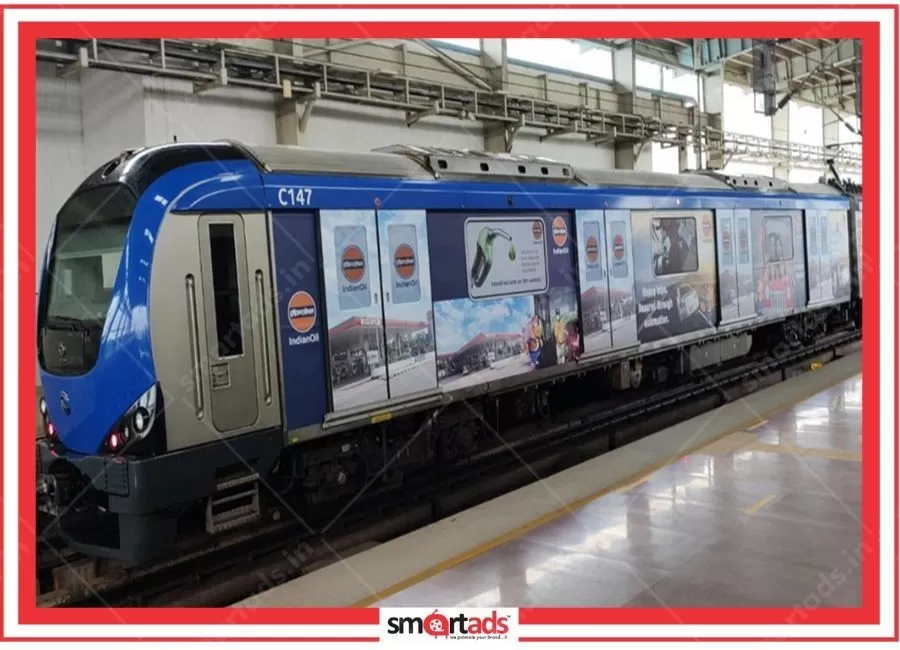
Exterior Metro Wrap
Size & Printing Cost as per actual
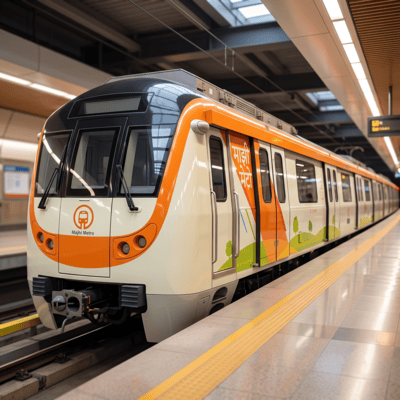
On the outside of metro Train, advertise
Rate per Metro Display Cost / 1 Month
Route:Sitabuldi To Khapri
₹1000000.00
Showing 1 to 4 of 4 Results
MEDIA DETAILS
Size & Printing Cost as per actual
On the outside of metro Train, advertise
Rate per Metro Display Cost / 1 Month
Route:Sitabuldi To Khapri
₹1000000.00
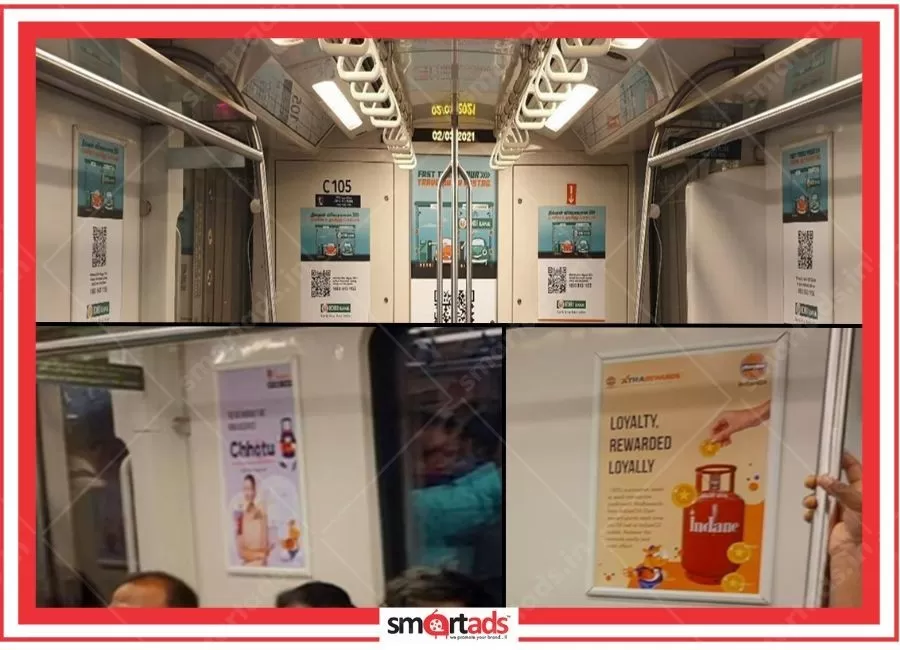
Size & Printing Cost as per actual
On the outside of metro Train, advertise
Rate per Metro Display Cost / 1 Month
Route:Sitabuldi To Khapri
₹500000.00
20 Sec Jingle
On the outside of metro Train, advertise
Rate per Metro Display Cost / 1 Month
Route:Sitabuldi To Khapri
₹400000.00
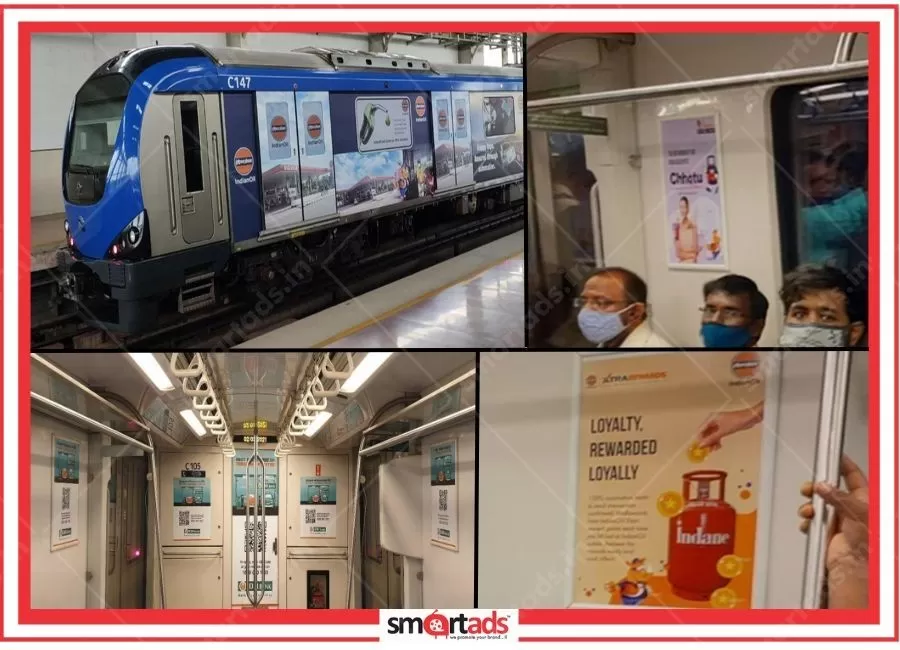
Size & Printing Cost as per actual
On the outside of metro Train, advertise
Rate per Metro Display Cost / 1 Month
Route:Sitabuldi To Khapri
₹1500000.00
MEDIA REACH

MinimumQty :
1
EstimateReachPeople :
150000000
Nagpur's Orange Line carries somewhere in the range of 65,000 to 80,000 daily commuters on its busiest days — a number that surprises most brand managers when they first hear it, especially those who still think of Nagpur as a secondary market. What makes this figure genuinely interesting for advertisers is not just the volume but the quality: these are largely working professionals, students, and middle-income households making a deliberate, recurring journey through one of central India's most commercially active corridors.
The thing is, metro train advertising in Nagpur Orange Line remains significantly underpriced relative to the attention it commands, which means early movers are still capturing brand recall at a fraction of what comparable formats cost in Mumbai or Pune.
Most people who ask this question are thinking about it too narrowly — they imagine a poster inside a train and leave it there. Metro train advertising on the Nagpur Orange Line is actually a spectrum of BTL advertising formats that spans everything from small seat-back panels inside a coach to a full train wrap that turns an entire rake into a moving billboard travelling across the entire north-south corridor of the city. The Orange Line, officially designated as Line 1 and operated under the authority of Nagpur Metro Rail Corporation Limited (NMRCL) in partnership with Maharashtra Metro Rail Corporation Limited (MAHA-METRO), runs approximately 19 kilometres from Automotive Square in the north to Khapri in the south, passing through 19 stations that cut through the commercial, educational, and residential heart of Nagpur, Maharashtra.
What distinguishes this medium from most other out-of-home advertising formats is the nature of the audience relationship. When someone walks past a hoarding on Wardha Road, your brand has perhaps three to five seconds of peripheral attention; when that same person steps into a metro coach, they are enclosed with your creative for an average of 15 to 25 minutes, which is a dwell time that very few non-traditional advertising formats can match. At SmartAds, we have found that this extended exposure window is the single most underappreciated advantage of transit media, and it is the reason why brand recall scores from metro train advertising consistently outperform static OOH formats in post-campaign studies.
The Orange Line is managed under a structured advertising policy by NMRCL, which means all campaign bookings, creative approvals, and installation timelines follow a defined process — a fact that actually works in the advertiser's favour because it ensures quality control and prevents the kind of clutter that degrades effectiveness on unregulated outdoor sites. Brands advertising here are essentially buying into a curated, premium transit environment, which is a positioning advantage that smart media planners in the Vidarbha region have started recognising over the last two to three years.
The range of formats available for orange line advertising is broader than most advertisers initially expect, and the choice between them depends heavily on campaign objectives rather than just budget. Interior train branding covers everything that lives inside the coach: seat-back panels that sit directly in a commuter's line of sight for the entire journey, grab handle branding which places your message on the overhead loops that standing passengers grip during transit, door panel advertising on the interior faces of coach doors, and window strip ads that run along the upper edge of windows — a format which tends to work particularly well for brands with a single strong visual or tagline rather than detailed copy.
Exterior train branding operates on an entirely different logic. A partial exterior wrap covers one or two sides of a coach and functions as a moving billboard that generates impressions not just among passengers but among pedestrians, motorists, and bystanders at every station and along every elevated section of the track. A full train branding or full train wrap takes this further by covering the entire exterior surface of a rake — typically six coaches — creating what is essentially a branded vehicle travelling the length of the city multiple times a day. We worked with a real estate developer in Nagpur on a full train wrap campaign during a pre-launch phase, and the client reported that their project enquiry volumes from the south Nagpur catchment area — which the Orange Line directly serves — increased by roughly 40% over the campaign period, which was something they had not seen from their hoarding-only strategy in previous launches.
Beyond these primary formats, there are supplementary options worth considering as part of an integrated transit media plan. Smart card advertising — branding on the NMRCL-issued travel cards — offers a hyperlocal advertising touchpoint that reaches regular commuters repeatedly, since the card is used at every entry and exit. Platform edge advertising and station-level formats can be combined with train-level formats to create a surround-sound brand experience across the entire commuter journey, from the moment a passenger enters the station to the moment they exit at their destination. Coach branding — where an entire coach interior is taken over by a single brand — represents the premium end of interior train branding and is particularly effective for brand awareness campaigns that need sustained, immersive exposure.
This is a question we get asked regularly, and the honest answer is that they serve fundamentally different purposes rather than being versions of the same thing. Interior train branding is a precision format: it reaches the people who are already inside the train, which means you are speaking to a confirmed captive audience of daily commuters who have nowhere else to look. The dwell time is high, the environment is controlled, and repeated exposure builds brand recall over time in a way that a single impression from an exterior format simply cannot replicate. Seat-back panels, grab handle branding, and door panel advertising all fall into this category, and they tend to work best for brands that need to communicate a message with some detail — a product feature, a service benefit, a QR code activation — because the audience has the time and the proximity to actually read and absorb the creative.
Full train branding, on the other hand, is a mass awareness play. When a train wrap is executed well, it generates impressions from an audience that is far larger than the ridership itself — everyone who sees the train at a station, everyone who watches it pass on an elevated section, everyone who photographs it and shares it on social media. The Nagpur Orange Line's elevated stretches through central and south Nagpur give a full train wrap exceptional visibility from surrounding roads and buildings, which amplifies the reach well beyond what the ridership numbers alone would suggest. The CPM for a full train wrap, when calculated against total impressions including pedestrian and motorist sightings, works out to somewhere in the range of ₹8 to ₹12, which is a number that tends to surprise clients who are used to paying ₹25 to ₹40 CPM for comparable reach on digital platforms.
The strategic recommendation we make at SmartAds is to treat these two formats as complements rather than alternatives. A brand that runs exterior train branding to build awareness among the general Nagpur population, while simultaneously running interior train branding to engage the daily commuter audience with a more detailed message, is effectively running two campaigns in one media buy — and the combined brand recall impact is measurably higher than either format in isolation. This is where the real value of metro train advertising in Nagpur Orange Line lies, and it is a strategy that most single-format buyers are currently missing.
Frankly speaking, this is the section that most advertisers skip to first, and we understand why — budget clarity is essential for any media planning conversation. Advertising rates for nagpur metro train advertising are structured by format, duration, and the number of coaches or units involved, and they are set by NMRCL with some flexibility for negotiated packages on longer campaigns. For interior train branding formats like seat-back panels, the entry-level cost works out to somewhere in the ballpark of ₹15,000 to ₹25,000 per coach per month, depending on the number of panels taken and the campaign duration; a full coach interior takeover — covering all seat-back panels, grab handles, and door panels in a single coach — is priced in the range of ₹40,000 to ₹60,000 per coach per month.
Exterior train branding carries a higher rate reflecting the broader reach it generates. A partial exterior wrap on one coach is typically priced somewhere between ₹50,000 and ₹80,000 per month, while a full train wrap covering all six coaches of a rake — which is what most high-visibility brand awareness campaigns opt for — is priced in the range of ₹3 lakh to ₹5 lakh per month, depending on the creative complexity and the installation requirements. These figures represent the media cost; production and installation charges are typically quoted separately and can add anywhere from 15% to 25% to the total campaign cost, which is something brands should factor into their initial budget planning rather than discovering at the final invoice stage.
The minimum booking duration for most orange line advertising formats is 30 days, though NMRCL does offer shorter campaign windows for festival-specific activations — Ganapati and Diwali periods, for instance, see higher demand and are often booked months in advance. For brands exploring nagpur metro advertising cost for the first time, we generally recommend a 60-day interior train branding campaign as the entry point, because 30 days is often not enough to build the repeated exposure that drives meaningful brand recall among daily commuters. One edtech brand we worked with in Nagpur started with a 30-day seat-back panel campaign, saw modest results, extended to 90 days, and reported a 3x improvement in unaided brand awareness scores among their target demographic of college-going students in the south Nagpur catchment — which is a pattern we have seen repeat across multiple categories.
The north-south corridor nagpur represents something genuinely unusual in the Indian tier-2 city advertising landscape: a linear, high-frequency transit route that connects the airport zone in the south with the commercial and industrial north, passing through the absolute centre of the city at Sitabuldi interchange station. This geographic reality means that a single train on the Orange Line passes through every major demand cluster in Nagpur — airport travellers, CBD office workers, residential commuters, college students, and retail shoppers — in a single 35-minute journey, which no other single OOH advertising format in the city can claim.
The Vidarbha region has historically been underserved by premium advertising infrastructure; most national brands allocate budgets to Mumbai, Pune, and Hyderabad first, treating Nagpur as an afterthought despite its status as a major commercial, political, and logistics hub. This underinvestment creates an opportunity for brands willing to move early — the competitive clutter on the Orange Line is still significantly lower than on metro systems in larger cities, which means your creative gets more uncontested attention from daily commuters. The FICCI-EY Media and Entertainment Report has consistently flagged tier-2 city transit media as one of the fastest-growing segments in Indian OOH advertising, and Nagpur specifically is cited as a high-growth market given the metro network's expansion trajectory.
On top of that, the Orange Line's ridership profile skews towards exactly the demographics that most brand managers are trying to reach: working professionals between 22 and 45 years of age, students from the numerous colleges along the corridor, and middle-income households that are actively making consumption decisions across categories from BFSI to real estate to consumer electronics. This is not a captive audience of reluctant commuters — these are aspirational, digitally active urban consumers who are receptive to brand messaging in a way that makes transit advertising in Nagpur genuinely effective as a brand awareness campaign vehicle.
The station-level audience profile on the Orange Line varies considerably from one end to the other, and what a lot of people miss is that the "best" station for your campaign depends entirely on who your target audience is rather than which station has the highest footfall. Sitabuldi interchange station sits at the commercial heart of Nagpur, Maharashtra, serving as the transfer point between the Orange Line and the Aqua Line; it draws the highest daily footfall of any station on the network and is the obvious choice for brands targeting the broadest possible cross-section of Nagpur's urban population. Kasturchand Park station and Chhatrapati Square station, both in the central corridor, serve a mix of office workers, shoppers, and government employees — a demographic that skews older and more financially established, which makes these stations particularly relevant for BFSI advertising and real estate advertising nagpur.
Khapri station at the southern terminal is adjacent to Nagpur's Dr. Babasaheb Ambedkar International Airport, which gives it a unique audience profile: business travellers, airport staff, and the residential population of south Nagpur, which has seen significant real estate development over the last decade. Brands in the hospitality, automotive, and premium consumer goods categories have found Khapri-adjacent placements particularly effective for reaching high-income travellers. Automotive Square station at the northern terminal, as its name suggests, sits in a zone with significant automotive retail and industrial activity, making it a natural fit for automotive brands, industrial equipment companies, and B2B advertisers targeting the manufacturing sector.
Indora Square station and Nari Road station serve a more mixed residential and light-industrial catchment in the northern section of the line; commuter demographics here tend towards working-class and lower-middle-income households, which makes these stations well-suited for mass-market FMCG brands, telecom advertisers, and healthcare advertising transit campaigns targeting a high-volume, price-sensitive audience. At SmartAds, we always tell our clients that a station-specific strategy — where the creative message is calibrated to the audience profile of each station cluster — consistently outperforms a one-size-fits-all placement, and the Orange Line's geographic diversity makes this kind of hyperlocal advertising approach both practical and measurably effective.
The honest answer is that almost any consumer-facing brand with a Nagpur presence can find a relevant audience on the Orange Line, but some categories have a structural advantage that makes metro train advertising in Nagpur Orange Line a particularly strong fit. Real estate developers in Nagpur — and there are many, given the city's status as a government-designated smart city and the ongoing development around the MIHAN special economic zone — have been among the earliest and most consistent advertisers on the network, because the corridor directly connects the residential growth zones in south Nagpur with the employment centres in the north and centre. A full train wrap for a residential project launch creates the kind of city-wide brand visibility that used to require a multi-site hoarding campaign at three to four times the cost.
BFSI brands — banks, insurance companies, mutual fund distributors, and fintech brand advertising players — benefit from the Orange Line's working professional ridership in a very specific way: these are people who are actively managing their finances, often on their smartphones during the commute, and a well-placed interior train branding campaign with a QR code or a short URL can bridge the gap between offline awareness and online conversion in a way that a hoarding simply cannot. We have seen this work particularly well for a private sector bank that ran a seat-back panel campaign promoting a savings account product; the QR code on the panel drove a measurable spike in app downloads from Nagpur PIN codes during the campaign period, which gave the client a direct attribution metric they could present to their marketing leadership.
Edtech advertising, OTT platform branding, healthcare brands, and consumer electronics companies have all found the Orange Line's student and young professional demographic to be highly responsive. For SMBs and startups in Nagpur — a category that most metro advertising agencies overlook in favour of national brands — the entry-level interior train branding formats offer a genuinely accessible price point for building brand awareness in a specific geographic corridor. An advertising agency nagpur that understands the local market can help smaller brands identify the right format and station cluster to maximise impact within a limited budget, which is something we at SmartAds have built specific packages around for the Nagpur market.
The booking process for metro train advertising nagpur runs through NMRCL's authorised advertising concessionaires, which means brands and agencies need to work either directly with the concessionaire or through a registered media buying agency that has an established relationship with the operator. The process begins with a campaign brief — format selection, duration, station or coach preferences, and creative specifications — which is then submitted for availability check and rate confirmation. NMRCL's advertising policy requires all creatives to be approved before production begins, which adds a step to the timeline that first-time advertisers sometimes underestimate; we generally advise clients to build in at least two weeks for creative approval and another week for installation, which means the effective lead time from brief to live campaign is typically three to four weeks.
Production of the physical materials — vinyl wraps for exterior train branding, printed panels for interior formats — is handled by approved vendors who understand the specific material requirements and installation protocols for NMRCL's rolling stock. The material specifications matter more than most clients initially appreciate: the wrong vinyl grade or adhesive can cause installation failures or damage to the coach surface, which creates liability issues and campaign delays. For a full train wrap, the artwork needs to be supplied at extremely high resolution — typically in the range of 300 DPI at actual size — and must account for the coach's dimensional constraints including windows, doors, and ventilation panels, all of which need to be mapped accurately in the design.
At SmartAds, our campaign execution process includes a pre-installation site inspection and a post-installation quality check, both of which are steps that smaller or less experienced agencies sometimes skip in the interest of speed. We have seen this backfire when a client's full train wrap was installed with misaligned panels across coaches, which diluted the visual impact of what should have been a striking brand statement. The investment in getting the execution right is small relative to the media cost, and it is the difference between a campaign that generates the brand visibility it was designed to deliver and one that simply occupies space.
This is a comparison that comes up in almost every media planning conversation we have about Nagpur, and the truthful answer is that it depends on what you are trying to achieve — but metro train advertising wins on specific metrics that matter a great deal for brand building. On pure reach, a large-format hoarding on a major arterial road in Nagpur can generate daily impressions in the range of 50,000 to 1,00,000, depending on location and traffic density; a full train wrap on the Orange Line generates comparable impressions but with a fundamentally different quality of exposure, because a significant portion of those impressions come from daily commuters who see the same creative repeatedly over the campaign period. Repeated exposure is the mechanism through which brand recall is built, and it is something that a static hoarding, which generates single-impression contacts, cannot replicate.
Against digital advertising, the comparison is more nuanced. Digital platforms offer targeting precision and measurable click-through data that out-of-home advertising formats cannot match; however, the advertising ROI metro format delivers on brand awareness metrics — particularly unaided recall and brand association — tends to be significantly higher than digital display formats, which are increasingly subject to ad fatigue, banner blindness, and ad-blocking. The TAM AdEx data on transit media effectiveness consistently shows higher brand recall rates for metro advertising compared to digital display, particularly among audiences in the 25 to 45 age bracket. What we tell our clients is that the most effective campaigns are not choosing between metro and digital but combining them: run the metro train advertising to build top-of-mind awareness among the Orange Line's daily commuter base, then use digital retargeting to convert that awareness into action among the same audience online.
The phygital approach — where a QR code or a short URL on the interior train branding creative drives commuters to a landing page, a product demo, or an app download — is something we have been building into our Nagpur metro campaigns with increasing frequency, and the results are consistently better than either medium in isolation. One fintech brand advertising client we worked with ran a 60-day interior coach branding campaign with a QR code activation; the campaign generated over 4,200 QR scans from Nagpur users, which translated into a cost-per-acquisition that was roughly 35% lower than their existing digital-only campaign targeting the same city.
The two metro lines in Nagpur serve genuinely different geographic and demographic corridors, and the choice between them — or the decision to run on both — should be driven by audience mapping rather than availability or price. The Orange Line (Line 1) runs north-south, connecting Automotive Square to Khapri, and its catchment is characterised by a mix of commercial, residential, and airport-adjacent zones; it is the longer and more established of the two lines, with higher daily ridership and a more diverse commuter profile. The Aqua Line (Line 2) runs east-west, connecting Prajapati Nagar to Lokamat Square (Hingna), and its catchment skews more heavily towards the western residential and industrial belt of Nagpur.
For brands targeting the broadest urban cross-section of Nagpur, Maharashtra — which is what most FMCG, BFSI, and consumer electronics campaigns need — the Orange Line is the stronger single-line choice, primarily because Sitabuldi interchange station sits at its centre and draws passengers from both lines, giving Orange Line advertisers access to a portion of the Aqua Line audience as well. For brands with a specific geographic focus — a real estate developer with a project in the western suburbs, for instance, or a healthcare brand with clinics along the east-west corridor — the Aqua Line may be the more efficient buy. The advertising rates nagpur metro for the Aqua Line tend to be slightly lower than the Orange Line, reflecting the lower ridership, which makes it an interesting option for brands with tighter budgets who want the transit media format without the premium pricing.
The most effective campaigns we have planned for clients in Nagpur have used both lines in a coordinated strategy: Orange Line for the primary awareness push, with Aqua Line as a secondary reinforcement layer in specific catchment zones. This approach delivers city-wide coverage at a combined cost that is still significantly lower than a comparable multi-site hoarding campaign, and the transit advertising format's captive audience advantage applies equally to both lines. For brands entering the Nagpur market for the first time, we typically recommend starting with the Orange Line given its higher ridership and the commercial significance of its station cluster, then evaluating Aqua Line expansion after the first campaign cycle.
Creative specifications for metro train advertising on the Nagpur Orange Line are more technical than most advertisers initially expect, and getting them wrong at the design stage creates expensive delays. For interior train branding formats, seat-back panels are typically sized at 210mm x 297mm (A4) or 297mm x 420mm (A3), depending on the coach model; the artwork must be supplied as a high-resolution PDF or TIFF file at a minimum of 300 DPI, with a 3mm bleed on all sides and all fonts embedded or converted to outlines. Grab handle branding involves a wraparound design that accounts for the cylindrical geometry of the handle, which requires a specific template that the installation vendor provides — designing without this template almost always results in misaligned artwork.
For exterior train branding and full train wrap formats, the dimensional requirements are considerably more complex. A standard NMRCL coach is approximately 22 metres long and 3.2 metres high, and a full train wrap artwork file — accounting for windows, doors, ventilation panels, and coach joints — can run to several gigabytes in its final production-ready form. The artwork is typically supplied as layered vector files (AI or EPS) with a separate raster overlay for photographic elements, and the colour profile must be specified for large-format print output rather than screen display, which means CMYK rather than RGB and careful attention to how colours shift between screen and vinyl. We always recommend that clients have their creative agency work from the official NMRCL coach template rather than estimating dimensions from photographs, because even small dimensional errors become very visible at full scale.
The material specifications for exterior wraps are equally important: NMRCL requires the use of approved cast vinyl grades with a specific minimum thickness and UV resistance rating, because the trains operate in Nagpur's intense summer heat — which regularly exceeds 45°C — and inferior materials degrade visibly within weeks. The approval process for exterior creatives includes a review by NMRCL's technical team to ensure the design does not obscure safety markings, emergency exit indicators, or operational signage, which means any creative that places key visual elements in these zones will be sent back for revision. Building these constraints into the brief at the outset, rather than discovering them during the approval stage, is something a good metro advertising agency will do as a matter of course.
Brand recall from metro train advertising consistently outperforms most other OOH advertising formats in post-campaign research, and the mechanism is straightforward: repeated exposure over a sustained campaign period creates memory encoding that a single-impression format simply cannot achieve. Studies referenced in the FICCI-EY Media and Entertainment Report have shown that transit advertising formats generate unaided brand recall rates in the range of 35% to 55% among regular users of the network, which compares favourably to the 15% to 25% unaided recall typically reported for roadside hoardings in comparable markets. The dwell time advantage of interior train branding — where a commuter is physically enclosed with the creative for 15 to 25 minutes — is the primary driver of this differential.
The advertising ROI metro calculation for the Orange Line looks particularly strong when you account for the frequency multiplier: a daily commuter who uses the Orange Line five days a week will see an interior train branding creative somewhere between 20 and 40 times over a 30-day campaign, which is a frequency level that would cost significantly more to achieve through digital advertising and is essentially impossible to replicate through static OOH formats. High-frequency impressions of this kind are what drive the shift from awareness to consideration in the consumer decision journey, and it is the reason why brands that run longer campaigns on the Orange Line consistently report better conversion outcomes than those that run short bursts. Our experience shows that 60 to 90 days is the sweet spot for most brand awareness campaigns on the Orange Line, because it allows enough time for the frequency effect to build while remaining within a budget envelope that most mid-sized brands can justify.
To be fair, metro train advertising is not a direct-response medium in the traditional sense — you are not going to see the same immediate click-through attribution that a search ad delivers. But for brand awareness campaign objectives, for category entry in a new market, and for sustained share-of-mind building among a defined commuter demographic, the advertising ROI metro format delivers is genuinely competitive with any other medium available in Nagpur. One automotive brand we worked with ran a 90-day exterior train branding campaign on the Orange Line ahead of a new model launch; their post-campaign brand tracking showed a 28-point increase in unaided awareness among Nagpur consumers, which the client's research team attributed primarily to the metro campaign given that no other significant media activity was running in the city during that period.
Q: What is metro train advertising on the Nagpur Orange Line?
Metro train advertising on the Nagpur Orange Line refers to the placement of brand communications across various formats on the trains and stations of Line 1 (the north-south corridor) of the Nagpur Metro, operated by NMRCL under the Maharashtra Metro Rail Corporation Limited (MAHA-METRO) framework. This includes interior formats such as seat-back panels, grab handle branding, door panel advertising, and window strip ads, as well as exterior formats including partial coach wraps and full train branding that turn entire rakes into moving billboards. It is classified as a BTL advertising and transit media format, and it is increasingly recognised as one of the most cost-effective brand visibility tools available in the Nagpur, Maharashtra market.
Q: How much does it cost to advertise on the Nagpur Orange Line metro train?
Nagpur metro advertising cost varies by format and duration. Interior train branding formats like seat-back panels start at roughly ₹15,000 to ₹25,000 per coach per month; full coach interior takeovers run in the range of ₹40,000 to ₹60,000 per coach per month. Exterior partial wraps are priced somewhere between ₹50,000 and ₹80,000 per coach per month, while a full train wrap covering all six coaches of a rake typically costs in the ballpark of ₹3 lakh to ₹5 lakh per month. Production and installation costs are additional and typically add 15% to 25% to the total. For a customised campaign quote based on your specific objectives and budget, reaching out to a registered metro advertising agency like SmartAds is the most efficient starting point.
Q: What advertising formats are available on the Nagpur Orange Line metro?
The available formats span interior and exterior placements across the train and station environments. Interior train branding options include seat-back panels, grab handle branding, door panel advertising, window strip ads, and full coach branding (a complete interior takeover of a single coach). Exterior formats include partial exterior wraps on individual coaches and full train branding that covers the entire exterior of a rake. Station-level formats — platform edge advertising, concourse panels, and entry/exit gate branding — are available as supplementary placements. Smart card advertising is also available as a hyperlocal advertising add-on for brands targeting frequent commuters specifically.
Q: How many stations does the Nagpur Orange Line cover and which are best for advertising?
The Orange Line covers 19 stations across its approximately 19-kilometre north-south corridor, running from Automotive Square in the north to Khapri in the south. The highest-footfall station is Sitabuldi interchange station, which serves as the transfer point between the Orange Line and the Aqua Line and draws the broadest cross-section of Nagpur's commuter population. Kasturchand Park station and Chhatrapati Square station are strong choices for BFSI and retail brands targeting central Nagpur's office-going population. Khapri station is valuable for brands targeting business travellers and the south Nagpur residential market, while Indora Square station and Nari Road station serve the northern residential and industrial catchment. The best station cluster for any given campaign depends on the brand's target audience geography.
Q: What is the difference between interior train branding and a full train wrap on the Nagpur Orange Line?
Interior train branding targets passengers already inside the coach, using formats like seat-back panels, grab handles, and door panels to deliver a message with high dwell time and repeated exposure to daily commuters. A full train wrap is an exterior format that covers the entire outer surface of a rake's six coaches, functioning as a moving billboard that generates impressions from pedestrians, motorists, and bystanders along the entire route — not just from passengers. The two formats serve different objectives: interior train branding builds deep brand recall among the commuter audience through repeated exposure, while full train branding maximises broad reach and brand visibility across the general Nagpur population. The most effective campaigns use both in combination.
Q: Who are the best metro train advertising agencies for the Nagpur Orange Line?
Several agencies operate in this space, including SmartAds.in, which works across 500+ Indian cities and has specific experience with Nagpur Orange Line campaigns across multiple categories. Other agencies active in the Nagpur metro advertising space include The Media Ant, Excellent Publicity, Eumaxindia, and Acme Advertiser. When evaluating an advertising agency nagpur for metro train advertising, the key criteria are: an established relationship with NMRCL's advertising concessionaire, experience with large-format production and installation, and the ability to handle the creative approval process efficiently. An integrated agency that can combine metro train advertising with digital retargeting will deliver stronger campaign outcomes than one that handles only the physical media placement.
Q: How many daily commuters does the Nagpur Orange Line metro train carry?
The Nagpur Orange Line carries an estimated 65,000 to 80,000 daily commuters on peak days, with ridership growing consistently since the network reached full operational status. Commuter demographics nagpur skew towards working professionals between 22 and 45 years of age, college students, and middle-income households in the north-south residential and commercial belt. Peak hours are typically 8 AM to 10 AM and 5 PM to 8 PM on weekdays, with a different but still significant ridership pattern on weekends driven by retail and leisure travel. The ridership is projected to grow as Nagpur's urban population expands and as the metro network extends further into the city's periphery.
Q: Is metro train advertising on the Nagpur Orange Line suitable for small businesses?
Yes — and this is something that the larger metro advertising agencies tend not to emphasise because their business model favours national brand clients. The entry-level interior train branding formats on the Orange Line are accessible to SMBs and local businesses at price points starting in the range of ₹15,000 to ₹25,000 per month, which is comparable to or lower than a mid-tier hoarding in a prime Nagpur location. For a local coaching institute, a regional healthcare brand, or a Nagpur-based fintech startup, a targeted seat-back panel campaign on a specific section of the Orange Line can deliver hyperlocal advertising reach to a highly relevant audience at a cost that fits within a modest marketing budget. The key is working with an agency that understands how to structure a small-budget campaign for maximum impact rather than simply selling the minimum available unit.
Q: How long should a metro train advertising campaign run on the Nagpur Orange Line for best results?
The minimum booking duration is typically 30 days, but our experience consistently shows that 60 to 90 days is the optimal campaign length for building meaningful brand recall among daily commuters. The frequency effect — where a commuter sees the same creative 20 to 40 times over a month — is what drives the shift from awareness to consideration, and this effect takes time to accumulate. For a product launch or a festival campaign (Ganapati, Diwali, or a major local event in Nagpur), a focused 30-day burst can be effective if the creative is strong and the format is high-impact. For brand-building objectives or market entry campaigns, 90 days is the minimum we recommend to clients who want to see measurable movement in brand awareness metrics
