
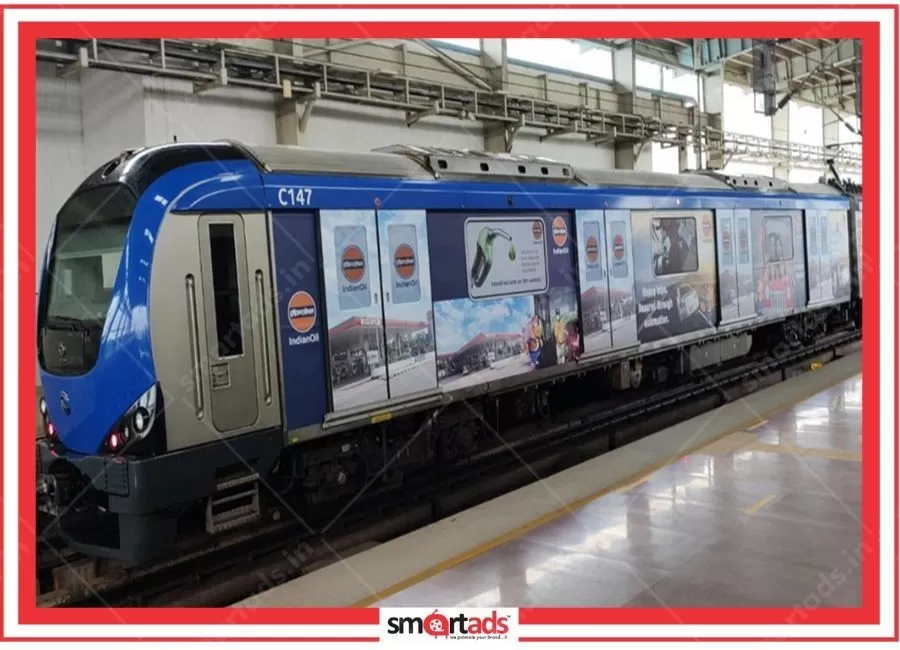
Exterior Metro Wrap
Size & Printing Cost as per actual
On the outside of metro Train, advertise
Rate per Metro Display Cost / 1 Month
Route:Mansarovar To Chandpole
₹1500000.00
Showing 1 to 3 of 3 Results
MEDIA DETAILS
Size & Printing Cost as per actual
On the outside of metro Train, advertise
Rate per Metro Display Cost / 1 Month
Route:Mansarovar To Chandpole
₹1500000.00
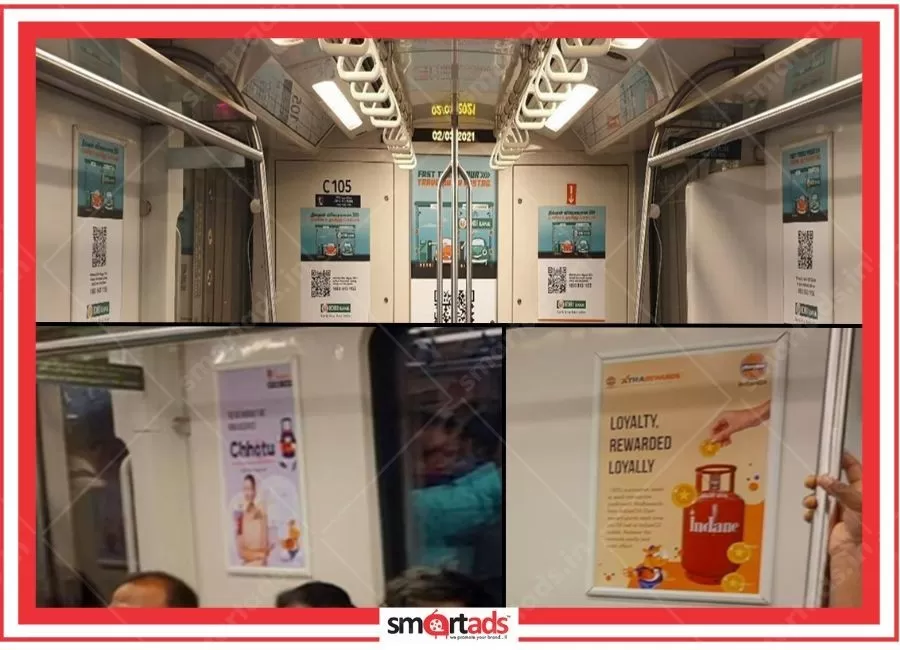
Size & Printing Cost as per actual
On the outside of metro Train, advertise
Rate per Metro Display Cost / 1 Month
Route:Mansarovar To Chandpole
₹300000.00
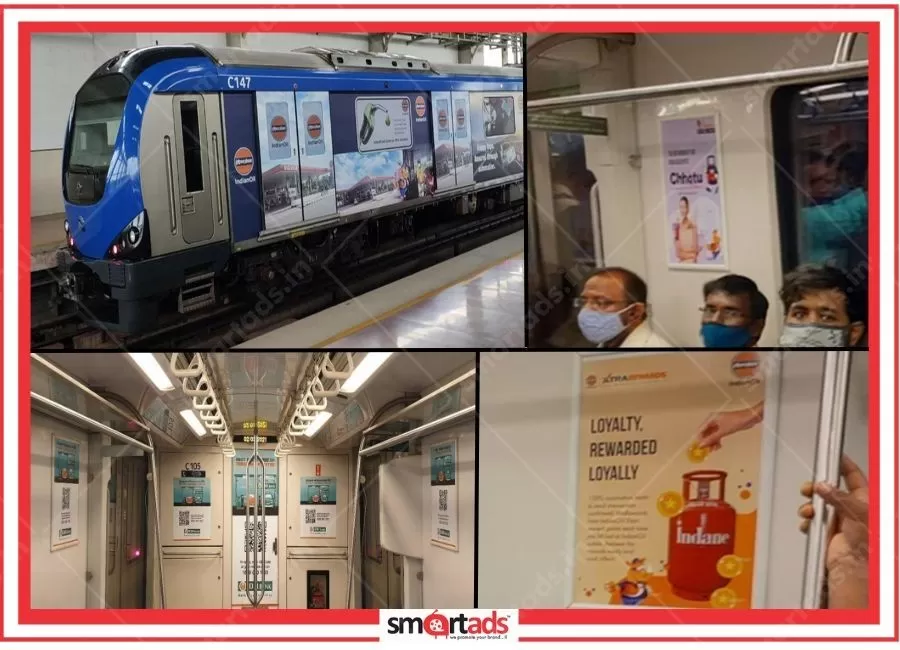
Size & Printing Cost as per actual
On the outside of metro Train, advertise
Rate per Metro Display Cost / 1 Month
Route:Mansarovar To Chandpole
₹1500000.00
MEDIA REACH

MinimumQty :
1
EstimateReachPeople :
150000000
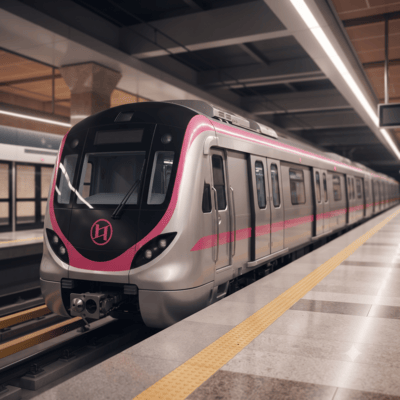
Jaipur's metro has quietly become one of the most underestimated advertising environments in the country — a captive, upwardly mobile audience moving through the heart of a city that added over 4 lakh new registered vehicles last year, which tells you something important about who is choosing to take the train instead.
The Pink Line, in particular, carries a passenger profile that most outdoor media in Jaipur simply cannot replicate: salaried professionals, college students, and daily commuters who dwell inside a clean, air-conditioned environment for anywhere between twelve and thirty-five minutes, with nowhere else to look. That kind of attention is genuinely rare, and frankly speaking, most brands in this market have not yet figured out how to use it properly.
The Pink Line — officially Phase 1B of the Jaipur Metro — runs from Mansarovar in the west to Badi Chaupar in the old city, passing through some of the most commercially significant corridors in Rajasthan's capital. Stations like Civil Lines, Sindhi Camp, and Chandpole sit at intersections of retail density, institutional footfall, and residential catchment that most media planners would find genuinely exciting if they mapped them properly. The line connects the newer residential and commercial zones of Mansarovar and Shyam Nagar with the dense commercial heart around Badi Chaupar, which means a single campaign running across the full corridor touches both the aspirational new-Jaipur consumer and the traditional trade-oriented old-city buyer.
What a lot of people miss is that the Pink Line's ridership skews differently from what you might expect of a Tier 2 metro system. DMRC-style ridership data from Jaipur Metro Rail Corporation shows consistent growth in daily ridership post-pandemic, with the system carrying somewhere in the range of 40,000 to 55,000 passengers on weekdays — a number which, when you break it down by station-level dwell time and platform exposure, translates into a remarkably cost-efficient reach figure for any brand willing to think beyond traditional hoardings. The stations at Sindhi Camp and Civil Lines, being interchange-adjacent and high-footfall nodes, generate disproportionately higher exposure than their raw ridership numbers suggest.
At SmartAds, we always tell our clients that the real value of metro advertising is not just the number of eyeballs — it is the quality of the environment in which those eyeballs encounter your brand. A commuter standing on a Jaipur Metro platform is not distracted by traffic, not squinting at a billboard from a moving car, and not scrolling past your ad in two seconds. The dwell time on platforms averages somewhere between four and nine minutes depending on the station, which gives even a static panel the kind of repeated exposure that outdoor media on NH-48 simply cannot guarantee.
The inventory available across the Jaipur Metro Pink Line spans several distinct formats, each with its own reach mechanics and audience interaction pattern. Train wraps — where the exterior of a rake is fully or partially branded — are arguably the most dramatic format available; a fully wrapped train moving through Jaipur's streets and elevated sections becomes a moving billboard that generates impressions not just inside the system but across every road-level crossing and pedestrian zone it passes through. Station branding, which includes platform panels, concourse displays, entry gate wraps, and ticket counter surrounds, works differently — it builds frequency with the same commuter audience over days and weeks rather than generating one-time mass reach.
Inside the coaches, the formats break down further into overhead panels, door panels, grab-handle danglers, and floor graphics — each of which occupies a different part of the commuter's visual field during the journey. Overhead panels, for instance, are read during standing commutes when passengers are looking for something to rest their eyes on; door panels get noticed during boarding and alighting when attention is naturally directed forward. A retail client we worked with in Jaipur — a mid-sized apparel chain expanding from three stores to seven — used a combination of door panels and concourse backlit displays across four stations, and over a six-week campaign period, they tracked a measurable uptick in footfall at their Sindhi Camp and Tonk Road outlets, which they attributed in part to the station-proximity branding reinforcing their OOH campaign running simultaneously on the arterial roads outside.
Digital screens are also now part of the Pink Line's station environment, particularly at the higher-footfall stations, which opens up the possibility of dynamic content — time-of-day messaging, promotional countdowns, and event-triggered creative — that static panels cannot deliver. The thing is, most brands still book static formats because they are more familiar, but the dynamic screen inventory on Jaipur Metro is genuinely underpriced relative to comparable digital OOH in Delhi or Mumbai, and we have found that clients who experiment with it early tend to lock in better rates before the inventory gets more competitive.
This is the question every brand manager asks first, and to be honest, the answer is more nuanced than a single rate card can capture. Train wrap campaigns — full exterior branding of one rake — typically work out to somewhere in the ballpark of ₹8 to ₹15 lakh per month depending on the duration of the booking and the number of rakes involved, which is a number that surprises most clients when they compare it to what they are paying for a single large-format hoarding on JLN Marg for the same period. Station branding packages, which bundle platform panels, concourse displays, and entry branding at a single station, are generally priced somewhere between ₹1.5 lakh and ₹4 lakh per month per station depending on the station's footfall tier and the specific formats included.
Individual coach panel campaigns — particularly for brands that want presence across the entire fleet rather than deep branding at specific stations — can be structured at a per-panel-per-month rate which works out to roughly ₹8,000 to ₹20,000 per panel depending on format size and placement within the coach. When you aggregate that across a meaningful number of coaches and add platform-level frequency, the total campaign investment for a well-structured Pink Line metro campaign sits somewhere between ₹3 lakh and ₹25 lakh per month, which gives you a wide range to work with depending on your objectives and budget. What we tell our clients at SmartAds is that the CPM for metro advertising in Jaipur — when calculated honestly against verified ridership and dwell-time-adjusted impressions — works out to roughly ₹12 to ₹18 per thousand impressions, which compares favourably to digital display CPMs in Tier 2 markets and is dramatically more cost-efficient than premium print or television in the same geography.
There are also negotiation levers that most direct advertisers miss entirely. Multi-station packages almost always carry volume discounts; booking for three months or more typically unlocks a rate reduction in the range of 15 to 25 percent compared to monthly rates; and combining station branding with train-side inventory in a single package deal tends to yield better value than buying them separately. We have seen brands save upwards of ₹2 to ₹3 lakh on a medium-sized campaign simply by restructuring their booking from individual format purchases to a bundled corridor package — which is exactly the kind of optimisation that a media planning partner familiar with the Jaipur Metro rate structure can facilitate.
Frankly speaking, the audience question is where metro advertising either wins or loses the argument for most brand categories. The Jaipur Metro's ridership, based on JMRC data and our own campaign-level audience research, skews toward the 22 to 45 age bracket, with a significant proportion of salaried employees, students from the city's numerous colleges and coaching institutes, and retail shoppers accessing the commercial zones along the corridor. This is not a mass-market, all-income audience — it is a self-selected group of urban consumers who have opted into a modern, organised transit experience, which correlates strongly with disposable income, brand awareness, and purchase intent in categories like banking, insurance, consumer electronics, fashion, and food delivery.
The Mansarovar end of the Pink Line feeds into one of Jaipur's largest residential colonies, which has a strong concentration of government employees, IT sector workers, and middle-class families — a demographic which several FMCG and consumer durables brands have identified as a priority target in Rajasthan. The Badi Chaupar end, conversely, delivers proximity to the old city's commercial ecosystem, which is relevant for brands targeting traders, small business owners, and the high-footfall tourist circuit. A single campaign running across the full corridor therefore delivers a genuinely diverse audience slice, and the creative strategy needs to account for that — something we discuss in detail during the planning stage with every client we onboard for metro advertising.
One automotive brand we worked with — a two-wheeler manufacturer running a pre-festive season push — specifically chose the Pink Line because their consumer research showed that a significant portion of their Jaipur prospects were daily metro commuters who were actively evaluating personal mobility options. Their campaign ran across coach interiors and two station concourses for eight weeks ahead of Diwali; the brand reported a 22 percent higher dealer inquiry rate from Jaipur compared to the same period in the previous year, which they tracked through a dedicated landing page URL featured on the metro creative. That kind of attribution is not always possible with outdoor media, but metro advertising's contained environment makes it more tractable than most.
Jaipur's outdoor advertising market is genuinely competitive — the city has a well-developed hoarding ecosystem along JLN Marg, Tonk Road, and Ajmer Road, and cinema advertising across the city's multiplex and single-screen circuit adds another layer of options. The question of where metro fits in the media mix is one we get asked constantly, and the honest answer is that it does not replace traditional OOH so much as it complements it in a specific and valuable way. A hoarding on JLN Marg generates drive-by impressions at high speed; a metro panel generates slower, more deliberate impressions from a captive audience — and those two things serve different creative and strategic purposes.
Radio advertising in Jaipur, particularly on stations which dominate the Rajasthan market, delivers broad reach and frequency at relatively low cost; newspaper advertising in publications like Rajasthan Patrika reaches an older, more established readership. Metro advertising sits in a different quadrant entirely — it is targeted by geography and commute behaviour, it delivers longer dwell times than almost any other format, and it reaches a younger, more urban demographic than either radio or print typically delivers in this market. The FICCI-EY Media and Entertainment Report has consistently noted that transit advertising in Indian metros is growing as a share of the OOH pie, which reflects exactly what we are seeing in our own booking patterns across cities.
Where metro advertising has a clear structural advantage over traditional outdoor is in measurement and accountability. JMRC publishes ridership data, which gives advertisers a verifiable baseline for impression estimates; the contained environment makes brand recall studies more feasible than on open roads; and the station-level granularity means you can actually target specific catchment zones rather than buying broad corridor reach. To be fair, the absolute reach numbers are lower than a major highway hoarding — but the quality-adjusted reach, particularly for brands targeting urban professionals in Jaipur, is often superior.
Creative strategy for metro advertising is something we feel strongly about at SmartAds, because we have seen well-funded campaigns underperform simply because the creative was designed for a billboard and then repurposed for a 30x20 inch coach panel without any rethinking. The inside of a metro coach is a fundamentally different environment from a roadside hoarding — the viewing distance is shorter, the ambient noise is lower, the audience is stationary or slowly moving, and there is time to actually read copy. These are conditions which allow for more information-dense creative than outdoor typically permits, and brands that take advantage of this tend to see better recall scores.
Overhead panels work best with clean, high-contrast visuals and a single strong message — something which can be absorbed in three to five seconds of upward glance. Door panels, which are viewed at close range during boarding, can carry slightly more copy and benefit from strong calls to action, QR codes, or promotional mechanics. Grab-handle danglers are the most tactile format in the coach environment; they move slightly with the train's motion, which draws the eye naturally, and they work particularly well for product launches or campaigns with a strong visual identity. One FMCG brand we worked with used danglers across a full rake for a new product launch in Jaipur, and their post-campaign brand awareness study showed recall rates among metro commuters that were nearly double the recall rates from their simultaneous newspaper insertions — which was a finding that genuinely shifted how they thought about their Jaipur media mix going forward.
Platform and concourse creative, on the other hand, benefits from the fact that passengers are often waiting and therefore have more time and cognitive bandwidth available. Larger format station branding — full platform pillar wraps, backlit panels, and entry gate displays — can carry more complex messaging, lifestyle imagery, and brand storytelling than coach interiors permit. The key principle we apply is that station creative should build brand context and aspiration, while coach interior creative should drive specific action — a product message, an offer, a QR code, a store address. When those two layers work together, the campaign delivers something that no single-format outdoor buy can replicate.
This is a question we hear from a lot of local and regional brands who assume metro advertising is exclusively for large national advertisers, and the assumption is wrong — though to be fair, it is an understandable one given how metro advertising has historically been packaged. The reality is that the Jaipur Metro's inventory structure allows for entry-level campaigns that are genuinely accessible to regional brands, local retailers, educational institutions, and healthcare providers who want to reach an urban, mobile audience without committing to the kind of budgets that a national campaign would require.
A single-station branding package at a mid-tier Pink Line station can be executed for somewhere in the range of ₹1.5 to ₹2.5 lakh per month, which is comparable to — and in many cases cheaper than — a single large-format hoarding in the same catchment zone. For a local coaching institute targeting students, a hospital building specialist care awareness, or a real estate developer whose project is adjacent to a metro station, this kind of targeted, station-specific investment can deliver very strong returns relative to the cost. We have executed campaigns for educational brands in Jaipur at budgets under ₹3 lakh for a four-week run, which delivered measurable inquiry volume that the client could track directly through their admissions team.
The honest caveat is that very small budgets — below ₹1 lakh — are difficult to execute meaningfully in metro advertising because the minimum booking units tend to be structured around station packages or rake-level inventory rather than individual panels. Below a certain threshold, the administrative overhead of the booking process relative to the media value makes it less efficient than alternatives. But for any brand with a monthly media budget of ₹2 lakh or more allocated to Jaipur, metro advertising deserves serious consideration as part of the mix — and at SmartAds, we have helped clients at exactly that budget level build campaigns that punched well above their weight.
The booking process for Jaipur Metro advertising runs through JMRC's authorised concessionaire — the entity which holds the advertising rights for the system and manages inventory allocation across stations and rakes. Direct booking is possible in theory, but in practice, the process involves rate negotiations, format availability checks, creative approval workflows, and production coordination that most brand teams find easier to manage through an experienced media agency. The concessionaire's rate card is a starting point, not a ceiling; like most OOH media in India, the published rates have meaningful negotiation room, particularly for longer booking durations and multi-format packages.
Lead times matter more in metro advertising than most clients expect. Creative production for coach panels and station displays — particularly backlit formats and vinyl wraps — requires a production window of typically two to three weeks after creative approval, which means the total time from campaign brief to live campaign is often four to six weeks. Brands that approach us with a two-week deadline for a metro campaign in Jaipur almost always end up with a compromised execution; the ones that plan ahead get better inventory, better rates, and better production quality. We have seen campaigns that were rushed into production with poor-quality vinyl printing that looked visibly inferior on the platform, which undermined the entire brand impression the campaign was meant to create.
Creative approval by JMRC is another step that catches first-time metro advertisers off guard. The authority has content guidelines which prohibit certain categories of advertising and require that creative materials be submitted for approval before production begins — not after. Political advertising, certain financial product categories, and content deemed inappropriate for a public transit environment are subject to restrictions which vary by interpretation and are best navigated with the help of someone who has dealt with the approval process before. At SmartAds, our team handles the end-to-end booking and approval process for all metro campaigns, which means our clients focus on the creative strategy while we manage the operational complexity.
Measurement in metro advertising is more structured than traditional OOH but less granular than digital, which means advertisers need to set realistic expectations and use the right mix of metrics. JMRC ridership data provides the foundation for impression estimates, and the industry standard for metro advertising measurement in India uses a combination of verified ridership counts, average dwell time per format type, and opportunity-to-see (OTS) calculations which are broadly aligned with the methodology used by IOAA (Indian Outdoor Advertising Association). These numbers are not as precise as digital click-through rates, but they are significantly more verifiable than the impression estimates used for most roadside OOH.
Brand recall studies — conducted via intercept surveys with metro commuters — are the most reliable way to measure campaign effectiveness in this environment, and we typically recommend clients running campaigns of ₹5 lakh or more invest in a small post-campaign recall study to benchmark their results. In our experience, well-executed metro campaigns in Jaipur deliver unaided recall rates in the range of 18 to 35 percent among regular commuters, which compares very favourably to the 8 to 15 percent unaided recall typically reported for roadside OOH in the same market. The contained environment, the repetition of daily commute exposure, and the absence of competing visual clutter all contribute to this recall premium.
For performance-oriented brands, QR codes, dedicated landing pages, and unique phone numbers on metro creative allow for direct attribution of inquiries and conversions — a measurement approach which we have seen work particularly well for real estate, education, and financial services brands. One banking client we worked with in Jaipur used a unique QR code on their metro station branding campaign, which drove over 800 scans in a four-week period — a number which, when converted at their standard lead-to-account ratio, represented a cost-per-acquisition that was significantly lower than their digital search campaigns in the same city. That kind of cross-channel comparison is exactly what justifies metro advertising's place in a modern media mix.
Q: What is the minimum budget required to run a metro advertising campaign on the Jaipur Pink Line?
The minimum viable campaign on the Jaipur Metro Pink Line — one that delivers meaningful exposure rather than token presence — typically requires a budget of somewhere between ₹1.5 lakh and ₹2.5 lakh per month, which generally covers a single-station branding package at a mid-footfall station or a coach panel campaign across a limited number of coaches. Below this threshold, the inventory options become quite limited and the cost efficiency of the medium starts to erode. For brands with budgets in this range, we typically recommend concentrating investment at one or two high-footfall stations — Sindhi Camp and Civil Lines being the most consistently recommended for their commuter volume and demographic profile — rather than spreading thinly across the full corridor. The important thing to understand is that even a focused, single-station campaign on the Pink Line can deliver meaningful frequency to a specific catchment audience, which makes it a viable option for local and regional brands that have historically assumed metro advertising was out of their reach.
Q: How long does it take to launch a metro advertising campaign in Jaipur from the time of booking?
The end-to-end timeline from campaign brief to live execution typically runs four to six weeks, which accounts for rate negotiation and inventory confirmation, creative development and approval by JMRC, production of the physical materials, and installation at the stations or on the rakes. The JMRC creative approval process alone can take one to two weeks depending on the format and the category of advertising, which is why we always advise clients to initiate the booking process well before their intended campaign start date. Brands that have a hard launch date — a product launch, a festive season window, a store opening — need to work backwards from that date and begin the process at least six weeks prior. Rushing the production phase is where most campaigns get compromised; poor-quality vinyl or backlit print that has been expedited tends to look noticeably inferior in the high-visibility metro environment, which defeats the purpose of the investment.
Q: Which stations on the Jaipur Pink Line generate the highest footfall and therefore the best advertising value?
Sindhi Camp and Civil Lines are consistently the highest-footfall stations on the Pink Line, driven by their proximity to the city's main bus terminal, commercial districts, and institutional zones; Mansarovar station, at the western terminus, also generates strong ridership because of the dense residential catchment it serves. Badi Chaupar, the eastern terminus, is particularly valuable for brands targeting the old city's commercial and tourist audience. The thing is, footfall alone is not always the right metric for station selection — the demographic profile of each station's catchment matters as much as the volume. A banking or insurance brand might find Civil Lines more valuable than Mansarovar even if the footfall numbers are similar, because the Civil Lines catchment skews more toward the salaried professional demographic which is their core target. At SmartAds, we map station selection to the client's specific audience profile rather than defaulting to the highest-footfall stations, which often leads to more efficient campaigns.
Q: Can metro advertising on the Jaipur Pink Line be combined with other media channels for better results?
Absolutely, and frankly speaking, metro advertising delivers its strongest results when it is part of an integrated campaign rather than a standalone buy. The most effective combinations we have seen in Jaipur pair metro branding with digital retargeting — where the metro exposure builds brand awareness and the digital layer follows up with performance-oriented messaging to the same geographic audience. Radio advertising in Jaipur, which reaches commuters before and after their metro journey, creates a natural audio-visual pairing that reinforces brand recall. Outdoor hoardings near metro station exits — particularly at Sindhi Camp and Civil Lines, where foot traffic spills onto major commercial streets — extend the metro campaign's reach into the ambient environment and create a surround-sound effect that no single medium can replicate. The FICCI-EY Media and Entertainment Report has noted that integrated campaigns which combine transit advertising with digital consistently outperform single-medium campaigns on brand recall and purchase intent metrics, which aligns with what we observe in our own campaign data.
Q: Are there any restrictions on the categories of advertising that are permitted on the Jaipur Metro?
JMRC, like most metro rail authorities in India, maintains content guidelines which restrict certain advertising categories in the public transit environment. Political advertising is generally not permitted; tobacco and alcohol advertising is prohibited; certain financial product categories — particularly those which could be construed as investment solicitation — require additional documentation and approvals. Healthcare advertising is permitted but subject to the standard ASCI and drug promotion guidelines which apply across all media. The approval process requires that creative materials be submitted to JMRC's designated authority before production begins, and changes requested during the approval process can add time to the launch timeline. For most mainstream consumer categories — FMCG, retail, education, automotive, banking, real estate, food and beverage — the approval process is relatively straightforward, though it still requires proper documentation and adherence to the prescribed creative dimensions and material specifications.
Q: How does the Jaipur Metro Pink Line audience compare to the audience reached by traditional outdoor advertising in the city?
The metro audience is a subset of Jaipur's broader urban population, which means it is smaller in absolute reach than a major highway hoarding but significantly more defined in demographic terms. Where a hoarding on Ajmer Road reaches a broad cross-section of Jaipur's population — including heavy vehicle drivers, tourists, and residents from across the income spectrum — the Pink Line audience is self-selected by the act of choosing metro travel, which correlates with urban residence, regular employment or education, and a degree of comfort with organised, modern infrastructure. IRS data on urban transit usage in Tier 1 and Tier 2 cities consistently shows that metro users over-index on income, education, and brand awareness relative to the general urban population, which makes the metro audience disproportionately valuable for categories where purchase decision-making is concentrated in the middle and upper-middle income segments. The tradeoff is reach versus quality, and for brands whose target audience is concentrated in that urban professional and aspirational consumer segment, the quality argument for metro advertising is genuinely compelling.
Metro train advertising on the Jaipur Pink Line occupies a specific and valuable position in the city's media landscape — one which is neither the cheapest option nor the broadest reach play, but which delivers something that most other formats in this market genuinely cannot: sustained, repeated exposure to a captive, demographically defined audience in a distraction-free environment. The brands that get the most from this medium are the ones that approach it with a clear understanding of what it does well and build their creative and channel strategy accordingly, rather than treating it as a box to check in a media plan.
What we have observed across multiple campaign cycles in Jaipur is that the Pink Line's advertising value is still somewhat underpriced relative to comparable transit media in larger cities — which means this is a window that will not stay open indefinitely as ridership grows and inventory competition increases. The brands that establish a presence on this corridor now, build familiarity with the booking process, and develop metro-specific creative disciplines will be better positioned as the medium matures and rates inevitably adjust upward. To be honest, we have seen this pattern play out in Delhi, Mumbai, and Bengaluru, where early metro advertisers locked in long-term deals at rates that look extraordinarily efficient by current standards.
The campaign anecdotes we have shared in this piece — the apparel retailer tracking footfall uplift, the automotive brand measuring dealer inquiries, the banking client counting QR code scans — are not outliers; they represent what thoughtful, well-executed metro campaigns can deliver when the medium is used with strategic intent rather than as a filler line in a media plan. The Jaipur Pink Line is a genuine opportunity for brands that are serious about reaching urban Rajasthan's most commercially active consumer base, and it deserves a more prominent place in the planning conversation than it currently receives.
If you are evaluating metro advertising as part of your Jaipur media strategy — whether you are planning a product launch, a brand-building campaign, or a performance-oriented activation — the SmartAds media planning team works across the full Pink Line inventory and can help you identify the right format mix, station selection, and budget structure for your specific objectives. You can reach us at SmartAds.in for a customised media plan that puts your brand in front of the right Jaipur audience, at the right stations, with the right creative approach.
