
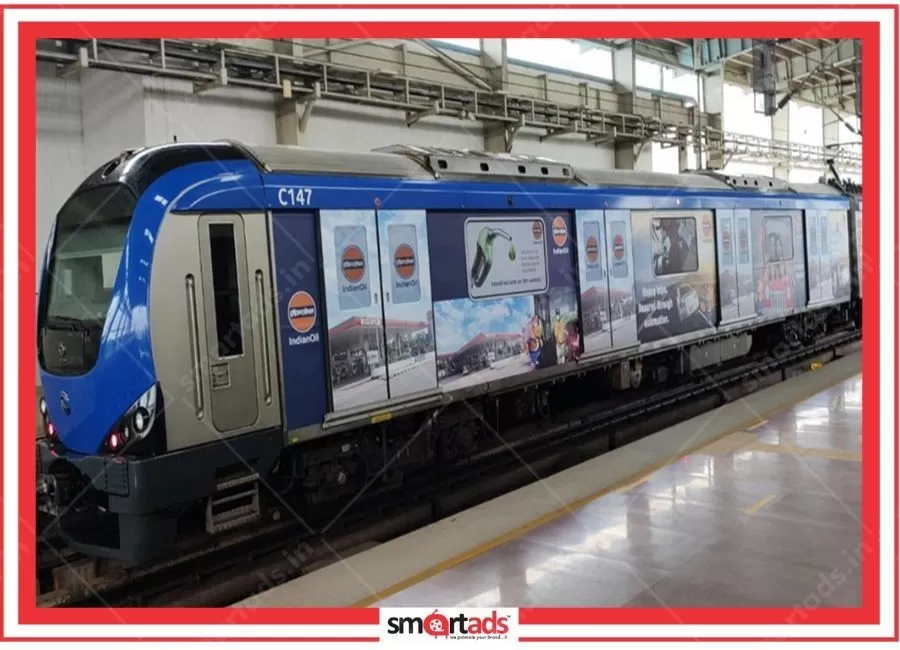
Exterior Metro Wrap
Custom
The advertisement spans the whole train,
Rate per Metro Display Cost / 1 Month
Route : Tirusulam To WIMCO Nagar
₹1000000.00
Showing 1 to 5 of 5 Results
MEDIA DETAILS
Custom
The advertisement spans the whole train,
Rate per Metro Display Cost / 1 Month
Route : Tirusulam To WIMCO Nagar
₹1000000.00
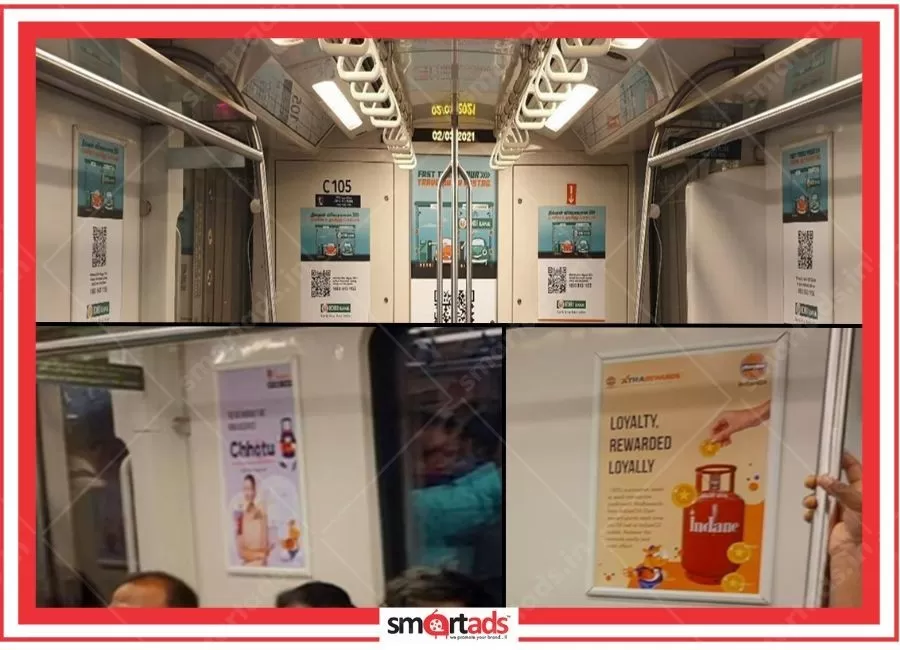
Custom
On the inside of the metro train the adv
Rate per Metro Display Cost / 1 Month
Route : Tirusulam To WIMCO Nagar
₹500000.00
20 Sec Audio
A jingle is a song or a phrase, and the
Rate per Metro Jingle Cost / 1 Month
Route :Tirusulam to WIMCO Nagar
₹400000.00

10 Sec Video
Digital screen on the metro station will
Rate per Metro Digital Display Cost / 1
Route :Tirusulam to WIMCO Nagar
₹600000.00

1 Metro Train
On the outside of the metro train the ad
Rate per Metro Display Cost / 1 Month
Route :Tirusulam to WIMCO Nagar
₹1500000.00
MEDIA REACH

MinimumQty :
1
EstimateReachPeople :
150000000
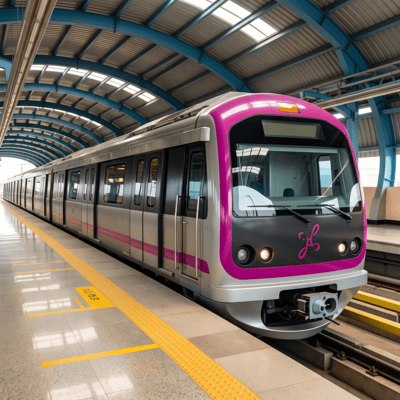
Namma Metro crossed 9 lakh daily riders in 2025 — a number that quietly makes it one of the most concentrated, captive, and demographically desirable advertising environments in South India. Most brands are still treating it like a secondary media option, which is precisely why the ones who commit to it are seeing disproportionate returns.
There is a particular moment that every media planner remembers — the first time a client sees their brand wrapped across the full exterior of a Namma Metro train pulling into MG Road station during evening rush hour. It is not a static billboard experience; it is a moving billboard that travels the length of the city, repeating its impression at every station stop, every crossing, every elevated stretch where thousands of pedestrians and motorists look up. Metro train advertising in Bangalore operates through a structured concession framework administered by the Bangalore Metro Rail Corporation Limited, which grants media rights to authorised partners who then manage inventory, creative approvals, and installation logistics on behalf of advertisers.
The mechanics are worth understanding clearly, because they differ meaningfully from standard OOH advertising in Bangalore. A brand does not simply book a space and put up a poster; the process involves submitting creatives for BMRCL approval, coordinating with licensed installation vendors, and adhering to specific format specifications that vary depending on whether you are booking interior branding, exterior train wrapping, station-level placements, or a combination. What a lot of people miss is that the media rights for different assets are held by different entities — Mudra OOH, for instance, holds rights for certain Purple Line assets, while other formats and corridors are managed through separate BMRCL-authorised channels. At SmartAds, we navigate this on behalf of our clients so they are not spending weeks figuring out who to call.
What makes this format genuinely different from other transit advertising in Bangalore is the dwell time. A commuter on the Purple Line travelling from Nagasandra to Silk Institute sits inside that train for anywhere between 45 minutes and over an hour depending on their journey segment; during that time, interior branding panels are directly within their line of sight, which creates a quality of exposure that no roadside hoarding or digital pre-roll ad can replicate. The captive audience advertising environment inside a metro coach is, frankly speaking, among the most underrated assets in the Indian media planning toolkit.
The range of formats available for metro train branding in Bangalore is wider than most advertisers initially expect, and the choice of format has a significant bearing on both the campaign's visual impact and its cost structure. On the exterior side, the most premium option is the full train wrap, which covers the entire outer surface of a metro train — roughly 5,300 square feet of branded space — transforming the train into a moving billboard that generates impressions not just at stations but across every elevated and ground-level stretch of the route. A partial exterior wrap, which covers specific panels or coaches rather than the full train, offers a more accessible entry point for brands with tighter budgets while still delivering strong exterior train branding.
Interior branding metro formats are equally varied and, in our experience, often more effective for message retention. Each Namma Metro train offers approximately 400 square feet of interior advertising space across formats that include overhead panel branding, door-adjacent panels, grab-handle branding, and seat-back panels — all of which are seen repeatedly by the same commuters during their journey, which compounds brand recall in a way that a single-exposure outdoor format simply cannot. Beyond the trains themselves, metro station advertising in Bangalore adds another layer: station pillar advertising, escalator branding at Bangalore metro stations, standee advertising in metro station concourses, digital display panels at metro stations, and kiosk activations in high-footfall interchange hubs like Majestic metro station. Smart card branding and co-branding opportunities at metro station entry gates represent newer formats that BMRCL has been opening up, and station naming rights under the BMRCL advertising framework — where a brand sponsors a station's identity — represent the most premium, longest-commitment option available.
One format that deserves more attention than it typically gets is escalator branding at Bangalore metro stations, particularly at high-traffic stations like Indiranagar metro station and Whitefield metro advertising zones. The escalator is a forced-attention environment; commuters have nowhere else to look, which makes it one of the highest effective-frequency transit placements available. We worked with a consumer electronics brand that ran escalator branding across five key stations simultaneously with interior panel branding on two trains, and the brand recall scores from their post-campaign survey were among the highest we had seen from any single-city BTL advertising campaign in Bangalore that year.
Frankly speaking, this is the question every client asks first, and it is also the question that most media vendors answer vaguely — either because they want you to call for a quote or because rates genuinely vary based on format, duration, corridor, and season. We believe in giving clients real numbers to work with, even if those numbers come with appropriate caveats.
For a full train wrap in Bangalore, the cost works out to somewhere in the ballpark of ₹8 to ₹12 lakh per train per month, which covers the exterior surface of a single train across its full route; this figure includes the media fee but typically excludes production and installation, which can add another ₹2 to ₹4 lakh depending on the complexity of the creative. Interior branding metro packages — covering a set of panels across one or more coaches — are priced more accessibly, with rates ranging roughly between ₹1.5 lakh and ₹5 lakh per month depending on the number of panels, the specific coach positions, and whether the booking is on the Purple Line or Green Line. Metro station advertising in Bangalore at individual stations is priced differently again; a single backlit panel at a mid-tier station might cost in the range of ₹40,000 to ₹80,000 per month, while premium placements at Majestic metro station or MG Road metro station advertising positions command significantly higher rates — sometimes two to three times the base rate — because of the sheer volume of daily footfall those stations handle.
Metro advertising rates in Bangalore also respond to demand seasonality in ways that most advertisers do not account for in their planning. Festival periods — Dussehra, Diwali, the IPL season — see inventory tighten considerably, and metro advertising costs in Bangalore during these windows can be 20 to 30 percent higher than off-peak rates. On the other hand, booking a longer-duration campaign of three months or more typically unlocks negotiated rates that bring the effective CPM down meaningfully; the cost per thousand impressions for metro advertising, when calculated against the 9 lakh daily ridership figure, works out to roughly ₹6 to ₹10 for interior formats — a number that surprises most first-time advertisers when they compare it to what they are paying for Instagram reach in the same city. At SmartAds, we always tell our clients that the CPM argument alone is enough to justify testing metro train advertising in Bangalore, even before you factor in the quality-of-attention differential.
This is a question we get asked on almost every Bangalore metro advertising campaign brief, and the honest answer is that the right corridor depends entirely on where your audience lives, works, and commutes — which sounds obvious but is frequently overlooked in favour of simply booking the "more popular" line. The Purple Line, running from Nagasandra in the northwest to Silk Institute in the south, covers 37 stations and passes through some of Bangalore's most commercially dense zones: Majestic metro station, which is the city's primary interchange hub; MG Road metro station, which sits at the heart of the central business district; and Indiranagar metro station, which serves one of the city's most affluent residential and retail catchments. Purple Line advertising therefore tends to attract brands targeting urban professionals, retail consumers, and the premium lifestyle segment.
The Green Line, running from Whitefield Kadugodi in the east to Challaghatta in the southwest, covers 32 stations and tells a different story. Whitefield metro advertising reaches one of the densest concentrations of IT professionals and tech-savvy audiences in the country — this is the corridor that connects the Silicon Valley of India's technology parks to the rest of the city, which means the Green Line ridership skews younger, more digitally native, and more likely to be in the 25-to-40 income bracket that most consumer brands covet. For app promotion via metro train advertising, for fintech brands, for edtech platforms, and for real estate metro advertising in Bangalore targeting IT professionals, the Green Line advertising corridor is frequently the stronger choice.
And then there is the Yellow Line, which launched in August 2025 and runs from RV Road to Bommasandra across 16 stations — a corridor that is still building its ridership base but which passes through Electronic City metro zones and connects to one of Bangalore's fastest-growing tech employment clusters. Yellow Line advertising inventory is currently less contested than the established corridors, which means brands willing to be early movers can secure premium positions at rates that will almost certainly not be available once ridership matures. We have been advising select clients to consider Yellow Line placements as part of a broader Namma Metro advertising strategy precisely because the early-mover advantage in transit media tends to be significant and lasting.
One of the most persistent misconceptions about commuter advertising in Bangalore is that metro riders are a homogeneous mass of office-goers. The reality, as reflected in ridership data and the demographic surveys that BMRCL has commissioned over the years, is considerably more nuanced. The Namma Metro ridership base skews heavily toward working professionals between the ages of 22 and 45, with a significant proportion holding graduate or postgraduate qualifications and falling in the middle-to-upper income brackets — this is not the same audience profile as a city bus or suburban rail network, which is a distinction that matters enormously for brand targeting decisions.
What makes the Bangalore metro advertising audience particularly valuable for certain categories is the psychographic profile that sits beneath the demographic data. These are urban commuters who have actively chosen to use public transit in a city where car ownership is high and parking is miserable; they tend to be time-conscious, digitally engaged, and receptive to brand messages that respect their intelligence. The IT professionals advertising opportunity on the Green Line is well-documented among media planners, but what is less discussed is the significant student and young professional population on the Purple Line between Majestic and MG Road, which makes that stretch valuable for categories like education, financial services, and consumer electronics. The tech-savvy audience concentration across both major corridors also makes Namma Metro advertising unusually effective for app promotion and digital-first brand launches.
From a media planning perspective, the captive audience advertising environment inside metro coaches creates conditions for brand recall that are structurally different from outdoor or digital formats. A commuter who sees your interior branding panel during a 40-minute journey is not scrolling past it in 1.5 seconds; they are sitting with it, reading it, potentially photographing it, and seeing it again on the return journey. Our experience at SmartAds shows that campaigns combining interior branding metro placements with station-level touchpoints at origin and destination stations generate brand recall scores that are consistently higher than equivalent-budget OOH advertising in Bangalore campaigns — sometimes by a margin of 15 to 20 percentage points in post-campaign brand lift studies.
This comparison comes up in almost every media planning conversation we have, and to be honest, framing it as a competition misses the point — but since most brands are making budget allocation decisions between these channels, the comparison is worth making clearly. A standard hoarding on a major Bangalore arterial road generates impressions primarily from vehicular traffic, which means the audience is moving at speed, distracted, and exposed for perhaps two to three seconds per pass; the effective frequency required to build brand awareness through OOH advertising in Bangalore is therefore high, which drives up the total campaign cost for equivalent recall outcomes. Metro train branding in Bangalore, by contrast, delivers extended dwell-time exposure to a stationary, captive audience — which is a fundamentally different quality of impression.
Digital advertising in Bangalore — whether search, social, or programmatic display — offers targeting precision and measurability that transit advertising cannot match directly; we would never argue otherwise. But digital also comes with skip rates, banner blindness, and an increasingly fragmented attention environment where a brand awareness campaign in Bangalore might generate millions of impressions that are technically served but never genuinely seen. The below the line advertising in Bangalore environment that metro transit creates is physically unavoidable in a way that a digital ad simply is not; you cannot install an ad blocker on a metro coach. What we tell our clients is that the most effective campaigns use metro train advertising in Bangalore to build top-of-mind awareness and brand recall, while digital channels handle the performance and retargeting layer — and increasingly, we are building campaigns where geo-targeted mobile ads are served to users near metro stations, which creates an omnichannel loop that amplifies the impact of both channels simultaneously.
One retail client we worked with in Bengaluru — a quick-service restaurant chain expanding into new neighbourhoods — ran a three-month interior branding metro campaign combined with geo-targeted digital ads served within a 500-metre radius of their target stations. The stores near those metro stations saw footfall growth that was measurably higher than stores in the control group, and the brand's aided awareness scores in those catchments improved by roughly 22 percentage points over the campaign period. That is the kind of result that makes metro advertising ROI tangible in a way that a simple CPM comparison never quite captures.
Real estate is perhaps the most obvious category, and for good reason — real estate metro advertising in Bangalore has been a consistent and growing segment of BMRCL's advertising revenue because the audience profile of metro riders maps almost perfectly onto the target buyer for mid-to-premium residential projects. A developer launching a project near Whitefield or Electronic City can run Whitefield metro advertising on the Green Line and reach exactly the IT professionals and working professionals who are most likely to be in the market for a home in that corridor; the geographic alignment between the metro route and the project location creates a relevance that no city-wide media format can replicate.
The fintech, edtech, and consumer app categories have found metro train advertising in Bangalore to be particularly effective for product launch campaigns, precisely because the tech-savvy audience concentration on both major corridors is so high. App promotion via metro train advertising benefits from the fact that commuters are typically on their phones during journeys, which means a well-designed interior panel with a QR code or a memorable tagline can drive direct downloads in a way that bridges the physical and digital worlds. We have seen this work exceptionally well for a Bengaluru-based fintech startup that ran a six-week interior branding campaign across 10 trains on the Purple Line; their app downloads in Bangalore spiked by roughly 34 percent during the campaign period, and the cost per install worked out to significantly below their digital channel benchmarks.
Beyond these high-profile categories, FMCG brands, healthcare and wellness companies, educational institutions, and automobile manufacturers have all found strong returns from Namma Metro advertising. The FMCG case is interesting because the metro environment is not the obvious choice for a category that typically relies on mass-reach television; but for urban-skewed product lines — premium packaged foods, personal care, health supplements — the demographic precision of metro train branding in Bangalore delivers a quality of audience alignment that justifies the relatively higher CPM compared to television. Karnataka metro advertising for state-level government campaigns and public awareness initiatives has also been a growing segment, particularly on the Purple Line which connects major civic hubs.
Majestic metro station is the undisputed anchor of the Namma Metro network — it is the interchange point between the Purple Line and the Green Line, which means every commuter transferring between corridors passes through it, generating a daily footfall that is substantially higher than any other station on the network. Station advertising at Majestic is consequently the most premium and most contested inventory in the Bangalore metro advertising ecosystem; brands that secure pillar advertising, standee positions, or digital display placements here are reaching an audience that is genuinely cross-demographic and city-wide in its geographic spread.
MG Road metro station advertising is the second tier of premium, serving the central business district catchment that includes corporate offices, retail flagships, and the hospitality cluster around Brigade Road and Residency Road. Indiranagar metro advertising positions are particularly valued by lifestyle, F&B, and fashion brands because the station's catchment is one of Bangalore's most affluent and trend-conscious neighbourhoods; a brand that wants to be seen by the city's early adopters and high-income urban consumers would do well to anchor their metro station advertising in Bangalore strategy around Indiranagar. On the Green Line, Whitefield metro advertising and the stations serving the ITPL and EPIP Zone catchments are the priority for technology-sector brands, while Electronic City metro stations serve the southern tech cluster that includes major IT campuses and their associated residential developments.
High footfall advertising at interchange stations — where commuters pause, wait, and move between platforms — creates a different quality of exposure than in-train formats; the dwell time is shorter but the audience is physically stationary and not yet absorbed in their phone or book. This is where escalator branding in Bangalore metro and standee advertising at metro stations tend to perform best, because the format matches the attention pattern of the environment. At SmartAds, our media planning approach for Bangalore metro advertising campaigns typically involves layering station-level touchpoints at the origin and destination stations most relevant to the target audience, combined with in-train formats for the dwell-time exposure that builds brand recall over the campaign duration.
The booking process for metro train advertising in Bangalore is more structured than most clients expect, and understanding the workflow upfront saves considerable time and frustration. The first step is identifying the right inventory — which line, which format, which stations, and which trains — based on the campaign's audience targeting and budget parameters; this is where working with an experienced metro advertising agency in Bangalore pays dividends, because the available inventory is not always transparently listed and negotiating the right positions requires knowledge of what is actually available versus what is technically on the rate card.
Once the inventory is confirmed and the booking is placed, the creative submission and BMRCL approval process begins — and this is the stage that most first-time advertisers underestimate in terms of time. BMRCL's approval process for exterior train wrapping and interior branding materials typically takes between 10 and 15 working days, during which the creative is reviewed for compliance with content guidelines, format specifications, and — critically — the Kannada language requirement that we will address in a dedicated section. After approval, the production and installation phase begins; for a full train wrap in Bangalore, the installation process itself requires a maintenance window and typically takes one to two days per train. From the point of brief submission to campaign go-live, brands should plan for a minimum of four to six weeks, and eight weeks is a more comfortable timeline for complex multi-format campaigns.
Media planning for Bangalore metro advertising campaigns also involves decisions about campaign duration and phasing that are worth thinking through before the booking is placed. A minimum campaign duration of four weeks is typically required for most formats, but the real brand recall benefits begin to compound from week six onwards as the same commuters encounter the creative repeatedly on their daily journeys. Our recommendation at SmartAds for most brand awareness campaigns is a minimum of eight weeks for interior branding and 12 weeks for exterior train branding, with creative refreshes at the midpoint to maintain audience engagement and prevent habituation.
This section covers ground that almost no competitor page addresses in any useful depth, which is remarkable given that creative compliance failures are one of the most common causes of campaign delays and rejected bookings. BMRCL's advertising guidelines are specific and non-negotiable on several points, and brands that come to the process without understanding them tend to find themselves in expensive revision cycles that push back their go-live dates.
The most operationally significant requirement — and the one that catches the most brands off guard — is the Kannada language creative compliance rule. BMRCL mandates that a meaningful portion of advertising creative displayed on Namma Metro assets must incorporate Kannada language content; the practical interpretation of this requirement means that brands cannot simply run their standard English-language national creative on metro assets without adaptation. For brands that do not have a Kannada creative development capability in-house, this means engaging a local creative agency or ensuring their metro advertising agency in Bangalore has this capability. A Kannada creative metro ad is not just a compliance requirement — it is also a genuine audience engagement opportunity, because Kannada-language messaging resonates more deeply with a significant segment of the metro ridership and signals cultural respect that urban Bangalore consumers notice and appreciate.
Beyond the language requirement, BMRCL's guidelines cover content restrictions — no political advertising, no content that could be deemed offensive or divisive, no competitive references to other public transport systems — as well as format specifications for print quality, material type, and installation methods. For exterior train wrapping, the vinyl specifications are precise and must be adhered to exactly, because substandard materials create safety and maintenance issues that BMRCL takes seriously. Digital display advertising at metro stations is subject to additional guidelines around animation duration, audio restrictions, and brightness levels. Our experience at SmartAds is that submitting a complete compliance checklist alongside the creative artwork significantly accelerates the approval process; BMRCL's review team responds faster when the submission is clearly structured and pre-checked against all known requirements.
Metro advertising ROI is one of those questions where the honest answer requires some nuance, because the returns depend heavily on the campaign objective, the format mix, the duration, and the brand's baseline awareness in the market. That said, we can offer some useful benchmarks from our campaign experience and from the broader transit advertising research that has been published by industry bodies.
For brand awareness campaigns, the most reliable metric is brand recall lift — the increase in aided and unaided brand awareness among the target audience over the campaign period. Our experience across multiple Namma Metro advertising campaigns suggests that a well-executed eight-week interior branding campaign on a single corridor can generate aided recall improvements of 15 to 25 percentage points among regular metro commuters in the target demographic, which is a meaningful shift for a brand investing in a new market or launching a new product. For performance-oriented campaigns — app downloads, website visits, store footfall — the measurability improves significantly when QR codes, unique UTM parameters, or dedicated landing pages are incorporated into the creative, which allows for direct attribution of campaign-driven actions.
The cost per thousand impressions for metro advertising in Bangalore, calculated against the 9 lakh daily ridership figure across the full network, works out to somewhere between ₹6 and ₹12 depending on the format — which compares favourably to digital display CPMs in the same market, particularly when the quality-of-attention differential is factored in. An automotive brand we worked with ran a 12-week exterior train branding campaign on the Purple Line, and their dealership enquiry volumes in Bangalore during the campaign period were roughly 28 percent higher than the same period in the previous year, against a backdrop of flat national sales trends; while attribution in OOH advertising is never perfectly clean, the correlation was strong enough that the client renewed the campaign for the following quarter. That kind of outcome is what makes metro train advertising in Bangalore a genuinely compelling proposition for brands willing to commit to it with adequate duration and creative investment.
Effective frequency in transit media is a concept that is well-established in international advertising research but surprisingly underappreciated in Indian media planning conversations. The basic principle is that brand recall does not build linearly with impressions — it builds in phases, with the most significant jumps occurring after repeated exposures over time. For a commuter who uses the metro five days a week, a four-week campaign delivers roughly 20 exposures to interior branding; a 12-week campaign delivers 60 exposures, which is where the recall curve typically plateaus at its highest point.
The practical implication is that short campaigns — four weeks or less — tend to generate awareness primarily among heavy users of the specific route, while campaigns of eight weeks or more begin to penetrate the broader commuter population including occasional and weekend riders. For product launches and new brand entries into the Bangalore market, we recommend a minimum of eight weeks as the baseline, with the first four weeks focused on awareness building and the second four weeks on reinforcing the message with a creative refresh. For established brands running seasonal or event-based metro advertising in Bangalore — around IPL, Dussehra, or major tech expos — a shorter, high-intensity burst of four to six weeks can be effective because the brand already has baseline awareness to build on.
The seasonal dimension of campaign planning deserves more attention than it typically gets. The period from October to January, which encompasses Dussehra, Diwali, and the pre-budget consumer spending peak, is consistently the highest-demand window for Namma Metro advertising inventory; booking during this period requires at least eight to ten weeks of advance planning, and rates are correspondingly higher. The January to March window, by contrast, tends to offer better availability and more negotiable rates, which makes it an attractive time for brands that have flexibility in their campaign timing. At SmartAds, our media planning approach involves mapping campaign windows against both the client's marketing calendar and the metro advertising inventory cycle, which often surfaces opportunities that a direct booking approach would miss entirely.
Q: How much does metro train advertising in Bangalore cost?
The cost varies considerably depending on the format and duration you choose. A full train wrap in Bangalore — covering the entire exterior of a single metro train — is priced somewhere in the range of ₹8 to ₹12 lakh per month for the media fee alone, with production and installation adding another ₹2 to ₹4 lakh. Interior branding metro packages are more accessible, with individual panel bookings starting around ₹40,000 to ₹80,000 per month and full-coach interior packages ranging up to ₹5 lakh per month. Metro station advertising in Bangalore at individual stations starts at roughly ₹40,000 per month for a standard backlit panel at a mid-tier station, rising significantly for premium positions at high-footfall stations like Majestic or MG Road. These are indicative benchmarks; actual metro advertising rates in Bangalore are negotiated based on duration, volume, and timing, and a multi-format, multi-month booking will typically secure meaningfully better rates than a single-format short-term placement.
Q: What advertising formats are available on Namma Metro trains?
Namma Metro advertising offers a wider format range than most advertisers initially expect. On the exterior, the options run from a full train wrap covering approximately 5,300 square feet of surface area down to partial wraps covering specific coaches or panel positions. Interior branding metro formats include overhead panels, door-adjacent panels, grab-handle branding, and seat-back panels — all of which benefit from the extended dwell time of a metro journey. At the station level, metro station advertising in Bangalore encompasses pillar advertising, escalator branding, standee advertising, digital display panels, kiosk activations, and smart card branding. Station naming rights under the BMRCL advertising framework represent the most premium long-term option, while co-branding opportunities at station entry points are available at select high-traffic locations.
Q: What is the daily ridership of Bangalore Metro and how does it affect ad reach?
Namma Metro crossed 9 lakh daily riders in 2025, which makes it one of the highest-ridership metro systems in India outside of Delhi and Mumbai. For advertisers, this figure translates into a reach figure that compounds meaningfully over campaign duration — a four-week interior branding campaign on a single train that runs the full Purple Line route will generate impressions in the tens of lakhs when the daily ridership and journey frequency are factored together. The more important point, though, is that this is not the same as a broadcast reach figure; these are real, physically present impressions from a captive audience advertising environment, which makes the effective value per impression substantially higher than an equivalent number of digital display impressions or roadside hoarding exposures.
Q: Which metro line — Purple Line or Green Line — is better for advertising?
Neither line is universally better; the right choice depends on your target audience's geography and profile. The Purple Line advertising corridor is stronger for brands targeting central Bangalore's commercial and retail catchment — covering Majestic, MG Road, Indiranagar, and the residential corridors of northwest Bangalore. The Green Line advertising corridor is the stronger choice for brands targeting IT professionals, tech-savvy audiences, and the eastern tech corridor that runs from Whitefield through to the city's major technology parks. For brands with a city-wide target, running campaigns on both lines simultaneously — or booking at the Majestic metro station interchange where both lines converge — delivers the broadest possible Bangalore metro advertising reach. The newly launched Yellow Line, serving the Electronic City metro corridor, is worth considering for brands targeting the southern tech cluster.
Q: Is metro train advertising in Bangalore effective for brand recall?
The evidence from both our own campaign experience and the broader transit advertising research literature is that metro train advertising in Bangalore is highly effective for brand recall, particularly for campaigns that run for eight weeks or longer. The captive audience advertising environment inside metro coaches, combined with the high effective frequency that daily commuters experience, creates conditions for brand recall that are structurally superior to most other outdoor or digital formats. Post-campaign brand lift studies we have conducted for Namma Metro advertising campaigns consistently show aided recall improvements of 15 to 25 percentage points among regular metro commuters — a result that compares favourably to equivalent-budget television or digital campaigns in the same market.
Q: How do I book metro train advertising in Bangalore?
The booking process involves several stages: identifying the right inventory (format, line, stations, and trains) based on your campaign objectives; confirming availability and securing the booking through a BMRCL-authorised media partner; submitting creatives for BMRCL approval, which typically takes 10 to 15 working days; completing production and installation; and then going live. The total timeline from brief to go-live is typically four to six weeks for simpler formats and six to eight weeks for full train wraps or multi-format campaigns. Working with an experienced metro advertising agency in Bangalore that has existing relationships with BMRCL's authorised media partners significantly accelerates this process and reduces the risk of creative rejection or compliance delays.
Q: What are BMRCL's guidelines and rules for metro advertising creatives?
BMRCL's creative guidelines cover content restrictions, format specifications, and language requirements. The most critical requirement for most brands is the Kannada language compliance rule, which mandates that advertising creatives displayed on Namma Metro assets incorporate Kannada language content — running a purely English-language national creative without Kannada adaptation is not compliant and will result in rejection. Beyond language, BMRCL prohibits political advertising, content deemed offensive or divisive, and certain competitive references. Format specifications for exterior train wrapping are precise in terms of vinyl material type, print resolution, and installation method. Digital display advertising at metro stations has additional guidelines around animation duration and audio. Submitting a complete compliance checklist alongside your creative artwork is the most effective way to accelerate the approval process.
Q: How long should a metro advertising campaign run in Bangalore?
For brand awareness objectives, a minimum of eight weeks is our recommendation, with 12 weeks being the sweet spot for maximum brand recall among the regular commuter population. Shorter campaigns of four weeks can be effective for established brands running event-based or seasonal activations, but they are generally insufficient for building meaningful awareness among a new audience. The effective frequency in transit media builds over time — a commuter who sees your interior branding panel five days a week for 12 weeks has had roughly 60 exposures to your creative, which is where recall typically plateaus at its highest point. For product launches and new brand entries into the Bangalore market, we recommend planning for at least eight weeks with a creative refresh at the midpoint.
Q: Can small businesses or startups advertise on Bangalore Metro trains?
Yes, and this is a point that deserves more emphasis than it typically gets in metro advertising conversations. While full train wraps and multi-station campaigns require budgets in the lakh range, entry-level options like a single standee advertising placement at a metro station or a small number of interior panels on a single train are accessible at budgets starting around ₹40,000 to ₹80,000 per month. For startups and SMBs, the most cost-effective approach is typically to focus on one or two high-relevance stations — choosing Indiranagar metro advertising for a lifestyle brand, or Whitefield metro advertising for a B2B tech product — rather than spreading a limited budget across the full network. A single well-placed standee at a high-footfall station, maintained for three months, can deliver meaningful brand visibility at a total investment that is well within the reach of a growth-stage startup.
Q: What industries are best suited for Namma Metro train advertising?
Real estate, fintech, edtech, consumer apps, FMCG, automotive, healthcare, and educational institutions have all found strong returns from Namma Metro advertising. Real estate metro advertising in Bangalore is particularly effective because the audience profile maps closely onto the target buyer for mid-to-premium residential projects. App promotion via metro train advertising works well because the tech-savvy, digitally native ridership is predisposed to act on app-related messaging. FMCG brands targeting the urban premium segment find that the demographic precision of metro train branding in Bangalore delivers better audience alignment than mass-reach television for their specific product lines. Government and public sector campaigns — particularly Karnataka metro advertising for civic awareness initiatives — have also been a consistent and growing segment of BMRCL's advertising revenue.
Q: How is metro train advertising different from OOH or billboard advertising?
The fundamental difference is attention quality. A roadside hoarding generates impressions from vehicular traffic moving at speed, with an average exposure time of two to three seconds per pass; a metro interior branding panel is seen by a stationary, captive audience for the full duration of their journey, which can be 30 to 60 minutes. This dwell-time advantage means that metro train advertising in Bangalore delivers a quality of brand exposure that drives higher recall per impression than standard O
