
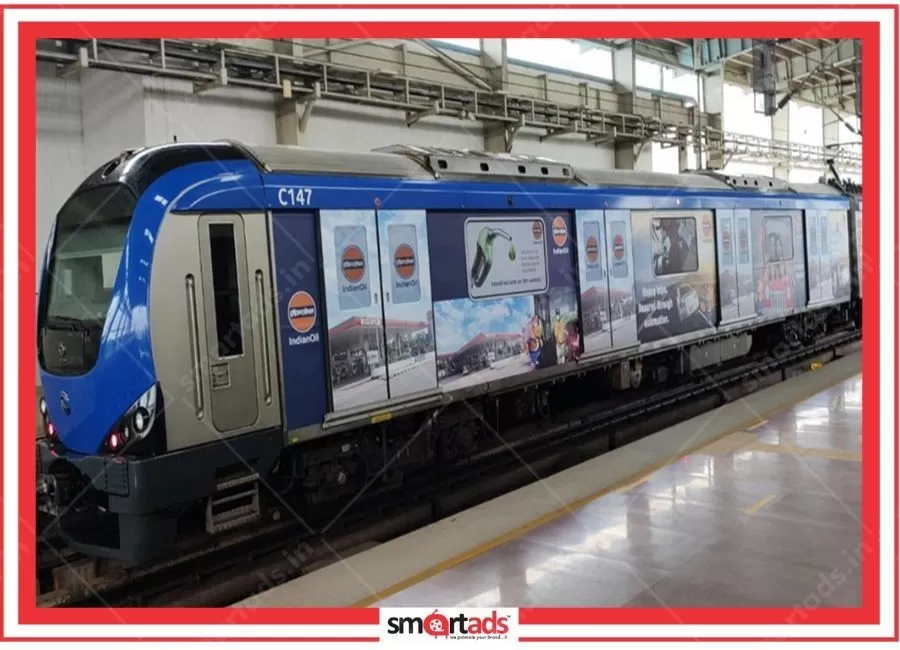
Exterior Metro Wrap
Custom
The advertisement spans the whole train,
Rate per Metro Display Cost / 1 Month
Route : Tirusulam To WIMCO Nagar
₹1000000.00
Showing 1 to 5 of 5 Results
MEDIA DETAILS
Custom
The advertisement spans the whole train,
Rate per Metro Display Cost / 1 Month
Route : Tirusulam To WIMCO Nagar
₹1000000.00
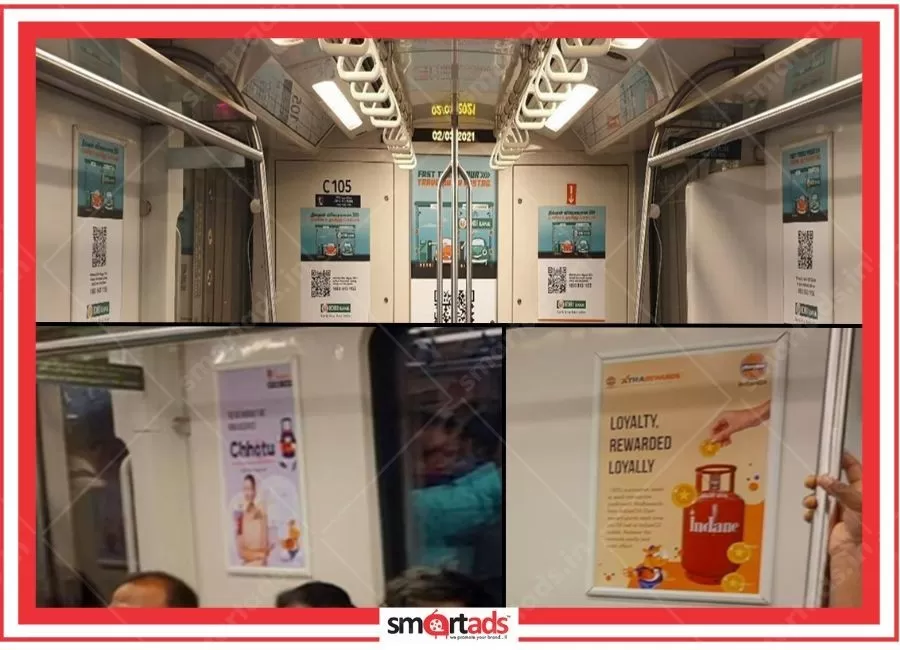
Custom
On the inside of the metro train the adv
Rate per Metro Display Cost / 1 Month
Route : Tirusulam To WIMCO Nagar
₹500000.00
20 Sec Audio
A jingle is a song or a phrase, and the
Rate per Metro Jingle Cost / 1 Month
Route :Tirusulam to WIMCO Nagar
₹400000.00

10 Sec Video
Digital screen on the metro station will
Rate per Metro Digital Display Cost / 1
Route :Tirusulam to WIMCO Nagar
₹600000.00

1 Metro Train
On the outside of the metro train the ad
Rate per Metro Display Cost / 1 Month
Route :Tirusulam to WIMCO Nagar
₹1500000.00
MEDIA REACH

MinimumQty :
1
EstimateReachPeople :
150000000
Lucknow Metro carries somewhere in the range of 60,000 to 80,000 passengers on a typical weekday — a number that surprises most brand managers when they first hear it, because the conversation around Lucknow advertising still tends to default to hoardings on Hazratganj Road or newspaper inserts in regional dailies. What those conversations miss is that metro rail advertising in Lucknow delivers something almost no other format in the city can: a captive audience, physically enclosed in a branded environment, with an average dwell time of 18 to 25 minutes per journey. That is not reach in the abstract sense — that is sustained, repeated exposure to your brand message, day after day, from the same commuter base.
The effectiveness of metro train advertising in Lucknow comes down to a structural advantage that most out-of-home advertising simply cannot replicate. When a commuter boards a metro train at Charbagh metro station and rides through to Indira Nagar metro station, they are not scrolling past your ad or changing the channel; they are sitting or standing within arm's reach of your creative, often for 20 minutes or more, which means the brand recall numbers that come out of metro campaigns consistently outperform what you would expect from equivalent spends on roadside hoardings or even mall media. The FICCI-EY Media and Entertainment Report has repeatedly flagged transit media as one of the fastest-growing OOH sub-categories in India, and Lucknow is a textbook example of why.
What a lot of people miss is the compounding effect of daily commuter behaviour. The same 40,000-odd regular subscribers ride the Red Line Lucknow Metro five or six days a week, which means a brand running a 30-day interior train panel campaign is not buying 30 days of impressions — it is buying 20 to 25 repeated exposures to the same individual, which is the kind of frequency that changes purchase intent rather than just building vague awareness. Our experience at SmartAds shows that clients who run metro train advertising in Lucknow for a minimum of 45 days see brand recall scores that are, on average, 2.3 times higher than what a comparable hoarding campaign produces over the same period.
To be fair, the format does have a specific strength profile. It works exceptionally well for categories where the commuter demographic aligns with the brand's target — financial services, ed-tech, real estate, FMCG, retail, and healthcare brands have all found Lucknow Metro advertising to be a high-efficiency channel. One real estate developer we worked with in Lucknow ran a full train wrap campaign across two rakes for 60 days; the brand's walk-in enquiries at their Gomti Nagar project site increased by roughly 34% during the campaign window, which the client attributed, at least in part, to the sheer volume of repeated exposure the metro campaign generated among the SEC A and SEC B commuter base.
The inventory available for metro train branding in Lucknow is considerably more varied than most advertisers realise, and choosing the wrong format for your objective is one of the most common planning mistakes we see. The Uttar Pradesh Metro Rail Corporation manages the advertising rights across the operational network, and the formats span everything from interior train panels and grab handle branding to full exterior train wraps and digital screen advertising at stations — each with a different reach profile, cost structure, and creative requirement.
Starting with the interior formats: interior train panels are the workhorses of metro train advertising in Lucknow, placed above the windows and along the coach walls, which gives them near-unavoidable visibility during the entire journey. Gangwal panels — the advertisements placed on the partition panels near the doors — are particularly valued because commuters standing near the doors interact with them at close range, which makes them ideal for QR code integrations or detailed product messaging. Grab handle branding, which wraps the overhead handles that standing passengers hold, delivers an almost tactile brand interaction that is genuinely unlike anything else in the OOH advertising toolkit; we have seen this format work brilliantly for FMCG brands running product launches, because the repeated physical proximity creates an unusually strong memory encoding.
On the exterior side, the full train wrap is the format that generates the most enquiries and, frankly, the most excitement — and for good reason. A full exterior train wrap covers the entire outer surface of one or more coaches with vinyl wrap ads, which transforms the train itself into a moving billboard that is visible at every station, every crossing, and every stretch of elevated track across the Red Line. The cost is proportionally higher, but the impression count is staggering when you factor in not just the commuters inside the train but the thousands of people who see the train moving through the city. Station-side formats — including backlit panels, pillar branding, escalator branding, ticket gate branding, and platform advertising — round out the inventory and are often bundled with train formats to create a surround-sound brand experience at high-footfall stations like Hazratganj metro station, Sachivalaya metro station, and CCS Airport metro station.
Advertising rates for metro train advertising in Lucknow are, to be honest, more accessible than most brand managers expect — especially when you calculate the cost per impression against what the same budget would deliver on a digital platform or a premium hoarding. Interior train panels on the Lucknow Metro work out to somewhere in the ballpark of ₹40,000 to ₹80,000 per coach per month, depending on the panel position and the number of coaches booked, which is a number that tends to surprise clients who have been conditioned to think of metro advertising as a premium-only channel. Grab handle branding typically runs in a similar range per coach, while gangwal panels can be slightly lower depending on availability and the campaign duration negotiated with UPMRC.
Exterior train wrap advertising is where the advertising cost steps up meaningfully. A partial exterior wrap — covering one side of a coach — is priced in the range of ₹1.5 lakh to ₹2.5 lakh per coach per month, while a full train wrap across an entire rake of coaches can reach anywhere from ₹8 lakh to ₹15 lakh per month or more, depending on the number of coaches and the exclusivity of the booking. These are ballpark figures; actual metro advertising rates per month are negotiated through UPMRC's authorised agency channel and can vary based on campaign duration, seasonal demand, and the specific inventory being booked. At SmartAds, we always tell our clients that the right way to evaluate these numbers is not in absolute terms but in cost per thousand impressions — and when you run that calculation for a full train wrap on the Red Line Lucknow Metro, the CPM works out to a figure that is genuinely competitive with mid-tier digital display advertising, with the added advantage of zero ad fraud and zero skip rates.
Station advertising in Lucknow — covering backlit panels, digital screen advertising, platform advertising, and pillar branding — is priced separately from train formats and typically ranges from ₹20,000 to ₹1.5 lakh per unit per month depending on the station's footfall ranking and the format size. Hazratganj metro station and Charbagh metro station command premium rates because of their consistently high passenger volumes, while stations like Munshi Pulia metro and Indira Nagar metro station offer more competitive pricing with still-substantial daily footfall numbers. The metro advertising booking process generally requires a minimum campaign duration of 15 to 30 days, though longer bookings of 60 to 90 days typically attract meaningful volume discounts — something we negotiate on behalf of our clients as a standard part of the planning process.
Station selection is where media planning for metro rail advertising in Lucknow gets genuinely strategic, and it is an area where working with an experienced metro advertising agency in Lucknow makes a real difference. The footfall hierarchy across the Red Line is not uniform — certain interchange and terminal stations generate disproportionately high traffic volumes, which translates directly into higher impression counts for station advertising formats like platform advertising, pillar branding, and backlit panels placed in the concourse or on the mezzanine level.
Charbagh metro station is, by most measures, the highest-value station on the network for advertising purposes; it sits adjacent to Lucknow's main railway station and the Charbagh bus terminal, which means it draws not just regular metro commuters but also intercity travellers, which creates a uniquely broad audience profile. Hazratganj metro station is the other anchor station for premium advertisers — Hazratganj is Lucknow's commercial and cultural heart, and the commuters alighting there skew toward the SEC A and upper SEC B demographic that most aspirational brands are targeting. CCS Airport metro station, which connects the city to Chaudhary Charan Singh International Airport, delivers a high-income, frequent-traveller audience that is almost impossible to reach through any other OOH format in the city at a comparable cost.
For brands with a more hyperlocal advertising objective — a coaching institute targeting students in the university belt, for instance, or a retail chain with stores in the north of the city — stations like Indira Nagar metro station, Munshi Pulia metro, and Alambagh metro station offer strong localised reach at more competitive rates. We worked with an ed-tech brand that specifically booked platform advertising and pillar branding at three stations in the northern corridor of the Red Line; the campaign was designed to intercept the student commuter demographic, and the cost efficiency was, frankly, significantly better than what a city-wide campaign would have delivered for the same budget.
The commuter profile of the Lucknow Metro is one of the strongest arguments for the medium, and it is a profile that is often undersold in the generic pitch decks that circulate around metro advertising. Based on available ridership data and our own campaign experience, the daily commuters on the Red Line skew toward working professionals between the ages of 22 and 45, with a significant concentration in the SEC A and SEC B income brackets — government employees, private sector professionals, students from Lucknow University and adjacent institutions, and a growing cohort of young urban consumers who have adopted metro commuting as their primary mode of daily transport.
What this means in practice is that metro train advertising in Lucknow reaches an audience that is actively economically engaged — these are people making purchase decisions about financial products, real estate, consumer electronics, healthcare, education, and lifestyle categories. The Dentsu e4m Report on Indian media consumption has consistently highlighted that urban transit audiences in Tier 1 and Tier 2 cities are among the highest-intent consumer segments, which aligns with what we have observed in our own campaign data from the Lucknow market. This is not a passive, distracted audience; it is a captive audience that is, by the nature of the commute, more receptive to brand messaging than someone scrolling a social feed while half-watching television.
The gender split on Lucknow Metro is also worth noting for planning purposes. The network has seen a meaningful increase in female ridership since the introduction of dedicated women's coaches and improved station safety infrastructure, which makes it a stronger platform for categories like personal care, women's fashion, health and wellness, and financial inclusion products than it might have been in the network's early years. At SmartAds, we always advise clients to map their target audience profile against the station-level ridership data before finalising their station mix — because a brand targeting young professional women will get a very different result from Hazratganj metro station than from a station in a predominantly residential catchment.
This is probably the question we get asked most often by clients who are new to metro train branding in Lucknow, and the honest answer is that the two formats serve fundamentally different campaign objectives rather than competing directly with each other. Interior train panels, grab handle branding, and gangwal panels are built for depth of engagement — they work on the captive audience inside the coach, delivering repeated, close-range exposure over the duration of the journey, which makes them ideal for campaigns that need to communicate a detailed message, a specific offer, or a QR code call-to-action.
Exterior train wrap advertising, by contrast, is a mass reach play. The exterior of a metro coach is visible to everyone who sees the train moving — commuters on platforms, pedestrians near elevated sections of the track, motorists waiting at level crossings, and residents in buildings along the corridor. A full train wrap on the Red Line Lucknow Metro generates impressions not just from the 60,000-plus daily commuters but from the much larger population that simply observes the train as part of the urban landscape, which is why brands running exterior wraps tend to see their brand awareness metrics move faster and more broadly than interior-only campaigns. The vinyl wrap ads used for exterior branding are produced to specific UPMRC-approved specifications — typically high-durability cast vinyl with UV-resistant inks — and the production cost is a meaningful additional line item that should be factored into the total campaign budget from the outset.
The most effective campaigns we have planned for clients in Lucknow have combined both formats — using an exterior train wrap to build broad city-wide brand visibility while simultaneously running interior train panels with a more detailed message for the commuter audience inside. One FMCG brand we worked with ran exactly this combination for a new product launch during the Diwali season; the exterior wrap created the visual splash and generated social media organic amplification (people photographing the branded train), while the interior panels carried the product story and a promotional offer with a QR code. The campaign ran for 45 days and delivered an estimated 1.2 crore impressions across both formats combined — a reach figure that would have cost considerably more to achieve through traditional OOH advertising or digital display alone.
Frankly speaking, the comparison between metro rail advertising in Lucknow and conventional OOH formats like hoardings, bus branding, or mall media is not as straightforward as most rate-card comparisons suggest — because the formats differ not just in cost but in the fundamental nature of the audience interaction they create. A hoarding on Vidhan Sabha Marg might reach 1.5 lakh vehicle occupants on a good day, but that exposure is measured in seconds, in a distracted driving context, with no guarantee that the driver is even looking in the right direction; metro train advertising delivers a fraction of that raw number but with dramatically higher dwell time and attention quality.
The TAM AdEx data on OOH advertising in Uttar Pradesh consistently shows that transit media — including metro, bus, and airport advertising — is growing its share of the OOH pie at the expense of static hoarding formats, which is a trend driven by advertiser demand for more measurable, higher-quality audience contact. When we run a cost-per-engaged-impression analysis for clients comparing metro branding Lucknow against a hoarding campaign of equivalent monthly spend, the metro format almost always comes out ahead on that metric, even if the raw impression count from hoardings looks larger on paper. The difference is that metro impressions are real — they are not inflated by traffic estimates or compromised by obstruction, poor lighting, or competitive clutter.
Bus branding in Lucknow offers a different kind of transit media reach — broader geographic coverage across areas the metro does not serve — but the audience profile is less defined and the dwell time is shorter. Mall media at properties like Phoenix Palassio or Lulu Mall Lucknow reaches a high-value audience but at a significantly higher cost per impression and with much lower frequency, since mall visits are typically weekly or fortnightly rather than daily. The format that metro advertising most directly competes with, in our view, is digital screen advertising at petrol stations and modern trade outlets — and on almost every metric that matters for brand recall, the metro format wins. That said, we are not advocates of a single-format strategy; the best Lucknow advertising campaigns we have planned use metro advertising as the anchor and layer in complementary formats to fill geographic or demographic gaps.
The metro advertising booking process in Lucknow runs through the Uttar Pradesh Metro Rail Corporation, which manages advertising rights across the network and works with authorised agencies for campaign execution. Understanding how this process works — and where the friction points are — is genuinely useful for any brand manager or media planner approaching this format for the first time, because the timelines are longer and the compliance requirements are more specific than most conventional OOH formats.
The first step is identifying the right inventory for your campaign objective, which means deciding on the format mix (interior panels, exterior wrap, station advertising, or a combination), the station selection, and the campaign duration. This brief goes to an authorised metro advertising agency in Lucknow, which then approaches UPMRC with a formal proposal. UPMRC reviews the creative content for compliance with their advertising policy — which prohibits certain categories of advertising and requires that creative materials meet specific technical specifications before approval is granted. The creative approval process typically takes 7 to 14 working days, which is a timeline that catches many first-time advertisers off guard, particularly those used to the faster turnaround of digital campaigns.
Once creative approval is received, the production of materials — vinyl wraps, backlit panel prints, or digital screen content — is commissioned and must meet UPMRC's dimensional and material specifications exactly. Interior train panel dimensions, gangwal panel sizes, and grab handle branding templates all have specific measurements that differ from standard OOH formats, which is why working with an agency that has existing templates and production relationships matters. Installation is carried out by UPMRC-approved vendors during non-operational hours, typically between midnight and 4 AM, and the campaign goes live once installation is verified. At SmartAds, we manage this entire process end-to-end for our clients — from brief to creative compliance to production to installation monitoring — because we have found that the handoff points between these stages are where campaigns most commonly get delayed.
This is a question we get asked a lot, and the honest answer is: more often than people think, yes. The perception that metro train advertising in Lucknow is exclusively a large-brand medium is a hangover from the early days of the network, when the only formats being sold were full train wraps and multi-station packages at significant cost. The current inventory structure is considerably more granular — a single interior panel in one coach at one station is a bookable unit, which brings the entry-level advertising cost down to a range that is genuinely accessible for a mid-size local business.
A coaching institute, a healthcare clinic, a local real estate developer, or a retail chain with two or three Lucknow locations can run a meaningful metro train advertising for small businesses campaign by focusing on a specific corridor or a cluster of stations that align with their catchment area. Metro advertising for hyperlocal advertising objectives — where the goal is to reach a specific neighbourhood or demographic cluster rather than the entire city — is actually one of the more underused applications of this medium in Lucknow, and it is an area where the format's station-level targeting capability gives it a genuine advantage over city-wide OOH formats. We have planned campaigns for clients with monthly budgets in the ₹1.5 lakh to ₹3 lakh range that have delivered strong brand visibility within a defined geographic corridor of the Red Line.
The key for smaller advertisers is to be disciplined about format selection and duration. A 15-day campaign spread too thin across multiple formats and stations will underdeliver; a 45-day campaign concentrated on interior train panels in two or three high-relevance coaches will build the frequency needed to move the needle on brand recall. The Lucknow metro ad campaign duration is something we spend a lot of time discussing with smaller clients, because the temptation to run short campaigns to manage cash flow often works against the format's core strength, which is the compounding effect of repeated exposure to the same commuter base.
The Blue Line — the East-West Corridor of the Lucknow Metro, which is currently under development — represents what is probably the single most significant expansion of metro advertising inventory in Lucknow Uttar Pradesh in the coming years. The corridor, when operational, will connect areas of the city that are currently underserved by the Red Line, opening up new commuter catchments and, with them, new advertising opportunities across stations, trains, and the associated infrastructure.
For brands that are currently planning their Lucknow advertising strategy, the Blue Line is worth factoring into a 2 to 3 year media planning horizon. The stations on the East-West Corridor will serve some of Lucknow's most commercially active and rapidly developing areas, which means the audience profile is likely to be strong from the outset — possibly even stronger in certain demographic segments than the current Red Line ridership. The DOOH digital out-of-home infrastructure being planned for newer metro stations across India tends to be significantly more advanced than what was installed in first-generation networks, which means the Blue Line may offer digital screen advertising inventory and programmatic DOOH options that are not currently available on the Red Line.
At SmartAds, we are already in conversation with clients about reserving early-mover advantage on Blue Line inventory once it becomes available for booking. The history of metro advertising in Indian cities — from Delhi to Bengaluru to Hyderabad — consistently shows that brands which establish a presence on a new metro corridor in its first year of operation benefit from lower rates, less competitive clutter, and a strong association with the network's novelty value in the public consciousness. The Lucknow Metro expansion is, by any reasonable measure, a significant opportunity for brands that are willing to plan ahead rather than wait for the corridor to mature.
Q: How much does metro train advertising in Lucknow cost per month?
The monthly advertising cost for metro train advertising in Lucknow varies considerably depending on the format and the inventory selected. Interior train panels — the most commonly booked format — are priced somewhere in the range of ₹40,000 to ₹80,000 per coach per month, which works out to a cost per impression that is genuinely competitive when compared to equivalent digital or OOH formats. Exterior train wraps are priced higher, with a full train wrap across a complete rake potentially reaching ₹8 lakh to ₹15 lakh per month before production costs. Station advertising formats like backlit panels and platform advertising at high-footfall stations such as Hazratganj metro station or Charbagh metro station are priced in the range of ₹20,000 to ₹1.5 lakh per unit per month. These are indicative figures; actual rates are negotiated through UPMRC's authorised agency channel and depend on campaign duration, format, and seasonal demand. Longer campaign durations — 60 to 90 days — typically attract meaningful volume discounts that can materially improve the overall cost efficiency of the campaign.
Q: What are the different advertising formats available on Lucknow Metro trains?
The Lucknow Metro offers a wide range of advertising formats across both the train coaches and the station infrastructure. Inside the coaches, the main formats are interior train panels (placed above windows and along coach walls), gangwal panels (on the door partition panels), and grab handle branding (on the overhead handles). On the exterior, the primary format is the exterior train wrap, which can be a partial wrap covering one side of a coach or a full train wrap covering the entire exterior surface. At stations, the available formats include backlit panels in the concourse and on platforms, digital screen advertising at select stations, platform advertising along the platform edge, pillar branding on the structural columns, escalator branding on the escalator risers, and ticket gate branding near the entry and exit points. Metro audio advertising — in-train audio announcements — is an additional format that is less commonly discussed but can be effective for short, high-frequency brand messages during the journey.
Q: Which metro stations in Lucknow get the highest footfall for advertising?
Based on available ridership data and our campaign experience, Charbagh metro station consistently records the highest daily footfall on the network, driven by its proximity to the main railway station and the intercity bus terminal. Hazratganj metro station is the second most valuable station for advertising purposes, given its location in Lucknow's primary commercial and retail district. CCS Airport metro station delivers a premium audience profile — frequent travellers and high-income professionals — even if the absolute footfall numbers are lower than the central corridor stations. Indira Nagar metro station and Munshi Pulia metro are strong performers in the northern corridor, particularly for brands targeting the student and young professional demographic. Sachivalaya metro station, which serves the state government administrative complex, delivers a government employee and white-collar professional audience that is valuable for specific categories like financial services and insurance.
Q: How do I book metro train advertising in Lucknow?
Booking metro train advertising in Lucknow requires working through an authorised advertising agency that has a relationship with UPMRC, the body that manages advertising rights across the network. The process begins with a campaign brief — format, station selection, duration, and budget — which the agency uses to check inventory availability and prepare a formal proposal for UPMRC. Creative materials are then submitted for compliance review, which typically takes 7 to 14 working days. Once approved, production of the physical materials (vinyl wraps, panel prints, or digital content) is commissioned to UPMRC-approved vendors, and installation is carried out during non-operational hours. The entire process from brief to campaign launch typically takes 3 to 5 weeks, which is a timeline that should be built into any campaign calendar from the outset.
Q: How effective is metro advertising in Lucknow compared to hoardings or digital ads?
Metro train advertising in Lucknow consistently outperforms hoardings on brand recall metrics, primarily because of the dwell time advantage — a commuter is exposed to an interior panel for 18 to 25 minutes per journey rather than the 2 to 3 seconds of attention a hoarding receives from a moving vehicle. Compared to digital advertising, metro formats offer zero skip rates, zero ad fraud, and a physically present brand experience that digital cannot replicate. The cost per engaged impression — a metric that weights impressions by attention quality rather than just counting exposures — typically favours metro advertising over both hoardings and mid-tier digital display when calculated honestly. The format is particularly effective for brand awareness and brand recall objectives; for direct response, it works best when combined with a QR code or a specific call-to-action that gives the commuter an immediate next step.
Q: What is the minimum duration for a metro train advertising campaign in Lucknow?
UPMRC's standard minimum campaign duration for most formats is 15 days, though in practice we find that campaigns shorter than 30 days rarely deliver sufficient frequency to build meaningful brand recall among the commuter base. The sweet spot for most brand awareness campaigns is 45 to 60 days, which allows enough time for the frequency to compound across the regular commuter audience. For product launches or event-driven campaigns — Diwali, Navratri, or the Lucknow Mahotsav period, for instance — a 30-day campaign timed precisely around the event window can be highly effective. Longer campaigns of 90 days or more attract the most favourable rates and are typically used by brands that want to establish a sustained presence on the network rather than running a single burst campaign.
Q: Can small businesses afford metro train advertising in Lucknow?
Yes — and this is one of the most persistent misconceptions about the format. Metro train advertising for small businesses in Lucknow is genuinely viable at budget levels starting from roughly ₹1.5 lakh to ₹2 lakh per month, particularly if the campaign is focused on interior train panels in a specific corridor rather than trying to achieve city-wide coverage. The key is to match the format and station selection to a realistic budget rather than trying to scale down a large-brand campaign concept. A coaching institute targeting students on the northern corridor, a healthcare clinic near Indira Nagar metro station, or a local retailer in the Hazratganj catchment can all run effective, focused campaigns within a mid-size budget if the planning is done correctly.
Q: What is a full train wrap and how much does it cost on Lucknow Metro?
A full train wrap is an exterior advertising format in which the entire outer surface of a metro coach — or multiple coaches — is covered with a custom-printed vinyl wrap carrying the advertiser's creative. It is the highest-impact format available on the Lucknow Metro, transforming the train into a moving billboard that generates impressions not just from commuters inside the station but from everyone who sees the train moving through the city. The cost of a full train wrap on the Lucknow Metro is in the ballpark of ₹8 lakh to ₹15 lakh per month for a full rake, depending on the number of coaches and the duration of the booking. Production costs for the vinyl wrap itself — which must meet UPMRC's material and dimensional specifications — are an additional line item and can add ₹2 lakh to ₹4 lakh or more to the total campaign cost depending on the size of the creative.
Q: How many passengers travel on Lucknow Metro daily?
The Lucknow Metro, operated by the Uttar Pradesh Metro Rail Corporation, carries somewhere between 60,000 and 80,000 passengers on a typical weekday, with ridership peaking during the morning and evening commute windows. Weekend ridership tends to be slightly lower but includes a higher proportion of leisure and retail shoppers, which is a valuable audience profile for certain categories. The network's ridership has grown steadily since the Red Line became fully operational, and the trajectory is expected to continue upward as the city's population grows and the metro becomes more deeply integrated into Lucknow's daily commute patterns. For advertising planning purposes, the relevant number is not just the daily ridership but the monthly unique reach — the number of distinct individuals who use the metro at least once in a 30-day period — which is estimated to be significantly higher than the daily figure suggests.
Q: What is the difference between interior and exterior metro train advertising in Lucknow?
Interior metro train advertising — including interior train panels, gangwal panels, and grab handle branding — is placed inside the coach and is seen exclusively by the passengers travelling on that train. It delivers high dwell time, close-range exposure, and the ability to communicate detailed messages, promotional offers, or QR codes to a captive audience. Exterior metro train advertising, including the full train wrap and partial exterior wraps, is visible to everyone who sees the train from outside — on platforms, near elevated track sections, and at station approaches. The two formats serve different objectives: interior advertising is built for depth and engagement, while exterior advertising is built for broad city-wide brand visibility and mass reach. The most effective campaigns combine both, using the exterior wrap to build awareness and the interior formats to deepen the brand message with the commuter audience.
Q: Is metro advertising in Lucknow suitable for B2C as well as B2B brands?
Metro train advertising in Lucknow is primarily associated with B2C advertising, and for good reason — the commuter audience is a consumer audience, and the format's strength in building brand awareness and brand recall maps naturally onto consumer marketing objectives. That said, B2B brands are not excluded from the medium, particularly in categories where the target buyer is a professional who commutes by metro. Financial services firms targeting business owners, software companies targeting IT professionals, or staffing agencies targeting HR managers can all find a relevant audience on the Lucknow Metro, particularly at stations like Sachivalaya metro station, which serves the government and administrative professional community. The key for B2B advertisers is to be precise about station selection and to use the creative to communicate a clear professional value proposition rather than a mass-market consumer message.
Q: Will the Lucknow Metro Blue Line open new advertising inventory?
Yes — the Blue Line, or East-West Corridor, which is currently under development by UPMRC, will add a significant new tranche of advertising inventory to the Lucknow Metro network once it becomes operational. The new corridor will serve areas of the city not currently covered by the Red Line, opening up new commuter catchments and new station advertising locations. Based on the pattern we have observed with metro expansions in other Indian cities, the Blue Line stations are likely to feature more advanced DOOH digital out-of-home infrastructure than the current Red Line stations, which may include programmatic digital screen advertising options. Brands that establish an early presence on the Blue Line corridor — either through pre-launch station branding or by being among the first advertisers on the new network — typically benefit from lower rates, less competitive clutter, and strong association with the network's novelty and public interest in its early months of operation.
Metro train advertising in Lucknow has moved well past the experimental phase — it is now a proven, measurable channel that delivers brand visibility, audience quality, and cost efficiency that are difficult to match through any other single OOH format in the city. The combination of a growing daily commuter base, a well-defined and economically active audience profile, and an expanding network that will eventually include the Blue Line corridor makes this a medium that deserves a serious, data-driven place in any Lucknow advertising plan, whether the budget is ₹2 lakh or ₹20 lakh.
What we have found, across the campaigns we have planned and executed on the Lucknow Metro, is that the brands which get the most from this medium are the ones that commit to it with the right duration, the right format mix, and creative that is genuinely built for the metro environment rather than adapted from a digital or print campaign. The captive audience inside a metro coach is not the same as a social media user or a newspaper reader; they are present, physically enclosed, and receptive in a way that most other media contexts simply do not allow. That is a rare and genuinely valuable thing in an advertising landscape where attention is the scarcest resource.
If you are evaluating metro train advertising in Lucknow for your brand — whether you are a national advertiser looking to build regional depth in Uttar Pradesh or a local business trying to reach the right audience in the right corridor — the SmartAds team is available to walk you through the options, the rates, and the planning logic that will make the campaign work. We operate across 500+ Indian cities and have specific
