
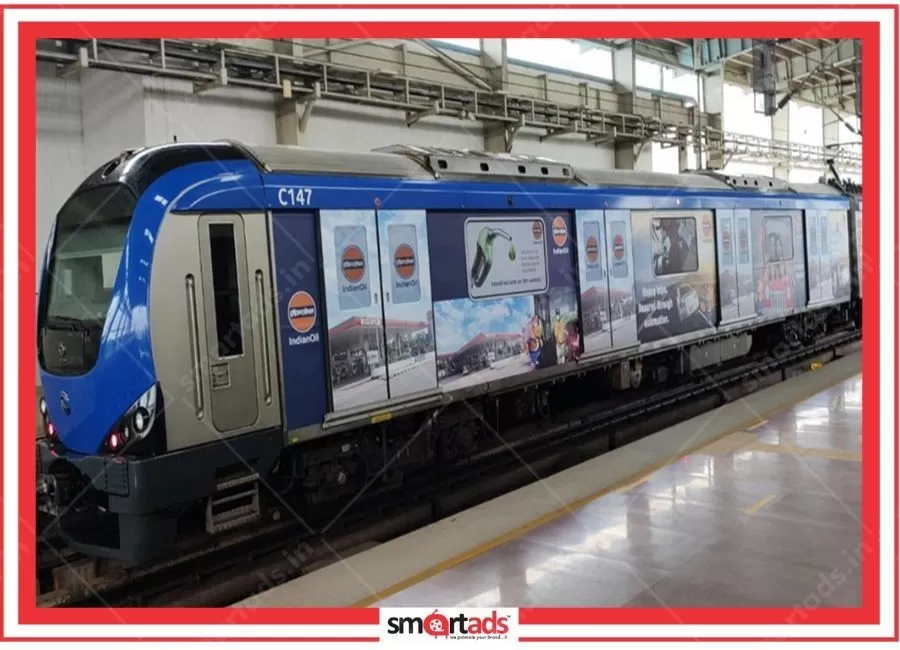
Exterior Metro Wrap
Custom
The advertisement spans the whole train,
Rate per Metro Display Cost / 1 Month
Route : Tirusulam To WIMCO Nagar
₹1000000.00
Showing 1 to 5 of 5 Results
MEDIA DETAILS
Custom
The advertisement spans the whole train,
Rate per Metro Display Cost / 1 Month
Route : Tirusulam To WIMCO Nagar
₹1000000.00
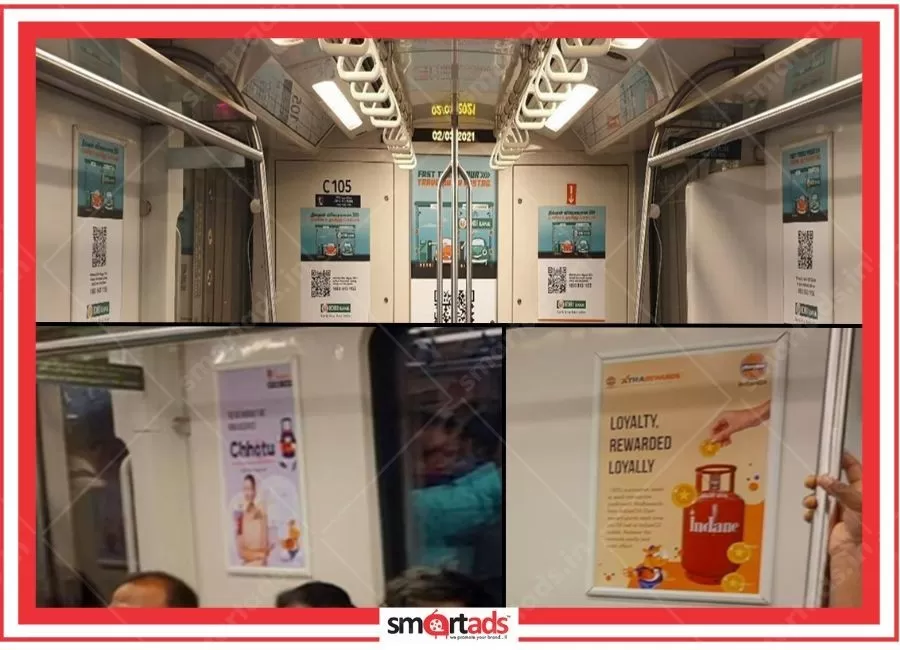
Custom
On the inside of the metro train the adv
Rate per Metro Display Cost / 1 Month
Route : Tirusulam To WIMCO Nagar
₹500000.00
20 Sec Audio
A jingle is a song or a phrase, and the
Rate per Metro Jingle Cost / 1 Month
Route :Tirusulam to WIMCO Nagar
₹400000.00

10 Sec Video
Digital screen on the metro station will
Rate per Metro Digital Display Cost / 1
Route :Tirusulam to WIMCO Nagar
₹600000.00

1 Metro Train
On the outside of the metro train the ad
Rate per Metro Display Cost / 1 Month
Route :Tirusulam to WIMCO Nagar
₹1500000.00
MEDIA REACH

MinimumQty :
1
EstimateReachPeople :
150000000
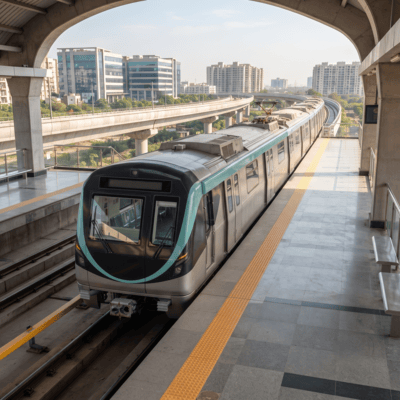
The Aqua Line carries somewhere in the neighbourhood of 35,000 to 40,000 daily commuters through Greater Noida — a number that most brand managers in Delhi-NCR have simply not caught up with yet, which means the advertising inventory here is still priced at a fraction of what comparable metro corridors command in Mumbai or even central Delhi. What makes this particularly interesting is the audience profile: Greater Noida's metro ridership skews heavily toward IT professionals, students from institutions like Sharda and Galgotias, and residents of premium townships like Gaur City and ATS Greens, which is a demographic that most mid-to-premium brands are actively chasing but often overpaying to reach through digital channels.
Frankly speaking, a lot of media planners we speak to lump all metro advertising in NCR into one undifferentiated bucket — they think of the Yellow Line or the Blue Line when they hear "metro advertising," and Greater Noida barely registers. That is a mistake, and we have seen brands pay for it by missing a genuinely captive audience at a time when that audience is not scrolling through Instagram or skipping pre-roll ads. The Aqua Line, operated by NMRC (Noida Metro Rail Corporation), runs from Noida Sector 51 to Depot Station in Greater Noida, covering 21.4 kilometres and 21 stations, which means a commuter travelling end-to-end spends somewhere between 35 and 45 minutes inside a controlled, distraction-limited environment.
The corridor passes through some of Greater Noida's most commercially significant zones — Knowledge Park, Pari Chowk, Alpha, Delta, and the Depot area — which are not just residential catchments but active commercial and institutional hubs. One automotive brand we worked with specifically wanted to reach first-time car buyers in the 25–38 age bracket, and when we mapped the Aqua Line's station footprint against their target geography, the overlap was almost embarrassingly precise. The campaign ran across station domination formats at three key stations for six weeks, and the client's dealership walk-ins from the Greater Noida zone went up by roughly 28% during the campaign period — a figure that held up even after accounting for seasonal variance.
At SmartAds, we always tell our clients that the value of a media format is not just about raw reach numbers; it is about the quality of attention you are buying. A commuter standing on a platform for four minutes, or seated in a coach for twenty minutes, is in a fundamentally different mental state than someone being retargeted on a news website while simultaneously watching a YouTube video. The Greater Noida metro environment is quiet, relatively uncrowded compared to Delhi Metro's busier lines, and the dwell time per passenger is long enough for a brand message to actually land.
The inventory on the Aqua Line covers a wider range of formats than most people expect, which is partly because NMRC has been more open to experimentation than some of the older metro systems. Station branding is the most visible category — this includes platform panels, concourse backlit displays, entry gate wraps, and pillar branding — and these formats work particularly well for brands that want sustained visibility over a campaign period of four to twelve weeks. Train branding, which involves vinyl wraps on the exterior of coaches or interior panel advertising inside the coaches themselves, is a different proposition altogether; it offers a more immersive brand experience and tends to be remembered better, though the production costs are higher.
Digital screens at stations are an increasingly important part of the media mix here; NMRC has been expanding its digital display network, and these screens allow for dynamic creative rotation, which means a brand can run different messages at different times of day without reprinting any physical material. We have found this particularly useful for clients in the quick-service restaurant and e-commerce categories, where time-of-day relevance — breakfast promotions in the morning, delivery app prompts in the evening — makes a meaningful difference to conversion rates. Ticket jacket advertising, fare gate branding, and Wi-Fi login page advertising round out the inventory, each of which serves a slightly different purpose in the media plan.
One format that we think is genuinely underutilised on the Aqua Line is train coach interior domination — where a brand takes over the full interior of a coach, including overhead panels, door stickers, and grab handle branding. A retail client we worked with in the education sector ran this format for eight weeks ahead of their admission season; the creative was designed to look like an immersive classroom, which generated significant organic social media attention as commuters photographed and shared it. The earned media value from that social amplification was something the client had not budgeted for, but it effectively doubled the campaign's reach without adding to the media spend.
This is the question every client asks first, and the honest answer is that rates vary considerably depending on format, duration, and the specific stations or trains involved — but we can give you a realistic ballpark. Station panel advertising at a standard non-prime station on the Aqua Line works out to somewhere between ₹40,000 and ₹80,000 per month per panel, which is a number that consistently surprises clients who have been paying three to four times that for comparable OOH inventory on NH-24 or the Yamuna Expressway. Prime stations — Pari Chowk, Knowledge Park II, and Alpha 1 tend to command premium positioning — carry higher rates, typically in the range of ₹80,000 to ₹1.5 lakh per panel per month, which still represents strong value given the captive audience quality.
Train exterior branding, which involves a partial or full coach wrap, is priced differently because it moves through the entire network rather than sitting at one location; a partial train wrap on the Aqua Line is typically in the ballpark of ₹3 to ₹5 lakh for a four-week period, while a full train takeover — all coaches, both exterior and interior — can go up to ₹12 to ₹18 lakh for a month-long campaign, depending on production complexity. Digital screen advertising, which is sold on a per-spot or per-loop basis, tends to start at roughly ₹15,000 to ₹25,000 per screen per month for a basic rotation, though prime-time slots and high-footfall station screens command premiums. These figures are indicative and subject to NMRC's current rate card, which we always recommend verifying directly or through a media partner before finalising budgets.
What a lot of people miss is that the cost-per-thousand-impressions (CPM) calculation for metro advertising often looks very different from the sticker price. When you divide the monthly panel cost by the number of commuter exposures — accounting for average daily footfall, dwell time, and repeat exposure from regular commuters — the effective CPM for a well-placed Aqua Line panel works out to somewhere between ₹6 and ₹14, which compares favourably with digital display CPMs that have been creeping upward as programmatic competition intensifies. The FICCI-EY Media & Entertainment Report has consistently noted that out-of-home and transit advertising delivers strong cost efficiency when measured against verified audience contacts rather than declared impressions.
The thing is, metro advertising is not equally effective for every category, and we would rather be honest about that than oversell the format. Categories that have consistently performed well on the Aqua Line include real estate (particularly township and residential projects in the Greater Noida and Noida Extension belt), education and coaching institutes, banking and financial services, consumer electronics, quick-service restaurants, and healthcare. What these categories share is a product or service that is relevant to the Aqua Line's core demographic — the working professional or student who commutes regularly and is making active decisions about housing, career, money, and lifestyle.
Real estate brands, in particular, have found the Aqua Line to be a remarkably efficient channel; a housing developer we worked with was targeting buyers for a project in Sector 12, Greater Noida, and ran a six-station domination campaign for ten weeks. The campaign generated over 1,200 site visit inquiries that were directly attributed to the metro creative through a dedicated QR code and phone number, which translated to a cost-per-lead that was roughly 40% lower than what the same client was achieving through Google Search campaigns targeting the same geography. That is not a result we see every time, but it illustrates the kind of efficiency that is possible when the format, audience, and message are well-aligned.
Categories that tend to underperform in this environment include hyper-local services with very narrow geographic relevance (a single restaurant in a sector far from any metro station, for instance) and products that require extensive explanation or demonstration before purchase. The metro environment rewards clarity and visual impact; a brand message that needs three paragraphs of copy to make sense is not going to work on a platform panel, regardless of how good the media placement is. At SmartAds, we spend considerable time with clients on creative strategy before we finalise the media plan, because a well-placed ad with weak creative is still a wasted investment.
Greater Noida's outdoor advertising market includes hoardings along the Yamuna Expressway, the Noida-Greater Noida Expressway, and key arterial roads within the city; it also includes mall advertising at Grand Venice, Omaxe Connaught Place, and Alpha Mall, as well as RWA and society-level activations in the township clusters. Each of these channels has its place, but metro advertising occupies a distinct position because of the dwell time advantage — a hoarding on the expressway is seen for perhaps two to four seconds at highway speed, while a platform panel is seen for four to six minutes by a standing commuter who has nothing else to look at.
The audience targeting precision of metro advertising is also worth noting; because station catchment areas are geographically defined and the ridership profile of specific stations is reasonably well-documented, a brand can make informed choices about which stations to prioritise based on where their target customers live or work. This is something that expressway hoardings simply cannot offer — you know the traffic volume, but you have very limited insight into who those drivers are. Mall advertising offers better audience profiling but typically at significantly higher costs and with shorter dwell times than most brands assume, because mall visitors are in motion and often distracted by the retail environment itself.
To be fair, a genuinely effective Greater Noida OOH campaign often combines metro advertising with one or two complementary formats — a highway hoarding for broad awareness and a metro station domination for deeper engagement, for instance — and we have seen this combination deliver significantly better brand recall scores than either format used in isolation. The GroupM TYNY report on out-of-home advertising has noted that multi-format OOH campaigns consistently outperform single-format buys on brand recall metrics, which aligns with what we observe in our own campaign measurement work.
NMRC's own ridership data, supplemented by IRS (Indian Readership Survey) demographic mapping for the corridor's catchment zones, paints a fairly specific picture of who rides the Aqua Line regularly. The core ridership is concentrated in the 22–45 age bracket, with a significant proportion of IT and BPO sector employees commuting to and from the Knowledge Park and Sector 62 employment clusters; students from the university belt around Knowledge Park I, II, III, and IV add a substantial younger demographic layer, particularly during academic session months. Household income levels in the primary catchment areas — Gaur City, Supertech Eco Village, ATS Greens, Ajnara Homes, and similar townships — tend to skew toward the ₹8 lakh to ₹25 lakh annual range, which puts this audience squarely in the aspirational middle class and upper-middle class segments.
What makes this demographic particularly valuable for advertisers is the combination of income level, digital literacy, and active purchase intent across multiple high-value categories. These are people who are in the process of building lives — buying homes, taking loans, choosing insurance products, upgrading smartphones, enrolling in upskilling courses, and making decisions about family healthcare. The purchase cycle for many of these categories is long and involves multiple touchpoints, which means a brand that establishes awareness through metro advertising and then reinforces it through digital retargeting is working with the grain of how this audience actually makes decisions.
On top of that, regular commuters see the same creative multiple times across a campaign period, which compounds the brand exposure in a way that a single digital impression cannot replicate. BARC's research on media touchpoint effectiveness has consistently shown that repeated exposure in a low-distraction environment builds brand salience more efficiently than equivalent reach delivered through high-distraction digital environments; the metro corridor, with its limited competing stimuli, is about as close to a low-distraction environment as you will find in a major urban market.
Here's where it gets interesting, because the planning process for metro advertising is meaningfully different from planning a digital campaign, and brands that approach it with a digital-first mindset often make avoidable mistakes. The first decision is station selection, which should be driven by a clear understanding of where your target customers are — not just where the highest footfall stations are. A premium housing brand targeting buyers for a project in Sector 1, Greater Noida, will get better results from Alpha 1 and Pari Chowk stations than from Knowledge Park II, even if the latter has higher daily footfall, because the catchment geography is more relevant.
Creative development for metro advertising needs to account for the specific viewing conditions of each format; a platform panel is typically viewed from a distance of three to eight metres by a commuter who is standing or walking, which means the headline needs to be readable at that distance and the visual hierarchy needs to be immediately clear. Interior coach panels are viewed at close range by seated passengers, which allows for more detailed copy and a more nuanced brand story. We always recommend developing format-specific creative rather than adapting a single master creative across all formats — the cost saving is not worth the effectiveness loss, and we have seen this backfire when clients insist on using a digital banner adapted for a 6x4 foot platform panel.
Campaign duration is another planning variable that brands frequently get wrong; a four-week campaign on the metro is often too short to build meaningful frequency among regular commuters, particularly if you are running a single station or a small number of panels. We generally recommend a minimum of eight weeks for a brand-building objective, with twelve weeks being the sweet spot for categories where the purchase decision cycle is longer — real estate, financial services, and education, for instance. For event-driven or promotional campaigns with a specific deadline, four to six weeks can work, but the creative needs to be extremely direct and the call to action needs to be immediately actionable.
NMRC, like all metro rail corporations in India, operates under a set of advertising guidelines that govern what can and cannot be displayed on its network; these guidelines are broadly aligned with the Advertising Standards Council of India (ASCI) code, but there are additional restrictions specific to the metro environment that brands need to be aware of before committing to a campaign. Political advertising is prohibited on the network, as is advertising for tobacco, alcohol, and certain categories of financial products that are not SEBI or RBI regulated. Creative that is considered offensive, sexually suggestive, or likely to cause public disorder is also prohibited, and NMRC reserves the right to reject creative at the approval stage without refund of booking fees.
The approval process itself takes time — typically ten to fifteen working days from creative submission to final approval, which means brands need to build this into their campaign timeline. Production and installation of physical formats adds another five to seven working days, so the practical lead time from campaign confirmation to go-live is somewhere between three and five weeks for most standard formats. Digital screen content can be updated more quickly once the initial approval is in place, which is one of the practical advantages of including digital formats in the media mix. We always advise clients to submit creative for approval before finalising the booking, because discovering a compliance issue after the booking is confirmed creates unnecessary complications.
One area where brands sometimes run into trouble is with claims-based advertising — particularly in the healthcare, education, and financial services categories, where regulatory guidelines around what can be asserted in advertising are quite specific. A coaching institute cannot claim "100% placement guarantee" on a metro panel without supporting documentation; a healthcare brand cannot make disease-cure claims. These restrictions apply across all advertising channels, but they tend to be enforced more consistently in the metro environment because NMRC has a formal review process, whereas a roadside hoarding vendor may not scrutinise creative as carefully.
This is genuinely one of the harder problems in out-of-home advertising, and we think the industry has made more progress on it in the last three years than in the previous decade. The most reliable approach we have found for metro campaigns is a combination of dedicated response mechanisms — QR codes, unique phone numbers, or specific landing page URLs that appear only in the metro creative — combined with pre- and post-campaign brand tracking surveys conducted among the target audience. The QR code approach has become significantly more practical since smartphone penetration among metro commuters is high and the habit of scanning codes has normalised, particularly post-2020.
For clients who are running integrated campaigns across metro and digital channels simultaneously, geo-fenced mobile advertising targeted at users within the station catchment areas can serve as a useful proxy measurement tool; if you see an uplift in digital ad engagement or branded search volume in the Greater Noida geography during the metro campaign period, that is a reasonable indicator of the metro advertising driving upper-funnel awareness. TAM AdEx data, which tracks advertising investment across media categories, can also provide useful context for understanding share-of-voice dynamics in your category during a campaign period. We use a combination of these approaches depending on the client's measurement infrastructure and budget for research.
To be honest, brands that insist on holding metro advertising to the same last-click attribution standard they apply to Google Search are going to be perpetually disappointed — not because the medium is ineffective, but because it operates at a different stage of the purchase funnel. Metro advertising builds awareness and consideration; it is rarely the final touchpoint before a purchase decision. The right question to ask is not "how many direct conversions did this metro campaign generate?" but rather "did brand awareness, consideration, and preference scores move in the target geography during the campaign period?" — and when we frame the measurement question that way, metro advertising consistently justifies its place in the media mix.
Q: How long does it take to book and launch a metro advertising campaign in Greater Noida?
The practical timeline from initial enquiry to campaign going live is typically four to six weeks, which accounts for rate negotiation and booking confirmation, creative development and internal approvals, submission to NMRC for compliance review (which takes ten to fifteen working days), and physical production and installation of materials. Digital screen campaigns can sometimes be launched more quickly once the compliance approval is in place, because there is no physical production lead time; however, the content still needs to go through the same review process. We always recommend starting the planning process at least six weeks before your intended campaign start date, and eight weeks if you are planning a complex multi-format or multi-station execution. Brands that try to compress this timeline often end up with rushed creative or miss their intended launch window entirely, which is an avoidable problem with a little advance planning.
Q: Can small and medium-sized businesses afford metro advertising in Greater Noida, or is it only for large brands?
This is a question we get more often than you might expect, and the honest answer is that metro advertising on the Aqua Line is more accessible to SMEs than most people assume. A single platform panel at a non-prime station for two months can be planned for a total budget — including production — of somewhere between ₹1.5 lakh and ₹2.5 lakh, which is within reach for a well-funded SME or a local business with a specific geographic focus. The key for smaller advertisers is to be very precise about station selection and format choice, concentrating spend on the one or two stations that are most relevant to their customer geography rather than trying to achieve network-wide coverage. We have worked with local education brands, healthcare clinics, and real estate developers in Greater Noida on campaigns in this budget range, and when the station selection and creative are well-executed, the results are competitive with what much larger budgets achieve through less focused approaches.
Q: What is the minimum campaign duration for metro advertising in Greater Noida?
NMRC's standard minimum booking period for most formats is four weeks, which is also the practical minimum for achieving any meaningful frequency among regular commuters. That said, we generally advise clients to think in terms of eight to twelve weeks for brand-building campaigns, because the compounding effect of repeated exposure to regular commuters — who see the same creative multiple times per week — is where the real value of the format lies. For event-driven or promotional campaigns with a hard deadline (a product launch, an admission season, a festive sale period), four to six weeks can be sufficient if the creative is direct and the call to action is clear. There are occasional opportunities for shorter tactical bookings, particularly for digital screen inventory, but these are subject to availability and are not always guaranteed. The general principle is that the longer the campaign runs, the lower the effective cost per impression, because fixed production costs are amortised over a longer period.
Q: How does Greater Noida metro advertising work alongside a digital campaign?
The two channels work best when they are planned together rather than in parallel silos, which is something we emphasise strongly in our integrated planning process. The metro campaign builds broad awareness and top-of-mind salience among the commuter audience; a geo-fenced mobile campaign targeting users within the station catchment areas then reinforces that message in a more interactive, clickable format. Search advertising — particularly branded search and category search terms relevant to Greater Noida — can capture the intent that the metro campaign generates, converting awareness into active consideration. We have seen this three-layer approach — metro for awareness, mobile for reinforcement, search for conversion — deliver significantly better overall campaign efficiency than any single channel used alone, because each layer is doing the job it is best suited for rather than being asked to carry the full weight of the purchase funnel. The creative consistency across channels matters enormously; a commuter who sees your metro panel and then encounters a mobile ad with the same visual language and message is far more likely to engage than one who encounters disconnected creative executions.
Q: Which stations on the Aqua Line get the highest footfall and are best for advertising?
Footfall on the Aqua Line is concentrated at a handful of interchange and terminal stations, with Noida Sector 51 (the interchange with Delhi Metro's Aqua Line), Pari Chowk, Knowledge Park II, and Alpha 1 consistently recording the highest daily passenger volumes. For brands targeting the student and academic community, stations in the Knowledge Park cluster are particularly relevant; for brands targeting residential communities and township residents, Alpha 1, Delta 1, and the Gaur City catchment stations tend to deliver stronger audience relevance. The highest-footfall stations command premium rates, which are not always justified for every brand — a local real estate developer targeting buyers for a specific sector may find that a mid-footfall station adjacent to their project's catchment area delivers better value than a prime station with higher absolute numbers but lower geographic relevance to their specific audience. Station selection is one of the areas where working with an experienced media partner genuinely pays off, because the decision involves nuances that are not visible from a rate card alone.
Q: Does NMRC offer any discounts for long-term or bulk bookings?
Rate negotiations with NMRC, like most government-affiliated media owners in India, are possible but require a degree of persistence and the right relationships; standard rate cards are published, but there is typically some room for negotiation on multi-station, multi-format, or extended-duration bookings. A brand committing to a twelve-week campaign across five stations will generally be in a stronger negotiating position than one booking a single panel for four weeks. Volume discounts in the range of ten to twenty percent are not uncommon for significant bookings, though these are not publicly advertised and are subject to availability and timing. Working through a media agency that has an established relationship with NMRC can be an advantage here, both in terms of rate access and in navigating the approval and production coordination process. We would caution against making rate negotiation the primary decision criterion, however — a slightly higher rate for a better station or format is almost always the right trade-off.
The Greater Noida metro corridor represents one of those relatively rare situations in Indian advertising where the audience quality, the competitive environment, and the pricing have not yet reached equilibrium — which means brands that move now are getting access to a genuinely captive, well-defined, and commercially valuable audience at rates that will not stay this low as the line's ridership continues to grow. NMRC's own projections, as well as the broader trajectory of metro ridership growth documented in the FICCI-EY Media & Entertainment Report, suggest that Aqua Line daily ridership will continue to increase as the Greater Noida township belt matures and as more employers establish operations in the Knowledge Park and Sector 62 clusters.
What we have seen, across the campaigns we have planned and executed on this corridor, is that the brands which do best are the ones that treat metro advertising as a strategic medium rather than a tactical afterthought — they invest in format-appropriate creative, they select stations based on audience geography rather than just footfall numbers, they run campaigns long enough to build genuine frequency, and they integrate the metro buy with complementary digital activity that reinforces and converts the awareness being built. The brands that struggle are the ones that adapt a digital banner for a platform panel, book for four weeks and expect brand-building results, or treat the medium as interchangeable with a roadside hoarding.
The Aqua Line is not the right channel for every brand or every campaign objective, and we would never suggest otherwise; but for brands targeting Greater Noida's growing professional and residential population, it offers a combination of audience quality, dwell time, and cost efficiency that is genuinely difficult to replicate through any other single medium in this geography. If you are planning a campaign in Greater Noida or the broader Noida-Greater Noida corridor and want a media partner who understands the specific dynamics of this market, the team at SmartAds.in works across all formats in this region and can help you build a plan that is grounded in real audience data and practical campaign experience. Reach out at [SmartAds.in](https://smartads.in) for a customised media plan tailored to your brand's objectives and budget.
