
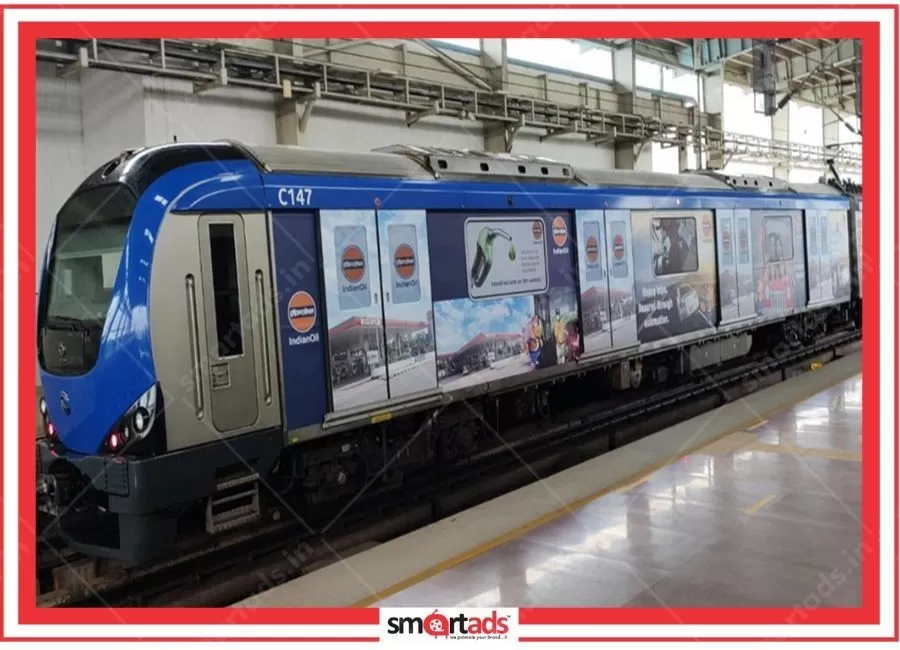
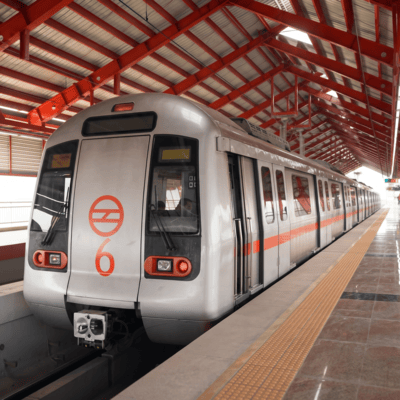
Exterior Metro Wrap
Size & Printing Cost as per actual
On the outside of metro Train, advertise
Rate per Metro Display Cost / 1 Month
Route:Shaheed Sthal To Rithala
₹900000.00
Showing 1 to 4 of 4 Results
MEDIA DETAILS
Size & Printing Cost as per actual
On the outside of metro Train, advertise
Rate per Metro Display Cost / 1 Month
Route:Shaheed Sthal To Rithala
₹900000.00
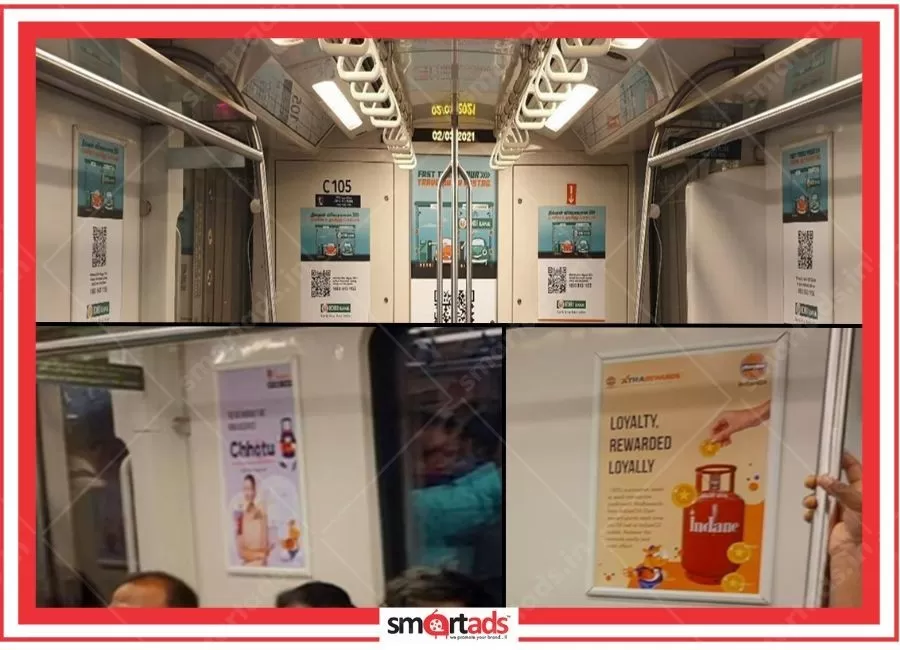
Size & Printing Cost as per actual
On the outside of metro Train, advertise
Rate per Metro Display Cost / 1 Month
Route:Shaheed Sthal To Rithala
₹500000.00
20 Sec Jingle
On the outside of metro Train, advertise
Rate per Metro Display Cost / 1 Month
Route:Shaheed Sthal To Rithala
₹400000.00
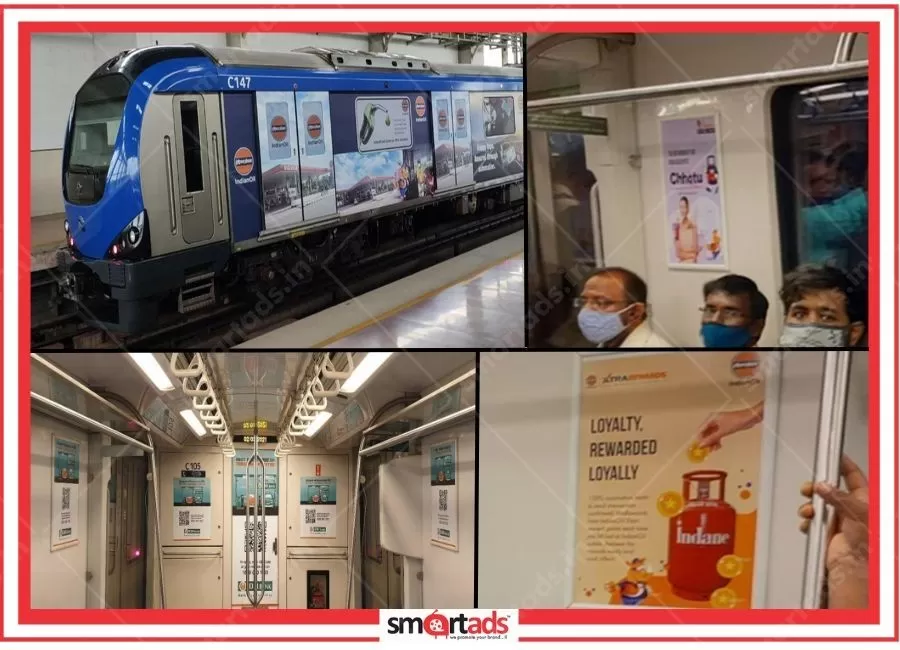
Size & Printing Cost as per actual
On the outside of metro Train, advertise
Rate per Metro Display Cost / 1 Month
Route:Shaheed Sthal To Rithala
₹1200000.00
MEDIA REACH

MinimumQty :
1
EstimateReachPeople :
150000000
The Delhi Metro Red Line carries somewhere in the ballpark of 5 to 6 lakh daily commuters on an average weekday — a number that most brands, frankly speaking, have never properly reckoned with when they are drawing up their BTL advertising budgets. What makes this even more striking is that these are not passive glancers on a highway; they are seated, standing, and waiting in an enclosed environment for anywhere between 15 and 45 minutes per trip, which means your brand gets the kind of sustained attention that outdoor advertising on a flyover simply cannot replicate. At SmartAds, we have found that the Red Line is consistently underestimated by media planners who default to the Yellow or Blue Line without ever running the numbers on what Line 1 actually delivers.
Metro train advertising on the Delhi Red Line is, at its core, a form of transit media that places brand messaging inside or on the exterior surface of operational trains running across Delhi Metro Line 1 — the corridor stretching from Rithala in the northwest to Shaheed Sthal (New Bus Adda) in the east, passing through some of Delhi's most densely populated residential and commercial zones. Unlike station advertising, which captures commuters only at the point of entry or exit, train advertising travels with the audience; the creative goes wherever the train goes, which means a single campaign can generate impressions across the entire 34-kilometre stretch multiple times a day.
The mechanics work through DMRC's non-fare revenue programme, under which the corporation licenses advertising space on its rolling stock to approved vendors and agencies. Brands do not approach DMRC directly in most cases; instead, they work through an advertising agency with DMRC empanelment — which is where an experienced partner becomes genuinely important, because the approval process involves creative compliance checks, material specifications, and installation coordination that can trip up first-time advertisers. The DMRC advertising framework covers everything from interior panel ads and seat-back displays to full exterior train wraps, and the inventory is allocated on a first-come, first-served basis across campaign windows that typically run in 30-day multiples.
What a lot of people miss is that the Red Line's trains are 8-coach formations, which means a single full train branding campaign gives you creative real estate across all eight coaches simultaneously — interior and exterior combined. We have worked with brands that initially budgeted for a two-coach interior campaign and, after seeing the footfall data for this corridor, upgraded to a full train branding package before the campaign went live. The captive audience dynamic on Line 1 is particularly strong because the Rithala to Shaheed Sthal journey takes the better part of an hour end-to-end, which translates into extended dwell time that is genuinely rare in out-of-home advertising.
The Red Line runs through 29 stations in its current configuration, connecting Rithala in Rohini to Shaheed Sthal (New Bus Adda) near Ghaziabad — and the geographic spread of this corridor is, frankly, one of the most compelling arguments for choosing Delhi Metro Line 1 over other lines for certain brand categories. The western end of the line passes through Rohini, one of Delhi's largest planned residential townships, which is home to a substantial middle-class and upper-middle-class population; the eastern end crosses into the Shahdara and Dilshad Garden belt before terminating near the Ghaziabad boundary, which adds a significant NCR dimension to the audience profile.
The interchange stations on this line deserve particular attention from media planners. Kashmere Gate is one of the busiest interchange points in the entire Delhi Metro network, connecting the Red Line with the Yellow Line and the Violet Line; this means footfall at Kashmere Gate is consistently among the highest in the system, and a train branding campaign that passes through this station multiple times daily gets exposure to transferring passengers from two other lines as well. Welcome station connects the Red Line to the Pink Line, and Inderlok serves as the interchange with the Green Line — so the Red Line is, in effect, a spine that feeds into and receives passengers from four other corridors, which dramatically amplifies the effective reach of any train advertising campaign running on it.
From a hyperlocal advertising standpoint, the corridor is unusually rich. Brands targeting Rohini advertising audiences can reach them on the western segment; brands with a north Delhi metro advertising objective benefit from the Kashmere Gate and Inderlok nodes; and brands pursuing ghaziabad metro advertising reach can activate the eastern segment around Dilshad Garden and Shaheed Sthal. At SmartAds, we always tell our clients that the Red Line is not one market — it is three or four distinct audience clusters stitched together by a single train set, which makes it far more versatile than it appears on a route map.
The format menu for metro train advertising in Delhi Red Line is broader than most brand managers realise when they first enquire, and the choice of format has a significant bearing on both the budget and the strategic outcome of the campaign. The most accessible entry point is interior train branding — panel ads placed inside the coaches, which include overhead panels above the doors, side panels along the coach walls, and seat-back displays on the rear of passenger seats. These formats create a high-dwell environment for brand messaging because commuters are physically enclosed with the creative for the duration of their journey.
Beyond interior panels, the Red Line supports window decal advertising, which places branded vinyl on the inside of coach windows; this format is particularly effective for products that benefit from visual storytelling because the creative occupies a large surface area at eye level. Digital screen inside metro coaches is another format that has been gaining traction on this corridor — DMRC has progressively installed digital display units in newer rolling stock, and these screens allow for dynamic content rotation, which is a meaningful upgrade over static panels for brands that want to run multiple messages or time-sensitive promotions. Coach branding, which covers the entire interior of one or more coaches with a unified brand theme, represents the premium end of interior formats and is the format we most often recommend for product launch advertising where maximum impact is the brief.
The exterior formats are where delhi red line advertising gets genuinely spectacular. A full train branding or exterior train wrap covers the outside surface of the coaches with large-format vinyl, effectively turning the train into a moving billboard that generates impressions not just from passengers inside but from pedestrians, motorists, and residents along the elevated sections of the route. The Red Line has significant at-grade and elevated stretches — particularly in the Rohini and Shahdara sections — which means an exterior-wrapped train is visible to a substantial non-commuter audience as well, an aspect of train wrap advertising india that is rarely factored into reach calculations but which we believe adds meaningfully to the total impression count. In-train audio advertising is the newest format on this corridor, and we will address it in its own section because it deserves more than a passing mention.
Interior train branding on the Delhi Red Line operates on a coach-by-coach allocation model, where brands can choose to brand one coach, a set of coaches, or the entire 8-coach train — and the creative specifications are tightly governed by DMRC's content and material guidelines. The standard panel ads inside metro coaches come in fixed dimensions that vary depending on placement: overhead longitudinal panels above the doors run the length of the coach and are among the highest-visibility formats because every standing passenger's sightline naturally falls on them; side wall panels are typically placed at seated eye level and are ideal for longer-copy creative that rewards closer reading.
The material specifications for interior train branding are non-negotiable from a DMRC approval standpoint — all vinyls must be fire-retardant, self-adhesive, and conform to the specific surface dimensions of the coach type in question. The Red Line operates a mix of rolling stock generations, which means the exact panel dimensions can vary slightly between train sets; this is a detail that catches first-time advertisers off guard when their creative arrives at the installation stage and does not fit correctly. Our media planning team at SmartAds always requests the specific coach type confirmation from the vendor before creative production begins, because a mismatch at this stage can delay a campaign by two weeks or more.
Seat-back display metro advertising is a format that deserves more credit than it typically receives in media planning conversations. These are panels affixed to the rear of passenger seats, which means a commuter sitting in any row is effectively looking at brand creative for the entire duration of their journey — a captive audience situation that is arguably more intimate than any other out-of-home format. We have run interior train branding campaigns for ed-tech brands on the Red Line where the seat-back panels carried QR codes linking to course registration pages, and the scan rates were meaningfully higher than what the same brands were seeing from their digital display campaigns, which tells you something important about the quality of attention in a high-dwell environment.
Full train branding on the Delhi Red Line is the format that generates the most conversation in our client meetings, and for good reason — it is the most visually dominant form of transit advertising available in the Delhi NCR market. A full train branding package covers both the interior and exterior of all eight coaches simultaneously, which means the brand is present at every touchpoint: the commuter sees it when the train pulls into the station, again when they board, and continuously throughout their journey inside the coach. The exterior train wrap, which is the outward-facing component of this format, is produced using high-resolution perforated vinyl that adheres to the coach body and windows without obstructing passenger sightlines from inside.
The scale of an exterior train wrap on an 8-coach train is genuinely impressive when you work through the numbers. Each coach is roughly 23 metres long and about 3.2 metres high on the exterior side panels, which works out to something in the ballpark of 73 square metres of brand surface per coach — and across eight coaches, you are looking at a moving billboard with close to 600 square metres of creative space, which is a number that tends to produce a moment of silence in client meetings when we put it that way. The train runs approximately 250 to 300 kilometres per day on the Red Line corridor, which means the exterior wrap generates impressions from pedestrians, motorists, and residents at every station approach, every road crossing, and every elevated section along the Rithala to Shaheed Sthal route.
One thing we have observed from running full train branding campaigns is that the elevated sections of the Red Line — particularly through Rohini and parts of the Shahdara stretch — create a visibility advantage that is not captured in standard commuter reach figures. Residents in high-rise buildings along the corridor can see a branded train from their windows; shopkeepers along elevated road crossings get repeated exposure every time the train passes; and the sheer novelty of a fully wrapped train means that social media photographs taken by commuters and bystanders extend the campaign's reach organically. A real estate transit media client we worked with ran a full train branding campaign on Line 1 for 60 days and reported that their brand awareness scores in Rohini and Shahdara improved by a margin that their agency had not projected from the media plan alone.
In-train audio advertising is the format that most agencies are not yet talking about with their clients, which is precisely why we think it represents one of the more interesting opportunities in the current Delhi metro advertising landscape. DMRC has been progressively rolling out an audio announcement system across its network that allows branded audio messages — typically 10 to 15 seconds in duration — to be played between station announcements inside the coaches. The Red Line's audio inventory is estimated to be in the range of 721 seconds per hour of operational time, which is a figure that becomes significant when you consider that the line operates for roughly 18 hours a day.
The audio format works particularly well for brands whose messaging benefits from repetition and sonic identity — FMCG metro advertising campaigns, for instance, have found that a consistent audio jingle metro placement across a 30-day campaign builds recall in a way that is difficult to achieve through visual formats alone, because the human brain processes audio even when the eyes are occupied with a phone screen or a book. This is the clutter-free advertising advantage of in-train audio: there is no competing brand audio in the environment, and the captive audience has no mechanism to skip or mute the announcement, which is a stark contrast to the digital advertising environment where ad avoidance is the default behaviour.
To be fair, in-train audio advertising is not the right format for every brand — it requires a strong audio creative concept, and the 10 to 15 second window demands economy of language that some brand teams find challenging. We have seen this backfire when clients try to compress a 30-second radio script into the metro audio slot without adapting the creative, resulting in a rushed delivery that leaves commuters more confused than engaged. The brands that have used this format most effectively on the Red Line have been those that treat it as a complement to their interior branding — so the commuter sees the panel ad and then hears the brand's audio cue, which creates a multi-sensory brand recall moment that neither format achieves independently.
Train advertising cost on the Delhi Red Line varies considerably depending on the format, the number of coaches, and the campaign duration — and we want to be upfront that the figures we share here are indicative benchmarks drawn from our agency's active bookings, because DMRC advertising rates are subject to periodic revision and vendor-specific negotiations. That said, giving you a realistic ballpark is more useful than the vague "contact for pricing" approach that most agency pages default to.
For interior train branding covering a single coach on the Red Line, the monthly cost works out to somewhere between ₹1.5 lakh and ₹2.5 lakh depending on the number of panels and the specific formats chosen — overhead panels, side panels, and seat-back displays are priced differently, and a full coach interior takeover sits at the higher end of that range. A 4-coach interior branding package, which is the format we most commonly recommend for brand awareness campaigns with a mid-range budget, typically falls in the ballpark of ₹5 lakh to ₹8 lakh per month, which includes creative production, DMRC approval fees, and installation. These metro advertising rates compare favourably with what a brand would spend on a comparable reach through digital display advertising in the Delhi NCR market, particularly when you factor in the quality of attention rather than just the raw impression count.
Full train branding — interior plus exterior wrap across all 8 coaches — is the premium format, and the monthly investment is typically in the range of ₹18 lakh to ₹30 lakh depending on the extent of the exterior wrap and whether the campaign includes in-train audio advertising as an add-on. The minimum campaign duration for most Red Line train advertising formats is 30 days, though some vendors offer 15-day windows for interior-only campaigns during off-peak booking periods. What is important to understand about train advertising cost on this corridor is that the effective CPM — when you divide the total investment by the number of commuter impressions across the campaign period — works out to roughly ₹8 to ₹12 per thousand impressions, which is a number that surprises most first-time advertisers when they compare it to what they are paying for Instagram reach in the same Delhi NCR geography.
The audience profile of the Red Line is one of the most distinctive in the Delhi Metro network, and understanding it properly is what separates a well-targeted campaign from a generic transit media buy. The western segment of the line — Rithala through Rohini — serves one of Delhi's largest planned residential clusters, with a commuter base that skews heavily toward working professionals, students, and middle-income families; Rohini advertising has historically attracted brands in the banking, insurance, FMCG, and consumer durables categories precisely because the disposable income profile in this zone is well-suited to those product categories.
The central segment, running through Kashmere Gate and into the Shahdara belt, carries a more mixed audience that includes daily commuters from old Delhi's commercial districts, government employees, and a significant student population from the colleges and universities in this corridor. Kashmere Gate, as an interchange station, also draws a large number of transit passengers who are changing lines rather than originating or terminating their journey there — which means the audience at this node is broader and more geographically diverse than the residential segments on either side. The eastern segment, from Welcome through Dilshad Garden to Shaheed Sthal, brings in a meaningful Ghaziabad component; a substantial share of the daily commuters on this stretch originate from Ghaziabad and the surrounding NCR areas, which makes the Red Line one of the few Delhi Metro corridors where a brand can genuinely claim Delhi NCR advertising reach rather than purely intra-Delhi reach.
The working professionals audience on the Red Line is particularly valuable for brands in the ed-tech, fintech, and professional services categories — these are urban commuters who are spending 30 to 60 minutes in transit twice a day, which is time they are often using productively: reading, listening, or thinking. We have found from our campaign post-analyses that brands which align their creative messaging with the aspirational mindset of this audience — career growth, financial planning, skill development — consistently outperform brands that run generic awareness creative on the same inventory.
The case for BTL advertising on the Delhi Metro Red Line rests on a combination of factors that are individually compelling and collectively quite powerful. The first is the captive audience dynamic, which we have already touched on — but it bears repeating that a commuter on an 8-coach train for 40 minutes is in a fundamentally different psychological state from a pedestrian walking past a hoarding or a driver glancing at a billboard. The enclosed environment, the absence of competing media stimuli, and the physical proximity of the brand creative to the audience create conditions for brand recall that out-of-home advertising in open environments simply cannot replicate.
The second factor is the repeat exposure advantage. Daily commuters on the Red Line travel the same route five or six days a week, which means a 30-day campaign generates not one impression per commuter but somewhere between 20 and 25 exposures over the campaign period — and the research on advertising frequency, including data cited in the FICCI-EY Media and Entertainment Report, consistently shows that brand recall improves non-linearly with frequency up to a saturation point that most metro campaigns do not reach. This repeat exposure dynamic is what makes delhi red line advertising particularly effective for brand awareness campaigns where the objective is to move from low awareness to top-of-mind recall.
The third factor — and this is where it gets interesting from a media planning perspective — is the clutter-free advertising environment. Unlike digital advertising, where a user's screen is competing with dozens of other brands in the same session, or outdoor advertising, where a hoarding competes with adjacent hoardings and the visual noise of the streetscape, the interior of a metro coach is a relatively controlled environment where your brand's creative is one of a small number of messages present. The DMRC advertising framework limits the number of brands that can advertise on any given train simultaneously, which means the share of voice for each advertiser is meaningfully higher than in most other media environments. At SmartAds, we position metro train advertising in delhi red line as a high-efficiency BTL channel precisely because of this combination of reach, frequency, and share of voice.
The metro advertising booking process for the Red Line begins with a media brief — format selection, campaign duration, target audience geography within the corridor, and budget range — which then gets translated into a specific inventory proposal by the agency. The agency's role here is to check availability with DMRC-empanelled vendors, confirm which train sets are available for the campaign window, and secure a provisional booking before creative production begins. Campaign booking on the Red Line typically requires a lead time of four to six weeks from brief to installation, which is longer than most digital campaigns but shorter than most clients expect given the scale of the format.
The creative production and DMRC approval process runs in parallel with the booking confirmation. All creative materials for metro train advertising in delhi red line must be submitted to DMRC for content review before production of the final vinyls or audio files — this review checks for compliance with DMRC's content guidelines, which prohibit certain categories of advertising including tobacco, alcohol, and content deemed inappropriate for a public transport environment. The approval process typically takes seven to ten working days, which is why we strongly advise clients to finalise their creative concepts at least three weeks before the intended campaign start date; any revision request from DMRC after the initial submission resets the clock and can push the go-live date back significantly.
Once DMRC approval is secured, the physical installation of interior branding or exterior train wrap is carried out by the empanelled vendor's team during non-operational hours — typically between midnight and 4 AM — to avoid disrupting train services. The installation of a full train branding across 8 coaches typically takes two to three nights, depending on the complexity of the exterior wrap design. At SmartAds, we manage the entire campaign booking process end-to-end for our clients, from vendor coordination and DMRC submission to installation supervision and post-installation photography, because the number of moving parts in a metro train advertising campaign is genuinely substantial and a missed step at any stage can delay the launch or compromise the creative quality.
The DMRC approval process for train advertisements is a step that many brands underestimate in their campaign planning timelines, and it is worth understanding in some detail because the consequences of non-compliance can range from a delayed launch to a rejected campaign. DMRC's advertising guidelines specify not just content restrictions but also technical requirements: the fire-retardancy rating of vinyl materials, the resolution specifications for printed graphics (typically a minimum of 72 DPI at full scale for exterior wraps, and higher for interior panels viewed at close range), and the adhesive specifications that ensure vinyls can be removed without damaging the coach surface.
Content-wise, the prohibited categories under DMRC advertising norms include tobacco products, alcohol and alcoholic beverages, content of a political nature, and any creative that could be deemed offensive or misleading under the Advertising Standards Council of India (ASCI) guidelines. Brands in the real estate category — which is one of the heavier users of real estate transit media on the Red Line — are required to include RERA registration details in their creative, and DMRC's review team checks for this compliance specifically. Financial services brands must ensure that any claims in their creative are compliant with SEBI or RBI guidelines as applicable, and ed-tech brands have faced scrutiny over outcome-based claims in recent years, which is a content risk worth flagging during the creative development stage.
The practical implication of all this is that the DMRC approval process is not a rubber stamp — it is a substantive review that requires the creative to be genuinely compliant, not just superficially so. We have seen campaigns where the client's internal legal team had cleared the creative, but DMRC's review identified a specific claim or visual element that required modification; the two-week delay that followed was entirely avoidable with earlier agency involvement in the creative review process. Our recommendation at SmartAds is always to involve the media planning team in the creative brief stage, not just the execution stage, so that potential compliance issues are identified before the creative goes into production.
Return on investment metro ads is a question that comes up in every client conversation, and frankly speaking, it is a question that the industry has not always answered well — partly because transit media measurement is genuinely more complex than digital attribution, and partly because some agencies have been content to let the reach numbers do the talking without connecting them to business outcomes. Our approach at SmartAds is to establish measurement frameworks before the campaign launches, not after, because the data you need to calculate ROI has to be collected during the campaign period.
The primary metrics for a delhi red line advertising campaign are reach (the number of unique commuters exposed to the campaign over its duration), frequency (the average number of times each commuter was exposed), and brand recall lift (the change in unaided or aided brand recall among the target audience between pre-campaign and post-campaign surveys). Reach for the Red Line can be estimated from DMRC's published ridership data for Line 1, adjusted for the specific stations and segments covered by the campaign; frequency is a function of the campaign duration and the commuting patterns of the target audience. Brand recall measurement requires a primary research component — typically a small-sample survey among commuters on the corridor — which adds cost but provides the most direct evidence of campaign effectiveness.
For clients who want to connect metro train advertising in delhi red line to downstream business metrics, we recommend pairing the campaign with a trackable response mechanism — a QR code on interior panels, a campaign-specific URL, or a promotional code mentioned in the audio advertising — which allows online conversions to be attributed to the metro campaign with reasonable confidence. One FMCG metro advertising client we worked with ran a 45-day interior branding campaign on the Red Line paired with a QR code linking to an e-commerce product page; the QR scan data showed a conversion rate that was roughly three times higher than the same brand's Google Display Network campaigns running simultaneously in the same geography, which is a data point that has stayed with us as evidence of what a captive audience can deliver when the creative and the call-to-action are well-aligned.
The honest answer to "how does Red Line transit advertising compare to other BTL channels?" is that it depends entirely on what the brand is trying to achieve — but there are some structural advantages and disadvantages that are worth laying out clearly. Compared to traditional outdoor advertising on hoardings or unipoles in the same Delhi NCR geography, metro train advertising delivers a fundamentally different audience relationship: a hoarding generates a fraction-of-a-second impression from a moving vehicle, while interior train branding generates minutes of exposure from a stationary audience. The CPM for outdoor advertising in Delhi can be lower in absolute terms, but the effective cost per quality impression — accounting for actual attention and dwell time — tends to favour metro advertising significantly.
Compared to digital advertising on Google or Meta targeting Delhi NCR audiences, metro train advertising in delhi red line offers something that digital cannot: physical presence in a real environment, which carries a credibility and authority that screen-based advertising has been steadily losing as ad fatigue increases. The GroupM TYNY Report has consistently noted that out-of-home and transit advertising are gaining share in media plans precisely because they occupy physical space that digital cannot replicate; for brand awareness campaigns where the objective is to create a sense of scale and presence, a fully wrapped train on the Red Line makes a statement that a digital banner simply cannot. That said, digital advertising offers targeting precision and real-time optimisation that transit media cannot match, which is why we typically recommend running metro train advertising as part of an integrated campaign rather than as a standalone channel.
Against radio advertising in Delhi — which is another BTL channel that targets the commuter audience — metro train advertising has the significant advantage of visual creative, which allows for product imagery, brand colour, and design language to be communicated. Radio reaches a broader geographic audience, but the audience is in motion and often partially distracted; the captive audience on a metro train is, by contrast, in a relatively low-distraction environment. In our experience, the most effective campaigns we have planned for the Red Line have used metro train advertising as the anchor medium, with radio and digital serving as amplification channels that reinforce the same creative message across the commuter's daily journey.
The industries that have historically generated the strongest results from metro train advertising in delhi red line are those whose target audiences overlap significantly with the Red Line's commuter profile — and that list is broader than most brand managers initially assume. FMCG brands have been consistent users of this corridor, particularly in the personal care, packaged foods, and household products categories, because the Red Line's middle-income residential catchment in Rohini and Shahdara aligns well with the mass-market consumer profile that FMCG brands are targeting. The high-frequency exposure that daily commuters receive from interior train branding is particularly well-suited to FMCG brand building, where the objective is to maintain top-of-mind presence rather than drive a single conversion event.
Ed-tech metro ads have grown substantially on this corridor over the past three years, driven by the large student and young professional population in the Rohini and Dilshad Garden segments; brands offering online courses, competitive exam preparation, and professional certification have found the Red Line audience to be highly receptive, particularly when the creative speaks directly to career advancement aspirations. Real estate transit media has also been a significant category on this line — developers with projects in Rohini, Rohini Sector extensions, and the Ghaziabad periphery have used full train branding to reach prospective buyers who are already living in or commuting through the target geography, which is a hyperlocal advertising precision that billboard campaigns in the same area cannot match.
Banking, insurance, and fintech brands have found the working professionals audience on the Red Line to be a valuable segment for product launch advertising and brand awareness campaigns; the dwell time in the high-dwell environment of the metro coach is long enough to communicate a reasonably complex financial product message, which is not something that most outdoor advertising formats can claim. Automobile brands — particularly two-wheeler and entry-level four-wheeler manufacturers — have run coach branding campaigns on the Red Line targeting the aspirational middle-income commuter, and the brand recall data from post-campaign surveys on those campaigns has been consistently strong. To be honest, the category that we think is most underserved on this corridor is healthcare and wellness — the audience profile is right, the dwell time is right, and the clutter-free advertising environment is ideal for a category that benefits from considered messaging.
Q: What is metro train advertising on the Delhi Red Line and how does it work?
Metro train advertising on the Delhi Red Line involves placing brand creative on the interior or exterior surfaces of operational trains running on Delhi Metro Line 1, which connects Rithala to Shaheed Sthal (New Bus Adda) across 29 stations. The advertising is managed through DMRC's non-fare revenue programme, under which approved vendors and agencies license space on the rolling stock; brands work through an empanelled advertising agency, which handles the DMRC approval process, creative compliance, vendor coordination, and physical installation. The format options range from interior panel ads inside coaches to full exterior train wraps, and campaigns typically run in 30-day windows with installation carried out during non-operational hours.
Q: How much does it cost to advertise on the Delhi Metro Red Line in 2026?
The train advertising cost on the Red Line varies by format and scale. A single-coach interior branding package runs somewhere between ₹1.5 lakh and ₹2.5 lakh per month; a 4-coach interior campaign falls in the ballpark of ₹5 lakh to ₹8 lakh per month; and a full train branding package covering all 8 coaches — interior and exterior combined — typically ranges from ₹18 lakh to ₹30 lakh per month depending on the extent of the exterior wrap. These figures include creative production, DMRC approval fees, and installation costs in most agency packages, though it is worth confirming the inclusions with your agency before signing off on the budget.
Q: What advertising formats are available on the Delhi Red Line (Line 1) trains?
The available formats include interior panel ads (overhead longitudinal panels, side wall panels, and seat-back displays), window decal advertising, digital screen inside metro coaches, coach branding (full interior takeover of one or more coaches), exterior train wrap (full or partial), and in-train audio advertising. Each format has specific creative specifications governed by DMRC guidelines, including material requirements, dimension standards, and content compliance criteria. The choice of format depends on the campaign objective: interior formats are best for dwell-time brand building, exterior wraps maximise reach among non-commuters, and audio advertising is most effective for sonic brand recall.
Q: How many coaches does the Delhi Metro Red Line have for branding?
The Red Line operates 8-coach train formations, which means a full train branding campaign covers all eight coaches simultaneously — both interior and exterior. Brands can choose to brand a subset of coaches (one, two, four, or six coaches) for interior-only campaigns, but exterior wraps are typically executed as full-train installations because partial exterior wraps can look visually inconsistent and may not meet DMRC's aesthetic standards for rolling stock presentation.
Q: What is the difference between interior branding and full train branding on the Red Line?
Interior train branding covers only the inside of the coaches — panels, seat-backs, windows, and overhead spaces — and is visible only to passengers who board the train. Full train branding adds an exterior train wrap to the interior campaign, which means the brand is visible both to commuters inside the coaches and to pedestrians, motorists, and residents along the route who see the train passing. Full train branding is the more expensive option but delivers significantly higher total impressions because it captures both the captive interior audience and the much larger external audience along the 34-kilometre corridor.
Q: How do I book a metro train advertising campaign on the Delhi Red Line?
The metro advertising booking process begins with a media brief submitted to an DMRC-empanelled advertising agency, which then checks inventory availability, confirms the campaign window, and secures a provisional booking. Creative materials are submitted for DMRC approval — a process that takes seven to ten working days — and once approval is received, the final vinyls or audio files are produced and installed during non-operational hours. The total lead time from brief to campaign launch is typically four to six weeks, which should be factored into campaign planning timelines.
Q: What is the minimum campaign duration for Red Line metro train advertising?
The metro advertising minimum duration for most formats on the Red Line is 30 days, which aligns with DMRC's standard campaign window structure. Some vendors offer 15-day campaigns for interior-only formats during off-peak booking periods, but these shorter windows are subject to availability and are not guaranteed. We generally recommend a minimum of 45 to 60 days for brand awareness campaigns because the frequency benefits of repeat exposure — which are central to the ROI case for metro train advertising — take time to accumulate across the daily commuter base.
**Q: Which stations on the Delhi Red Line
