
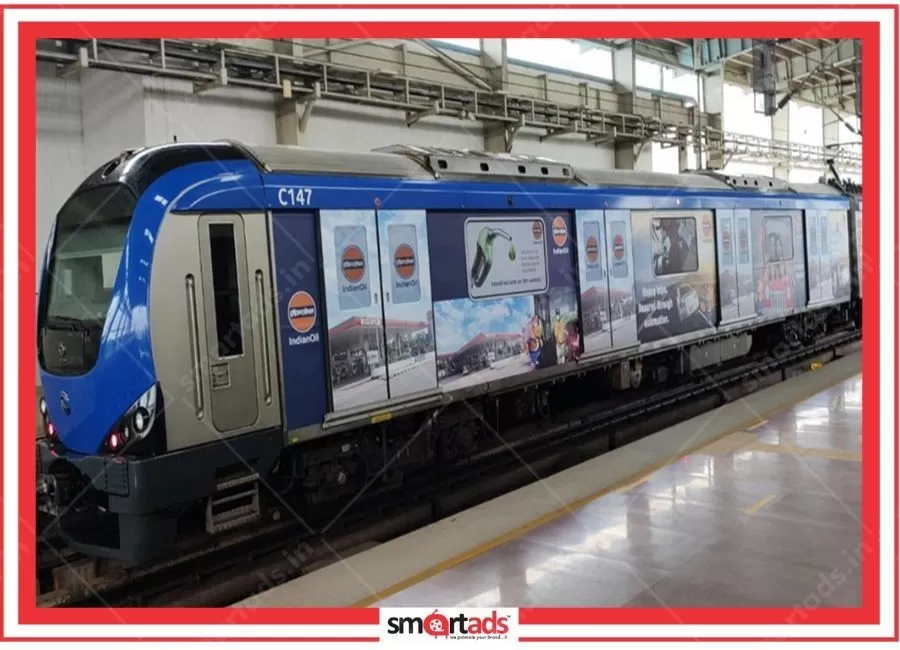
Exterior Metro Wrap
Custom
The advertisement spans the whole train,
Rate per Metro Display Cost / 1 Month
Route : Tirusulam To WIMCO Nagar
₹1000000.00
Showing 1 to 5 of 5 Results
MEDIA DETAILS
Custom
The advertisement spans the whole train,
Rate per Metro Display Cost / 1 Month
Route : Tirusulam To WIMCO Nagar
₹1000000.00
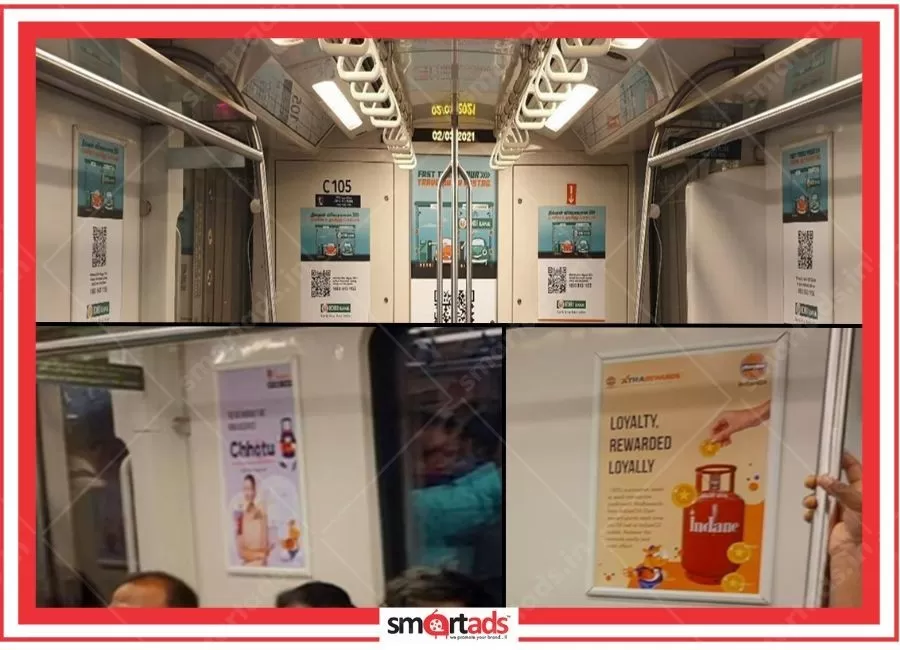
Custom
On the inside of the metro train the adv
Rate per Metro Display Cost / 1 Month
Route : Tirusulam To WIMCO Nagar
₹500000.00
20 Sec Audio
A jingle is a song or a phrase, and the
Rate per Metro Jingle Cost / 1 Month
Route :Tirusulam to WIMCO Nagar
₹400000.00

10 Sec Video
Digital screen on the metro station will
Rate per Metro Digital Display Cost / 1
Route :Tirusulam to WIMCO Nagar
₹600000.00

1 Metro Train
On the outside of the metro train the ad
Rate per Metro Display Cost / 1 Month
Route :Tirusulam to WIMCO Nagar
₹1500000.00
MEDIA REACH

MinimumQty :
1
EstimateReachPeople :
150000000
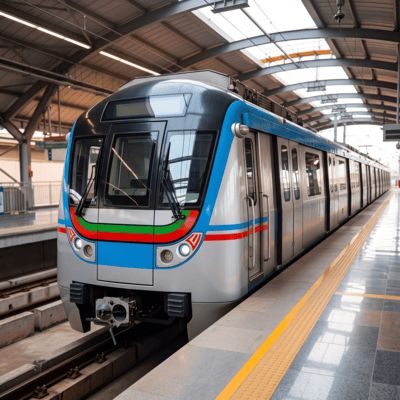
Hyderabad's metro rail system carries somewhere in the ballpark of 4.5 lakh passengers every single day — and that number climbs considerably during peak hours, festive seasons, and when the city's famously gridlocked roads push more commuters underground. What most brand managers underestimate, frankly speaking, is not the reach itself but the quality of that reach: these are urban professionals, IT employees, students, and shoppers who are seated, stationary, and with nowhere else to look for an average dwell time of 22 to 35 minutes per journey. Metro train advertising in Hyderabad is not just another out-of-home format; it is one of the very few advertising environments in India where your brand commands undivided attention at scale.
Most outdoor advertising formats in Hyderabad compete with traffic, sunlight, roadside clutter, and a driver's instinct to watch the road rather than the billboard. Metro advertising operates in an entirely different environment — one that is controlled, clean, well-lit, and designed in a way that makes brand messaging almost impossible to avoid. We have found, across hundreds of transit campaigns we have planned and executed, that brand recall scores from in-train branding Hyderabad consistently outperform equivalent spends on roadside hoardings by a margin that surprises even seasoned media planners.
The Hyderabad Metro Rail network, operated under Hyderabad Metro Rail Limited (HMRL) and built by L&T Metro Rail Hyderabad, spans roughly 69 kilometres across three lines, which makes it one of the longest operational metro networks in India — a distinction that directly translates into advertising scale. A single full train wrap on the Red Line, for instance, travels the entire Miyapur to LB Nagar corridor multiple times a day, functioning as a moving billboard that covers some of the city's most commercially active zones: Ameerpet, Hitec City, Madhapur, Banjara Hills, and the Secunderabad interchange. The sheer geography of that exposure, which no static hoarding can replicate, is what makes transit advertising Hyderabad such a compelling proposition.
On top of that, the audience composition matters enormously for brand targeting. BARC viewership data and IRS readership surveys consistently show that metro commuters in Tier-1 Indian cities skew younger, more educated, and more digitally active than the general urban population — which means that a brand running metro advertising in Hyderabad is not just buying impressions, it is buying impressions from a demographic that is actively making purchase decisions in categories like real estate, consumer electronics, financial services, food delivery, and apparel. At SmartAds, we always tell our clients that the metro is not the cheapest medium in the city, but it is almost certainly the most efficient one when you factor in audience quality alongside raw numbers.
The range of formats available for metro rail advertising Hyderabad is considerably wider than most advertisers realise when they first approach us. The most visible — and consequently the most discussed — is the exterior train branding or full train wrap, where the entire external surface of a metro rake is covered in a brand's creative, turning the train itself into a moving billboard that is seen by pedestrians, motorists, and platform audiences across every station it passes through. A full train wrap on Hyderabad Metro typically covers six to eight coaches, which means the brand impression is delivered not just inside the station but across the entire 69-kilometre network throughout the day.
Interior train branding Hyderabad is, in our experience, where the real value lies for brands that want engagement rather than pure awareness. Inside the coaches, advertisers can book overhead panels, door panels, seat-back cards, grab handle danglers, and full coach branding options, which transform the interior of a coach into an immersive brand environment. One FMCG client we worked with ran a full coach branding campaign during the festive season, covering every available interior surface with a consistent visual narrative; the post-campaign brand recall survey they conducted showed a 34% lift in unaided recall among respondents who identified as metro commuters, which was significantly higher than the recall lift from their simultaneous newspaper insertions.
Beyond the trains themselves, metro station advertising Hyderabad offers its own ecosystem of formats: platform signage, concourse branding, metro pillar advertising, escalator wrap advertising, and digital screen advertising through DOOH panels installed at key stations. LED screen ads are available at major interchange stations like Ameerpet and Hitec City, which see the highest footfall volumes; these DOOH placements allow dynamic content rotation and can be scheduled by time of day, which is a capability that static formats simply cannot offer. There are also audio advertising slots inside stations — a format that almost no competitor agency discusses in depth, but which we have used effectively for brands in the banking and insurance categories, where a 15-second audio message played during peak commute hours reaches a captive audience that is already in a transactional mindset.
The three operational lines of Hyderabad Metro — the Red Line running from Miyapur to LB Nagar, the Blue Line connecting Jubilee Bus Station to Falaknuma, and the Green Line stretching from Nagole to Raidurg via Ameerpet — each serve distinctly different audience profiles, which is something a thoughtful media plan must account for rather than simply booking the cheapest available inventory.
The Red Line is, by ridership volume, the busiest corridor in the network; it passes through Ameerpet, which functions as the primary interchange with the Green Line, and continues through Hitec City and Madhapur — the heart of Hyderabad's IT corridor. For brands targeting technology professionals, young urban consumers, or the startup ecosystem, the Red Line's Miyapur-to-Hitec City stretch is arguably the most valuable transit advertising real estate in Telangana. Station-level footfall data shared by HMRL indicates that Hitec City Metro Station alone handles upwards of 50,000 to 60,000 passenger movements on a typical weekday, which is a number that puts it in the same league as major interchange stations in Delhi and Bangalore.
The Green Line, running from Nagole through Uppal and into Ameerpet before terminating at Raidurg, serves a more mixed demographic — it covers eastern Hyderabad's residential and commercial zones as well as the Banjara Hills and Jubilee Hills corridors, which are among the highest-income neighbourhoods in the city. The Blue Line, connecting Jubilee Bus Station to Falaknuma, covers the older city and the Secunderabad area, which gives it strong reach into traditional retail consumers and the city's large government-employed workforce. At SmartAds, we typically recommend that clients with a city-wide awareness objective book inventory across all three lines, while clients with hyper-local targeting objectives focus their spend on two or three key stations rather than spreading it thin across the entire network.
This is the question that every client asks first, and it is also the question that most agency websites refuse to answer directly — which, frankly speaking, is unhelpful to any media planner trying to build a budget proposal. We will give you real numbers, with the caveat that rates are negotiated with HMRL and L&T Metro Rail Hyderabad and can vary based on campaign duration, season, and inventory availability.
A full train wrap — covering the exterior of an entire rake — works out to somewhere in the ballpark of ₹8 lakh to ₹15 lakh per month, depending on the specific rake, the line it operates on, and whether the campaign falls during a high-demand period like Diwali, IPL season, or state elections. Interior full coach branding, which covers all overhead panels, door panels, and grab handles within a single coach, is priced in the range of ₹1.5 lakh to ₹3.5 lakh per coach per month; a brand looking to dominate a full rake's interior would be looking at a total investment of roughly ₹10 lakh to ₹25 lakh per month, which sounds significant until you calculate what that delivers in terms of captive impressions. The CPM — cost per thousand impressions — for metro train advertising in Hyderabad works out to roughly ₹8 to ₹15, which is a number that genuinely surprises most first-time metro advertisers when they compare it to what they are paying for Instagram reach in the same city, where CPM for quality urban audiences often runs ₹80 to ₹150.
Metro station advertising Hyderabad rates are more modular and accessible: a single platform signage panel at a high-footfall station like Ameerpet or Secunderabad is priced somewhere between ₹40,000 and ₹1.2 lakh per month; metro pillar advertising at concourse level runs in the ₹25,000 to ₹80,000 range per pillar per month; and escalator wrap advertising, which is a high-impact but relatively underutilised format, costs in the ballpark of ₹60,000 to ₹1.5 lakh per escalator per month. For startups and SMBs looking for an entry point, a combination of three to four platform panels at a single key station — say, Hitec City or Madhapur — with a campaign duration of 30 days can be assembled for a total budget of around ₹1.5 lakh to ₹3 lakh, which is a genuinely viable minimum spend for metro advertising in Hyderabad.
To be honest, we have seen this question answered too narrowly by most agencies, which tend to list only large consumer brands. The reality is that the Hyderabad Metro's audience composition makes it relevant for a far wider range of advertisers than the conventional wisdom suggests. Real estate developers, for instance, have been among the most consistent users of metro rail advertising Hyderabad — and with good reason, because the metro's catchment areas overlap almost perfectly with the city's most active residential micro-markets; a developer launching a project in Kondapur or Gachibowli would find the Hitec City and Madhapur stations to be extraordinarily efficient at reaching the exact income profile that buys 2BHK and 3BHK apartments in that corridor.
Educational institutes — from engineering colleges and MBA programmes to edtech platforms and coaching centres — have found metro advertising for educational institutes to be particularly effective during the January-to-March admission season, when the captive audience of students and young professionals on the metro is actively thinking about career and education decisions. One edtech client we worked with ran a 45-day campaign combining interior train branding Hyderabad with platform signage at six stations along the Red Line; they reported a 28% increase in website traffic from Hyderabad during the campaign period, with a significant portion of that traffic attributable to QR code scans from their in-coach panels — which brings us to an important point about measurability that we will address in a later section.
Metro advertising for FMCG brands, financial services companies, and healthcare providers has also grown substantially since 2022, as the network's ridership recovered and surpassed pre-pandemic levels. The daily commuters who use Hyderabad Metro are not a passive audience; they are actively engaged with their environment in a way that roadside hoarding viewers rarely are, and brands that understand this tend to invest in creative that invites interaction — QR codes, AR-enabled panels, and contest mechanics — rather than simply displaying a logo and a tagline. Metro advertising for startups is an area we are particularly enthusiastic about at SmartAds, because the format's modularity means a well-funded startup can achieve city-scale brand visibility for a fraction of what a television or newspaper campaign would cost.
The honest answer is that it depends entirely on what you are trying to achieve — but the comparison almost always favours metro advertising when the objective is urban brand visibility among a defined, high-quality audience. A standard 40x20 feet hoarding on the Hyderabad Outer Ring Road might cost ₹2 lakh to ₹4 lakh per month and deliver somewhere between 1.5 lakh and 3 lakh daily impressions, but those impressions are fleeting — a driver passing at 60 kilometres per hour has perhaps two to three seconds of exposure, which is barely enough to register a brand name, let alone a message. Metro advertising in Hyderabad, by contrast, delivers that same audience in an enclosed environment for 22 to 35 minutes, which is a fundamentally different quality of exposure that effective frequency research consistently validates as superior for brand recall.
The comparison with digital advertising is equally instructive. Programmatic display and social media campaigns in Hyderabad can deliver enormous impression volumes at low CPMs, but viewability rates for digital display in India hover around 50 to 60 percent according to industry measurement standards — meaning roughly half of all digital impressions are never actually seen by a human being. Metro advertising has a viewability rate that is, by definition, close to 100 percent; a panel inside a metro coach is seen by every passenger in that coach, for the entire duration of their journey, with no ad blocker and no scroll-past option. The GroupM TYNY Report has consistently highlighted out-of-home advertising's resilience and effectiveness as a complementary medium to digital, and transit-oriented advertising specifically tends to punch above its weight in brand recall studies.
Where traditional OOH advertising genuinely outperforms metro rail advertising Hyderabad is in sheer geographic spread — a network of 50 hoardings across the city covers more physical territory than the metro's three lines. But for advertisers who care about audience quality, dwell time, and the ability to deliver a complex brand message rather than a simple visual cue, transit advertising Hyderabad offers something that no hoarding network can match. We have found, across campaigns where clients ran simultaneous metro and hoarding buys, that the metro component consistently delivered higher brand association scores even when the hoarding component delivered more raw impressions.
The booking process for metro train advertising in Hyderabad involves working through HMRL-authorized channels, which is a distinction that matters more than most advertisers realise. There are a significant number of brokers and intermediaries in the Hyderabad market who claim to offer metro advertising inventory but are not formally authorized by Hyderabad Metro Rail Limited or L&T Metro Rail Hyderabad; campaigns booked through unauthorized brokers frequently encounter creative rejection, delayed installation, and in some cases, removal of materials mid-campaign without refund. Working with an authorized metro advertising agency Hyderabad is not just a convenience — it is a protection for your budget and your campaign timeline.
The formal process, as we execute it at SmartAds, involves five distinct stages. First, the inventory is confirmed and booked with the relevant HMRL-authorized concessionaire, with a booking period that typically requires 15 to 21 days of lead time for standard formats and 30 to 45 days for full train wraps, which require more complex installation logistics. Second, the creative artwork is submitted for HMRL approval — this is a step that trips up many first-time metro advertisers, because the approval process has specific technical requirements around file format, resolution, content guidelines, and size specifications that differ from standard OOH production specs. Creative design approval from HMRL typically takes seven to ten working days, which must be factored into the campaign timeline.
Third, once creative is approved, the materials are produced and installed — exterior train wraps require specialized vinyl application teams and are typically installed overnight to avoid disruption to operations; interior panels are installed during maintenance windows. Fourth, a post-installation audit is conducted to verify that all materials are correctly placed and in good condition; this is a step that many agencies skip but which we consider non-negotiable, because installation errors caught early can be corrected before the campaign goes live. Fifth, campaign monitoring continues throughout the flight, with periodic checks to ensure that materials remain in good condition — vinyl wraps on exterior surfaces are subject to weather and cleaning, and any damage should be flagged and addressed promptly. End-to-end execution of this kind, from booking through to campaign closure and reporting, is exactly what a proper metro advertising agency Hyderabad should be providing.
The industries that have historically dominated Hyderabad Metro advertising inventory are real estate, education, banking and financial services, and consumer durables — and there are structural reasons for each of these that go beyond simple category affinity. Real estate advertising on the metro works because the purchase decision for a home is one of the highest-involvement decisions a consumer makes, which means it benefits enormously from repeated exposure in a high-attention environment; a commuter who sees the same project advertised on their daily journey for 30 days is far more likely to visit a site office than one who saw a single digital ad.
The education sector's affinity for metro advertising in Hyderabad is driven by the network's demographic alignment with the student and young professional audience, which is the primary target for everything from engineering entrance coaching to MBA programmes to upskilling platforms. Banking and financial services brands use the metro's captive audience to communicate complex product messages — insurance plans, mutual fund schemes, home loan offers — that require more than three seconds of attention to register. Consumer durables and electronics brands, particularly those launching new products, have found the full train wrap format to be an exceptionally effective launch vehicle, because the visual impact of a branded train arriving at a platform creates a moment of genuine brand theatre that no static format can replicate.
Emerging categories that we are seeing grow their metro advertising spends in Hyderabad include food delivery platforms, healthcare and diagnostics chains, gaming and entertainment apps, and EV brands — all of which share a target audience that is young, urban, digitally active, and concentrated in exactly the corridors that the Hyderabad Metro serves. One automotive brand we worked with — specifically, an EV two-wheeler company — ran a train wrap advertising Hyderabad campaign on the Red Line for 60 days, combined with platform activations at Hitec City and Ameerpet; the campaign generated over 1.2 crore estimated impressions and drove a measurable spike in test ride bookings from the catchment areas around those stations, which the client tracked through geo-tagged booking data from their app.
Exterior metro branding and interior train branding Hyderabad demand fundamentally different creative approaches, and conflating them is one of the most common mistakes we see brands make when they first enter this medium. Exterior train branding — whether it is a full train wrap or a partial coach panel — is consumed in motion, from a distance, often by people who are themselves moving; the creative must therefore work at a glance, with a single dominant visual, a brand name that reads clearly at 20 to 30 metres, and minimal copy. The most effective exterior wraps we have executed have been those with bold colour fields, large-format product imagery, and a single call to action — not the ones that try to communicate five brand messages simultaneously.
Interior train branding Hyderabad operates under entirely different conditions: the viewer is seated or standing within two to three metres of the panel, has 20 to 35 minutes to engage with it, and is in a mental state that is receptive to detailed information. This is the environment where longer copy, QR codes, AR triggers, and multi-panel narrative storytelling work exceptionally well; we have executed campaigns where a brand told a sequential story across six overhead panels in a single coach, with each panel building on the previous one, which created an almost editorial experience for commuters. The integration of QR codes into interior panels has become standard practice, and we have seen scan rates of 2 to 5 percent of estimated coach occupancy — which, across a month-long campaign on a busy line, can translate into tens of thousands of qualified website visits.
Platform signage and concourse branding occupy a middle ground between these two extremes: they are seen by commuters who are walking, which means dwell time is shorter than in-coach but longer than exterior exposure; creative for these formats should be bold enough to stop a moving viewer but detailed enough to reward the few seconds of attention that a platform audience will give. Digital screen advertising and LED screen ads at stations like Ameerpet, Hitec City, and Secunderabad allow for dynamic content that can be updated in real time, which is particularly valuable for promotional campaigns with changing offers or countdown mechanics. DOOH at metro stations is, in our view, one of the most underutilised formats in the Hyderabad market — the inventory is limited, which keeps demand high, but the brands that do book it tend to see exceptional engagement.
Measuring return on investment from metro train advertising in Hyderabad requires a more sophisticated approach than simply counting impressions, and this is an area where we see a lot of brands fall short — not because the medium is unmeasurable, but because the measurement framework needs to be designed before the campaign launches, not after. The most basic measurement layer is impression estimation, which is calculated from HMRL ridership data — roughly 4.5 lakh daily passengers across the network — combined with the specific inventory booked; a full train wrap on the Red Line, for instance, is estimated to generate somewhere between 8 lakh and 12 lakh impressions per day when you account for both on-board passengers and platform audiences who see the exterior.
Beyond raw impressions, the measurement tools available for metro advertising in Hyderabad have become considerably more sophisticated in recent years. QR code tracking on interior panels provides direct attribution for digital actions — website visits, app downloads, form fills — that can be tied back to the metro campaign with a high degree of confidence; this is a capability that static hoardings simply cannot offer. Geo-fenced mobile advertising can be layered onto a metro campaign to retarget users who have been physically present at specific metro stations, which creates a phygital loop that amplifies the metro investment with digital precision. One retail client we worked with in Hyderabad used this approach during a 45-day campaign: they ran interior branding across the Red Line combined with geo-fenced mobile retargeting at Hitec City, Madhapur, and Ameerpet stations; the combined campaign delivered a 19% increase in store footfall from the metro catchment areas, which they measured through their loyalty programme data.
Brand recall measurement, which is the most direct indicator of whether a metro campaign has achieved its awareness objective, is typically conducted through pre- and post-campaign surveys among metro commuters; we have found that well-executed metro campaigns in Hyderabad generate unaided brand recall lifts of 15 to 35 percent among regular commuters, which is a range that compares favourably with television and print recall benchmarks from the same markets. The FICCI-EY Media Report has repeatedly highlighted transit advertising's growing share of the OOH segment, driven precisely by this combination of measurability and audience quality; and as footfall tracking technologies — including Bluetooth beacon networks and Wi-Fi analytics at metro stations — become more widely deployed by HMRL, the attribution capabilities available to metro advertisers will only improve.
Q: What is metro train advertising in Hyderabad and how does it work?
Metro train advertising in Hyderabad refers to the placement of brand messaging across various surfaces and formats within the Hyderabad Metro Rail network — including the exterior and interior of metro trains, station platforms, concourses, pillars, escalators, and digital screens. The network is operated under Hyderabad Metro Rail Limited (HMRL) with infrastructure built and managed by L&T Metro Rail Hyderabad, and all advertising inventory is managed through HMRL-authorized concessionaires. Advertisers work with an authorized metro advertising agency Hyderabad to select formats, book inventory, get creative approved by HMRL, and manage installation and monitoring throughout the campaign duration. The medium works by placing brand messages in front of a captive audience of daily commuters who are enclosed in the metro environment for an average of 22 to 35 minutes per journey, which creates a dwell time that no other out-of-home format in the city can match.
Q: How much does metro train advertising in Hyderabad cost?
Metro advertising cost Hyderabad varies significantly by format and scale. A full train wrap — covering the entire exterior of a metro rake — is priced somewhere in the range of ₹8 lakh to ₹15 lakh per month; interior full coach branding works out to roughly ₹1.5 lakh to ₹3.5 lakh per coach per month; platform signage at high-footfall stations runs between ₹40,000 and ₹1.2 lakh per panel per month; and metro pillar advertising is priced in the ballpark of ₹25,000 to ₹80,000 per pillar per month. Advertising rates Hyderabad metro are influenced by the specific station or line, campaign duration, and seasonal demand. For startups and smaller brands, a viable entry-level campaign — three to four platform panels at a key station for 30 days — can be assembled for ₹1.5 lakh to ₹3 lakh total.
Q: What are the different advertising formats available on Hyderabad Metro trains?
The formats available for metro rail advertising Hyderabad span a wide spectrum. On the trains themselves, exterior train branding options include full train wraps and partial coach panels; interior formats include overhead panels, door panels, seat-back cards, grab handle danglers, and full coach branding. At stations, advertisers can book platform signage, concourse branding, metro pillar advertising, escalator wrap advertising, digital screen advertising via DOOH panels, and LED screen ads at major stations. Audio advertising slots inside stations are also available, which is a format that very few brands have explored but which delivers a uniquely captive impression during peak commute hours.
Q: Which metro lines in Hyderabad are best for advertising – Red, Blue, or Green?
The Red Line, running from Miyapur to LB Nagar and passing through Ameerpet, Hitec City, and Madhapur, is the busiest and most commercially valuable corridor for most advertisers, particularly those targeting IT professionals and young urban consumers. The Green Line, from Nagole to Raidurg via Ameerpet, serves a mixed demographic including the Banjara Hills and Jubilee Hills corridors, which are the city's highest-income zones. The Blue Line, connecting Jubilee Bus Station to Falaknuma via Secunderabad, reaches the older city and a more traditional retail consumer base. For city-wide campaigns, all three lines should be covered; for hyper-local targeting, the choice of line should be driven by the geographic concentration of the target audience.
Q: Which metro stations in Hyderabad get the highest footfall for advertising?
Hitec City Metro Station and Ameerpet Metro Station consistently rank as the highest-footfall stations in the network, with Hitec City handling upwards of 50,000 to 60,000 passenger movements on a typical weekday. Madhapur, Secunderabad, LB Nagar, Miyapur, and Raidurg are also high-traffic stations that offer strong metro station advertising Hyderabad opportunities. Ameerpet is particularly strategic because it is the interchange point between the Red and Green lines, which means it captures commuters from both corridors simultaneously — making it arguably the single most valuable station in the network for brand visibility.
Q: How do I get HMRL approval to advertise on Hyderabad Metro trains?
HMRL creative approval is a formal process that requires submission of artwork in specified file formats and resolutions, compliance with content guidelines that prohibit certain categories of advertising (including political content and some competitive messaging), and review by HMRL's designated authority. The process typically takes seven to ten working days from submission. Working with an HMRL-authorized metro advertising agency Hyderabad is the most reliable way to navigate this process, because an experienced agency will prepare the creative submission in the correct format and flag any compliance issues before submission, which avoids the delays associated with rejection and resubmission.
Q: Is metro train advertising in Hyderabad suitable for small businesses and startups?
Yes, and this is something we feel strongly about at SmartAds. Metro advertising for startups is genuinely viable at entry-level budgets of ₹1.5 lakh to ₹3 lakh per month, which can deliver meaningful brand visibility at a specific high-footfall station like Hitec City or Ameerpet. The key for smaller advertisers is to concentrate spend rather than spread it thin — three to four panels at one strategic station will deliver better results than a single panel each at ten different stations. The modular nature of metro station advertising Hyderabad means that startups can begin with a single format and scale up as they see results.
Q: How long should a metro advertising campaign in Hyderabad run for best results?
Effective frequency research in transit advertising consistently shows that a minimum campaign duration of 30 days is needed to build meaningful brand recall among regular commuters, who may travel the same route three to five times per week. A 45 to 60 day campaign is the range we most commonly recommend for brand awareness objectives, because it ensures that the average commuter on the target route sees the brand messaging enough times to move from awareness into consideration. For product launches or time-sensitive promotions, shorter bursts of 15 to 21 days can be effective when combined with other media, but as a standalone medium, metro advertising rewards sustained presence.
Q: What is the reach and audience size of Hyderabad Metro Rail advertising?
Hyderabad Metro Rail Limited's network carries an estimated 4 to 4.5 lakh passengers per day under normal operating conditions, with that number rising to 5 to 6 lakh on peak days during festive seasons and major events. A full network campaign — covering trains and stations across all three lines — can generate estimated impressions in the range of 1.2 crore to 1.5 crore per month, which places it among the highest-reach single-city OOH buys available in Telangana. The audience skews urban, educated, and between 22 and 45 years of age, which is a demographic profile that aligns well with most consumer brand targets.
Q: How does metro advertising in Hyderabad compare to hoardings and digital ads in terms of ROI?
The CPM for metro train advertising in Hyderabad — roughly ₹8 to ₹15 per thousand impressions — compares very favourably with digital display CPMs of ₹80 to ₹150 for quality urban audiences in the same market. Compared to hoardings, metro advertising delivers a fraction of the geographic spread but many times the dwell time per impression, which translates into significantly higher brand recall scores. The return on investment calculation ultimately depends on the campaign objective: for pure reach, hoardings may offer more cost-efficient impressions; for audience quality, dwell time, and brand recall, metro advertising in Hyderabad is consistently the superior choice.
Q: Can I do exterior train wrap advertising on a single coach or must I book the full train?
Both options are available, though full train wrap bookings are more common and more impactful. Single-coach exterior branding is available and is a more accessible entry point for brands that want exterior visibility without the investment of a full rake wrap; the visual impact is naturally lower, but the cost is proportionally reduced. Full coach branding on the interior, covering all panels within a single coach, is a popular mid-range option that delivers an immersive brand environment for a fraction of the full-rake interior cost.
Q: What industries benefit most from advertising on Hyderabad Metro trains?
Real estate, education, banking and financial services, consumer durables, FMCG, healthcare, food delivery, and EV brands have all demonstrated strong results from metro rail advertising Hyderabad. The common thread is that these categories either benefit from repeated exposure to a high-quality urban audience (real estate, financial services) or have a target demographic that is concentrated in the metro's catchment areas (IT professionals, students, young urban consumers). Metro advertising for real estate and metro advertising for educational institutes are particularly well-established use cases in the Hyderabad market.
Q: How do I measure the success of my metro train advertising campaign in Hyderabad?
Measurement approaches include QR code tracking on interior panels (for direct digital attribution), geo-fenced mobile retargeting and analytics (for footfall and behaviour data), pre- and post-campaign brand recall surveys among commuters, and business outcome metrics like website traffic, store footfall, and sales lift from the metro catchment areas. DOOH placements at stations also offer audience measurement data through the platform's own analytics. A well-designed measurement framework should be established before the campaign launches, with baseline metrics captured in advance so that lift can be accurately calculated.
Q: What is the minimum budget required to start a metro advertising campaign in Hyderabad?
The practical minimum budget for a meaningful metro advertising campaign in Hyderabad is somewhere around ₹1.5 lakh to ₹2 lakh for a 30-day campaign using platform signage at a single key station. Below this level, the inventory options become very limited and the campaign impact is difficult to sustain. For brands that want to combine station advertising with in-train formats, a realistic starting budget is in the ₹3 lakh to ₹5 lakh range per month, which allows for a combination of interior panels and platform signage at two to three stations along a single line.
Q: Are there digital screen advertising options inside Hyderabad Metro stations?
Yes — digital screen advertising and LED screen ads are available at major Hyderabad Metro stations, particularly at high-footfall interchange stations like Ameerpet, Hitec City, and Secunderabad. These DOOH placements allow dynamic content rotation, time-of-day scheduling, and in some cases, real-time content updates, which makes them particularly valuable for promotional campaigns with changing offers. The inventory for digital screens at metro stations is limited relative to demand, which means early booking is advisable for campaigns timed around peak seasons.
There is a version of this conversation
