
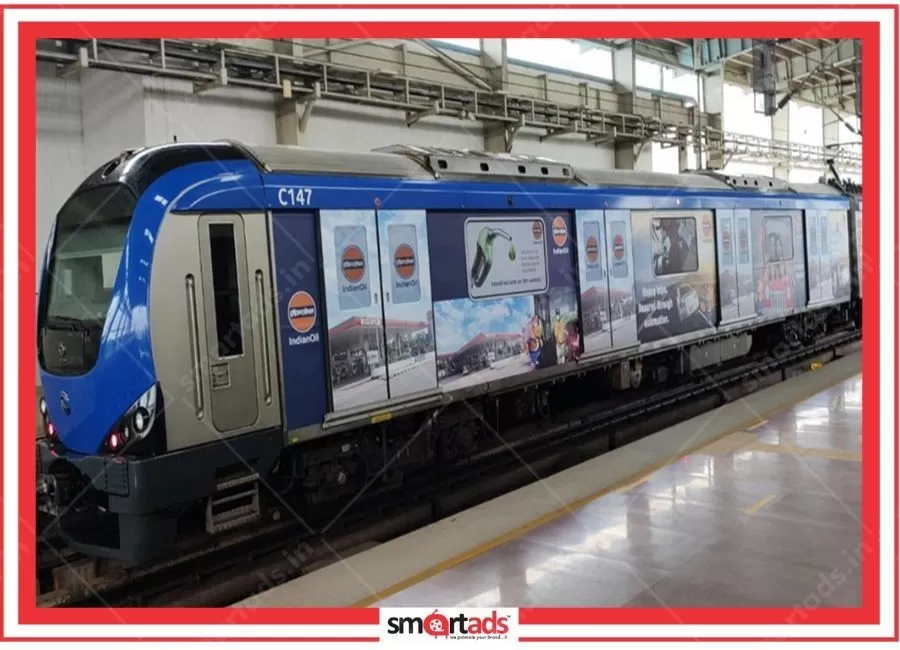
Exterior Metro Wrap
Custom
The advertisement spans the whole train,
Rate per Metro Display Cost / 1 Month
Route : Tirusulam To WIMCO Nagar
₹1000000.00
Showing 1 to 5 of 5 Results
MEDIA DETAILS
Custom
The advertisement spans the whole train,
Rate per Metro Display Cost / 1 Month
Route : Tirusulam To WIMCO Nagar
₹1000000.00
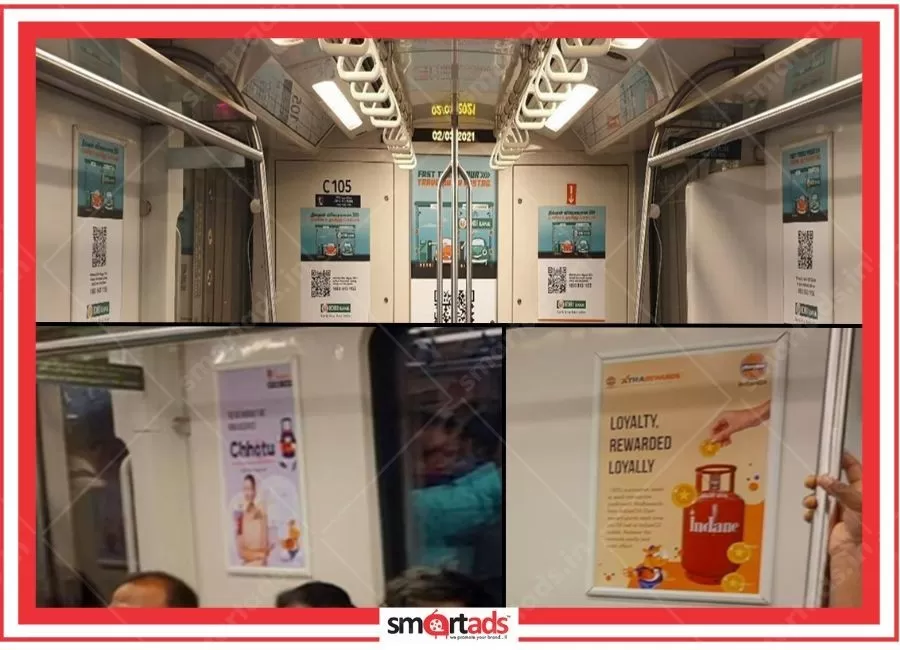
Custom
On the inside of the metro train the adv
Rate per Metro Display Cost / 1 Month
Route : Tirusulam To WIMCO Nagar
₹500000.00
20 Sec Audio
A jingle is a song or a phrase, and the
Rate per Metro Jingle Cost / 1 Month
Route :Tirusulam to WIMCO Nagar
₹400000.00

10 Sec Video
Digital screen on the metro station will
Rate per Metro Digital Display Cost / 1
Route :Tirusulam to WIMCO Nagar
₹600000.00

1 Metro Train
On the outside of the metro train the ad
Rate per Metro Display Cost / 1 Month
Route :Tirusulam to WIMCO Nagar
₹1500000.00
MEDIA REACH

MinimumQty :
1
EstimateReachPeople :
150000000
Most brands that approach us for non-traditional advertising in Hyderabad are surprised to learn that Secunderabad — not Hitech City, not Banjara Hills — sits at one of the most strategically valuable intersections in the entire metro network. The daily commuter volume moving through Secunderabad's metro stations creates a captive audience that few other out-of-home advertising environments in Telangana can match. What makes this even more interesting is that the audience profile skews heavily toward working professionals, defence personnel, government employees, and upwardly mobile urban consumers — exactly the demographic that most advertisers are chasing but rarely reaching efficiently through traditional OOH advertising.
Metro train advertising in Secunderabad is, at its core, the practice of placing brand communications across the physical and digital surfaces of the Hyderabad Metro Rail network as it serves the Secunderabad corridor — which includes station environments, train exteriors, in-coach spaces, platform infrastructure, and digital screens. But that clinical description undersells what actually happens when a well-executed campaign runs on this network. What you are really doing is inserting your brand into the daily rhythm of tens of thousands of daily commuters who have nowhere else to look, no skip button, and no way to scroll past your message.
The operational framework works through Hyderabad Metro Rail Limited (HMRL) and its concessionaire, L&T Metro Rail Hyderabad Limited (L&TMRHL), which controls all commercial advertising rights across the network. Brands cannot directly approach station managers or train operators; instead, advertising is booked through authorised media buying agencies — which is where a metro advertising agency like SmartAds becomes essential to the process. The agency coordinates with the authorised advertising partners of L&TMRHL, submits creative materials for HMRL approval, handles compliance documentation, and manages the physical installation of materials, whether that is a vinyl wrap on a train exterior or a static panel inside a coach.
The mechanics of how a campaign actually runs are worth understanding in some detail, because the process differs meaningfully from booking a roadside hoarding. Once a format is selected — say, in-coach advertising across a set of coaches on the Blue Line — the creative must be submitted for HMRL approval, which typically takes somewhere between seven and fourteen working days depending on the complexity of the format and the current approval queue. Installation is then scheduled during non-operational hours, usually between midnight and 4 AM, which means the campaign goes live cleanly without disrupting service. Our experience shows that brands which factor this lead time into their campaign calendar — rather than treating it as an afterthought — consistently achieve better launch alignment with their marketing cycles.
Secunderabad sits at a genuinely unusual position in the Hyderabad Metro network, because it is served by two separate metro lines rather than one — a fact that most advertisers miss entirely when they first start planning a campaign here. The Blue Line, officially designated as the Nagole–Raidurg corridor, passes through Secunderabad East metro station; the Green Line, running from JBS Parade Ground to MG Bus Station, serves Secunderabad West metro station as well as JBS Parade Ground metro station, which is the northern terminus of that line. This dual-line configuration means that a brand advertising specifically in the Secunderabad geography is actually reaching two distinct commuter flows with somewhat different demographic profiles.
Secunderabad East metro station, sitting on the Blue Line Hyderabad Metro, draws heavily from commuters travelling toward Ameerpet, HITEC City, and Raidurg — which means the audience skewing through this station trends toward IT professionals, corporate employees, and young urban consumers making the daily journey from residential areas in and around Secunderabad toward the western employment hubs of Hyderabad. Secunderabad West metro station, on the Green Line Hyderabad Metro, connects toward Begumpet and eventually MG Bus Station, which serves a somewhat different mix of government employees, traders, students, and inter-city travellers who are also using Secunderabad Junction Railway Station nearby. The JBS Parade Ground metro station, as the Green Line terminus, sees particularly high footfall during peak hours because it functions as a transfer point for TSRTC bus commuters as well.
What a lot of people miss is that advertising on both lines simultaneously — which is entirely possible within a single campaign — creates a frequency of exposure effect that is genuinely difficult to replicate through any other transit advertising or OOH advertising format in Hyderabad. A commuter who lives near Secunderabad and works in HITEC City will encounter your brand at Secunderabad East station in the morning, possibly again on the Blue Line train, and potentially at JBS Parade Ground if they are connecting onward. That repeated impressions pattern, built into the natural commute structure, is where the real value lies in metro train advertising in Secunderabad.
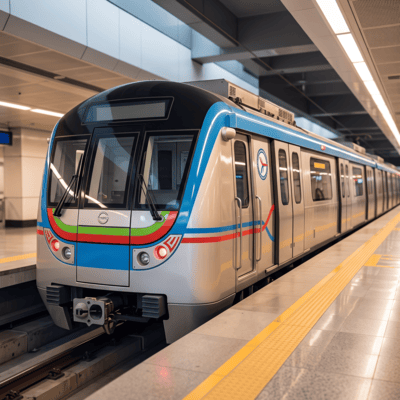
The range of formats available across the Hyderabad Metro network is considerably wider than most brands realise when they first enquire, and the choice of format has a dramatic impact on both cost and campaign effectiveness. Train wrap advertising — where a vinyl wrap is applied to the exterior of an entire metro coach or multiple coaches — is arguably the most visually arresting format available, functioning essentially as a moving billboard that travels the full length of the Blue Line or Green Line multiple times each day. A full coach branding execution on the Hyderabad Metro creates an impression count that compounds with every station stop, because the train is visible to platform audiences at every station it passes through, not just the stations where you have bought static panel space.
Inside the train, in-coach advertising takes several distinct forms, each with its own dwell time characteristics. Seat back panels are placed directly in the sightline of seated passengers and benefit from the fact that average journey times on the Hyderabad Metro work out to somewhere between twelve and twenty-five minutes depending on origin and destination — which is a dwell time that most digital advertising formats would envy. Door wraps, which cover the interior-facing surfaces of coach doors, are seen by both seated and standing passengers and create a particularly high-frequency exposure for commuters who position themselves near the doors. Overhead panels and full coach interior branding — where ceiling strips, window decals, and multiple interior surfaces are wrapped simultaneously — create what we describe to clients as a "brand immersion" experience, where the commuter is effectively inside your advertisement for the duration of their journey.
At the station level, the format options expand further into platform signage, escalator branding, entry exit zone advertising, and pillar wraps. Metro pillar advertising in Secunderabad is particularly effective at Secunderabad East and Secunderabad West stations because the pillar structures at these stations are positioned along high-footfall walking paths, meaning that the static panel is seen not just by waiting passengers but by every person moving through the station concourse. Digital OOH screens at Secunderabad metro stations add a dynamic layer to the format mix, allowing brands to run time-sensitive creative, rotate multiple messages, and even respond to contextual triggers — a feature that is increasingly being used by retail brands running day-part specific promotions.
Frankly speaking, this is the question that most brand managers lead with, and it is also the question that is most poorly answered by most sources online — which either give vague ranges or simply say "contact for pricing." We will do better than that here, while being honest about the fact that final rates depend on network availability, campaign duration, and negotiation through an authorised metro advertising agency.
For in-coach advertising on the Hyderabad Metro, seat back panels typically cost somewhere in the ballpark of ₹80,000 to ₹1.5 lakh per coach per month, which works out to a CPM that surprises most first-time advertisers when they compare it to what they are paying for Instagram reach — because the metro CPM is often lower when you account for the genuine dwell time and the absence of competing messages in the same physical space. Full coach branding, which covers all interior surfaces of a single coach, is priced considerably higher, generally in the range of ₹3 lakh to ₹6 lakh per coach per month depending on the line and the specific coach position within the train consist.
Train wrap advertising — the exterior vinyl wrap that turns the entire coach into a moving billboard — commands a premium that reflects its visibility impact; a single coach exterior wrap on the Blue Line Hyderabad Metro is typically priced somewhere between ₹5 lakh and ₹12 lakh per month, with full train wraps covering multiple coaches running proportionally higher. Metro station advertising rates for platform signage and pillar wraps at high-footfall stations like Secunderabad East and Secunderabad West tend to start at around ₹50,000 to ₹1.2 lakh per panel per month for static formats, while digital OOH screens at Secunderabad metro stations are priced on a per-slot basis, with monthly packages for a reasonable share-of-voice working out to roughly ₹1.5 lakh to ₹3 lakh depending on screen location and daypart targeting. It is worth noting that these metro advertising rates are indicative benchmarks based on our agency experience; actual rates are subject to HMRL concessionaire pricing at the time of booking, and volume negotiations for multi-format or multi-month campaigns can bring effective costs down meaningfully.
The Hyderabad Metro Rail network, before the disruptions of 2020-21, was consistently recording daily ridership figures in the range of four to five lakh passengers across the full network — a number that has been recovering steadily and, according to HMRL operational data, has been trending back toward and in some corridors beyond pre-pandemic levels. The Secunderabad stations specifically — Secunderabad East on the Blue Line and Secunderabad West along with JBS Parade Ground on the Green Line — collectively account for a meaningful share of this daily volume, given that Secunderabad functions as a major interchange node connecting metro travel with Secunderabad Junction Railway Station and TSRTC bus services.
What makes the ridership figure particularly valuable for advertisers is not just the raw number but the demographic composition of the audience. Secunderabad's commuter profile is weighted toward SEC A and SEC B households — working professionals, government and defence employees, students from the city's numerous educational institutions, and retail consumers from the densely populated residential areas of Marredpally, Trimulgherry, and Bowenpally that feed into the Secunderabad metro catchment. This is an urban audience with disposable income, brand awareness, and active purchase decision-making — which is precisely why metro train advertising in Secunderabad delivers a quality of audience that raw footfall numbers alone do not fully capture.
At SmartAds, we always tell our clients that reach in transit advertising is not a single-exposure metric — it is a compounding one. A campaign running for thirty days on the Blue Line Hyderabad Metro will reach the same core commuter group repeatedly, building brand recall through repeated impressions in a way that a single roadside hoarding simply cannot replicate. The FICCI-EY Media and Entertainment Report has consistently highlighted transit advertising as one of the fastest-growing segments within the broader OOH advertising ecosystem in India, and our own campaign data supports the finding that metro environments deliver brand recall scores that are meaningfully higher than equivalent-spend roadside formats.
The comparison between metro train advertising and conventional billboard or hoarding advertising in Secunderabad is one we have this conversation about regularly, and the answer is more nuanced than a simple "metro wins." The fundamental difference lies in the nature of the audience's attention. A driver passing a hoarding on the Secunderabad-Hyderabad highway has perhaps three to five seconds of peripheral exposure to your message, is simultaneously managing traffic, and is in a mental state that is not particularly receptive to advertising. A metro commuter, by contrast, is stationary or near-stationary, has no driving task competing for attention, and is in a physical environment where your brand communication is one of very few stimuli available — which creates a dwell time advantage that is structurally impossible to replicate in roadside OOH advertising.
The captive audience dynamic is the core argument for metro branding over traditional out-of-home advertising, but there are secondary advantages that also matter. Metro train advertising in Secunderabad is not subject to the visibility variables that affect hoardings — weather, tree growth, competing structures, or the simple fact that a driver's sightline may not align with the panel. In-coach advertising is seen by every passenger in that coach, period. Platform signage is seen by every person waiting on that platform. The frequency of exposure is also structurally higher in a metro environment, because the same commuter uses the same route daily, meaning your brand message is encountered not once but potentially twenty to twenty-five times over a month-long campaign — a frequency of exposure figure that would require significant additional spend to achieve through roadside OOH advertising.
To be fair, hoardings and billboards in Secunderabad have their own strengths — they reach vehicular traffic that does not use the metro, they are visible to pedestrians across a wider geographic radius, and large-format roadside executions can create a visual impact that even a full train wrap cannot match in terms of sheer size. Our recommendation, which is based on what we have seen work across dozens of campaigns in the Hyderabad market, is that the most effective strategy is not metro versus hoarding but metro plus hoarding, with the metro doing the frequency and recall work while large-format OOH advertising handles geographic breadth and top-of-mind awareness.
This is a distinction that almost no competitor page addresses, and it is genuinely important for advertisers who want to target specific audience segments rather than simply buying presence on "Secunderabad metro" as an undifferentiated geography. Secunderabad East metro station sits on the Blue Line Hyderabad Metro, which runs the Nagole–Raidurg corridor — one of the busiest and most commercially significant lines in the Hyderabad Metro network because it connects eastern residential areas with the western IT and commercial belt. The commuter profile at Secunderabad East therefore skews heavily toward IT professionals, young working adults, and corporate employees who are making the daily east-to-west journey toward Ameerpet, HITEC City, and the financial district.
Secunderabad West metro station, on the Green Line Hyderabad Metro, serves a different commuter flow — one that is more mixed in terms of occupation and purpose of travel. The Green Line connects JBS Parade Ground to MG Bus Station, passing through Begumpet, which means it carries a significant share of government employees, students, traders, and inter-city travellers who are using the metro as a feeder to Secunderabad Junction Railway Station or the central bus terminus. Advertising at Secunderabad West and JBS Parade Ground metro station therefore reaches an audience that is somewhat broader in demographic terms but potentially very well-suited for categories like financial services, educational institutes, healthcare, and FMCG brands targeting a mass urban consumer.
The practical implication for media planning is that a brand with a specific target audience should choose its Secunderabad station mix deliberately rather than defaulting to whichever station has available inventory. A real estate developer targeting IT professionals and young families would logically weight their spend toward Secunderabad East and the Blue Line corridor toward HITEC City; a coaching institute or healthcare brand targeting a broader urban demographic would find Secunderabad West and JBS Parade Ground metro station more aligned with their audience. At SmartAds, we map this station-audience fit as a standard part of our metro advertising planning process, and it consistently improves campaign efficiency compared to undifferentiated station-level buying.
The booking process for metro train advertising in Secunderabad is more structured than most first-time advertisers expect, and understanding the sequence upfront saves a significant amount of time and prevents the creative rework that tends to derail campaign timelines. The process begins with format selection and availability confirmation — because metro advertising inventory, particularly for premium formats like train wraps and full coach branding, is limited and can be booked out weeks or months in advance, especially around festival seasons and major retail events.
Once the format and duration are confirmed, the creative development phase begins, and this is where HMRL's approval requirements become relevant. Hyderabad Metro Rail Limited mandates that all advertising creatives comply with specific guidelines around content (no political, religious, or controversial messaging), format specifications (resolution, bleed margins, material specifications for vinyl wraps), and brand category restrictions. The creative submission goes to the authorised advertising partner of L&TMRHL, which then routes it through the HMRL approval process — a timeline that, in our experience, typically runs between seven and fourteen working days for standard formats, though complex executions like full train wraps or digital OOH content may take longer. Brands that submit clean, compliant creatives on the first attempt consistently get faster approvals; brands that need revision rounds can lose two to three weeks in the process.
After approval, installation is scheduled and executed during non-operational hours, with the campaign going live at the next operational opening. For a brand planning a campaign around a product launch or a seasonal event, we recommend building in a minimum of three to four weeks of lead time from the point of brief to campaign go-live — which accounts for format confirmation, creative development, HMRL approval, and installation scheduling. The minimum campaign duration for most metro advertising formats in Secunderabad is typically one month, though some digital OOH screen packages offer shorter durations; multi-month bookings of three months or more generally attract better effective rates and are worth considering for brands that are building sustained brand awareness rather than running a one-off burst campaign.
The honest answer is that metro train advertising in Secunderabad is not equally well-suited to every category, and we have seen campaigns underperform when the brand-audience fit was not properly thought through at the planning stage. The categories that consistently deliver the strongest return on investment in our experience are those whose target consumers overlap substantially with the Secunderabad metro commuter profile — which, as established, skews toward educated, urban, working adults with meaningful disposable income.
Metro advertising for real estate brands has been particularly effective in the Secunderabad corridor, because the commuter audience includes exactly the income group that is actively evaluating residential and commercial property purchases in Hyderabad. A residential project in Kompally, Alwal, or Medchal — areas that are geographically proximate to Secunderabad — can reach its precise target buyer through Blue Line and Green Line advertising in a way that is difficult to achieve through digital targeting alone. Metro advertising for educational institutes is similarly well-suited, given the significant student population using Secunderabad metro stations; coaching institutes, engineering colleges, and MBA programmes have all run effective campaigns in this corridor. Metro advertising for retail brands — particularly fashion, electronics, and lifestyle categories — benefits from the fact that metro commuters are active consumers who are making purchase decisions regularly and who respond to brand visibility in their daily environment.
Metro advertising for startups is an area where we have seen interesting results, particularly for fintech, health-tech, and consumer app brands that are trying to build brand awareness among an urban, digitally literate audience. One fintech startup we worked with ran a three-month in-coach advertising campaign across the Blue Line Hyderabad Metro, targeting the Secunderabad to HITEC City corridor; the campaign generated a brand recall lift that the client measured through their own app download attribution, and the cost per acquired user worked out to be roughly forty percent lower than their concurrent digital acquisition campaigns. That is not a universal result, but it illustrates the kind of efficiency that is possible when the audience-format fit is right.
Hyderabad Metro Rail Limited, as the government entity overseeing the metro rail system in Telangana, maintains regulatory oversight of all commercial advertising on the network — which means that advertising on the Hyderabad Metro is not a purely commercial transaction but one that involves a layer of public-sector compliance. The approval framework exists to ensure that advertising content is appropriate for a public transit environment, that installation does not compromise passenger safety or the structural integrity of metro assets, and that the overall commercial environment of the stations remains consistent with the brand standards that HMRL has established for the network.
The practical implications of this regulatory framework for advertisers are several. First, certain categories of advertising are restricted or prohibited entirely — these include political advertising, content that could be considered religiously sensitive, tobacco and alcohol advertising, and content that does not meet HMRL's content standards. Second, all creative materials must be submitted in specific technical formats, with vinyl wraps requiring particular material specifications to ensure adhesion quality and removability without damage to train surfaces. Third, the approval process is not instantaneous; brands that treat the HMRL approval step as a formality and build their campaign timelines without accounting for it frequently find themselves scrambling to adjust launch dates.
What we tell our clients at SmartAds is that the HMRL approval process, while it adds a step to the campaign timeline, is also a quality filter that benefits advertisers in the long run. Because the approval process screens out low-quality or inappropriate advertising, the overall advertising environment on the Hyderabad Metro remains relatively premium — which means that your brand is not appearing alongside content that would undermine its positioning. The regulatory framework, in other words, is part of what makes Hyderabad Metro advertising a credible brand-building environment rather than a cluttered one.
Train wrap advertising and in-coach advertising are the two most frequently confused formats in metro train advertising, and the confusion is understandable because both involve the physical train — but they target entirely different audience moments and create very different brand experiences. A train wrap is an exterior execution: a vinyl wrap applied to the outside surface of one or more coaches, which transforms the entire train into a moving billboard that is visible to anyone who sees the train — platform audiences at every station, pedestrians near elevated sections of the track, and even people in nearby buildings along the metro corridor. The audience for a train wrap is therefore much larger than just the passengers inside the train; it includes every person who visually encounters the train during its operational day.
In-coach advertising, by contrast, is an interior execution — seat back panels, door wraps, overhead strips, window decals, or full coach interior branding — which is seen exclusively by the passengers who are inside that specific coach. The audience is smaller in absolute terms but the quality of engagement is dramatically higher, because these passengers are in a captive environment with your brand for the full duration of their journey. The dwell time for in-coach advertising on the Hyderabad Metro averages somewhere between fifteen and twenty-five minutes for most commuter journeys, which is a sustained exposure period that creates genuine brand recall rather than the momentary impression of exterior or roadside formats.
The strategic choice between train wrap advertising and in-coach advertising depends on the campaign objective. If the goal is maximum reach and brand awareness — getting the brand name and visual identity in front of as many people as possible — then a train wrap on the Blue Line Hyderabad Metro, travelling the full Nagole to Raidurg corridor multiple times daily, is an extraordinarily efficient moving billboard. If the goal is message comprehension, call-to-action response, or detailed product communication — where the audience needs time to read and absorb the message — then in-coach advertising with its extended dwell time is the more appropriate choice. Many of the most effective campaigns we have planned combine both: the exterior wrap for reach and brand recognition, the interior panels for message depth and conversion intent.
Digital OOH screens at Secunderabad metro stations represent one of the most underutilised formats in the Hyderabad Metro advertising ecosystem, and frankly speaking, that underutilisation is an opportunity for brands that are willing to look beyond the traditional static panel. DOOH advertising screens are installed at multiple points within the Secunderabad East and Secunderabad West station environments — concourse areas, platform waiting zones, and entry exit zones — and they offer capabilities that static formats simply cannot match: dynamic creative rotation, day-part targeting, real-time content updates, and the ability to run multiple brand messages within a single campaign.
The day-part targeting capability of DOOH advertising at Secunderabad metro stations is particularly valuable for brands whose message relevance varies by time of day. A quick-service restaurant brand, for instance, might run breakfast messaging during the 7-9 AM peak commute, lunch promotions during the midday off-peak, and evening dining creative during the 6-8 PM return journey — all within the same campaign buy, without any additional production cost beyond the creative variants. This kind of contextual relevance is something that static platform signage cannot deliver, and it is one of the reasons that digital OOH screens at metro stations are commanding growing interest from retail and FMCG advertisers who previously focused exclusively on traditional formats.
The integration of digital metro advertising with broader digital marketing campaigns is an area where we have seen particularly interesting results. One retail client we worked with in the Secunderabad market ran a campaign that combined DOOH advertising at Secunderabad East station with a QR code-based activation — the DOOH screen displayed a dynamic offer, and commuters who scanned the QR code received a personalised discount that was redeemable at the client's nearby store. The campaign generated a measurable footfall lift that was directly attributable to the metro activation, and the cost per store visit worked out to be considerably lower than the client's previous digital-only acquisition campaigns. The convergence of physical transit advertising and digital activation is, in our view, where the most interesting innovation in metro branding is happening right now.
Return on investment measurement for metro train advertising in Secunderabad is an area where the industry has historically been weaker than digital advertising, but the measurement landscape has improved considerably and there are now several credible methodologies for quantifying the impact of a metro advertising campaign. Brand recall studies — where a sample of metro commuters is surveyed before and after a campaign to measure unaided and aided recall of advertised brands — consistently show that in-coach advertising on the Hyderabad Metro delivers recall scores in the range of forty to sixty percent for campaigns that run for a minimum of four weeks, which is a figure that compares favourably with equivalent-duration television or digital campaigns targeting the same demographic.
The ROI calculation for metro train advertising needs to account for the full value of the exposure, not just the immediate conversion. Metro branding builds brand equity over time through repeated impressions, and the compounding effect of a commuter encountering your brand twenty or more times over a month-long campaign creates a familiarity and trust that influences purchase decisions over a longer horizon than most digital attribution models capture. The GroupM TYNY Report and Dentsu e4m Report have both highlighted the growing recognition among Indian advertisers that transit advertising generates brand equity effects that are systematically undervalued when measured purely through last-click or short-window attribution models.
One automotive brand we worked with ran a six-week in-coach advertising campaign on the Blue Line Hyderabad Metro, specifically targeting the Secunderabad to HITEC City corridor, which they had identified as a high-concentration zone for their target buyer profile. Post-campaign brand tracking showed a twenty-eight percent lift in unaided brand recall among metro commuters in the target corridor, and the brand's dealership in Secunderabad reported a measurable increase in walk-in enquiries during the campaign period that correlated with the metro advertising activity. The client's conclusion — and ours — was that the metro campaign had delivered a brand recall and consideration impact that their concurrent digital spend had not achieved at comparable cost, particularly among the premium urban audience segment that the metro corridor was reaching.
Q: What is metro train advertising in Secunderabad and how does it work?
Metro train advertising in Secunderabad refers to the placement of brand communications across the advertising surfaces of the Hyderabad Metro Rail network as it serves the Secunderabad area — covering train exteriors through vinyl wraps, interior coach spaces through seat back panels and door wraps, station environments through platform signage and pillar wraps, and digital screens through DOOH advertising installations. The process works through Hyderabad Metro Rail Limited (HMRL) and its concessionaire L&T Metro Rail Hyderabad Limited, which manages all commercial advertising rights on the network. Brands book campaigns through authorised metro advertising agencies, which handle creative submission, HMRL approval, installation coordination, and campaign monitoring. The key operational characteristic that distinguishes metro advertising from other OOH formats is the captive audience dynamic — commuters inside a metro coach or waiting on a platform have sustained, uninterrupted exposure to advertising messages for the duration of their dwell time, which creates brand recall conditions that roadside or digital formats rarely replicate.
Q: Which metro lines and stations cover Secunderabad for advertising purposes?
Secunderabad is served by two metro lines, which gives it a unique dual-line coverage that most other stations in the Hyderabad Metro network do not have. The Blue Line Hyderabad Metro, running the Nagole–Raidurg corridor, passes through Secunderabad East metro station; the Green Line Hyderabad Metro, running from JBS Parade Ground to MG Bus Station, serves Secunderabad West metro station and JBS Parade Ground metro station. For advertising purposes, this means that a brand can choose to advertise on one or both lines depending on their target audience — the Blue Line skews toward IT and corporate commuters travelling toward HITEC City and Ameerpet, while the Green Line serves a broader mix of government employees, students, and inter-city travellers connecting through Secunderabad Junction Railway Station. Campaigns can be structured to cover both lines simultaneously for maximum Secunderabad coverage, or targeted to a single line for audience-specific efficiency.
Q: What are the different advertising formats available on Hyderabad Metro trains in Secunderabad?
The format options span exterior and interior train surfaces as well as station environments. On the train exterior, train wrap advertising uses vinyl wraps to cover the outside of coach bodies, creating a moving billboard visible to platform audiences at every station and to anyone who sees the train in transit. Inside the coach, in-coach advertising formats include seat back panels, door wraps, overhead strip panels, window decals, and full coach branding that covers multiple interior surfaces simultaneously. At the station level, formats include platform signage, metro pillar advertising, escalator branding, entry exit zone advertising, and digital OOH screens at Secunderabad metro stations. Each format has distinct audience characteristics — exterior wraps maximise reach, interior formats maximise dwell time and message depth, station formats capture commuters in the pre-boarding and post-alighting moments when purchase intent and local relevance are often highest.
Q: How much does metro train advertising in Secunderabad cost?
Metro advertising rates in Secunderabad vary significantly by format, duration, and network demand. Indicative benchmarks based on our agency experience: seat back panels in in-coach advertising typically run in the range of ₹80,000 to ₹1.5 lakh per coach per month; full coach branding covering all interior surfaces is generally somewhere between ₹3 lakh and ₹6 lakh per coach per month; train wrap advertising for a single coach exterior is typically in the ballpark of ₹5 lakh to ₹12 lakh per month; and platform signage or pillar wrap formats at Secunderabad stations start at roughly ₹50,000 to ₹1.2 lakh per panel per month. Digital OOH screen packages at Secunderabad metro stations are priced on a per-slot or monthly share-of-voice basis, generally starting at around ₹1.5 lakh per month for a meaningful presence. Multi-format and multi-month campaigns attract negotiated rates that can improve effective CPM meaningfully, and this is where working with an experienced metro advertising agency like SmartAds pays off in terms of both rate negotiation and format selection.
Q: What is the daily ridership and reach of the Hyderabad Metro in Secunderabad?
The Hyderabad Metro Rail network was recording daily ridership in the range of four to five lakh passengers across the full network before 2020, and ridership has been recovering steadily toward and in some corridors beyond those levels since. Secunderabad's metro stations — Secunderabad East, Secunderabad West, and JBS Parade Ground — collectively account for a significant share of this daily volume given Secunderabad's role as a major interchange node. The reach figure for a metro advertising campaign in Secunderabad compounds over the campaign duration, because the same commuter population encounters the campaign repeatedly — a thirty-day campaign at Secunderabad East station, for instance, will generate repeated impressions across the same core audience of daily commuters, building brand recall through frequency of exposure in a way that single-exposure OOH formats cannot match.
Q: What is the difference between Secunderabad East and Secunderabad West metro station advertising?
Secunderabad East metro station, on the Blue Line Hyderabad Metro, primarily serves commuters travelling the Nagole–Raidurg corridor, which means its audience profile skews toward IT professionals, corporate employees, and young working adults making the daily journey toward HITEC City, Ameerpet, and the western commercial belt. Secunderabad West metro station, on the Green Line Hyderabad Metro, serves a broader and more mixed demographic — government employees, students, traders, and inter-city travellers connecting with Secunderabad Junction Railway Station. For advertisers, this distinction matters significantly: a brand targeting tech-sector professionals or premium urban consumers should weight their spend toward Secunderabad East and the Blue Line; a brand targeting a broader urban demographic or categories like education, healthcare, and FMCG will find Secunderabad West and JBS Parade Ground metro station more aligned with their audience profile.
Q: How do I book a metro train advertisement in Secunderabad?
Booking a metro train advertisement in Secunderabad involves working through an authorised metro advertising agency, since direct booking with HMRL or L&T Metro Rail Hyderabad Limited is not available to individual brands. The process begins with format selection and inventory availability confirmation, followed by creative development according to HMRL specifications. The creative is then submitted for HMRL approval, which typically takes seven to fourteen working days for standard formats. After approval, installation is scheduled during non-operational hours, and the campaign goes live at the next operational opening. We recommend building in a
