
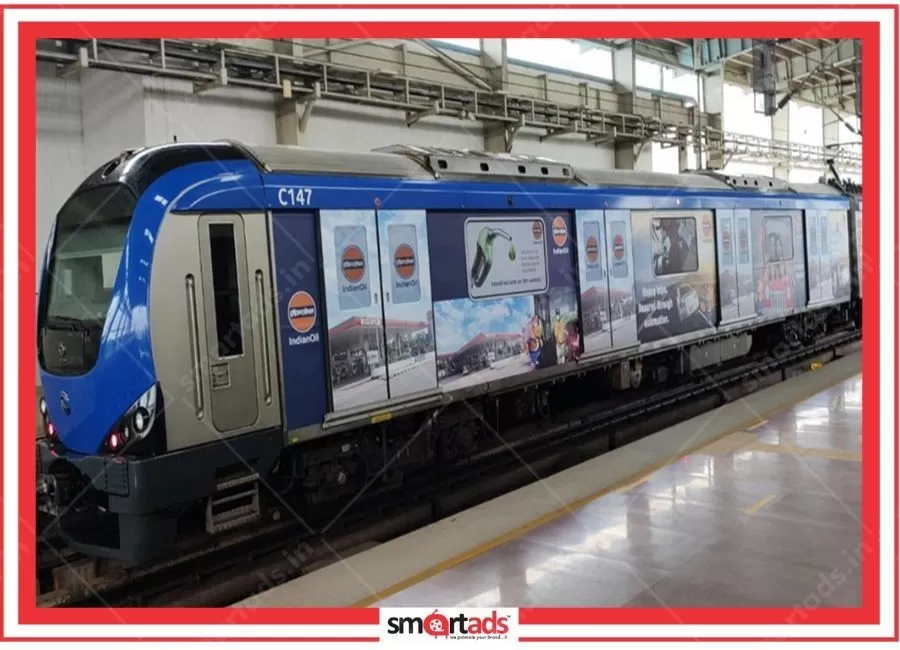
Exterior Metro Wrap
Custom
The advertisement spans the whole train,
Rate per Metro Display Cost / 1 Month
Route : Tirusulam To WIMCO Nagar
₹1000000.00
Showing 1 to 5 of 5 Results
MEDIA DETAILS
Custom
The advertisement spans the whole train,
Rate per Metro Display Cost / 1 Month
Route : Tirusulam To WIMCO Nagar
₹1000000.00
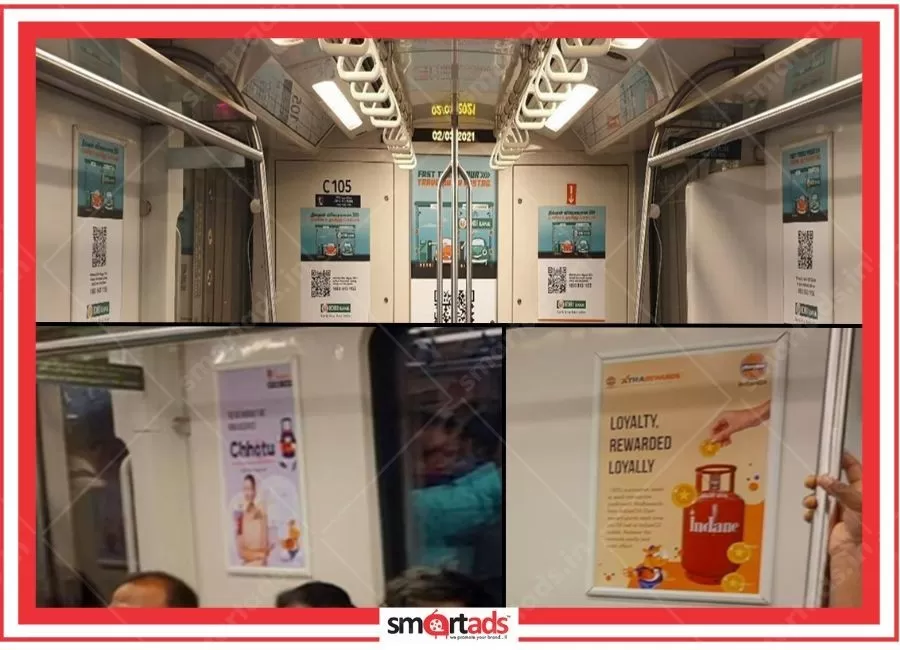
Custom
On the inside of the metro train the adv
Rate per Metro Display Cost / 1 Month
Route : Tirusulam To WIMCO Nagar
₹500000.00
20 Sec Audio
A jingle is a song or a phrase, and the
Rate per Metro Jingle Cost / 1 Month
Route :Tirusulam to WIMCO Nagar
₹400000.00

10 Sec Video
Digital screen on the metro station will
Rate per Metro Digital Display Cost / 1
Route :Tirusulam to WIMCO Nagar
₹600000.00

1 Metro Train
On the outside of the metro train the ad
Rate per Metro Display Cost / 1 Month
Route :Tirusulam to WIMCO Nagar
₹1500000.00
MEDIA REACH

MinimumQty :
1
EstimateReachPeople :
150000000
Jaipur's metro ridership crossed a meaningful threshold quietly — and most advertisers in Rajasthan still haven't noticed. The Jaipur Metro Rail Corporation network, which connects Mansarovar to Chandpole along the Pink Line, now moves tens of thousands of daily commuters through some of the city's most commercially significant corridors; and yet, metro train advertising in Jaipur remains dramatically underpriced relative to the audience quality it delivers. At SmartAds, we have been placing campaigns on this network since its early operational years, and what we consistently find is that brands which discover Jaipur Metro advertising tend to stay — because the numbers, once you see them clearly, are difficult to argue with.
There is a particular kind of advertising environment that media planners dream about but rarely find in practice — one where the audience cannot scroll away, cannot change the channel, and cannot physically exit the space for a defined period of time. Metro train advertising in Jaipur creates exactly that environment. A commuter boarding at Mansarovar and riding through to Chandpole spends somewhere between 18 and 22 minutes inside the train, which means your interior train branding is not competing for attention the way a roadside hoarding competes with traffic signals, pedestrians, and the general visual noise of Jaipur's streets. The dwell time commuter advertising achieves on metro networks is, frankly speaking, unmatched by almost any other out-of-home format.
What a lot of people miss is the distinction between passive reach and engaged reach. A billboard on MI Road might be seen by a hundred thousand pairs of eyes in a day, but the average glance lasts under two seconds; a panel inside a Jaipur Metro train coach, on the other hand, is looked at, re-read, and sometimes photographed by commuters who have nothing else to occupy them. Our experience shows that brand recall scores for interior metro train branding in Jaipur run significantly higher than equivalent spends on traditional outdoor advertising Jaipur formats — a finding that aligns with what transit media research has consistently demonstrated across Indian metro networks. The captive audience dynamic is not a marketing abstraction here; it is a measurable reality.
On top of that, the BTL advertising case for Jaipur Metro is strengthened by the specific demographic profile of JMRC commuters. Unlike some transit systems which skew heavily toward a single income group, the Jaipur Metro Pink Line passes through commercial zones, educational corridors, and residential clusters that collectively attract a genuinely mixed audience — salaried professionals, college students, tourists visiting the UNESCO World Heritage Walled City, and government employees. This breadth makes metro advertising in Jaipur unusually versatile for below-the-line advertising campaigns that need to reach multiple audience segments without running parallel media buys.
The range of formats available on the Jaipur Metro network is wider than most advertisers expect when they first approach us, and understanding the differences between them is essential before committing budget. At the broadest level, formats divide into two categories — those that appear on the exterior of the train, which function as moving billboards travelling the full length of the Pink Line route, and those placed inside the coaches, which engage the captive audience during the journey itself. Each serves a different strategic purpose, and the most effective campaigns we have planned for clients tend to combine both.
Exterior train branding, which includes the full train wrap advertising format as well as partial panel applications on specific coach sections, gives brands maximum visibility across the entire city corridor that the Pink Line covers. A fully wrapped Jaipur Metro train is, without exaggeration, one of the highest-impact advertising formats available in Rajasthan — it is essentially a moving billboard that passes through Chandpole, Sindhi Camp, Badi Chaupar, Civil Lines, and Mansarovar multiple times per day, accumulating impressions across every station stop and every road crossing along the elevated track. The train wrap advertising format is managed through EG Communications, which holds the concession for exterior train branding on the JMRC network, and any agency booking this format — including SmartAds — coordinates with them for production and installation approvals.
Interior train branding formats include inside panels positioned above windows and doors, seat-back panels, overhead hangers, and full coach takeovers where every available surface inside a single coach is branded for a single advertiser. Station branding formats, which are technically distinct from train branding but are often planned together as an integrated transit advertising Jaipur campaign, include platform panel advertising, concourse advertising at major interchange stations, entry exit branding at station gates, and — at select stations — digital DOOH screens that allow dynamic creative rotation. Smart card advertising, which places brand messaging on the physical metro cards distributed to commuters, is a niche but surprisingly memorable format that we have used effectively for BFSI advertising clients who want to put their brand literally in a commuter's wallet.
This is the question every client asks first, and we appreciate the directness — so here is what the market actually looks like, based on our current bookings and rate negotiations with JMRC and its concessionaire partners. A single inside panel placement inside a Jaipur Metro train coach runs in the ballpark of ₹25,000 to ₹40,000 per month, which makes it one of the most accessible entry points into metro advertising for small businesses in Jaipur who want to test the format without committing a large budget. Full coach interior branding, where all panels within one coach are owned by a single brand, typically works out to somewhere between ₹1.5 lakh and ₹2.5 lakh per month depending on the coach position and campaign duration.
Exterior train branding costs scale significantly with the scope of coverage. A partial exterior wrap covering two to three coach panels is generally priced in the range of ₹3 lakh to ₹5 lakh per month; a full train wrap advertising campaign, which covers the entire exterior surface of a six-coach rake, can run anywhere from ₹8 lakh to ₹15 lakh per month — a number that sounds large until you calculate the cost-per-impression. When we have run these calculations for clients, the CPM for a full train wrap on the Jaipur Metro Pink Line works out to roughly ₹8 to ₹12, which is a figure that genuinely surprises most brand managers when they compare it to what they are currently paying for Instagram reach or programmatic display in the same city.
Metro advertising cost in Jaipur for station formats varies by station tier. High-footfall stations like Mansarovar, Chandpole, and Sindhi Camp command premium rates — platform panel advertising at these locations is priced somewhere between ₹50,000 and ₹1.2 lakh per panel per month — while mid-corridor stations offer more accessible rates that work well for metro advertising for small businesses with tighter budgets. Jaipur Metro advertising rates are also influenced by campaign duration; a three-month commitment typically attracts a discount of 15 to 20 percent versus a single-month booking, which is something we always recommend clients factor into their planning. The metro train advertising cost per month can thus be optimised meaningfully through advance booking and duration bundling, and at SmartAds, we negotiate these terms on behalf of our clients as a standard part of the planning process.
The Jaipur Metro Pink Line — formally the East-West Corridor under Phase 1A of the JMRC network — runs from Mansarovar in the west to Chandpole in the east, covering nine stations across approximately 9.2 kilometres of elevated track. Not all stations are equal from an advertising standpoint, and understanding which locations generate the highest footfall is critical for allocating station branding budgets effectively. Mansarovar station, which serves as the western terminus and connects to one of Jaipur's largest residential and commercial townships, consistently records among the highest daily entry-exit counts on the network; the footfall here is driven by a combination of daily commuters heading toward the city centre and residents of the Mansarovar township who use the metro for shopping and work trips.
Chandpole station, at the eastern terminus, sits at the edge of Jaipur's historic walled city and draws a distinctly different audience — tourists visiting Hawa Mahal and the Pink City heritage zone, local traders from the old city markets, and visitors to the Rajasthan government offices in the area. This makes Chandpole one of the most strategically interesting stations for brands targeting both urban professionals and culturally engaged tourists. Sindhi Camp station, which connects to Jaipur's main bus terminus and offers interchange connectivity toward Jaipur Junction, is arguably the highest-traffic interchange point on the line; the footfall here includes intercity travellers, which adds a regional Rajasthan dimension to the audience profile that brands with state-wide ambitions find particularly valuable.
Badi Chaupar station, positioned in the heart of the walled city commercial zone, and Civil Lines station, which serves the administrative and judicial district, both offer strong contextual advertising environments — the former for retail and lifestyle brands, the latter for professional services, BFSI advertising, and edtech brands targeting working professionals. Ram Nagar station, which sits in a mid-corridor residential zone, tends to attract a more homogenous daily commuter audience and is often used for sustained brand awareness campaigns that prioritise frequency over contextual targeting. Our recommendation at SmartAds is always to map station selection against the specific audience segment a brand is trying to reach, rather than defaulting to the highest-footfall location, which is not always the most relevant one.
The demographic profile of Jaipur Metro daily commuters is something we have studied carefully across multiple campaign cycles, and it is more nuanced than the broad "urban commuter" label suggests. JMRC ridership data, combined with primary research conducted by transit media planning teams, indicates that the core commuter base skews toward the 22 to 45 age group, with a significant proportion of salaried employees in government, IT, and retail sectors; this is an audience with disposable income, active purchase consideration across categories, and meaningful digital literacy — which makes them responsive to brand messaging that connects metro advertising in Jaipur with digital follow-up touchpoints.
The tourist dimension of the Jaipur Metro audience is frequently underestimated. Jaipur receives millions of domestic and international tourists annually, and a meaningful proportion of them use the metro to navigate between the railway station area, the walled city, and the newer commercial districts. This creates an unusual situation where a transit advertising Jaipur campaign simultaneously reaches local daily commuters and high-spending visitors — an audience combination that is particularly valuable for hospitality brands, retail destinations, food and beverage chains, and OTT platform advertising campaigns targeting culturally engaged consumers. We worked with a hospitality client in Jaipur who specifically chose the Pink Line's eastern stations for this reason, and the campaign delivered measurably higher brand recall among tourist respondents than their parallel hotel corridor advertising.
College students and young professionals represent a third significant segment, particularly on the western corridor toward Mansarovar, where several educational institutions and IT parks generate consistent commuter traffic. This segment is the primary target for edtech advertising, fintech brands, and consumer app launches — categories where the combination of high dwell time and a young, digitally active audience makes metro train advertising in Jaipur particularly effective. Targeted advertising on metro networks works precisely because the route itself acts as a demographic filter; if your brand is relevant to urban, educated, income-earning Jaipur residents, the metro delivers them to you with a consistency that broad outdoor advertising Jaipur formats simply cannot replicate.
This is a question we get asked constantly, and the honest answer is that it depends entirely on what the campaign is trying to achieve — which sounds like a diplomatic non-answer until you understand the fundamental difference in how each format works. Interior train branding operates on depth; it has a smaller instantaneous reach than exterior formats, but the quality of engagement it generates is substantially higher because the audience is physically enclosed with the creative for the duration of their journey. A commuter sitting beneath your inside panel for 20 minutes will read your copy, process your brand message, and — if the creative is well-executed — form a genuine brand association that persists well beyond the journey.
Exterior train branding, by contrast, operates on breadth. The full train branding format turns the entire JMRC rake into a moving billboard that is seen not just by commuters inside the train but by pedestrians, motorists, and bystanders at every level crossing and station stop along the Pink Line route. The cumulative daily impressions from a fully wrapped train are substantial — when we calculate the reach for a full train wrap advertising campaign across the Pink Line's operational hours, the numbers work out to a reach figure that is competitive with a mid-tier television spot in the Jaipur market, but at a fraction of the cost. The exterior format is the right choice when the campaign objective is mass brand visibility and awareness at scale; the interior format is the right choice when the objective is message comprehension, product detail communication, or driving a specific action.
What we tell our clients at SmartAds is that the most effective metro train branding Jaipur campaigns combine both — using the exterior wrap to generate awareness and curiosity among the broader city audience, while the interior panels deliver the detailed message to the captive commuter audience that is already predisposed to engage. A real estate advertising client we worked with in Jaipur ran exactly this combination for a new township launch; the exterior wrap drove brand recognition across the city corridor, while the interior panels carried floor plan details, pricing, and a QR code for site visit bookings. The campaign generated over 400 qualified site visit inquiries over a 60-day period — a result that the client's digital-only campaigns in the same period did not come close to matching.
Frankly speaking, the category fit for metro train advertising in Jaipur is broader than most industry conversations acknowledge. The instinct is to think of metro advertising as a format for large consumer brands with mass-market ambitions — and those brands do use it effectively — but our experience across hundreds of campaigns shows that the format works exceptionally well for a much wider range of categories when the targeting logic is applied correctly. Real estate advertising is perhaps the most natural fit; Jaipur's property market is active, the metro corridor itself passes through or near several major development zones, and the audience profile of daily commuters overlaps almost perfectly with the active homebuyer demographic that real estate brands are trying to reach.
BFSI advertising — covering banking, insurance, mutual funds, and lending products — is another category that consistently performs well on the Jaipur Metro network. The commuter audience's income profile and financial literacy make them receptive to financial product messaging, and the extended dwell time inside the train allows for the kind of detailed benefit communication that financial products often require. Edtech brands have been increasingly active on the Jaipur Metro over the past two to three years, driven by the concentration of students and young professionals in the western corridor; an edtech advertising campaign we ran for a test preparation brand targeting engineering and medical aspirants in Jaipur delivered a cost-per-lead figure that was roughly 40 percent lower than the brand's parallel social media campaigns in the same period.
OTT platform advertising, fintech brands, consumer electronics, fashion retail, and food delivery services all find strong audience alignment on the Jaipur Metro network. Tourism and hospitality brands — particularly those targeting domestic travellers visiting Rajasthan — benefit from the tourist dimension of the ridership mix. Even categories that might seem counterintuitive, such as B2B software or professional services, can find value in metro advertising in Jaipur when the campaign is designed around the Civil Lines and Sindhi Camp station environments, which concentrate government and corporate professionals. The key insight, which we share with every new client who approaches us about this format, is that the metro audience is not a single homogenous group — it is a layered, multi-segment audience that rewards thoughtful targeting.
The booking process for metro advertising in Jaipur has more steps than most advertisers expect, and understanding the timeline upfront prevents the kind of last-minute scrambles that we have seen derail otherwise well-planned campaigns. The process begins with format selection and availability confirmation — because inventory on the Jaipur Metro, particularly for exterior train branding and full coach takeovers, is limited and can be booked months in advance during peak seasons. Once the format and duration are confirmed, a formal booking order is raised with JMRC or its authorised concessionaire, which triggers the creative approval process.
Creative approval by the Jaipur Metro Rail Corporation is a step that first-time advertisers consistently underestimate. JMRC has specific guidelines around content — political messaging, religious content, and certain product categories are restricted — and the creative must be submitted in the correct technical specifications for the format. For exterior train branding and full train wrap advertising, the creative files need to meet precise dimensional and resolution requirements, and the vinyl printing and installation must be carried out by JMRC-approved vendors. The approval and installation timeline, from creative submission to live campaign, typically runs between 10 and 21 days for interior formats and between 21 and 35 days for exterior wraps, depending on the complexity of the installation and the current workload of the approved installation teams.
At SmartAds, we manage this entire process for our clients — from initial format recommendation and rate negotiation through creative specification briefing, JMRC approval coordination, vendor management, and post-installation verification. The campaign duration for metro train advertising in Jaipur typically runs in monthly cycles, with minimum booking periods of one month for most formats; we generally recommend a minimum of three months for brand awareness campaigns to allow sufficient frequency buildup among the daily commuter audience. For seasonal campaigns tied to Diwali, Teej, the Jaipur Literature Festival, or other Rajasthan-specific occasions, we advise clients to initiate the booking process at least six to eight weeks before the desired campaign start date, as inventory at premium stations and for exterior formats gets absorbed quickly in the pre-festival period.
The comparison between metro advertising in Jaipur and traditional outdoor advertising Jaipur formats — hoardings, unipoles, bus shelters, and metro pillar hoarding Jaipur installations — is one that comes up in almost every media planning conversation we have, and the answer is more nuanced than a simple "one is better than the other" conclusion. Traditional OOH advertising in Jaipur, particularly large-format hoardings on MI Road, Tonk Road, and the Ajmer Road corridor, delivers enormous raw reach — these locations are passed by hundreds of thousands of vehicles and pedestrians daily, and the sheer scale of the format creates strong brand visibility. What OOH advertising Jaipur formats cannot deliver, however, is dwell time; the average exposure to a roadside hoarding is measured in seconds, not minutes.
Metro train advertising in Jaipur, by contrast, delivers a fundamentally different quality of exposure. The captive audience inside the train is not just exposed to the brand — they are enclosed with it, which creates conditions for genuine message processing that outdoor advertising Jaipur formats cannot replicate. When we compare the ROI metro advertising India benchmarks against equivalent OOH spends, the pattern we consistently observe is that metro advertising delivers superior brand recall and message retention metrics, while traditional OOH delivers superior raw reach numbers. The right answer for most campaigns is not to choose between them but to understand which objective each format serves.
To be fair to traditional OOH, there are campaign objectives where it outperforms metro advertising — mass market FMCG launches, for instance, where the primary goal is maximum impressions at minimum cost, may be better served by a broad hoarding network than by the more contained reach of the metro. But for campaigns where audience quality, message complexity, or demographic precision matters — which describes the majority of the campaigns we plan for our clients — metro train advertising in Jaipur consistently delivers a better return on the media investment. The CPM comparison is instructive here: a large-format hoarding on a premium Jaipur location might deliver a CPM in the range of ₹5 to ₹10, while a metro interior panel works out to a similar or slightly higher CPM but with dramatically higher engagement rates and brand recall scores.
ROI measurement for metro train advertising in Jaipur is an area where most agencies give vague, non-committal answers — and we understand why, because the measurement methodologies are genuinely varied and the right approach depends on the campaign objective. What we can share from our own campaign data is that the metrics we track most reliably are brand recall lift, footfall attribution (for retail and real estate clients), lead generation volume, and digital amplification — the last of which refers to the measurable increase in branded search queries, social media mentions, and direct website traffic that correlates with an active metro advertising campaign.
For one BFSI advertising client we worked with in Jaipur, a three-month interior train branding campaign combined with platform panel advertising at Mansarovar and Sindhi Camp stations generated a 34 percent lift in branded search volume in Jaipur during the campaign period, compared to a baseline measured in the three months prior. The client's call centre also recorded a 22 percent increase in inbound enquiries from Jaipur during the same period — a correlation that, while not perfectly attributable to the metro campaign alone, was consistent with the timing and geography of the media placement. These are the kinds of downstream indicators that, in our experience, give brand managers the evidence they need to justify metro advertising budgets to their management teams.
The ROI calculation for mass transit advertising India benchmarks, as referenced in industry reports including the GroupM TYNY Report and the FICCI-EY Media Report, consistently shows that transit advertising formats outperform equivalent OOH investments on brand recall metrics by a margin of 25 to 40 percent. For Jaipur specifically, the relatively lower cost of metro advertising in Jaipur compared to Mumbai or Delhi metro networks means that the cost-efficiency of the format is even more pronounced — brands are accessing a high-quality captive audience at rates that reflect a market which has not yet been fully discovered by national advertisers, which creates a genuine first-mover advantage for brands willing to commit to the format now.
Phase 2 of the JMRC network — the Orange Line, which is planned to run from Sitapura in the south to Ambabari in the north — represents what we believe will be a significant expansion of the metro advertising in Jaipur opportunity over the coming years. The Orange Line corridor, once operational, will pass through several of Jaipur's most commercially active zones, including the IT and industrial areas around Sitapura and the dense residential and retail corridors in the northern parts of the city; this will substantially increase both the daily ridership of the network and the geographic reach of metro train advertising campaigns.
For brands planning medium-to-long-term advertising strategies in Jaipur, the Orange Line expansion is a forward-looking consideration that deserves attention now. Advertisers who establish a presence on the existing Pink Line during this period are building brand familiarity with a commuter base that will eventually expand as the network grows; the brand recall equity accumulated through consistent metro train branding Jaipur campaigns on the current network will carry forward into the expanded ridership base that the Orange Line will bring. We have seen this pattern play out in other Indian metro markets — brands that were early adopters of transit advertising in cities like Kochi and Lucknow found themselves with a significant brand recognition advantage when those networks expanded and ridership scaled.
The advertising formats available on the Orange Line, when it becomes operational, are expected to include the full range of exterior and interior train branding options, as well as expanded station branding opportunities at new interchanges and terminal stations. The Sitapura end of the corridor, which connects to Jaipur's industrial and IT zone, will likely attract significant interest from B2B brands, technology companies, and professional services advertisers; the Ambabari end, which serves a dense residential catchment in northern Jaipur, will be attractive to consumer brands targeting middle-income households. At SmartAds, we are already tracking the Orange Line development timeline and advising clients with long-term Jaipur advertising strategies to factor the expanded network into their planning.
One area where we see campaigns underperform consistently — and this is something almost no competitor page addresses — is creative execution. The physical environment of a metro train coach creates specific viewing conditions that are quite different from a roadside hoarding or a digital banner, and creative that is not designed for these conditions will underperform regardless of how well the media placement is planned. Inside panels in Jaipur Metro coaches are typically viewed from distances of between one and three metres, which means font sizes that work on a large-format outdoor hoarding will appear too small; our rule of thumb is that body copy on interior train branding should be readable from two metres away without effort, which typically means a minimum font size of 28 to 36 points for secondary text.
Colour contrast is critical in the metro coach environment, where ambient lighting conditions vary and the visual competition from other panels — if the coach is not a full takeover — can be significant. High-contrast colour combinations, particularly dark backgrounds with light text or vice versa, consistently outperform low-contrast designs in terms of readability and brand recall. For exterior train branding and full train wrap advertising, the creative challenge is different — the design needs to work at speed, because observers on platforms and at road crossings are seeing the train in motion; bold, simple visual elements with a single dominant brand message perform better than complex, detail-heavy layouts that require sustained viewing to process.
Copy length is another variable that brands consistently get wrong on metro formats. The temptation to use the extended dwell time of interior train branding to communicate multiple product benefits leads to overcrowded panels that commuters mentally filter out; our recommendation, based on what we have seen work across dozens of Jaipur Metro advertising campaigns, is to limit interior panel copy to a headline, a single supporting line, and a clear call to action. The creative should do one job very well, not five jobs adequately. For QR code integrations — which are increasingly common on metro advertising formats — the QR code should be large enough to scan from a seated position, which means a minimum size of 5 by 5 centimetres on the physical panel.
Q: How much does metro train advertising in Jaipur cost per month?
The metro train advertising cost per month in Jaipur varies considerably by format and location, but to give you a practical working range: a single inside panel inside a Jaipur Metro coach starts at roughly ₹25,000 to ₹40,000 per month, which is accessible enough to make metro advertising for small businesses a realistic option. Full coach interior branding runs somewhere between ₹1.5 lakh and ₹2.5 lakh per month; exterior partial wraps fall in the ₹3 lakh to ₹5 lakh range; and a full train wrap advertising campaign covering an entire six-coach rake can run from ₹8 lakh to ₹15 lakh per month depending on duration and negotiated terms. Station branding formats at premium locations like Mansarovar and Chandpole are priced between ₹50,000 and ₹1.2 lakh per panel per month. Longer campaign durations attract meaningful discounts — typically 15 to 20 percent for three-month commitments — and at SmartAds we negotiate these terms as a standard part of the booking process.
Q: What are the different advertising formats available on Jaipur Metro trains?
The Jaipur Metro network offers a range of formats across both train and station environments. On the trains themselves, interior formats include inside panels above windows and doors, seat-back panels, overhead hangers, and full coach interior takeovers; exterior formats include partial panel wraps on specific coach sections and the full train wrap advertising format that covers the entire exterior of a rake. At stations, the available formats include platform panel advertising, concourse advertising at major stations, entry exit branding at station gates, digital DOOH screens at select locations, and smart card advertising on physical metro cards. Each format serves a different strategic purpose — interior formats for message depth and engagement, exterior formats for mass visibility, station formats for contextual targeting at specific locations along the Pink Line route.
Q: Who is the authorized agency for metro train wrap advertising in Jaipur?
EG Communications holds the concession for exterior train branding and full train wrap advertising on the JMRC network, which means any exterior train wrap campaign must be routed through or coordinated with them for production and installation. Interior formats and station branding are managed through JMRC's own advertising concession arrangements. As a metro advertising agency Jaipur, SmartAds works with all authorised concessionaires and coordinates the full booking, approval, and installation process on behalf of clients — so the client does not need to navigate the concessionaire relationships directly.
Q: What is the daily ridership of Jaipur Metro and how does it affect ad reach?
Jaipur Metro daily ridership on the Pink Line has been growing steadily, with the network recording daily commuter numbers in the range of 40,000 to 60,000 on normal operational days, with peaks during festival periods and major city events. For advertising reach calculations, the relevant figure is not just the number of commuters but the number of impression opportunities — a single train making multiple return trips per day accumulates exterior impressions from station bystanders, road crossing observers, and platform commuters in addition to the captive audience inside the coaches. When we calculate the total daily impressions for a full train wrap advertising campaign on the Pink Line, the figure works out to substantially more than the raw ridership number suggests, because the moving billboard effect of the exterior wrap generates impressions across the entire route corridor throughout the operational day.
Q: Can small businesses advertise on Jaipur Metro trains within a limited budget?
Yes — and this is something we actively encourage, because the entry-level formats on the Jaipur Metro network are genuinely accessible for smaller advertisers. A single platform panel at a mid-corridor station can be booked for as little as ₹25,000 to ₹35,000 per month, which brings metro advertising for small businesses well within reach for local retailers, coaching institutes, clinics, and service businesses in Jaipur. Interior coach panels at similar price points allow small businesses to reach a specific, recurring audience of daily commuters on the Pink Line without committing to the larger budgets required for exterior or full-network formats. The key for small business campaigns is format selection — concentrating spend on one or two high-relevance stations or formats rather than spreading a limited budget too thinly across multiple touchpoints.
Q: How long does it take to launch a metro train advertising campaign in Jaipur?
The campaign timeline depends on the format. Interior panel formats, which involve printing and installation of vinyl or paper panels inside coaches, typically have a lead time of 10 to 14 days from creative approval to live installation. Exterior train branding and full train wrap advertising require longer lead times — typically 21 to 35 days — because the vinyl production, JMRC approval, and installation process is more complex. Station branding formats fall somewhere between the two, with a typical lead time of 14 to 21 days. For campaigns tied to specific events or seasonal windows — Diwali, Teej, the Jaipur Literature Festival — we recommend initiating the booking process at least six to eight weeks in advance to ensure availability and avoid production timeline pressure.
Q: What is the difference between interior train branding and exterior train branding in Jaipur Metro?
Interior train branding refers to all advertising formats placed inside the metro coaches — panels, hangers, seat-backs, and full coach takeovers — which are seen exclusively by commuters travelling inside the train. The key advantage of interior train branding is the extended dwell time it captures; a commuter is exposed to interior panels for the full duration of their journey, which creates conditions for genuine message engagement. Exterior train branding refers to vinyl applications on the outside surface of the train — partial panels or full train wraps — which function as a moving billboard visible to anyone along the Pink Line route, including non-commuters. The two formats serve different objectives: interior for depth of engagement, exterior for breadth of reach; and the most effective Jaipur metro train branding campaigns typically combine both.
Q: Which metro stations on the Jaipur Pink Line get the highest footfall for advertising?
Mansarovar, Chandpole, and Sindhi Camp consistently record the highest footfall on the Pink Line, for different reasons. Mansarovar serves a large residential and commercial township at the western terminus; Chandpole connects to the historic walled city and tourist zones at the eastern terminus; and Sindhi Camp serves as the primary interchange with Jaipur's bus network and draws intercity travellers in addition to local commuters. Badi Chaupar and Civil Lines are strong secondary options — the former for retail-adjacent audiences in the old city commercial zone, the latter for professional and government sector audiences. For station branding campaigns, we recommend aligning station selection with the specific audience segment the brand is targeting rather than defaulting to the highest-footfall location.
Q: What types of brands and industries typically advertise on Jaipur Metro trains?
The category mix on Jaipur Metro advertising is broad. Real estate advertising brands — particularly township developers and residential project launches — are among the most consistent advertisers on the network, given the strong alignment between the commuter demographic and the active homebuyer profile. BFSI advertising (banking, insurance, lending, mutual funds), edtech brands, OTT platform advertising, fintech apps, consumer electronics, fashion retail, food delivery services, and hospitality brands all have active presences on the network. Government and public sector campaigns — health awareness, civic initiatives, state government schemes — are also a significant category. The common thread across all of these is that they are targeting an urban, educated, income-earning audience in Jaipur, which is precisely what the metro delivers.
Q: How does metro train advertising in Jaipur compare to billboard or hoarding advertising in terms of ROI?
The comparison is not straightforward because the two formats serve different objectives, but on the metrics that matter most
