
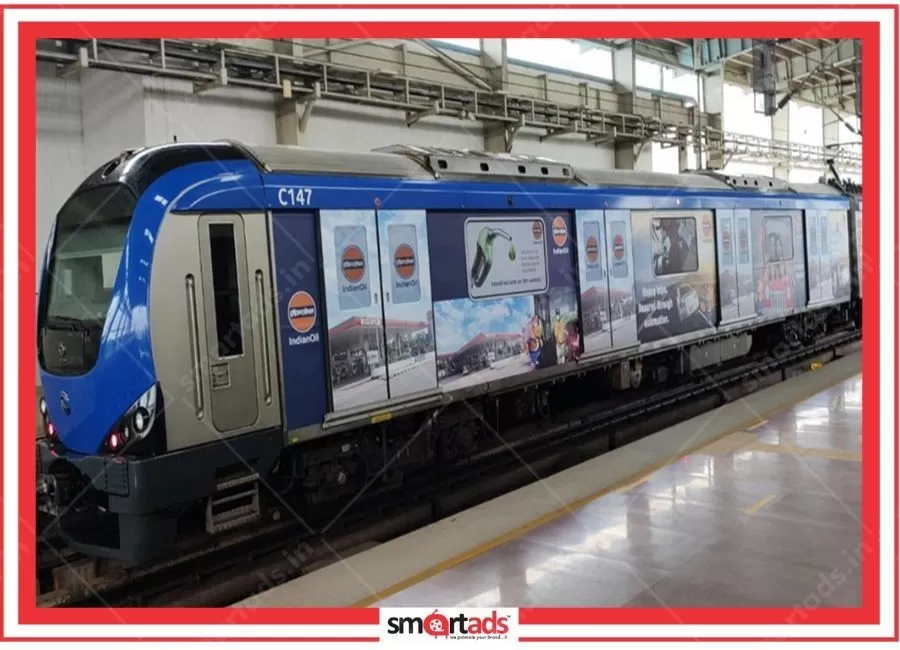
Exterior Metro Wrap
Custom
The advertisement spans the whole train,
Rate per Metro Display Cost / 1 Month
Route : Tirusulam To WIMCO Nagar
₹1000000.00
Showing 1 to 5 of 5 Results
MEDIA DETAILS
Custom
The advertisement spans the whole train,
Rate per Metro Display Cost / 1 Month
Route : Tirusulam To WIMCO Nagar
₹1000000.00
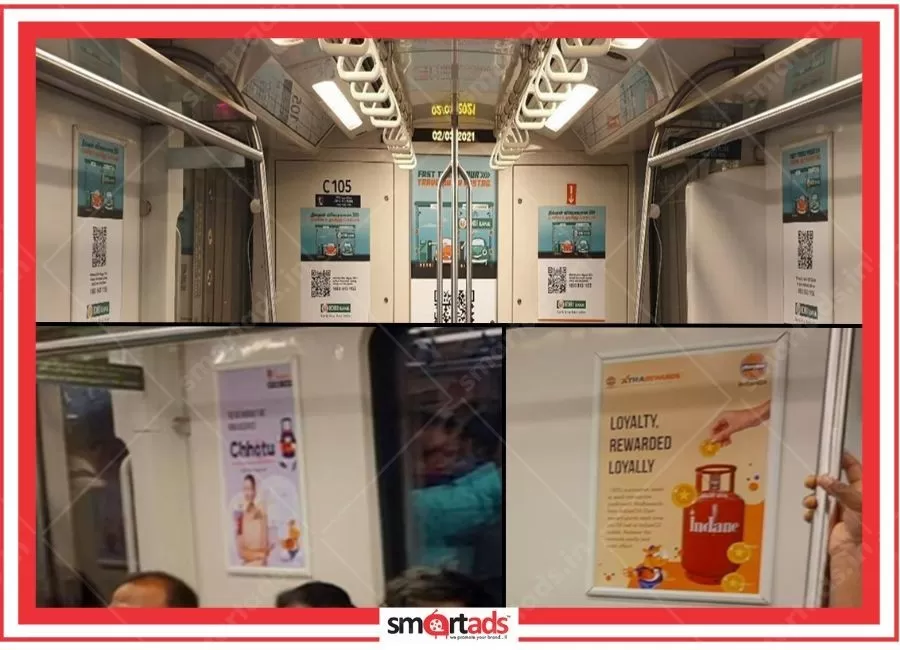
Custom
On the inside of the metro train the adv
Rate per Metro Display Cost / 1 Month
Route : Tirusulam To WIMCO Nagar
₹500000.00
20 Sec Audio
A jingle is a song or a phrase, and the
Rate per Metro Jingle Cost / 1 Month
Route :Tirusulam to WIMCO Nagar
₹400000.00

10 Sec Video
Digital screen on the metro station will
Rate per Metro Digital Display Cost / 1
Route :Tirusulam to WIMCO Nagar
₹600000.00

1 Metro Train
On the outside of the metro train the ad
Rate per Metro Display Cost / 1 Month
Route :Tirusulam to WIMCO Nagar
₹1500000.00
MEDIA REACH

MinimumQty :
1
EstimateReachPeople :
150000000
Most brand managers we speak to have Ballabgarh somewhere on their radar as a market — they know the industrial belt, they know the purchasing power that has quietly accumulated in Faridabad's residential corridors — but very few of them have connected that awareness to the advertising opportunity sitting right there on the Delhi Metro Violet Line. Raja Nahar Singh Metro Station, which serves as the terminal point of Line 6 and which draws commuters from across the Ballabgarh–Faridabad stretch every single day, is one of the most underutilised advertising assets in the entire NCR metro network. The brands that have figured this out are running campaigns at a fraction of what comparable OOH advertising costs them in Delhi proper, and the results, frankly speaking, have been striking.
Metro train advertising, at its core, is about placing your brand inside a moving environment where the audience has nowhere else to go — which is a dynamic that very few other media formats can genuinely claim. On the Delhi Metro Violet Line, which runs from Kashmere Gate all the way down to Raja Nahar Singh station in Ballabgarh, the advertising inventory spans everything from full exterior train wraps to interior metro panels, station branding at platform level, digital screens, backlit panels near entry gates, and even smart card advertising. The Delhi Metro Rail Corporation manages this inventory through a structured non-fare revenue programme, which means every format has a defined approval process, a rate card, and a minimum campaign duration — and navigating that process is where most brands stumble without the right media planning support.
The way it actually works in practice is that DMRC licenses advertising rights on the Violet Line to authorised vendors, who then work with agencies and direct clients to place campaigns across the network. What a lot of people miss is that the Ballabgarh segment — specifically the stretch from Escorts Mujesar Metro Station through NCB Colony to Raja Nahar Singh — operates with slightly different footfall dynamics than the central Delhi stations, which actually makes it more valuable for hyperlocal advertising targeting Haryana's industrial and residential belt. The commuter who boards at Raja Nahar Singh is not the same demographic as the commuter at Rajiv Chowk; they have different income profiles, different consumption patterns, and critically, different brand exposure histories — which means your campaign can achieve a level of novelty and recall here that is genuinely harder to replicate in more cluttered metro corridors.
At SmartAds, we always tell our clients that metro train advertising is fundamentally a captive audience medium; the dwell time inside a metro coach during the Ballabgarh-to-central-Delhi commute, which averages somewhere between 45 and 60 minutes depending on the boarding point, gives a brand repeated visual contact with the same commuter over multiple journeys in ways that a roadside billboard simply cannot. This is the structural advantage that makes metro advertising in Ballabgarh worth serious consideration for any brand targeting the NCR's southern and Haryana-adjacent markets.
The format landscape for metro advertising on the Violet Line is considerably richer than most advertisers initially assume, and the choice of format has a significant bearing on both the cost structure and the kind of brand recall you can realistically expect. Train wrap branding — which involves applying a vinyl wrap across the exterior of an entire metro coach or a full train — is the most visually dramatic option and functions essentially as a moving billboard travelling the entire Kashmere Gate–Raja Nahar Singh corridor multiple times a day. A full train branding execution on the Violet Line means your creative is seen not just by the passengers inside but by everyone standing on every platform the train passes through, which multiplies the effective reach considerably beyond the commuter count alone.
Interior train branding is, in our experience, where the real value lies for brands that want sustained engagement rather than pure awareness. Interior metro panels — which are placed above the seating rows, on the coach doors, and on the overhead grab-rail sections — sit within the natural sightline of a seated commuter for the entire duration of their journey; a well-designed interior campaign with a clear QR code integration can drive measurable digital actions, whether that is an app install, a landing page visit, or a product enquiry. We have seen this work particularly well for edtech brands and fintech brands targeting the young professionals and students who make up a substantial portion of the daily commuters on the Ballabgarh route. Exterior train branding, on the other hand, tends to suit FMCG brands and real estate advertisers who want mass visibility across the corridor rather than a direct-response outcome.
Beyond the train itself, station branding at Raja Nahar Singh Metro Station offers its own distinct inventory — platform advertising panels, entry gate advertising displays, backlit panels in the concourse area, and digital screens near the ticketing zones are all available through DMRC's authorised channel. Audio jingle advertising is a format that deserves specific mention here: DMRC piloted in-station audio announcements with brand integrations on the Violet Line in December 2023, which opened up a genuinely novel non-traditional advertising touchpoint for brands willing to experiment. Smart card advertising, which places brand messaging on the physical metro smart cards distributed to commuters, is another format that achieves an unusually long dwell time given that commuters carry and use these cards daily for weeks or months.
The Delhi Metro Violet Line — officially Line 6 — is not the network's most celebrated corridor in media planning conversations, which is precisely why it represents such a strong opportunity for brands willing to look beyond the obvious. The line stretches from Kashmere Gate in central Delhi through the heart of Faridabad and terminates at Raja Nahar Singh station in Ballabgarh, covering a distance of roughly 34 kilometres and passing through some of the NCR's most commercially active zones along the way. What makes this corridor particularly interesting from a brand visibility standpoint is the mix of audience segments it aggregates — office commuters heading into Delhi, industrial workers travelling between Faridabad's manufacturing zones, students accessing colleges and coaching centres, and a growing cohort of young professionals who have chosen to live in Ballabgarh and Faridabad for the relatively lower real estate costs while working in Delhi.
The Haryana Mass Rapid Transit Corporation, which partnered with DMRC on the extension of the Violet Line to Ballabgarh, has been instrumental in expanding the ridership base on this corridor; the extension to Raja Nahar Singh station, which made Ballabgarh directly accessible to the Delhi Metro network, effectively brought a new and previously underserved commuter population into the transit advertising ecosystem. Footfall at Raja Nahar Singh Metro Station has grown steadily since the extension opened, and while exact DMRC ridership figures by station are not always publicly disaggregated, industry estimates from transit media specialists suggest daily entries and exits at this terminal station are in the range of several tens of thousands — a number that compounds meaningfully when you consider the weekly and monthly reach of a sustained campaign.
From a media planning perspective, the Violet Line's brand visibility advantage is also structural: because it is a terminal-to-terminal line rather than a loop or a cross-network connector, the commuter flow is relatively predictable and the audience composition is more consistent than on interchange-heavy stations. At SmartAds, we have found that campaigns on the Violet Line tend to generate stronger brand recall scores in post-campaign surveys than equivalent spends on more fragmented Delhi Metro corridors, which we attribute partly to the higher dwell time and partly to the lower advertising clutter compared to lines like the Yellow Line or the Blue Line.
This is the question every client asks first, and it is also the one where most published information online is either outdated or deliberately vague — so we will be as specific as we responsibly can while acknowledging that DMRC rates are periodically revised and final costs depend on campaign duration, format mix, and negotiated packages. For interior metro panel placements on the Violet Line, the cost per panel per month works out to somewhere in the ballpark of ₹3,000 to ₹6,000 depending on the panel position and the number of coaches covered; a campaign covering a full coach's interior across a single train, which typically involves 20 to 30 panel positions, would therefore require a monthly outlay in the range of ₹60,000 to ₹1.5 lakh for that single train unit.
Exterior train branding and full train wrap campaigns are naturally at a different price point — a full train branding execution on the Violet Line, which covers the exterior vinyl wrap across all coaches of a single train set, is typically priced somewhere between ₹8 lakh and ₹15 lakh per month depending on the number of train sets involved and the complexity of the creative execution. The vinyl wrap production cost, which is separate from the media space cost, adds another ₹2 to ₹4 lakh depending on the size and finish quality; this is a number that surprises a lot of first-time metro advertisers when they compare it to what they have been paying for static billboard production, but the reach-per-rupee calculation tends to look very different once you account for the daily route coverage. Station branding at Raja Nahar Singh Metro Station — covering backlit panels, platform advertising, and entry gate advertising — is available in packages that start at roughly ₹1.5 lakh per month for a basic presence and scale up to ₹5 lakh or more for a dominant station takeover.
For brands with tighter budgets, smart card advertising and audio jingle integrations offer entry points that are considerably more accessible — smart card campaigns can be executed in the range of ₹50,000 to ₹1.5 lakh for a defined distribution volume, while audio jingle placements are typically negotiated as part of a broader station branding package rather than as standalone buys. What we tell our clients at SmartAds is that the metro advertising cost in Ballabgarh needs to be evaluated against the effective CPM rather than the absolute spend figure; the CPM for interior train branding on the Violet Line works out to roughly ₹8 to ₹12 per thousand impressions, which is a number that tends to shift the conversation quite quickly when compared to what brands are paying for comparable reach through print or radio in the same geography.
Understanding the commuter audience on the Ballabgarh–Faridabad Violet Line is essential to making a sound media planning decision, and this is an area where most generic metro advertising content fails to provide anything useful. The Ballabgarh industrial area, which is home to a significant concentration of manufacturing units, auto ancillary companies, and textile businesses, generates a substantial daily workforce commute; a meaningful share of the daily commuters boarding at Raja Nahar Singh and the intermediate Violet Line stations are blue-collar and semi-skilled workers travelling to and from their workplaces in Faridabad and Delhi. This segment has real purchasing power, particularly in categories like FMCG, consumer durables, and financial services — and they are a captive audience that is significantly under-targeted by most mainstream brand campaigns.
Alongside the industrial workforce, the Ballabgarh metro route carries a growing segment of young professionals and students — many of them residents of the newer residential colonies along National Highway 44 and the surrounding areas — who commute daily to Delhi for work or education. This demographic, which skews between 22 and 35 years of age and has household incomes that would qualify them as SEC A2 to SEC B, is precisely the target audience for categories like edtech, fintech brands, real estate advertising, and lifestyle brands. The commute duration from Ballabgarh to central Delhi, which runs to nearly an hour in many cases, means this audience has substantial idle time during which brand exposure is both unavoidable and, if the creative is compelling, genuinely engaging.
What a lot of brands get wrong is assuming that the Faridabad metro advertising audience is a monolith; in reality, the commuter composition shifts meaningfully depending on the time of day, with the morning peak being heavily weighted towards working adults and the afternoon and evening peaks bringing in a more mixed demographic that includes students, homemakers making shopping trips, and leisure travellers. A well-structured metro advertising campaign in Ballabgarh should account for this variation — which is why format selection matters as much as creative execution, and why interior train branding that works across all commuter segments tends to outperform narrowly targeted station-level placements for most brand objectives.
Frankly speaking, the comparison between metro train advertising and traditional OOH advertising like billboards is one that most clients find genuinely eye-opening when we walk them through the numbers. A standard unipole billboard on NH-44 near Ballabgarh — which is a high-traffic location and therefore commands a premium — is typically priced somewhere between ₹1.5 lakh and ₹3 lakh per month; it delivers impressions to passing vehicular traffic, but those impressions are fleeting, typically lasting two to three seconds per vehicle, and the audience is not captive in any meaningful sense. Metro advertising on the Violet Line, by contrast, delivers impressions that last for the duration of the commute — which, as we noted earlier, can be 45 to 60 minutes — and the brand recall that comes from repeated, sustained exposure is structurally different from what a roadside billboard can achieve.
Television advertising in the Haryana and NCR market, which typically involves regional channel buys or spot placements on national channels with geographic targeting, operates at a very different cost and reach scale. A 30-second spot on a regional Hindi news channel reaching the Haryana market might cost somewhere between ₹8,000 and ₹25,000 per spot depending on the channel and the time band; achieving meaningful frequency — which is generally accepted to require at least three to five exposures for brand recall to register — requires a sustained flight of spots that quickly adds up to several lakhs per month. Metro advertising in Ballabgarh achieves frequency organically, because the same commuter passes your interior metro panel every single working day; the brand recall that builds from this daily repetition is something that TV advertising, which competes with remote controls and second screens, struggles to replicate.
The ROI comparison also needs to account for targeting precision, which is where non-traditional advertising formats like metro branding have a structural advantage over broadcast media. A television spot reaches whoever happens to be watching, across a broad geography and demographic range; metro train advertising on the Ballabgarh route reaches specifically the people who live and work in the Ballabgarh–Faridabad corridor, which is exactly the target audience for most local and regional brands operating in this market. At SmartAds, we have found that for brands with a hyperlocal advertising objective — a real estate developer launching a project in Faridabad, a local retail chain expanding in Ballabgarh — the cost-per-relevant-impression from metro advertising consistently outperforms both OOH and television by a meaningful margin.
The honest answer is that the industries which see the strongest results from metro advertising in Ballabgarh are those whose target audience overlaps most cleanly with the daily commuter profile of the Violet Line — which, as we have described, skews towards working adults, young professionals, and students in the 20 to 40 age bracket. Real estate advertising has been one of the most consistent performers in our experience; a real estate developer we worked with who was launching a mid-segment residential project in Faridabad ran a two-month interior train branding campaign on the Violet Line, and the campaign generated a measurable uplift in site visits from commuters who had seen the interior metro panels during their daily journey. The project team reported that a significant proportion of the enquiries during the campaign period specifically mentioned the metro ads as the first point of contact — which is a brand recall outcome that is genuinely difficult to achieve through digital-only campaigns targeting the same geography.
Fintech brands and banking products have also shown strong results on the Violet Line corridor, particularly for products like savings accounts, credit cards, and insurance that appeal to the salaried workforce commuting from Ballabgarh and Faridabad into Delhi. One fintech brand we worked with integrated QR code functionality into their interior metro panel creative, directing commuters to a landing page where they could complete a preliminary application during their commute; the campaign generated a cost-per-lead that was, in the client's own words, significantly lower than what their performance marketing campaigns on social media were delivering for the same audience. FMCG metro advertising has similarly performed well, particularly for personal care, packaged foods, and beverages brands targeting the mass-market consumer segment that is well-represented in the Ballabgarh commuter population.
Edtech brands targeting students and young professionals have found the Violet Line particularly valuable because of the concentration of educational institutions in and around Faridabad, which feeds a steady stream of college-going commuters onto this route. Beyond these categories, local businesses — retail chains, hospitals, diagnostic centres, and educational institutions based in Ballabgarh or Faridabad — represent a category of advertiser that is significantly underserved by existing metro advertising content but which has, in our experience, some of the strongest ROI outcomes because the geographic alignment between the ad placement and the business location is near-perfect.
The booking process for metro train advertising in Ballabgarh is more structured than most clients expect, and understanding it upfront saves a considerable amount of time and frustration. DMRC manages advertising on the Violet Line through authorised concessionaire vendors who hold the rights to sell specific inventory categories — train wraps, interior panels, station branding, and so on — and the first step is identifying which vendor holds the relevant inventory for the specific format and location you want. This is not always straightforward, because different vendors may hold rights to different format categories on the same line, and the DMRC tender status for Violet Line advertising can change as concession periods expire and are re-tendered; working with an experienced metro advertising agency that maintains active relationships with the authorised vendors is genuinely the most efficient way to navigate this.
Once the vendor is identified and the inventory availability is confirmed — which is a step that often reveals that certain formats or certain campaign windows are already booked, particularly around festival seasons — the booking process involves submitting creative artwork for DMRC approval, which has specific technical specifications for each format type. DMRC's content approval process typically takes somewhere between seven and fourteen working days for standard formats; more complex executions like full train branding or station takeovers may require additional approvals and can take three to four weeks from submission to installation. Campaign duration minimums are generally set at one month for most formats, though some station branding packages allow for shorter campaigns of two to three weeks during high-footfall periods.
At SmartAds, we manage the entire booking process on behalf of our clients — from vendor identification and inventory negotiation through to creative specification compliance, DMRC approval submission, and installation supervision. What we have found is that brands which try to navigate the DMRC booking process independently often lose two to three weeks on administrative back-and-forth that an experienced media buying partner can compress significantly; on top of that, the negotiated rates available through an agency with established vendor relationships are typically more favourable than what a direct advertiser would be offered for the same inventory.
Return on investment from metro advertising is a topic where the industry has historically been better at generating anecdotal evidence than rigorous measurement, but the measurement tools available today — particularly QR code tracking, unique landing page analytics, and pre/post brand recall surveys — have made it considerably more possible to quantify outcomes. The GroupM TYNY Report and the FICCI-EY Media Report have both highlighted transit advertising as one of the fastest-growing OOH sub-categories in India, with brands increasingly recognising that the captive audience dynamic of metro commuting creates brand recall rates that are structurally superior to most other out-of-home advertising formats. Independent research cited in industry publications suggests that brand recall from interior metro panel campaigns can be as high as 60 to 70 percent among regular commuters who have been exposed to a campaign for four or more weeks — a figure that compares very favourably to the 20 to 30 percent recall typically reported for roadside billboard campaigns.
The Ballabgarh–Faridabad corridor specifically offers a return on investment argument that is strengthened by the relatively lower cost of advertising compared to central Delhi metro stations, combined with a commuter audience that is, for many brand categories, more commercially relevant than the more diverse and diffuse audiences on the busier central Delhi lines. A campaign that might cost ₹8 to ₹10 lakh per month for a full train branding execution on the Yellow Line could achieve comparable or superior results for a Haryana-focused brand on the Violet Line at a budget of ₹4 to ₹6 lakh — which represents a meaningful efficiency gain that compounds over a multi-month campaign. The transit media advantage in terms of ROI is also amplified when the campaign is integrated with digital touchpoints; QR code integration on interior metro panels, which we have now made a standard recommendation for all metro advertising campaigns we plan, allows brands to track direct response outcomes and attribute them specifically to the metro channel.
One automotive brand we worked with ran a three-month campaign combining interior train branding and station branding at Raja Nahar Singh Metro Station to support the launch of a new vehicle variant targeting first-time car buyers in the Faridabad–Ballabgarh market; the campaign generated a 34 percent increase in dealership walk-ins from the Faridabad zone during the campaign period, which the client's sales team attributed in part to the sustained metro advertising presence. The brand recall survey conducted at the end of the campaign showed that 58 percent of respondents who commuted regularly on the Violet Line could correctly identify the brand and the product being advertised — a result that the client's marketing head described as the strongest brand recall score they had seen from any single media channel in that market.
This is a question we get asked more often than almost any other, and the honest answer is: yes, with the right format selection and campaign structure, metro advertising in Ballabgarh is accessible to SMBs that have a monthly marketing budget of ₹1 lakh or more. The perception that metro advertising is exclusively a large-brand game is understandable — full train branding and station takeovers are indeed significant investments — but the format range on the Violet Line includes options that are genuinely within reach for local businesses. Smart card advertising, for instance, which places a brand message on the physical metro cards distributed to commuters at Raja Nahar Singh and surrounding stations, can be executed for a relatively modest outlay and achieves a dwell time that most other advertising formats cannot match; a commuter who uses the same smart card for six months is, in a very literal sense, carrying your brand with them every day.
Interior metro panel placements on a single coach, which represent the smallest discrete unit of interior train branding available, can be booked for a monthly investment that is within the budget range of many local Ballabgarh businesses — a diagnostic centre, a coaching institute, a local retail brand, or a real estate developer with a single project. The key for SMBs is to concentrate the campaign rather than spreading it thin; a focused presence on one or two coaches of a specific train that runs the full Kashmere Gate–Raja Nahar Singh route, combined with a clear call to action and a QR code directing to a WhatsApp number or a landing page, can generate measurable enquiries at a cost that competes favourably with local newspaper advertising or FM radio spots. To be fair, the minimum campaign duration requirement of one month does mean that SMBs need to commit to a sustained presence rather than a one-off placement, but this is actually a feature rather than a limitation — the brand recall benefits of metro advertising are cumulative, and a single week of exposure delivers a fraction of the value that four weeks of consistent presence generates.
At SmartAds, we have worked with several local Ballabgarh and Faridabad businesses to structure metro advertising campaigns that fit within SMB budgets while maximising the impact of the investment; the key is combining a modest but well-placed interior metro panel presence with a strong creative execution and a clear digital integration that allows the brand to capture and track the response. A local edtech brand we worked with in Faridabad ran a six-week interior panel campaign on the Violet Line targeting students and young professionals, with a QR code linking to a free trial registration page; the campaign generated over 800 QR scans during the six-week period, which translated into a cost-per-lead that was significantly lower than what the client had been achieving through social media advertising for the same audience.
The choice between interior train branding and exterior train branding is one that should be driven by campaign objectives rather than budget alone, and the two formats serve genuinely different strategic purposes. Exterior train branding — which involves applying a vinyl wrap to the outside of one or more metro coaches — functions as a moving billboard that generates awareness among everyone who sees the train: commuters on station platforms, pedestrians near elevated track sections, and road traffic at level crossings. The visual impact of a full train branding execution is undeniable; a well-designed exterior wrap on a Violet Line train travelling the full Ballabgarh-to-Kashmere-Gate route is seen by a substantial audience at every station it passes through, which means the effective reach extends well beyond the passenger count of that specific train. For brand awareness campaigns — a new product launch, a brand refresh, a market entry — exterior train branding delivers scale and visual drama that is hard to match.
Interior train branding, by contrast, is where sustained engagement happens; the commuter who sits or stands inside a branded coach for 45 minutes is in a fundamentally different relationship with the advertising than the commuter who glances at an exterior wrap for three seconds on a platform. Interior metro panels, which are placed in the direct sightline of seated and standing passengers, benefit from the absence of competing stimuli — there is no scrolling feed, no competing billboard, no ambient noise drowning out the message — and the result is a quality of attention that most other advertising formats cannot replicate. For campaigns with a direct response objective — driving app downloads, generating enquiries, promoting a specific offer — interior train branding with QR code integration is almost always the more effective choice, and the cost-per-action outcomes tend to be significantly stronger than what exterior-only campaigns deliver.
The most effective campaigns we have planned on the Violet Line have combined both formats: an exterior train wrap to generate the broad awareness and the visual impact that builds brand salience across the corridor, paired with interior metro panels that deliver the detailed message and the call to action to the captive commuter audience. This combination approach requires a higher budget, naturally, but the synergy between the two formats — where the exterior creates curiosity and the interior converts that curiosity into action — produces brand recall and response rates that neither format achieves independently. Station branding at Raja Nahar Singh Metro Station adds a third layer to this combination, reaching commuters at the moment of boarding or alighting when they are most attentive to their immediate environment.
Raja Nahar Singh Metro Station — which was formerly known as Ballabhgarh Metro Station before being renamed in honour of the historical figure — is the terminal station of the Delhi Metro Violet Line and therefore occupies a unique position in the advertising ecosystem of this corridor. As a terminal station, it has a commuter behaviour pattern that is distinct from intermediate stations: every single passenger on the Violet Line either starts or ends their journey here, which means the station captures 100 percent of the line's Ballabgarh-bound ridership at a single point. This makes Raja Nahar Singh Metro Station one of the highest-value single-station advertising locations on the Violet Line, because there is no dilution of the audience across multiple boarding points — every commuter using this stretch passes through this station.
The advertising inventory at Raja Nahar Singh Metro Station includes backlit panels in the concourse and ticketing areas, platform advertising panels on both platforms, entry gate advertising displays at the station entrances, and digital screens near the customer service areas. The platform advertising panels, which are positioned at eye level along the platform edge, benefit from the dwell time that commuters spend waiting for trains — a wait time that averages somewhere between three and eight minutes depending on the time of day, during which a well-placed backlit panel or digital screen has the commuter's full attention. Entry gate advertising, which places brand messaging at the physical entry and exit points of the station, captures commuters at the moment of transition between the metro environment and the street, which is a moment of heightened attentiveness that makes it particularly effective for local business advertising and hyperlocal campaign objectives.
Frankly speaking, station branding at Raja Nahar Singh is one of the most underutilised advertising assets in the Faridabad metro advertising market; most campaigns we see on the Violet Line focus on train-level inventory and overlook the station-level opportunity, which means the competitive clutter at the station is currently very low. For a brand that wants to establish a dominant presence in the Ballabgarh market, a station takeover at Raja Nahar Singh — which involves booking multiple format categories simultaneously to create an immersive brand environment throughout the station — is an approach that delivers a level of brand visibility that is genuinely difficult to achieve through any other single BTL advertising format in this geography.
Q: What is metro train advertising in Ballabgarh and how does it work?
Metro train advertising in Ballabgarh refers to the placement of brand communications across the advertising inventory of the Delhi Metro Violet Line, specifically on the train sets and stations serving the Ballabgarh corridor — with Raja Nahar Singh Metro Station as the terminal point. The way it works is that DMRC licenses advertising rights on the Violet Line to authorised vendors, who then make the inventory available to brands and agencies; the formats available range from interior metro panels inside the coaches, exterior vinyl wraps on the train body, station branding at platform and concourse level, digital screens, backlit panels, smart card advertising, and audio jingle integrations at station level. Campaigns are booked for a minimum duration — typically one month — and require creative artwork to be submitted for DMRC approval before installation, a process that generally takes one to two weeks for standard formats. The fundamental dynamic that makes metro train advertising work is the captive audience effect: commuters on the Violet Line spend 45 to 60 minutes inside the metro system on each journey, during which they are exposed to brand messaging in an environment with very limited competing stimuli, which produces brand recall rates that are structurally superior to most other out-of-home advertising formats.
Q: Which metro line covers Ballabgarh and what advertising formats are available on it?
Ballabgarh is served by the Delhi Metro Violet Line, officially designated as Line 6, which runs from Kashmere Gate in central Delhi to Raja Nahar Singh station in Ballabgarh — a corridor of roughly 34 kilometres passing through the heart of Faridabad along the way. The advertising formats available on this line span the full range of metro advertising inventory: full train branding through exterior vinyl wraps, interior train branding through coach panels and door wraps, station branding at Raja Nahar Singh and other Violet Line stations including Escorts Mujesar and NCB Colony, digital screens in station concourses, backlit panels at entry and exit points, smart card advertising, and audio jingle integrations at the station level. The specific availability of each format at any given time depends on the current DMRC tender status and the booking position of the authorised vendors, which is why working with an experienced metro advertising agency that maintains active vendor relationships is the most efficient way to confirm what is available for your campaign window.
Q: How much does metro train advertising in Ballabgarh cost in 2025–2026?
Metro advertising cost in Ballabgarh varies significantly by format, which is why it is more useful to think in terms of format-specific ranges rather than a single figure. Interior metro panel placements on the Violet Line are in the ballpark of ₹3,000 to ₹6,000 per panel per month, meaning a full coach interior campaign covering 20 to 30 panels would require a monthly investment of roughly ₹60,000 to ₹1.5 lakh per train. Full train branding through exterior vinyl wraps is a larger investment, typically somewhere between ₹8 lakh and ₹15 lakh per month per train set, with vinyl production costs adding another ₹2 to ₹4 lakh on top. Station branding packages at Raja Nahar Singh Metro Station start at roughly ₹1.5 lakh per month for a basic presence and scale to ₹5 lakh or more for a comprehensive station takeover. Smart card advertising and audio jingle integrations are the most accessible entry points, with smart card campaigns executable in the range of ₹50,000 to ₹1.5 lakh for a defined distribution volume. These figures are indicative and subject to DMRC rate revisions and vendor negotiation; the effective CPM across formats tends to work out to roughly ₹8 to ₹12, which is the number that matters most for media planning decisions.
Q: How do I book a metro advertising campaign at Raja Nahar Singh (Ballabgarh) station?
Booking a metro advertising campaign at Raja Nahar Singh Metro Station involves several steps that are best navigated with the support of an authorised metro advertising agency. The process begins with confirming inventory availability with the DMRC-authorised vendor holding the rights to the specific format category you want — station branding, platform advertising, digital screens, or entry gate advertising — because availability varies by campaign period and format type. Once availability is confirmed, you submit a booking request along with your creative brief and artwork; the artwork must comply with DMRC's technical specifications for each format, which differ significantly between digital screens, backlit panels, and vinyl applications. DMRC's content approval process then reviews the creative for compliance with their advertising guidelines, which typically takes seven to fourteen working days. After approval, the installation is scheduled and executed by the vendor's technical team, with the campaign going live on the agreed start date. The entire process from initial enquiry to campaign launch typically takes three to five weeks for standard formats, which means planning your booking well in advance of your intended campaign start date is essential — particularly for high-demand periods like the festive season.
**Q: Is
