
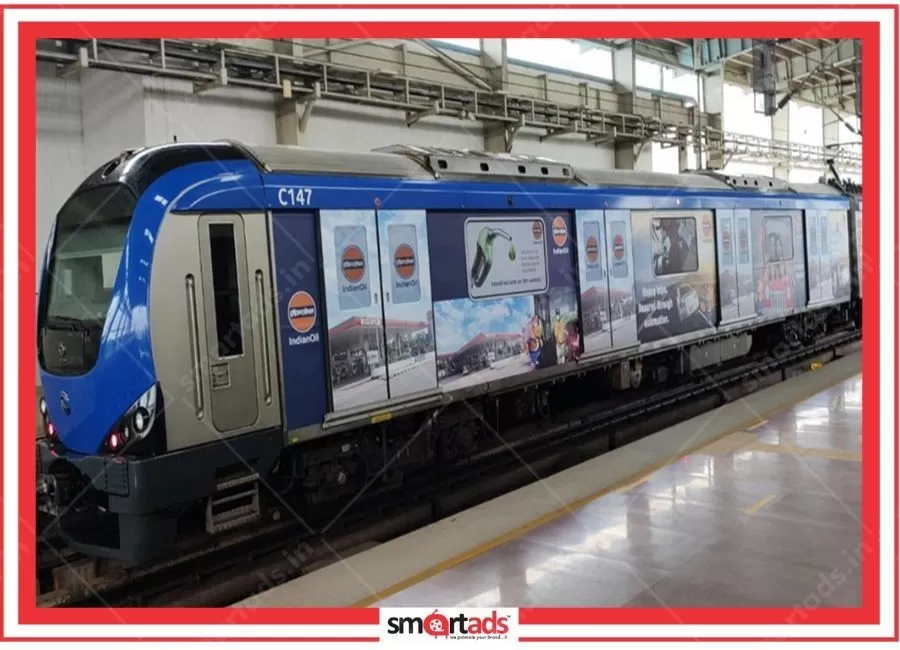
Exterior Metro Wrap
Size & Printing Cost as per actual
On the outside of metro Train, advertise
Rate per Metro Display Cost / 1 Month
6 Coaches & Route : Inderlok To Brigadie
₹2060000.00
Showing 1 to 4 of 4 Results
MEDIA DETAILS
Size & Printing Cost as per actual
On the outside of metro Train, advertise
Rate per Metro Display Cost / 1 Month
6 Coaches & Route : Inderlok To Brigadie
₹2060000.00
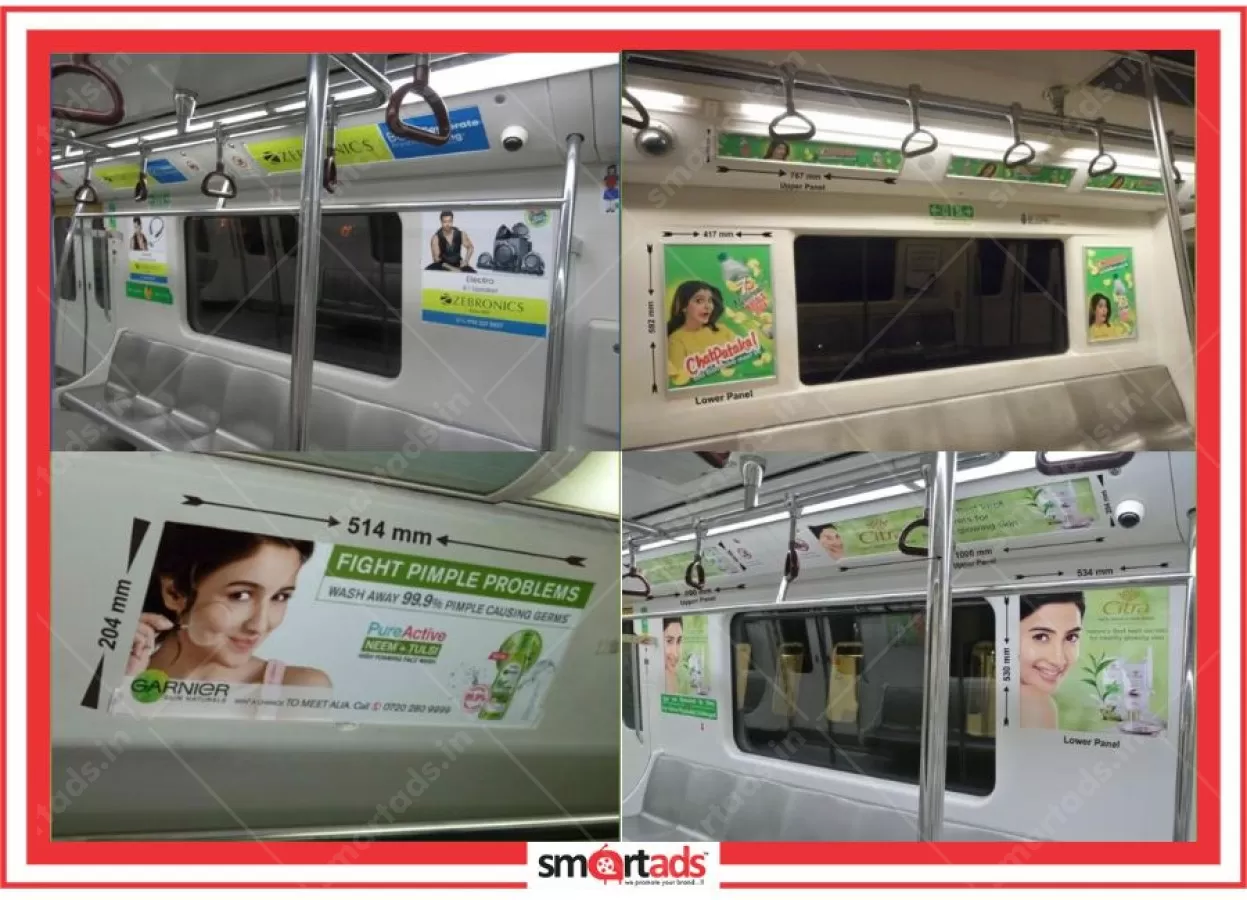
Size & Printing Cost as per actual
On the outside of metro Train, advertise
Rate per Metro Display / Per match
4 Coach & Route : Inderlok To Brigadier
₹390000.00
20 Sec Jingle
On the outside of metro Train, advertise
Rate per Metro Display Cost / 1 Month
Route:Inderlok To Brigadier Hoshiyar Sin
₹400000.00
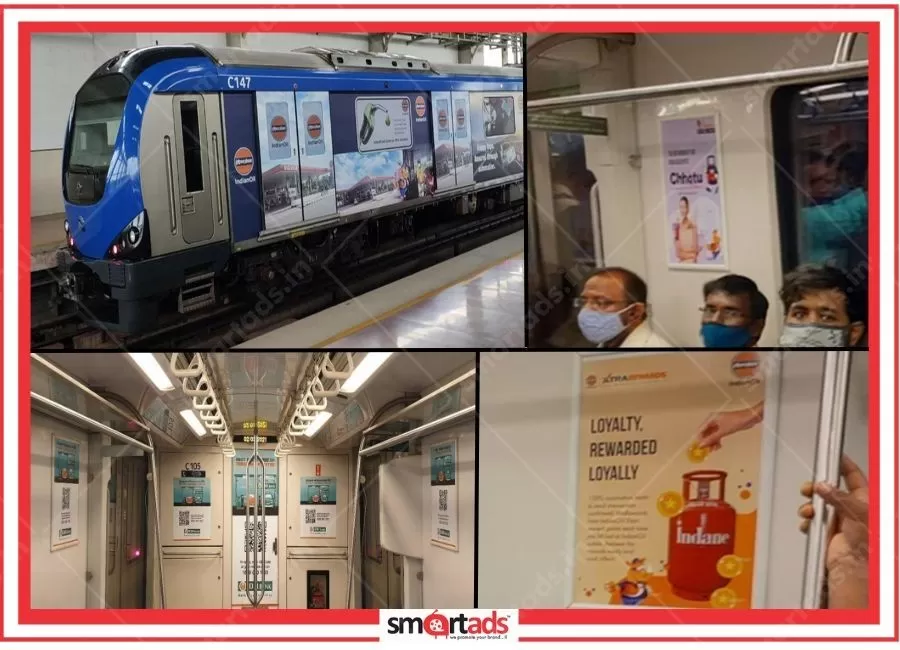
Size & Printing Cost as per actual
On the outside of metro Train, advertise
Rate per Metro Display Cost / 1 Month
Route:Inderlok To Brigadier Hoshiyar Sin
₹4490000.00
MEDIA REACH

MinimumQty :
1
EstimateReachPeople :
150000000
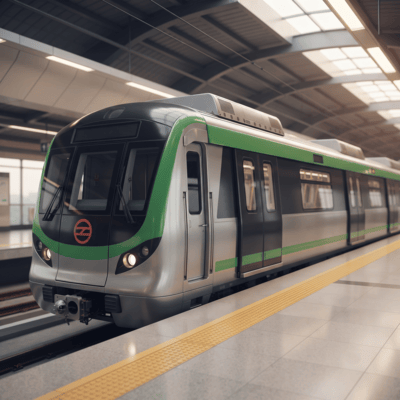
Most advertisers who call us about Delhi metro advertising ask first about the Yellow Line or the Blue Line — which is understandable, given the sheer volume of content written about those corridors. What a lot of people miss is that the Delhi Metro Green Line Main, running from Inderlok all the way to Brigadier Hoshiyar Singh station in Bahadurgarh, carries a daily ridership that crosses well into the lakhs, serves one of Delhi's most commercially underserved corridors, and — critically — extends into Haryana, making it the only Delhi Metro line that gives you a genuine cross-state audience within a single campaign booking. The brands that have figured this out are getting exceptional value; the ones that haven't are still paying Blue Line premiums for audiences they could reach more efficiently here.
Metro train advertising in Delhi Green Line Main is, at its core, a form of transit advertising where brand creatives are placed directly on or inside the rolling stock — the actual trains — that operate on DMRC's Line 5 between Inderlok and Brigadier Hoshiyar Singh station. Unlike metro station advertising, which is fixed to a location, train advertising travels the entire length of the corridor multiple times a day, which means your creative is not sitting in one place waiting for footfall to come to it; the creative goes to the audience. This distinction matters enormously when you are planning a campaign that needs to build frequency rather than just awareness.
The way it works operationally is that DMRC, through its authorised advertising concessionaires, allocates specific coaches or full train rakes for branding campaigns; advertisers work through a registered metro advertising agency to submit creatives, obtain DMRC approval, and then have the material installed by certified vendors. The Green Line Main operates on a 4-coach configuration — which is a detail that surprises many planners who are used to working with the 6- or 8-coach trains on the Yellow or Blue Lines — and this directly affects the creative dimensions, the number of available panels per train, and ultimately the cost structure of the campaign. At SmartAds, we always brief our clients on this configuration difference upfront, because a creative designed for a Blue Line coach will not simply transfer to a Green Line coach without rework.
What makes metro train advertising in Delhi Green Line Main particularly interesting from a media planning standpoint is the dwell time. Commuters travelling from Inderlok to Bahadurgarh are on the train for anywhere between 35 and 50 minutes depending on their boarding point, which creates a captive audience environment that very few other BTL advertising formats can replicate. A passenger seated or standing in a branded coach is exposed to your creative repeatedly during that journey; they cannot scroll past it, they cannot skip it, and in a clutter-free environment where the only branding present is yours, the brand recall potential is genuinely high.
The range of ad formats available on Delhi Green Line Main trains is broader than most advertisers expect, and choosing the wrong format is one of the most common — and costly — mistakes we see brands make. Interior train branding covers everything inside the coach: overhead panels above the seats, back-panel branding behind the driver's cab, door panels, grab-rail danglers, and the overhead strip panels that run the full length of the coach ceiling. Each of these formats has a different dwell time dynamic; the overhead strip panels, for instance, are visible to virtually every passenger in the coach regardless of where they are standing or sitting, which makes them arguably the highest-reach format within a single coach.
Exterior train branding, on the other hand, involves placing vinyl wraps or printed panels on the outside of the coaches — the sides, the front, and in some configurations the rear of the train. A full train wrap on the Green Line Main, which covers the exterior of all four coaches in a coordinated brand design, is the most impactful and the most visible format, because the train is seen not just by its passengers but by everyone on the platforms, at level crossings, and along the elevated sections of the route through North West Delhi and into Haryana. We worked with a consumer durables brand that wanted to launch a new product line specifically targeting the Punjabi Bagh and Paschim Vihar catchment; they opted for a full train wrap combined with interior overhead panels, and the combination delivered what their post-campaign survey described as "unavoidable" brand visibility — their words, not ours.
Beyond the standard formats, there are coach branding packages that allow an advertiser to take over an entire coach's interior — every available panel surface — which creates an immersive brand environment that is particularly effective for product launches, rebranding exercises, or campaigns that need to communicate a complex message. Metro coach panels can also be combined with smart card advertising, where brand messages appear on the DMRC smart cards issued at stations along the Green Line Main route, creating a touchpoint that passengers carry with them beyond the train journey itself. Digital screens inside newer coaches on Line 5 offer another layer of campaign integration, though availability varies by rake.
The Delhi Metro Green Line Main runs from Inderlok in North Delhi to Brigadier Hoshiyar Singh station in Bahadurgarh, Haryana — a distance of roughly 29 kilometres that passes through some of Delhi's most densely populated and commercially active western corridors. The stations along this route, in sequence from the Delhi end, include Inderlok, Ashok Park Main, Punjabi Bagh West, ESI Hospital, Punjabi Bagh, Shivaji Park, Madipur, Paschim Vihar East, Paschim Vihar West, Peera Garhi, Udyog Nagar, Surajmal Stadium, Nangloi, Nangloi Railway Station, Rajdhani Park, Mundka, Mundka Industrial Area, Ghevra, Tikri Kalan, Tikri Border, Pandit Shree Ram Sharma, Bahadurgarh City, and Brigadier Hoshiyar Singh.
What a lot of people miss about this corridor is the sheer geographic and demographic range it covers within a single metro line. The stretch from Inderlok through Punjabi Bagh and into Paschim Vihar passes through some of Delhi's most affluent residential and commercial zones; from Nangloi onward into Mundka, the character shifts toward dense working-class and lower-middle-income residential areas with very high daily commuter volumes; and from Tikri Border into Bahadurgarh, you are in Haryana — specifically Jhajjar district — where the audience profile includes a significant proportion of industrial workers, small business owners, and students who commute daily into Delhi. This is not a homogeneous corridor, which is actually a strength for advertisers who want to reach a broad cross-section of Delhi-NCR's population in a single campaign.
The Green Line Main also intersects with other DMRC lines at key interchange stations — Inderlok connects to the Red Line, and Punjabi Bagh connects to the Pink Line — which means trains on this route carry not just origin-to-destination commuters but also interchange passengers who are boarding specifically at these nodes. Nangloi Railway Station, which sits adjacent to the Nangloi metro station, adds a feeder dimension: passengers arriving by suburban rail from Haryana and outer Delhi transfer here, which amplifies the catchment area of the Green Line Main well beyond what the metro ridership numbers alone suggest. Footfall at stations like Mundka, Nangloi, and Punjabi Bagh is consistently among the highest on the line, and these are the stations where platform dwell time is longest — meaning exterior train branding gets maximum exposure precisely where the audience density is greatest.
Frankly speaking, the audience on the Delhi Metro Green Line Main is one of the most commercially interesting and underserved in the entire DMRC network, and we say this based on years of planning campaigns across multiple lines. The daily commuters on this corridor skew toward a working-age demographic — roughly 18 to 45 years old — with a significant proportion of urban professionals employed in the commercial districts of Punjabi Bagh, Paschim Vihar, and the industrial areas around Mundka and Bahadurgarh. Students form a substantial secondary segment, particularly between Nangloi and Bahadurgarh, where several colleges and vocational institutes draw students who commute by metro daily.
The Haryana extension of the Green Line Main is a genuinely distinctive audience characteristic that no other Delhi metro line offers. Passengers boarding at Bahadurgarh, Bahadurgarh City, and the stations near Tikri Border are residents of Haryana who work or study in Delhi — a demographic that is aspirational, brand-conscious, and, importantly, underexposed to the kind of high-quality brand communication that metro advertising delivers. We have found, in our campaign planning work for FMCG and financial services clients, that this NCR-Haryana overlap audience responds particularly well to brands that communicate aspirational value; they are not as saturated with advertising as the central Delhi audience, which means your campaign stands out more.
North West Delhi, which forms the core of the Green Line Main catchment, has a household income profile that sits firmly in the middle-income to upper-middle-income range, with strong spending in categories like consumer electronics, two-wheelers, home improvement, financial products, and education. The target audience here is not the premium luxury buyer — but it is exactly the mass-premium consumer that most FMCG, banking, telecom, and retail brands are chasing. On top of that, the sheer volume of daily commuters on this corridor, which DMRC ridership data consistently places among the busier non-central lines, means that even a single train wrap generates millions of impressions over a 30-day campaign period.
Advertising rates for metro train advertising in Delhi Green Line Main vary depending on format, duration, and whether you are booking a single coach, multiple coaches, or a full train wrap — but we can give you the kind of real benchmarks that most agency pages avoid publishing. For interior train branding on a single coach, covering the overhead panels and back-panel, the advertising cost works out to somewhere in the ballpark of ₹80,000 to ₹1.5 lakh per coach per month, which is a range that reflects the difference between a basic panel package and a more comprehensive interior takeover. A full coach interior branding — every available panel surface inside one coach — typically falls somewhere between ₹1.5 lakh and ₹2.5 lakh per month depending on the specific rake and the concessionaire's current inventory.
Exterior train branding, which involves vinyl application on the outside of the coaches, carries a higher production cost alongside the space cost; the total investment for a full train wrap on a 4-coach Green Line Main train — including production, installation, DMRC approval fees, and the monthly space rental — works out to roughly ₹8 lakh to ₹15 lakh per month, which sounds significant until you calculate the effective CPM. Given that a single train on the Green Line Main completes multiple round trips daily and is seen by thousands of passengers and bystanders each day, the CPM for a full train wrap works out to somewhere in the range of ₹6 to ₹12, which is a number that surprises most first-time advertisers when they compare it to what they are paying for Instagram reach in the same geographic market.
Campaign duration is a critical variable in the cost equation; DMRC's concessionaires typically offer monthly rates, with discounts available for bookings of three months or more — and in our experience at SmartAds, a 90-day campaign on the Green Line Main delivers meaningfully better brand recall outcomes than a 30-day burst, because the repeated exposure to the same captive audience builds recognition rather than just awareness. For a mid-sized brand with a campaign budget in the range of ₹5 to ₹20 lakh, the Green Line Main offers a genuinely competitive cost-per-reach compared to outdoor advertising options like hoardings along Rohtak Road or NH-9, where a single site in a premium location can cost ₹3 to ₹6 lakh per month without the captive audience advantage.
The honest answer is that the Green Line Main is not the right choice for every campaign — but for brands targeting North West Delhi, the Haryana border corridor, or the working-to-middle-income urban professional demographic, it is frequently the most efficient choice available. The Yellow Line and Blue Line carry higher absolute ridership, which means higher absolute reach, but they also carry significantly higher advertising rates and, frankly, considerably more advertising clutter; a passenger on the Yellow Line between Rajiv Chowk and Hauz Khas is exposed to so much brand communication that individual campaigns struggle to break through. The Green Line Main, by contrast, operates in a relatively clutter-free environment where a well-executed campaign genuinely stands out.
The BTL advertising case for the Green Line Main is also strengthened by the hyperlocal advertising precision it offers. If your brand has retail outlets, service centres, or distribution points in Punjabi Bagh, Paschim Vihar, Nangloi, or Mundka — or if you are opening a new location in any of these areas — advertising on the Green Line Main puts your message in front of the exact people who live and work within walking distance of those locations. We ran a campaign for a quick-service restaurant chain that was opening outlets in Paschim Vihar and Nangloi; they used interior train branding on the Green Line Main with a QR code panel that drove footfall directly to the new stores, and within the first month of the campaign, the Nangloi outlet attributed roughly 22% of its new customer acquisitions to the metro campaign — a figure that was tracked through the QR redemption data.
On top of that, the Green Line Main's extension into Haryana creates a non-traditional advertising opportunity that is genuinely unique in the Delhi metro network. Brands in categories like real estate, automotive, financial services, and consumer durables that want to reach the aspirational Haryana-NCR consumer — someone who commutes into Delhi daily and is exposed to Delhi's commercial culture but lives in a market that is less advertising-saturated — will find the Green Line Main to be a remarkably efficient vehicle. This is not a corridor that most media planners think of first, which is precisely why the brands that do use it tend to see stronger share-of-voice outcomes.
The booking process for metro train advertising in Delhi Green Line Main runs through DMRC's authorised advertising concessionaires, which manage the inventory of train panels, coach branding slots, and full train wraps across the network. The first step is identifying available inventory — specific coaches or rakes are allocated to campaigns, and availability varies by month and by format, so early planning is essential; we generally advise our clients to begin the booking process at least 6 to 8 weeks before the intended campaign start date to avoid inventory conflicts. A registered green line advertising agency like SmartAds handles the concessionaire relationship, which simplifies the process considerably for the advertiser.
Once inventory is confirmed, the creative submission and DMRC approval process begins, which is the step that most first-time advertisers underestimate in terms of time and complexity. DMRC has specific guidelines governing content, size, material specifications, and installation methods for all train advertising; creatives must be submitted in the prescribed format, reviewed for compliance with DMRC's advertising policy, and formally approved before any installation can begin. The DMRC approval timeline typically runs between 10 and 20 working days, though this can vary; campaigns with straightforward creatives and standard formats tend to move through approval faster than those involving unusual materials or non-standard dimensions. We have seen campaigns delayed by two to three weeks because the creative was submitted at the wrong resolution or with colour specifications that did not meet DMRC's printing requirements — which is a costly mistake when you are working against a campaign launch deadline.
After DMRC approval is received, the installation is carried out by certified vendors during the train's scheduled maintenance window, which usually happens at night when the rake is in the depot. The entire installation for a full train wrap on a 4-coach Green Line Main train typically takes one to two nights, after which the train re-enters service with your branding active. Campaign duration is tracked from the date the train enters service with the creative installed, and removal at the end of the campaign period follows the same depot-based process. At SmartAds, we manage the entire workflow — from concessionaire negotiation and creative compliance checking through to installation supervision and post-campaign documentation — so that our clients are not navigating the DMRC system independently.
DMRC's advertising guidelines for Line 5 train branding are consistent with its network-wide policy, but there are format-specific nuances that matter in practice. All advertising content must be non-political, non-religious, and compliant with the Advertising Standards Council of India's (ASCI) code; creatives depicting competitive comparisons, claims that require substantiation, or content that could be construed as misleading are routinely flagged during the review process. The material specifications for exterior vinyl wraps require a minimum print resolution of 720 DPI at final output size, with UV-resistant inks that meet DMRC's durability standards for outdoor application — which, given that the Green Line Main has significant elevated sections exposed to direct sunlight and monsoon weather, is a genuinely important technical requirement.
For interior train branding, the panel dimensions vary by position within the coach; overhead panels typically measure somewhere in the range of 18 inches by 24 inches, while back-panel branding behind the cab can be significantly larger — in the ballpark of 4 feet by 3 feet — and the grab-rail danglers are typically A4 or A5 format. The 4-coach configuration of the Green Line Main means that a full interior coach takeover involves a specific number of panel positions per coach, which the concessionaire will specify during the booking process; it is important to design creatives to these exact dimensions rather than adapting from other formats, because imprecise sizing leads to rejection at the approval stage.
The DMRC approval process itself involves submission of the creative artwork, a declaration of compliance with ASCI guidelines, and in some cases a sample print for material approval before the full production run is authorised. Frankly speaking, the approval process is not as onerous as some advertisers fear — but it does require discipline in preparation. What we tell our clients at SmartAds is to treat the DMRC submission as a formal document process, not a casual creative review; every specification must be met precisely, every declaration must be complete, and the timeline must account for the possibility of a revision request, which adds at least another week to the process.
The comparison between metro train advertising in Delhi Green Line Main and outdoor advertising along the NH-9 or Rohtak Road corridor is one we are asked to make frequently, and the honest answer is that they serve different communication objectives rather than being direct substitutes. A hoarding on Rohtak Road delivers high-speed, momentary impressions to vehicular traffic — the exposure lasts perhaps two to three seconds per vehicle pass, the audience is moving, and the creative must communicate in an instant. Metro train advertising, by contrast, delivers extended dwell time exposure to a captive audience; a passenger on the Green Line Main is with your creative for the duration of their journey, which creates an opportunity for more complex messaging, QR code integration, and detailed brand communication that outdoor advertising simply cannot support.
The cost comparison is also instructive. A premium hoarding site along NH-9 in the Mundka or Tikri area works out to roughly ₹2.5 to ₹5 lakh per month for the site alone, without production costs, and reaches a predominantly vehicular audience with a very short exposure window. Interior train branding on the Green Line Main, at a broadly similar budget, reaches a captive audience with a dwell time of 35 to 50 minutes per journey and delivers repeated exposure to the same commuters over the campaign period — which is where the brand recall advantage becomes decisive. The FICCI-EY Media Report has consistently highlighted transit advertising as one of the fastest-growing non-traditional advertising segments in India, precisely because of this dwell time and frequency advantage over conventional OOH advertising.
Digital advertising in the same geographic market — say, hyperlocal social media targeting of North West Delhi pincodes — offers precise targeting and measurable click-through data, but it competes in an extremely cluttered environment where the average user is exposed to dozens of ads per session and banner blindness is a genuine issue. Metro train advertising in Delhi Green Line Main, operating in a clutter-free environment with no competing brand messages on the same surface, achieves a quality of attention that digital formats struggle to replicate. The most effective campaigns we have planned combine both: digital for precision targeting and retargeting, metro train branding for frequency and brand recall building among the daily commuter audience.
The comparison between the Green Line Main and the Pink, Yellow, and Blue Lines is not simply a matter of which line has higher ridership — it is a question of which line delivers the best fit for a specific campaign objective and target audience. The Yellow Line, which runs from Samaypur Badli to HUDA City Centre, carries the highest ridership in the DMRC network and commands correspondingly premium advertising rates; a full train wrap on the Yellow Line can cost two to three times what the same format costs on the Green Line Main, which makes it the right choice for mass-market national campaigns but a difficult proposition for brands with regional or hyperlocal objectives. The Blue Line, running from Dwarka to Noida/Vaishali, is similarly premium-priced and serves a predominantly east-west audience that does not overlap significantly with the North West Delhi and Haryana catchment of the Green Line Main.
The Pink Line, which serves the outer ring of Delhi, shares some demographic similarities with the Green Line Main in terms of its working-to-middle-income audience profile, but it does not offer the Haryana extension that makes the Green Line Main distinctive. Delhi Metro Line 5 is the only line that crosses the state border into Haryana, which is a genuinely unique characteristic from an advertising geography standpoint; no other line in the DMRC network gives you simultaneous reach into Delhi and Haryana within a single train-based campaign. For brands in real estate, automotive, FMCG, or financial services that are actively targeting the NCR-Haryana consumer, this cross-state reach is a meaningful competitive advantage.
What we tell clients who are comparing lines is to think about audience fit before budget; the Green Line Main at a lower rate with a perfectly matched audience will almost always outperform a Yellow Line campaign at a premium rate reaching an audience that is only partially relevant. One automotive brand we worked with was considering a Yellow Line campaign for a new two-wheeler launch, but when we mapped their dealer locations against the metro network, it became clear that their highest-density dealer cluster was in Punjabi Bagh, Paschim Vihar, and Mundka — all Green Line Main stations. Shifting the campaign to the Green Line Main reduced their media spend by roughly 40% while actually improving the geographic relevance of the campaign, and their post-campaign dealer inquiry data showed a 31% uplift in walk-ins from the North West Delhi corridor during the campaign period.
Measuring ROI from metro train advertising in Delhi Green Line Main requires a more thoughtful approach than simply counting impressions, because the value of this format lies in a combination of reach, frequency, dwell time, and the quality of attention it generates — none of which are fully captured by a simple CPM calculation. The starting point for any ROI assessment is establishing the baseline reach: a single train on the Green Line Main, running multiple round trips per day across a 30-day campaign, generates a cumulative impression count that works out to somewhere in the range of 15 to 25 lakh impressions per month for an exterior wrap, depending on the specific route sections and the time-of-day distribution of ridership. Interior branding reaches a smaller but more attentive audience — the passengers actually inside the coach — which typically works out to somewhere between 3 and 8 lakh impressions per month per coach.
The brand recall dimension is where metro train advertising consistently outperforms other BTL advertising formats in independent research. Studies cited in the FICCI-EY Media Report and industry data from TAM AdEx's transit advertising analysis consistently show that metro train advertising achieves unaided brand recall rates in the range of 35 to 55%, compared to 15 to 25% for standard outdoor advertising — a difference that is directly attributable to the dwell time and clutter-free environment advantages. Repeated exposure to the same creative over a 30- or 90-day campaign period compounds this recall effect, which is why we recommend minimum 60-day campaigns for brand-building objectives and 30-day bursts only for time-sensitive promotions or event-driven campaigns.
The most reliable way to measure ROI from a Green Line Main campaign in practical terms is to build in a direct response mechanism — a QR code on interior panels that drives to a landing page, a unique promo code for retail redemption, or a dedicated phone number for inquiry tracking. We ran a campaign for a financial services client targeting the Bahadurgarh and Mundka corridor, where interior panels carried a QR code linking to a loan application page; over a 60-day campaign period, the QR code generated roughly 4,200 scans, of which approximately 18% converted to completed applications — a conversion rate that the client described as significantly above their digital channel benchmarks for the same audience. The combination of metro train branding for awareness and a digital activation mechanism for conversion is, in our view, the most effective way to make BTL advertising in Delhi Metro both measurable and accountable.
Q: What is metro train advertising on the Delhi Green Line Main?
Metro train advertising on the Delhi Green Line Main refers to brand communication placed on or inside the trains operating on DMRC's Line 5 between Inderlok and Brigadier Hoshiyar Singh station in Bahadurgarh, Haryana. It is a form of transit advertising that travels the entire corridor multiple times daily, delivering brand messages to a captive audience of daily commuters in a clutter-free environment; it encompasses interior formats like overhead panels and coach branding as well as exterior formats including partial and full train wraps.
Q: How many coaches does the Delhi Metro Green Line (Line 5) train have for branding?
The Delhi Metro Green Line Main operates on a 4-coach configuration, which distinguishes it from the 6- and 8-coach trains on the Yellow and Blue Lines. This 4-coach format means there are fewer panel positions per train compared to the longer lines, which affects both the creative dimensions and the pricing structure; however, it also means that a full train wrap or full interior takeover on the Green Line Main is proportionally more affordable than on the longer lines, making it accessible to mid-sized advertisers who might find a Yellow Line train wrap cost-prohibitive.
Q: What are the available ad formats for Delhi Green Line Main train advertising?
The available ad formats include interior train branding — overhead panels, back-panel branding, door panels, grab-rail danglers, and full coach interior takeovers — as well as exterior train branding in the form of partial side panels, full side wraps, and complete full train wraps covering all four coaches. Digital screens inside certain coaches offer an additional format option, and smart card advertising at Green Line Main stations provides a supplementary touchpoint. The choice of format depends on the campaign objective, budget, and whether the priority is reach (exterior) or dwell time and message complexity (interior).
Q: How much does it cost to advertise on the Delhi Metro Green Line Main?
Interior coach branding on the Green Line Main typically works out to somewhere between ₹80,000 and ₹2.5 lakh per coach per month depending on the extent of the panel coverage, while a full train wrap covering all four coaches — including production and installation — falls somewhere in the range of ₹8 lakh to ₹15 lakh per month. These are indicative benchmarks; actual advertising rates depend on current inventory availability, campaign duration, and the specific concessionaire's pricing at the time of booking. Longer campaign durations of 90 days or more typically attract meaningful discounts.
Q: Which stations are covered under the Delhi Metro Green Line Main route?
The Green Line Main covers 23 stations from Inderlok to Brigadier Hoshiyar Singh, passing through Ashok Park Main, Punjabi Bagh West, ESI Hospital, Punjabi Bagh, Shivaji Park, Madipur, Paschim Vihar East, Paschim Vihar West, Peera Garhi, Udyog Nagar, Surajmal Stadium, Nangloi, Nangloi Railway Station, Rajdhani Park, Mundka, Mundka Industrial Area, Ghevra, Tikri Kalan, Tikri Border, Pandit Shree Ram Sharma, and Bahadurgarh City before terminating at Brigadier Hoshiyar Singh station.
Q: Does the Delhi Green Line extend into Haryana and how does that affect ad reach?
Yes — the Delhi Metro Green Line Main is the only DMRC line that crosses the state border into Haryana, with the stations from Tikri Border onward (including Bahadurgarh City and Brigadier Hoshiyar Singh) located in Jhajjar district, Haryana. This cross-state extension means that a single train-based campaign on the Green Line Main reaches both Delhi and Haryana audiences simultaneously, which is a unique advantage for brands targeting the NCR-Haryana consumer — particularly in categories like real estate, automotive, FMCG, and financial services where the Haryana border market is commercially significant.
Q: What is the daily footfall on the Delhi Metro Green Line Main?
DMRC's published ridership data, which is updated periodically and referenced in industry analyses including the GroupM TYNY Report's transit media sections, indicates that the Green Line as a whole carries daily ridership in the range of several lakh passengers; high-footfall stations like Mundka, Nangloi, Punjabi Bagh, and Paschim Vihar West consistently rank among the busier stations on the line. Exact station-by-station footfall figures are available from DMRC's official publications and are used by our planning team at SmartAds to identify the highest-impact campaign configurations.
Q: How is Green Line Main metro train advertising different from Green Line Branch advertising?
The Green Line has a main line running from Inderlok to Brigadier Hoshiyar Singh and a branch line that connects to Kirti Nagar. The main line carries the majority of the ridership and serves the longer, more commercially diverse corridor; the branch line is shorter and carries lower absolute ridership, which means it commands lower advertising rates but also delivers lower reach. For campaigns targeting the North West Delhi and Haryana corridor, the main line is the appropriate choice; the branch line is better suited to hyperlocal campaigns specifically targeting the Kirti Nagar catchment.
Q: Can I book individual coach branding on the Delhi Metro Green Line?
Yes — individual coach branding is available on the Delhi Metro Green Line Main, which makes it accessible for advertisers who want to test the format at a lower initial investment before committing to a full train wrap. A single-coach interior branding package gives you all the panel positions within that one coach, and the coach travels the full length of the route with every trip, so the geographic reach is identical to a full train campaign — the difference is simply in the number of passengers who are inside the branded coach at any given moment.
Q: What is the difference between interior train branding and full train wrapping on the Green Line?
Interior train branding covers the panel surfaces inside the coach — overhead panels, back panels, door panels, and danglers — and is seen only by passengers travelling inside the train; it delivers high dwell time and detailed message exposure to a captive audience. A full train wrap covers the exterior of all four coaches in a coordinated brand design and is visible to everyone who sees the train — passengers on platforms, people at level crossings, and bystanders along the elevated sections of the route. The two formats serve different objectives and are most powerful when used in combination.
Q: How long does DMRC approval take for Green Line Main train advertisements?
DMRC approval for train advertising creatives typically takes between 10 and 20 working days, though this can vary depending on the complexity of the creative and the current volume of submissions being processed. Campaigns with straightforward content and standard format specifications tend to move through approval faster; creatives that require material sample approval or that involve unusual dimensions may take longer. We recommend building at least four weeks of pre-production and approval time into any Green Line Main campaign timeline.
Q: Is Delhi Metro Green Line advertising a BTL or OOH media activity?
Metro train advertising in Delhi Green Line Main is classified as a BTL advertising activity — specifically a form of transit advertising — rather than traditional OOH advertising, though the distinction is sometimes debated in media planning circles. DMRC train advertising is not captured in standard OOH inventory counts and is typically planned and bought through specialist metro advertising agencies rather than conventional outdoor vendors; it sits in the non-traditional advertising category in most media planning frameworks, alongside cinema advertising, mall branding, and airport advertising.
Q: How do I measure the ROI of my metro train advertising campaign on the Green Line?
The most effective ROI measurement approach combines impression-based metrics — calculated from DMRC ridership data and the specific route coverage of the campaign — with direct response mechanisms embedded in the creative, such as QR codes, unique promo codes, or dedicated inquiry numbers. Brand recall surveys conducted before and after the campaign period provide a qualitative ROI dimension; footfall tracking at retail locations within the Green Line Main catchment provides a commercial ROI dimension. The combination of these approaches gives a reasonably complete picture of campaign effectiveness.
Q: What audience demographics does the Delhi Green Line Main corridor serve?
The Green Line Main corridor primarily serves working-age adults between 18
