
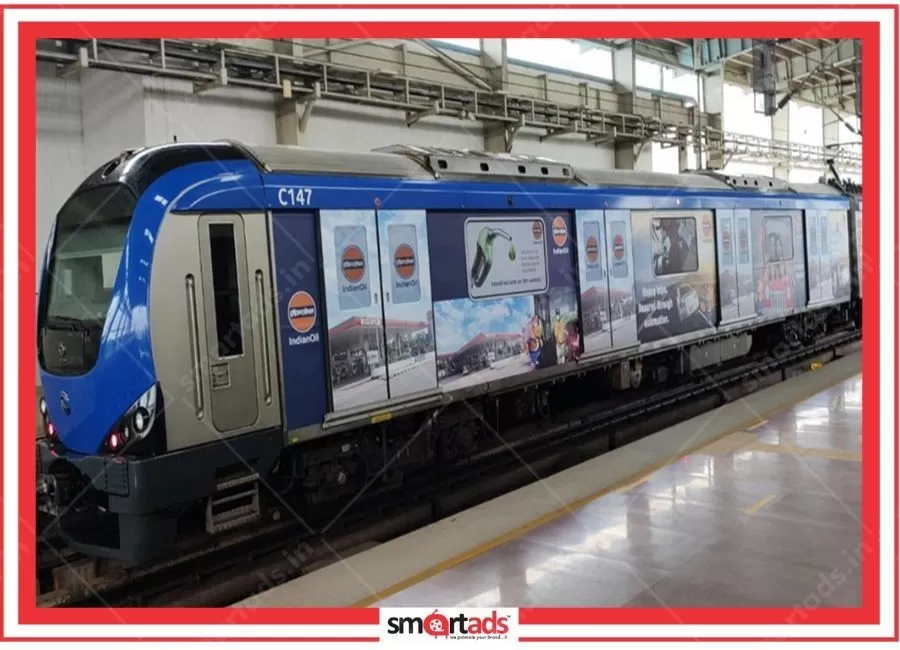
Exterior Metro Wrap
Size & Printing Cost as per actual
On the outside of metro Train, advertise
Rate per Metro Display Cost / 1 Month
Route:Kirti Nagar To Ashok Park Main
₹4490000.00
Showing 1 to 5 of 5 Results
MEDIA DETAILS
Size & Printing Cost as per actual
On the outside of metro Train, advertise
Rate per Metro Display Cost / 1 Month
Route:Kirti Nagar To Ashok Park Main
₹4490000.00
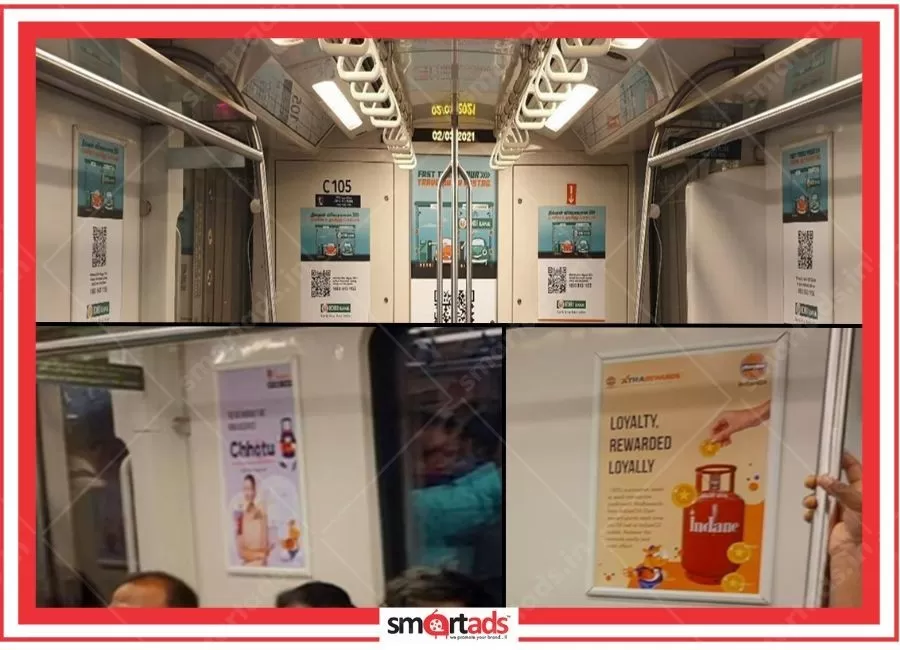
Size & Printing Cost as per actual
On the outside of metro Train, advertise
Rate per Metro Display Cost / 1 Month
Route:Kirti Nagar To Ashok Park Main
₹384000.00
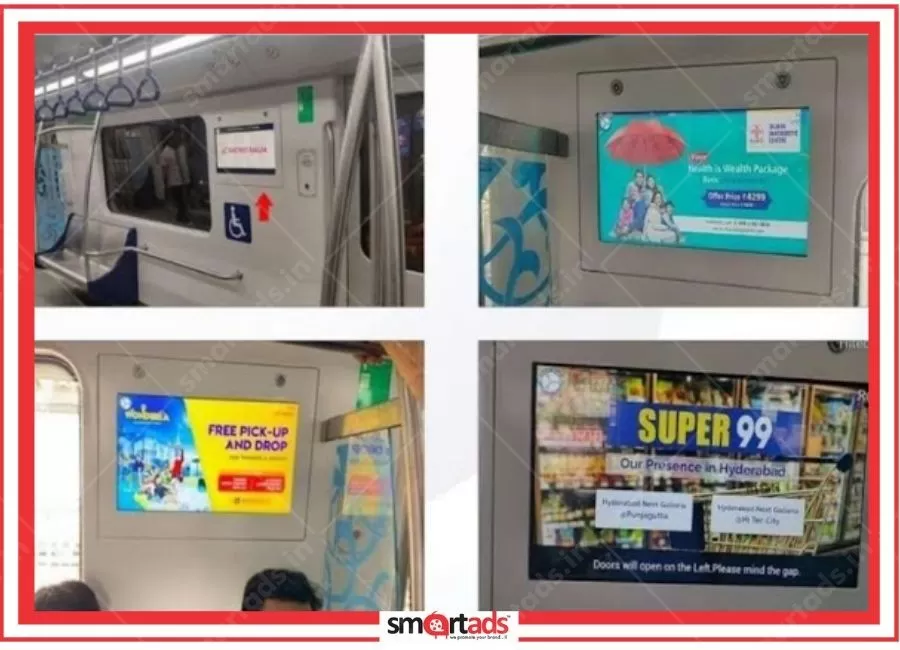
10 Sec Video
On the outside of metro Train, advertise
Rate per Metro Display Cost / 1 Month
Route:Kirti Nagar To Ashok Park Main
₹600000.00
20 Sec Jingle
On the outside of metro Train, advertise
Rate per Metro Display Cost / 1 Month
Route:Kirti Nagar To Ashok Park Main
₹400000.00

1 Metro Train
On the outside of metro Train, advertise
Rate per Metro Display Cost / 1 Month
Route:Kirti Nagar To Ashok Park Main
₹4490000.00
MEDIA REACH

MinimumQty :
1
EstimateReachPeople :
150000000
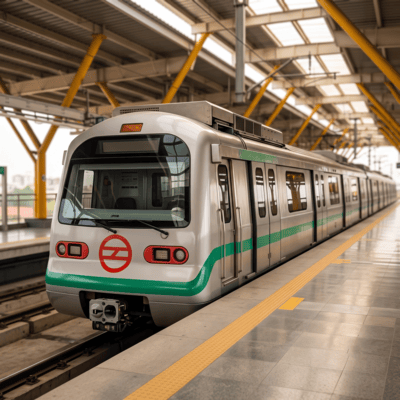
Most advertisers planning a Delhi metro campaign immediately gravitate toward the Blue Line or the Yellow Line, which carry the highest aggregate footfall numbers and therefore attract the most competitive ad rates. What gets consistently underestimated — and frankly, what we at SmartAds have been quietly recommending to clients who want strong reach without the premium price tag — is the Delhi Metro Green Line Branch, a three-station spur running from Ashok Park Main through Satguru Ram Singh Marg to Kirti Nagar, which sits at the intersection of two of Delhi's most commercially active western corridors. The branch is small, yes; but small in this context means concentrated, captive, and surprisingly cost-effective.
The Delhi Metro Green Line Branch — formally a spur of Line 5 — is a short but strategically significant stretch that branches off the main Green Line at Inderlok and terminates at Kirti Nagar, covering three stations in sequence: Ashok Park Main, Satguru Ram Singh Marg, and Kirti Nagar. It is sometimes referred to as the Kirti Nagar spur, and while it may not appear on most advertisers' radar as a primary media buy, the geography it serves is anything but peripheral. The corridor cuts through some of West Delhi's most densely populated and commercially active neighbourhoods, passing through catchment areas that include Punjabi Bagh, Patel Nagar, Moti Nagar, and the Kirti Nagar Industrial Area — all of which generate consistent, purpose-driven commuter traffic throughout the week.
What makes the branch structurally interesting from a media planning perspective is the interchange advantage at both ends of the spur. Ashok Park Main connects to the Red Line, which means commuters travelling from North Delhi and North West Delhi — areas like Rohini, Pitampura, and Kohat Enclave — frequently pass through this junction; Kirti Nagar, at the other terminus, connects to the Blue Line, which is one of DMRC's highest-ridership corridors running from Dwarka to Noida and Vaishali. This dual-interchange positioning means that the Green Line Branch is not just serving its own catchment — it is also capturing transfer traffic from two of Delhi's busiest metro lines, which dramatically expands the effective audience for any metro train advertising campaign placed on this spur.
The trains operating on the Green Line Branch are 4-coach trains, which is a detail that matters quite a bit when you are planning interior train branding or coach panel advertising. Unlike the longer 6- or 8-coach formations on the main corridors, the 4-coach configuration means your creative occupies a proportionally larger share of the passenger's visual field; there is simply less train to compete with, which gives each panel or wrap a stronger relative presence. At SmartAds, we always tell our clients that the Green Line Branch's compact format is actually an asset — it is one of the few places in the Delhi metro network where a single coach booking can genuinely feel like a brand takeover.
The honest answer, which most generic metro advertising pages will not give you, is that the Green Line Branch offers something the main corridors cannot: a clutter-free advertising environment paired with a highly defined geographic audience. On the Blue Line or Yellow Line, your ad is one of dozens competing for attention across eight or more coaches; on the Green Line Branch, the train itself is shorter, the dwell time per station is consistent, and the commuter base is remarkably predictable in terms of residential and professional profile. Frankly speaking, for brands targeting West Delhi consumers — whether that is a real estate developer, a consumer electronics retailer, a financial services firm, or a healthcare brand — this kind of audience specificity is difficult to replicate through any other single out-of-home advertising format in the area.
The daily ridership across the three Green Line Branch stations — Ashok Park Main, Satguru Ram Singh Marg, and Kirti Nagar — is estimated in the range of somewhere between 40,000 and 60,000 passengers per day when combined, a figure that includes both boarding passengers and interchange transfers; this number climbs noticeably during peak hours, which on this corridor run roughly from 8 AM to 12 PM and again from 5 PM to 9 PM. What a lot of people miss is that these are not casual footfall numbers — these are purposeful commuters who are either heading to work in the commercial and industrial clusters of West Delhi or returning home to the residential neighbourhoods that the branch serves. The quality of attention a brand receives from a daily commuter who rides the same route five days a week is categorically different from the fleeting glance a billboard on Rohtak Road might generate.
High dwell time is another factor that the transit advertising literature consistently underscores, and the Green Line Branch delivers it reliably. The journey from Ashok Park Main to Kirti Nagar takes approximately seven to nine minutes, which is long enough for a commuter to read a coach panel ad, register a brand message, and — if the creative is well-executed — pull out their phone and act on it. We have found, across multiple campaigns planned through SmartAds, that metro train advertising on enclosed corridors like this spur generates brand recall rates that are meaningfully higher than static OOH formats, precisely because the audience has nowhere else to look and the exposure is repeated across multiple trips over the campaign period.
The format options for metro train advertising on the Delhi Green Line Branch broadly fall into two categories — exterior train branding and interior train branding — and within each, there are several execution types that vary in cost, impact, and minimum booking requirements. Exterior train branding, which includes full train wrap and partial wrap formats, is the most visually dramatic option; a full train wrap on the 4-coach Green Line Branch train essentially converts the entire exterior surface of the train into a moving billboard that travels through West Delhi, North Delhi, and wherever the train's operational circuit takes it. The visibility generated by a full train wrap is particularly strong at Kirti Nagar and Ashok Park Main, both of which are elevated stations where the train is visible from surrounding streets and buildings.
Interior train branding covers a wider range of formats, from coach panel advertising — which involves placing branded panels on the interior walls, doors, and above-window spaces within each coach — to full coach branding, where every available interior surface within a single coach is wrapped or branded. Digital screens metro formats are also available at select points, though the Green Line Branch's 4-coach trains are more heavily weighted toward static panel formats than digital display options. Backlit panel placements, where available, tend to perform particularly well for product launches and brand awareness campaigns because the illumination draws the eye even in the relatively well-lit interior of a metro coach. On top of that, station branding options at Ashok Park Main, Satguru Ram Singh Marg, and Kirti Nagar — including platform pillar wraps, gate branding, and kiosk activation spaces — can be combined with train branding to create an integrated campaign that surrounds the commuter at every touchpoint of their journey.
Smart card advertising is a format that is occasionally overlooked in the planning process but which can be a surprisingly effective addition to a metro branding campaign; DMRC-issued smart cards are handled by commuters multiple times per day, and a branded card or a card sleeve insert creates a tangible, repeated brand interaction that complements the visual impressions generated by coach panel advertising. For experiential advertising activations — product sampling, interactive kiosks, or live demonstrations — the concourse areas at Kirti Nagar and Ashok Park Main offer reasonable space, subject to DMRC approval and event permissions. What our experience at SmartAds shows is that the most effective Green Line Branch campaigns tend to combine at least two format types, because the spur's compact geography means a commuter will encounter your brand at the station and then again inside the train, which creates a layered exposure pattern that significantly improves brand recall.
Advertising rates on the Delhi Metro Green Line Branch are structured by format, duration, and the number of coaches or panels booked, and they are considerably more accessible than most brand managers expect when they first enquire. Interior coach panel advertising — which is typically the entry-level format for brands new to metro train advertising — works out to roughly somewhere between ₹80,000 and ₹1,50,000 per coach per month depending on panel size, placement within the coach, and whether the booking covers peak-period trains or the full operational schedule. For a brand that wants to book a full coach — meaning all interior panels within a single coach of the 4-coach Green Line Branch train — the advertising cost is typically in the ballpark of ₹2,50,000 to ₹4,00,000 per month, which, when you divide it by the estimated impressions generated across daily ridership, works out to a CPM that surprises most first-time advertisers when they compare it to what they are paying for Instagram reach in the same West Delhi geography.
Full train wrap — the exterior branding format that covers the entire outer surface of the train — is the premium option, and the advertising rates for a full train wrap on the Green Line Branch are roughly in the range of ₹8,00,000 to ₹15,00,000 per month for the complete 4-coach formation; this is a significant investment, but the impression volume it generates — across every station the train serves, every road that runs parallel to the elevated track, and every interchange point at Ashok Park Main and Kirti Nagar — means the effective CPM is still competitive with traditional out-of-home advertising formats in West Delhi. Partial exterior wraps, which cover one or two coaches rather than the full train, are available at proportionally lower rates and are a sensible option for brands that want exterior visibility without committing to the full train wrap budget. Station branding packages at the three Green Line Branch stations are priced separately, and a combined train-plus-station package — which is what we typically recommend for campaigns where brand visibility is the primary objective — can be negotiated as a bundled rate that offers better value than booking each format independently.
One thing worth flagging for media planners is that minimum booking durations for metro train advertising on the Green Line Branch are generally set at one month for interior formats and three months for exterior train branding, which reflects DMRC's operational requirements around installation and removal of exterior wraps. Campaigns that run for three months or longer typically attract rate negotiations that can bring the effective monthly cost down by somewhere between 10 and 20 percent, which is a lever that a good metro advertising agency will use on your behalf. At SmartAds, we have consistently been able to negotiate bundled packages for clients combining Green Line Branch train branding with station branding at Kirti Nagar, which tends to deliver the strongest combined reach within the campaign budget.
The audience profile on the Delhi Metro Green Line Branch is one of the most commercially attractive in the western Delhi metro network, and it is defined by the residential and commercial character of the neighbourhoods the spur serves. Kirti Nagar is home to one of Asia's largest furniture and home décor markets — the Kirti Nagar Industrial Area — which draws traders, retailers, interior designers, and consumers from across Delhi NCR on a daily basis; this means the commuter base at Kirti Nagar station includes not just local residents but also a significant proportion of business visitors and trade buyers who are actively in a purchasing mindset. Patel Nagar and Moti Nagar, which fall within the catchment of Satguru Ram Singh Marg station, are established middle-to-upper-middle-class residential neighbourhoods with high concentrations of urban professionals, government employees, and small business owners — a demographic that is consistently attractive for financial services, consumer durables, insurance, and education brands.
Punjabi Bagh, which is accessible from the Green Line Branch catchment, adds another layer to the audience profile; it is one of West Delhi's most affluent residential enclaves, with a consumer base that over-indexes on premium lifestyle categories including automobiles, real estate, jewellery, and international travel. The interchange dynamic at Ashok Park Main, where the Green Line Branch meets the Red Line, means that the effective reach of a metro train advertising campaign on this spur extends into the commuter flows from North Delhi — areas like Shalimar Bagh, Netaji Subhash Place, and Pitampura — which adds a North Delhi dimension to what might otherwise be considered a purely West Delhi campaign. Daily commuters who use the Red Line to reach Ashok Park Main and then transfer to the Green Line Branch are exposed to interior train branding for the duration of their branch journey, which means the audience is genuinely broader than the station footfall numbers alone would suggest.
From a hyperlocal advertising perspective, the Green Line Branch is particularly well-suited for brands that have retail or service locations in West Delhi and want to drive footfall from a defined geographic catchment. We worked with a consumer electronics retailer based in Rajouri Garden — which is close enough to the Kirti Nagar and Moti Nagar catchment to benefit directly — who ran a three-month interior train branding campaign on the Green Line Branch; the campaign generated a measurable increase in walk-in traffic from customers who specifically mentioned seeing the metro ad, and the cost per store visit worked out to a figure that was substantially lower than what the same brand was paying for performance digital advertising targeting the same West Delhi postcodes. This kind of hyperlocal advertising efficiency is, in our experience, one of the strongest arguments for the Green Line Branch as a BTL advertising medium.
This is a question we get asked regularly, and the honest answer is that it depends almost entirely on your campaign objective and your target geography — which sounds like a hedge, but it is actually a meaningful distinction. The Green Line Main Line runs from Inderlok to Brigadier Hoshiyar Singh station near Bahadurgarh in Haryana, covering a much longer corridor that passes through areas like Punjabi Bagh West, Madipur, Paschim Vihar, and Bahadurgarh — a route that serves a large and diverse commuter base including cross-border Haryana commuters who travel into Delhi for work. If your campaign objective is maximum aggregate reach and you are targeting a broad West Delhi and North West Delhi audience, the main Green Line line offers more stations, more trains, and higher total daily ridership, which makes it the stronger choice for pure volume metrics.
The Green Line Branch, by contrast, wins on audience concentration and advertising cost efficiency. The three-station spur serves a more defined geographic catchment, which means the audience is less diffuse and more predictable; for brands that are specifically targeting the Kirti Nagar, Patel Nagar, Moti Nagar, and Punjabi Bagh consumer base, the branch delivers that audience with less waste than a main line campaign that also reaches commuters from Bahadurgarh and Haryana who may have no relevance to a West Delhi-focused brand. The clutter-free advertising environment on the shorter 4-coach trains is another differentiator — on the main Green Line, trains are longer and the ad environment is more competitive; on the branch, a single coach booking feels more ownable and generates stronger brand visibility per rupee spent.
What we typically recommend to clients who have the budget for it is a combined approach — using the Green Line Branch for high-frequency, high-impact interior train branding targeted at the West Delhi core audience, while supplementing with selective station branding on the main Green Line at high-footfall stations like Punjabi Bagh West or Paschim Vihar East. This kind of integrated BTL advertising strategy, which uses the branch for depth and the main line for breadth, tends to produce the strongest overall campaign performance; it is a media mix logic that applies across transit advertising more broadly, and the Green Line ecosystem is particularly well-suited to it because the branch and main line share interchange infrastructure at Inderlok and Ashok Park Main.
The booking process for metro train advertising on the Delhi Green Line Branch runs through DMRC's authorised advertising concessionaire, which manages all commercial advertising inventory across the Delhi Metro network — including train branding, station branding, and digital screens metro placements. The process begins with a campaign brief that specifies the format, duration, number of coaches or stations, and the creative approach; this brief is then used to check inventory availability on the Green Line Branch, which — because it is a shorter spur with fewer trains — can book up quickly during peak advertising seasons like Diwali, the pre-summer period, and the January-March quarter when many brands are activating their annual advertising plans.
Once inventory is confirmed and rates are agreed upon, the creative artwork needs to be submitted for DMRC approval before any installation can begin; the approval process typically takes somewhere between two and four weeks, which means campaign timelines need to account for this lead time when planning launch dates. Media booking for exterior train branding formats — full train wrap or partial wrap — requires additional lead time for production and installation, and the total timeline from brief to live campaign is generally in the range of four to six weeks for exterior formats and two to three weeks for interior train branding. Working with a metro advertising agency that has an established relationship with DMRC's concessionaires can meaningfully shorten this timeline, because pre-approved vendor status and familiarity with the approval workflow removes several friction points from the process.
At SmartAds, our campaign execution process for Green Line Branch bookings typically involves a three-stage approach: first, we conduct a brief alignment session with the client to define the audience, format, and creative strategy; second, we handle all inventory negotiations, DMRC approval submissions, and production coordination on the client's behalf; third, we conduct post-installation audits to verify that the branding has been executed correctly and that all panels are in good condition throughout the campaign period. This end-to-end media booking support is something that brands managing metro advertising directly — without an agency — frequently underestimate the complexity of, particularly when it comes to navigating DMRC's creative guidelines and approval timelines for the first time.
DMRC's creative guidelines for metro train advertising are more specific than most advertisers expect, and getting them wrong at the submission stage is one of the most common reasons campaigns get delayed. For interior train branding and coach panel advertising, DMRC requires that all creative content be non-political, non-religious, non-controversial, and compliant with the Advertising Standards Council of India (ASCI) code; any content that could be construed as objectionable or that makes comparative claims against named competitors is typically rejected at the DMRC approval stage. The creative must also clearly identify the advertiser — anonymous or teaser campaigns that do not display a brand name or logo are generally not permitted under DMRC's advertising policy.
For exterior train branding, including full train wrap formats, the creative specifications are technically demanding; the artwork must be supplied in high-resolution vector or raster formats at the correct scale for the specific coach dimensions, and the colour profiles need to account for the vinyl printing process used in exterior wraps. The wrap material itself must be sourced from DMRC-approved vendors, which is a requirement that catches some advertisers off guard when they assume they can use their own production partners. DMRC approval for exterior formats also involves a structural assessment to ensure that the wrap does not interfere with any safety markings, emergency exit indicators, or operational signage on the train exterior — a process that adds time to the pre-campaign workflow but is non-negotiable.
One practical point that our team at SmartAds always flags for clients is the importance of submitting creatives with sufficient margin for trimming and alignment, particularly for coach panel advertising where the panels are installed within a frame that may slightly crop the edges of the artwork. Supplying artwork that is designed to the exact panel size without bleed is a common mistake that results in either a resubmission request or a visually compromised installation; we recommend a minimum bleed of 5mm on all sides for interior panels, and a more generous allowance for exterior wrap sections that cross panel joins on the coach body. DMRC approval, once granted, is valid for the duration of the booked campaign period, and any creative changes mid-campaign require a fresh approval submission — which is another reason to get the creative right before the campaign goes live.
The commercial geography of the Green Line Branch makes it particularly well-suited to a specific set of brand categories, and understanding this alignment is what separates a well-planned metro train advertising campaign from one that simply buys space without strategic intent. Real estate developers targeting West Delhi buyers — particularly those with projects in Dwarka, Janakpuri, Punjabi Bagh, or the emerging corridors along NH-9 and Rohtak Road — find the Green Line Branch audience highly relevant, because the commuter base on this spur includes exactly the kind of urban professional and upper-middle-class household that constitutes the primary buyer profile for mid-premium residential projects. One real estate client we worked with ran a two-month full coach branding campaign on the Green Line Branch timed to coincide with a project launch in Punjabi Bagh; the campaign generated enquiry volumes that the client's marketing team attributed, in significant part, to the metro branding — and the cost per enquiry was roughly half of what the same campaign was generating through digital lead generation in the same period.
Home furnishing and interior design brands have an almost self-evident fit with the Green Line Branch, given that Kirti Nagar station sits at the doorstep of one of India's largest furniture markets; a brand that is present in the Kirti Nagar market and wants to build brand recall among the trade buyers and retail consumers who visit the area regularly would be hard-pressed to find a more targeted transit advertising opportunity anywhere in Delhi. Beyond real estate and home furnishing, the branch is well-suited for financial services brands — banks, insurance companies, mutual fund distributors — targeting the salaried urban professional demographic of Patel Nagar and Moti Nagar; for consumer electronics and appliance brands with retail presence in West Delhi; and for education and coaching institutes targeting the student population that uses the Red Line interchange at Ashok Park Main to commute from North Delhi.
Automotive brands, particularly those launching new models in the mid-segment or SUV categories, have also found the Green Line Branch to be a productive advertising environment; the commuter profile on this spur over-indexes on car-owning households compared to the metro network average, which makes the audience receptive to automotive messaging in a way that, say, a predominantly student-commuter corridor might not be. FMCG brands looking for hyperlocal advertising reach in West Delhi — particularly those running activation campaigns tied to retail distribution in the Punjabi Bagh, Patel Nagar, or Moti Nagar markets — can use interior train branding on the Green Line Branch as a cost-effective way to build brand visibility in a defined geography without the broad wastage of a city-wide OOH advertising buy.
The comparison that comes up most frequently in our client conversations is metro train advertising versus traditional out-of-home advertising — specifically large-format hoardings on Rohtak Road or Ring Road — and the answer is more nuanced than the OOH industry would like you to believe. A prime hoarding on Rohtak Road in the Punjabi Bagh stretch can cost somewhere in the range of ₹3,00,000 to ₹6,00,000 per month, which sounds comparable to a full coach interior branding package on the Green Line Branch; but the comparison breaks down when you factor in dwell time, because a driver passing a hoarding at 40 kilometres per hour has perhaps two to three seconds of exposure, while a commuter sitting in a metro coach for seven to nine minutes is exposed to the interior train branding for the entire duration of the journey. The effective CPM on metro train advertising, when calculated against actual dwell-time-weighted impressions, is consistently lower than equivalent OOH advertising formats in the same geography — a point that the FICCI-EY Media Report has noted in its analysis of non-traditional advertising growth in India.
Radio advertising on stations that index heavily in West Delhi — which is a format that many brands use alongside OOH for geographic reach — is priced differently and serves a different awareness function; it builds frequency through audio repetition but lacks the visual brand recall that interior train branding generates. The combination of radio and metro train advertising is one that we have found works particularly well for retail brands, because radio drives top-of-mind awareness while the metro branding reinforces the visual brand identity for commuters who are already in the target geography. Non-traditional advertising formats like auto-rickshaw branding and bus shelter advertising are cheaper on a per-unit basis but generate significantly lower dwell time and brand recall than metro train advertising; they are useful for hyperlocal reach at a neighbourhood level, but they do not replicate the captive audience quality that makes metro advertising distinctively effective.
The emerging comparison that media planners are increasingly being asked to make is metro train advertising versus digital advertising — specifically programmatic display and social media advertising targeting West Delhi postcodes. Digital advertising offers precise targeting and measurable click-through data, which makes it easy to justify to management; but what it cannot replicate is the physical presence and brand recall that comes from a commuter seeing your brand every morning and evening for thirty consecutive days. We have seen campaigns where the combination of Green Line Branch interior train branding with a parallel digital retargeting campaign — using QR codes on coach panels to create a trackable digital bridge between the BTL and digital elements — produced return on investment figures that neither channel could have achieved independently. This kind of integrated campaign thinking, which uses metro branding to build brand recall and digital to capture the resulting intent, is where the real value of transit advertising lies in the current media environment.
Q: What is the Delhi Metro Green Line Branch and which stations does it include?
The Delhi Metro Green Line Branch — also referred to as the Kirti Nagar spur or the Line 5 branch — is a short spur line that branches off the main Green Line at Inderlok and runs through three stations: Ashok Park Main, Satguru Ram Singh Marg, and Kirti Nagar. It serves the western and north-western parts of Delhi, connecting residential neighbourhoods like Patel Nagar and Moti Nagar with the commercial hub of the Kirti Nagar Industrial Area. The branch is notable for its interchange connectivity — Ashok Park Main connects to the Red Line, while Kirti Nagar connects to the Blue Line — which means the spur functions as a transfer corridor for commuters from multiple parts of Delhi, expanding its effective audience well beyond the immediate catchment of its three stations.
Q: How much does metro train advertising on the Delhi Green Line Branch cost per month?
Advertising rates on the Green Line Branch vary by format and duration, but as a general benchmark, interior coach panel advertising works out to roughly ₹80,000 to ₹1,50,000 per coach per month for standard panel placements; a full coach interior branding package — covering all interior surfaces within a single coach — is typically in the ballpark of ₹2,50,000 to ₹4,00,000 per month. Exterior train branding, including full train wrap formats covering the entire 4-coach formation, is a more significant investment, generally in the range of ₹8,00,000 to ₹15,00,000 per month. Station branding at the three Green Line Branch stations is priced separately, and bundled train-plus-station packages are available and typically offer better value than individual format bookings. Rates are also subject to negotiation for longer campaign durations, with campaigns of three months or more generally attracting discounts in the range of 10 to 20 percent.
Q: What advertising formats are available on the Green Line Branch metro trains?
The primary formats available for metro train advertising on the Green Line Branch include exterior full train wrap, exterior partial wrap (covering one or two coaches), interior full coach branding, interior coach panel advertising (individual panels on walls, doors, and above-window spaces), and backlit panel placements where available. In addition to train formats, station branding options at Ashok Park Main, Satguru Ram Singh Marg, and Kirti Nagar include platform pillar wraps, concourse branding, gate advertising, kiosk activation spaces, and smart card advertising. Experiential advertising activations — product demonstrations, sampling, and interactive installations — are also possible in the concourse areas of the larger stations, subject to DMRC approval and event permissions.
Q: How many coaches do Green Line Branch metro trains have?
The metro trains operating on the Delhi Metro Green Line Branch run as 4-coach formations, which is shorter than the 6- or 8-coach trains that operate on the main corridors like the Blue Line or Yellow Line. This compact formation has a direct bearing on advertising strategy — it means that a full train wrap or full interior branding campaign on the Green Line Branch covers fewer coaches but achieves a proportionally stronger visual presence per coach, because the shorter train length means each branded coach represents a larger share of the total train. For advertisers, the 4-coach configuration also means that a single coach booking on the Green Line Branch feels more ownable and less fragmented than a single coach booking on a longer main-line formation.
Q: Can I book advertising on a single coach of the Green Line Branch train?
Yes, single coach bookings are available for interior train branding on the Green Line Branch, and they represent one of the most accessible entry points for brands new to metro train advertising. A single coach interior branding package covers all available panel spaces within that coach — walls, doors, ceiling panels, and above-window spaces — and provides a concentrated brand environment for commuters travelling in that specific coach. Given that the Green Line Branch trains run as 4-coach formations, a single coach booking means your brand occupies 25 percent of the total interior advertising inventory on the train, which is a meaningful share. For exterior formats, minimum bookings typically cover the full train rather than individual coaches, because the visual continuity of the exterior wrap is a key part of the format's impact.
Q: What is the daily ridership or footfall on the Green Line Branch stations?
The combined daily footfall across the three Green Line Branch stations — Ashok Park Main, Satguru Ram Singh Marg, and Kirti Nagar — is estimated at somewhere between 40,000 and 60,000 passengers per day, a figure that includes both boarding and alighting passengers as well as interchange transfers. Kirti Nagar, as the Blue Line interchange station, tends to generate the highest individual station footfall among the three; Ashok Park Main, with its Red Line interchange, is the second highest. These numbers are consistent with DMRC's broader ridership data trends, which have shown steady recovery and growth in the post-pandemic period, with the overall Delhi Metro network now carrying upwards of 60 lakh passengers per day on peak weekdays according to DMRC operational reports.
Q: How do I book metro train advertising on the Delhi Metro Green Line Branch?
Booking metro train advertising on the Green Line Branch involves working through DMRC's authorised advertising concessionaire, which manages all commercial inventory across the network. The process begins with an inventory check for your preferred format and duration, followed by a rate negotiation and booking confirmation; creative artwork then needs to be submitted for DMRC approval, which typically takes two to four weeks. Working with an experienced metro advertising agency — one that has established relationships with DMRC's concessionaires and familiarity with the approval process — significantly simplifies the booking workflow and reduces the risk of delays caused by creative rejections or documentation issues. SmartAds.in handles end-to-end media booking for Green Line Branch campaigns, including inventory negotiation, DMRC approval management, production coordination, and post-installation audit.
Q: Which brands or industries are best suited for advertising on the Green Line Branch?
The Green Line Branch is particularly well-suited for real estate developers targeting West Delhi buyers, home furnishing and interior design brands given the proximity of the Kirti Nagar furniture market, financial services brands targeting urban professionals in Patel Nagar and Moti Nagar, consumer electronics and appliance retailers with West Delhi distribution, automotive brands targeting mid-to-premium segment buyers, and education institutions targeting the student commuter base that uses the Red Line interchange at Ashok Park Main. FMCG brands running hyperlocal advertising campaigns in West Delhi also find the branch cost-effective for building brand recall within a defined geographic catchment.
Q: What is the difference between Green Line Main and Green Line Branch advertising?
The Green Line Main Line covers a much longer corridor from Inderlok to Bahadurgarh in Haryana, serving a broader and more diverse commuter base that includes cross-border Haryana commuters; it offers higher aggregate reach but with more geographic diffusion. The Green Line Branch, by contrast, is a three-station spur serving a concentrated West Delhi catchment, which makes it better suited for hyperlocal advertising campaigns where audience specificity and clutter-free advertising environment are priorities over raw reach volume. The branch's 4-coach trains also create a more ownable advertising environment per coach than the longer main-line formations. For brands with a West Delhi focus and a defined target audience, the branch typically delivers better cost efficiency; for brands seeking maximum aggregate reach across West Delhi and North West Delhi, the main line is the stronger choice — and the two can be combined for an integrated campaign approach.
Q: How long should a metro train advertising campaign run on the Green Line Branch for maximum brand recall?
Our experience across multiple campaigns shows that a minimum of three months is the threshold at which metro train advertising on the Green Line Branch begins to generate strong brand recall among regular commuters; shorter campaigns — one month or less — can build initial awareness but rarely achieve the repeated exposure frequency that converts awareness into recall and purchase intent. The logic is straightforward: a daily commuter who rides the Green Line Branch five days a week will see your interior train branding roughly 20 times in a one-month campaign; over three months, that same commuter has seen your brand 60 or more times, which is the kind of frequency that builds genuine brand recall. Campaigns timed to coincide with festive seasons — Diwali, Navratri, or the pre-summer period — benefit from the additional emotional context of the season and tend to generate stronger consumer response, so a three-month campaign that spans a major festive period is often the most efficient use of the metro train advertising budget.
Q: Does the Green Line Branch interchange with any other metro lines?
Yes, and this is one of the branch's most strategically significant attributes. Ashok Park Main station, at
