
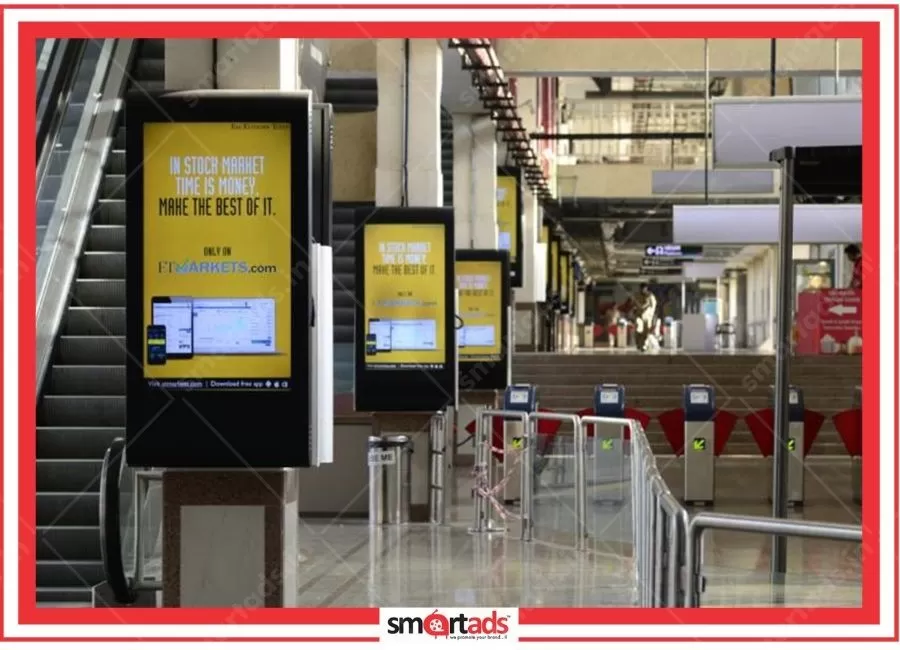
Entry Exit Panel
8 ft x 4 ft
Bright and vibrant multicolored letterin
Rate per Panel / 1 Month
Min Requirement is 3 Panel
₹48000.00
Showing 1 to 4 of 4 Results
MEDIA DETAILS
8 ft x 4 ft
Bright and vibrant multicolored letterin
Rate per Panel / 1 Month
Min Requirement is 3 Panel
₹48000.00
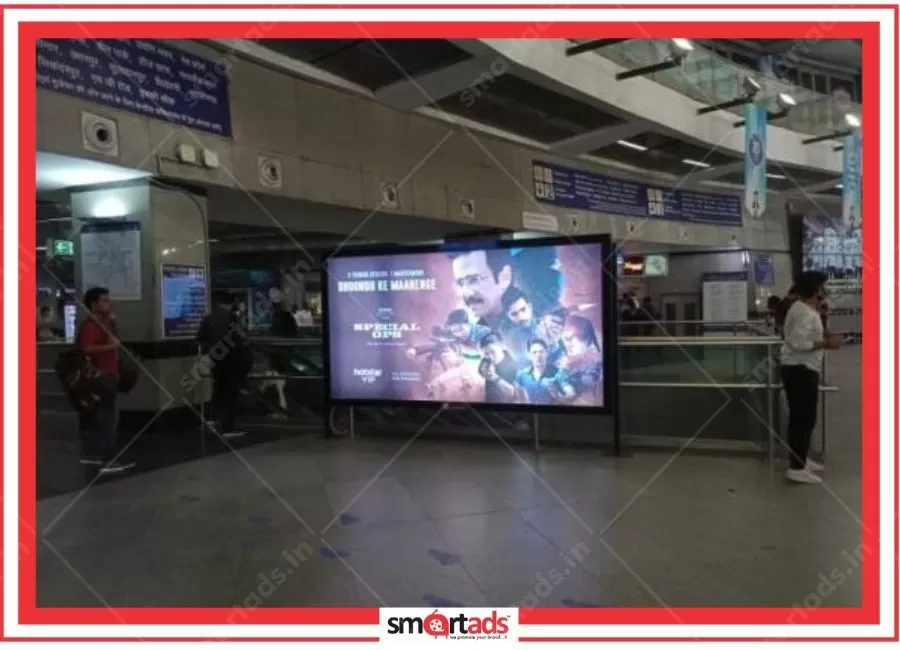
10 ft X 5 ft
A new wide wall system designed to accom
Rate per Panel / 1 Month
Min Requirement is 3 Panel
₹50000.00
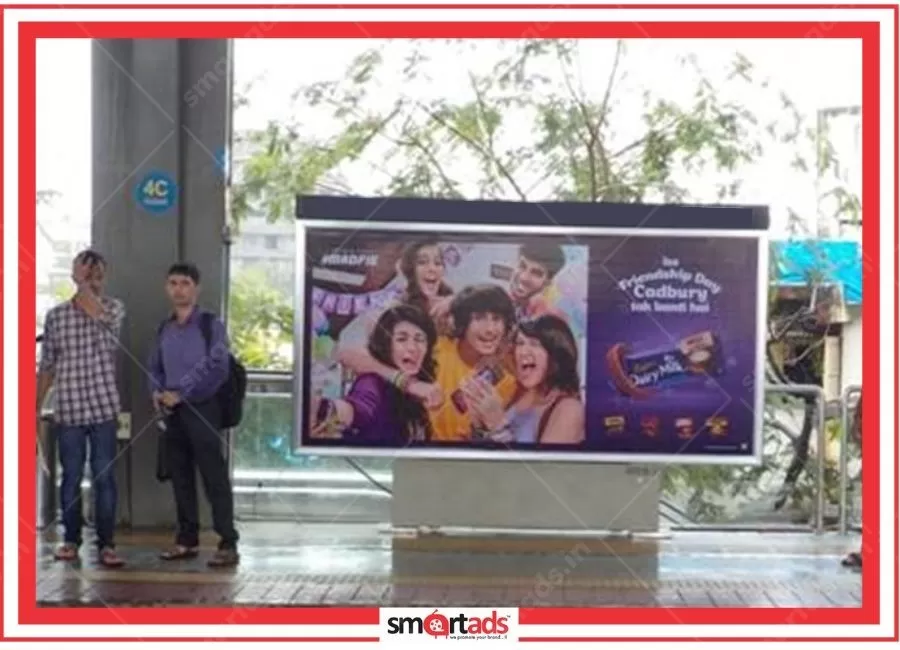
8 ft x 4 ft
A raised flooring or other horizontal su
Rate per Panel / 1 Month
Min Requirement is 3 Panel
₹35000.00
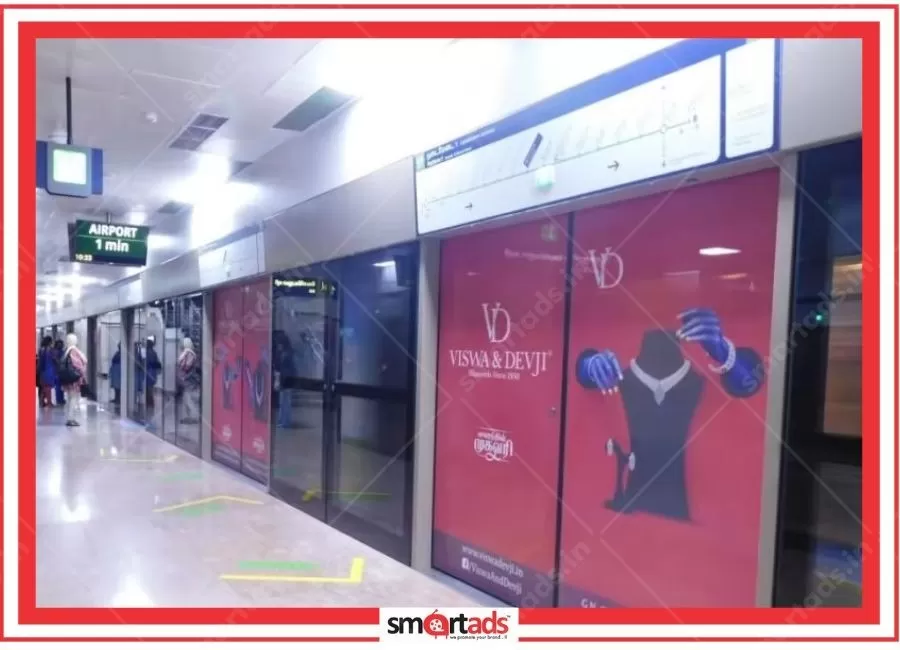
7 ft x 4 ft
Also known as platform edge doors (PEDs)
Rate per Plateform / 1 Month
Min Requirement is 1 Station
₹1200000.00
MEDIA REACH

MinimumQty :
10
EstimateReachPeople :
15 Million
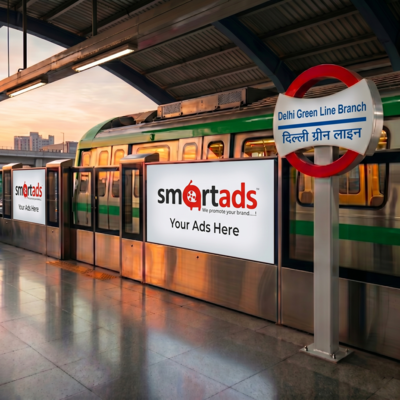
Most brands planning a BTL advertising campaign in Delhi instinctively reach for the Blue Line or the Yellow Line — and we understand why. The numbers look impressive on paper, the names are familiar, and the sales pitches are polished. What a lot of people miss is that the Delhi Metro Green Line Branch, running from Kirti Nagar to Ashok Park Main, quietly delivers some of the most concentrated, demographically consistent commuter exposure available anywhere in West Delhi, at rates that still reflect the corridor's underutilised potential.
There is a tendency to treat metro station advertising as a single, monolithic format — a hoarding here, a panel there — but that framing undersells what DMRC advertising on the Green Line Branch actually makes possible. Metro station advertising, at its core, refers to any paid brand communication placed within the physical environment of a metro station: on platforms, concourses, entry gates, pillars, digital screens, and even within the train carriages themselves. On the Green Line Branch specifically, which connects Kirti Nagar to Ashok Park Main across a short but strategically dense corridor, these placements operate in what we would describe as a clutter-free environment — one where commuters have no competing screen, no roadside distraction, and no reason to look away.
The Delhi Metro Rail Corporation governs all advertising on its network, which means every campaign placed on the Green Line Branch must go through DMRC's authorised advertising channels. This is not a limitation; it is actually one of the format's structural advantages. Because DMRC advertising is regulated, the inventory is finite, the placements are exclusive, and the brand visibility metro commuters experience is undiluted. A platform hoarding advertising placement at Kirti Nagar metro station, for instance, is not competing with twelve other hoardings on the same wall — it occupies a defined, approved slot that DMRC has designated for commercial use.
At SmartAds, we always tell our clients that transit advertising is fundamentally different from other out-of-home advertising because the audience is not passing by — they are waiting, standing, and often returning to the same spot every single day. That repetition is the engine of brand recall, and on the Green Line Branch, where daily commuters tend to be highly habitual in their travel patterns, that engine runs particularly efficiently. Non-traditional advertising formats like metro branding work precisely because they insert a brand into a routine, not just into a moment.
The Green Line Branch is a spur of Line 5 — the main Green Line that runs from Inderlok to Brigadier Hoshiyar Singh station near Bahadurgarh — and it branches off from Kirti Nagar to terminate at Ashok Park Main. The stations on this branch are Kirti Nagar, Punjabi Bagh West, ESI Hospital, and Ashok Park Main; these four stations form a compact but commercially significant micro-corridor that cuts through some of West Delhi's most densely populated and commercially active neighbourhoods.
Kirti Nagar metro station is the anchor of this branch, and it deserves particular attention because it functions as an interchange station — the point where the Green Line Branch meets the Blue Line, which is one of Delhi Metro's highest-footfall corridors. That interchange dynamic means Kirti Nagar is not just a Green Line Branch station; it is a convergence point where commuters from two separate lines pass through the same physical space, which makes platform hoarding advertising and concourse branding at this station dramatically more valuable than a simple station-by-station footfall figure would suggest. Frankly speaking, the interchange effect at Kirti Nagar is the single most underappreciated asset in West Delhi's out-of-home advertising landscape.
Moving further along the branch, Punjabi Bagh metro station serves one of Delhi's most affluent residential and commercial localities, drawing a commuter mix that skews toward upper-middle-income households, business owners, and working professionals — a profile that many FMCG, automotive, and financial services brands actively seek. ESI Hospital station, by contrast, draws a more diverse footfall that includes healthcare workers, patients, and the surrounding residential population of Manohar Park and adjacent areas; this makes it particularly relevant for pharmaceutical, insurance, and health-and-wellness advertisers. Ashok Park Main metro station, at the terminus of the branch, serves a dense residential catchment in North West Delhi and connects commuters who would otherwise rely entirely on surface transport.
The honest answer is that the Green Line Branch offers something that most West Delhi advertising options cannot: a captive audience advertising environment where dwell time is measured in minutes, not seconds. When a commuter waits on a platform at Punjabi Bagh metro station or walks through the concourse at Kirti Nagar, they are in a physical space with limited visual alternatives — which means your brand message, whether it is a panel advertising placement or a digital screen advertising unit, receives a quality of attention that roadside hoardings simply cannot guarantee.
Our experience shows that brands which have historically relied on OOH advertising Delhi formats like unipoles and gantries along NH-9 or the Ring Road often find that metro station branding delivers measurably higher brand recall scores, even at comparable spend levels. The FICCI-EY Media & Entertainment Report has consistently highlighted transit media as one of the fastest-growing segments within India's out-of-home advertising ecosystem, and the underlying reason is not complicated: urban audiences are spending more time in transit environments, and the clutter-free environment of a metro station makes every placement work harder. On top of that, the Green Line Branch's relatively compact geography means a brand can achieve saturation coverage across the entire corridor without the kind of budget that a multi-line Delhi Metro campaign would require.
One automotive brand we worked with — a mid-size two-wheeler manufacturer targeting young working professionals in West Delhi — ran a six-week campaign combining platform hoarding advertising at Kirti Nagar metro station with train interior branding across Green Line Branch rakes. The results were striking: post-campaign brand recall surveys showed recall rates in the high fifties among commuters who used the branch regularly, compared to recall rates in the low thirties for the same brand's simultaneous roadside hoarding campaign in the same geography. The difference, as our media planning team noted, came down to dwell time advertising — commuters simply spent long enough in the metro environment to actually process and retain the message.
The range of formats available for metro station advertising in Delhi Green Line Branch is considerably wider than most first-time metro advertisers expect, and the choice of format should be driven by campaign objectives rather than simply by what happens to be available. Platform hoarding advertising is the most recognisable format — large-format backlit panels positioned on station platforms where waiting commuters have a direct, unobstructed sightline; these are particularly effective for brand awareness campaigns that need visual impact and extended dwell time. Concourse branding, which covers the entry and exit areas of a station, works differently: it catches commuters in motion, which makes it better suited to high-frequency, simple-message campaigns where the visual needs to register in two or three seconds.
Pillar advertising metro placements are a format that gets underestimated, and we have seen this backfire when brands skip them in favour of only platform hoardings — pillars are positioned at eye level throughout the station, which means they accumulate impressions across every single commuter movement, not just the waiting period. Digital screen advertising metro units, where available on the Green Line Branch, allow for dynamic creative rotation and time-of-day targeting, which is particularly useful for brands that want to serve different messages to the morning rush versus the evening commute. Train interior branding — panels placed inside the carriages above the windows and near the doors — delivers the longest dwell time of any metro format, since commuters are seated or standing in a contained space for the entire duration of their journey.
Beyond the station environment itself, train exterior wrap advertising is available on Delhi Metro rakes including those operating on Line 5, which means a brand's creative can travel the entire Green Line and Green Line Branch route as a moving billboard; this is one of the most premium formats in DMRC advertising and tends to be booked well in advance, particularly during festive periods. Audio announcement advertising, where a brand message is integrated into the station's public address system, is a format that many brands overlook entirely — but in our experience, it adds a layer of brand recall that purely visual formats cannot replicate, because it reaches commuters whose eyes may be on their phones. Entry gate branding, which covers the physical turnstile and gate structures at station entrances, is a hyperlocal advertising format that is particularly effective for brands with a strong call-to-action, since it intercepts commuters at the precise moment they are entering or exiting the station.
Advertising rates on the Green Line Branch are not published in a simple rate card format, which is one reason so many brands end up either overpaying or underestimating the investment required. What we can share, based on our experience executing campaigns on this corridor, is that platform hoarding advertising at a standard station like ESI Hospital or Ashok Park Main typically works out to somewhere in the ballpark of ₹40,000 to ₹80,000 per month per panel, depending on panel size, illumination, and the duration of the booking — with longer commitments generally attracting meaningful rate reductions.
Kirti Nagar metro station, given its interchange status and significantly higher passenger footfall, commands a premium; advertising rates at Kirti Nagar tend to run roughly 30 to 50 percent higher than at non-interchange stations on the same branch, which is a number that surprises some clients until we walk them through the footfall differential. Train interior branding across a full rake on the Green Line Branch can work out to somewhere between ₹1.5 lakh and ₹3 lakh per month depending on the number of panels booked and whether the booking covers the full interior or specific carriage zones; this is a format where the cost-per-impression is genuinely low when you account for the number of journeys each rake completes daily. Digital screen advertising metro rates on the Green Line Branch are typically structured on a per-spot, per-day basis, with a 10-second spot in a standard rotation working out to roughly ₹500 to ₹1,500 per day per screen — which, when compared to what brands are paying for programmatic digital display at similar reach levels, is a number that makes metro advertising cost look considerably more attractive.
For metro advertising delhi green line branch rates 2025, it is worth noting that DMRC typically revises its rate structures annually, and festive period inventory — particularly around Diwali, Navratri, and the January sales season — is both more expensive and more competitive. Our standard advice to clients is to plan Green Line Branch campaigns at least six to eight weeks ahead of the intended go-live date, both to secure preferred placements and to allow adequate time for the DMRC approval process. Minimum campaign durations on most Green Line Branch formats are typically in the range of four weeks, though some digital screen formats allow shorter runs; minimum spend thresholds vary by format but are generally accessible enough that small and mid-size businesses can participate without requiring a large-brand budget.
The demographic profile of daily commuters on the Delhi Metro Green Line Branch is one of the most commercially attractive in West Delhi, and it is a profile that many media planners have not fully mapped because the branch does not appear in headline footfall rankings the way the Blue Line or Yellow Line does. Our experience shows that the Green Line Branch corridor — running through Kirti Nagar, Punjabi Bagh, and the surrounding North West Delhi residential zones — draws a commuter base that is disproportionately composed of working professionals target audience segments, particularly those employed in the commercial and industrial establishments concentrated around Kirti Nagar's furniture market, the Punjabi Bagh business district, and the healthcare facilities near ESI Hospital.
Students target audience metro segments are also well-represented on this branch, drawn from the several colleges and coaching institutes in the West Delhi catchment; these commuters tend to be in the 18-to-25 age bracket, which is a segment that many consumer brands, ed-tech platforms, and financial services companies actively prioritise. What a lot of people miss is that the Punjabi Bagh locality specifically skews toward upper-middle-income households — families with disposable income, established purchasing habits, and a demonstrated preference for branded products across categories from automobiles to real estate to premium FMCG. Urban audience targeting on the Green Line Branch, therefore, is not a generic mass-reach play; it is a reasonably precise instrument for reaching an economically active, aspirational, and brand-responsive audience that happens to be geographically concentrated in one of Delhi's most commercially significant western corridors.
The interchange dynamic at Kirti Nagar metro station adds another layer to this audience picture, because the Blue Line commuters who pass through Kirti Nagar are themselves a high-value demographic — connecting from areas like Rajouri Garden, Janakpuri, and Dwarka on one side, and Connaught Place and East Delhi on the other. Geotargeting metro campaigns at Kirti Nagar, therefore, effectively reaches an audience that extends well beyond the Green Line Branch's own catchment, which is a strategic advantage that no other station on this branch can replicate.
The campaign booking process for metro station advertising in Delhi Green Line Branch involves working through a DMRC-authorised advertising agency, since brands cannot approach DMRC directly for most standard advertising formats. This is where having an experienced metro advertising agency matters considerably — not just for securing the right placements, but for navigating the DMRC approval process, which involves artwork submission, content review, and formal approval before any material can be installed. In our experience, the approval timeline typically runs somewhere between two and four weeks from the date of artwork submission, though complex formats like train exterior wrap or audio announcement advertising may take slightly longer.
The practical sequence, as we walk our clients through it, begins with a brief — defining the campaign objective, target geography within the branch, preferred formats, duration, and budget envelope. From there, the media planning metro team identifies available inventory (which, particularly for premium placements at Kirti Nagar metro station, may require flexibility on timing if preferred slots are already booked), prepares a proposal with advertising rates green line specifics, and submits the booking request to DMRC's concession partner. Artwork specifications for Green Line Branch placements vary by format — platform hoardings have different dimension requirements than train interior panels or digital screen advertising metro units — and getting these specifications right at the first submission is important for avoiding approval delays.
At SmartAds, our campaign execution team handles the entire process end-to-end, from initial inventory check through to installation supervision and post-campaign material removal; this matters because installation at metro stations is subject to DMRC's operational schedules, which means installations typically happen during non-peak hours and require coordination with station staff. For brands asking how to advertise kirti nagar metro station or how to approach ashok park main station ad booking, the honest answer is that the process is straightforward when managed by an authorised advertising agency with established DMRC relationships, but it can be slow and frustrating when approached without that infrastructure.
This is a question we get asked often, and the answer is more nuanced than a simple footfall comparison would suggest. The Blue Line and Yellow Line carry significantly higher aggregate daily passenger footfall than the Green Line Branch — that is not in dispute — but aggregate footfall is not the same as advertising effectiveness, and the two are frequently conflated in media planning conversations. The Green Line Branch's relatively lower footfall means less competition for advertising inventory, which translates to better placement availability, more negotiating room on advertising rates green line versus other lines, and a clutter-free environment that is genuinely harder to achieve at the busiest stations on the network.
To be fair, there are campaign objectives for which the Blue Line or Yellow Line is clearly the better choice — a national brand launch that needs maximum raw impressions in a single week, for instance, would be better served by the sheer volume of the network's busiest corridors. But for brands with a specific West Delhi or North West Delhi geographic focus, or for brands whose target audience profile matches the Punjabi Bagh and Kirti Nagar commuter demographic, the Green Line Branch delivers a more efficient cost-per-relevant-impression than a high-footfall line where a significant portion of the audience falls outside the target geography. Interchange station advertising at Kirti Nagar partially bridges this gap, offering access to Blue Line commuter volumes within a Green Line Branch campaign framework.
A real estate developer we worked with — targeting buyers for a residential project in the Punjabi Bagh-Paschim Vihar belt — ran a parallel test: four weeks of panel advertising metro placements on the Green Line Branch alongside four weeks of comparable placements on a section of the Blue Line. The Green Line Branch campaign generated a higher volume of qualified enquiries relative to spend, which our team attributed to the geographic precision of the audience — people who were already living and working in the project's catchment area, rather than a broader Delhi audience for whom the location was less relevant. That is hyperlocal advertising working as it should.
Advertising ROI from metro station branding on the Green Line Branch is genuinely difficult to express as a single number, because it depends so heavily on campaign objective, format mix, creative quality, and the brand's broader media presence. What we can say with confidence, based on our campaign experience and data from industry sources including the TAM AdEx transit media tracking and the Dentsu e4m Report's out-of-home advertising sections, is that transit advertising consistently outperforms roadside OOH advertising delhi formats on brand recall metrics — and the Green Line Branch's clutter-free environment amplifies this advantage.
Brand recall from well-executed metro station advertising in Delhi Green Line Branch campaigns tends to run significantly higher than recall from comparable roadside hoarding investments, particularly among daily commuters who are exposed to the same placement multiple times per week. Advertising frequency is the key variable here; a commuter who passes the same platform hoarding advertising placement twice daily, five days a week, over a four-week campaign has been exposed to that creative roughly forty times — a frequency level that would cost considerably more to achieve through digital display or roadside OOH at equivalent audience quality. The GroupM TYNY Report has noted that transit media's cost-efficiency advantage over other OOH formats is particularly pronounced in metro cities, where commuter volumes are high and dwell time is extended.
For brands considering how to measure advertising ROI from a Green Line Branch campaign, we recommend establishing pre-campaign baseline metrics — brand awareness scores, footfall at nearby retail locations, or digital search volume for brand terms in the target geography — and then measuring the same metrics at campaign end and four weeks post-campaign. One FMCG client we worked with used this methodology for a Green Line Branch campaign promoting a new product launch in West Delhi; post-campaign tracking showed a measurable uplift in brand awareness among the target demographic in the Punjabi Bagh and Kirti Nagar catchment areas, with the effect persisting for several weeks after the campaign ended, which is consistent with the brand recall literature on high-frequency transit media exposure.
Frankly speaking, almost any brand with a West Delhi or North West Delhi audience focus can find a productive use for Green Line Branch advertising, but some categories have a structural advantage that makes this corridor particularly well-suited to their objectives. Real estate is the most obvious — the Punjabi Bagh, Kirti Nagar, and Paschim Vihar belt is one of Delhi's most active residential property markets, and the commuter audience on this branch includes a high proportion of the household decision-makers who are actively evaluating property purchases. Education and ed-tech brands benefit from the strong student commuter segment, particularly for coaching institutes, professional certification programmes, and higher education institutions whose catchment overlaps with the Green Line Branch geography.
Healthcare and pharmaceutical brands have a natural affinity with the ESI Hospital station catchment, which draws a commuter base that is already primed for health-related messaging; this makes it one of the more unusual hyperlocal advertising opportunities in the Delhi Metro network, where a single station's audience profile is so clearly defined by the institution it serves. Financial services — banking, insurance, mutual funds, and fintech platforms — consistently perform well in transit advertising environments because the commuter audience skews toward economically active adults who are in the income brackets most relevant to these products. FMCG brands, particularly those in the premium and aspirational segments, find the Punjabi Bagh commuter demographic to be a strong fit, given the locality's established purchasing power and brand-consciousness.
West Delhi advertising for automotive brands — particularly two-wheelers, entry-level cars, and used-car platforms — has a long history of performing well in this corridor, given the density of working professionals and young families who are in active vehicle consideration. On top of that, the growth of quick-commerce and food delivery platforms in the Punjabi Bagh and Manohar Park localities has made the Green Line Branch an increasingly attractive corridor for app-based brands seeking to drive downloads and first-order conversions among a geographically concentrated urban audience.
Q: What is metro station advertising on the Delhi Green Line Branch?
Metro station advertising on the Delhi Green Line Branch refers to all paid brand communication formats placed within the stations and trains of the Green Line Branch corridor — the spur of Delhi Metro's Line 5 that runs from Kirti Nagar to Ashok Park Main. This includes platform hoardings, concourse branding, pillar advertising, digital screens, train interior panels, train exterior wraps, audio announcements, and entry gate branding; all placements are governed by the Delhi Metro Rail Corporation and must be executed through an authorised advertising agency. The format is classified as both BTL advertising and out-of-home advertising, and it is increasingly recognised as one of the more effective non-traditional advertising channels available in the West Delhi market.
Q: Which stations are included in the Delhi Metro Green Line Branch?
The Green Line Branch covers four stations: Kirti Nagar, Punjabi Bagh West, ESI Hospital, and Ashok Park Main. Kirti Nagar is the interchange station where the branch connects to the Blue Line, which makes it the highest-footfall station on the branch and the most sought-after location for premium advertising placements. The green line branch station list advertising inventory spans all four stations, though availability and rates vary significantly between the interchange station and the three branch-only stations.
Q: How much does it cost to advertise at Delhi Metro Green Line Branch stations?
Metro advertising cost on the Green Line Branch varies by format, station, and campaign duration. Platform hoarding advertising at non-interchange stations typically works out to somewhere in the range of ₹40,000 to ₹80,000 per panel per month, while Kirti Nagar metro station placements command a premium of roughly 30 to 50 percent above that baseline given its interchange footfall. Train interior branding across a full rake runs in the ballpark of ₹1.5 lakh to ₹3 lakh per month, and digital screen advertising metro spots are typically priced per 10-second rotation slot per day. Minimum campaign durations are generally four weeks, and longer bookings typically attract rate reductions that make the effective cost-per-impression considerably more attractive.
Q: What ad formats are available for Green Line Branch metro advertising?
The full range of formats available for metro station advertising in Delhi Green Line Branch includes platform hoarding advertising, concourse branding, pillar advertising metro placements, panel advertising metro units (both static and digital), train interior branding, train exterior wrap, audio announcement advertising, and entry gate branding. Each format serves a different campaign objective — platform hoardings are best for dwell time advertising and brand awareness, while entry gate branding and audio announcements are better suited to high-frequency, call-to-action messaging. Digital screen advertising metro units allow for creative rotation and time-of-day targeting, which adds a layer of flexibility that static formats cannot match.
Q: Why is the Kirti Nagar interchange station a premium advertising spot on the Green Line Branch?
Kirti Nagar metro station is the only interchange station on the Green Line Branch, connecting Line 5 (the Green Line) with the Blue Line — one of Delhi Metro's busiest corridors. This interchange function means that the station's daily passenger footfall includes not only Green Line Branch commuters but also a significant volume of Blue Line commuters who transfer at Kirti Nagar, which creates a combined audience that is substantially larger than any other station on the branch. For brands seeking the highest possible reach within a Green Line Branch campaign, Kirti Nagar is the non-negotiable anchor placement; for brands with a more targeted West Delhi or North West Delhi focus, the other branch stations offer a more geographically precise audience at lower rates.
Q: How do I book a metro advertising campaign on the Green Line Branch?
The campaign booking process requires working through a DMRC-authorised advertising agency, since direct bookings from brands are not available for most standard formats. The process begins with a campaign brief, followed by inventory identification, rate negotiation, artwork preparation to DMRC specifications, formal submission for DMRC approval (which typically takes two to four weeks), and then installation coordination. For ashok park main station ad booking or how to advertise kirti nagar metro station enquiries, SmartAds handles the entire process end-to-end, including DMRC liaison, artwork specification guidance, and installation supervision.
Q: What is the daily footfall at Green Line Branch stations like Kirti Nagar and Ashok Park Main?
Delhi metro green line branch footfall data is published periodically by DMRC, though specific per-station figures are not always publicly available in granular form. Based on our campaign planning experience and DMRC ridership data, Kirti Nagar metro station handles significantly higher daily passenger volumes than the other three branch stations given its interchange function — estimates from transit media planning benchmarks place Kirti Nagar's combined Green Line and Blue Line footfall in the range of several tens of thousands of daily passengers. Ashok Park Main, as a terminus station, draws a more localised commuter base from the surrounding North West Delhi residential areas; its footfall is lower in absolute terms but highly concentrated in terms of geographic origin, which makes it valuable for hyperlocal advertising campaigns targeting that specific catchment.
Q: How long does a typical metro advertising campaign run on the Green Line Branch?
Most metro station advertising campaigns on the Green Line Branch run for a minimum of four weeks, which is the standard minimum booking period for static formats like platform hoardings and concourse branding. Many brands opt for eight-week or twelve-week campaigns to build the advertising frequency required for strong brand recall, particularly for awareness-stage campaigns where multiple exposures are needed to move the audience through the consideration funnel. Festive period campaigns — particularly around Diwali and the January sales season — are often booked for six to eight weeks to capture the full duration of elevated consumer spending intent.
Q: Who is the target audience reached through Green Line Branch metro advertising?
The commuter audience on the Green Line Branch is predominantly composed of working professionals, students, and upper-middle-income households from the Punjabi Bagh, Kirti Nagar, Manohar Park, and North West Delhi residential catchments. This is an urban audience targeting segment that skews toward economically active adults in the 22-to-45 age bracket, with a meaningful proportion of high-income households — particularly in the Punjabi Bagh catchment — that are relevant to premium consumer brands. The interchange effect at Kirti Nagar extends this audience to include Blue Line commuters from a broader West Delhi and Central Delhi geography.
Q: How does Green Line Branch advertising compare to advertising on other Delhi Metro lines?
The Green Line Branch offers lower absolute footfall than the Blue Line or Yellow Line but delivers superior geographic precision for West Delhi and North West Delhi-focused campaigns, a clutter-free environment that supports higher brand recall, and advertising rates that are generally more accessible than premium placements on the network's busiest corridors. For brands whose target audience is specifically concentrated in the Punjabi Bagh-Kirti Nagar-Paschim Vihar belt, the Green Line Branch frequently delivers a better cost-per-relevant-impression than a high-footfall line where a large proportion of the audience falls outside the target geography.
Q: Does DMRC approval take a long time for Green Line Branch ad placements?
DMRC approval for Green Line Branch advertising placements typically takes somewhere between two and four weeks from the date of artwork submission, assuming the creative content meets DMRC's content guidelines and the artwork is submitted in the correct specifications for the chosen format. Complex formats like train exterior wrap or audio announcement advertising may require additional review time. Working with an authorised advertising agency that has established DMRC relationships and experience with the approval process significantly reduces the risk of delays caused by artwork rejections or specification errors.
Q: Can small businesses afford to advertise at Delhi Metro Green Line Branch stations?
Cost-effective advertising delhi options on the Green Line Branch are more accessible than most small business owners assume. While train exterior wrap and full-station takeovers are premium investments suited to larger budgets, individual panel advertising metro placements at non-interchange stations like ESI Hospital or Ashok Park Main can be structured within budgets that a local business or regional brand can realistically sustain. The key is format selection — a single well-placed platform hoarding or a pillar advertising metro campaign at the right station can deliver meaningful brand visibility metro exposure at a fraction of the cost of a multi-station campaign.
Q: What industries benefit the most from advertising on the Green Line Branch?
Real estate, education, healthcare, financial services, FMCG, automotive, and app-based consumer platforms have all run successful campaigns on the Green Line Branch, with real estate and education showing particularly strong ROI given the demographic alignment between the branch's commuter audience and the target customer profiles for these categories. The ESI Hospital station catchment makes that specific station unusually valuable for healthcare and pharmaceutical advertisers, while the Punjabi Bagh metro station catchment's income profile makes it attractive for premium consumer brands across multiple categories.
Q: Is exterior train wrap advertising available on the Green Line (Line 5)?
Train exterior wrap advertising is available on Delhi Metro rakes operating on Line 5, including those serving the Green Line Branch. This is one of the most premium formats in DMRC advertising, and it is subject to availability — which tends to be limited, particularly during high-demand periods. Bookings for train exterior wrap on the Green Line typically need to be placed well in advance, and the format requires DMRC approval for both the creative content and the physical wrap execution. The advantage of this format is that the branded rake travels the entire Green Line and Green Line Branch route, delivering brand visibility metro exposure across the full corridor rather than at a single station.
Q: How is ROI measured for a metro advertising campaign on the Green Line Branch?
Advertising ROI for Green Line Branch campaigns is most reliably measured through a combination of pre- and post-campaign brand tracking surveys, footfall or enquiry data from nearby retail or sales locations, and digital proxy metrics like search volume uplift for brand terms in the target geography. For direct-response objectives, QR codes, unique landing pages, or promotional codes embedded in the creative can provide more direct attribution. Our media planning metro team at SmartAds typically recommends establishing clear baseline metrics before campaign launch and measuring at campaign end and four weeks post-campaign to capture the residual brand recall effect that transit advertising consistently delivers.
The Green Line Branch is not the most talked-about corridor in Delhi Metro's advertising ecosystem, and that is precisely what makes it interesting. Brands that have discovered this corridor — the ones that have run platform hoarding advertising at Kirti Nagar metro station, or wrapped a rake in their creative and watched it travel the Line 5 corridor for eight weeks — tend to return to it, because the audience quality and the cost efficiency combine in a way that is genuinely difficult to replicate through other West Delhi advertising formats. The interchange effect at Kirti Nagar, the income profile of the Punjabi Bagh commuter, the clutter-free environment that makes every placement work harder — these are structural advantages, not marketing claims.
What we have consistently found, across campaigns ranging from real estate launches to FMCG product introductions to ed-tech brand building, is that the Green Line Branch rewards brands that commit to it with adequate frequency and a multi-format approach. A single panel at one station for four weeks is a start; a coordinated campaign combining platform hoardings at Kirti Nagar, train interior branding across the branch rakes, and concourse branding at Punjabi Bagh metro station, sustained over eight to twelve weeks, is where the brand recall numbers start to look genuinely compelling. The investment required is not trivial, but it is considerably more accessible than brands typically assume before they see an actual rate proposal.
If you are evaluating metro station advertising in Delhi Green Line Branch as part of a broader media plan — or if you are building a West Delhi campaign from scratch and trying to decide how much weight to give transit advertising versus roadside OOH or digital — the SmartAds media planning team is well-placed to help you model the options with actual numbers rather than generic benchmarks. We work across 500+ Indian cities and have specific experience with DMRC advertising across multiple Delhi Metro lines, including the Green Line Branch. Reach out to us at SmartAds.in for a customised media plan that reflects your actual campaign objectives, target audience, and budget — not a templated proposal, but a recommendation built around what we know works in this corridor.
