
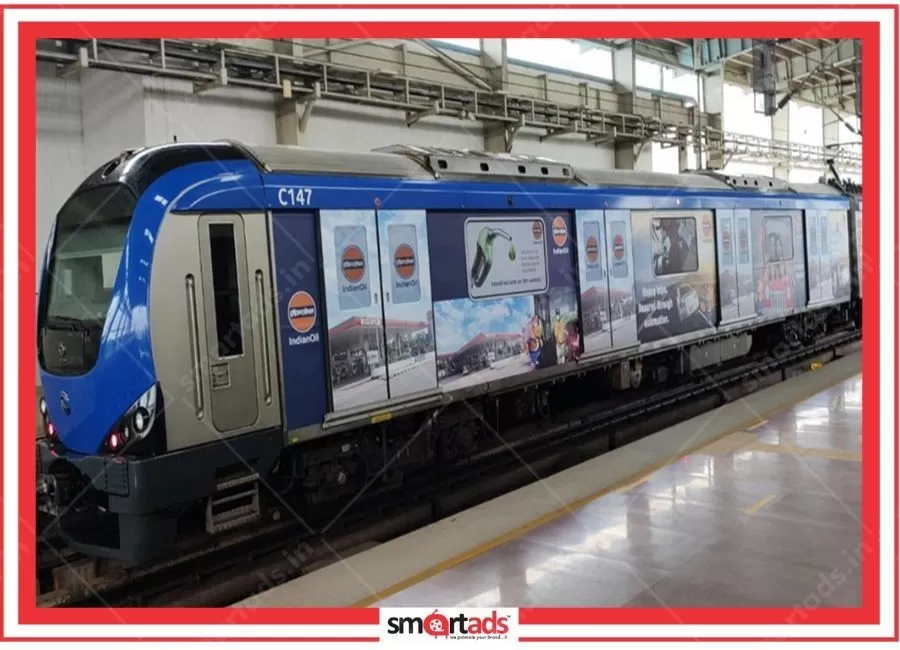
Exterior Metro Wrap
Size & Printing Cost as per actual
On the outside of metro Train, advertise
Rate per Metro Display Cost / 1 Month
Route: Maujpur Babarpur To Majilis Park
₹1440000.00
Showing 1 to 4 of 4 Results
MEDIA DETAILS
Size & Printing Cost as per actual
On the outside of metro Train, advertise
Rate per Metro Display Cost / 1 Month
Route: Maujpur Babarpur To Majilis Park
₹1440000.00
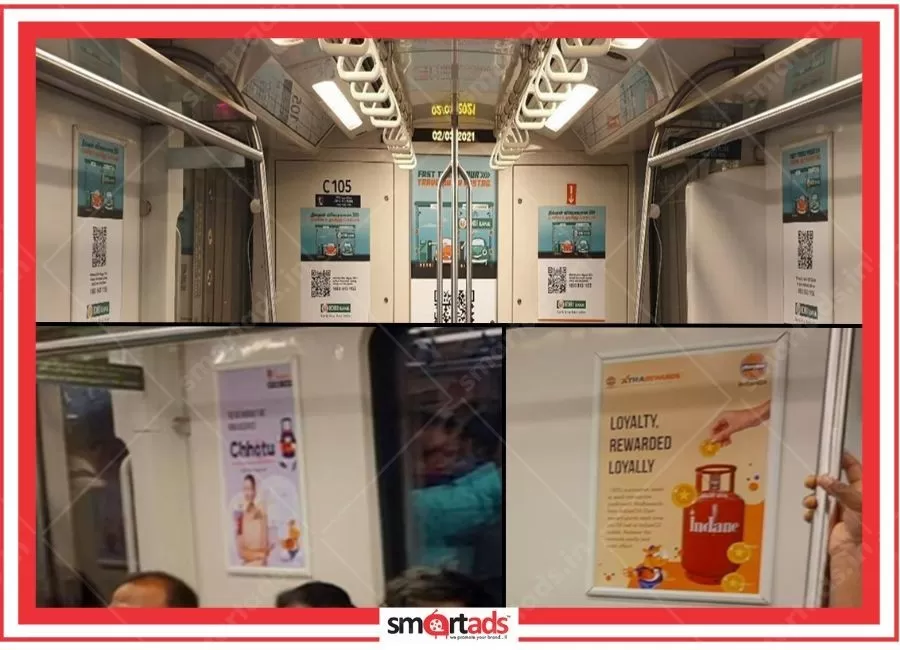
Size & Printing Cost as per actual
On the outside of metro Train, advertise
Rate per Metro Display Cost / 1 Month
Route : Maujpur Babarpur To Majilis Park
₹625000.00
20 Sec Jingle
On the outside of metro Train, advertise
Rate per Metro Display Cost / 1 Month
Route : Maujpur Babarpur To Majilis Park
₹400000.00
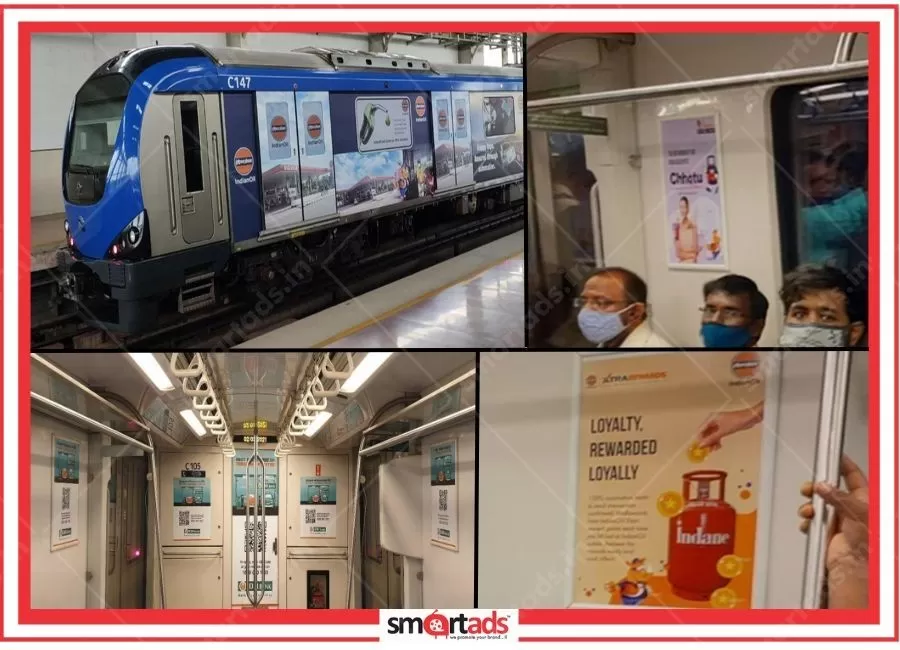
Size & Printing Cost as per actual
On the outside of metro Train, advertise
Rate per Metro Display Cost / 1 Month
Route : Maujpur Babarpur To Majilis Park
₹4065000.00
MEDIA REACH

MinimumQty :
1
EstimateReachPeople :
150000000
The Pink Line carries somewhere in the ballpark of 3.5 to 4 lakh daily commuters through some of Delhi's most commercially significant corridors — and yet, in our experience, it remains one of the most underbooked metro advertising routes in the entire DMRC network. Most brands chase the Blue Line or the Yellow Line by default, which is understandable given their sheer scale, but that instinct often means paying a premium to compete in a noisier environment when a more targeted, arguably more valuable audience is sitting right there on the Majlis Park to Shiv Vihar corridor.
Frankly speaking, the Pink Line is not just another metro corridor — it is a cross-city connector that stitches together neighbourhoods with genuinely distinct demographic profiles, which is something that most media planners fail to appreciate until they actually map out the stations. Running from Majlis Park in the northwest all the way to Shiv Vihar in the east, the line passes through Azadpur, Netaji Subhash Place, Rajouri Garden, South Extension, Lajpat Nagar, Vinobapuri, and Trilokpuri, among others; this means a single campaign placed across the Pink Line can touch working-class commuters, upper-middle-class shoppers, and young professionals within the same media buy.
What we tell our clients at SmartAds is that the Pink Line's real value lies in its intersection density — it crosses more interchange stations than almost any other line in the network, which means a significant portion of its ridership is not just Pink Line users but commuters transferring from other lines who pass through Pink Line stations as part of their daily journey. Rajouri Garden, for instance, is an interchange with the Blue Line, and the dwell time at such stations tends to be higher because passengers are navigating transfers; that additional dwell time translates directly into more seconds of exposure for your creative. The DMRC's own ridership data, cross-referenced with BARC's out-of-home audience measurement studies, consistently shows that interchange stations deliver disproportionately higher ad recall compared to non-interchange stations on the same route.
On top of that, the Pink Line has seen consistent ridership growth since its phased completion, and the eastern extension toward Shiv Vihar opened up corridors that were previously underserved by metro infrastructure — which means the audience on that stretch is, in many ways, a newer metro commuter who is still in the habit-formation phase of using the system and therefore arguably more attentive to the environment around them. We have found, through post-campaign surveys conducted for a retail client based in East Delhi, that brand recall among Pink Line commuters on the eastern corridor was roughly 18 to 22 percent higher than the campaign average across other lines, which was a number that surprised even our own planning team.
The demographic composition of a metro line is not uniform, and the Pink Line is a particularly instructive example of why route-level audience planning matters more than most brands think. The western stretch — from Majlis Park through Netaji Subhash Place and into Rajouri Garden — carries a heavy concentration of business owners, traders, and mid-income salaried professionals, many of whom are associated with the commercial activity around NSP and the Rajouri Garden market cluster; this is an audience that responds well to categories like financial services, consumer electronics, and automobile advertising.
As the line moves through South Extension and Lajpat Nagar, the audience profile shifts noticeably toward higher-income households, with a significant proportion of women commuters who are either shopping in these markets or working in the service sector nearby — and this is, to be honest, one of the most underappreciated targeting opportunities in Delhi's out-of-home landscape. A fashion brand or a premium FMCG label that wants to reach SEC A and SEC B women in South Delhi could do far worse than placing train panel ads and station branding on this specific stretch of the Pink Line. The IRS data, which tracks readership and media consumption patterns across Indian cities, has consistently flagged South Extension and Lajpat Nagar as high-affinity zones for premium lifestyle categories.
The eastern corridor, meanwhile, tells a different story — Trilokpuri, Vinobapuri, and the areas around Shiv Vihar have a younger, more aspirational demographic that is increasingly connected digitally but still commutes physically, which makes metro advertising a particularly effective bridge medium for brands that are running parallel digital campaigns. We have seen this work very effectively for an edtech brand we worked with, which was running performance marketing on social media simultaneously with a Pink Line train-wrap campaign; the brand reported a measurable uplift in organic search queries and direct app downloads during the weeks when the metro campaign was live, which suggested that the physical presence was reinforcing the digital messaging in a way that neither medium could have achieved alone.
The DMRC offers a reasonably well-structured inventory of advertising formats across the Pink Line, and the choice of format depends heavily on whether you are trying to build awareness at scale, drive recall at a specific location, or create an immersive brand experience. Train panel advertising — which involves placing creative on the interior panels above the seats and on the doors — is the most commonly booked format and for good reason; every passenger on a train car is a captive audience for the duration of their journey, which on the Pink Line averages somewhere between 20 and 35 minutes depending on entry and exit points.
Station branding, which encompasses backlit panels, pillar wraps, platform screen door branding, and concourse displays, offers a different kind of exposure — it is seen not just by commuters on that line but by anyone passing through the station, including transfers and people accompanying commuters. The larger format options, like full station takeovers or branded entry gates, are particularly effective for launches and high-impact campaigns where the objective is to create a moment of cultural visibility rather than just frequency; we have executed a full station takeover at Lajpat Nagar for an apparel brand during a festive season launch, and the footfall-to-store correlation data that the client shared afterwards was compelling enough that they booked the same station for the following year's campaign before the first one had even ended.
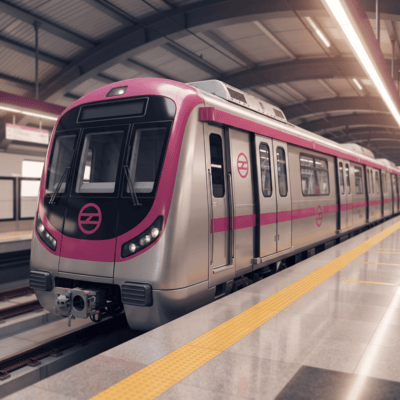
Train wraps — where the exterior of a metro car is covered with a full-bleed creative — are the most premium and most visible format, and they are particularly valuable on the Pink Line because the elevated sections of the route, especially between Rajouri Garden and Mayur Vihar, offer significant outdoor visibility to road traffic as well; a train wrap on this corridor is, in effect, a moving billboard that reaches both the captive commuter audience inside and the ambient outdoor audience below. The CPM for train wraps, when calculated across the total impressions delivered over a 30-day campaign period, works out to roughly ₹6 to ₹9, which is a number that surprises most first-time metro advertisers when they compare it to what they are paying for premium outdoor hoardings in the same corridors.
This is the question that every client asks within the first ten minutes of a briefing, and the honest answer is that rates vary quite significantly based on format, duration, station selection, and the time of year — but we can give you a working framework that is more useful than the vague "contact us for pricing" approach that most vendors default to. Interior train panel campaigns on the Pink Line — covering a standard set of panels across a rake — typically run somewhere in the ballpark of ₹2.5 lakh to ₹4 lakh per month for a single rake, depending on panel count and exclusivity; for brands that want multiple rakes, volume discounts are negotiable and can bring the per-rake cost down by 15 to 20 percent.
Station branding packages are priced differently because they are location-specific, and high-footfall stations like Rajouri Garden, Lajpat Nagar, and South Extension command a premium over lower-traffic stations on the eastern corridor. A backlit panel at a premium station might cost in the range of ₹80,000 to ₹1.5 lakh per month, while a full pillar wrap package at the same station could push into the ₹3 to ₹5 lakh range; the key is to match the station to the campaign objective rather than simply booking the most expensive station because it sounds prestigious. What a lot of people miss is that mid-tier stations on the Pink Line — places like Vinobapuri or Trilokpuri Sanjay Lake — often deliver excellent frequency at a fraction of the cost, and for brands targeting the eastern Delhi market specifically, these stations are genuinely better value than the premium options.
Train wraps, as the most premium format, are priced on a negotiated basis with DMRC and typically require a minimum booking period of 30 days; the investment for a full exterior wrap on a single rake generally starts somewhere around ₹8 to ₹12 lakh per month, which sounds significant until you calculate the per-impression cost across the estimated daily reach of a single Pink Line rake, which DMRC ridership data suggests is in the range of 12,000 to 18,000 unique commuters per day. At SmartAds, we always tell our clients to run that per-impression calculation before reacting to the headline cost, because the economics of metro advertising almost always look more favourable once the math is done properly.
The comparison that matters most for most of our clients is not Pink Line versus Blue Line — it is Pink Line metro advertising versus traditional outdoor formats like hoardings, bus shelters, and transit media in the same geography. A premium hoarding on the Outer Ring Road near Lajpat Nagar, for instance, will cost somewhere in the range of ₹2 to ₹4 lakh per month, which is broadly comparable to a train panel campaign on the Pink Line; but the hoarding delivers a passive, fleeting impression to fast-moving traffic, while the train panel delivers a sustained, multi-minute exposure to a seated audience that has nothing else to look at.
The FICCI-EY Media and Entertainment Report has consistently noted that transit advertising — and metro advertising in particular — delivers superior recall metrics compared to static outdoor formats, which aligns with what we observe in our own campaign measurement work. To be fair, hoardings have their own strengths — they work well for directional messaging and location-based prompts near retail outlets — but for brand building and message comprehension, the captive environment of a metro car is genuinely difficult to replicate through any other out-of-home format. We have had clients run A/B comparisons between metro panel campaigns and equivalent-spend hoarding campaigns in the same Delhi corridors, and the recall differential in favour of metro advertising has been consistent enough that we now recommend it as a primary format rather than a supplementary one for most brand-building objectives.
Radio advertising in Delhi, which is another common comparison, offers broad reach but zero visual impact and is increasingly fragmented across in-car audio, streaming, and traditional FM; metro advertising, by contrast, delivers a visual, multi-format brand experience to an audience that is physically present and attentive. The GroupM TYNY Report has flagged out-of-home — and transit media specifically — as one of the fastest-recovering and fastest-growing traditional media categories in India post-2022, which reflects a broader industry recognition that physical brand presence in high-footfall environments delivers something that digital and broadcast media simply cannot replicate.
Not every campaign objective is equally well-served by metro advertising, and being honest about this is something we consider important — because a mismatched objective leads to disappointing results and unfair conclusions about the medium. Metro advertising on the Pink Line is, in our experience, exceptionally well-suited to brand awareness and recall objectives, product launches, and campaigns where the creative message benefits from sustained exposure time; it is less suited to pure direct-response objectives where you need an immediate, trackable action from the audience.
For categories like banking and financial services, automobile launches, real estate, education, healthcare, and premium FMCG, the Pink Line offers a particularly strong environment because the commute provides time for the audience to actually read and process the creative — which is something that a two-second billboard impression simply cannot offer. We worked with an automobile brand that was launching a new compact SUV in Delhi, and the Pink Line train panel campaign — which ran for six weeks across three rakes — was specifically designed with long-copy creative that explained the vehicle's key features in detail; the brand's post-campaign research showed that aided awareness among Pink Line commuters was significantly higher than among a matched control group exposed only to the brand's outdoor and digital activity.
Seasonal and event-driven campaigns also perform very well on the Pink Line, particularly around festive periods like Diwali and Navratri, when the Lajpat Nagar and South Extension stations see a substantial spike in footfall from shoppers who do not normally use the metro. The thing is, metro advertising inventory on the Pink Line tends to get booked up quite quickly in the September-to-November window, which is why we advise clients to confirm their festive season bookings by August at the latest — a lesson learned the hard way by more than one brand that came to us in October looking for premium station branding and found the best spots already committed.
The most common mistake we see brands make with metro advertising is treating it as a single-format, single-station exercise rather than a corridor-level media strategy. A well-structured Pink Line campaign should think about the commuter journey holistically — from the moment they enter a station, through the platform experience, into the train car, and out the other side — because each touchpoint in that journey offers a different kind of engagement opportunity, which can be used to build a sequential brand narrative rather than simply repeating the same message.
Our recommendation for most mid-sized campaigns — those with a monthly budget in the range of ₹8 to ₹15 lakh — is to combine station branding at two or three high-footfall stations with interior train panel advertising across one or two rakes, which creates both a location-specific presence and a journey-long brand experience. The station branding builds the initial impression and creates a sense of brand ownership over a particular geography; the train panels then reinforce that message in a more immersive, longer-exposure environment. For brands with larger budgets, adding a train wrap to this mix creates a third layer of visibility — the exterior wrap generates impressions from road traffic and pedestrians, which effectively extends the campaign's reach beyond the metro commuter audience entirely.
Creative strategy matters enormously in this format, and it is something that is often underinvested relative to the media spend. Metro commuters are a captive audience, but they are also a habituated one — they see the same panels every day, which means your creative needs to either tell a story across multiple panels within a car or be refreshed at regular intervals to maintain attention. At SmartAds, we have found that campaigns which use a sequential storytelling approach across the panels in a single train car — where each panel advances a narrative or reveals a different aspect of the product — consistently outperform single-image campaigns on recall metrics, sometimes by a margin of 30 percent or more.
The booking process for DMRC advertising goes through DMRC's authorised concessionaire, and the process involves submitting creative specifications, getting DMRC's content approval, and confirming the booking with a formal purchase order and advance payment — which typically needs to happen at least three to four weeks before the campaign go-live date, though for premium formats like train wraps, six to eight weeks of lead time is more realistic. The content approval process is worth taking seriously; DMRC has specific guidelines around creative content, and campaigns that involve political messaging, comparative advertising, or certain categories of financial products require additional documentation and can face delays if not prepared correctly.
Working with an agency that has an established relationship with the concessionaire is genuinely useful here, not just for rate negotiation but for navigating the approval process efficiently and for getting access to inventory that may not be formally listed as available. We have, on multiple occasions, been able to secure premium station positions for clients at short notice because of existing relationships and advance knowledge of when particular inventory was coming available — which is the kind of operational advantage that is difficult to quantify but very real in practice. The TAM AdEx data on metro advertising booking patterns consistently shows that the most desirable inventory — premium stations and train wraps — is typically committed three to six months in advance by repeat advertisers, which underscores the value of planning and booking early.
For brands that are new to metro advertising, we recommend starting with a two-month pilot campaign rather than committing to a longer term immediately; this gives you enough time to generate meaningful recall and awareness data while also allowing for creative refinement based on what you observe. A pilot campaign on the Pink Line, structured around interior train panels and one station branding package, can typically be executed for a total investment of somewhere between ₹6 and ₹10 lakh for two months — which is a reasonable test budget for a medium that, in our experience, tends to deliver very favourably against brand-building benchmarks when the creative and station selection are well-matched to the campaign objective.
This is a question we get asked more often than almost any other, and the honest answer is: more often than people assume, yes. There is a persistent perception that metro advertising is exclusively the territory of large national brands with multi-crore media budgets, which is understandable given that train wraps and full station takeovers are genuinely significant investments; but the interior panel formats and smaller station branding packages are accessible at budget levels that many regional and mid-sized brands can realistically consider. A single-rake interior panel campaign on the Pink Line, running for one month, can be executed for an investment that is comparable to a mid-tier digital campaign — and it delivers a very different kind of audience quality.
The Pink Line is particularly well-suited to local and regional brands precisely because of its geographic specificity; a brand that is strong in East Delhi and wants to build awareness among the Trilokpuri-to-Lajpat Nagar commuter corridor does not need to buy the entire DMRC network to achieve meaningful results. We have worked with a regional retail chain that had no presence in traditional advertising and was allocating its entire media budget to performance digital marketing; we proposed a three-month Pink Line panel campaign targeting the eastern corridor stations, and the brand saw a measurable increase in walk-in traffic at its East Delhi stores that correlated clearly with the campaign period. The client's comment afterwards — that they had never realised physical advertising could be this targeted — is something we hear fairly often from brands making the transition from pure digital to integrated media.
Frankly speaking, the brands that get the most value from Pink Line metro advertising are those that approach it as a precision medium rather than a mass medium — using station selection, format choice, and creative strategy to reach a specific audience in a specific geography with a message that is genuinely relevant to that audience's context and mindset. That kind of strategic discipline is what separates a metro campaign that delivers measurable results from one that simply generates impressions without impact.
Q: How long does it take for a Pink Line metro advertising campaign to go live after booking?
The lead time depends significantly on the format you are booking and the time of year. For standard interior train panel campaigns, the process from confirmed booking to campaign live date is typically three to four weeks, which accounts for creative submission, DMRC content approval, and the physical installation of panels. Station branding formats, particularly backlit panels and pillar wraps, follow a similar timeline, though installations at high-footfall stations may be scheduled during off-peak hours to minimise disruption, which can occasionally add a few days to the timeline. Train wraps are the most time-intensive format — the printing, approval, and application process means you should budget six to eight weeks of lead time, and during peak festive season, this can stretch further because installation crews are working across multiple campaigns simultaneously. Our strong advice is to treat these lead times as minimums rather than targets; campaigns that are planned and confirmed early almost always execute more smoothly and with better creative output than those that are rushed to meet a deadline.
Q: Can a brand advertise on specific stations rather than across the entire Pink Line?
Absolutely, and in many cases, station-specific advertising is the more strategically sound approach for brands with defined geographic or demographic targeting requirements. The DMRC's advertising inventory is structured to allow station-level selection, which means you can book branding at Lajpat Nagar without committing to stations on the eastern corridor, or focus exclusively on the interchange stations like Rajouri Garden and South Extension where footfall is highest. The thing is, station-specific campaigns require more careful creative planning because the audience at each station has a somewhat different profile, and a one-size-fits-all creative may not resonate equally well across all locations. For brands that have the creative bandwidth, developing station-specific or corridor-specific creative — with messaging tailored to the audience profile of each location — consistently outperforms generic creative on recall metrics. We have executed station-specific campaigns for clients in the financial services and retail categories where the creative at South Extension was meaningfully different from the creative at Azadpur, and the audience response data supported that investment in creative differentiation.
Q: How is the effectiveness of a Pink Line metro advertising campaign measured?
Measurement in metro advertising is an area where the industry has made genuine progress but still has room to improve, and being transparent about this is important. The most commonly used measurement approach involves a combination of DMRC ridership data — which gives you a baseline estimate of impressions delivered based on daily footfall and train frequency — and brand recall surveys conducted among a sample of commuters during and after the campaign period. BARC has been developing out-of-home audience measurement methodologies that are increasingly being applied to metro environments, which is improving the quality of reach and frequency data available to advertisers. For brands running integrated campaigns — where the metro activity is running alongside digital or broadcast — attribution modelling can help isolate the contribution of the metro campaign to overall brand metrics, though this requires a properly structured research design from the outset. We recommend that clients who are running metro advertising for the first time build a measurement plan before the campaign launches rather than trying to retrofit measurement after the fact; the difference in data quality is substantial, and it makes the post-campaign conversation with management significantly more productive.
Q: What creative formats and specifications are required for Pink Line metro advertising?
Creative specifications vary by format, and getting them right from the outset saves significant time in the approval process. Interior train panels are typically produced in standard sizes that vary by panel position — the overhead panels above seats, the door panels, and the end-wall panels each have distinct dimensions, and DMRC's concessionaire will provide a format guide upon booking confirmation. The materials used must meet DMRC's specifications for fire safety and adhesion, which means working with a vendor who has experience in metro-format production rather than a standard print supplier. Station branding formats — backlit panels, pillar wraps, and platform screen door branding — each have their own size and material requirements, and the resolution requirements for backlit formats are higher than for standard print because the illumination makes low-resolution artwork visibly degraded. Content guidelines are equally important; DMRC requires that all advertising content be submitted for approval before installation, and categories like alcohol, tobacco, and certain financial products face additional scrutiny. We always recommend sharing creative concepts with the concessionaire's approval team informally before submitting final artwork, because catching a potential issue at the concept stage is far less disruptive than a rejection after final production.
Q: How does the Pink Line's ridership compare to other DMRC lines, and does that affect advertising value?
The Pink Line's daily ridership is lower than the Blue Line and Yellow Line in absolute terms, which is a fact that some brands interpret as a disadvantage but which we would argue is actually a feature for certain campaign objectives. The Blue Line and Yellow Line carry the highest absolute ridership in the DMRC network, which makes them attractive for mass-reach campaigns; but that scale comes with higher rates and, in some cases, more cluttered advertising environments where multiple brands are competing for the same commuter's attention. The Pink Line's more moderate ridership — in the ballpark of 3.5 to 4 lakh daily commuters — means that advertising inventory is less contested, rates are more negotiable, and the relative share of voice that a brand can achieve with a given budget is meaningfully higher. For brands that are targeting specific Delhi corridors — South Delhi, East Delhi, or the Rajouri Garden commercial belt — the Pink Line is not a compromise on the Blue Line; it is the right medium for the right audience, and the cost efficiency of reaching that audience through the Pink Line is genuinely superior to what the larger lines can offer for the same geographic and demographic target. The Dentsu e4m Report on out-of-home advertising in Indian metros has noted that secondary metro lines in large cities often deliver better cost-per-targeted-impression metrics than primary lines precisely because of this dynamic.
Q: What is the minimum campaign duration for Pink Line metro advertising, and are short-term campaigns worthwhile?
The minimum booking period for most Pink Line advertising formats is 30 days, and our honest view is that this minimum is also close to the practical minimum for generating meaningful brand impact. A 30-day campaign delivers enough frequency — given that most commuters use the metro on a near-daily basis — to build genuine recall among regular users of the line; anything shorter than that tends to produce impressions without the repetition necessary for the message to stick. That said, there are situations where shorter campaigns make strategic sense — product launches, event-driven campaigns tied to a specific date, or tactical campaigns designed to capitalise on a news moment or seasonal trigger. For these situations, some flexibility exists in the booking terms, particularly if the inventory is otherwise unsold, and an agency relationship with the concessionaire can be useful in negotiating non-standard durations. For brands that are running metro advertising as part of a broader integrated campaign — where the metro activity is one layer of a multi-channel push — even a 30-day burst can deliver significant incremental impact, particularly if the campaign is timed to coincide with the peak activity period of the broader campaign.
The Pink Line is, in our assessment, one of the most genuinely undervalued advertising environments in Delhi's out-of-home landscape — not because it lacks audience quality or reach, but because it has historically been overlooked in favour of the more prominent DMRC lines, which means the brands that do book it tend to enjoy a disproportionate share of voice relative to what they are paying. That dynamic will not last indefinitely; as ridership on the Pink Line continues to grow and as more brands discover the targeting precision that the corridor offers, inventory will tighten and rates will follow. The window for booking premium positions at current pricing is real, and it is narrower than most brands realise.
What we have tried to lay out in this piece is a genuine working framework for thinking about Pink Line metro advertising — not as a generic out-of-home option, but as a precision medium with specific audience characteristics, specific format strengths, and specific strategic applications where it outperforms almost every alternative in the same budget range. The brands that get the most from this medium are those that invest in understanding the corridor, matching their creative to the audience's context, and measuring the campaign with enough rigour to build a body of evidence that justifies continued investment. The brands that get the least from it are those that treat it as a checkbox — booking a few panels because someone said metro advertising is a good idea, without the strategic intent that makes any medium work.
If you are evaluating metro advertising on the Pink Line as part of your next campaign plan, or if you are trying to build a case for it internally and need data and benchmarks to support that conversation, the SmartAds media planning team works with clients across exactly these kinds of decisions every day. We bring both the market knowledge and the booking relationships to make Pink Line campaigns work efficiently and effectively — and we are happy to share what we have learned from campaigns across this corridor. Reach out to us at SmartAds.in to start a conversation about what a Pink Line campaign could look like for your brand and your budget.
